


Key Takeaways
- Regional ecommerce expansion can fail when startups assume that buyer behavior is identical across different markets.
- Localization must cover language, pricing, currencies, taxes, product availability, payments, delivery, and customer support.
- Strong seller onboarding requires verification, catalog moderation, commission rules, payout visibility, and performance tracking.
- Delivery promises should reflect actual service zones, fulfilment capacity, tracking capabilities, and return operations.
- A controlled regional launch helps founders validate demand, seller supply, payments, and logistics before expanding further.
Launch Readiness Signals
- Validate local category demand, customer segments, price sensitivity, payment habits, and delivery expectations.
- Define seller verification, product-listing standards, commissions, settlement schedules, and dispute procedures.
- Configure regional currencies, tax rules, delivery zones, payment methods, return policies, and support workflows.
- Give administrators control over users, sellers, catalogs, orders, payouts, refunds, promotions, and regional reports.
- Launch in a focused city or region first unless vendor coverage, logistics, support, and marketing are ready for wider expansion.
Real Insights
- A polished storefront cannot compensate for weak seller operations, unreliable delivery, or limited administrative control.
- Translation alone does not create a localized shopping experience or establish customer trust.
- Launching too many categories can weaken inventory quality, vendor support, fulfilment, and customer service.
- Marketplace readiness should be measured through completed orders, successful payouts, reliable deliveries, and resolved disputes.
- Miracuves develops white-label, source-code-owned regional ecommerce marketplaces with seller workflows, local payments, delivery management, admin controls, and rapid deployment support.
Launching an ecommerce marketplace in a new region looks exciting from the outside. The opportunity feels clear: more buyers, more vendors, more product categories, and a wider addressable market. But regional marketplace expansion fails when startups treat every market as if it behaves the same.
A regional ecommerce marketplace is not only a website or mobile app where customers place orders. It is a full operating system for local buying habits, vendor relationships, delivery coverage, payment preferences, tax rules, customer trust, catalog depth, refunds, support, and admin control.
This is why many startups struggle after launch. They build the surface layer first, but underestimate the operational layer underneath.
For founders planning a marketplace launch across cities, countries, or regional buyer groups, the goal is not to copy a successful ecommerce model blindly. The goal is to understand what must be localized, what must be controlled from the backend, and what must be validated before scaling.
Miracuves helps founders move faster with ready-made and white-label marketplace solutions that can be adapted for regional ecommerce operations, including catalog management, vendor control, branded experiences, and admin workflows.
Why Regional Ecommerce Marketplaces Fail Even When the Product Looks Good
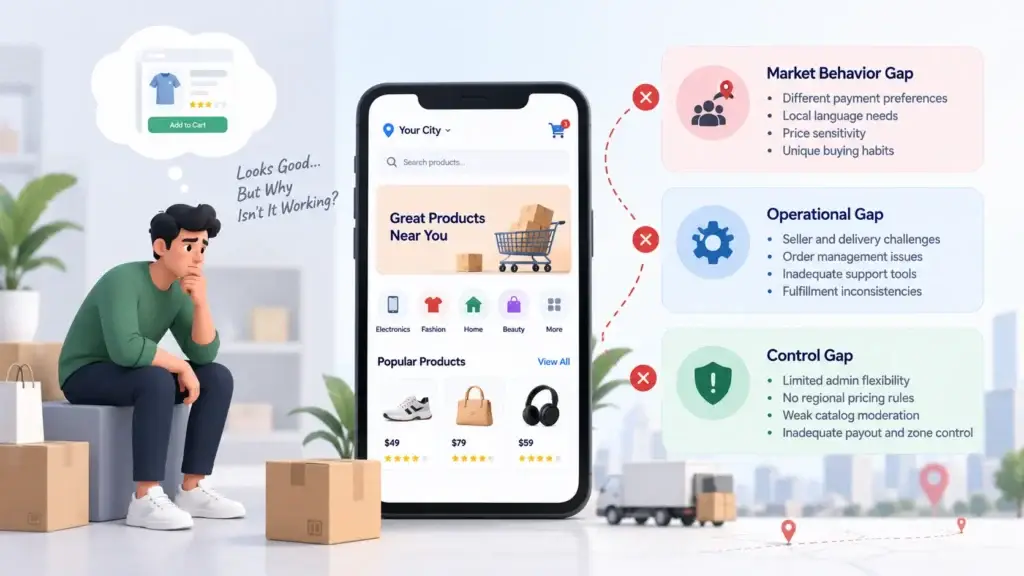
Image Source: AI-generated visual by Miracuves
A marketplace can look polished and still fail regionally.
The app may have product listings, search, cart, checkout, seller accounts, and delivery tracking. But if it does not match how the target market actually buys, sells, pays, and receives products, the experience breaks quickly.
Regional ecommerce failure often comes from three hidden gaps:
- Market behavior gap: Customers in different regions may prefer different payment methods, languages, price points, return expectations, and product categories.
- Operational gap: Vendors, delivery teams, support agents, and marketplace operators may not have the tools to manage orders reliably.
- Control gap: The admin backend may not support regional pricing, catalog moderation, delivery zones, seller payouts, or local campaign management.
A strong marketplace launch should connect product design with business operations. Founders need to ask: Can this platform support how this specific region buys and sells?
That question is more important than simply launching with a long feature list.
Mistake 1: Entering a Region Without Understanding Local Buyer Behavior
Many startups assume that ecommerce behavior is universal. They expect customers in a new region to browse, compare, pay, and accept delivery in the same way as customers in another market.
That assumption can become expensive.
Some regions are highly discount-driven. Some rely heavily on cash-based transactions. Some buyers trust local vendors more than unknown marketplace sellers. Some customers need product descriptions in their local language before they feel confident placing an order. Others may abandon carts if delivery fees appear too late in checkout.
A regional ecommerce marketplace must be built around buyer context.
What founders should validate before launch
Before entering a new market, founders should understand:
- Which product categories customers already buy online
- Whether buyers prefer prepaid payments, wallet payments, cards, or cash-based options
- How sensitive customers are to delivery fees
- Which languages and regional terms should appear in catalog content
- How much trust buyers place in reviews, ratings, return policies, and seller verification
- Whether local shoppers expect fast delivery, scheduled delivery, or pickup options
The mistake is not launching early. The mistake is launching early without learning how the region behaves.
A ready-made marketplace foundation can help founders test faster, but the business logic still needs to reflect local demand.
Mistake 2: Treating Localization as Simple Translation
Translation is only one part of localization.
A regional ecommerce marketplace needs deeper localization across product content, pricing, currencies, taxes, delivery rules, product availability, seller policies, customer support, and marketing campaigns.
For example, a product title may be translated correctly but still fail because the size chart, product variant, delivery estimate, or return condition does not match local expectations.
Localization should not be treated as a cosmetic task. It is part of marketplace trust.
Localization layer founders often miss
| Localization Area | Common Mistake | Better Marketplace Approach |
|---|---|---|
| Language | Translating only homepage and menu labels | Localize product pages, checkout, support content, notifications, and vendor communication |
| Pricing | Using one pricing structure across regions | Allow regional price control, currency rules, discounts, and tax handling |
| Catalog | Showing the same products everywhere | Control availability by market, delivery zone, vendor, and inventory capacity |
| Delivery | Promising one delivery standard across regions | Configure delivery zones, expected timelines, and fulfilment rules separately |
| Support | Offering generic customer service | Train support flows around local payment, return, and delivery issues |
| Promotions | Running one campaign everywhere | Create market-specific offers based on buyer behavior and category demand |
A founder entering a new ecommerce market needs localization at the platform level, not just the content level.
Mistake 3: Onboarding Vendors Without a Clear Marketplace Control System
A regional marketplace depends on vendors. But adding sellers quickly without control can create catalog clutter, fake availability, poor fulfilment, pricing disputes, refund issues, and customer dissatisfaction.
Vendor onboarding should not be treated as a basic signup form. It should be a governed workflow.
Each vendor needs approval rules, category access, commission setup, product upload control, order handling expectations, payout timelines, and performance visibility.
What strong vendor onboarding should include
A scalable marketplace should support:
- Vendor registration and verification
- Category-based seller approval
- Product listing moderation
- Inventory and variant management
- Commission and payout configuration
- Seller order dashboard
- Vendor wallet or settlement reporting
- Ratings and performance tracking
- Dispute and return management
- Admin control over seller visibility
Without these controls, a marketplace may grow in listings but decline in customer trust.
This is one area where a structured marketplace platform from Miracuves can support founders better than a loosely assembled ecommerce build. The right admin control layer helps marketplace operators manage sellers, products, payouts, and operational quality from one backend.
Mistake 4: Making Delivery Promises Before Mapping Regional Fulfilment Reality
Delivery can make or break a regional ecommerce marketplace.
Founders often plan the app first and delivery operations later. This creates a serious gap. Customers do not judge a marketplace only by what they can order. They judge it by whether the product arrives on time, in good condition, with clear tracking and a reliable support process.
Regional delivery complexity increases when the marketplace serves multiple cities, remote zones, multiple vendors, heavy products, grocery-like categories, or cash collection workflows.
Delivery questions to answer before launch
Founders should clarify:
- Which areas are serviceable at launch?
- Which zip codes or zones should be restricted?
- Will delivery be handled by internal agents, third-party logistics, vendors, or a hybrid model?
- How will delivery fees be calculated?
- How will failed deliveries be handled?
- How will returns, refunds, and exchanges move through the system?
- Will cash collection require delivery-agent reconciliation?
- Can the admin team track orders by vendor, region, delivery status, and payment mode?
The mistake is promising speed before understanding operational capacity.
A better launch approach is to begin with clearly defined service zones, reliable vendor coverage, and delivery workflows that can be expanded after the marketplace proves demand.
Mistake 5: Ignoring Regional Payment Preferences and Settlement Workflows
Payment behavior varies heavily across markets.
Some customers prefer cards. Some prefer wallets. Some rely on cash-based transactions. Some need bank transfer options, local gateways, or region-specific payment methods.
For a marketplace, payment is not only about customer checkout. It also affects vendor payouts, commission deduction, refunds, reconciliation, delivery-agent settlement, and finance reporting.
Payment and settlement issues startups often miss
| Payment Layer | Why It Matters |
|---|---|
| Customer checkout | The wrong payment options can reduce conversion in a new market |
| Cash-based orders | Requires careful reconciliation between customer, delivery agent, vendor, and operator |
| Vendor payouts | Sellers need transparent payout history and settlement timelines |
| Refunds | Poor refund workflows damage customer trust quickly |
| Commission deduction | The platform must calculate marketplace earnings accurately |
| Finance dashboard | Operators need reporting visibility across orders, vendors, and regions |
A regional ecommerce marketplace should be monetization-ready from the beginning. Commission logic, delivery fees, promotional charges, seller subscriptions, featured listings, and advertising models should not be added as afterthoughts.
Mistake 6: Launching With Too Many Categories Too Early
Many startups believe that a regional marketplace should launch with a large catalog to look established. But category expansion without operational readiness can weaken the marketplace.
More categories mean more vendors, more product rules, more inventory problems, more return policies, more delivery requirements, and more support tickets.
A better strategy is to launch with categories that match regional demand and operational feasibility.
Category selection should depend on
- Existing local demand
- Vendor readiness
- Product margin
- Delivery complexity
- Return risk
- Inventory reliability
- Repeat purchase potential
- Local competition intensity
- Ability to promote the category profitably
For example, grocery, fashion, electronics, pharmacy, home goods, and wholesale categories each require different catalog structures and fulfilment logic. A marketplace that treats all categories the same will struggle as soon as real orders begin.
Founders should build category depth before category width.
Mistake 7: Not Giving the Admin Team Enough Backend Control
A marketplace founder should not need developers for every operational change.
If the admin dashboard is weak, the business becomes slow. The team cannot adjust categories, approve vendors, manage disputes, configure delivery areas, review payouts, track payments, run promotions, or moderate listings efficiently.
This becomes a serious problem during regional expansion because every market may need different rules.
Admin controls that matter for regional ecommerce
A strong marketplace admin layer should support:
- User, vendor, and delivery partner management
- Category and product approval
- Commission and fee configuration
- Delivery zone settings
- Coupon and promotional campaign management
- Order status monitoring
- Payout and wallet visibility
- Refund and dispute handling
- Content and banner management
- Reporting by market, vendor, category, and payment method
The admin panel is not a backend accessory. It is the operating center of the marketplace.
For founders planning to enter new markets, Miracuves’ ready-made marketplace approach can reduce avoidable development time because key customer, seller, delivery, and operator workflows are already structured for faster deployment.
Read More: Pre-Launch vs Post-Launch Marketing for a Regional Ecommerce Marketplace: What Should Startups Prioritize?
Founder Decision Signals
Speed
If the market opportunity is time-sensitive, a ready-made marketplace foundation can help founders test demand faster instead of spending months building basic ecommerce flows.
Cost
Regional marketplace costs increase when localization, delivery, vendor payouts, and admin control are added late. Planning these early reduces rework.
Scalability
The platform should support multiple sellers, zones, payment modes, categories, and fulfilment workflows before expansion pressure begins.
Market Fit
A successful launch depends on matching regional buyer behavior, not simply copying a marketplace model from another geography.
Mistake 8: Building Without a Clear Monetization Model
A marketplace can generate orders and still struggle financially if the monetization model is unclear.
Founders often focus on customer acquisition first and assume revenue will follow. But marketplace economics should be designed before launch.
A regional ecommerce marketplace can use several revenue streams, but each one requires platform support.
Common marketplace monetization options
| Revenue Model | How It Works | What the Platform Needs |
|---|---|---|
| Commission per order | The platform earns a percentage from each completed transaction | Commission engine, vendor settlement, order reporting |
| Delivery fee | Customers pay for fulfilment based on distance, zone, or order value | Delivery fee rules, zone mapping, checkout logic |
| Vendor subscription | Sellers pay monthly or yearly to access the platform | Seller plans, billing, access controls |
| Featured listings | Vendors pay for better placement or promotional visibility | Listing boost logic, campaign tracking |
| Advertising | Sellers or brands promote products inside the marketplace | Banner control, ad placements, performance reports |
| Service fees | Customers or vendors pay small operational fees | Fee configuration, invoice visibility |
Monetization should be connected to admin dashboards, reporting, and payout logic. Otherwise, the finance team ends up calculating marketplace economics manually.
Mistake 9: Underestimating Trust, Safety, and Dispute Handling
Trust is especially important when entering a new regional market.
Customers may not know the marketplace yet. Vendors may be unsure about payouts. Delivery teams may need verification. Marketplace operators may face fake listings, cancelled orders, payment disputes, refund requests, or product quality complaints.
Trust is not created only through branding. It is created through systems.
Trust-building marketplace workflows include
- Verified seller onboarding
- Product moderation
- Customer reviews and ratings
- Clear return and refund policies
- Secure payment gateway integration
- Order history and delivery proof
- Delivery-agent verification
- Admin dispute resolution
- Activity logs
- Customer support workflows
A marketplace that cannot manage disputes will lose trust faster than it gains traffic.
Security and operational controls should be treated as part of the marketplace foundation, especially when payments, seller payouts, customer data, and delivery records are involved.
Mistake 10: Choosing a Build Approach That Slows Market Validation
Founders usually face two major paths when launching a regional ecommerce marketplace:
- Build every module from scratch.
- Start with a ready-made, white-label marketplace foundation and customize it for the target market.
Custom development can make sense when the product requires highly unique workflows. But for many regional marketplace launches, the first challenge is not inventing a new ecommerce architecture. The challenge is validating buyer demand, vendor supply, delivery capability, payment behavior, and regional operations.
This is where a launch-ready marketplace foundation can be practical.
Miracuves supports founders with ready-made marketplace solutions that can be branded, configured, and deployed faster. For relevant ready-made builds, Miracuves highlights 6-day solution delivery, helping startups move from planning to market testing without waiting through long development cycles.
For founders evaluating a regional ecommerce launch, the smarter question is not “How many features can we build?” It is “How fast can we launch the right foundation and learn from the market?”
Regional Marketplace Launch Checklist for Founders
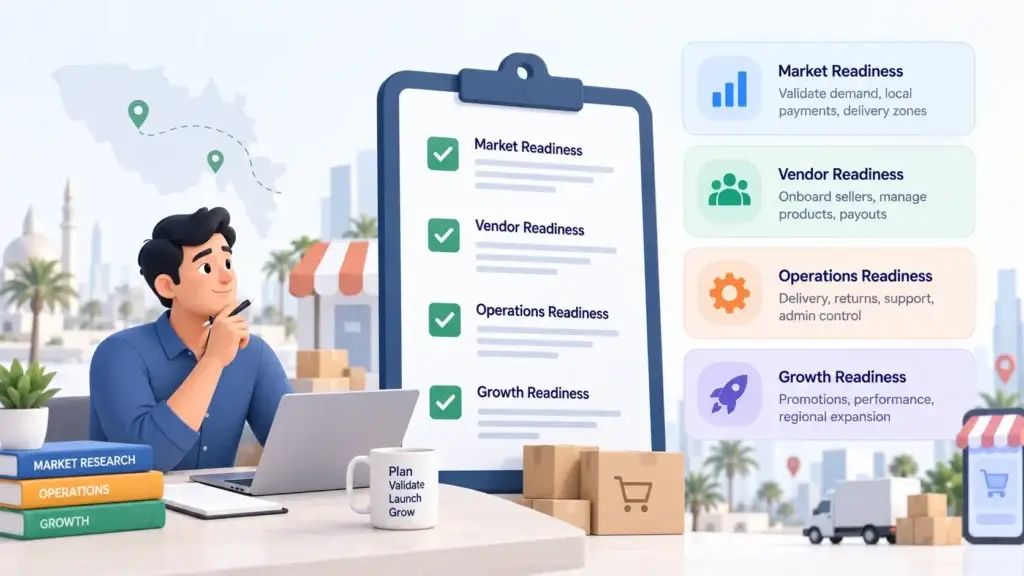
Image Source: AI-generated visual by Miracuves
Before launching in a new market, founders should review the business and technical foundation carefully.
Market readiness
- Have you validated category demand in the target region?
- Do you know which customer segments will buy first?
- Have you studied local payment preferences?
- Are return expectations and delivery timelines clear?
- Do you know which cities, zones, or districts are launch-ready?
Vendor readiness
- Have you defined seller verification rules?
- Can vendors upload and manage products easily?
- Are commissions, payouts, and settlement timelines clear?
- Can the admin team approve or reject products?
- Do vendors have access to order and payout visibility?
Operations readiness
- Are delivery zones configured?
- Is fulfilment handled internally, externally, or through vendors?
- Can the platform manage failed deliveries and returns?
- Is customer support prepared for regional issues?
- Can the admin dashboard track orders, payments, disputes, and performance?
Growth readiness
- Can you launch local promotions?
- Can you track category-level performance?
- Can sellers run featured listings or campaigns?
- Can you expand to another city or region without rebuilding the system?
- Does the platform support future monetization models?
A launch checklist prevents founders from confusing “the app is ready” with “the business is ready.”
Final Thoughts: Regional Ecommerce Success Depends on Market Fit, Not Just Marketplace Features
Regional ecommerce marketplace success is not about launching the biggest platform on day one. It is about launching the right platform for the right market with enough control to adapt quickly.
The most common mistakes happen when founders underestimate localization, vendor operations, delivery reality, payment behavior, trust, admin control, and monetization design.
A good marketplace launch gives founders room to learn. A stronger marketplace foundation gives them room to scale.
Miracuves helps founders enter regional ecommerce markets faster with ready-made, white-label, source-code-owned marketplace solutions designed for practical launch execution, admin control, and faster validation.
FAQs
What are the biggest regional ecommerce marketplace launch mistakes?
The biggest mistakes include poor localization, weak vendor onboarding, unrealistic delivery promises, limited payment options, unclear monetization, lack of admin control, and launching too many categories before operational readiness.
Why is localization important for a regional ecommerce marketplace?
Localization helps the marketplace match local buyer behavior. It includes language, pricing, currency, taxes, product availability, payment preferences, delivery rules, support workflows, and promotional strategy.
Should startups launch a marketplace in one city first or multiple regions at once?
Most startups should begin with a focused launch region unless they already have strong vendor coverage, delivery capacity, support operations, and marketing budget across multiple regions. A controlled regional launch helps validate demand before scaling.
What features matter most in a regional ecommerce marketplace?
Important features include multi-vendor management, product catalog control, customer checkout, payment gateway integration, delivery zone management, vendor payouts, order tracking, reviews, refund handling, and a powerful admin dashboard.
How can startups avoid vendor onboarding problems?
Startups should create clear seller approval rules, product listing standards, commission structures, payout timelines, performance dashboards, and dispute workflows before launch. Vendor quality directly affects customer trust.
Why do ecommerce marketplaces struggle with delivery in new regions?
Delivery becomes difficult when service zones, route capacity, delivery fees, failed orders, cash collection, and return workflows are not planned properly. Regional logistics must be mapped before customer promises are made.
Is a ready-made marketplace solution useful for regional ecommerce launches?
Yes, a ready-made marketplace solution can help founders launch faster when the core workflows already exist. The key is to customize the platform for local catalog rules, vendor operations, payment behavior, delivery zones, and branding.
How does Miracuves help founders launch regional ecommerce marketplaces?
Miracuves helps founders build white-label marketplace platforms with source code, admin control, vendor workflows, branded app experiences, and faster deployment. For relevant ready-made solutions, Miracuves supports 6-day delivery so founders can validate markets sooner.
Miracuves is an independent software development company. We are not affiliated with, connected to, sponsored by, or endorsed by any company or product named in this article.
Terms such as “X Clone” are used descriptively. It is how the software industry refers to building a platform with functionality comparable to a known service, and how clients search for it.
The entire design and codebase of our products is built by our own team. Our products contain no code, design, graphics, or content originating from any third-party website or applications.
All third-party names and marks referenced in this article are the property of their respective owners, referenced solely to identify the services discussed.



