



Key Takeaways
- White-label delivery app architecture helps retail chains launch digital delivery without replacing their existing core systems.
- Retail teams, store managers, delivery partners, customers, and admins need connected workflows for smooth order fulfillment.
- Inventory sync, order routing, delivery assignment, payment handling, tracking, and admin dashboards are core architecture layers.
- Integration risk depends on legacy software, stock accuracy, API readiness, store operations, and real-time delivery logic.
- A decoupled delivery engine helps retailers add modern digital ordering while protecting daily offline business operations.
Integration Signals
- Customers need product browsing, store availability, secure checkout, delivery tracking, order updates, and support access.
- Store teams need inventory visibility, order alerts, pickup preparation, stock updates, cancellation control, and fulfillment status.
- Delivery partners need assignment alerts, route navigation, pickup confirmation, live status updates, and earnings visibility.
- Admins need control over stores, products, orders, drivers, payments, delivery zones, commissions, reports, and disputes.
- API integrations help connect delivery apps with inventory software, POS systems, payment gateways, notifications, and analytics tools.
Real Insights
- Retail chains do not always need to rebuild their entire IT stack to launch a delivery division.
- Operational decoupling lets retailers add customer-facing delivery apps while keeping legacy inventory systems stable.
- Poor integration can cause overselling, wrong stock visibility, delayed dispatch, refund issues, and store-level confusion.
- A white-label architecture is strongest when it connects digital ordering with real-world store and delivery operations.
- Miracuves builds white-label delivery apps for retail chains with inventory sync, POS integrations, dispatch workflows, payment handling, live tracking, and admin control.
For many regional retail chains, the delivery opportunity is obvious. Customers want faster ordering, real-time tracking, flexible delivery slots, and mobile-first convenience. The harder question is not whether to launch delivery. It is how to launch it without disturbing the systems that already run daily store operations, which is why many operators now explore E-Commerce & Retail solutions that connect digital channels with existing business infrastructure.
A brick-and-mortar retail brand often depends on legacy inventory software, store-level POS workflows, warehouse records, procurement logic, and accounting processes. Replacing that stack just to add a mobile delivery channel can create unnecessary risk. The smarter enterprise move is operational decoupling: keeping the core retail system stable while launching a separate digital delivery layer around it.
This composite case study looks at how a regional retail chain could launch an on-demand delivery division in 30 days by connecting a white-label Miracuves delivery engine to its existing inventory management system.
The Legacy Software Bottleneck: Adding Digital Delivery Without Breaking Existing IT
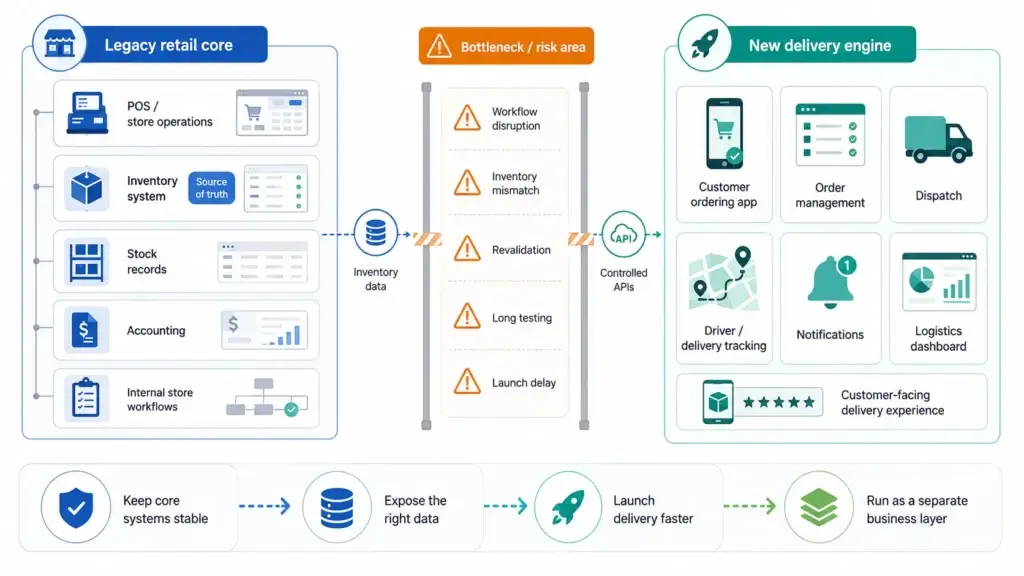
Traditional retail systems are usually built for store operations, not on-demand fulfillment. They are excellent at recording purchases, managing inventory, tracking stock movement, and supporting store teams. But they are not always designed for real-time mobile ordering, dynamic dispatch, live delivery tracking, customer notifications, or driver availability.
This creates a bottleneck for corporate leaders. They want a modern customer experience, but their IT teams are cautious about changing systems that already support revenue every day.
A direct rebuild can create several risks:
- Store staff may face workflow disruption.
- Inventory records may become inconsistent.
- POS and accounting logic may need revalidation.
- Internal teams may spend months testing dependencies.
- Delivery launch timelines may stretch far beyond the market opportunity.
The retail chain in this case did not need to modernize every internal system first. It needed a controlled way to expose the right inventory and order data to a new delivery layer.
That distinction changed the entire project.
Instead of treating digital delivery as a full-system transformation, the company treated it as a new business division powered by a separate delivery engine. The existing inventory system remained the source of truth. The new delivery app became the customer-facing and logistics-facing layer.
Read More: The True Cost of Free App Builders: When Your MVP Hits the Feature Ceiling
Case Analysis: Decoupling Frontend Delivery Apps from Core Backend Inventory
The core architectural decision was simple: do not let the delivery app directly control the main retail database.
Instead, the retail chain used a decoupled model.
The legacy inventory system continued managing stock, SKU records, store availability, and internal controls. The delivery engine handled mobile ordering, customer accounts, delivery zones, driver assignment, order status, payment workflows, push notifications, and admin oversight.
The two systems connected through a controlled integration layer.
| System Layer | Role in the New Delivery Division | Why It Was Kept Separate |
|---|---|---|
| Existing inventory system | Managed SKU availability, stock levels, store inventory, and internal records | It was already trusted by store teams and finance operations |
| Miracuves delivery engine | Managed customer app, driver app, delivery workflow, tracking, and admin control | It provided modern delivery features without rebuilding the legacy core |
| Integration layer | Passed approved inventory and order data between systems | It reduced database risk and controlled what data moved between platforms |
| Admin dashboard | Allowed business teams to manage orders, delivery status, zones, and operational rules | It gave the new division control without overloading store IT teams |
This is the value of operational decoupling. The company did not have to choose between “old system” and “new app.” It allowed both systems to do what they were best at.
The inventory system stayed stable. The delivery engine moved fast.
Why Operational Decoupling Matters for Enterprise Retail Brands
Operational decoupling is not just a technical preference. It is a board-level risk control.
For a regional retail chain, daily operations depend on predictable systems. If stock data breaks, store teams suffer. If POS workflows fail, sales are affected. If finance reports become inconsistent, management loses trust in the digital initiative.
A decoupled delivery model avoids that by creating a controlled boundary between the legacy system and the new digital channel.
The delivery app does not need full access to the internal database. It only needs the right data at the right time, such as product availability, order confirmation, delivery status, and fulfillment location.
That boundary gives executives three advantages.
First, the brand can launch faster because it is not waiting for a full ERP or POS replacement. Second, the core system remains protected because only approved data flows through the integration layer. Third, the new delivery division can evolve independently as customer behavior, route density, and order volume change.
Read More: The Staffing Trap: The True Financial Cost of Building an Internal Dev Team
The 30-Day Rollout Model
A 30-day launch does not mean rushing blindly. It means narrowing the launch scope, using a ready-made delivery foundation, and focusing integration work only on what the first version needs.
For this retail chain, the rollout could be structured like this.
| Timeline | Business Focus | Technical Focus |
| Days 1–5 | Confirm delivery zones, store locations, order categories, and launch scope | Map inventory fields, order fields, customer flows, and admin permissions |
| Days 6–12 | Configure branding, customer app screens, delivery rules, and store workflows | Set up white-label customer, driver, and admin modules |
| Days 13–20 | Connect inventory availability and order confirmation workflows | Build API or middleware connection between inventory software and delivery engine |
| Days 21–25 | Train store managers, dispatch teams, and delivery coordinators | Test order flow, payment flow, delivery assignment, notifications, and exception handling |
| Days 26–30 | Launch controlled pilot across selected stores | Monitor order accuracy, delivery status, support tickets, and operational feedback |
The goal was not to digitize the entire corporation in 30 days. The goal was to launch a focused delivery arm that could prove demand, protect existing operations, and create a scalable foundation for expansion.
Speed and Stability: The Miracuves White-Label Corporate Integration Strategy
A white-label delivery engine gives enterprise teams a practical middle path between a long custom build and a fragile plug-in approach. For businesses planning this kind of rollout, Miracuves’ delivery app development solutions provide a relevant foundation for customer apps, delivery workflows, admin control, and operational visibility.
Miracuves’ delivery ecosystem is aligned with this model because its delivery solutions are designed around customer apps, driver apps, vendor or store workflows, admin dashboards, live tracking, and source-code ownership. For enterprises, that matters because the app is not only a front-end interface. It is an operating layer for a new revenue channel.
A Miracuves-style delivery setup can support:
- Branded customer app experience
- Driver or fleet partner app
- Store or merchant workflow
- Admin dashboard
- Delivery zone control
- Order assignment
- Real-time tracking
- Payment gateway integration
- Notifications
- Offer and promotion controls
- Reporting and operational visibility
For a corporate buyer, the strategic advantage is not only speed. It is control.
The company can launch under its own brand, define fulfillment rules, manage delivery partners, control customer communication, and integrate selectively with existing inventory systems. That makes the white-label approach more suitable for a traditional business that wants digital expansion without losing operational discipline.
Explore Miracuves’ delivery clone solutions for food, grocery, pharmacy, parcel, and hyperlocal delivery models.
How the Delivery Engine Protected the Main Database
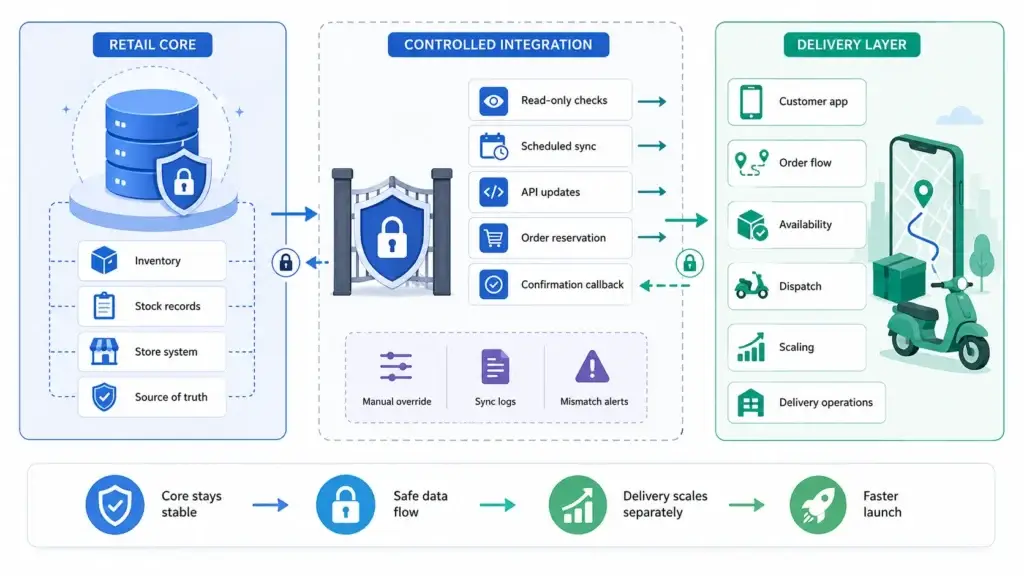
The most important technical principle was isolation.
The delivery engine did not replace the inventory system. It requested or received inventory availability through a controlled integration path. This prevented the new app from creating uncontrolled write actions inside the company’s core database.
A practical setup may include:
- Read-only stock availability checks
- Scheduled inventory sync
- API-based product availability updates
- Order reservation logic
- Order confirmation callbacks
- Manual override controls for store managers
- Logs for inventory mismatches and failed syncs
This gave the retail chain a safer operating model. If the delivery app had an issue, the store system continued functioning. If inventory data needed correction, the source of truth remained inside the existing inventory platform. If delivery demand increased, the delivery layer could be scaled without rewriting the retail core.
That separation is what made speed possible without creating unnecessary instability.
Read More: Designing a Peer-to-Peer Rental Engine: Solving the Availability Challenge
Customer Experience Improved Without Rebuilding Store Operations
From the customer’s point of view, the change felt immediate.
They could browse available products, place orders from a branded mobile app, receive status updates, track deliveries, and interact with the brand outside the physical store. But behind the scenes, the company did not need to rebuild every store process at once.
That is the power of a decoupled white-label architecture. It modernizes the customer experience first while giving internal teams time to improve deeper operations later.
The retail chain could start with selected stores, limited delivery zones, and high-demand product categories. Once the operating model proved stable, it could expand to additional locations, categories, and fulfillment rules.
This phased approach is especially useful for corporate executives because it turns digital transformation into a controlled operating program rather than a risky one-time migration.
Founder and Executive Decision Signals
Speed
Choose white-label delivery architecture when the business needs a working digital channel faster than a full custom development cycle allows.
Stability
Use operational decoupling when the existing inventory, POS, or ERP system is too important to disturb during launch.
Control
Prioritize source-code ownership and admin control when the delivery division must evolve with internal policies and brand rules.
Scalability
Start with selected stores and delivery zones, then expand once order accuracy, fleet capacity, and support workflows are validated.
Where This Model Works Best
This architecture is especially useful for traditional operators that already have customers, stock, locations, and brand trust but lack a modern delivery interface. Retail brands handling supermarket-style fulfillment can explore grocery delivery app solutions, while courier-led businesses can evaluate parcel delivery app development for pickup, dispatch, and last-mile delivery workflows.
Good fits include:
- Regional grocery chains
- Pharmacy chains
- Specialty retail stores
- Department stores
- Convenience store networks
- Wholesale distributors
- Local retail groups expanding into hyperlocal delivery
- Brands that want delivery without depending fully on third-party marketplaces
For grocery-first businesses, Miracuves’ Instacart clone app can support a marketplace-style delivery model. For parcel or courier expansion, a FedEx clone app model can support tracking, proof-of-delivery, and logistics workflows.
The right choice depends on whether the brand is moving products from stores, warehouses, dark stores, vendors, or courier hubs.
Read More: Beyond the Code: The DevOps Guide to Launching Production Architecture
Common Mistakes Enterprise Teams Should Avoid
The first mistake is trying to rebuild the entire technology stack before launching the delivery channel. That often delays market entry and makes the project too large.
The second mistake is giving the delivery app too much direct access to the core database. A delivery division needs data access, not uncontrolled database dependency.
The third mistake is launching in every store at once. A controlled rollout gives teams time to test order accuracy, stock sync, delivery assignment, refunds, and customer support.
The fourth mistake is treating the delivery app as only a customer interface. The real value sits in the operating system behind it: admin controls, delivery rules, store coordination, fleet workflows, and reporting.
Enterprise Integration Checklist
Before launching a white-label delivery arm, executives should confirm:
- Which inventory system remains the source of truth?
- Which product categories are included in the first launch?
- Which stores or locations will fulfill orders?
- How often should inventory sync?
- What happens when stock is unavailable after checkout?
- Who manages order exceptions?
- How are refunds and cancellations handled?
- Which team owns fleet performance?
- Which reports matter during the first 30 days?
- What data should not be exposed to the delivery layer?
This checklist turns the launch from a software project into an operating model.
Why White-Label Architecture Beats a Full Rebuild for This Use Case
A full custom rebuild can make sense when a company has unique workflows, proprietary logistics logic, or long-term platform ambitions that cannot fit any existing product foundation. But for many traditional retail chains, the first priority is not technical uniqueness. It is controlled speed.
A white-label delivery engine already includes the core modules needed to operate an on-demand channel. That lets the business focus its custom effort on branding, integration, delivery rules, reporting, and store-specific workflows. This is where ready-made apps become useful for enterprises that want a faster launch path without building every customer, driver, and admin module from zero.
This is where Miracuves can support enterprise teams: by helping them start with a launch-ready delivery foundation instead of building every customer, driver, admin, and dispatch module from zero.
For larger logistics and fleet-led operations, Miracuves’ transportation and logistics solutions can also support broader delivery and movement workflows.
Final Thoughts: Digital Delivery Does Not Have to Break Legacy Operations
The strongest digital transformation projects are not always the ones that replace everything. They are often the ones that protect what already works while adding the new layer the market now expects.
For a regional retail chain, launching on-demand delivery in 30 days is not about shortcuts. It is about architectural discipline.
By decoupling the delivery frontend from the core inventory backend, the business can move quickly without risking daily operations. Customers get a modern mobile experience. Store teams keep familiar systems. Executives get a controlled path to test a new digital division.
Miracuves helps businesses build ready-made, white-label delivery app solutions with source-code ownership, branded design, admin control, and faster deployment.If your retail chain is planning a delivery arm, the right move may not be a full rebuild. It may be a carefully integrated delivery layer that lets your existing business scale into a new channel. To explore the right architecture for your business, talk to Miracuves experts about a delivery setup aligned with your existing systems, launch scope, and operational goals.
FAQs
What is white-label delivery app architecture?
White-label delivery app architecture is a ready-made delivery software foundation that can be branded, configured, and integrated with a business’s existing systems. It usually includes customer apps, driver apps, admin dashboards, delivery tracking, payments, and order management.
How can a retail chain launch delivery without replacing its inventory system?
A retail chain can use operational decoupling. The existing inventory system remains the source of truth, while the delivery app connects through APIs or middleware to access approved product, stock, and order data.
Why is operational decoupling important for enterprise delivery apps?
Operational decoupling reduces risk. It allows a company to launch a new digital delivery channel while protecting core systems such as inventory, POS, ERP, accounting, and store workflows.
Is a white-label delivery app suitable for large traditional businesses?
Yes, when the business needs faster launch, brand control, admin visibility, and integration with existing operations. The key is configuring the white-label app around the company’s real workflows instead of treating it as a generic app.
What should enterprises integrate first?
The first integration layer should usually focus on product availability, stock status, order confirmation, delivery status, payments, and admin reporting. Deeper integrations can be added after the first controlled launch.
Does a white-label delivery app replace ERP or POS software?
No. In a decoupled model, the delivery app works around the ERP, POS, or inventory system. It creates a modern customer and logistics layer without forcing a full replacement of internal software.