


Key Takeaways
What You’ll Learn
- Security is the foundation of any Revolut-style fintech platform, not just an added feature.
- Core protection layers include authentication, encryption, and transaction monitoring.
- KYC and AML systems are essential for regulatory compliance and fraud prevention.
- Real-time alerts and card controls improve user trust and platform safety.
- Strong backend architecture ensures secure scaling and financial data integrity.
Stats That Matter
- Modern fintech apps rely on multi-layer security systems including 2FA and biometric authentication.
- PCI-DSS compliance is a standard requirement for handling card and payment data securely.
- Transaction-heavy apps require audit logs and real-time monitoring for fraud detection.
- API-based financial systems must include rate limiting and secure authentication layers.
- Security-first architecture directly impacts user trust and long-term platform growth.
Real Insights
- Fintech apps must be built as financial infrastructure, not just user-facing applications.
- Trust is created through transparency, transaction visibility, and secure workflows.
- Start with strong authentication and gradually expand into advanced fraud detection systems.
- Compliance readiness should be planned from the initial development stage.
- Long-term success depends on balancing usability with strict security controls.
A fintech product should not be evaluated only by how polished its interface looks. Founders also need to understand how the platform handles authentication, identity verification, financial transactions, APIs, administrator permissions, sensitive data, fraud signals, third-party providers, and incident response.
A white-label Revolut-style product can reduce the time required to assemble a digital banking experience. However, a ready-made foundation is not automatically secure or compliant. Its real security depends on the codebase, deployment configuration, infrastructure, financial-service integrations, target jurisdiction, internal operating model, and post-launch maintenance.
For founders comparing a product foundation, Miracuves’ Revolut-style fintech platform shows how mobile and web applications, multi-currency accounts, cards, transfers, Banking-as-a-Service integrations, and administrative controls can fit into one configurable fintech ecosystem.
This guide remains focused on the security decision: what to inspect, what evidence to request, which risks to address, and how to connect security with product features, business operations, revenue, cost, and launch planning.
By the end, you should be able to determine whether a white-label Revolut app has the technical controls, operational visibility, and compliance-ready workflows needed for your proposed market and business model.
Understanding the White-Label Revolut Security Landscape
What Does White-Label Fintech Security Actually Mean?
White-label fintech security refers to the controls already included in a ready-made financial product and the additional controls configured for a particular deployment.
A product foundation may already include authentication, protected APIs, transaction records, user verification workflows, payment integrations, access permissions, and administrative controls. Starting with these modules can reduce the amount of foundational functionality that must be designed from zero.
However, the existence of these features does not prove that every deployment is secure.
Security also depends on:
- How the product is hosted
- How encryption keys and credentials are managed
- Which third-party providers are connected
- How administrator privileges are assigned
- Whether dependencies are maintained
- How transactions are reconciled
- How user identities are verified
- How suspicious activity is reviewed
- How incidents are detected and handled
- How customizations are tested before release
The codebase is only one component. Infrastructure, integrations, staff access, operating procedures, legal obligations, and maintenance practices can all create or reduce risk.
White-Label Fintech Security Myths and Reality
| Common belief | Practical reality |
|---|---|
| White-label apps are always less secure than custom products. | Security depends on architecture, implementation, testing, deployment, access controls, integrations, and maintenance—not only on whether the initial product was ready-made or custom-built. |
| A prebuilt app does not need further testing. | Every deployment should be reviewed after branding, customization, infrastructure setup, and third-party integration. |
| Secure APIs make the whole product safe. | APIs are one layer. Authentication, authorization, data storage, infrastructure, monitoring, admin access, and business processes also matter. |
| Compliance modules make the business compliant. | Software can support workflows, but legal compliance depends on the operating company, jurisdiction, providers, licences, policies, and professional review. |
| Encryption solves every security problem. | Encryption protects particular data states. It cannot replace access governance, fraud monitoring, secure code, incident response, and operational controls. |
| The provider is responsible for every security issue. | Responsibilities are normally shared between the software provider, hosting provider, financial partners, integration providers, and platform operator. |
Why Founders Worry About White-Label Financial Products
Financial applications may process identity documents, payment details, account data, transaction histories, device data, contact information, and compliance records.
The concern is therefore justified. One weak permission, exposed API, compromised administrator account, incorrectly configured storage service, or poorly governed integration can affect both users and the operating business.
Founders should be particularly cautious when a provider:
- Cannot explain the product architecture
- Refuses independent testing
- Does not document third-party integrations
- Uses outdated dependencies
- Cannot define post-launch support responsibilities
- Treats compliance as a marketing badge
- Offers no visibility into administrator controls
- Cannot explain how transaction records are reconciled
- Makes absolute guarantees about security or regulatory approval
The correct response is not to reject every ready-made fintech platform. It is to conduct structured due diligence before approving the launch.
Read More: Best Revolut Clone Script in 2026: Features & Pricing Compared
Current Security Risks Founders Should Model
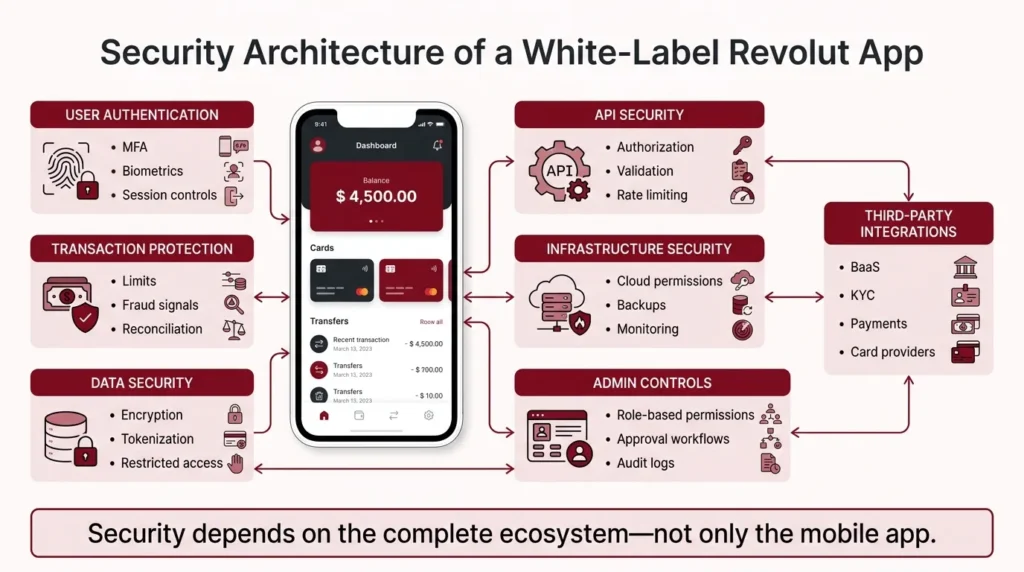
A Revolut-style platform connects several sensitive systems. Its security risks are rarely limited to the mobile application or a single database.
Founders should evaluate exposure across the following areas.
Account Takeover and Credential Abuse
Weak passwords, phishing, stolen sessions, reused credentials, compromised devices, or insecure recovery processes can allow attackers to access user accounts.
The platform should consider:
- Multi-factor authentication
- Biometric authentication where appropriate
- Secure password and recovery workflows
- Device and session visibility
- Session expiration
- Refresh-token rotation
- Login-risk signals
- Notifications for sensitive account changes
- Stronger confirmation for high-risk actions
API Authorization Failures
An authenticated API request is not necessarily an authorized request. The platform must confirm that the user or administrator is permitted to access the requested account, transaction, document, or action.
API protection may include:
- Object-level authorization
- Role and permission checks
- Input validation
- Rate limiting
- Request signing where appropriate
- Secure token handling
- Replay protection
- Error-response controls
- API activity logging
- Webhook verification
Third-Party Integration Risk
A fintech platform may connect with identity providers, payment gateways, card processors, Banking-as-a-Service companies, cloud platforms, analytics tools, notification services, customer-support systems, and fraud-monitoring providers.
Every connection expands the operational boundary.
Before integrating a provider, review:
- What data the provider receives
- Why that data is needed
- How credentials are stored
- Whether access can be limited
- How webhooks are authenticated
- What happens when the service is unavailable
- How errors and duplicate events are handled
- Which organization is responsible for incidents
- How the integration can be disabled safely
Cloud and Infrastructure Misconfiguration
A secure application can still be exposed through incorrectly configured storage, unrestricted databases, leaked secrets, weak firewall rules, excessive cloud permissions, incomplete backups, or unmonitored administrative access.
Infrastructure controls should cover:
- Network restrictions
- Encryption
- Secrets management
- Permission-based cloud roles
- Logging and alerting
- Backup security
- Recovery procedures
- Development and production separation
- Configuration review
- Patch and vulnerability management
Transaction and Ledger Risk
Security in a fintech app is not limited to preventing unauthorized logins. The product must also preserve the accuracy and traceability of money movement.
Risks can include:
- Duplicate transactions
- Incorrect balances
- Failed reversals
- Delayed provider events
- Replayed webhooks
- Broken fee calculations
- Incorrect foreign-exchange rates
- Inconsistent transaction statuses
- Reconciliation gaps
- Unauthorized administrator adjustments
Transaction controls should therefore be designed with idempotency, approval logic, auditability, provider synchronization, exception handling, and reconciliation in mind.
Read More: Why Choose a White-Label Revolut like app Instead of Building from Scratch?
Key Security Risks and How to Identify Them
1. Data Protection and Privacy Risks
Identity and KYC Information
A fintech platform may process government-issued documents, identity-verification results, photographs, addresses, dates of birth, and other sensitive information.
Founders should confirm:
- Which identity data is stored
- Which data remains with the verification provider
- Who can access verification records
- How long information is retained
- How deletion or restriction requests are handled
- Whether development teams can access production information
- How sensitive documents are encrypted
Collect only the data needed for a defined purpose. Keeping unnecessary information increases both security exposure and privacy responsibility.
Payment and Card Information
When payment account data falls within the platform’s environment, the relevant PCI DSS responsibilities must be assessed.
The current active version is PCI DSS v4.0.1. The PCI Security Standards Council describes PCI DSS as a baseline of technical and operational requirements for protecting payment account data. The precise validation scope depends on how payment information is stored, processed, or transmitted. ed payment methods and appropriately scoped payment providers may reduce exposure, but it does not automatically remove every responsibility.
Location and Device Information
Location, IP address, device identity, login history, and behavioural signals can help with fraud detection. They can also create privacy concerns when collected without clear purpose, appropriate notice, or access controls.
The product should define:
- Why the information is collected
- How long it is kept
- Who can access it
- Whether users receive appropriate notice
- Whether the information is shared with other providers
- How inaccurate or unnecessary data is corrected or removed
2. Technical Vulnerabilities
Poor Code Quality
A ready-made platform may contain old dependencies, incomplete authorization logic, insecure defaults, test credentials, debug endpoints, or code that was reused without proper review.
Useful controls include:
- Peer review
- Static application security testing
- Dynamic application security testing
- Dependency scanning
- Secret scanning
- Secure release procedures
- Independent testing
- Remediation tracking
Weak Server and Cloud Security
Unpatched servers, broad network exposure, unrestricted administrative interfaces, or poorly managed cloud credentials can create serious risk.
Infrastructure should be reviewed independently from the frontend application.
Insecure API Design
API security should cover more than encryption. Authentication, authorization, input validation, rate limiting, event logging, and abuse protection are equally important.
OAuth 2.0 or OpenID Connect may be appropriate for some identity and authorization flows, but the selected design should match the product architecture. Using a particular token format does not automatically make an API secure.
Vulnerable Third-Party Components
Libraries, SDKs, plugins, and external services should be inventoried and monitored. The provider should have a process for identifying vulnerable components, evaluating their impact, and deploying appropriate updates.
3. Business, Legal, and Operational Risks
Unclear Responsibility
A breach or operational failure can become more difficult to manage when the provider, platform operator, hosting company, and financial partners have not agreed on responsibilities.
Contracts and operating procedures should identify who handles:
- Monitoring
- Incident investigation
- Regulator communication
- User communication
- Infrastructure recovery
- Provider escalation
- Security patches
- Evidence retention
- Legal review
Reputation Damage
Fintech customers expect accurate balances, dependable transfers, transparent fees, secure account access, and responsive support.
A security incident, unexplained transaction error, or inaccessible account can damage user trust even when no large-scale breach occurs.
Financial Loss
Fraud, downtime, duplicate payments, reconciliation errors, disputes, legal costs, remediation, and customer support can all create financial impact.
Security planning should therefore be connected to business continuity and operational risk—not treated only as an engineering concern.
Regulatory Exposure
The legal requirements affecting a fintech business depend on its market, services, providers, customer types, data flows, and licensing structure.
A software provider may support configurable KYC, AML, privacy, transaction-monitoring, and reporting workflows. Final legal obligations should still be confirmed with qualified advisers and the relevant regulated partners.
For related launch risks, read Top Mistakes Startups Make When Building a Revolut Clone.
White-Label Revolut App Risk Assessment Checklist
| Category | Questions to assess | Priority |
| Authentication | Are MFA, secure recovery, session management, device visibility, and high-risk action checks supported? | Critical |
| Authorization | Are user and administrator permissions enforced at API and data levels? | Critical |
| Data protection | Is sensitive information encrypted, minimized, retained appropriately, and access-controlled? | Critical |
| Payment security | What card or payment data enters the platform, and who owns the PCI DSS responsibilities? | Critical |
| Transactions | Are duplicate events, failed transfers, reversals, fees, balances, and reconciliation handled safely? | Critical |
| APIs | Are APIs authenticated, authorized, validated, rate-limited, logged, and monitored? | Critical |
| Infrastructure | Are production systems isolated, monitored, backed up, and protected through permission-based access? | Critical |
| Admin controls | Are roles separated, sensitive actions logged, and high-risk operations subject to approval? | Critical |
| Integrations | Are BaaS, KYC, card, payment, analytics, and messaging providers reviewed and documented? | High |
| Code integrity | Are code reviews, dependency scans, security tests, and controlled releases performed? | High |
| Incident response | Are detection, escalation, investigation, recovery, and communication responsibilities documented? | High |
| Legal readiness | Are privacy notices, user agreements, provider contracts, data maps, and regulatory responsibilities reviewed? | High |
| Maintenance | Is there a documented process for patches, vulnerabilities, updates, and post-launch support? | High |
A single “yes” or security badge is not enough. Ask for evidence relevant to the proposed deployment and operating model.
How Security Supports Product Value, Operations, and Revenue
Security is not separate from the business model of a fintech app. It influences which features can be offered, how customers are onboarded, what administrators can control, which financial partners can be connected, and how confidently the platform can expand.
A founder evaluating an app like Revolut should therefore assess security in the context of the entire product rather than treating it as a final technical checklist.
User Features That Need Security Controls
A digital banking product may include:
- Customer registration and login
- Identity verification
- Multi-currency balances
- Account funding
- Beneficiary management
- Local and international transfers
- Foreign-exchange conversion
- Physical and virtual cards
- Payment requests
- Transaction statements
- Spending insights
- Business accounts
- Subscription plans
- Notifications
- Customer support
Each feature creates a related control requirement.
For example:
| Product feature | Supporting security and operational control |
| Customer onboarding | Identity checks, consent capture, duplicate-account controls, secure document handling |
| Account login | MFA, session controls, recovery protection, device visibility |
| Beneficiary creation | Confirmation, cooling periods or risk review where appropriate |
| Money transfer | Limits, transaction verification, fraud signals, ledger integrity |
| Currency exchange | Reliable rate sources, quote expiration, fee visibility, reconciliation |
| Card management | Provider controls, card status synchronization, transaction alerts, dispute workflows |
| Business accounts | Multi-role permissions, approval workflows, activity logs |
| Support | Restricted customer access, identity checks, ticket history, escalation |
| Admin dashboard | Role-based access, reason-based actions, audit trails, sensitive-action approvals |
Readers who need a broader product explanation can review what a Revolut app is and how it works.
Why the Admin Panel Is a Security Control Layer
The administrative dashboard is where the platform operator manages the financial product after launch.
It should provide controlled visibility and permission-based workflows rather than unrestricted access to every employee.
Important administrative capabilities can include:
- User and business-account management
- KYC review
- Account restrictions and suspensions
- Card and transfer status management
- Currency and country configuration
- Transaction limits
- Fee configuration
- Provider management
- Suspicious-activity queues
- Dispute and refund handling
- Reconciliation visibility
- Role-based permissions
- Approval workflows
- Activity logs
- Reports and exports
The purpose of the admin panel is not simply convenience. It helps the platform operator resolve issues, manage risk, adjust commercial rules, investigate activity, and operate the product without requesting a developer change for every decision.
How Admin Permissions Should Be Separated
Different internal roles may require different access.
A support employee may need to view account status but should not necessarily be able to change financial limits. A compliance reviewer may need access to identity and transaction-review information but not deployment settings. A finance employee may need reconciliation reports without access to user passwords or infrastructure credentials.
Possible role groups include:
- Customer support
- KYC and compliance
- Transaction-risk review
- Finance and reconciliation
- Product operations
- Analytics
- Technical operations
- Senior administrators
The principle should be simple: each person receives only the access required for their responsibilities.
Security and Monetization Must Be Planned Together
A digital banking platform may generate revenue through:
- Monthly or annual subscriptions
- International transfer fees
- Foreign-exchange margins
- Card-related fees
- Business accounts
- Premium limits
- Partner commissions
- Financial-service integrations
- Value-added tools
- Banking-as-a-Service arrangements
Every revenue model creates operational requirements.
Subscription plans need billing and entitlement controls. Transfer fees require accurate transaction records. Foreign-exchange monetization depends on reliable rates, quotes, fee disclosure, and reconciliation. Business accounts may need multiple users, approvals, and spending policies. Card programmes require provider synchronization, transaction visibility, and dispute management.
For deeper planning, review the Revolut business model and revenue strategy.
The stronger founder decision is not to add every possible revenue stream immediately. It is to choose a focused revenue model and confirm that the product has the admin, security, reporting, integration, and customer-support controls required to operate it.
See the Revolut Clone Platform in Action
Understanding Revolut’s business model helps define the opportunity, but a live product walkthrough gives better clarity. Review digital wallets, multi-currency accounts, instant transfers, card controls, KYC workflows, subscriptions, transaction monitoring, admin controls, branding, and launch scope before making your decision.
Security Standards and Assurance Evidence to Evaluate
A secure fintech product may need to support several technical standards, assurance frameworks, privacy obligations, and financial-control requirements.
These should not be presented as one universal compliance package. The applicable scope depends on the services, jurisdiction, data flows, providers, regulated partners, and operating entity.
PCI DSS
PCI DSS is relevant when payment account data is stored, processed, or transmitted within the product environment.
Founders should confirm:
- Which systems are within scope
- Whether payment data is tokenized
- Whether card information enters Miracuves-controlled or operator-controlled systems
- Which responsibilities belong to the gateway or processor
- Which validation method is required
- Whether logs or support tools expose payment information
PCI DSS v4.0.1 is the active version supported by the PCI Security Standards Council. n a generic statement that a payment provider is compliant. Confirm how the entire payment flow affects your own scope.
Privacy and Data-Protection Requirements
Privacy requirements can affect:
- Data collection
- Consent
- Processing notices
- User requests
- Retention
- Deletion
- Third-party sharing
- Cross-border transfers
- Breach handling
- Marketing communications
- Children’s data where relevant
Requirements may include GDPR, UK GDPR, US federal or state obligations, India’s Digital Personal Data Protection framework, and local market rules.
India’s principal legislation is the Digital Personal Data Protection Act, 2023, supported by the Digital Personal Data Protection Rules, 2025. The relevant commencement and implementation obligations should be checked for the planned launch date and business model. C 2 is an examination and reporting framework concerning controls relevant to security, availability, processing integrity, confidentiality, and privacy.
It is useful assurance evidence, but it should not be presented as a universal fintech licence or automatic proof that every customer deployment is compliant.
When reviewing a SOC 2 report, verify:
- The organization covered
- The services included
- The system boundaries
- The reporting period
- Any exceptions
- Complementary controls expected from customers
- Whether the relevant deployment environment is included
The AICPA describes SOC as a suite of service offerings related to system-level controls of service organizations. 7001
ISO/IEC 27001 can provide evidence that an organization operates an information-security management system within a defined scope.
Founders should verify:
- The certificate owner
- The certification body
- The covered services and locations
- The expiration date
- Whether the proposed product environment falls within scope
A certificate should be treated as evidence to evaluate, not as proof that every line of code or customer configuration is secure.
KYC and AML Workflows
A platform can support:
- Identity verification
- Document review
- Sanctions or watchlist screening
- Risk classification
- Transaction monitoring
- Suspicious-activity flags
- Manual review queues
- Account restrictions
- Compliance reporting
- Record retention
These workflows can help founders prepare operational controls for regulated markets.
However, software does not replace licensing, compliance personnel, regulated partnerships, legal advice, or jurisdiction-specific procedures.
Use the phrase “compliance-ready foundation” only when the platform supports configurable workflows. Do not describe the software as automatically compliant or approved in every country.
Read More: Revolut vs Wise Business Model: What Fintech Founders Should Learn Before Building
Technical Controls for a Secure Revolut-Style App
| Security layer | Recommended controls | Business purpose |
| Authentication | MFA, biometrics where appropriate, secure recovery, session expiry, device visibility | Reduce unauthorized account access |
| Authorization | Role-based permissions, object-level checks, approval rules | Prevent users and staff from accessing unauthorized data or actions |
| Data transfer | Modern TLS configuration and certificate management | Protect data moving between systems |
| Data storage | Encryption, restricted access, key management, data minimization | Reduce exposure of stored information |
| APIs | Authentication, authorization, validation, rate limits, request logs, webhook verification | Protect product and provider connections |
| Transactions | Idempotency, approval logic, limits, state control, reconciliation | Preserve financial accuracy |
| Admin access | Strong authentication, role separation, reason-based actions, activity logs | Reduce internal misuse and support investigations |
| Infrastructure | Network controls, cloud permissions, secrets management, monitoring | Protect the deployment environment |
| Application code | Reviews, SAST, DAST, dependency checks, secret scanning | Identify software vulnerabilities |
| Availability | Backups, tested recovery, provider failover planning | Support business continuity |
| Detection | Centralized logs, alerts, transaction monitoring, anomaly review | Identify suspicious or failed activity |
| Response | Escalation plans, responsibilities, evidence retention, communication processes | Reduce incident impact |
The exact implementation should be based on a threat model and the selected product scope.
Red Flags: How to Identify an Unsafe White-Label Provider
1. No Product or Security Documentation
A provider should be able to explain the architecture, data flows, deployment responsibilities, integration boundaries, and access model.
Not every document must be disclosed before a commercial agreement, but complete refusal to provide technical clarity is a warning sign.
2. Low Pricing Without Scope Clarity
A cost-efficient product is not automatically unsafe. The risk appears when the provider cannot explain what is included, what is excluded, which integrations require additional work, and who owns post-launch responsibilities.
Compare scope rather than headline price.
3. Absolute Compliance Claims
Be cautious when a provider promises:
- Full compliance in every country
- Guaranteed regulatory approval
- Banking licences included
- Automatic PCI DSS compliance
- Guaranteed SOC 2 coverage
- No need for legal review
A responsible provider should explain the difference between software capabilities and the operator’s legal obligations.
4. Outdated or Unsupported Technology
Ask how the provider monitors dependencies, runtime versions, mobile frameworks, server components, and third-party SDKs.
The most important question is not whether the provider uses a fashionable framework. It is whether the selected technology is supported, maintainable, documented, and updated.
5. Refusal to Permit Testing
A provider that refuses reasonable code review, architecture review, vulnerability testing, or penetration testing may create long-term risk.
Testing rights, confidentiality, and remediation responsibilities should be agreed in advance.
6. No Update or Vulnerability Process
Ask how vulnerabilities are reported, prioritized, fixed, tested, and deployed.
Do not assume that “support included” automatically covers every security update or third-party integration issue.
7. No Backup and Recovery Plan
The provider or operator should explain:
- What is backed up
- How backups are protected
- How often recovery is tested
- What recovery objectives apply
- Who initiates recovery
- How financial data is reconciled after restoration
8. Unrestricted Admin Access
A single administrator role with access to every customer, transaction, setting, and infrastructure function creates avoidable risk.
Look for role separation, logs, sensitive-action approval, and permission-based dashboards.
White-Label Fintech Provider Evaluation Checklist
| Evaluation area | Questions to ask | Evidence to request |
| Product access | Can we review the mobile app, web app, and admin dashboard? | Live demo or controlled test access |
| Architecture | How are user, API, database, provider, and admin layers structured? | Architecture overview and data-flow map |
| Code ownership | Is source code included, licensed, or hosted only by the provider? | Contract and delivery terms |
| Security testing | What testing has been completed, and can we commission additional testing? | Scope, methodology, remediation status |
| Access control | How are user and administrator permissions separated? | Role and permission matrix |
| Integrations | Which BaaS, KYC, payment, card, notification, or analytics providers are supported? | Integration list and responsibility map |
| Infrastructure | Who owns hosting, monitoring, backups, and production access? | Deployment and support documentation |
| Transactions | How are duplicate, failed, reversed, and delayed transactions handled? | Workflow or technical documentation |
| Updates | How are vulnerabilities and dependency updates handled? | Maintenance and support policy |
| Incidents | Who detects, investigates, reports, and resolves security incidents? | Incident-response plan or contractual terms |
| Compliance | Which workflows are supported, and which obligations remain with us? | Scope statement and legal disclaimer |
| Customization | How are changes reviewed and tested? | Change and release process |
Due-Diligence Steps Before Choosing a Provider
- Review the actual product rather than relying only on screenshots.
- Request an architecture overview and responsibility map.
- Identify all providers involved in KYC, BaaS, cards, payments, hosting, notifications, and analytics.
- Confirm what data enters each provider’s systems.
- Review source-code and intellectual-property terms.
- Define hosting, deployment, monitoring, and support ownership.
- Conduct an independent technical review where appropriate.
- Agree on vulnerability reporting and remediation procedures.
- Add security and availability responsibilities to the contract.
- Confirm which legal and regulatory obligations remain with the operating company.
- Review the administrative dashboard and permission model.
- Test user, transaction, recovery, dispute, and support workflows before production launch.
A strong fintech partnership is built on accountability, evidence, clear scope, and documented responsibilities.
Best Practices for Secure White-Label Revolut Implementation
Pre-Launch Security Practices
1. Create a Threat Model
Identify the important assets, likely attackers, entry points, privileged roles, third-party dependencies, and financial workflows.
The threat model should cover users, administrators, APIs, providers, infrastructure, transactions, and internal staff.
2. Review the Code and Dependencies
Use appropriate code-review, static-analysis, dependency-scanning, and secret-scanning tools.
High-risk findings should be remediated and retested before release.
3. Test the Running Application
Dynamic testing and penetration testing can help identify weaknesses that are not visible through source review alone.
The scope should include:
- Mobile applications
- Web applications
- APIs
- Authentication
- Authorization
- Admin functions
- Infrastructure
- Connected providers where testing is permitted
4. Harden the Infrastructure
Review:
- Network exposure
- Firewall and security-group rules
- Cloud permissions
- Administrative access
- Secrets and credentials
- Database access
- Logging
- Backup security
- Staging and production separation
5. Configure Admin Roles
Create role definitions before onboarding operational staff.
Avoid shared administrator accounts. Use individual identities, strong authentication, and activity logs.
6. Test Financial Workflows
Test normal and abnormal scenarios, including:
- Duplicate transfer requests
- Failed provider responses
- Webhook delays
- Reversals
- Refunds
- Expired quotes
- Incorrect beneficiary information
- Account restrictions
- Transaction limits
- Reconciliation differences
7. Complete Legal and Provider Review
Confirm privacy notices, user agreements, data-processing responsibilities, provider contracts, security obligations, and jurisdiction-specific requirements.
Post-Launch Monitoring and Maintenance
1. Centralize Security and Operational Logs
Collect relevant authentication, administrator, API, infrastructure, transaction, and provider-event logs.
Protect logs from unauthorized alteration and define retention based on legal and operational needs.
2. Monitor Authentication and Transaction Activity
Review failed logins, unusual devices, high-risk account changes, transaction velocity, repeated failures, suspicious beneficiaries, and administrator actions.
Automated signals should support—not completely replace—human review.
3. Maintain Dependencies and Infrastructure
Monitor vulnerabilities affecting libraries, runtimes, operating systems, cloud components, mobile SDKs, and third-party services.
Patch timelines should depend on risk, exposure, exploitability, testing requirements, and service impact rather than one universal deadline.
4. Maintain an Incident-Response Plan
The plan should define:
- How incidents are detected
- Who is contacted
- Who can restrict accounts or services
- How evidence is preserved
- How providers are escalated
- How recovery is managed
- Who handles legal and regulatory assessment
- How users are informed where required
Under GDPR Article 33, notification to the relevant supervisory authority may be required within 72 hours after awareness of a qualifying personal-data breach, unless the breach is unlikely to result in risk. That rule should not be presented as a universal deadline applying identically in every country. Backup and Recovery Procedures
A backup is useful only if it can be restored correctly.
Recovery tests should verify:
- Data integrity
- Access permissions
- Application functionality
- Transaction consistency
- Provider synchronization
- Recovery documentation
- Responsible personnel
Read More: Exploring the Revenue Model Behind Revolut
How Security Affects Cost and Launch Planning
The cost of a secure digital banking product is influenced by more than the number of screens in the mobile application.
Important cost drivers include:
- Target countries
- Consumer or business account scope
- KYC and identity providers
- AML and sanctions-screening requirements
- BaaS providers
- Payment and card providers
- Multi-currency and foreign-exchange workflows
- Mobile, web, and admin platforms
- User and staff roles
- Transaction limits and approvals
- Reporting and reconciliation
- Infrastructure and data-residency requirements
- Security testing
- Custom branding
- Custom features
- Data migration
- Post-launch support
A ready-made product can reduce the amount of foundational application functionality that must be built from zero. It does not remove the need to validate integrations, deployment, security controls, legal responsibilities, or operational procedures.
Current Miracuves Cost Reference
At the time of this update, Miracuves lists its ready-made Revolut-style platform at $27,999 as a one-time package, with a standard six-day go-live for the defined ready-made scope.
The product page distinguishes this package from enterprise or compliance-heavy deployments, which require a custom quote and timeline based on final requirements. urrent price and inclusion list before publication or contracting because integrations, feature changes, provider requirements, infrastructure, and customization can affect the final scope.
For a detailed cost breakdown, visit Revolut-style fintech app development cost.
What Can Be Customized Without Losing Product Control?
A white-label platform can be customized across several layers.
Branding
Common branding changes include:
- Application name
- Logo
- Colour palette
- Typography
- Icons
- Onboarding content
- Emails and notifications
- App-store presentation
Branding changes are normally lower risk than changes to transactions, permissions, or financial logic, but they should still pass quality and release checks.
Product Modules
Founders may select or expand:
- Personal accounts
- Business accounts
- Multi-currency wallets
- Transfers
- Cards
- Foreign exchange
- Payment requests
- Subscription plans
- Financial insights
- Support workflows
- Reporting
- Provider integrations
Every new module should be assessed for data, permission, transaction, provider, and compliance impact.
Admin Rules
Administrative customization may include:
- User roles
- Approval workflows
- Transaction limits
- Fees
- Countries
- Currencies
- Account statuses
- Review queues
- Dispute processes
- Risk rules
- Reporting permissions
Admin customizations should be documented and tested because they can directly affect financial operations.
Financial Providers
The product may need connections with specific BaaS, banking, payment, card, KYC, AML, notification, or analytics providers.
Provider replacement is not only a technical task. It may change data flows, user experience, settlement logic, error handling, reconciliation, contracts, and regulatory responsibilities.
Safe Customization Process
Use a controlled process:
- Document the requested change.
- Identify affected workflows and data.
- Review security and legal impact.
- Update the threat model.
- Implement the change in a non-production environment.
- Test normal, failed, and abusive scenarios.
- Complete code and configuration review.
- Approve the release.
- Monitor the changed workflow after launch.
Secure Revolut-Style App Launch Process
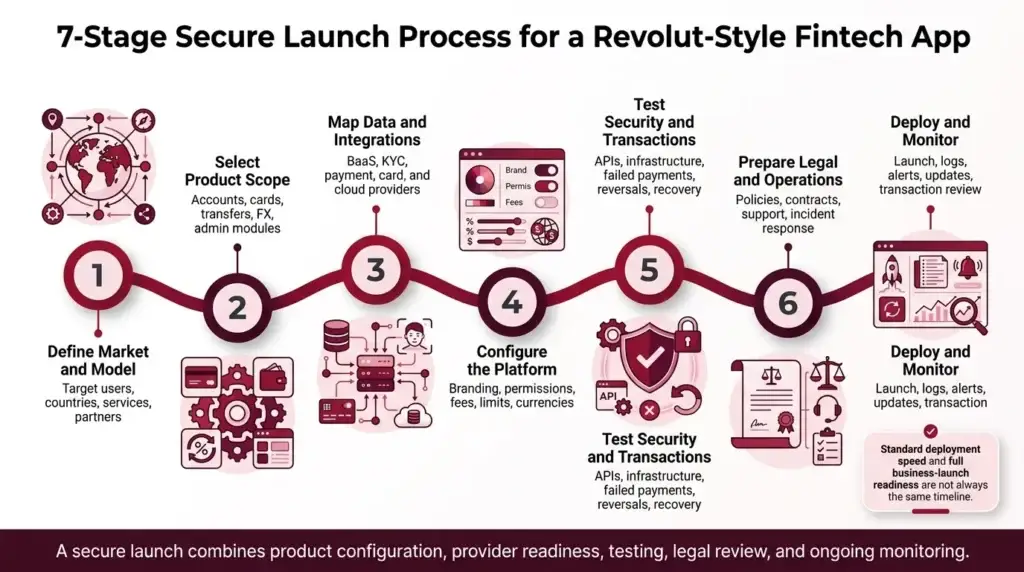
Stage 1: Define the Market and Operating Model
Confirm:
- Target customer
- Launch country
- Financial services
- Revenue model
- Regulated partners
- Provider responsibilities
- Operator responsibilities
Starting with a clear business model prevents unnecessary features and uncontrolled compliance complexity.
Stage 2: Select the Product Scope
Choose the accounts, wallet, transfer, card, foreign-exchange, business-finance, support, reporting, and admin modules needed for the first release.
Avoid adding features without a defined user or commercial purpose.
Stage 3: Map Data and Integrations
Document:
- What user data enters the platform
- Where it is stored
- Which providers receive it
- Which systems create financial records
- Who manages credentials
- Who owns each control
Stage 4: Configure the Product
Complete:
- Branding
- User journeys
- Administrative roles
- Limits
- Fees
- Countries and currencies
- Notifications
- Provider settings
- Infrastructure
- Monitoring
Stage 5: Test Security and Financial Workflows
Complete application, API, infrastructure, integration, transaction, recovery, and user-acceptance testing.
Remediate important findings before production release.
Stage 6: Complete Legal and Operational Readiness
Prepare appropriate:
- Privacy documentation
- User terms
- Provider agreements
- Internal procedures
- Support workflows
- Incident-response plans
- Escalation contacts
- Compliance responsibilities
Stage 7: Deploy and Monitor
Launch the approved scope, monitor authentication and transaction activity, review administrator actions, maintain logs, address incidents, and improve the platform as operational evidence becomes available.
A six-day standard white-label deployment may cover branding and deployment of a predefined product scope. Custom integrations, testing, regulatory review, data migration, or new feature development can extend the complete business-launch timeline.
Read More: Why Choose a White-Label Revolut like app Instead of Building from Scratch?
Legal and Compliance Planning by Region
A regional table should be treated as a planning aid, not legal advice.
| Region | Areas founders may need to review |
| European Union | GDPR, payment-service requirements, strong customer authentication, outsourcing, operational resilience, AML/KYC, cross-border data transfers |
| United Kingdom | UK GDPR, financial-conduct rules, payment-service requirements, AML/KYC, consumer obligations, provider authorization |
| United States | Federal and state privacy requirements, consumer-finance obligations, AML/KYC, money-transmission considerations, partner-bank responsibilities |
| India | RBI requirements relevant to the operating model, KYC and AML obligations, payment rules, DPDP Act 2023, DPDP Rules 2025, provider responsibilities |
| Canada | Federal or provincial privacy requirements, FINTRAC obligations where applicable, consumer and payment responsibilities |
| UAE and Saudi Arabia | Central-bank or free-zone requirements, AML/KYC, privacy, cloud, outsourcing, and data-residency considerations |
The exact obligations depend on whether the business acts as a technology provider, programme manager, payment provider, financial institution, distributor, agent, data controller, data processor, or another regulated participant.
Core Legal and Operational Documents
Depending on the business, founders may need:
- Privacy notice
- Terms of service
- Cookie notice
- Data-retention policy
- Security policy
- Incident-response procedure
- Data-processing agreements
- Provider agreements
- Financial-partner agreements
- User consent records
- Complaints procedure
- Refund and dispute policy
- AML and KYC procedures
- Employee access policy
- Business-continuity plan
These documents should reflect the actual product and provider relationships. Generic templates should not be published without review.
How to Evaluate a Secure White-Label Fintech Provider
A provider should be evaluated through evidence, product visibility, clear responsibilities, and realistic contractual commitments—not through blanket claims that a platform is completely secure or automatically compliant.
Before selecting a provider, confirm:
- Whether you can review the mobile, web, and admin experiences
- Whether source-code ownership or access is included
- Which security controls are already implemented
- Which controls require configuration
- Which controls require custom development
- Which third-party integrations are included
- Who manages infrastructure
- Who monitors the platform
- Who maintains backups
- Who responds to incidents
- Whether independent testing is permitted
- How sensitive administrator actions are controlled
- How vulnerabilities are handled
- Which documents are included
- Which obligations remain with your company
Miracuves can help founders review product workflows, customization scope, admin requirements, provider integrations, source-code delivery, and deployment responsibilities before the final build is approved.
The final security and compliance position will still depend on the selected modules, infrastructure, third-party providers, jurisdiction, operating model, and professional review.
Founder Decision Signals
Product Visibility
You should be able to review the real mobile, web, transaction, and admin workflows before approving the platform.
Operational Control
Confirm that your team can manage users, permissions, fees, limits, reviews, disputes, providers, and reports through controlled workflows.
Security Evidence
Look for architecture clarity, testing rights, documentation, responsibility mapping, and a defined vulnerability process.
Commercial Fit
Select product modules and monetization methods that match a real customer problem instead of launching every possible feature.
Customization Control
Confirm how branding, integrations, roles, limits, currencies, and workflows can be changed without losing product maintainability.
Launch Readiness
Treat deployment speed, provider integrations, testing, legal review, and operational preparation as separate parts of the launch plan.
Final Thoughts: Treat Security as Part of the Product Strategy
The security of a white-label Revolut app cannot be judged by its interface, feature count, deployment speed, or list of integrations alone.
A reliable product foundation should combine:
- Secure authentication
- Controlled APIs
- Accurate transaction workflows
- Data protection
- Administrator governance
- Provider oversight
- Monitoring
- Documentation
- Incident response
- Clearly assigned responsibilities
For founders, the most useful question is not simply:
“Is this platform secure?”
The stronger question is:
“Can this platform be configured, tested, operated, monitored, and maintained securely for my specific users, market, partners, revenue model, and financial services?”
That question creates a more practical path to selecting the right product, estimating the correct launch scope, preparing internal operations, and avoiding security assumptions that become expensive after deployment.
FAQs
Is a white-label Revolut app secure?
A white-label Revolut app can be secure when authentication, APIs, transactions, infrastructure, and admin permissions are properly configured. The final security level depends on testing, integrations, hosting, and ongoing maintenance.
Is a white-label fintech app as secure as a custom-built product?
Both ready-made and custom fintech apps can be secure when built and maintained correctly. Security depends more on architecture, testing, access controls, integrations, and operations than on the development approach.
Does a white-label fintech app automatically meet PCI DSS, GDPR, or banking regulations?
No, software alone does not make a fintech business compliant. Final compliance depends on the target market, data flows, financial partners, infrastructure, policies, and legal review.
What security controls should a fintech admin panel include?
A fintech admin panel should include role-based access, activity logs, KYC reviews, transaction monitoring, limits, disputes, and approval workflows. Each employee should receive only the permissions required for their role.
How do KYC and AML workflows improve fintech security?
KYC workflows help verify users and reduce fraudulent or duplicate accounts. AML workflows support transaction monitoring, risk reviews, suspicious-activity detection, and account restrictions.
What affects the cost of securing a Revolut-style fintech app?
Cost depends on integrations, target markets, infrastructure, user roles, transaction controls, testing, customization, and compliance requirements. A ready-made foundation can reduce development work, but market-specific requirements may increase the final scope.
How much does the Miracuves Revolut-style platform cost?
Miracuves currently lists its ready-made Revolut-style platform at $3,099 for the defined standard scope. Custom features, integrations, infrastructure, and compliance requirements may affect the final quote.
How long does it take to launch a white-label Revolut-style platform?
Miracuves currently offers an approximately six-day deployment for its standard ready-made scope. Custom integrations, security testing, legal review, and additional features can extend the complete launch timeline.
Can an app like Revolut be customized without weakening security?
Yes, provided every change is reviewed for its impact on permissions, APIs, transactions, data, and integrations. Custom workflows should be tested before they are deployed to production.
Related Articles: