


Building a regional ecommerce marketplace is not only about launching a storefront and waiting for buyers to arrive. The real challenge is creating balance between sellers, local demand, delivery coverage, pricing, trust, and repeat purchase behaviour.
For founders, this is where marketplace growth becomes more complex than normal ecommerce. A single-brand store only needs to sell its own inventory. A regional marketplace must convince sellers to join, buyers to trust the platform, delivery partners to fulfil orders, and operators to control the entire ecosystem from one backend.
That is why the strongest regional marketplace strategy starts with one focused question: which local market can you serve better than broad national platforms?
This guide explains how founders can plan seller acquisition, map local demand, build marketplace liquidity, expand into new regions, and avoid the common mistakes that make ecommerce marketplaces grow fast but break operationally.
Key Takeaways
- Regional ecommerce marketplace growth strategy helps founders build market density before expanding too broadly.
- Seller acquisition should begin with high-demand local categories, not random vendor onboarding.
- Local demand mapping helps decide which city, zone, category, and product type should be launched first.
- A marketplace grows stronger when seller supply, delivery capacity, trust workflows, and buyer acquisition scale together.
- Miracuves helps founders move faster with ready-made, white-label ecommerce marketplace platforms that support branded regional launches.
Why Regional Ecommerce Marketplaces Need a Different Growth Strategy
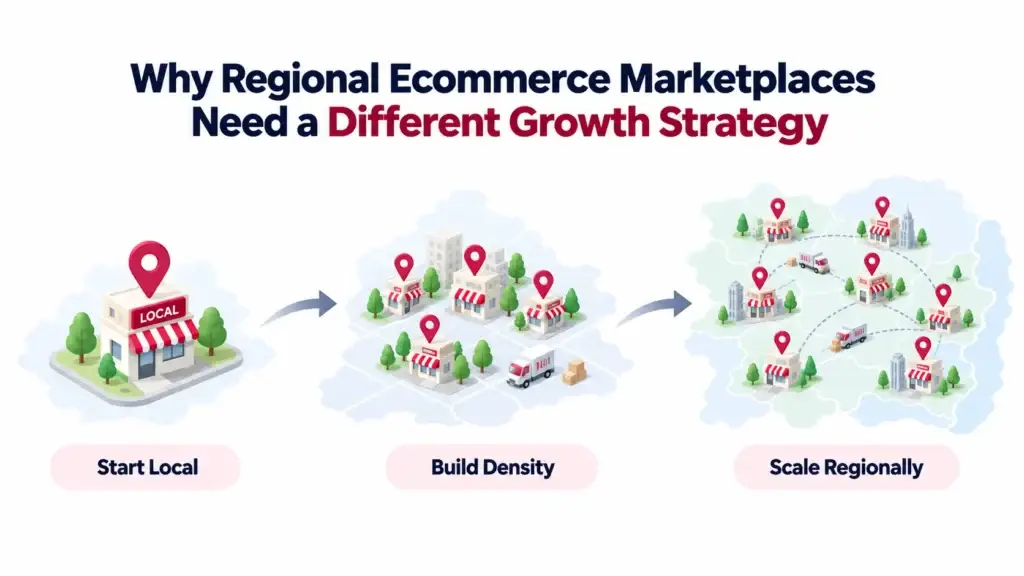
Regional ecommerce is not just a smaller version of national ecommerce. Buyers in different regions may have different price expectations, language preferences, payment habits, product needs, delivery tolerance, and trust signals.
A founder entering a regional market cannot rely only on ads. Paid campaigns may generate traffic, but traffic does not create marketplace trust by itself. Buyers need relevant products. Sellers need order confidence. Delivery partners need predictable routes. Operators need enough control to manage disputes, refunds, commissions, catalog quality, and payouts.
This is why regional marketplaces should grow through controlled density. Instead of launching across too many cities at once, the smarter route is to win a smaller geography deeply, prove repeat demand, then expand with a repeatable operating playbook.
How This Topic Supports the Ecommerce Marketplace Money Page
This article is not designed to replace a commercial solution page. A solution page should focus on platform features, demo access, app modules, pricing discussions, deployment readiness, and direct purchase intent.
This blog supports that page by educating founders on the growth decisions they must make before or during launch:
- Which sellers should be onboarded first?
- Which region should the marketplace enter first?
- How should local demand be validated?
- What operational systems are needed before scaling?
- When does a founder need a ready-made platform instead of building every module from zero?
For founders who already understand the strategy and want a platform foundation, Miracuves’ multi-market ecommerce marketplace solution can be explored as a practical next step without turning this article into a product page.
The Regional Marketplace Growth Flywheel
A marketplace becomes valuable when buyers and sellers both see enough activity to stay. This is the marketplace flywheel:
- Acquire the right sellers in a focused region.
- Build enough product depth in high-demand categories.
- Drive buyer traffic through local search, social, referrals, and promotions.
- Improve trust through reviews, delivery reliability, refunds, and support.
- Use transaction data to improve assortment, pricing, and seller quality.
- Repeat the same playbook in the next region.
The flywheel fails when one side grows faster than the other. Too many sellers without buyers causes seller churn. Too many buyers without enough catalog depth causes poor conversion. Too many orders without fulfillment readiness damages trust.
Sustainable marketplace expansion means scaling supply, demand, and operations together.
Step 1: Choose the First Region Based on Marketplace Density
Many founders choose their first region based on familiarity. That can help, but it should not be the only factor. A better regional ecommerce marketplace launch starts by evaluating density.
Density means the selected area has enough sellers, buyers, delivery routes, payment readiness, and product demand to support repeat transactions.
Signals of a Strong First Region
- Seller concentration: Enough local merchants, wholesalers, distributors, or category specialists are already active.
- Buyer demand: People are already searching for or buying similar products offline or online.
- Fulfillment feasibility: Delivery routes, pickup points, and return workflows can be managed without heavy overhead.
- Category gap: Existing platforms do not fully serve local preferences, regional brands, or last-mile needs.
- Trust advantage: Local sellers can offer familiarity, faster support, or better regional relevance.
A regional marketplace should not start by trying to be everything for everyone. It should start by becoming the strongest digital buying destination for a specific region, category group, or customer behaviour.
Step 2: Build Seller Acquisition Around Category Demand
Seller acquisition is one of the hardest parts of ecommerce marketplace growth. Many founders make the mistake of onboarding any seller willing to join. That creates catalog volume but not necessarily marketplace quality.
The better approach is to acquire sellers based on demand clusters. A demand cluster is a group of products that buyers in a region already want, search for, reorder, gift, compare, or buy seasonally.
Seller Segments Worth Prioritising
| Seller Type | Why They Matter | Best Marketplace Use Case |
|---|---|---|
| Local retailers | They already understand neighbourhood demand and customer preferences. | Daily essentials, fashion, electronics, beauty, home goods |
| Regional brands | They bring differentiated products that larger platforms may not highlight well. | Food products, apparel, wellness, handmade goods |
| Wholesalers and distributors | They can support stronger catalog depth and better supply continuity. | Bulk buying, B2B commerce, grocery, electronics accessories |
| Niche specialists | They improve category authority and help buyers trust the marketplace. | Pharmacy, books, auto parts, professional supplies |
| Franchise or chain operators | They can help expand supply across multiple locations faster. | Multi-city regional commerce and controlled category expansion |
Seller acquisition should feel less like mass recruitment and more like supply design. Every seller added should improve buyer choice, price competitiveness, delivery feasibility, or regional trust.
Step 3: Create a Seller Onboarding Process That Reduces Drop-Off
Sellers do not join a marketplace only because the founder explains the vision. They join when the process feels clear, the commercial terms make sense, and the platform reduces their work instead of adding more complexity.
A strong seller onboarding process should include:
- Simple registration and verification
- Business profile setup
- Product upload or bulk catalog import
- Commission and payout explanation
- Order acceptance and rejection rules
- Inventory update workflows
- Refund and return handling
- Seller support and training
The seller should understand what happens after joining: how products go live, how orders are received, how payouts are calculated, how disputes are handled, and how performance affects visibility.
This is where platform infrastructure matters. A regional marketplace needs a seller panel, product management, order queues, wallet visibility, withdrawal requests, analytics, and admin approval controls. Without these, seller acquisition becomes manual and difficult to scale.
Step 4: Validate Local Demand Before Expanding Categories
Founders often want to launch many categories from day one because it makes the marketplace look larger. But large catalogs can hide weak demand. A leaner category strategy usually creates better early traction.
Start with categories that have clear regional purchase behaviour. These may include essentials, fashion, electronics accessories, home products, wellness items, packaged foods, or locally preferred brands.
The right category depends on the target region, buyer income level, availability gaps, and fulfillment complexity.
Local Demand Mapping Questions
- What products are people already buying frequently in this region?
- Which items are difficult to access locally?
- Which categories have repeat purchase potential?
- Which products are seasonal, festival-driven, or culturally specific?
- Which items can be delivered reliably without high return risk?
- Which categories have enough sellers to support price comparison?
The goal is not to launch the biggest catalog. The goal is to launch the most relevant catalog for the first market.
Step 5: Balance Buyer Acquisition With Seller Readiness
Buyer acquisition should begin only when the marketplace can fulfil demand confidently. Sending paid traffic to an underprepared marketplace wastes budget and can damage trust.
Before scaling buyer campaigns, founders should check whether sellers are active, inventory is updated, delivery coverage is clear, pricing is competitive, and customer support is ready.
Practical Buyer Acquisition Channels for Regional Marketplaces
- Local SEO: Build pages for region-specific categories, buying guides, and product collections.
- Regional social content: Use local language, local use cases, and culturally relevant product messaging.
- Referral campaigns: Encourage buyers and sellers to invite people from the same locality.
- Community partnerships: Work with local business groups, residential communities, creators, and offline networks.
- Seller-led promotion: Let sellers promote their storefronts and product pages to existing customers.
- Seasonal campaigns: Build promotions around festivals, weather, school cycles, local events, and regional shopping moments.
Regional buyer acquisition works best when the platform feels local, not generic. Product discovery, language, delivery promise, payment options, support, and promotions should reflect the region being served.
Step 6: Design Fulfillment Zones Before Scaling Orders
A marketplace can survive slow early growth, but it struggles when orders arrive faster than fulfillment systems can handle. Regional expansion needs clear logistics logic from the beginning.
Founders should define zones for pickup, delivery, returns, cash collection where applicable, and support coverage. Each zone should have realistic delivery promises based on seller location, product type, courier availability, and operational capacity.
Fulfillment Decisions That Affect Marketplace Growth
| Decision Area | Why It Matters | Founder Impact |
|---|---|---|
| Delivery radius | Controls which buyers can place orders from which sellers. | Prevents overpromising in unsupported areas. |
| Seller pickup workflow | Defines how products move from seller to buyer. | Improves order speed and accountability. |
| Return handling | Protects buyer trust and seller fairness. | Reduces disputes and support pressure. |
| Delivery partner visibility | Helps operators track assignments and status updates. | Creates operational control during order spikes. |
| Cash reconciliation | Tracks collected payments against orders and delivery agents. | Protects marketplace finance and payout accuracy. |
Growth should follow fulfillment readiness. Entering a new region before logistics is clear may increase orders for a short period, but it usually hurts repeat purchase behaviour.
Step 7: Build Trust Systems Into the Marketplace
Trust is one of the biggest growth levers in a regional ecommerce marketplace. Buyers may hesitate to purchase from unknown sellers. Sellers may worry about delayed payouts, unfair returns, or low-quality leads. Operators need control over both sides.
Trust cannot depend only on customer support. It should be built into the product workflow.
Trust Features Founders Should Prioritise
- Seller verification and approval workflows
- Product moderation before listings go live
- Ratings and reviews
- Refund and dispute management
- Secure payment gateway integration
- Order history and invoice records
- Role-based admin access
- Activity logs for operational accountability
- Buyer support and seller support workflows
Marketplace trust depends on identity, payment safety, delivery clarity, dispute control, and transparent records. When these workflows are missing, growth becomes fragile because every issue requires manual intervention.
Founder Decision Signals
Speed
If the market opportunity is seasonal or region-specific, a ready-made marketplace foundation can help founders launch faster instead of waiting through a long build cycle.
Cost
Costs should be evaluated against operational readiness, not only design screens. Seller panels, admin controls, logistics workflows, and payout systems directly affect launch quality.
Scalability
A marketplace should support new zones, categories, sellers, delivery partners, and payment options without forcing the operator to rebuild core workflows.
Market Fit
Founders should validate one region deeply before expanding. Repeat orders, active sellers, low cancellation rates, and stable fulfillment are stronger signals than traffic alone.
Step 8: Choose the Right Monetization Model for Regional Growth
Marketplace monetization should not make early seller acquisition harder. If commissions are too high before sellers see order volume, sellers may join but remain inactive. If fees are too low, the marketplace may grow transactions without building a sustainable business.
The right model depends on category margins, seller size, fulfillment cost, payment behaviour, and the platform’s role in demand generation.
Common Revenue Streams for Regional Ecommerce Marketplaces
| Revenue Stream | How It Works | Best Used When |
|---|---|---|
| Commission on orders | The platform earns a percentage or fixed fee per transaction. | There is consistent order volume and seller margins can support it. |
| Seller subscriptions | Sellers pay a recurring fee for access, tools, or premium visibility. | Sellers receive measurable value beyond basic listing access. |
| Featured listings | Sellers pay for better placement in category or search pages. | The marketplace has enough buyer traffic to justify visibility upgrades. |
| Delivery fees | The platform earns from fulfillment or convenience charges. | Delivery is controlled or coordinated by the platform. |
| Advertising placements | Sellers or brands pay for promotional slots. | The marketplace has strong category-level discovery. |
| Value-added services | The platform offers catalog support, photography, packaging, analytics, or seller training. | Sellers need help becoming digitally ready. |
Early monetization should protect marketplace liquidity. In the beginning, founders may use lower friction terms to activate strong sellers, then introduce more structured monetization as order volume and seller value increase.
Step 9: Use Data to Decide When to Expand
Expansion should be triggered by operating signals, not excitement. A marketplace is ready to enter a new region when the first region shows evidence of repeatable demand and operational control.
Expansion Readiness Metrics
- Repeat purchase rate is improving.
- Seller activation rate is stable.
- Catalog availability is consistent.
- Order cancellations are under control.
- Refund and dispute workflows are manageable.
- Delivery success rate is reliable.
- Customer support volume is predictable.
- Unit economics are visible enough to guide the next launch.
New regions should not be treated as copy-paste markets. The playbook can repeat, but seller mix, product demand, pricing, language, payment preferences, and fulfillment zones may need adjustment.
Step 10: Build a Repeatable Regional Expansion Playbook
Once the first region works, the founder’s job is to document the system. A repeatable expansion playbook helps the team avoid starting from zero in every new location.
Your Expansion Playbook Should Include
- Region selection criteria
- Priority category list
- Seller acquisition scripts and onboarding steps
- Seller verification checklist
- Catalog upload process
- Commission and payout rules
- Delivery zone setup
- Buyer launch campaign plan
- Support and dispute workflows
- Expansion readiness dashboard
This is also where a strong admin dashboard becomes critical. Operators should be able to manage sellers, products, categories, delivery areas, payouts, refunds, promotions, notifications, and reports without depending on developers for every small operational change.
Founders planning a regional marketplace can explore Miracuves’ ready-made ecommerce marketplace foundation when they need buyer, seller, delivery, and operator workflows already structured for a faster launch.
Read more: Regional Ecommerce Marketplace vs Global Marketplace: Which Business Model Fits Startups Better?
Ready-Made Platform vs Building From Zero for Regional Ecommerce
Custom development gives flexibility, but it also requires more time, planning, testing, and budget discipline. A ready-made approach gives founders a working foundation that can be branded and customized for the target market.
The better choice depends on the founder’s stage, available capital, launch urgency, feature complexity, and need for source-code ownership.
| Build Option | Best For | Growth Advantage | Founder Risk |
|---|---|---|---|
| Ready-made marketplace foundation | Founders who want to launch quickly and validate regional demand. | Faster deployment, existing workflows, admin control, branded launch. | Customization scope must be clearly defined before launch. |
| Fully custom marketplace build | Businesses with unique workflows, large budgets, and longer planning cycles. | Deep flexibility and custom architecture decisions. | Longer timeline, higher discovery effort, more testing risk. |
| Basic ecommerce storefront | Single-brand sellers that do not need multi-vendor workflows. | Simpler setup and lower operational complexity. | Not suitable for seller onboarding, commissions, payouts, or multi-vendor growth. |
For many regional marketplace founders, the opportunity cost of waiting is real. If the main goal is to test seller acquisition, buyer demand, and regional fulfillment quickly, a launch-ready foundation can reduce the time spent rebuilding standard marketplace modules.
How Miracuves Helps Founders Launch Regional Ecommerce Marketplaces Faster
Miracuves helps founders build ready-made and white-label marketplace platforms with source-code ownership, branded design, seller workflows, admin control, and monetization-ready modules.
For regional ecommerce operators, the benefit is not simply speed. The bigger value is starting with a structured product foundation that supports customer browsing, seller product management, order handling, delivery coordination, commissions, payouts, and operator-level control.
Where relevant, Miracuves’ ready-made solution approach can support a 6-day launch, depending on selected modules, branding needs, integrations, and final customization scope. That gives founders a faster route to test regional demand without building every marketplace workflow from zero.
You can also browse Miracuves’ wider ecommerce app solutions if your model is closer to a general multi-vendor platform, wholesale marketplace, category marketplace, or regional retail ecosystem.
Mistakes Founders Should Avoid When Growing a Regional Marketplace
Expanding Before the First Region Is Stable
Expansion looks attractive, but weak repeat purchases, poor seller activation, delayed deliveries, and unresolved disputes become more expensive in every new region.
Onboarding Sellers Without Category Logic
More sellers do not automatically mean stronger supply. The marketplace needs sellers who improve selection, price, availability, and local relevance.
Ignoring Seller Experience
If sellers cannot manage products, orders, stock, payouts, and refunds easily, they may join the platform but stop using it actively.
Using Ads Before Operations Are Ready
Paid campaigns can create traffic, but if inventory, delivery, payment, and support workflows are weak, the marketplace may lose trust quickly.
Treating Every Region the Same
Regional markets differ by language, pricing, products, trust signals, payment habits, and delivery expectations. A scalable playbook still needs local adaptation.
Final Thoughts: Regional Marketplace Growth Is Built on Density, Trust, and Control
A regional ecommerce marketplace does not win by copying a large platform’s surface-level marketing. It wins by understanding a specific region better, onboarding the right sellers, solving local demand, building reliable fulfillment, and creating trust through strong operational workflows.
For founders, the smartest growth path is not always the broadest launch. It is the launch that proves one market, documents the playbook, and expands only when the platform can support more sellers, buyers, orders, and regions without losing control.
Miracuves helps founders move from idea to launch faster with ready-made, white-label marketplace solutions built for branding, admin control, monetization, and source-code ownership. If your goal is to test regional ecommerce demand quickly, a multi-market commerce platform foundation can help you start with the core workflows already in place.
FAQs
What is a regional ecommerce marketplace growth strategy?
A regional ecommerce marketplace growth strategy is a plan for building supply, demand, logistics, trust, and monetization within a specific geography before expanding into other markets. It focuses on seller acquisition, local buyer needs, delivery coverage, payment preferences, and repeatable expansion systems.
How do you acquire sellers for a regional ecommerce marketplace?
Start by identifying high-demand local categories, then onboard sellers who improve product depth, pricing, availability, and trust. The onboarding process should include verification, product upload support, commission clarity, payout workflows, order management, and seller training.
Why is local demand mapping important for marketplace expansion?
Local demand mapping helps founders understand what buyers actually want in a specific region. It prevents the marketplace from launching irrelevant categories, overstocking weak products, or spending on campaigns before there is enough product-market fit.
Should a regional marketplace launch in one city first or multiple cities?
Most founders should start with one focused region or a small group of connected zones. This makes it easier to manage seller quality, delivery operations, buyer feedback, and repeat transactions before expanding into new locations.
What features does a regional ecommerce marketplace need?
A regional marketplace typically needs customer browsing, seller onboarding, product management, cart and checkout, payment integration, delivery workflows, ratings and reviews, refunds, seller payouts, admin dashboards, promotions, notifications, and analytics.
How does a regional marketplace make money?
Common revenue streams include order commissions, seller subscriptions, featured listings, advertising placements, delivery fees, and value-added seller services such as catalog support, packaging support, or analytics access.
When is a marketplace ready to expand into a new region?
A marketplace is usually ready to expand when repeat purchases are improving, sellers are active, order cancellations are manageable, delivery success is stable, support issues are controlled, and the first region’s operating playbook can be repeated.
Can Miracuves help launch a regional ecommerce marketplace faster?
Yes. Miracuves helps founders build ready-made and white-label marketplace platforms with source code, admin control, seller workflows, delivery coordination, and branded deployment. For ready-made solutions, a 6-day launch may be available depending on final scope and customization needs.
Miracuves is an independent software development company. We are not affiliated with, connected to, sponsored by, or endorsed by any company or product named in this article.
Terms such as “X Clone” are used descriptively. It is how the software industry refers to building a platform with functionality comparable to a known service, and how clients search for it.
The entire design and codebase of our products is built by our own team. Our products contain no code, design, graphics, or content originating from any third-party website or applications.
All third-party names and marks referenced in this article are the property of their respective owners, referenced solely to identify the services discussed.



