A fashion ecommerce marketplace looks simple from the customer side: open the app, search for a style, choose a size, add to cart, pay, receive the order, and return it if the fit does not work. But behind that smooth shopping journey is a business model that connects shoppers, brands, inventory, logistics, payments, returns, content, promotions, and platform governance.
That is why the business model of Myntra remains useful for founders to study. The real lesson is not only that a fashion platform sells clothes online. The deeper lesson is how a marketplace can coordinate demand, supply, merchandising, fulfilment, and customer trust at scale.
For startups planning to build a fashion ecommerce marketplace, the question is not simply “How do we create an app?” The better question is: how will brands list products, how will shoppers discover them, how will inventory stay accurate, how will returns be handled, how will the platform earn revenue, and how will operations remain controlled as order volume grows?
This guide breaks down the fashion ecommerce marketplace business model from a founder’s point of view. It explains how the major moving parts connect and what startups can learn before building, buying, or launching a fashion marketplace platform.
Key Takeaways
- A fashion ecommerce marketplace business model connects shoppers, brands, inventory, fulfilment, payments, returns, and platform operations into one controlled ecosystem.
- The strongest fashion marketplaces do not only list products. They manage discovery, trust, pricing, seasonal demand, seller performance, and post-purchase experience.
- Inventory is more complex in fashion because every colour, size, fit, and variant must be tracked accurately.
- Returns and exchanges are not side issues in fashion ecommerce. They directly affect customer trust, margins, operations, and seller relationships.
- Startups should design the business model before designing the interface because revenue, fulfilment, and admin control decide long-term scalability.
- Miracuves helps founders move from idea to launch faster with ready-made and white-label app solutions built for marketplace operations.
What Is a Fashion Ecommerce Marketplace Business Model?
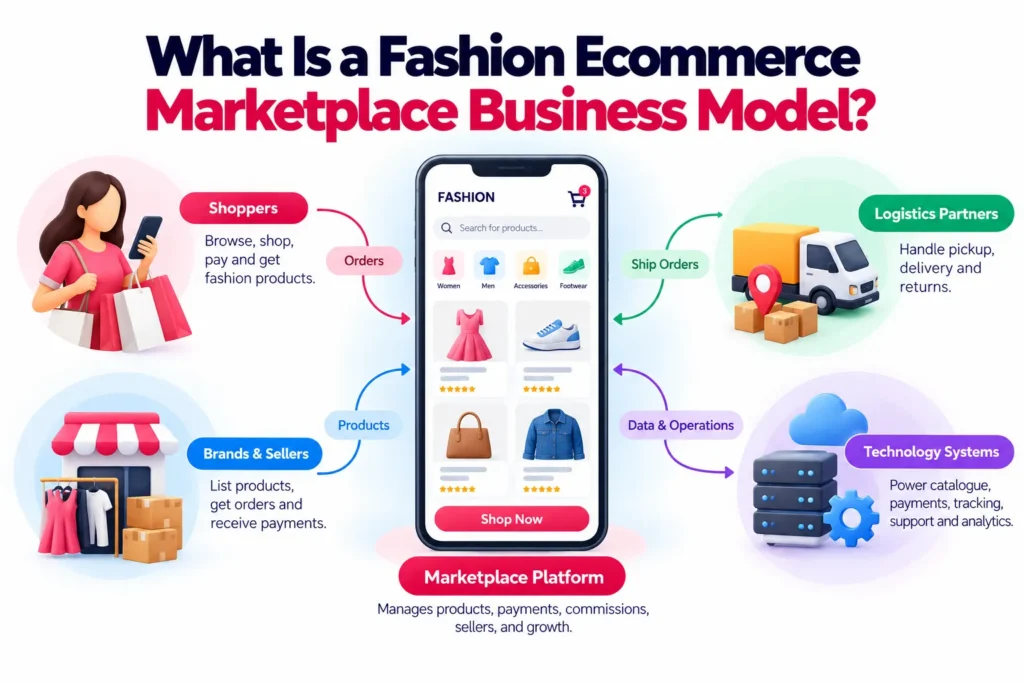
A fashion ecommerce marketplace business model is the operating structure that allows multiple brands, sellers, or labels to sell fashion and lifestyle products through one digital platform. The marketplace does not only act as a storefront. It becomes the control layer between product supply, shopper demand, payments, promotions, logistics, returns, and data.
In a single-brand ecommerce store, one business controls the catalogue, stock, pricing, delivery promise, and customer relationship. In a marketplace, the platform operator must coordinate many independent sellers while keeping the shopper experience consistent. That makes marketplace operations more powerful, but also more complex.
A fashion marketplace typically connects five major groups:
- Shoppers who want variety, trust, convenience, price discovery, easy returns, and style inspiration.
- Brands and sellers who want visibility, orders, payments, customer access, and marketplace credibility.
- Platform operators who manage categories, commissions, campaigns, seller quality, payments, disputes, and growth.
- Logistics partners or internal fulfilment teams who handle pickup, delivery, exchange, and reverse logistics.
- Technology systems that connect catalogue, inventory, checkout, payment, order tracking, customer support, analytics, and admin control.
The business model succeeds when these groups work together without creating friction. A shopper should not feel the complexity behind the marketplace. They should only experience relevant products, clear prices, trustworthy sellers, smooth checkout, fast updates, and easy resolution if something goes wrong.
Why Myntra’s Business Model Matters for Fashion Marketplace Startups
Myntra became a strong reference point for fashion ecommerce because it showed how online fashion shopping can be built around selection, brand depth, mobile-first discovery, personalization, discounts, content, and post-purchase convenience. For founders, the important lesson is not to copy every visible feature. The real lesson is to understand the operating system behind a fashion marketplace.
Fashion ecommerce is not the same as selling electronics, groceries, or standard packaged goods. Fashion has style preferences, seasonal drops, size uncertainty, high browsing behavior, trend cycles, influencer impact, return sensitivity, and complex inventory variants. A marketplace business model must reflect these realities from the beginning.
For example, a dress listed in five sizes and four colours is not one inventory item. It is twenty sellable combinations. If the marketplace does not track each variant correctly, the customer may order a size that is unavailable, the seller may oversell inventory, and the platform may face refund pressure. This is why fashion marketplace design must connect business strategy with operational accuracy.
Startups studying the business model of Myntra should focus on the principles behind the model: curated supply, mobile-first shopping, multi-brand positioning, reliable fulfilment, returns management, promotional events, personalization, and recurring shopper engagement.
The Four Core Layers of a Fashion Ecommerce Marketplace
A fashion ecommerce marketplace works through four connected layers: demand, supply, inventory, and operations. If one layer is weak, the whole business model becomes unstable.
Fashion Marketplace Business Model Layers
| Layer | What It Controls | Why It Matters for Founders |
|---|---|---|
| Demand Layer | Shopper acquisition, search, personalization, campaigns, content, offers, and loyalty | Without demand, sellers do not get orders and the marketplace cannot prove value. |
| Supply Layer | Brand onboarding, seller approval, catalogue quality, pricing, assortment, and seller performance | Without strong supply, the platform cannot offer enough variety or quality to retain shoppers. |
| Inventory Layer | SKU variants, colour-size combinations, stock updates, product availability, returns, and replenishment | Without accurate inventory, the platform faces cancellations, refunds, customer complaints, and seller disputes. |
| Operations Layer | Orders, payments, delivery, returns, refunds, disputes, settlement, analytics, and admin control | Without operational control, growth creates chaos instead of scale. |
Many early-stage founders overfocus on the demand layer because it is the most visible part of the product. They think about homepages, banners, search bars, wishlists, and checkout screens. These are important, but a marketplace cannot survive on interface design alone. The backend logic must know which seller owns which product, which size is available, which order line belongs to which brand, when the seller should be paid, and what happens when a return is approved.
That is where fashion marketplace business-model clarity becomes important. The founder needs to understand how the commercial model and operational model connect before investing heavily in marketing or development.
How Shoppers Fit Into the Fashion Marketplace Model
Shoppers are the demand engine of a fashion marketplace. But fashion shoppers behave differently from many other ecommerce customers. They browse often, compare heavily, save items for later, look for visual proof, wait for offers, check reviews, and worry about fit. A marketplace that understands these behaviours can design better discovery and retention loops.
The shopper side of the model usually depends on six expectations:
- Variety: shoppers want access to multiple brands, styles, prices, categories, and seasonal collections in one place.
- Trust: they need confidence in product quality, seller reliability, payment safety, and return policies.
- Discovery: they expect filters, recommendations, style edits, trending collections, and search results that reduce decision fatigue.
- Convenience: they want easy checkout, multiple payment methods, delivery updates, and simple support.
- Value: fashion shoppers often compare discounts, coupons, sale events, and loyalty benefits before buying.
- Post-purchase comfort: clear exchange, refund, and return workflows reduce purchase hesitation.
For startups, this means shopper experience is not just a design problem. It is a business model problem. If return policies are unclear, conversion drops. If product pages lack size clarity, refunds increase. If inventory is inaccurate, trust breaks. If brand pages are weak, sellers do not get enough value from the platform.
A fashion marketplace must therefore treat shopper journeys as business assets. Search, filters, wishlists, image galleries, product reviews, size guides, payment options, and order tracking all influence revenue quality, not just user experience.
How Brands and Sellers Create the Supply Side of the Marketplace
Brands and sellers are the supply engine of a fashion ecommerce marketplace. They bring the products that attract shoppers. But they will only stay active if the marketplace gives them visibility, operational control, fair payouts, and a reliable way to grow online sales.
For the platform operator, seller onboarding is one of the first business-model decisions. The marketplace must decide whether it will allow open seller registration, approve sellers manually, work only with curated brands, invite local boutiques, onboard private labels, or support a hybrid model.
Each model changes the platform’s quality control responsibility. A fully open marketplace may grow supply faster, but it also needs stronger moderation, product approval, seller ratings, dispute handling, and policy enforcement. A curated marketplace may grow slower, but it can create stronger brand positioning and customer trust.
Seller-side success usually depends on:
- Simple product listing and catalogue upload workflows
- Clear category, attribute, colour, size, and pricing controls
- Order management and fulfilment visibility
- Return and exchange status tracking
- Commission transparency and payout reporting
- Brand pages or seller storefronts
- Performance insights such as sales, cancellations, refunds, and customer feedback
When sellers feel that the platform gives them demand, trust, and control, they have a reason to list more products. When sellers feel that orders, returns, commissions, or payouts are unclear, they reduce participation. That is why seller experience is part of the marketplace business model, not only an admin feature.
Why Inventory Is the Hardest Part of Fashion Ecommerce
Inventory is where fashion marketplaces become more complex than standard ecommerce stores. A shirt is not just a shirt. It may have five sizes, six colours, separate SKU codes, different stock levels, discounted prices, seller-specific availability, and return eligibility rules. If the platform does not model this correctly, the business will struggle once real orders begin.
Fashion inventory must usually support:
- Colour and size variants
- SKU-level stock control
- Low-stock alerts
- Separate pricing per variant when needed
- Seasonal collections
- Discounted and clearance inventory
- Returnable and non-returnable product rules
- Inventory updates after cancellation, return, exchange, or failed delivery
For shoppers, inventory accuracy means they can trust what they see. For brands, inventory accuracy means fewer disputes and fewer overselling problems. For the platform operator, inventory accuracy means fewer refunds, fewer support tickets, and better operational forecasting.
This is one reason a fashion marketplace founder should not treat inventory as a later improvement. The inventory model should be designed early because it affects catalogue structure, checkout logic, seller dashboards, warehouse workflows, returns, refunds, and analytics.
How Platform Operations Connect Orders, Payments, Delivery, and Returns
The operations layer is the part of the marketplace that customers rarely see but always feel. If orders are delayed, returns are confusing, payments fail, sellers miss updates, or support cannot resolve disputes, the shopper experience weakens even if the app looks polished.
A fashion ecommerce marketplace typically needs operational workflows for:
- Order placement and confirmation
- Seller acceptance or rejection
- Packaging and pickup
- Delivery partner assignment
- Shipment tracking
- Cash-on-delivery handling where relevant
- Payment gateway reconciliation
- Seller commission calculation
- Refund approval and settlement
- Return pickup and restocking
- Customer support and dispute management
In fashion, the order lifecycle does not end at delivery. The platform must be ready for returns, exchanges, size issues, refund requests, damaged item claims, and restocking decisions. This makes reverse logistics a central part of the business model.
Founders should think of operations as a profit-protection layer. A marketplace may generate strong sales during a campaign, but if returns, cancellations, payment reconciliation, and seller settlement are poorly managed, revenue quality declines. Growth without operational control can create more loss than value.
Fashion Marketplace Revenue Streams: How the Platform Makes Money
A fashion ecommerce marketplace can monetize in several ways. The right revenue mix depends on the platform’s positioning, seller relationships, fulfilment model, customer base, and category strategy. A startup does not need to launch with every revenue stream on day one, but it should understand which monetization layers may become important over time.
Common Revenue Streams in a Fashion Ecommerce Marketplace
| Revenue Stream | How It Works | Founder Consideration |
|---|---|---|
| Commission on Sales | The platform earns a percentage or fee from each completed order. | This is usually the core marketplace revenue stream, but commission rules must be transparent for sellers. |
| Seller Subscription Plans | Brands pay a recurring fee for access to the platform, advanced tools, or higher listing capacity. | This works better when the platform already delivers consistent value to sellers. |
| Sponsored Listings | Sellers pay for higher visibility in search, category pages, banners, or campaign sections. | This can add strong revenue, but it must not damage shopper trust or discovery quality. |
| Fulfilment and Logistics Fees | The platform charges sellers for warehousing, packing, delivery, or return handling. | This requires operational maturity and clear service-level expectations. |
| Private Labels | The platform sells its own branded products alongside marketplace sellers. | This can improve margin control, but it must be managed carefully to avoid seller conflict. |
| Loyalty or Membership Programs | Customers pay or engage for benefits such as early access, exclusive offers, or priority experiences. | This is strongest when repeat purchase behavior is already visible. |
| Campaign and Event Participation Fees | Sellers contribute to major promotional events, seasonal sales, or featured collections. | This can drive volume, but discounting must be balanced against seller margins. |
The strongest fashion marketplaces usually do not depend on one monetization source forever. They begin with transaction revenue and gradually add advertising, seller tools, logistics services, loyalty programs, and brand partnerships. The founder’s responsibility is to introduce revenue layers without making the platform feel unfair to sellers or confusing to shoppers.
For a deeper breakdown of monetization specifically around Myntra’s revenue logic, you can also read Miracuves’ guide on the revenue model of Myntra.
Cost Structure: What It Takes to Operate a Fashion Marketplace
Revenue is only one side of the fashion ecommerce marketplace business model. The other side is cost. A marketplace can show strong order volume but still struggle if logistics, discounts, returns, support, and technology costs are not controlled.
Common cost areas include:
- Technology costs: app development, web platform, hosting, cloud infrastructure, payment gateway integration, security, maintenance, and upgrades.
- Operations costs: seller onboarding, catalogue review, order monitoring, support teams, dispute management, and admin operations.
- Marketing costs: performance ads, influencer campaigns, content production, referral programs, seasonal campaigns, and discount funding.
- Logistics costs: pickup, packing, delivery, failed delivery, return pickup, warehouse handling, and customer communication.
- Payment costs: payment gateway fees, refund processing, wallet handling, and reconciliation effort.
- Return-related costs: inspection, restocking, damaged goods, reverse logistics, refund delays, and support time.
Founders should not look at marketplace profitability only through gross sales. A better view is contribution after discounts, returns, fulfilment, payment fees, seller commissions, and support costs. Fashion ecommerce often looks attractive at the top line, but the operational details decide whether growth is healthy.
How Discovery and Personalization Drive Fashion Marketplace Growth
In fashion ecommerce, shoppers rarely know the exact product name they want. They may search by occasion, colour, brand, price range, size, style, fabric, trend, or inspiration. This makes discovery one of the strongest growth levers in a fashion marketplace.
A good discovery layer helps shoppers move from browsing to buying. It includes search, filters, recommendation sections, trending products, curated collections, brand pages, category pages, personalized feeds, wishlists, and abandoned-cart reminders.
For startups, personalization should not be treated only as an advanced AI feature. Even simple personalization can improve the shopping journey if the platform understands category preferences, size history, viewed products, saved items, previous purchases, and price sensitivity.
Content also plays a major role. Style guides, lookbooks, influencer-led collections, festival edits, seasonal campaigns, and editorial product storytelling can help a marketplace shift from transactional shopping to inspired shopping. This matters because fashion is emotional. People do not only buy products; they buy identity, occasion, confidence, and expression.
Returns and Exchanges: The Trust Layer of Fashion Ecommerce
Returns are one of the most important parts of the fashion ecommerce business model. In many categories, returns are exceptions. In fashion, they are expected. Size mismatch, fit issues, colour differences, damaged items, changed preferences, and delayed delivery can all trigger returns or exchanges.
A founder who ignores returns will eventually face unhappy customers, confused sellers, delayed refunds, inventory mismatches, and support overload. A founder who designs returns properly can turn uncertainty into trust.
A strong return workflow should clarify:
- Which products are returnable or exchangeable
- How many days the customer has to request a return
- What reasons are allowed
- Whether images or evidence are required
- Who approves the return
- How pickup is scheduled
- When inventory is updated
- How refunds are processed
- How seller commission is reversed or adjusted
When return logic is connected to inventory, payments, seller settlement, and customer communication, the marketplace becomes easier to operate. When return logic is manual, every refund creates avoidable friction.
Admin Control: The Hidden Backbone of the Marketplace
Customers experience the storefront, but founders run the business through the admin layer. The admin dashboard is where the platform operator manages sellers, users, products, categories, orders, payments, commissions, offers, returns, disputes, reports, and permissions.
For a fashion marketplace, admin control is not a back-office convenience. It is the governance system of the business. Without it, founders depend on developers or manual spreadsheets for every operational change.
A practical admin system should help the operator:
- Approve or reject brands and sellers
- Review product listings before publishing
- Manage categories, attributes, colours, and sizes
- Set commission rules and campaign rules
- Track orders, cancellations, returns, and refunds
- Monitor seller performance
- Handle disputes and customer complaints
- Review payment and payout records
- Control banners, promotions, and featured collections
- Access reports for sales, inventory, returns, and revenue
For founders evaluating platform options, admin depth should be treated as a decision signal. A visually attractive marketplace with weak admin control may look ready, but it can become hard to manage once sellers, orders, and support issues increase.
Security and Trust Workflows in a Fashion Ecommerce Marketplace
Marketplace trust depends on more than product quality. Shoppers and sellers both need confidence that payments, data, accounts, refunds, and platform actions are handled safely. This makes security and trust workflows part of the business model.
Important trust layers include secure payment gateway integration, encrypted data transfer, role-based access control, admin access controls, audit logs, seller verification, customer account protection, fraud monitoring signals, review moderation, refund tracking, and dispute management.
For fashion marketplaces, fraud and abuse can appear in different forms: fake listings, misleading product images, refund abuse, duplicate accounts, payment disputes, fake reviews, and seller-side fulfilment issues. The platform should therefore include operational controls that help the admin team review, moderate, and respond quickly.
Security should not be used as a vague marketing claim. It should be designed into payment workflows, user permissions, seller controls, support records, and admin activity logs. This helps founders build a marketplace that is easier to govern as it grows.
Founder Decision Signals Before Building a Fashion Marketplace
Speed
If your goal is to validate demand quickly, starting with a ready-made fashion marketplace foundation can reduce avoidable build time compared with creating every module from zero.
Cost
The real cost is not only development. It includes integrations, maintenance, seller operations, support, returns, marketing, fulfilment, and future customization.
Scalability
A marketplace must scale across sellers, products, variants, campaigns, payments, delivery workflows, and returns. Weak backend logic becomes expensive later.
Market Fit
Founders should validate category focus, seller willingness, shopper demand, pricing strategy, and return expectations before expanding too many product lines.
Before building a fashion marketplace, founders should define the operating model clearly. Will the platform manage delivery or let sellers handle fulfilment? Will the marketplace accept all sellers or curate selected brands? Will returns be approved automatically or manually? Will the platform earn through commissions only or add sponsored visibility and seller plans later?
These choices should come before feature planning. When the business model is clear, the product roadmap becomes more focused. When the business model is unclear, the platform may include many features but still fail to operate profitably.
Ready-Made vs Custom Fashion Marketplace Development
Founders usually face two development paths: build a custom marketplace from scratch or start with a ready-made foundation and customize it for the market. Both options can work, but they serve different business situations.
Ready-Made vs Custom Fashion Marketplace Build
| Build Option | Best For | Business Tradeoff |
|---|---|---|
| Ready-Made Marketplace Foundation | Founders who want faster launch, tested core flows, admin control, and market validation without starting from zero. | Faster execution, but customization should be planned around the selected platform foundation. |
| Fully Custom Development | Businesses with highly unique workflows, complex enterprise integrations, or a long product discovery cycle. | Greater flexibility, but usually higher time, cost, and execution risk. |
| Hybrid Approach | Founders who want a launch-ready core with selected custom modules for differentiation. | Balanced path when the core marketplace model is standard but the brand strategy needs customization. |
A ready-made approach can be practical when the core marketplace flows are already known: shoppers browse, brands list products, orders are placed, sellers fulfil, payments are processed, returns are handled, and the admin manages the system. The founder can then focus more energy on category strategy, seller acquisition, branding, marketing, and operational execution.
For founders who want to move faster, Miracuves offers a launch-ready fashion marketplace solution that can be customized around branding, marketplace workflows, admin control, and business model needs. This link is included as the next step for readers who move from learning the model to evaluating a build path.
What Startups Can Learn from the Business Model of Myntra
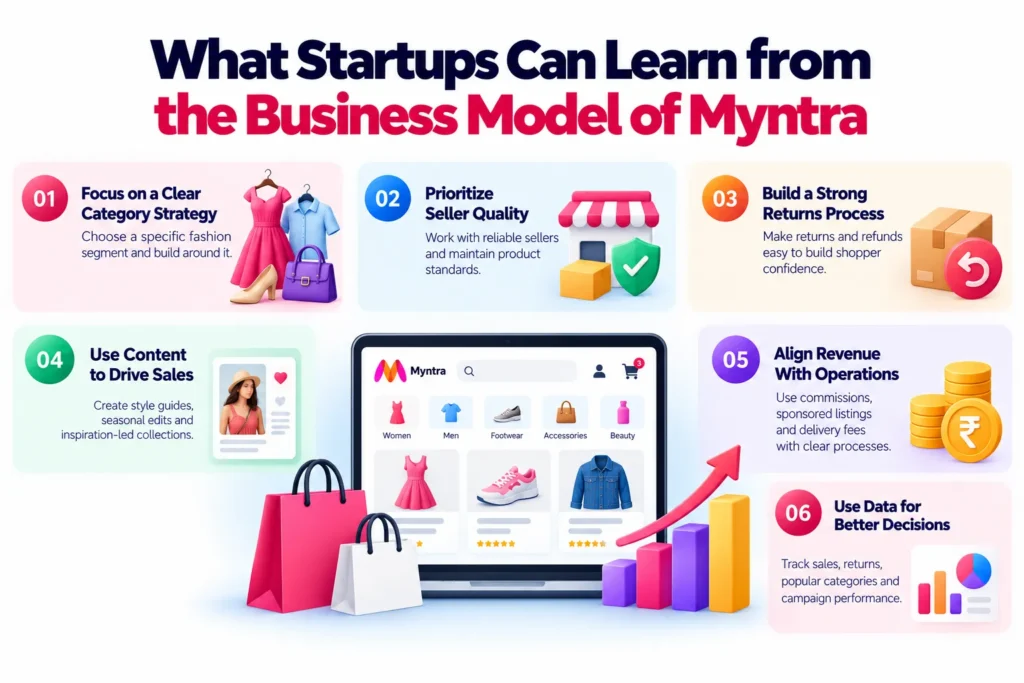
The most useful startup lesson from Myntra’s business model is that fashion ecommerce is not only about selling apparel online. It is about creating a managed marketplace where shoppers trust the experience, brands trust the sales channel, and the operator controls the system behind both sides.
Here are the biggest lessons founders should take away:
1. Build Around a Clear Category Strategy
A fashion marketplace should not try to sell everything from day one. Founders should decide whether they want to focus on premium fashion, affordable fashion, regional brands, streetwear, ethnic wear, kidswear, footwear, accessories, sustainable fashion, or multi-category lifestyle retail. A focused category strategy makes seller acquisition, branding, merchandising, and marketing easier.
2. Treat Seller Quality as a Growth Lever
Marketplace supply is not only about the number of sellers. It is about the quality of sellers. Poor product images, delayed fulfilment, inaccurate stock, unclear size charts, and weak packaging can damage the entire platform’s reputation. Strong seller rules protect the shopper experience.
3. Design Returns Before Scaling Marketing
Marketing can bring shoppers in, but returns management determines whether they come back. A clear return workflow reduces hesitation before purchase and reduces support load after purchase. Fashion founders should design returns, refunds, and exchanges before running large campaigns.
4. Use Content to Convert Browsers Into Buyers
Fashion shoppers often need inspiration. Editorial collections, style guides, influencer picks, seasonal edits, and occasion-based product groupings can help shoppers discover products they did not directly search for. This turns the marketplace into a shopping destination rather than only a catalogue.
5. Connect Revenue Strategy With Operations
Commissions, sponsored listings, seller plans, delivery fees, and campaign participation can all generate revenue. But each revenue stream requires operational clarity. If sponsored products reduce relevance, shoppers may lose trust. If commissions are unclear, sellers may churn. If delivery fees are poorly structured, cart abandonment may rise.
6. Use Data for Better Marketplace Decisions
Fashion marketplace data can reveal which sizes sell fastest, which categories return most often, which sellers fulfil reliably, which campaigns convert, and which products attract views but not purchases. Founders should use this data to improve merchandising, pricing, inventory planning, and seller management.
To understand the shopper-side workflow in more detail, read Miracuves’ guide on what the Myntra app is and how it works.
Mistakes Founders Should Avoid in Fashion Marketplace Planning
Mistakes Founders Should Avoid
Building Only the Storefront and Ignoring Operations
A beautiful storefront cannot compensate for weak seller management, inventory errors, poor return workflows, or unclear payout logic. Operations must be part of the product plan from day one.
Using a Simple Product Model for Complex Fashion Inventory
Fashion products need variant-level thinking. Size, colour, stock, price, return status, and availability must be handled accurately or the platform will face cancellations and customer complaints.
Launching Too Many Categories Too Early
Expanding categories before proving demand can create catalogue clutter, seller inconsistency, and marketing confusion. Focused category growth is usually easier to manage.
Treating Returns as a Manual Support Problem
Returns affect inventory, payments, seller settlement, customer trust, and support cost. They should be designed as a controlled workflow, not handled case by case.
How Miracuves Helps Founders Launch Fashion Marketplace Platforms Faster
Once the business model is clear, the next question is execution. Founders need a platform foundation that can support shoppers, brands, inventory, orders, payments, returns, admin control, and future customization. Building every module from zero can be useful for highly custom cases, but it can also delay market validation.
Miracuves helps founders launch faster with ready-made and white-label marketplace solutions that can be aligned with the chosen business model. For fashion ecommerce, this means founders can start with a marketplace-ready foundation and customize the experience around category focus, branding, seller workflows, payment flows, delivery operations, and growth strategy.
For businesses that want a broader ecommerce build beyond the fashion marketplace model, explore Miracuves’ ecommerce app development services. If your planning is industry-specific, you can also review Miracuves’ retail and ecommerce industry solutions.
Final Thoughts: The Real Business Model Is the Connection Between Every Layer
The business model of a fashion ecommerce marketplace is not only about commission revenue or online product listings. It is about how every layer connects: shoppers discover products, brands supply inventory, the platform governs quality, orders move through fulfilment, payments settle correctly, returns are handled fairly, and data helps the operator improve decisions.
Myntra’s success offers useful lessons because it shows how fashion ecommerce depends on more than product variety. It depends on trust, merchandising, technology, logistics, personalization, seller relationships, and operational control.
For founders, the smartest path is to define the business model before choosing the build path. Decide who you will serve, which brands you will onboard, how inventory will work, how returns will be handled, how revenue will be earned, and what operational controls are needed. Once that clarity exists, the platform becomes easier to build, launch, and scale.
If you are planning a fashion marketplace and want to understand the feature layer before execution, you can also read Miracuves’ guide on Myntra app features explained and the fashion app security guide.
FAQs
What is a fashion ecommerce marketplace business model?
A fashion ecommerce marketplace business model is the structure that connects shoppers, brands, product listings, inventory, payments, fulfilment, returns, and platform operations. The platform earns revenue through commissions, seller services, sponsored placements, fulfilment fees, memberships, or other monetization layers while managing trust between buyers and sellers.
How does a fashion marketplace make money?
A fashion marketplace can make money through sales commissions, seller subscriptions, sponsored listings, fulfilment fees, logistics support, private labels, loyalty programs, and campaign participation fees. The right mix depends on the platform’s category focus, seller relationships, order volume, and operational maturity.
Why is inventory management important in fashion ecommerce?
Inventory management is critical because fashion products have size, colour, fit, style, and seasonal variations. Each variant may need its own stock count, price, availability, and return status. Poor inventory control can lead to overselling, cancellations, refunds, and customer dissatisfaction.
What can startups learn from the business model of Myntra?
Startups can learn that fashion ecommerce success depends on more than listing products online. A strong model connects curated supply, shopper discovery, personalization, brand partnerships, logistics, returns, payments, promotions, and admin control into one marketplace ecosystem.
Should a fashion marketplace startup build from scratch or use a ready-made solution?
The right choice depends on the founder’s timeline, budget, customization needs, and validation goals. A ready-made solution can help founders launch faster with core marketplace flows already in place, while custom development may suit businesses with highly unique workflows or enterprise-specific requirements.
What are the biggest challenges in running a fashion ecommerce marketplace?
The biggest challenges include seller quality control, SKU-level inventory accuracy, product discovery, return management, payment settlement, logistics coordination, customer support, campaign planning, and maintaining trust between shoppers and sellers.
How do returns affect a fashion marketplace business model?
Returns affect revenue, inventory, logistics, seller payouts, customer support, and shopper trust. A strong return workflow helps reduce friction, while poor return handling can increase costs and damage repeat purchase behavior.
What features should a fashion marketplace platform include?
A fashion marketplace platform should include product catalogue management, brand or seller dashboards, variant-level inventory, search and filters, wishlist, cart and checkout, payment integration, order tracking, return management, reviews, promotions, analytics, and admin controls.
Miracuves is an independent software development company. We are not affiliated with, connected to, sponsored by, or endorsed by any company or product named in this article.
Terms such as “X Clone” are used descriptively. It is how the software industry refers to building a platform with functionality comparable to a known service, and how clients search for it.
The entire design and codebase of our products is built by our own team. Our products contain no code, design, graphics, or content originating from any third-party website or applications.
All third-party names and marks referenced in this article are the property of their respective owners, referenced solely to identify the services discussed.