
Key Takeaways
- A direct restaurant ordering platform revenue model can combine recurring subscriptions, setup fees, branded apps, premium integrations, marketing tools, and other add-on services.
- Subscriptions create recurring platform revenue, while setup and customization fees can cover onboarding, configuration, menu migration, branding, integrations, and initial implementation.
- Additional services can expand revenue without depending heavily on per-order commissions, giving restaurants clearer ownership of their direct ordering relationship.
Revenue Model Signals
- Subscription plans can be structured around restaurant locations, order volume, feature access, POS integrations, analytics, loyalty tools, support levels, or advanced operational capabilities.
- Setup fees may include account configuration, menu imports, payment gateway setup, POS connectivity, branded ordering pages, staff training, and multi-location deployment.
- Branded mobile apps can generate separate revenue through app design, custom branding, push notifications, loyalty features, maintenance, app-store support, and ongoing feature upgrades.
Restaurant Monetization Insights
- Add-on services can include loyalty programs, email or SMS marketing, advanced analytics, delivery integrations, online reputation tools, custom reports, gift cards, and premium support.
- Operators should track subscription revenue, setup revenue, add-on adoption, branded app uptake, revenue per restaurant, churn, upgrade rates, support costs, and customer lifetime value.
- Miracuves develops customizable direct restaurant ordering platforms with subscriptions, branded apps, POS integrations, payments, loyalty tools, marketing features, analytics, and restaurant admin controls.
Direct restaurant ordering has changed the economics of restaurant technology. Instead of relying entirely on a percentage of every food order, a platform operator can build recurring revenue around the software and services restaurants use to manage their own digital ordering channels.
That creates a fundamentally different business model. Revenue can come from monthly or annual subscriptions, onboarding and setup charges, branded mobile applications, premium integrations, marketing tools, loyalty capabilities, support packages, and other operational services. The platform becomes more than an ordering interface; it becomes a software ecosystem that restaurants pay to use and expand.
For founders exploring this market, understanding these revenue streams is important before deciding what to build. A platform with several complementary income sources can potentially create more predictable revenue than a model dependent on a single transaction fee, but only when the pricing structure matches the value restaurants actually receive.
This guide breaks down how the direct restaurant ordering revenue model works, where recurring and one-time income can come from, and what founders should consider when designing a monetization-ready restaurant technology business.
Why Direct Restaurant Ordering Creates a Different Revenue Opportunity
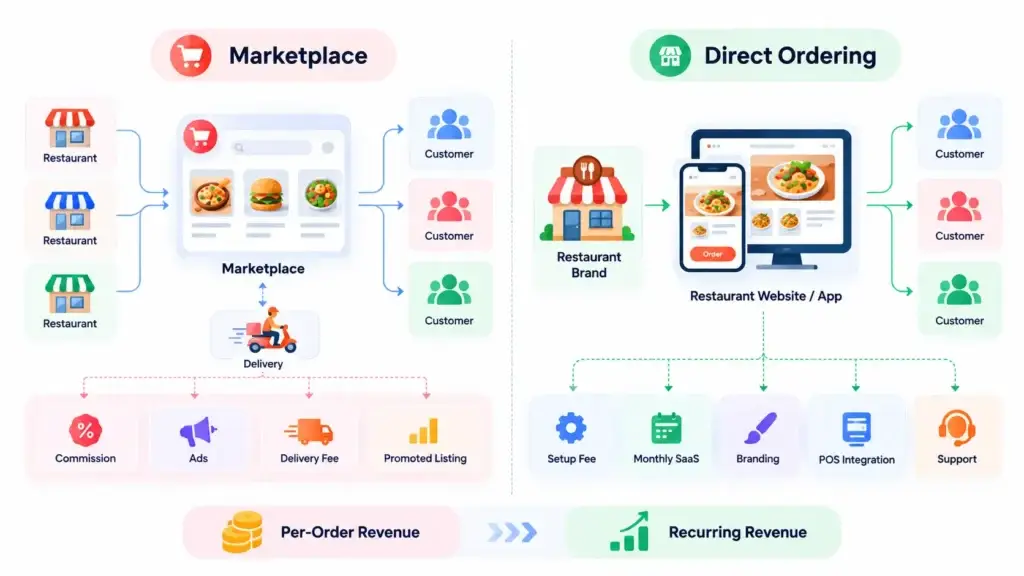
A marketplace and a direct ordering platform solve different commercial problems.
A marketplace typically creates value by bringing restaurants and consumers together. Its economics may therefore depend heavily on transaction commissions, advertising, delivery charges, promoted visibility, and other marketplace activity.
A direct ordering platform is closer to a restaurant technology business. The restaurant already has its brand, menu, customers, and operations. The platform provides the technology required to receive and manage digital orders through channels controlled by the restaurant.
That difference changes what can be monetized.
Instead of asking, “How much can the platform take from each order?”, founders can ask, “What software and operational value will restaurants pay for every month?”
That opens the door to SaaS-style recurring revenue alongside setup, branding, integration, support, and other service-based income.
Subscription Revenue Can Become the Recurring Foundation
Subscription pricing is one of the clearest monetization models for direct restaurant ordering software. Restaurants pay a recurring monthly or annual fee to access the platform, while the software business gains greater revenue predictability.
A subscription can cover the core ordering environment, including menu management, order administration, customer ordering interfaces, reporting, basic promotions, location settings, and operational dashboards. The exact package should depend on the target restaurant segment and product scope.
This model can be especially attractive when the platform positions itself around predictable software costs rather than taking a large percentage from every transaction.
For the platform operator, subscriptions also create an important business metric: recurring revenue can grow not only by acquiring new restaurant accounts but also by retaining existing restaurants and expanding the services they use.
A subscription structure might therefore vary according to:
- Number of restaurant locations
- Included ordering channels
- Monthly or annual billing
- Advanced reporting requirements
- Marketing and loyalty capabilities
- Integration requirements
- Support level
- Additional operational modules
The important point is not to create as many pricing tiers as possible. It is to create clear value boundaries that restaurants can understand.
Setup and Onboarding Fees Monetize the Work Before the First Order
Getting a restaurant onto an ordering platform involves more than creating a username and password. Depending on the product, onboarding can involve menu configuration, branding, payment setup, operating hours, tax rules, delivery zones, staff permissions, domain configuration, testing, and training.
A setup fee allows the platform operator to monetize that implementation work.
This revenue is generally non-recurring, but it can improve the economics of customer acquisition because some of the work required to activate a new restaurant is paid for directly.
Founders should decide what the standard subscription includes and what counts as implementation work. A simple restaurant may require relatively little configuration, while a multi-location business with custom workflows and integrations can require substantially more effort.
The setup model can therefore be standardized for smaller restaurants while allowing custom onboarding charges for more complex accounts.
Branded Restaurant Apps Create a Premium Revenue Layer
Not every restaurant needs its own mobile application. For restaurants with strong repeat ordering, loyalty programs, multiple locations, or an established customer base, however, a branded ordering app can provide additional value.
That creates another monetization layer for the platform.
A branded app can be offered as an upgrade rather than being included automatically in every subscription. The restaurant receives a consumer-facing experience aligned with its own branding, while the platform operator can monetize app configuration, publishing support, maintenance, updates, and premium functionality.
From the restaurant’s perspective, the value goes beyond simply having an icon on a customer’s phone. A branded experience can support repeat ordering, loyalty engagement, promotions, saved preferences, order history, and direct communication when implemented appropriately.
From the platform operator’s perspective, branded applications can increase both initial account value and ongoing recurring revenue.
Add-On Services Can Increase Revenue Per Restaurant
The core ordering product establishes the customer relationship. Add-ons create opportunities to expand it.
Restaurants do not all need the same capabilities on day one. A small independent restaurant may initially want straightforward online ordering, while a growing restaurant group may later require loyalty, advanced analytics, integrations, multiple locations, marketing automation, or enhanced support.
A modular platform can monetize these requirements without making the base package unnecessarily complicated.
Useful add-on categories can include:
| Add-On Category | Restaurant Value | Platform Revenue Opportunity |
|---|---|---|
| Loyalty tools | Encourages repeat purchases and customer retention | Recurring premium module |
| Advanced analytics | Gives operators deeper sales and customer insights | Higher subscription tier or add-on |
| Marketing tools | Supports promotions and customer re-engagement | Monthly add-on |
| Custom integrations | Connects ordering with existing restaurant systems | Setup plus maintenance fees |
| Multi-location controls | Centralizes management across restaurant branches | Per-location or enterprise pricing |
| Premium support | Provides faster or expanded operational assistance | Recurring support package |
| Branded mobile apps | Creates a restaurant-owned mobile ordering experience | Setup and recurring maintenance |
| Custom design | Creates stronger brand consistency | Project-based customization fee |
The commercial advantage of this structure is expansion revenue. The platform does not necessarily need to sell every module during initial onboarding. As the restaurant grows or its needs become more sophisticated, additional services can be introduced.
Multi-Location Pricing Can Grow With Restaurant Customers
A restaurant group with several outlets generally creates more platform activity and requires more operational configuration than a single-location restaurant. Multi-location pricing can therefore become an important component of the business model.
Platforms can charge per location, provide volume-based pricing, or create custom plans for larger restaurant groups.
The product must also justify that additional spend. Restaurant groups may need centralized menus, location-specific availability, branch-level reporting, user permissions, regional pricing, promotions, order routing, and consolidated administrative controls.
This makes multi-location capability more than a technical feature. It becomes part of the platform’s account-expansion strategy.
When an independent restaurant opens additional locations, the software provider can potentially grow alongside the restaurant without acquiring an entirely new customer.
Integrations Can Become Both a Product Advantage and a Revenue Stream
Restaurant technology rarely operates in isolation. Depending on the target market, restaurants may need payment gateways, delivery services, POS systems, accounting tools, marketing software, CRM systems, messaging services, or other operational integrations.
Standard integrations can be included within higher subscription plans, while specialized integrations can be treated as paid implementation projects.
There can also be recurring maintenance implications. APIs change, authentication requirements evolve, and external systems require monitoring. Founders should therefore avoid treating every integration as a one-time technical task with no ongoing cost.
A stronger monetization approach clearly separates standard platform connectivity from custom integration work.
This protects margins while giving larger restaurant customers the flexibility they need.
Marketing and Customer Retention Tools Can Create Recurring Add-On Revenue
Once restaurants establish a direct ordering channel, their next challenge is getting customers to return to it.
That creates a natural product expansion opportunity.
Promotional codes, loyalty points, customer segmentation, push notifications, email campaigns, referral programs, cashback rules, and targeted offers can be packaged as premium marketing capabilities.
These features have stronger commercial logic when they help restaurants increase repeat ordering or improve customer relationships. Rather than selling “more software,” the platform is selling capabilities connected to customer retention.
A broader restaurant ordering platform marketing strategy can connect these capabilities with customer acquisition, retention, promotions, repeat ordering, and direct restaurant-customer relationships.
Founders should nevertheless be careful about excessive feature bundling. The platform should make it easy for restaurants to understand which tools are included, which are optional, and what business problem each upgrade solves.
Payment Processing Is a Separate Layer Founders Need to Model Carefully
Payment processing can easily be confused with platform monetization.
A direct ordering business may charge restaurants a software subscription while payments are processed through an external payment provider. Processing charges can therefore exist separately from the platform’s own subscription, setup, or service revenue.
Depending on the business structure and integrations, founders need to determine who contracts with the payment provider, who pays transaction-processing costs, how refunds are handled, and how payment information flows through the system.
These decisions affect pricing transparency and operational complexity.
A platform marketed around predictable software pricing should make external payment costs clear rather than allowing restaurants to assume every payment-related charge is included in the software subscription.
Delivery Services Can Add Revenue Without Turning the Product Into a Marketplace
Direct ordering and delivery do not necessarily have to be bundled into the same business model.
Some restaurants already operate their own delivery fleet. Others need external delivery providers. Some primarily want pickup ordering.
A restaurant ordering platform can accommodate these different operating models and potentially monetize delivery-related integrations, dispatch capabilities, delivery-zone controls, or premium logistics modules.
The key is preserving the distinction between the restaurant’s ordering channel and the infrastructure supporting fulfilment.
For founders, this creates flexibility. Delivery functionality can become an expansion layer instead of forcing every restaurant into the same operating model.
What Does the Revenue Stack Look Like?
A well-designed restaurant ordering platform can combine multiple revenue sources rather than depending on one fee.
| Revenue Stream | Revenue Type | Typical Commercial Logic |
|---|---|---|
| Software subscription | Recurring | Access to the core ordering platform |
| Setup and onboarding | One-time | Configuration and implementation |
| Branded mobile app | One-time + recurring | Branding, publishing, maintenance, premium functionality |
| Additional locations | Recurring | Expands account as restaurant footprint grows |
| Marketing tools | Recurring | Loyalty, promotions and customer engagement |
| Advanced analytics | Recurring | Deeper operational and customer reporting |
| Custom integrations | Project + possible recurring | Specialized connectivity and maintenance |
| Premium support | Recurring | Enhanced service and assistance |
| Customization | Project-based | Restaurant-specific workflows or design requirements |
| Delivery functionality | Usage, subscription or integration-based | Fulfilment and logistics capabilities |
The advantage of this model is diversification. Subscription revenue creates the recurring base, while implementation and customization create project revenue. Premium applications, integrations, and add-ons can increase account value over time.
Founders can also examine the broader restaurant ordering platform business model to understand how recurring subscriptions, service revenue, and other monetization layers can work together.
Subscription Revenue vs Transaction Commissions
The difference between these models becomes clearer when viewed from the restaurant’s perspective.
With transaction-based pricing, platform costs rise as order volume rises. With subscription pricing, the core software charge can remain more predictable, although payment processing, delivery, messaging, and other external services may still create variable costs.
For the software operator, commission-based pricing can create revenue directly proportional to transaction volume. Subscription pricing can create more predictable recurring software revenue but requires the platform to demonstrate enough ongoing value for restaurants to renew.
Neither structure works automatically.
The correct approach depends on the target restaurant, product positioning, acquisition strategy, operating costs, and services included.
A founder building a direct-ordering SaaS product should therefore model retention and account expansion just as carefully as initial restaurant acquisition.
Founder Decision Signals: What Makes This Model Sustainable?
Recurring Value
A sustainable subscription model depends on continuous restaurant value, not simply recurring billing. Order management, customer engagement, reporting, integrations, and operational support should give restaurants clear reasons to continue using the platform.
Revenue Expansion
Revenue should have room to grow alongside restaurant needs. Multi-location management, branded apps, advanced analytics, marketing tools, and integrations can create natural upgrade opportunities without making the initial package unnecessarily expensive.
Operational Efficiency
Setup and onboarding can generate additional revenue, but excessive manual work can reduce margins. Standardizing menu configuration, account setup, training, and common integrations helps the platform serve more restaurants without increasing operational complexity at the same rate.
Pricing Clarity
Restaurants should clearly understand what their subscription covers and which services create additional costs. Keeping setup fees, integrations, payment processing, premium features, and other add-ons transparent can strengthen trust and make the overall revenue model easier to scale.
Why Platform Architecture Influences the Revenue Model
Monetization is partly a business decision and partly a product architecture decision.
If founders want to charge for multiple locations, the platform needs location-level controls. If they want to sell premium analytics, the system needs reliable reporting and data structures. If branded apps are a premium service, branding and configuration need to be manageable without rebuilding the application for every customer.
The same applies to integrations, loyalty programs, promotions, permissions, delivery rules, and premium support.
These monetization opportunities depend on having the right restaurant ordering platform capabilities, because features such as multi-location controls, promotions, analytics, integrations, and administrative tools determine which services can realistically be packaged and monetized.
This is why founders should decide on the intended revenue model before development is complete. Adding monetization logic after the platform has already been architected can create unnecessary redevelopment.
A deeper restaurant ordering platform development guide can help founders understand how those commercial requirements translate into application architecture, integrations, dashboards, and operational workflows.
The stronger approach is to design product modules and commercial packages together.
Building a Restaurant Ordering Business Without Starting Every Module From Zero
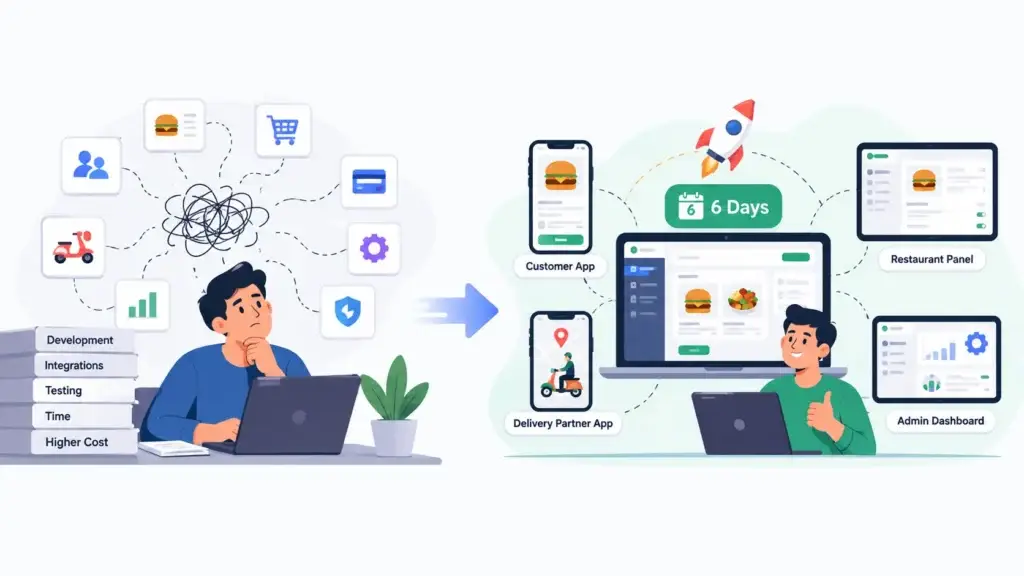
Founders entering restaurant technology need more than a consumer ordering screen. The business may require restaurant administration, menus, order workflows, payment connectivity, customer management, delivery logic, reporting, permissions, branding, and operational controls.
Building every layer independently can extend the time before the founder can begin validating restaurant demand.
Founders should therefore evaluate the cost of developing a restaurant ordering platform based on the modules, integrations, branding requirements, and customization needed for their intended revenue model.
Miracuves provides a ready-made restaurant ordering solution that can serve as a product foundation for businesses entering this space. Founders interested in the underlying platform can explore Miracuves’ dedicated restaurant ordering solution to understand the available product route, while keeping the revenue strategy described in this guide separate from the product-selection decision.
For ready-made solutions, Miracuves’ six-day delivery model can be particularly relevant to founders who already understand their restaurant segment and want to move from business-model planning into market execution without rebuilding standard platform modules from the beginning.
For founders evaluating how to reach that point, comparing ready-made and custom restaurant ordering development can clarify the trade-offs between launch speed, customization, development effort, and long-term product control.
The important distinction is that technology provides the foundation; the founder still needs to decide how subscriptions, setup services, branded experiences, integrations, and premium capabilities should be packaged for the target market.
Mistakes Founders Should Avoid When Designing the Revenue Model
Relying on One Revenue Stream
A subscription can provide the recurring revenue foundation, but relying on it alone can limit growth. Relevant add-on services, branded apps, integrations, and account expansion opportunities can improve the overall economics of the business.
Charging for Features Without Demonstrating Value
Restaurants are more likely to pay for an upgrade when its value is clear. Premium features should connect directly to operational efficiency, customer retention, branding, reporting, marketing, or business growth rather than simply adding another charge.
Ignoring Onboarding Costs
Menu migration, payment configuration, branding, integrations, staff training, and account setup can consume significant operational resources. These costs should be considered when designing setup fees and the wider pricing model.
Making Pricing Unnecessarily Complicated
Too many overlapping subscriptions, setup fees, service charges, and add-ons can make the platform difficult to evaluate. Restaurants should be able to understand what they are paying for and calculate their expected platform costs clearly.
Treating Every Restaurant Identically
An independent restaurant, a growing regional chain, and a large multi-location operation can have very different technology requirements. Pricing and product packages should provide enough flexibility to serve different operational needs without unnecessary complexity.
Building Monetization After Building the Product
Subscription tiers, premium modules, multi-location plans, integrations, and add-on services are easier to manage when the platform architecture supports them from the beginning. Monetization should therefore influence product planning rather than being added only after development is complete.
How Founders Can Choose the Right Monetization Mix
There is no universal pricing structure that fits every direct restaurant ordering business.
A founder targeting independent restaurants may prioritize a simple monthly subscription, straightforward setup, and optional branded applications. A platform targeting growing restaurant groups may benefit more from location-based pricing, advanced analytics, integrations, permissions, and premium support.
The decision should begin with the target customer’s operational problem.
Ask whether restaurants primarily need a direct ordering channel, stronger brand ownership, centralized multi-location management, customer retention tools, delivery capabilities, or integrations with an existing technology stack.
The strongest revenue model then charges for the capabilities that solve those problems rather than creating fees simply because the platform can.
Final Thoughts: Build Revenue Around Restaurant Value
Direct restaurant ordering platforms have several ways to make money because the product can create value at multiple stages of the restaurant’s digital operation.
Subscriptions can establish recurring revenue. Setup fees can monetize implementation. Branded applications can create premium packages. Multi-location plans can expand with restaurant groups. Integrations, marketing capabilities, analytics, customization, and support can increase account value as customer requirements become more sophisticated.
The strategic opportunity is not simply to replace one type of order fee with another. It is to build a software business in which restaurants understand what they are paying for and can expand their technology usage as their operations grow.
For founders ready to turn that model into a product, Miracuves offers a launch-ready restaurant ordering foundation with source-code ownership, branding flexibility, admin control, and a six-day delivery model for ready-made solutions. That can shorten the path from revenue-model planning to actual restaurant-market validation without requiring every standard platform component to be developed from zero.
FAQs
How do direct restaurant ordering platforms make money?
Direct restaurant ordering platforms can earn revenue from monthly or annual software subscriptions, setup and onboarding fees, branded applications, additional restaurant locations, premium marketing tools, analytics, integrations, customization, and support services. The exact combination depends on the platform’s target customers and product scope.
Can a restaurant ordering platform make money without charging commission on every order?
Yes. A platform can use subscription-based software pricing and monetize optional services such as onboarding, branded apps, integrations, marketing tools, analytics, multi-location management, and premium support. Payment-processing and delivery costs may still exist separately.
Why are subscriptions useful for a restaurant ordering software business?
Subscriptions can create recurring revenue and make software costs more predictable for restaurant customers. Their sustainability depends on retention, however, so the platform must continue providing operational value after the initial setup.
What can be included in a restaurant ordering setup fee?
Depending on the platform, setup can cover menu configuration, branding, payment setup, location settings, delivery zones, account configuration, testing, staff permissions, training, and launch assistance.
Are branded restaurant apps a separate revenue stream?
They can be. Platforms may offer a branded consumer application as a premium upgrade and charge for configuration, publishing assistance, customization, maintenance, or additional app functionality.
What add-on services can restaurant ordering platforms sell?
Common opportunities include loyalty programs, promotions, customer engagement tools, advanced reporting, multi-location controls, specialized integrations, custom workflows, premium support, branded applications, and delivery-related capabilities.
Is subscription pricing better than transaction-based pricing?
They serve different commercial models. Subscription pricing can create predictable recurring software revenue, while transaction pricing links platform revenue directly to order activity. The appropriate model depends on customer expectations, operating costs, product positioning, and the value delivered.
How quickly can a founder launch a restaurant ordering platform?
The timeline depends heavily on whether the platform is developed from scratch or uses an existing product foundation. Miracuves positions its ready-made solutions around a six-day delivery model, while custom development requires a separate timeline based on the required functionality, integrations, and customization.
Miracuves is an independent software development company. We are not affiliated with, connected to, sponsored by, or endorsed by any company or product named in this article.
Terms such as “X Clone” are used descriptively. It is how the software industry refers to building a platform with functionality comparable to a known service, and how clients search for it.
The entire design and codebase of our products is built by our own team. Our products contain no code, design, graphics, or content originating from any third-party website or applications.
All third-party names and marks referenced in this article are the property of their respective owners, referenced solely to identify the services discussed.