


Key Takeaways
- Commission is a percentage of volume a new marketplace does not have yet, so a commission-only model earns almost nothing in exactly the months it needs money most.
- Your costs are fixed, immediate and knowable; commission is variable, delayed and dependent on strangers, and the other five lines exist largely to close that gap.
- A vendor subscription is the strongest early line because it bills on a date you choose and sells presence, tooling and predictability rather than a promise of orders.
- Featured placement is premature on a thin roster: buyers see the whole roster in one scroll and work out which results were paid for within two visits.
- Pricing is a behavioural instrument, because a subscription makes a maker want volume from you while a heavy commission quietly teaches them to sell somewhere else.
Early Revenue Mix Signals
- Model the first twelve months on their own volume and read what the commission line actually returns.
- Switch on one modest vendor plan and one commission rate, and leave the other four lines off.
- Credit any setup fee back against the vendor’s first months of trading rather than keeping it as a toll.
- Keep payouts, statements and basic order data outside every tier, on every plan, without exception.
- Build placement slots, membership entitlements and per-vendor plans now, and switch them on when the roster earns it.
Real Insights
- The tail of a roster is where commission-only economics break first, because a maker who sells nothing pays you nothing while still consuming support time, catalogue review and a slot in every payout run.
- A setup fee attached to visible work improves who joins, since free registration fills the approval queue with people who signed up on a Sunday evening and will never trade.
- Buyer membership changes frequency rather than generating fee revenue, but it promises a year of variety that a thirty-maker roster cannot supply.
- Delivery fee margin only exists where you carry the delivery cost, so on a platform where fulfilment is chosen per vendor it covers part of the roster and never the whole of it.
- Miracuves ships a multi-vendor speciality food marketplace where per-vendor plans, fees, placement slots and membership entitlements already exist, which turns the revenue mix into a configuration decision, and eligible ready-made scopes follow a 6-day deployment path for the build itself.
A speciality food marketplace goes live on a Tuesday with thirty makers on the roster. A baker two suburbs over. Two separate people making hot sauce who do not know about each other yet. A pasta maker who produces on Thursdays only.
In the first full month the platform takes 240 orders at an average basket of 38. That is gross merchandise value of a little over 9,100. At a commission rate somewhere in the mid teens, the platform earns roughly 1,370. Those figures are illustrative rather than measured, but their shape is not.
That 1,370 does not pay the recruiter, the support inbox, the hosting, or the afternoon spent explaining a payout hold. Commission is a share of a number that is small because the number is new. The other five revenue lines on a multi-vendor speciality food marketplace exist partly to solve that.
A marketplace like Goldbelly earns on more than commission, and the other lines are the ones that pay before volume exists.
The First Month Arithmetic of a Speciality Food Marketplace
In its first month a marketplace like Goldbelly has almost no commission to collect and every cost still to cover.
Founders model marketplace revenue as a rate multiplied by volume, which is correct and useless. The rate is a decision you make in an afternoon. The volume is the outcome of eighteen months of work by other people.
A roster is an asset that does not pay rent
Thirty approved makers is a genuine achievement and a genuine balance-sheet item. In month one it is also completely inert.
The roster is what a buyer sees on arrival and what a competitor cannot copy in a weekend. None of that converts into cash in the month you acquire it.
The cost of building it is immediate and mostly human. Somebody found each maker, chased the document that never arrived, reviewed the catalogue and fixed the photographs. The vendor onboarding and approval machinery reduces the effort per maker. It does not make it free, and it does not make it later.
What the commission line actually returned
Divide the illustrative month by the roster and you get about 46 per maker. Now notice the distribution will not be flat.
Five makers account for most of it. Ten produce a handful of orders each. The rest produce almost nothing while still consuming support time, catalogue review and a slot in every payout run.
That tail is where commission-only economics break most visibly. A maker who sells nothing costs you money every month and pays you nothing. Commission prices that vendor at zero and absorbs their support burden anyway.
The Timing Mismatch at the Centre of a Food Marketplace
Strip the marketplace down to its cash behaviour and one asymmetry is left. Your costs are fixed, immediate and known in advance. Your commission is variable, delayed and dependent on strangers deciding to buy.
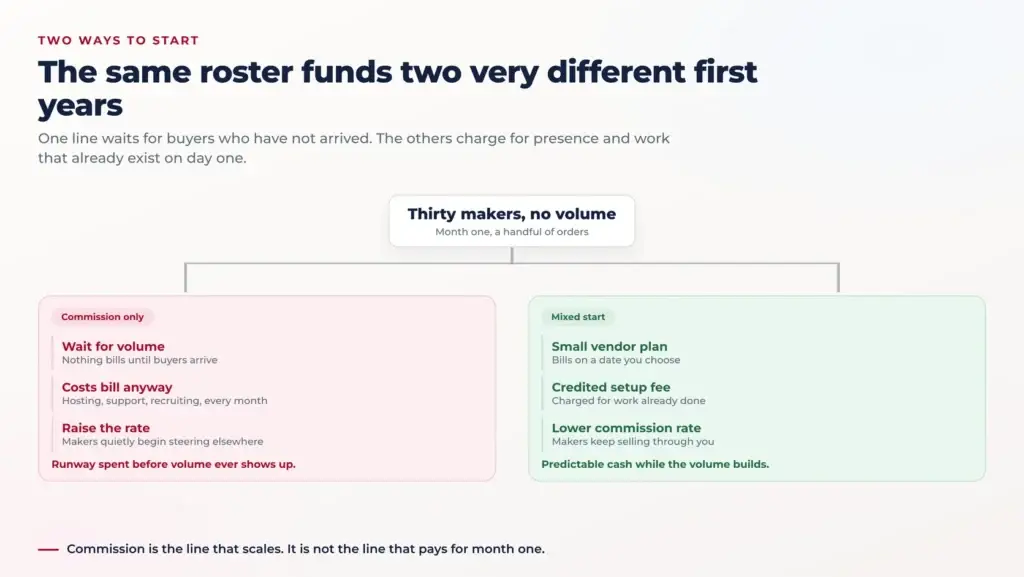
Image Source: AI-generated visual by Miracuves
Your costs arrive on a calendar
Hosting bills monthly whether or not anyone orders. The support person is paid whether the inbox has four messages or four hundred. The recruiter costs the same in a quiet month, and quiet months are when you need them hardest.
Payment processing is the rare cost that truly scales with volume, which is why it is not the cost that hurts you early.
None of that is a surprise, so it can be planned against. What cannot be planned with the same confidence is the month in which volume finally covers it. Founders get the cost side right to two decimal places and the timing of the revenue side wrong by three quarters.
The lines that close the gap charge for something other than a sale
Commission is the only one of the six lines that needs a completed transaction before it earns anything.
Subscriptions, setup fees and placement charge a vendor for something that exists whether or not a buyer turned up this month: presence, work you performed, or attention you control.
Buyer membership charges demand for a commitment rather than a purchase. Delivery margin is a hybrid, real only where you carry the delivery cost. Reading the lines by what triggers the charge is more useful than any taxonomy of business models, and the business model page sets out all six.
Six revenue lines, read by what triggers the charge
| Line | What triggers it | Earns before volume exists |
|---|---|---|
| Commission per order | A completed, settled order | No. It scales with volume and nothing else. |
| Vendor subscription | A billing date, regardless of orders | Yes. The most predictable line you have. |
| Onboarding and setup fee | Approval and catalogue work completed | Yes, and it is the earliest possible line. |
| Featured placement | A period of promised visibility | Technically yes, honestly no. Needs an audience. |
| Delivery fee margin | A delivery you paid to fulfil | No, and only where you carry the cost. |
| Buyer membership | A recurring buyer commitment | Yes, but it commits you to a roster you lack. |
Vendor Subscriptions in a Speciality Food Marketplace
A monthly plan charged to a maker is the most useful line a young speciality food marketplace has, and the most frequently mispositioned. It fails when sold as a promise of orders. It works when sold as a storefront, a set of tools, and a predictable place to be found.
What a maker believes they are buying
Ask a maker who has paid for a year why they still do, and the answer is rarely volume. Their catalogue lives somewhere that works, orders arrive in a format they can cook to, and payouts land on a schedule.
They are buying an operating surface for a small food business, which most cannot build and will not maintain. A maker who sells at two markets a month is also buying a place that exists on the other twenty-eight days.
Predictability is the third part. A producer who knows what the platform costs each month can price their goods against it, which is impossible when the whole relationship is a percentage.
What belongs inside a tier
Tiers should separate on scale and sophistication, not on access. More listings. Scheduled production windows and stock limits rather than a simple open or closed switch. Standing weekly orders. Deeper reporting. A second staff login.
A good boundary is one a growing maker crosses naturally, noticing only because they wanted what sits on the other side. A bad one is drawn through a feature the maker already relies on, then used as a lever.
What must never sit behind a tier
Three things belong to every vendor on every plan. Getting paid, on the normal schedule at the normal speed. Seeing a clear statement of what they earned and what was deducted. And the basic ability to set hours, mark an item out of stock and pause when the kitchen is closed.
Faster payouts behind a higher plan is the most tempting version of this mistake and the most damaging. It turns your treasury function into a paywall and reads as a penalty on the smallest producers.
Onboarding Fees in a Speciality Food Marketplace
A setup fee is the earliest money a marketplace can legitimately collect, because it is charged for work that happens before any sale is possible. It is also the line most likely to poison a roster. The distance between a fair fee and a toll is whether anything happens in exchange.
What admission genuinely costs you
Admitting a maker is not a form submission. Someone reviews the registration documents and checks they belong to the business named. Someone reads the catalogue and decides whether thirty listings describing the same three jars is a catalogue.
Then comes the shaping. Lead times get written down. Production days get set. Fulfilment is agreed, since it is chosen per vendor: your riders inside a zone, the maker delivering with their own staff, or collection in person. That is why the team that builds the onboarding path treats it as the core of the product.
Why a fee can raise the quality of the roster
The counterintuitive effect of a modest setup fee is that it improves who joins. Free registration produces a queue full of people who signed up on a Sunday evening, never uploaded a document, and will never trade.
A fee attached to visible work filters for intent. Completion rates climb and the approval queue shortens. The vendor who walks away over a small fee was usually the vendor who would have abandoned onboarding in week two.
When the fee becomes corrosive
It turns corrosive the moment it is charged for nothing. If the fee buys an automated approval and a welcome email, makers work that out within a month and tell each other. It also turns corrosive when set high enough to be a barrier rather than a filter.
Two safeguards keep it honest. Name what the fee covers in specific terms, so the maker can check they received it. And credit it back against commission or subscription over the first months of trading, which turns a toll into a deposit.
Featured Placement and the Honesty Constraint
Selling visibility looks like pure margin, because there is no cost of goods in a homepage slot. The constraint is not economic, it is arithmetic. Placement is only worth buying when there is something to be placed above.
A small roster cannot hide a paid result
With thirty makers, a buyer sees most of the roster in a single scroll. If three of them are permanently at the top and those three are the ones paying, the pattern is obvious within two visits.
It is also obvious to the other twenty-seven, who now believe the platform they pay for is working against them. Labelling a slot as promoted keeps you honest, but disclosure does not fix a surface too small to sell attention on.
Build the slot now, sell it later
The engineering should exist early even though the line stays off. A promotable slot, a campaign with a start and end date, a record of who occupied which position on which day, and a disclosure label that renders everywhere.
Use the slot for free before you sell it. Feature a new maker in their first fortnight. Feature seasonal production. That trains buyers to look at the position, which is the thing you will later be selling.
It also earns goodwill with the roster instead of spending it. A maker who has been featured for free once reads a paid slot later as a product rather than a tax, which is a materially different conversation when you finally switch the line on.
Buyer Membership, the One Demand-Side Line
Every line so far is charged to a vendor. Membership is the exception: a recurring fee paid by a buyer for reduced delivery fees, early access to limited production, or a monthly credit.
What membership changes about frequency
A membership does not mainly generate fee revenue. It changes behaviour. Someone who has paid for a year of reduced delivery fees checks your platform first, because not using it feels like waste. A member converts a maybe into a habit.
That habit makes the roster stickier too. A maker who sees repeat buyers rather than one-time curiosity stays and invests in their listings. The demand-side line quietly becomes a supply-side retention tool.
Why it is dangerous on a thin roster
A membership is a promise of repeated future value. Sell it against thirty makers and you have promised a year of variety that thirty makers cannot supply. The member orders four times, exhausts what interests them, and spends ten months as a refund conversation waiting to happen.
There is a funding question underneath it. If membership waives delivery fees, somebody absorbs that cost, and it must not silently be the maker. Decide whether the platform funds the benefit or vendors opt in, and record that split on the order.
A benefit quietly charged to vendors is a commission increase wearing a different name, and the roster will eventually read it that way. The recorded split is what lets you answer the question honestly when a maker asks why a member’s order paid them less.
Delivery Fee Margin, and Where It Does Not Exist
One honest sentence first, because it shapes the section. This platform delivers locally, inside delivery zones, using riders you run or makers delivering themselves. It does not ship perishable goods by carrier across a country.
National shipping is a different business with cold chain, packaging science and multi-day transit risk. Saying so plainly is worth more than the reach it gives up, because a buyer who expects a parcel and receives a rider is a refund and a bad review.
Margin exists only where you carry the cost
Where you run the riders, the fee charged to the buyer and the amount paid to fulfil the delivery are two different numbers, and the gap is a revenue line. It is thin, it moves with distance and time of day, and it goes negative on a long drop at a quiet hour.
Where the maker delivers with their own staff or the buyer collects, the margin is not thin, it is absent. You never paid for the delivery, so charging as though you had is an invented cost buyers eventually notice.
Because fulfilment is chosen per vendor, this line covers part of the roster and not the rest, which is another reason it cannot carry you. The economics of a local fleet sit with the delivery solution.
Which Line To Switch On First
A menu of six options is not advice. Here is the recommendation, and the reasoning matters more than the conclusion, because your situation will differ in the details.
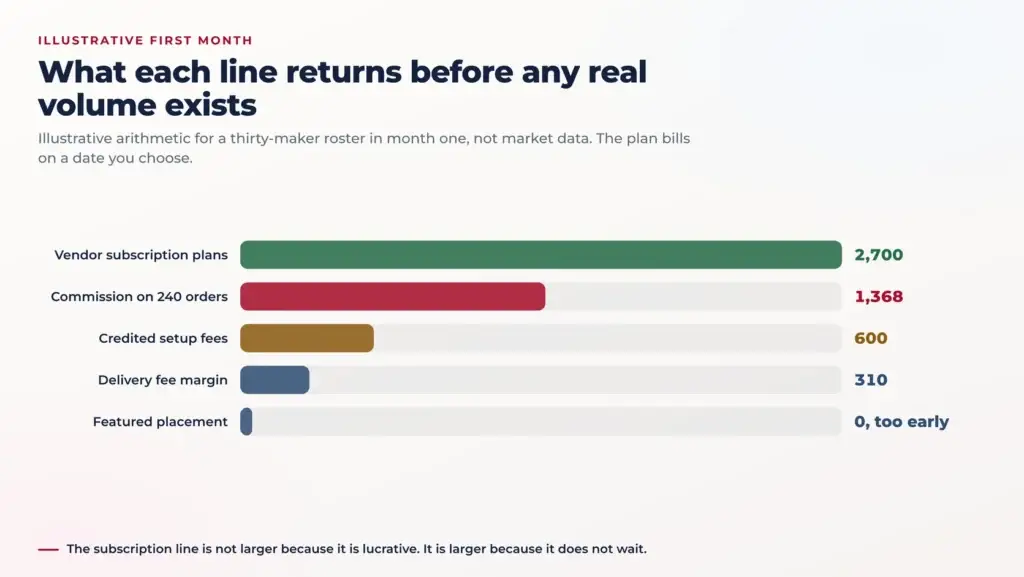
Image Source: AI-generated visual by Miracuves
Start with a vendor subscription, commission alongside it
Switch on one modest vendor plan and one commission rate. Nothing else. Keep the plan cheap enough that a maker producing on Thursdays can justify it, and set the commission lower than you eventually intend.
Return to the illustrative month. Thirty makers on a small monthly plan produce a predictable figure that arrives on a date you choose, before any buyer does anything. The same roster produced roughly 1,370 of commission across a full month of trading.
The subscription line is not bigger because subscriptions are lucrative. It is bigger because it does not wait.
Why not placement, membership or a setup fee first
Placement fails the honesty test at this size. Membership commits you to variety you cannot deliver. A setup fee earns once per maker, so it funds recruitment rather than operations and rewards you for signing vendors rather than making them succeed.
Delivery margin is unavailable until you have a fleet and real drop density. That leaves the subscription as the only line that is honest at thirty vendors, recurring, and aligned with the behaviour you want. It can be configured rather than built if the scope you start from already includes per-vendor plans.
Pricing Is a Behavioural Instrument
Here is the part most revenue models omit. Each line does not only collect money, it tells a maker what to do. Two mixes producing the same total this month will produce different rosters a year from now.
A subscription makes a maker want volume from you
A maker paying monthly has a fixed cost to amortize, and the only way to amortize it is to sell more through you specifically. They update listings. They answer questions faster. They tell their own following where to order.
That same fixed cost is why the plan must stay modest early. A subscription exceeding what a small producer can absorb in a slow month does not create effort, it creates cancellation. Price it against the worst month a viable maker will have.
A high commission makes them want to sell elsewhere
Commission is a per-unit tax on the exact behaviour you are trying to encourage. Push it high enough and a rational maker starts steering. The card in the box mentions their own site. The repeat customer is asked to message directly next time.
Steering is invisible in your dashboards. Order volume flattens and you diagnose a demand problem when you have a margin problem. A mix weighted toward recurring fees keeps the maker’s interests pointed the same way as yours.
Fees that punish the behaviour you asked for
Check every line for this failure mode before switching it on. A per-listing charge produces thin catalogues from makers with wide ranges. A payout fee teaches vendors to batch withdrawals. A photography charge guarantees bad photographs, on a platform where photographs are most of the selling.
The test is one question asked honestly. If a maker optimized purely against this charge, what would they do, and would you want it? If they would list less, photograph less or communicate less, the line is priced against your own product.
Founder Decision Signals
Speed
A vendor plan bills on a date you choose and earns from the first cycle. A commission line waits for buyers you do not have yet, which can be several quarters at a young roster.
Cost
Your fixed costs arrive monthly regardless of volume. Match them with a line that also arrives monthly, rather than with a percentage of a number still close to zero.
Scalability
Subscriptions carry the early months and then flatten. Commission compounds with volume and eventually dominates. Plan the crossover deliberately instead of discovering it.
Market Fit
If makers will not pay a modest monthly fee for presence and tooling, that is a signal about your value to supply, and it arrives far earlier than any demand-side signal will.
The Early Mix Should Be Wrong for the Long Run
A mature marketplace earns most of its money from commission. A young one should not try to. The mistake is not choosing an early mix that will later be wrong. It is failing to plan the transition out of it.
At thirty makers
Subscriptions do the heavy lifting. Commission is a modest second. A credited setup fee may run alongside. Placement and membership stay switched off with their plumbing unused. The mix is deliberately unfashionable and produces revenue on a schedule you can forecast.
It also concentrates your attention correctly. If subscription revenue is your main line, your job every day is keeping makers active and satisfied, which happens to be the same job as building the asset.
At three hundred makers
Commission becomes the largest line without anyone deciding it should, because volume finally arrives. Subscription revenue grows with the roster, which makes it a smaller share of a bigger total.
Placement becomes viable and honest, since a buyer scrolling three hundred makers benefits from curation and cannot reverse-engineer the ranking. Membership becomes defensible because variety now exists.
The instructive part is that the subscription does not stop being useful when it stops being dominant. It carries the tail of the roster and holds a floor under revenue in a seasonal trough. The platform-level view sits with the wider solution catalogue.
What You Must Never Charge a Maker For
Some lines look like revenue and are actually damage. They share a signature: they charge a vendor for something that is either already theirs, or is the platform’s own obligation.
Payouts and statements
Paying a vendor what they earned is not a service you sell them. It is the transaction completing. A withdrawal fee or a premium for standard-speed settlement reads the same way to a maker: a second bite of money you already took a share of.
The same applies to statements. A vendor is entitled to see what they sold, what was deducted, what is on hold and why. Charging for that turns every payout question into a support ticket and makes your own operations surface look like something to work around.
Their own customer relationship
Basic information about their own orders is not a premium feature. What a maker sold, when, in what quantity and to which delivery area belongs to them. Limits on contact details are a privacy question rather than a pricing one, and should be explained on that basis.
Get this wrong and you create exactly the incentive discussed earlier. A maker locked out of their own performance data starts building a parallel channel, using the customers your platform introduced them to.
Building the Lines Before You Charge for Them
Almost every line above needs machinery that takes longer to build than the pricing decision takes to make. Lines you intend to switch on in year two have to be specified in year one, while they still earn nothing.
What each line needs underneath it
A subscription needs plans attached per vendor, a billing cycle, and defined behaviour for a failed payment that does not silently unpublish a catalogue mid-order. A setup fee needs recording against the vendor and, if credited, tracking against future earnings.
Placement needs campaigns, dated slots and a disclosure label. Membership needs an entitlement the order path can read at checkout, and a funding split recorded on the order.
A thin build treating revenue as one percentage in a settings screen cannot grow a second line without surgery, which is the failure described in The Out-of-Stock Trap: Why Cheap Delivery Scripts Ruin Restaurant Relationships and the reason the comparison in The 36-Month TCO Comparison: SaaS Delivery Builders vs. Owned White-Label Engines lands where it does. Teams who move onto infrastructure they control, as in Migrating from SaaS to Owned Infrastructure: A Peak-Hour Performance Comparison, usually do it after a pricing change they could not make.
Modelling year three and living in month one
A spreadsheet where commission carries the business is probably accurate eventually and useless now. Model the first twelve months separately, with the volume you will actually have, and see what the commission line really returns.
Selling a subscription as a promise of orders
Positioned as order volume, every slow month is a broken promise. Positioned as a storefront, tooling and predictable presence, it survives a quiet quarter, because the thing the maker bought is still there.
Selling placement on a roster of thirty
Buyers see the whole roster in one scroll and work out who paid. You collect a small fee, spend credibility with buyers, and tell the other makers that visibility is for sale rather than earned.
Putting payouts behind a higher tier
Faster settlement as an upsell reads as a penalty on your smallest producers. It is the feature most likely to be screenshotted into a maker community, and the cheapest possible trust to lose.
Funding a buyer benefit out of vendor margin quietly
If membership waives a delivery fee and the maker absorbs it, you have raised commission without saying so. Decide who funds the benefit, record the split on the order, and tell the roster.
Leaving the unused lines unbuilt
Placement slots, membership entitlements and per-vendor plans are cheap to design in and expensive to retrofit. Build the plumbing while the line is switched off, then switch it on when the roster earns it.
Final Thoughts: Charge for What Already Exists
Commission is what Goldbelly earns at scale. The other lines are what carry a marketplace to it.
The cold-start revenue problem is not solved by charging more. It is solved by charging for something that already exists on day one: the storefront, the tooling, the presence and the work of admission. Commission rewards you for the business you eventually build, and it is worth waiting for rather than inflating early.
All of this rests on the platform holding more than one revenue line at once. That is configuration on a platform designed for a roster and surgery on one that was not. Architecture decides what you can change later, as the load testing in Sub-2 Second Tracking: Load-Testing GPS Delivery Updates on Flutter and Laravel shows. What we commit to on timelines is set out on our facts page, and the build routes sit with our development service.
If you are deciding which line to switch on first, the useful conversation is not about rates. It is about your cost base, the size of your roster, how your makers fulfil, and how long the early mix needs to carry you. That is a ninety-minute discussion with numbers in front of you, and you can book it with our team whenever you have them.
FAQs
What revenue streams does a speciality food marketplace have?
Because commission is a percentage of volume, and a new marketplace has a roster rather than volume. Take an illustrative month of 240 orders at a basket of 38. That is about 9,100 of gross merchandise value, and a mid-teens rate returns roughly 1,370. That figure does not cover the recruiter, the support inbox, the hosting or the payment fees, all of which arrived on a calendar regardless.
Which revenue line should a food marketplace switch on first?
One modest vendor subscription plan, with a commission rate alongside it set lower than you eventually intend. Nothing else. The subscription bills on a date you choose, before any buyer has done anything, which is the property that matters when costs are immediate and volume is not. Placement, membership and delivery margin all need conditions a thirty-vendor roster does not yet have.
What should a food marketplace vendor subscription be sold as?
As a storefront, a set of tools and a predictable place to be found, never as a promise of orders. Positioned as order volume, every slow month reads as a broken promise and the maker cancels. Positioned as an operating surface for a small food business, it survives a quiet quarter because the thing the maker bought is still there and still working.
What should never sit behind a food marketplace subscription tier?
Three things, on every plan. Getting paid on the normal schedule at the normal speed. Seeing a clear statement of what was earned and what was deducted. And the basic ability to set hours, mark an item out of stock and pause when the kitchen is closed. Faster payouts as an upsell is the most tempting version of this mistake and the most damaging.
Is an onboarding or setup fee fair to charge makers?
It is fair when real work happens in exchange: document review, catalogue review, photograph decisions, lead times, production days and the fulfilment arrangement. It becomes a toll when it buys an automated approval and a welcome email, which makers work out within a month. Name what the fee covers, and credit it back against commission or subscription over the first months of trading.
When is featured placement premature?
While the roster is small enough that a buyer sees most of it in one scroll. If three makers sit permanently at the top and those three are the ones paying, the pattern is obvious within two visits, and it is obvious to the other twenty-seven as well. Build the slot, the dated campaign and the disclosure label early, use the slot for free, and sell it later.
Why is buyer membership risky on a small roster?
A membership is a promise of repeated future value. Sold against thirty makers, it promises a year of variety those makers cannot supply, so the member orders four times and spends the remaining months as a refund conversation waiting to happen. There is also a funding question: if membership waives a delivery fee, decide who absorbs it and record that split on the order.
How does the revenue mix change as the roster grows?
The early mix should be deliberately wrong for the long run. At thirty makers, subscriptions do the heavy lifting and commission is a modest second. At three hundred, commission becomes the largest line without anyone deciding it should, and placement and membership become both viable and honest. The subscription does not stop being useful, it changes job from funding the business to stabilizing it.
Miracuves is an independent software development company. We are not affiliated with, connected to, sponsored by, or endorsed by any company or product named in this article.
Terms such as “X Clone” are used descriptively. It is how the software industry refers to building a platform with functionality comparable to a known service, and how clients search for it.
The entire design and codebase of our products is built by our own team. Our products contain no code, design, graphics, or content originating from any third-party website or applications.
All third-party names and marks referenced in this article are the property of their respective owners, referenced solely to identify the services discussed.



