Key Takeaways
- A direct restaurant ordering platform growth strategy should balance restaurant acquisition, local customer demand, repeat ordering, branded channels, and retention rather than focusing only on sign-ups.
- Growth becomes stronger when restaurants can attract customers through their own websites, apps, QR ordering, loyalty programs, local promotions, and direct communication channels.
- Sustainable expansion depends on helping restaurants increase order frequency and customer lifetime value while keeping onboarding, ordering, payments, and fulfillment simple.
Restaurant & Local Demand Signals
- Restaurant acquisition can use local outreach, multi-location partnerships, onboarding support, menu migration, branded ordering pages, POS integrations, and introductory platform offers.
- Local demand can grow through restaurant SEO, social media, QR codes, neighborhood campaigns, email and SMS marketing, referral programs, first-order offers, and geo-targeted promotions.
- Operators should track active restaurants, published menus, first orders, order volume per location, local conversion rate, acquisition cost, payment success, and restaurant retention.
Repeat Order Insights
- Saved customer profiles, reorder shortcuts, loyalty rewards, personalized offers, subscriptions, push notifications, email campaigns, and reliable fulfillment can encourage repeat ordering.
- Teams should monitor repeat order rate, order frequency, average order value, customer retention, loyalty participation, promotion dependency, restaurant retention, and revenue per location.
- Miracuves develops customizable direct restaurant ordering platforms with restaurant onboarding, branded ordering, POS integrations, payments, loyalty, marketing tools, analytics, repeat-order features, and admin controls.
Launching a direct restaurant ordering platform is only the beginning. The more difficult challenge is creating enough activity on both sides of the platform to make it commercially useful. Restaurants need a reason to participate, local customers need a reason to order directly, and both groups need enough value to keep returning.
That makes growth less about generating the largest possible number of app downloads and more about building a repeatable local commerce loop. A ready-made restaurant ordering solution can provide the technology foundation for onboarding restaurants and managing digital orders, but those partnerships have limited value if menus remain incomplete, restaurants receive few orders, or customers never return after their first purchase. Likewise, consumer advertising becomes expensive when the platform has weak restaurant coverage in the neighborhoods where those customers actually live.
The stronger approach connects restaurant acquisition, merchant activation, local demand, direct-order conversion, and customer retention. Each stage strengthens the next. Rather than treating every transaction as an isolated order, the objective is to create stronger restaurant relationships and encourage customers to return through a dependable direct-ordering experience.
For founders, the important question is therefore not simply, “How do we get more restaurants or customers?” It is: How do we create concentrated local demand that gives restaurants measurable value and gives customers enough reasons to order again?
Why Direct Restaurant Ordering Growth Is a Two-Sided Challenge
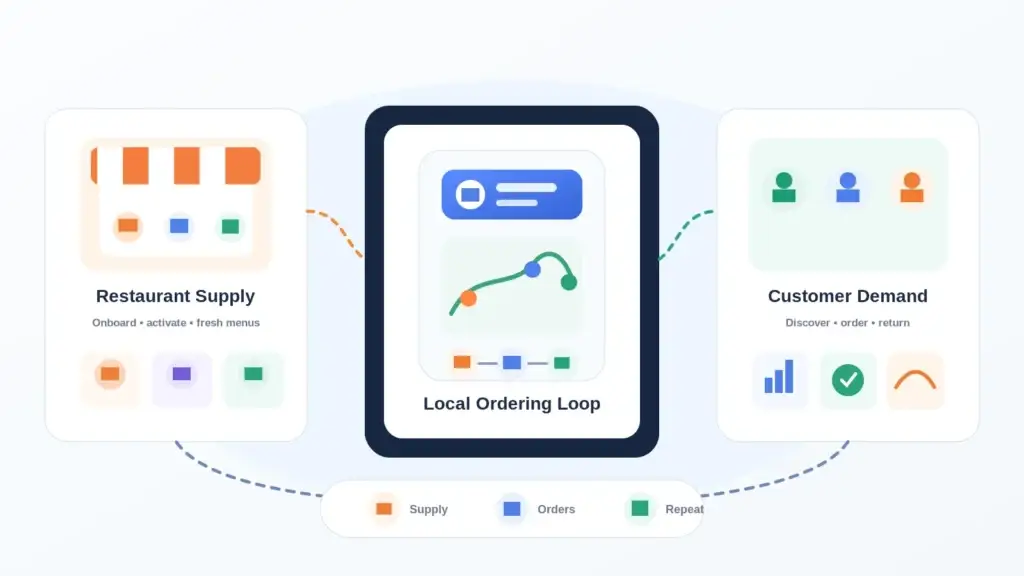
A direct restaurant ordering platform has two acquisition problems operating simultaneously. On the supply side, the business needs restaurants that are willing and prepared to receive digital orders. On the demand side, it needs customers who can discover those restaurants and complete orders through a direct digital channel. Understanding how these two sides interact is important because growth becomes difficult when restaurant supply expands without corresponding local demand, or customer acquisition outpaces the availability of relevant restaurant options.
On the supply side, the platform needs restaurants that are willing and prepared to receive digital orders. On the demand side, it needs customers who are willing to discover those restaurants and complete orders through a direct digital channel. Growing one side without the other creates imbalance.
Imagine launching in a neighborhood with only a handful of restaurants. Even strong customer marketing may struggle because users have too little choice. Now reverse the situation: onboard dozens of restaurants but generate almost no local orders. Restaurant owners see little commercial value, engagement falls, menus become outdated, and eventually partners stop treating the platform as an important sales channel.
This is why restaurant ordering growth should be viewed as a local liquidity problem rather than a simple user-acquisition campaign. The objective is to create enough relevant supply and enough concentrated demand within a defined geographic area that customers can find appealing options and restaurants can see meaningful order activity.
Miracuves’ own food-and-beverage platform guidance makes a similar operational distinction: restaurant marketplaces need customer demand, merchant supply, and—where the model includes delivery—courier supply to develop together.
For founders, this changes the growth question from “How quickly can we expand?” to “Where can we create a healthy ordering loop first?”
Start With Restaurant Density, Not Maximum Geographic Coverage
A common growth mistake is treating geographic expansion as evidence of traction. Being technically available across an entire city means little when restaurant supply and customer demand are scattered too thinly to create a dependable ordering experience.
A stronger launch strategy usually begins with a deliberately limited service area. This might be a residential cluster, business district, university zone, suburban community, or another locality where restaurants and likely customers are concentrated.
Within that area, the platform can identify which cuisine categories and restaurant types are necessary to make the ordering experience useful. A neighborhood may need quick lunch options, family dinner restaurants, cafés, healthy food, late-night meals, or premium local brands. The right mix depends on actual local behavior rather than an arbitrary restaurant target.
Miracuves has previously explored the value of concentrating food-delivery operations within a dense service zone, where demand, restaurant operations, and fulfillment can be managed more deliberately before geographic expansion.
This gives founders a more useful early-stage target: category coverage and local relevance, rather than the total number of restaurant logos on the platform.
Restaurant Acquisition Should Begin With the Merchant’s Business Problem
Restaurant owners rarely need another technology pitch. They need a clear explanation of how a new ordering channel can contribute to their business.
That means acquisition conversations should start with the restaurant’s existing situation. Does the business have strong social engagement but no convenient direct-order path? Does it receive frequent repeat customers but have no structured digital relationship with them? Is online ordering fragmented across several tools? Does the restaurant want greater control over branding, promotions, or customer engagement?
Once the underlying problem is understood, the platform’s value proposition becomes more concrete.
A restaurant acquisition strategy can therefore segment prospects according to factors such as:
- Existing online ordering maturity
- Strength of local brand recognition
- Repeat-customer potential
- Social and search visibility
- Menu suitability for pickup or delivery
- Number of outlets
- Geographic relevance to the launch zone
- Existing customer community
- Operational readiness for digital orders
This prevents the sales team from approaching every restaurant with the same generic pitch.
It also improves supply quality. Ten highly relevant restaurants that actively promote their ordering channel can contribute more to an early neighborhood launch than a much larger list of inactive merchants.
Historical food-delivery scaling experience also illustrates why anchor restaurant relationships can matter: securing a recognizable partner can make subsequent restaurant acquisition easier because other merchants can see tangible participation in the network.
Restaurant Acquisition Is Not Complete Until the Restaurant Is Active
A signed agreement should not automatically count as successful restaurant acquisition.
There is a major difference between a restaurant appearing in the database and a restaurant being ready to generate orders. An inactive merchant inflates supply numbers without improving the customer experience.
Activation means the restaurant can actually participate in growth. Its menu needs to be accurate, operating hours should be correct, pricing and modifiers need to make sense, ordering workflows must be understood, staff should know how incoming orders are handled, and customers should have a clear route to the ordering experience.
The growth team should therefore monitor the journey from prospect → signed restaurant → activated restaurant → first order → consistently ordering restaurant.
That funnel reveals where restaurant acquisition is actually breaking. If many merchants sign but few activate, the problem may be onboarding friction. If they activate but receive few orders, local demand may be insufficient. If they receive early orders but later become inactive, restaurant value or ongoing partner support may need attention.
This is a much healthier way to evaluate merchant growth than celebrating signup totals alone.
Turn Restaurant Partners Into Local Distribution Channels
Restaurant acquisition should contribute to customer acquisition as well.
Every restaurant already has some combination of existing diners, social followers, website visitors, email subscribers, local search visibility, walk-in traffic, and repeat customers. Once that restaurant becomes active on a direct ordering platform, those touchpoints can become distribution channels for digital orders.
Restaurants can promote direct ordering through practical customer-facing placements such as:
- Website ordering buttons
- QR codes on menus, receipts, packaging, and counters
- Social profile links
- Local email or SMS campaigns where consent permits
- In-store signage
- Post-purchase communications
- Loyalty messaging
- Search and business-profile links
- Packaging inserts for existing customers
The advantage is intent. A person already interacting with a restaurant is significantly closer to an ordering decision than a broad advertising audience.
This creates an important growth principle: merchant acquisition and consumer acquisition should not operate as completely separate departments. A newly activated restaurant can immediately become part of the platform’s demand-generation network.
Build Local Demand Around Restaurant Clusters
Broad city-wide marketing can create impressive reach numbers while producing weak order density. Direct ordering is inherently local, so acquisition campaigns should reflect the geography of actual restaurant supply.
Suppose a platform has strong coverage in three neighborhoods but limited coverage elsewhere. Advertising equally across the whole city wastes budget by attracting users who may open the platform and discover few relevant options nearby.
A more disciplined approach concentrates marketing around areas where supply is already strong enough to convert interest into orders.
Local demand campaigns might combine search visibility, restaurant-owned audiences, neighborhood social content, local creators, community partnerships, geo-targeted paid campaigns, referral activity, and restaurant-specific promotions. The goal is not simply to produce traffic. It is to produce order-capable traffic within the service area.
Miracuves’ analysis of food-delivery marketplace trends similarly emphasizes neighborhood-level demand, zone-specific offers, delivery-radius management, and concentrated order density rather than treating an entire city as one homogeneous market.
Match Campaigns to Local Ordering Occasions
Local demand becomes even more useful when campaigns reflect why people order.
Office districts may respond strongly to weekday lunches and group orders. Residential neighborhoods may generate more family dinner demand. University areas may have different price sensitivity and late-evening patterns. Some areas may respond to pickup incentives, while others depend heavily on delivery convenience.
Instead of running one generic “order food online” campaign, the growth team can build messages around actual occasions:
- Weekday lunch
- Family dinner
- Weekend ordering
- Late-night meals
- Group and office orders
- Pickup on the commute home
- Local events
- Seasonal menu launches
- Reorders from familiar restaurants
This makes local demand generation more relevant while giving restaurants a practical reason to participate in campaigns.
The First Order Is a Conversion Event, Not the End Goal
Many growth teams overvalue first-order acquisition.
A promotion can persuade someone to order once, but a one-time discounted transaction does not necessarily indicate healthy demand. If the customer never returns without another large incentive, acquisition may have created volume without creating durable value.
The first order should instead begin a measurable retention journey.
After purchase, the platform has opportunities—subject to consent and applicable privacy requirements—to understand useful behavioral signals such as the restaurant selected, ordering time, basket composition, fulfillment preference, reorder interval, and response to future communications.
This is one of the strategic advantages of direct ordering. Industry analysis notes that first-party ordering can give restaurants greater insight into frequency, preferences, purchasing behavior, and promotion response, supporting more relevant engagement and loyalty activity.
The marketing objective therefore shifts from “get the order” to “earn the next order.”
Create a Clear First-Order-to-Second-Order Journey
The gap between a customer’s first and second order deserves specific attention because the second purchase begins to demonstrate habit rather than curiosity.
A customer who has already completed checkout should not have to rediscover the entire experience. The platform should make returning straightforward: familiar restaurant discovery, easy access to previous orders where supported, relevant communication, and a dependable checkout experience all reduce friction.
Retention communication should also respond to behavior rather than becoming an endless stream of generic discounts. A lunch customer may respond differently from a weekend family-order customer. Someone who repeatedly buys from one restaurant does not need the same message as a customer who explores different cuisines.
Useful retention triggers can include reorder reminders, restaurant-specific updates, loyalty progress, relevant menu launches, personalized offers, seasonal occasions, and carefully timed win-back messages.
The principle is simple: retention should increase relevance, not notification volume.
First-Party Customer Relationships Make Retention More Intelligent
Direct ordering has a strategic advantage beyond the transaction itself: it can create an identifiable customer relationship where appropriate permissions and privacy controls are in place.
That matters because retention becomes difficult when the restaurant cannot connect transactions over time. Knowing that a restaurant generated 500 orders is useful. Knowing how many came from first-time versus returning customers, how frequently customers reorder, which cohorts are becoming inactive, and which promotions lead to another purchase is far more actionable.
Recent restaurant-industry reporting has highlighted this shift from acquisition toward customer ownership, with direct interactions helping restaurants understand order history, preferences, frequency, and response to offers.
This information can help restaurants and platform operators answer better growth questions:
Which restaurants generate the strongest repeat behavior?
Those restaurants may deserve greater visibility or partnership attention.
Which neighborhoods produce customers who return?
Those areas may justify deeper local investment.
Which acquisition sources generate only first orders?
The campaign may be creating low-quality demand.
When do customers typically become inactive?
That can inform the timing of re-engagement.
Which restaurant categories create natural ordering habits?
Those categories may help guide future merchant acquisition.
The result is a feedback loop in which customer behavior improves future restaurant and marketing decisions.
Retention Depends on Operations as Much as Marketing
No loyalty campaign can permanently compensate for a poor ordering experience.
If menus are inaccurate, restaurants repeatedly reject orders, payment flows fail, pickup instructions are unclear, orders arrive late, or customer issues remain unresolved, the marketing team will continually spend money replacing customers who should have returned naturally.
That means growth metrics should be viewed alongside operational metrics.
Restaurant acceptance, cancellation reasons, menu accuracy, payment success, order preparation, fulfillment reliability, refunds, support issues, and customer feedback can all affect repeat behavior. The exact metrics will vary according to whether the business supports pickup, restaurant-managed delivery, or a broader delivery operation.
This is where platform growth and product operations meet. Miracuves’ guide to owned food-delivery infrastructure, for example, shows how checkout, restaurant acceptance, payments, notifications, dispatch, and admin visibility can all become business risks during demand peaks.
A useful growth team therefore does not ask only, “Which campaign produced this customer?” It also asks, “What happened during the order experience that made this customer return—or disappear?”
Discounts Should Accelerate Behavior, Not Become the Business
Discounting can be useful for encouraging trial, supporting a new restaurant launch, reactivating customers, or creating demand during a specific period. The danger begins when discounts become the platform’s main reason to order.
Customers trained to wait for aggressive promotions can become expensive to retain. Restaurants may also become frustrated if order growth depends on offers that weaken their economics.
A stronger promotional strategy attaches incentives to a behavioral objective. A first-order offer can reduce trial friction. A second-order incentive can encourage early habit formation. A referral reward can turn existing customers into acquisition channels. A restaurant-funded campaign can stimulate demand around a new menu or quiet period.
The question should always be: What customer behavior is this promotion designed to change?
If the growth team cannot answer that question, the discount is probably buying temporary volume rather than building the ordering habit.
Promotion decisions should also make sense within the wider economics of the platform. Subscription income, transaction-based revenue, promoted visibility, delivery-related income, and other restaurant ordering revenue streams can influence how aggressively a business uses discounts to acquire or retain customers. The objective is to balance demand generation with a monetization structure that can support restaurants, customers, and platform operations as order volume grows.
Restaurant Retention Matters Alongside Customer Retention
Growth is not sustainable if the platform retains customers but continually loses restaurant partners.
Restaurant retention depends on whether merchants continue to see measurable business value from the platform. That value is also connected to the wider restaurant platform business model, including how restaurant relationships, recurring revenue, transaction activity, promotions, and customer retention work together commercially. A restaurant that receives relevant demand, can manage orders efficiently, understands its performance, and has a workable relationship with the platform has stronger reasons to remain active over the long term.
This makes restaurant success part of growth strategy rather than merely customer support.
Platform teams should watch for signals such as falling order acceptance, outdated menus, declining activity, unresolved operational issues, reduced campaign participation, or long periods without orders. These signals can indicate a partner relationship weakening before the restaurant formally leaves.
For subscription-oriented restaurant technology in particular, Miracuves’ business-model analysis notes the importance of identifying a restaurant that is becoming inactive before renewal rather than discovering the problem afterward.
That principle applies more broadly: merchant churn is often visible before it happens.
Measure the Growth Loop, Not Vanity Metrics
Downloads, impressions, registered restaurants, social reach, and website traffic can all provide context, but none independently proves that the platform has developed a healthy local ordering business.
Founders need metrics that show whether supply and demand are reinforcing each other.
| Growth Layer | Useful Signals | What the Founder Learns |
|---|---|---|
| Restaurant acquisition | Qualified prospects, signed partners, acquisition source | Whether relevant local supply is growing |
| Restaurant activation | Menu-ready rate, activation time, first-order rate | Whether signed restaurants become usable supply |
| Local demand | Traffic by zone, customer acquisition source, restaurant-page activity | Where demand is actually forming |
| Conversion | Checkout completion, first-order conversion, payment success | Whether demand turns into transactions |
| Customer retention | Second-order rate, repeat-order rate, reorder interval | Whether first orders develop into habits |
| Restaurant health | Active partners, order acceptance, partner inactivity | Whether merchants continue receiving value |
| Campaign efficiency | Acquisition cost, repeat behavior by source, promotion response | Which channels create durable customers |
| Local density | Active restaurants and repeat customers by service area | Whether a neighborhood is ready for deeper investment |
The important point is not to collect every possible metric. It is to connect the metrics into a diagnostic system.
If restaurant acquisition is rising but customer conversion is flat, the platform may have a demand problem. If first orders grow but repeat orders do not, retention or service quality needs investigation. If customer demand rises but restaurant acceptance falls, supply or operational capacity may be under pressure.
A good dashboard should help the team decide what to fix next, not merely show that activity occurred.
Use Cohorts to Understand Whether Growth Is Improving
Aggregate order growth can hide poor retention.
For example, total monthly orders may rise because paid acquisition keeps adding new customers even while earlier customers disappear. Without cohort analysis, that can look healthier than it really is.
Instead, group customers by when or how they were acquired and observe their subsequent behavior. A cohort might consist of customers who placed their first order in a particular month, came through a restaurant QR code, responded to a local campaign, or joined through a referral.
The platform can then compare how those groups behave over time.
This makes it possible to distinguish high-volume acquisition from high-quality acquisition. A smaller channel that produces customers who reorder may deserve more investment than a large campaign generating mostly one-time promotional orders.
The same thinking can be applied to restaurants. Compare partners by acquisition source, neighborhood, restaurant type, activation period, or campaign participation to understand which merchant profiles become healthy long-term supply.
Build a Restaurant Ordering Growth Flywheel
The strongest direct-ordering strategy connects restaurant acquisition, merchant activation, local demand, and repeat ordering rather than treating each one as a separate campaign. When these elements reinforce one another, the platform can create a healthier growth cycle in which better restaurant supply attracts customers and stronger customer demand gives restaurants more reason to remain active.
Relevant Restaurant Supply
Restaurant acquisition should focus on quality and local relevance rather than simply increasing partner numbers. Prioritize restaurants that match actual neighborhood demand, popular ordering occasions, cuisine preferences, and geographic coverage. A smaller concentration of relevant restaurants can create more customer value than a large but scattered merchant network.
Merchant Activation
Signing a restaurant does not automatically make it useful supply. Restaurants need to become ordering-ready with accurate menus, operating hours, pricing, order-management processes, and staff awareness. Moving new partners from signup to their first successful orders quickly helps turn restaurant acquisition into measurable platform activity.
Concentrated Local Demand
Customer acquisition should focus on neighborhoods where restaurant coverage is already strong enough to provide meaningful choice. Restaurant-owned audiences, local search visibility, community marketing, geo-targeted campaigns, referrals, and relevant promotions can then work together to generate demand where customers can actually complete orders.
Repeat Ordering
The first transaction should begin the retention journey rather than complete the acquisition journey. Reliable ordering experiences, relevant customer communication, loyalty initiatives, reorder opportunities, and first-party behavioral insights can help turn first-time customers into returning buyers.
Together, these four elements create a growth flywheel: relevant restaurants improve local choice, stronger choice helps attract customers, customer orders create value for restaurant partners, and repeat ordering strengthens the economics of the platform. As this cycle becomes more consistent, founders can use what they learn in one neighborhood to guide restaurant acquisition and demand generation in the next.
The flywheel works because each part contributes to the next. Better restaurants make the platform more useful to local customers. More customer demand makes restaurant participation more valuable. More transactions create better behavioral insight. Better insight improves restaurant acquisition, marketing, personalization, and retention. Stronger restaurant and customer retention then makes expansion into adjacent areas less dependent on starting from zero.
This is a more defensible growth model than continuously buying isolated first orders.
Know When a Neighborhood Is Ready to Expand
Expansion should follow evidence, not impatience.
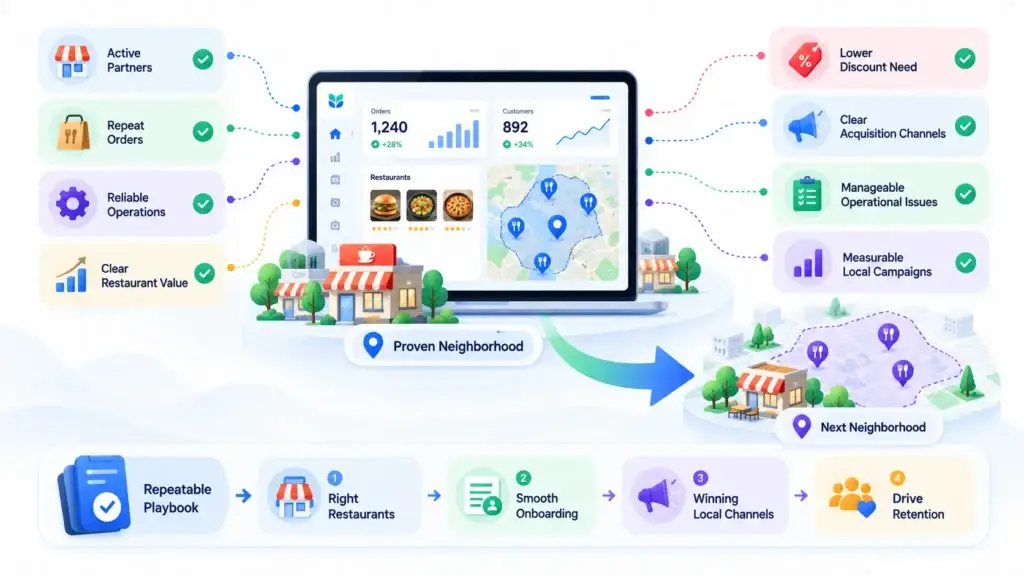
A platform is in a stronger position to enter an adjacent area when its existing launch zone shows healthy restaurant activation, repeat ordering, dependable operations, and clear restaurant value. The exact thresholds depend on the business, so founders should avoid copying arbitrary benchmarks from unrelated markets.
Instead, look for directional signals: restaurant partners remain active, customers reorder without requiring constant deep discounts, acquisition channels are becoming understandable, operational problems are manageable, and local campaigns can generate measurable transactions.
At that point, expansion becomes an exercise in reproducing a known operating playbook rather than improvising a new launch.
This also creates better learning. The team knows which restaurant profiles to approach, which onboarding bottlenecks to remove, which local marketing channels perform, and which retention campaigns deserve early attention.
The Technology Should Enable the Growth Strategy
Growth eventually becomes constrained when the technology cannot support the operating model.
Restaurant teams need practical ways to manage orders and their digital presence, while customers need a reliable path from restaurant discovery to checkout. Platform operators also need visibility across restaurants, users, orders, payments, promotions, and performance. The right restaurant ordering platform features should support these operational requirements while giving growth teams enough visibility to distinguish restaurant acquisition from activation and first-time customers from repeat ordering behavior.
This is where founders evaluating the technology behind a direct restaurant ordering business can move from strategy into commercial investigation.
Once the growth model is clear, founders need a product foundation capable of supporting restaurant onboarding, customer ordering, operational control, payments, promotions, and ongoing platform management. Miracuves provides a ready-made restaurant ordering solution with customer, restaurant, delivery, web, and administrative interfaces, along with source-code ownership and deployment support. This gives founders an established operational foundation while leaving the business team to concentrate on restaurant acquisition, local demand generation, retention, and geographic growth.
For founders whose operating model is already defined, the technology decision often comes down to ready-made vs custom restaurant ordering development. Building from an established foundation can reduce the amount of core ordering infrastructure that needs to be created from zero, while custom requirements may demand additional engineering and integration work. Miracuves offers a 6-day launch path for applicable ready-made deployments, allowing the business team to focus earlier on restaurant acquisition, merchant activation, neighborhood demand, and repeat-order growth.
As restaurant volume and ordering activity increase, the underlying system also needs to coordinate menus, payments, order states, restaurant operations, integrations, notifications, and administrative controls without turning each new requirement into a separate workaround. A well-planned direct restaurant ordering platform architecture creates clearer boundaries between these functions and gives founders a stronger technical foundation for supporting growth across additional restaurants and locations.
The implementation decision also depends on the technical resources available internally. Businesses that need support across configuration, integrations, deployment, customization, and post-launch technical requirements may benefit from working with an experienced restaurant ordering platform development partner rather than coordinating each technical component independently. The development approach should ultimately support the operating model and growth priorities instead of determining them.
Mistakes That Weaken Direct Restaurant Ordering Growth
Expanding Before Building Local Restaurant Density
Entering too many neighborhoods too quickly can spread restaurant supply and marketing resources too thinly. Build meaningful restaurant coverage and measurable customer demand within focused geographic areas first, then use those learnings to guide expansion into nearby markets.
Counting Restaurant Signups as Successful Acquisition
A signed restaurant does not automatically strengthen the platform. If its menu is incomplete, staff are unprepared, or the restaurant rarely accepts orders, it adds little practical value for customers. Track activation, time to first order, and ongoing restaurant activity alongside total partner signups.
Buying First Orders Without Measuring Repeat Behavior
Discounts and paid campaigns can generate an initial transaction without creating a lasting customer relationship. Compare acquisition channels by second-order rate, repeat-order behavior, and retention so marketing investment moves toward customers who continue ordering rather than one-time promotional buyers.
Treating Every Growth Problem as a Marketing Problem
Weak growth can come from poor restaurant coverage, slow merchant activation, inaccurate menus, ordering friction, fulfilment issues, or low customer retention. Increasing advertising before identifying the actual bottleneck can raise acquisition costs without improving the underlying growth loop.
Using the Same Growth Strategy in Every Neighborhood
Restaurant availability, cuisine preferences, ordering occasions, customer behavior, and fulfilment conditions can vary significantly between local markets. Use neighborhood-level performance data to adapt restaurant acquisition, promotions, demand generation, and expansion decisions instead of applying one city-wide formula everywhere.
Founder Decision Signals: What Should You Prioritize Next?
Restaurant Acquisition
If restaurant acquisition is weak, review the merchant value proposition, restaurant targeting, sales process, and local credibility before increasing consumer advertising. Strong customer demand is difficult to sustain when the platform lacks relevant restaurant supply.
Merchant Activation
If restaurants are signing up but few become active, focus on onboarding, menu readiness, staff training, ordering workflows, integrations, and time to first order. The goal is to turn signed partners into restaurants that can reliably accept and fulfil customer orders.
Local Demand & Repeat Orders
If restaurants are active but order volume remains weak, examine neighborhood visibility, restaurant-owned distribution, customer acquisition, and local supply-demand fit. If first orders are growing but repeat orders remain low, investigate ordering experience, fulfilment quality, retention journeys, relevance, and dependence on promotions.
Market Expansion
If restaurant activity and repeat ordering are healthy but overall growth has slowed, the business may be ready to reproduce its restaurant-acquisition and local-demand playbook in an adjacent geographic cluster rather than simply spending more on marketing in the existing market.
These signals help founders identify where the growth loop is actually breaking before committing additional resources. Not every growth problem requires more marketing; sometimes the priority is stronger restaurant supply, faster merchant activation, better retention, or more disciplined geographic expansion.
Final Thoughts: Growth Comes From Closing the Loop
A direct restaurant ordering platform does not become stronger simply because more restaurants register or more consumers install an app. Sustainable growth appears when restaurant supply and customer demand reinforce one another.
Acquire restaurants that matter to a specific local market. Activate them properly. Turn each restaurant’s existing presence into a demand channel. Concentrate customer acquisition where supply is strong. Make the first order easy, then treat the second order as a critical retention milestone. Use first-party insights responsibly to improve relevance, and watch operational performance because ordering reliability is part of marketing whether the growth team owns it or not.
Most importantly, measure the entire loop.
When restaurant acquisition produces useful supply, local marketing produces qualified demand, reliable ordering produces trust, and customer relationships produce repeat transactions, growth becomes less dependent on constantly replacing yesterday’s customers.
For founders who have validated that strategy and now need the product foundation to execute it, Miracuves can provide a white-label restaurant ordering solution with source-code ownership, administrative control, branding, and a 6-day ready-made launch path where the selected scope fits. The technology creates the operating foundation; the growth strategy determines what you do with it.
FAQs
How do you grow a direct restaurant ordering platform?
-Growth comes from developing restaurant supply and customer demand together. Start with a focused geographic area, acquire restaurants that match local demand, move those restaurants quickly into active ordering, and generate customer demand around that supply. After the first transaction, measure repeat ordering and restaurant activity so acquisition develops into retention rather than temporary volume.
How can a restaurant ordering platform acquire more restaurant partners?
Restaurant acquisition becomes stronger when the sales proposition addresses a real merchant problem instead of presenting a generic technology pitch. Target restaurants according to local relevance, online-ordering maturity, customer following, menu suitability, repeat-order potential, and operational readiness. Restaurant activation and subsequent order activity should be measured alongside signed-partner totals.
Why is local demand important for restaurant ordering platforms?
Restaurant ordering is geographically constrained. Customers usually need relevant restaurant options within a practical pickup or delivery area, while restaurants need customers close enough to transact. Concentrating restaurant supply and marketing in defined neighborhoods can create stronger order density than spreading both resources thinly across an entire city.
How can direct ordering increase repeat restaurant orders?
Direct ordering can create an identifiable customer relationship when appropriate permissions are in place. Restaurants and platform operators can use order history, preferences, frequency, and engagement signals to develop more relevant loyalty, reorder, and win-back activity. The underlying ordering and fulfillment experience must still be dependable for those campaigns to work.
What is the difference between restaurant acquisition and restaurant activation?
Restaurant acquisition means securing a restaurant as a partner. Restaurant activation means getting that partner into a state where customers can successfully order from it. An activated restaurant needs accurate menu information, workable ordering processes, operational readiness, and a clear path to receiving its first orders.
Which metrics matter most for restaurant ordering growth?
Useful metrics include qualified restaurant acquisition, merchant activation, time to first order, first-order conversion, repeat-order rate, reorder interval, active restaurant rate, order acceptance, customer acquisition source, retention by cohort, and performance by geographic zone. The most useful dashboard connects these signals rather than treating them independently.
Should a restaurant ordering platform rely heavily on discounts?
Discounts can reduce first-order friction, stimulate quiet periods, encourage a second purchase, or support referrals, but they should have a defined behavioral objective. Continual discounting without retention measurement can produce transaction volume without proving that customers value the platform enough to return.
When should a direct ordering platform expand into another area?
Expansion is more defensible once the initial market demonstrates useful restaurant density, merchant activation, repeat customer behavior, manageable operations, and identifiable acquisition channels. The goal is to replicate a working local growth system rather than use expansion to compensate for unresolved problems in the first market.
Miracuves is an independent software development company. We are not affiliated with, connected to, sponsored by, or endorsed by any company or product named in this article.
Terms such as “X Clone” are used descriptively. It is how the software industry refers to building a platform with functionality comparable to a known service, and how clients search for it.
The entire design and codebase of our products is built by our own team. Our products contain no code, design, graphics, or content originating from any third-party website or applications.
All third-party names and marks referenced in this article are the property of their respective owners, referenced solely to identify the services discussed.