


Key Takeaways
- A direct restaurant ordering platform business model connects restaurants, customers, ordering channels, payments, POS systems, loyalty, marketing, fulfillment, and platform services within one digital ecosystem.
- Restaurants control menus, pricing, branding, customer relationships, and order operations, while customers place orders through websites, branded apps, QR ordering, pickup, or delivery channels.
- The platform creates value by simplifying ordering infrastructure, integrating restaurant systems, supporting recurring customer engagement, and reducing dependence on third-party marketplace channels.
Business Model & Ordering Signals
- Restaurants can manage menus, item availability, pricing, modifiers, locations, promotions, operating hours, incoming orders, preparation status, refunds, and customer data through dedicated dashboards.
- Customers can browse menus, customize items, apply offers, choose pickup or delivery, complete payments, track order status, earn loyalty rewards, and reorder from saved history.
- Ordering channels can include restaurant websites, branded mobile apps, QR menus, social links, kiosks, and integrated POS systems, all feeding orders into a centralized operational workflow.
Platform Service Insights
- Platform services can include subscriptions, setup and onboarding, branded apps, payment integrations, POS connectivity, loyalty programs, marketing automation, analytics, delivery integrations, and support.
- Operators should monitor active restaurants, order volume, average order value, repeat customers, subscription retention, feature adoption, payment success, POS sync reliability, and revenue per restaurant.
- Miracuves develops customizable direct restaurant ordering platforms with online ordering, restaurant dashboards, branded apps, POS integrations, payments, loyalty, marketing tools, analytics, and admin controls.
Online restaurant ordering is often described as a simple digital journey: a customer opens a menu, selects food, pays, and waits for the order. From a business perspective, however, the model is considerably more connected.
A direct restaurant ordering platform sits between several moving parts. Restaurants need digital storefronts and order-management tools. Customers need convenient ordering and payment experiences. Website, mobile, QR, social, and other ordering channels need to send demand into a consistent workflow. Payments need to be recorded correctly. Pickup or delivery needs to be coordinated. The platform operator needs a sustainable way to provide and monetize the technology.
Understanding these relationships is essential for founders considering a restaurant technology business because the platform is not merely an ordering interface. It is the infrastructure connecting restaurant operations, customer demand, digital channels, transaction flows, fulfilment, and recurring platform services.
This guide breaks down the direct restaurant ordering platform business model from that ecosystem perspective and explains where value, control, revenue, and operational responsibility sit.
What Is a Direct Restaurant Ordering Platform Business Model?
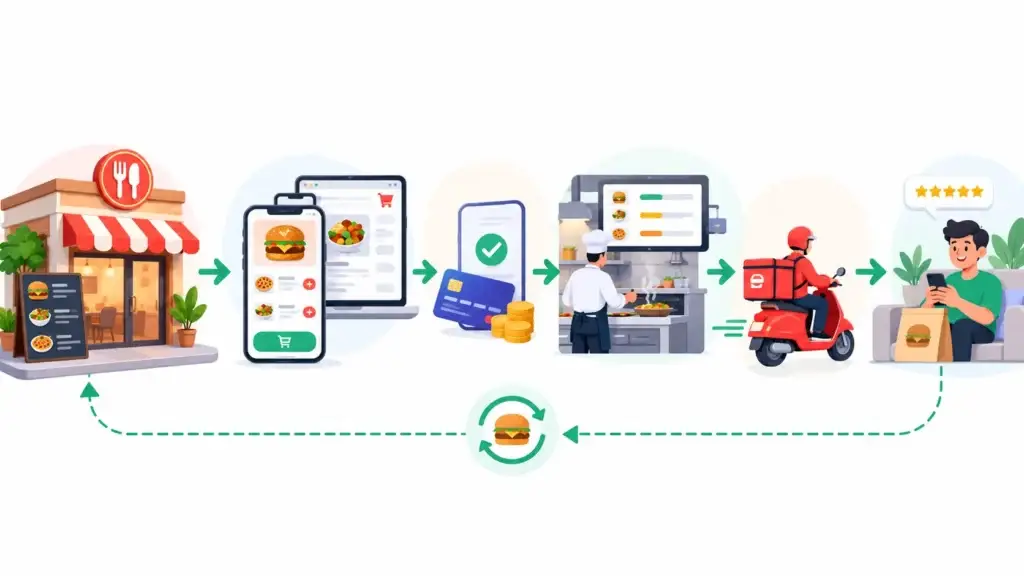
A direct restaurant ordering platform provides the technology that allows a restaurant to receive digital orders through channels associated with its own customer relationship rather than depending entirely on a broad consumer marketplace.
The important distinction is not simply where the customer clicks Order. It is how the commercial relationship is structured.
The restaurant typically manages its menu, pricing, availability, preparation, promotions, and brand experience. Customers use a digital storefront to discover available items, customize an order, choose fulfilment, pay, and receive status information. The technology platform provides the infrastructure that keeps these actions connected.
Depending on the operating model, the platform may also provide payment integrations, loyalty tools, analytics, delivery coordination, customer communication, marketing capabilities, multi-location management, and administrative controls.
This creates an ecosystem rather than a single transaction.
Restaurant → Ordering Channel → Customer Order → Payment → Restaurant Operations → Fulfilment → Customer Relationship → Repeat Order
For founders, this distinction matters because every arrow in that flow can create operational responsibility, product requirements, or a potential revenue stream.
How Restaurants, Customers, and the Platform Connect
The easiest way to understand the model is to separate the ecosystem into its core participants and then examine what each one contributes.
| Participant | Primary Role | Value Received | Important Platform Requirement |
|---|---|---|---|
| Restaurant | Creates and fulfils food orders | Direct digital sales, branding, customer relationships and operational tools | Menu, order, promotion and reporting controls |
| Customer | Places and pays for orders | Convenient ordering, payment, pickup or delivery | Fast storefront, checkout and order visibility |
| Platform operator | Provides the technology layer | Recurring or transaction-based platform revenue | Admin, billing, restaurant management and analytics |
| Payment provider | Processes digital transactions | Processing revenue | Secure payment integration and transaction records |
| Delivery operation | Moves orders when delivery is selected | Delivery-related revenue or service fees | Dispatch, zones, tracking and status management |
| Ordering channel | Creates an entry point for demand | Easier customer acquisition and conversion | Consistent menus, links and checkout experience |
The platform becomes valuable when these participants do not have to operate as disconnected systems.
A restaurant should not need one workflow for website orders, another for mobile orders, and an entirely separate process for pickup customers if those orders can be managed through a common operational layer. Likewise, customers should not need to understand the restaurant’s internal technology. Their experience should simply move from menu to checkout to fulfilment with as little friction as possible.
Restaurants Are the Supply and Operating Core
Restaurants are more than vendors listed inside the system. In a direct-ordering model, they are usually the operational center of the transaction.
They decide what can be sold, when it is available, what it costs, how quickly it can be prepared, whether an order can be delivered to a particular area, and which promotions are commercially sensible.
A useful restaurant-side platform therefore needs to support operational control rather than merely display a menu.
Typical restaurant workflows can include:
- Menu, category, variation and add-on management
- Opening hours and temporary availability
- Order acceptance and rejection
- Preparation-status updates
- Pickup and delivery settings
- Delivery-zone configuration
- Offers, coupons and loyalty campaigns
- Customer and order history
- Sales and payment reporting
- Multi-location or branch management
The business implication is significant. If restaurant staff find these workflows difficult, customer-facing design alone cannot save the platform. A visually attractive ordering experience that creates operational confusion behind the counter can lead to rejected orders, inaccurate menus, delayed preparation, refunds, and poor retention.
The restaurant dashboard therefore influences both product usability and platform economics.
Customers Create Demand, but Repeat Customers Create Leverage
Customers interact with a much simpler surface. They want to find the restaurant, understand the menu, customize their food, check the total price, choose delivery or pickup, pay easily, and know what is happening after checkout.
Behind that simplicity sits a strategic advantage: repeat ordering.
A customer who already knows a restaurant does not necessarily need a broad discovery experience every time they want dinner. For these users, a direct ordering channel can shorten the journey between intent and purchase.
That changes the platform’s role. It does not need to treat every transaction as a fresh customer-acquisition event. Instead, it can help restaurants turn existing demand into a repeatable digital relationship.
Useful retention mechanisms can include saved customer profiles, order history, quick reordering, loyalty points, targeted coupons, promotional notifications, favorite items, and location-aware availability.
This is also why customer data requires careful handling. Access should be permission-based, privacy-conscious, and aligned with the platform’s terms, applicable privacy requirements, and the restaurant’s operating model. Customer information is valuable because it improves service and retention—not because it should be collected without clear purpose.
Ordering Channels Are Demand Entry Points, Not Separate Businesses
A direct ordering strategy becomes more powerful when customers have several convenient routes into the same commerce engine.
Those routes might include:
- A restaurant website
- A branded mobile experience
- QR codes on tables, receipts, packaging, or printed materials
- Direct ordering links
- Social profiles and campaigns
- Email or SMS promotions
- Search and local discovery traffic
- In-store digital ordering
The important architectural principle is consistency.
If a restaurant changes the price of an item, marks a dish unavailable, introduces a new add-on, or changes its opening hours, those changes should ideally flow through the relevant ordering surfaces without creating unnecessary manual work.
This is where a platform evolves from a website builder into an operating layer. Multiple acquisition channels can feed demand into a common order-management system, allowing the restaurant to concentrate on fulfilment instead of maintaining disconnected storefronts.
How an Order Moves Through the Platform
Consider a customer who reaches a restaurant through a direct ordering link.
The customer enters the storefront and sees the available menu for the relevant restaurant or branch. They select items, choose variations or add-ons, and place them in the cart. Before checkout, the system needs to validate pricing and availability so the order reflects the restaurant’s current menu state.
The customer then selects the fulfilment method. Pickup may require a collection time, while delivery may require address validation, delivery-zone logic, fees, and estimated timing. Payment is then completed through the configured method.
Once the order reaches the restaurant, staff need a clear way to accept it, prepare it, update its status, and hand it over for pickup or delivery. The customer should receive appropriate status updates throughout the process.
After fulfilment, the transaction becomes part of the platform’s reporting and customer history. That information can support reconciliation, customer service, analytics, loyalty programs, and future marketing where appropriate.
The customer experiences one order. The platform processes a chain of connected business events. Founders who want to examine this journey in more detail can explore how a direct restaurant ordering system works across customer ordering, restaurant operations, payments, and fulfilment.
Direct Ordering Does Not Mean One Ordering Channel
One misconception is that direct ordering means customers must use a dedicated restaurant app. In practice, the strongest channel depends on the restaurant’s audience.
A frequent customer may appreciate a mobile experience that makes reordering fast. A first-time website visitor may prefer ordering without installing anything. A dine-in customer may scan a QR code. A customer responding to a promotion may enter through a campaign link.
The platform should therefore be designed around channel flexibility with operational consistency.
For a founder, this creates an important product decision. The objective is not to build the maximum number of customer interfaces. It is to identify the channels that create meaningful demand and connect them efficiently to the restaurant’s operational workflow.
Where Does the Platform Operator Fit?
The platform operator supplies the technology and, depending on the model, may also provide onboarding, support, payments, marketing tools, delivery coordination, or other services.
This makes the operator’s value proposition different from that of the restaurant.
Restaurants are selling food. The platform operator is selling digital ordering capability and operational infrastructure.
That infrastructure can include restaurant onboarding, branded storefronts, menu management, order processing, payment integrations, reporting, promotional tools, loyalty capabilities, customer communication, delivery configuration, and administrative controls.
The operator therefore needs to answer a fundamental business-model question:
What recurring problem are restaurants paying the platform to solve?
If the answer is merely “we provide an app,” retention may be difficult. If the platform consistently helps restaurants manage digital ordering, maintain customer relationships, simplify operations, and coordinate channels, its value becomes easier to understand and price.
How Direct Restaurant Ordering Platforms Can Generate Revenue
There is no requirement for every platform to monetize in the same way. Revenue design should reflect the services being provided and the economics of the target restaurant segment.
| Revenue Stream | How It Works | Business Logic |
|---|---|---|
| Restaurant subscriptions | Restaurants pay a recurring platform fee | Creates predictable recurring platform revenue |
| Setup and onboarding | Restaurants pay for configuration, branding or menu setup | Monetizes implementation work |
| Transaction charges | Platform receives an agreed fee or percentage on qualifying orders | Aligns revenue with order activity |
| Delivery-related fees | Revenue comes from delivery or logistics services | Useful where the platform participates in fulfilment |
| Premium tools | Restaurants pay for additional capabilities | Expands account value without changing the core product |
| Promotional services | Restaurants pay for optional visibility or campaign tools | Adds a marketing-related revenue layer |
| Customer membership | Customers pay for eligible benefits | Creates a consumer-side recurring revenue stream where appropriate |
A subscription-led model can be attractive because both the restaurant and platform operator can forecast software costs and recurring revenue more easily. A transaction-based model may reduce the restaurant’s fixed commitment when order volume is still low, while a hybrid structure can serve different restaurant profiles. Founders evaluating the commercial structure more deeply can compare different restaurant ordering platform business models before deciding how restaurants, transactions, and supporting services should contribute to platform revenue.
The key is to avoid designing monetization in isolation. Pricing affects restaurant acquisition, retention, support expectations, product scope, and long-term unit economics.
Subscription vs Transaction-Based Revenue
A recurring subscription and a transaction-based charge solve different commercial problems.
A subscription creates predictable software expenditure for the restaurant and predictable recurring revenue for the platform operator. This can work well when restaurants already process enough direct order volume to justify a fixed technology expense.
Transaction-based pricing lowers the fixed barrier because the restaurant pays in proportion to activity. That can make onboarding easier for smaller or newer restaurants, although higher-volume restaurants may eventually prefer predictable subscription economics.
A platform can also support a hybrid approach where different restaurants use different commercial arrangements.
The founder’s decision should therefore be based on restaurant maturity, expected order volume, services included, acquisition strategy, and operating costs—not simply on which pricing model appears easiest to explain. A deeper analysis of restaurant ordering platform revenue streams can help founders evaluate how subscriptions, transaction charges, services, and other income sources fit together.
The Role of Customer Relationships in the Business Model
The commercial value of direct ordering becomes clearer when customer relationships are treated as an asset rather than an accidental by-product of checkout.
Restaurants can use first-party ordering interactions to understand repeat purchase patterns, popular menu items, order frequency, promotion response, and customer preferences where appropriate and permitted.
That information can support better decisions around:
- Loyalty programs
- Repeat-order campaigns
- Menu optimization
- Personalized promotions
- Customer service
- Branch-level demand
- Seasonal campaigns
- Re-engagement
The objective is not simply to collect more data. It is to make the direct channel increasingly useful to both the restaurant and its customers.
For platform operators, this means retention features deserve as much attention as acquisition features. Restaurants can combine loyalty, promotions, customer communication, and other direct restaurant marketing and retention strategies to encourage repeat ordering. When the platform helps generate recurring demand, the technology becomes part of the restaurant’s revenue operation rather than another software subscription waiting to be cancelled.
Who Owns the Customer Relationship?
In a direct restaurant ordering model, “customer ownership” is better understood as relationship control and authorized access rather than literal ownership of a person or their data.
The restaurant may have a direct commercial relationship with the diner because the diner intentionally orders from that restaurant’s digital storefront. The platform provides the technology that facilitates the transaction and may process customer information according to its contractual role, privacy policy, permissions, and applicable regulations.
For founders, the practical questions are therefore more useful than the phrase “who owns the customer?”
Ask instead:
- Who can communicate with the customer after an order?
- What information can the restaurant access?
- What permissions has the customer provided?
- Who handles support and disputes?
- Where is transaction history stored?
- Who is responsible for protecting customer information?
- Can the restaurant export relevant business data?
- What happens to data if the restaurant leaves the platform?
These questions turn a vague ownership debate into concrete product and governance requirements.
Pickup, Restaurant Delivery, and Platform Delivery Change the Economics
Fulfilment determines how much operational responsibility the platform carries.
With pickup, the restaurant prepares the food and the customer collects it. The technology primarily coordinates ordering, payment, preparation status, and collection timing.
With restaurant-managed delivery, the restaurant receives the order through the platform but uses its own delivery staff. The platform may provide zones, fees, timing, and status tools without directly operating the fleet.
With platform-supported delivery, another logistics layer enters the business model. Driver onboarding, assignment, routing, tracking, delivery fees, payouts, failed deliveries, and disputes may all become platform responsibilities.
That distinction matters because a direct ordering business does not automatically need to become a logistics business.
Founders should decide whether delivery is a core revenue-generating service, an optional integration, or something restaurants should manage themselves. Adding logistics can increase the value of the platform, but it also increases operational complexity.
Payments Connect Customer Experience to Financial Operations
Checkout may look like a small feature, but payment architecture touches almost every participant in the ecosystem.
Customers need familiar and reliable payment methods. Restaurants need accurate transaction records and settlement visibility. Platform operators need to understand fees, refunds, failed transactions, reconciliation, and any platform charges. Support teams need enough transaction history to investigate disputes.
The underlying system should therefore maintain clear records connecting an order with its payment status, restaurant, customer, fulfilment method, discounts, fees, and refund activity.
Secure payment gateway integration, encrypted data transfer, role-based access, audit logs, and permission-based administrative controls should be treated as part of the platform foundation rather than optional marketing features.
Final payment, privacy, tax, and regulatory requirements will depend on the operating jurisdiction, integrations, and commercial structure.
Admin Control Is the Business Operating Layer
Customers see menus. Restaurants see orders. The platform operator needs to see the business.
That is the purpose of the admin layer.
A useful administrative system can give operators control over restaurant onboarding, users, order activity, payment configuration, service areas, promotions, disputes, reporting, platform settings, and other operational rules.
This becomes increasingly important as the number of restaurants grows. Decisions that can be handled through configuration are generally easier to scale than decisions requiring developers to change code for individual restaurants.
For founders, admin functionality should therefore be evaluated through a simple question:
Can the business team operate and adjust the platform without asking developers to handle routine operational changes?
If the answer is no, growth can turn small configuration tasks into recurring engineering bottlenecks.
Direct Ordering and Marketplace Discovery Can Coexist
A direct-ordering strategy does not require restaurants to abandon every other customer-acquisition channel.
Discovery and retention are different problems.
Broad marketplaces can expose a restaurant to consumers who have never encountered the brand before. Direct channels can be especially useful once customers already know the restaurant and want a convenient way to order again.
This creates a more balanced channel strategy. Restaurants can evaluate external channels based on their ability to generate incremental discovery while building direct channels for repeat demand, loyalty, and brand engagement.
For platform founders, this means the product does not necessarily have to “replace” every existing ordering route. It can become the restaurant’s owned digital commerce layer and connect the channels that make sense for its business.
Founder Decision Signals Before Building the Platform
Restaurant Segment
Define whether you serve independent restaurants, multi-location brands, or larger restaurant networks.
Revenue Model
Choose between subscriptions, transaction fees, service charges, or a hybrid model.
Fulfilment Model
Decide whether orders use pickup, restaurant-managed delivery, or platform-supported delivery.
Channel Strategy
Identify whether customers will order through websites, mobile apps, QR codes, or direct ordering links.
Data Control
Define customer data access, permissions, privacy responsibilities, and retention policies.
Admin Control
Make routine restaurant, pricing, order, and platform settings manageable without developer support.
Features Should Follow the Business Model
A common product-planning mistake is to start by collecting every feature found across restaurant apps and then attempting to build them all.
The stronger approach is to start with the business relationships.
If restaurants pay subscriptions, the platform needs subscription and entitlement management. If restaurants run their own deliveries, the system needs restaurant-controlled delivery settings. If the platform manages drivers, dispatch and payout workflows become necessary. If retention is central to the proposition, customer history, loyalty, promotions, and reordering become more important.
This is why founders evaluating a ready-made direct ordering solution should look beyond the customer interface. The restaurant panel, admin controls, payment logic, fulfilment configuration, and commercial settings determine whether the software actually fits the intended operating model. Reviewing the broader features of a restaurant ordering platform can help founders map those capabilities back to their actual business requirements instead of building from a generic feature checklist.
Miracuves provides a restaurant ordering platform foundation that can be configured around these connected workflows, allowing founders to start from an established technology base rather than designing every operational module from zero.
Ready-Made Platform vs Building Every Module From Scratch
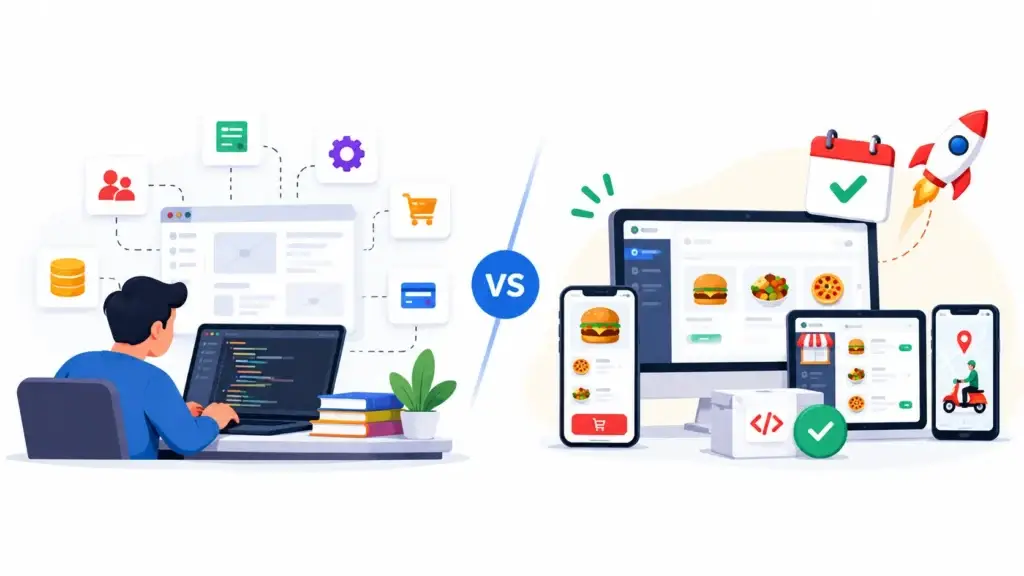
The strategic question is not whether custom development is inherently better or worse. It is whether the business model requires technology that is genuinely unique. Founders making that decision can compare a ready-made restaurant ordering platform with custom development based on differentiation, technical ownership, launch requirements, customization, and long-term product plans.
Building from scratch gives founders extensive architectural freedom, which can be valuable when the operating model contains proprietary workflows or unusual integrations. The trade-off is that standard ordering functions—accounts, menus, carts, payments, restaurant management, fulfilment settings, dashboards, and reporting—still need to be designed, developed, integrated, and tested.
That additional development scope also affects budgeting. Founders comparing implementation routes should consider the cost of developing a restaurant ordering platform in relation to required modules, integrations, customization, technology choices, and launch scope rather than treating development as a single fixed expense.
A ready-made foundation changes the sequence. The standard commerce and operational layers already exist, so effort can be directed toward branding, configuration, integrations, and the areas that actually differentiate the business.
For founders whose model aligns with direct restaurant ordering, Miracuves offers a launch-ready restaurant technology solution with full source code and white-label customization. Ready-made Miracuves solutions can be deployed in 6 working days once required launch inputs such as branding, hosting, developer accounts, and an onboarded payment gateway are available. Custom requirements can affect scope and timing.
Mistakes Founders Should Avoid
Treating the Platform as Only a Customer App
The visible storefront is only one layer. Restaurant operations, admin controls, payments, fulfilment, reporting, and customer service determine whether the business can operate reliably after orders start arriving.
Confusing Direct Ordering With Customer Acquisition
Technology can make ordering easier, but it does not automatically create restaurant demand. Restaurants still need marketing, repeat-customer strategies, local discovery, loyalty, and strong service.
Adding Delivery Operations Without Modeling the Cost
Running delivery introduces dispatch, driver availability, zones, payouts, support, failed deliveries, and service-level expectations. Founders should understand these responsibilities before making logistics central to the product.
Building Features Before Choosing the Revenue Model
Subscription billing, transaction charges, premium modules, onboarding services, and delivery revenue require different platform controls. Monetization should influence architecture rather than being attached after development.
Ignoring Restaurant-Side Usability
A complicated restaurant dashboard creates operational friction exactly where speed matters most. Menu updates, order acceptance, availability, preparation status, and reporting should be easy for staff to manage during real service periods.
Treating Customer Data as an Unrestricted Asset
Customer information needs appropriate permissions, security controls, privacy-conscious handling, and policies aligned with applicable regulations and contractual responsibilities.
How Miracuves Can Support a Direct Restaurant Ordering Business
Miracuves helps founders move from business-model planning to a launch-ready product without rebuilding standard restaurant-commerce workflows from the beginning.
The available platform foundation connects customer ordering with restaurant management, multi-channel access, menu and availability controls, pickup and delivery workflows, promotions, payments, administrative management, and related operating functions.
Founders that need support translating these requirements into an implementation plan can also evaluate what to look for in a restaurant ordering platform development company, including experience with restaurant workflows, integrations, customization, deployment, scalability, and post-launch requirements.
For founders whose requirements align with the existing ready-made architecture, the key advantage is speed: Miracuves can deploy the ready-made solution in 6 working days, subject to the required launch inputs and customization scope. Full source-code access also gives the business a foundation it can continue adapting as its restaurant network and operating model evolve.
The important point is not simply launching quickly. It is launching technology that reflects how restaurants, customers, ordering channels, payments, fulfilment, and platform revenue are supposed to work together.
Final Thoughts: Design the Connections Before Choosing the Features
The direct restaurant ordering platform business model is not defined by a single app, revenue stream, or checkout page. Its value comes from connecting several relationships efficiently.
Restaurants provide products and fulfilment. Customers provide demand. Digital channels provide access. Payments move the transaction. Delivery or pickup completes it. Platform services provide the infrastructure that keeps the ecosystem manageable. Data and retention workflows help turn individual transactions into longer customer relationships.
For founders, that means the strongest starting point is not asking, “Which features should the app have?”
Start with more fundamental questions: Which restaurants are you serving? How will customers reach them? Who manages fulfilment? What will restaurants pay for? Which operational responsibilities belong to the platform? Which customer relationships should the technology help restaurants strengthen?
Once those decisions are clear, the required product architecture becomes much easier to define.
Miracuves can provide the ready-made technology foundation for founders who want to turn that operating model into a branded restaurant ordering platform while reducing the time required to build standard ordering infrastructure from the ground up.
FAQs
What is a direct restaurant ordering platform?
A direct restaurant ordering platform is a technology system that allows restaurants to receive digital orders through restaurant-focused channels such as websites, branded ordering interfaces, direct links, QR access, or mobile experiences. It can connect menus, checkout, payments, order management, pickup or delivery, promotions, customer records, and administrative controls.
How does a direct restaurant ordering business make money?
Platform operators can monetize through restaurant subscriptions, onboarding and setup services, transaction-based charges, premium capabilities, delivery-related fees, promotional tools, or customer memberships. The appropriate combination depends on the restaurant segment and services the platform provides.
Is direct ordering the same as a food delivery marketplace?
Not necessarily. A broad marketplace usually emphasizes restaurant discovery across many businesses, while direct ordering emphasizes the restaurant’s own digital relationship with its customers. A platform can also combine elements of both models depending on its strategy.
Can restaurants use direct ordering alongside other sales channels?
Yes. Restaurants can use different channels for different purposes. External discovery channels may help reach new customers, while a restaurant’s own ordering surfaces can provide a convenient route for existing and repeat customers.
What ordering channels can connect to a restaurant platform?
Depending on the platform, customers may enter through a restaurant website, mobile interface, QR code, direct ordering link, social campaign, email promotion, or other digital touchpoint. The important requirement is keeping menu, order, payment, and operational information consistent.
Does a direct ordering platform need its own delivery fleet?
No. The platform can support customer pickup, restaurant-managed delivery, third-party logistics integrations, or an operator-managed delivery network. The correct structure depends on the business model and the amount of logistics responsibility the platform wants to assume.
Why is the admin dashboard important for a restaurant ordering platform?
The admin dashboard gives the platform operator control over restaurants, users, orders, service areas, commercial settings, payments, promotions, disputes, reporting, and other operational rules. Strong admin controls reduce dependence on developers for routine business changes.
How quickly can Miracuves deploy a ready-made restaurant ordering platform?
Where the business requirements fit the ready-made Miracuves foundation, deployment can be completed in 6 working days after the required branding, hosting, developer accounts, payment gateway, and other launch inputs are available. Additional custom development or integrations can change the final scope and timeline.
Miracuves is an independent software development company. We are not affiliated with, connected to, sponsored by, or endorsed by any company or product named in this article.
Terms such as “X Clone” are used descriptively. It is how the software industry refers to building a platform with functionality comparable to a known service, and how clients search for it.
The entire design and codebase of our products is built by our own team. Our products contain no code, design, graphics, or content originating from any third-party website or applications.
All third-party names and marks referenced in this article are the property of their respective owners, referenced solely to identify the services discussed.



