Key Takeaways
- A direct restaurant ordering platform lets restaurants accept branded online orders through their own websites or apps while managing menus, payments, pickup, delivery, customer data, and operations.
- Customers can browse a restaurant’s digital menu, customize items, place orders, pay online, choose pickup or delivery, and receive status updates without relying on a third-party marketplace.
- The complete workflow connects menu availability, order details, payment confirmation, restaurant preparation, fulfillment status, customer notifications, and final pickup or delivery.
Ordering & Payment Workflow Signals
- Branded ordering can support restaurant-controlled domains, mobile apps, digital menus, modifiers, carts, promo codes, scheduled orders, saved customer profiles, and personalized offers.
- Payment workflows can manage cards, digital wallets, taxes, tips, discounts, transaction authorization, payment confirmation, failed transactions, refunds, and reconciliation.
- POS integrations can synchronize menu data, incoming orders, payment status, preparation workflows, item availability, and transaction records to reduce duplicate restaurant operations.
Pickup & Delivery Operations Insights
- Pickup workflows can include preparation estimates, ready-for-pickup notifications, scheduled collection, curbside options, order verification, and customer arrival updates.
- Delivery workflows may include service zones, delivery fees, driver assignment, third-party delivery integrations, live tracking, estimated arrival times, proof of delivery, and failed-delivery handling.
- Miracuves develops customizable direct restaurant ordering platforms with branded ordering, digital menus, payments, POS integrations, pickup and delivery workflows, loyalty, analytics, and admin controls.
Online food ordering does not always need to begin on a large restaurant marketplace. A restaurant can create its own digital ordering channel where customers browse the menu, select items, pay online, choose pickup or delivery, and receive order updates while interacting directly with the restaurant’s brand.
That is the basic idea behind a direct restaurant ordering platform.
Instead of treating online ordering as a separate marketplace relationship, direct ordering turns the restaurant’s website, mobile experience, or branded ordering page into a digital storefront. The ordering system then connects the customer-facing experience with menus, checkout, payments, restaurant operations, fulfillment, notifications, and customer information.
For restaurant operators, the important question is therefore not simply whether customers can place an order online. The real question is whether the restaurant can manage the complete journey—from menu discovery and payment to preparation and fulfillment—without losing control of its brand or creating more work for its staff.
This guide explains how that process works, what technology sits behind it, and what founders and restaurant businesses should evaluate before building or adopting a direct ordering platform.
What Is a Direct Restaurant Ordering Platform?
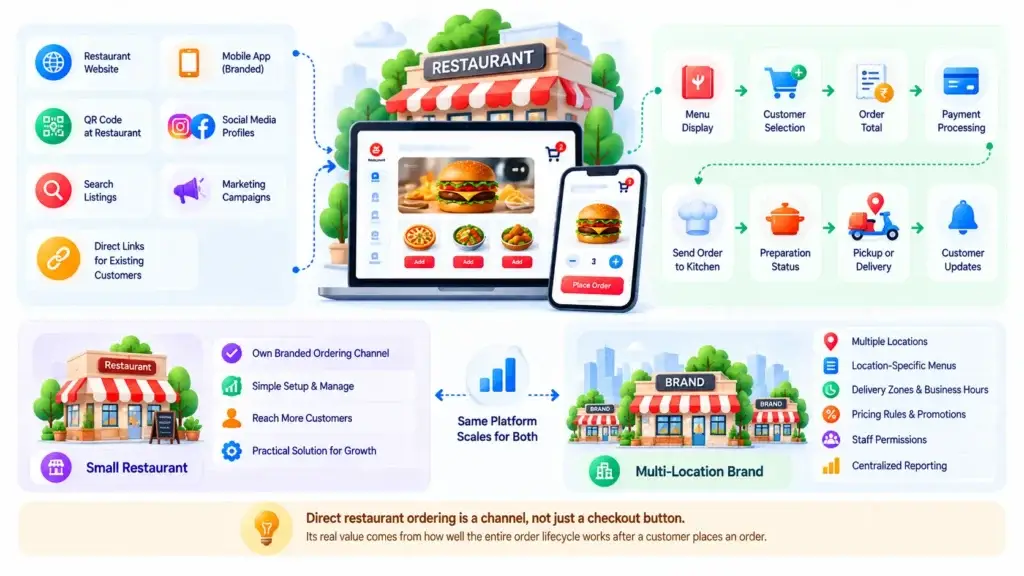
A direct restaurant ordering platform is software that enables a restaurant to receive digital food orders through its own branded ordering channel. Customers may reach that channel through the restaurant website, a branded mobile experience, QR codes, social profiles, search listings, marketing campaigns, or direct links shared with existing customers.
The defining characteristic is the relationship between the restaurant and the customer. The restaurant remains at the center of the ordering experience rather than appearing as one listing among many businesses inside a broader marketplace.
A typical platform combines several functions that previously might have required separate tools. It can display menus, capture customer selections, calculate the order total, process payment, send the order to the restaurant, manage preparation status, coordinate pickup or delivery, and keep customers informed as the order progresses.
For a small restaurant, this may provide a practical digital ordering channel. For a multi-location brand, the same concept can become a much broader operating layer with location-specific menus, delivery zones, business hours, pricing rules, promotions, staff permissions, and centralized reporting.
The important distinction is that direct ordering is a channel, not merely a checkout button. Its value depends on how well the entire order lifecycle works after a customer presses “Place Order.”
How Does Direct Restaurant Ordering Work?
The customer experience looks simple: open a menu, choose food, pay, and receive the order. Behind those few actions, however, several systems have to coordinate correctly. Menu availability, checkout rules, payment confirmation, order states, restaurant operations, and fulfillment all depend on the underlying restaurant ordering platform architecture working as a connected system rather than as isolated features.
A customer normally enters through a restaurant-controlled digital touchpoint and selects the appropriate location where necessary. The platform then loads the relevant menu, prices, item availability, modifiers, taxes, service options, and operating hours.
As products are added to the cart, the ordering engine validates choices and calculates the applicable subtotal, taxes, discounts, delivery charges, tips, or other configured fees. The customer selects pickup or delivery, provides the required information, chooses a payment method, and confirms the order.
The restaurant then receives the order through its operational interface. Staff can accept it, begin preparation, update its status, and move it toward pickup or delivery. Notifications keep the customer informed while the platform records the transaction and order history.
A simplified flow looks like this:
Branded ordering channel → Menu → Cart → Checkout → Payment → Restaurant acceptance → Preparation → Pickup or delivery → Completion → Customer history
Every stage affects the next. If menu availability is inaccurate, the restaurant may receive an order it cannot prepare. If payment confirmation is delayed, staff may not know whether to begin cooking. If preparation status is not synchronized with delivery, food can sit waiting for a driver.
This is why successful restaurant ordering depends as much on operational coordination as interface design.
What Makes the Ordering Experience Truly Branded?
A branded restaurant ordering experience means the restaurant remains visually and commercially recognizable throughout the customer journey.
The storefront can use the restaurant’s name, logo, colors, menu photography, categories, promotional banners, offers, and messaging. Depending on the implementation, the experience may live on the restaurant’s website, a dedicated ordering site, a mobile app, or a combination of these channels.
Branding matters because ordering is part of the customer relationship. A diner who repeatedly purchases directly from the same restaurant should feel that they are returning to that restaurant—not beginning a new relationship with an unrelated intermediary every time they want dinner.
A well-designed branded ordering flow should also maintain consistency beyond appearance. Menu structure, pricing, offers, loyalty logic, customer communication, receipts, and post-order messages should feel connected to the same business.
For founders building restaurant technology, this creates an important product requirement: branding should be configurable without interfering with the underlying ordering engine. The interface can change from one restaurant or concept to another while core workflows for checkout, payments, order processing, and fulfillment remain dependable.
How Digital Menus Connect Customers With Restaurant Operations
The menu is one of the most operationally important parts of any restaurant ordering system. It is not simply a digital copy of a printed menu.
A modern digital menu may need to manage categories, individual dishes, descriptions, images, prices, variants, modifiers, add-ons, taxes, preparation availability, opening hours, and location-specific differences. Restaurants also need the ability to temporarily disable unavailable items without rebuilding the storefront.
Consider a pizza restaurant offering multiple sizes, crust choices, toppings, sauces, and meal combinations. The customer sees a straightforward customization interface, but the platform must preserve each selection accurately when the order reaches the restaurant.
Menu accuracy becomes even more important across multiple locations. One outlet may have different prices, stock, operating hours, delivery coverage, or promotional offers from another. The ordering platform therefore needs to identify which restaurant location will fulfill the order before presenting information that could affect checkout.
For restaurant operators, better menu control reduces the gap between what customers believe they can order and what the kitchen can actually produce.
How the Cart and Checkout Process Works
The cart is where menu selections become an executable restaurant order.
Once customers add items, the system needs to preserve quantities, modifiers, special instructions, discounts, fulfillment choices, and pricing rules. Before payment, it should validate whether the restaurant is open, the selected products remain available, minimum-order conditions have been met, and the customer’s fulfillment option is valid.
Checkout then gathers the information required to complete the order. For pickup, that might include the customer’s name, contact details, pickup location, and requested time. Delivery requires additional information such as the delivery address, service area validation, delivery instructions, and applicable delivery charges.
A strong checkout should reduce unnecessary friction without removing essential operational information. Asking customers for too much information can increase abandonment, but collecting too little can create problems after payment.
This balance matters because checkout conversion and fulfillment reliability are connected. The fastest checkout is not useful if restaurant staff later have to call customers to obtain missing information.
How Payments Work in Direct Restaurant Ordering
Payment processing connects the customer’s checkout with the restaurant’s financial and operational workflow.
Depending on the business and target market, an ordering system can support cards, digital wallets, local payment methods, cash-based options, or payment at pickup. The exact combination depends on payment-provider availability and the restaurant’s operating model.
For an online payment, the platform typically sends the transaction through an integrated payment gateway. Once the payment processor returns the relevant status, the ordering system needs to associate that result with the correct order.
This synchronization is important. An order should not accidentally appear as successfully paid when the transaction failed, nor should a valid payment leave the restaurant wondering whether it can begin preparation.
Restaurants also need workflows for exceptions. Payments can fail, customers can cancel, items can become unavailable, and refunds may sometimes be necessary. The administrative side of the platform should therefore make payment and order status sufficiently clear for staff to resolve problems without reconstructing the transaction manually.
Secure payment gateway integration and careful handling of payment data should be treated as foundational requirements rather than optional extras.
How Restaurant Pickup Orders Work
Pickup removes the last-mile delivery requirement, but it does not eliminate fulfillment complexity.
During checkout, customers select pickup and may choose an available collection time. The restaurant receives the order, confirms it, prepares the food, and updates the order when it is ready. The customer can then receive a notification and collect it from the specified location.
The platform may need to manage:
- Pickup availability by location and operating hours
- ASAP versus scheduled orders
- Preparation-time estimates
- Order confirmation and ready-for-pickup notifications
- Temporary pauses during unusually busy periods
- Customer identification or order references at collection
- Separate rules for pickup-only products or promotions
Pickup can be particularly valuable for restaurants that already have strong local demand because digital pre-ordering can reduce telephone ordering and counter queues while keeping fulfillment within the restaurant’s existing operation.
The important operational metric is not simply how quickly an order enters the system. Restaurants need pickup promises that reflect actual kitchen capacity. A platform that accepts unlimited orders into the same fifteen-minute window can create a poor experience even when its ordering interface works perfectly.
How Direct Delivery Orders Work
Delivery adds another operational layer because the prepared order must travel from the restaurant to the customer.
The ordering system first needs to determine whether the customer’s address is eligible for delivery. That may involve delivery zones, distance rules, postal codes, minimum order values, operating hours, or location-specific delivery fees.
Once an eligible order is accepted and prepared, fulfillment can follow different models. A restaurant may operate its own delivery team, connect external logistics services, or use a combination depending on geography and order volume.
The platform should maintain clear order states so the restaurant, delivery operation, customer, and administrative team understand what is happening. Depending on the setup, those states might include confirmed, preparing, ready for pickup, assigned for delivery, collected, on the way, and completed.
For founders, the important lesson is that delivery is not simply pickup with an address field added. Delivery introduces dispatch, driver availability, travel time, service zones, delivery fees, tracking, failed-delivery scenarios, and customer communication.
Businesses expecting meaningful delivery volume should design those workflows deliberately instead of treating logistics as a secondary feature.
Pickup vs Delivery: What Changes Inside the Platform?
Both fulfillment methods can begin with the same menu and checkout, but the operational logic changes after the order is placed.
| Area | Pickup Ordering | Delivery Ordering |
|---|---|---|
| Customer information | Contact and pickup details | Contact details plus validated delivery address |
| Fulfillment | Customer collects order | Order travels to customer |
| Timing | Preparation and collection window | Preparation plus dispatch and travel time |
| Geography | Usually tied to selected outlet | Requires delivery-zone eligibility |
| Fees | May have few fulfillment fees | Can include distance or zone-based delivery fees |
| Tracking | Order status may be sufficient | Delivery status and location visibility may be useful |
| Operational dependency | Primarily restaurant staff | Restaurant plus delivery operation |
| Exceptions | Late pickup, incorrect order | Driver delays, address issues, failed delivery and other logistics problems |
Offering both through the same platform gives customers flexibility, but each mode should have its own configurable rules.
What Happens on the Restaurant Side After an Order Is Placed?
The customer sees a confirmation screen. The restaurant sees work entering its operation.
A restaurant dashboard or ordering panel should make new orders immediately visible and provide enough information for staff to act. That includes ordered items, modifiers, customer instructions, payment status, fulfillment method, expected timing, and customer details where appropriate.
Restaurant staff may then accept the order and update its progress as preparation moves forward. The exact workflow depends on the business. A quick-service restaurant might prioritize speed and automation, while a premium restaurant accepting scheduled orders may need more control over time slots.
The restaurant side also needs menu and availability controls. During a busy service period, staff may need to pause online orders, extend preparation times, mark dishes unavailable, or change fulfillment availability.
These controls matter because digital ordering should adapt to restaurant capacity. Technology that continues accepting unrealistic demand can turn an online growth channel into an operational bottleneck.
Why the Admin Dashboard Matters Behind the Scenes
The restaurant panel manages daily fulfillment. The administrative layer governs the broader platform.
For a business operating one or more restaurant brands, the admin dashboard can provide control over restaurants, locations, users, orders, payments, configuration, delivery settings, promotional rules, permissions, and reporting.
The precise controls depend on the business model, but founders should think about the dashboard as the system’s control layer. Customer-facing interfaces create transactions; the admin environment determines how those transactions are governed.
This becomes increasingly important when a platform expands to multiple locations or restaurant partners. Manually changing settings for each location can become inefficient, while centralized controls can make it easier to maintain operational consistency.
Good administrative design also reduces unnecessary developer dependency. Routine operational changes should not require code changes whenever a restaurant needs to update availability, adjust a setting, review an order, or manage a user.
How Customer Notifications Fit Into the Order Journey
Customers want reassurance after payment. They want to know whether the restaurant received the order, whether preparation has started, when the food is ready, and—when delivery is involved—what is happening after the order leaves the restaurant.
Notifications translate internal order states into useful customer communication.
Depending on the platform, updates can be delivered through push notifications, SMS, email, in-app messages, or other configured channels. The important principle is that messages should reflect actual order events rather than create expectations the restaurant cannot meet.
Too few updates create uncertainty and support calls. Too many low-value notifications create noise. A practical notification strategy focuses on moments that change what the customer needs to know or do.
Why Customer Data Is Important in a Direct Ordering Model
One of the strategic differences between direct ordering and marketplace dependence is the opportunity to build a first-party customer relationship, subject to applicable privacy rules and user consent.
Order history can help a restaurant understand purchasing patterns, popular products, ordering frequency, preferred locations, and repeat behavior. With appropriate permissions, restaurants can use relevant customer information to support loyalty programs, personalized offers, reorder experiences, and a stronger restaurant customer retention strategy. This makes first-party ordering valuable beyond the individual transaction because the restaurant can build more relevant relationships with returning customers instead of treating every order as an isolated purchase.
However, customer ownership should not be interpreted as unrestricted use of personal information. Restaurants and platform operators need privacy-conscious data handling, appropriate access controls, clear consent mechanisms, and processes aligned with the laws applicable to their markets.
The goal is not to collect as much information as possible. It is to capture the information genuinely needed to provide the service and build a useful customer relationship responsibly.
Direct Ordering Does Not Mean Restaurants Must Abandon Every Other Channel
A direct ordering strategy does not have to be an all-or-nothing decision.
External discovery channels can help new customers find a restaurant, while a restaurant-controlled ordering channel can provide another route for existing customers, local traffic, website visitors, social followers, loyalty members, and people responding to direct marketing.
That creates a more balanced acquisition strategy. One channel can contribute reach while another strengthens the restaurant’s first-party customer relationship.
For founders building technology around this relationship, the channel strategy also influences the wider direct restaurant ordering business model. The platform has to create enough operational and commercial value for restaurants to make direct ordering part of their long-term digital strategy, which connects customer ownership, restaurant relationships, recurring platform usage, and sustainable monetization.
For restaurant operators, the more useful question is therefore not, “Which single channel should replace everything else?” It is, “Which orders and customer relationships should we be capable of managing directly?”
That distinction leads to a healthier digital strategy because it separates customer discovery from customer retention.
What Features Matter Most in a Direct Restaurant Ordering Platform?
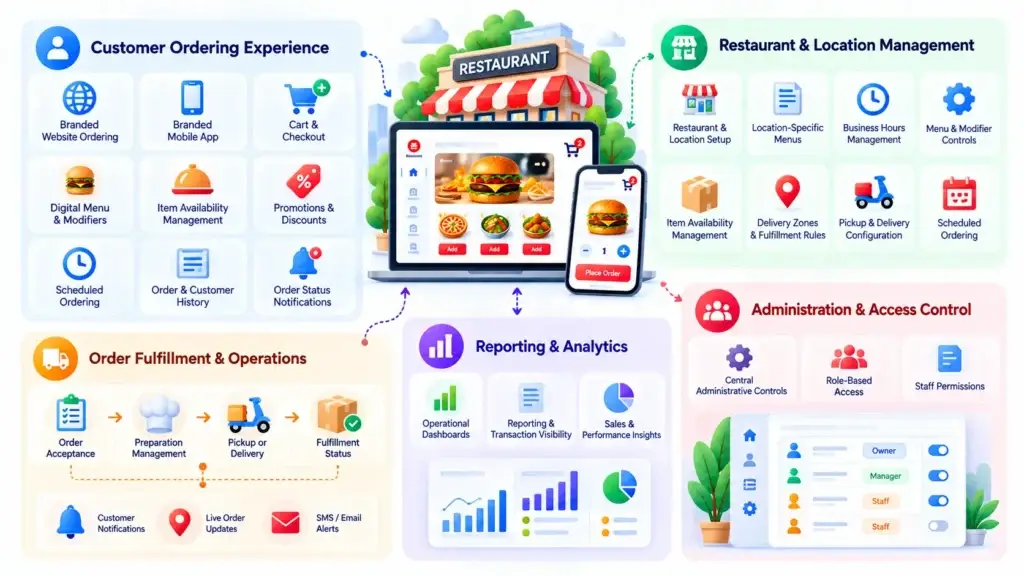
Feature lists can become unnecessarily long. Founders should instead evaluate whether the platform handles the critical order journey reliably.
The most important capabilities usually include:
- Branded web or mobile ordering
- Restaurant and location management
- Digital menu and modifier controls
- Item availability management
- Cart and checkout
- Secure payment gateway integration
- Pickup and delivery configuration
- Delivery zones and fulfillment rules
- Scheduled ordering where required
- Order acceptance and preparation management
- Customer status notifications
- Promotions and discount controls
- Customer and order history
- Restaurant operational dashboards
- Central administrative controls
- Reporting and transaction visibility
- Role-based access where multiple staff members manage operations
Not every restaurant needs every feature on launch day. A single-location takeaway business and a multi-location restaurant technology operator have very different requirements.
The value of these capabilities comes from how well they work together across the customer, restaurant, fulfillment, and administrative sides of the platform. Founders moving from initial category research into product evaluation can assess the required restaurant ordering platform features against their own operating model, rather than selecting functionality simply because it appears on a long feature checklist.
The stronger product decision is to identify the workflows that directly affect ordering and fulfillment first, then add functionality that supports retention, automation, reporting, and expansion.
What Should Founders Evaluate Before Choosing or Building a Platform?
A polished ordering interface can hide weak operational foundations. Founders should therefore evaluate a platform from the moment a customer discovers a menu until the order is completed and any exception is resolved.
Founder Decision Signals
Brand Control
Determine whether restaurants can control their storefront identity, menus, promotions, ordering experience, and customer communication without forcing every location into an inflexible template.
Operational Control
Check whether restaurant teams can manage availability, preparation times, order status, pickup, delivery settings, payments, and exceptions without relying on developers for routine changes.
Fulfillment Flexibility
Evaluate whether pickup, scheduled ordering, restaurant-managed delivery, and other required fulfillment methods can follow separate business rules while remaining manageable from one system.
Growth Readiness
Consider what happens when the business adds locations, restaurants, staff accounts, delivery zones, order volume, promotions, or new integrations. A platform should support growth without turning everyday administration into manual work.
Founders should also test exception scenarios before making a platform decision. Ask what happens when payment succeeds but an item becomes unavailable, when a restaurant pauses orders, when a customer enters an unsupported delivery address, when preparation runs late, or when an order requires a refund.
Once the operational requirements are documented, vendor evaluation becomes easier because founders can compare technical capability against actual business needs. A suitable restaurant ordering development partner should be evaluated around ordering workflows, payment and fulfillment requirements, customization flexibility, administrative control, integration needs, source-code ownership, and the product’s expected growth path.
Those situations reveal more about operational quality than a perfect demonstration order.
Common Mistakes When Planning Direct Restaurant Ordering
Treating the Digital Menu as a Static Catalogue
Menus change constantly. Products sell out, prices change, modifiers vary, promotions expire, and availability differs by location. A platform needs operational menu controls rather than simply attractive product pages.
Building Checkout Without Designing Fulfillment
Accepting payment is only the beginning of the transaction. The platform also needs to communicate the order correctly, support preparation, manage pickup or delivery, and handle exceptions.
Using the Same Rules for Pickup and Delivery
The two order types share a storefront but have different timing, geography, cost, and operational requirements. Treating them identically can create inaccurate delivery promises and confusing workflows.
Ignoring Restaurant-Side Usability
Customers may use the ordering interface for several minutes, but restaurant teams can interact with the operational system throughout an entire shift. Poor restaurant-side UX creates repetitive work and increases the risk of mistakes.
Collecting Data Without a Retention Strategy
Customer information becomes valuable when it improves service, loyalty, communication, and repeat ordering. Simply storing order records without a clear purpose adds little business value.
Planning Only for Successful Orders
Real restaurant operations include failed payments, cancellations, unavailable products, delayed preparation, refund requests, incorrect addresses, and fulfillment disputes. These workflows should be considered from the beginning.
Direct Restaurant Ordering vs a Food Delivery Marketplace
The two models solve different problems.
A marketplace is primarily designed around discovery and aggregation. Customers can browse multiple restaurants inside a common ecosystem, while the platform coordinates transactions and often logistics across participating businesses.
Direct ordering is centered on the restaurant’s own digital relationship with the customer. Discovery may happen elsewhere, but the ordering experience belongs to the restaurant-controlled channel.
| Decision Area | Direct Restaurant Ordering | Marketplace Ordering |
|---|---|---|
| Primary relationship | Restaurant and customer | Platform mediates discovery and ordering |
| Brand visibility | Restaurant-led | Shared marketplace environment |
| Restaurant discovery | Must be generated through brand and marketing channels | Built into marketplace browsing |
| Customer retention | Can connect directly with restaurant-controlled programs | Often influenced by marketplace ecosystem |
| Menu control | Managed within restaurant ordering environment | Managed according to marketplace structure |
| Fulfillment | Can support pickup, own delivery, or connected delivery | Depends on marketplace model |
| Strategic role | First-party ordering and retention | Discovery and incremental demand |
These approaches can coexist. Restaurants may use broader channels for acquisition while encouraging customers who already know the brand to use direct ordering when appropriate.
Where a Ready-Made Restaurant Ordering Foundation Can Help
Building every ordering workflow from zero gives a business extensive design freedom, but it also means developing and testing the customer storefront, restaurant operations, payment flows, fulfillment logic, administrative controls, and other core modules before meaningful market learning can begin.
The financial difference between building from zero and adapting an existing foundation also depends on the selected modules, payment and delivery integrations, branded interfaces, operational requirements, and customization scope. Evaluating the restaurant ordering platform development cost against those requirements gives founders a more useful budgeting framework than treating every restaurant ordering product as an identical software build.
For founders whose differentiation comes from branding, restaurant relationships, regional strategy, pricing, service quality, or a particular operating model, starting from an existing product foundation can shorten that path. The decision between ready-made and custom restaurant ordering development should ultimately depend on how much of the core ordering workflow is already standardized and where the business genuinely needs custom technology to create differentiation.
Miracuves provides a ready-made restaurant ordering solution that can be adapted with branded interfaces, restaurant operations, customer ordering, delivery workflows, administrative control, and source-code ownership. For applicable ready-made deployments, Miracuves offers a 6-day delivery path, allowing founders to spend more time configuring the business for their market rather than rebuilding standard ordering modules from the beginning.
Internal link opportunity: Link the phrase “ready-made restaurant ordering solution” above to the dedicated Miracuves money page. This is intentionally a partial-match, category-focused anchor rather than the money page’s primary target phrase.
The purpose of that solution page is to help founders evaluate the actual product and implementation path. This guide, by contrast, is designed to explain the operating model so founders understand what they should evaluate before reaching that stage.
Final Thoughts: Direct Ordering Is Really About Owning the Customer Journey
A direct restaurant ordering platform is easy to describe as software that lets customers buy food from a restaurant online. In practice, its role is much broader.
The platform connects the restaurant’s digital brand with menu management, checkout, payments, preparation, pickup, delivery, customer communication, and operational control. When these pieces work together, the restaurant gains a digital ordering channel that can support both customer convenience and repeat relationships.
For founders, the important decision is not how many features can be placed into an ordering app. It is whether the platform can reliably move an order from customer intent to restaurant fulfillment while giving the business enough control to adapt its menu, operations, branding, and growth strategy.
That is what separates a simple ordering interface from a useful restaurant commerce platform.
FAQs
What is a direct restaurant ordering platform?
A direct restaurant ordering platform is software that allows customers to order food through a restaurant-controlled digital channel. It can connect branded menus, carts, checkout, payments, restaurant operations, pickup, delivery, notifications, and customer order history in one ordering workflow.
How does online ordering work for a restaurant?
Customers access a digital menu, choose products and modifiers, add them to a cart, select pickup or delivery, provide the required information, and complete checkout. The restaurant receives the order, prepares it, updates its status, and completes fulfillment through pickup or delivery.
Can one restaurant ordering system handle both pickup and delivery?
Yes. A platform can support both, but the workflows should use different operational rules. Pickup focuses primarily on preparation and collection timing, while delivery also requires address eligibility, delivery zones, fees, dispatch, travel time, and additional order-status management.
What is branded online ordering for restaurants?
Branded online ordering provides a restaurant-controlled storefront using its identity, menu, imagery, colors, promotions, and customer experience. Depending on the implementation, customers may order through a website, dedicated ordering page, branded mobile application, QR code, or another restaurant-controlled digital channel.
How are payments processed in a restaurant ordering platform?
Online payments are generally processed through an integrated payment provider. The ordering system sends the transaction for processing and associates the returned payment status with the corresponding order. Exact payment methods and processing requirements depend on the provider and target market.
Does direct restaurant ordering require an in-house delivery fleet?
Not necessarily. A restaurant may offer pickup only, operate its own delivery team, connect external logistics services, or combine different fulfillment methods. The appropriate setup depends on order volume, delivery geography, operational resources, and the restaurant’s business model.
Why is an admin dashboard important for restaurant ordering?
An admin dashboard provides the broader control layer for managing restaurants or locations, users, orders, payments, operational settings, fulfillment rules, reporting, and other platform configurations. This becomes increasingly important as the number of restaurants, locations, users, and orders grows.
Can a direct restaurant ordering platform support multiple locations?
Yes, provided the system is designed for location-level configuration. Each outlet may require its own menu availability, business hours, pricing, delivery zones, preparation settings, promotions, and operational controls while the business maintains centralized administrative visibility.
Miracuves is an independent software development company. We are not affiliated with, connected to, sponsored by, or endorsed by any company or product named in this article.
Terms such as “X Clone” are used descriptively. It is how the software industry refers to building a platform with functionality comparable to a known service, and how clients search for it.
The entire design and codebase of our products is built by our own team. Our products contain no code, design, graphics, or content originating from any third-party website or applications.
All third-party names and marks referenced in this article are the property of their respective owners, referenced solely to identify the services discussed.