



























Key Takeaways
- Cross-border payment platform mistakes is without clearly defining target corridors, supported currencies, FX logic, payout methods, compliance requirements, and transaction limits.
- include unclear transfer fees, weak KYC and AML workflows, unreliable payout partners, poor reconciliation, limited failure handling, and insufficient liquidity planning.
- A reliable international payment product should validate the complete journey from onboarding and beneficiary creation to FX conversion, transfer processing, payout, refund, and settlement before scaling.
Critical Launch Mistakes
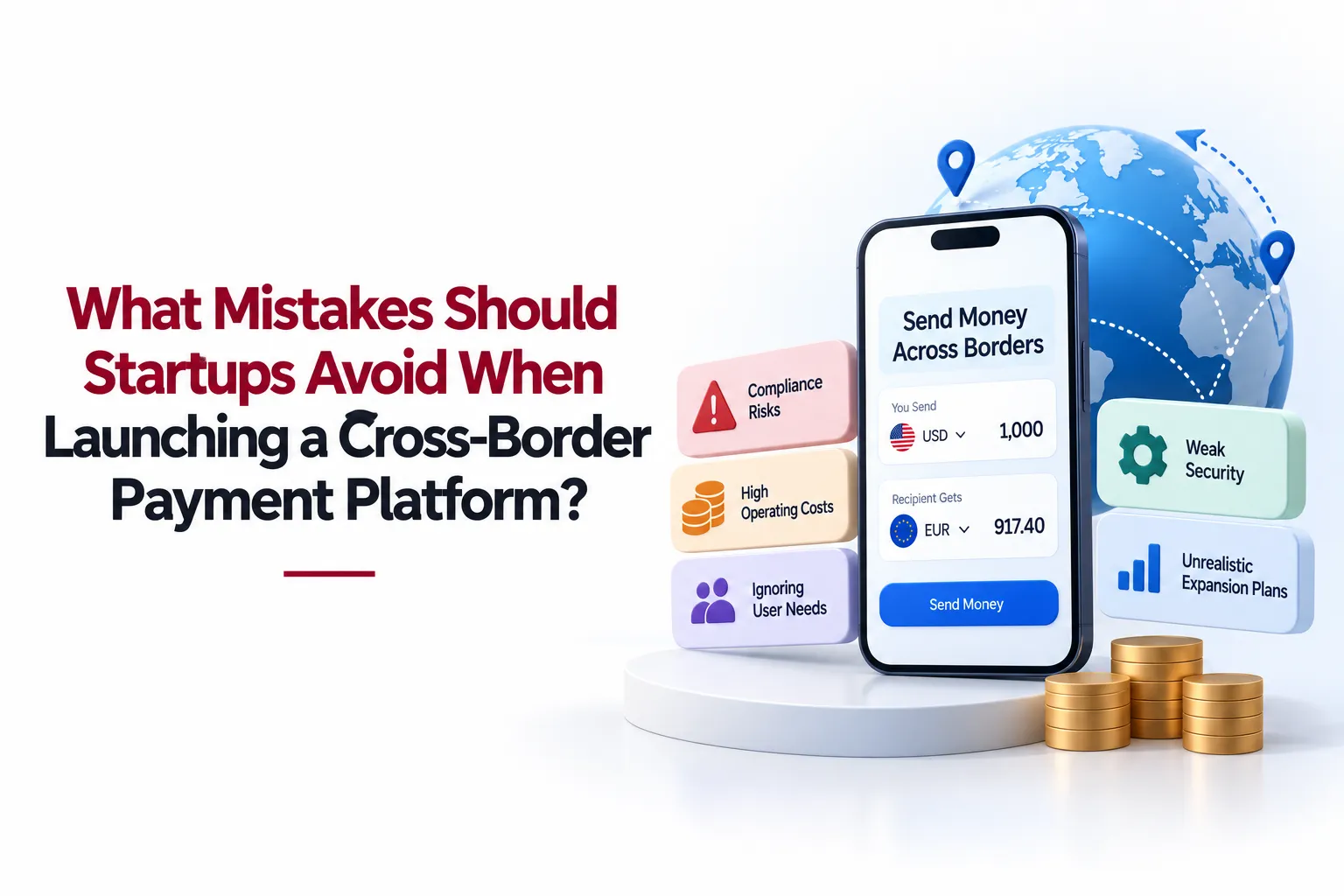
- Supporting too many countries and currencies too early can increase compliance, banking integration, liquidity, FX management, and operational complexity before core corridors are validated.
- Hiding exchange-rate spreads, transfer fees, payout charges, or estimated delivery times can reduce customer trust and create confusion during checkout and transfer confirmation.
- Ignoring failed transfers, rejected beneficiaries, delayed payouts, refunds, duplicate transactions, reconciliation differences, and partner outages can create serious support and settlement problems.
Founder Risk Insights
- Founders should test KYC approval, sanctions screening, transfer limits, FX calculations, beneficiary verification, payout routing, transaction monitoring, refunds, and reconciliation before increasing transaction volume.
- A phased corridor strategy can help teams evaluate transfer success rate, payout speed, support workload, repeat usage, transaction cost, and compliance burden before entering additional markets.
- Miracuves develops customizable cross-border payment platforms with multi-currency transfers, FX management, KYC and AML controls, payout workflows, transaction monitoring, reconciliation, analytics, and admin management.
Launching a cross-border payment platform is not the same as launching a normal payment app.
A local payment product may deal with one currency, one country, one payment environment, and a simpler transaction flow. A cross-border platform has more moving parts: sender verification, recipient details, currency conversion, FX rates, payout rails, settlement, failed transfers, refunds, compliance workflows, fraud monitoring, admin access, and reconciliation.
From the user side, the experience should feel simple. A sender enters an amount, checks the fee, adds a recipient, confirms the transfer, and tracks the payout.
From the founder side, that simple flow requires deep operational planning.
Most fintech mistakes do not happen because founders lack ambition. They happen because the product is planned like a basic wallet instead of a regulated money movement platform. This guide explains the key mistakes startups should avoid before launching a cross-border payment platform.
Why Cross-Border Payment Platforms Fail Differently From Normal Apps
Many startups think the difficult part is building the user interface. That is only the visible layer.
The real difficulty sits behind the transfer flow.
A cross-border payment platform must answer questions such as:
- Who is allowed to send money?
- Which documents are required for verification?
- Which countries and currencies are supported first?
- Which payout rail should be used for each corridor?
- How is the exchange rate calculated?
- How long is an FX quote valid?
- What fee does the user see before confirmation?
- What happens when a payout fails?
- Who can approve a flagged transaction?
- How are refunds handled?
- How are transfers reconciled?
- What should support teams see in the admin dashboard?
When these questions are ignored, the product may look ready but fail under real transaction pressure.
For readers who want to understand the full transfer flow first, this guide explains how cross-border payment platforms work from onboarding to FX, payouts, and admin control.
Mistake 1: Trying to Serve Every Corridor From Day One
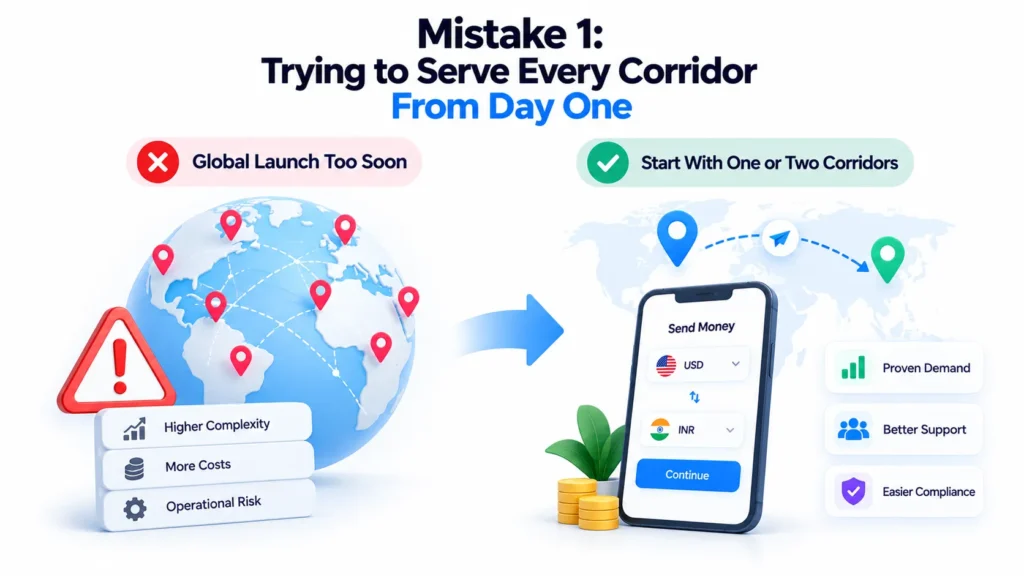
The first mistake is trying to launch globally before one corridor is proven.
A payment corridor is the route between the sending market and receiving market. Each corridor has its own currency pair, user behavior, payment method, payout rail, settlement time, support risk, regulatory expectation, and cost structure.
A startup may want to support many countries immediately, but every added corridor increases complexity.
A corridor can differ by:
- Sending currency
- Receiving currency
- Payment collection method
- Payout rail
- Transfer limits
- KYC requirements
- Delivery timeline
- FX spread
- Refund process
- Support workload
- Partner availability
- Compliance review needs
A focused launch is usually stronger than a broad but fragile rollout.
How to avoid this mistake
Start with one or two priority corridors where demand, payment partners, compliance planning, and payout execution are clear.
Before expanding, confirm:
- Who sends money on this corridor?
- Who receives money?
- How frequently do transfers happen?
- What payout method is expected?
- What fee level can the market accept?
- Which partner or rail supports the flow?
- What verification rules apply?
- How will failed transfers be handled?
- What support questions are likely?
A strong first corridor gives the startup real transaction data. Expansion should happen after the first route works reliably.
Mistake 2: Treating Compliance as a Final Checklist
Compliance is not something to add after development. It shapes the product from the beginning.
A cross-border payment platform may need identity verification, business verification, transaction monitoring, AML workflow support, fraud review queues, transfer limits, sanctions-screening integration support, audit logs, role-based admin access, and reporting workflows.
Final compliance depends on jurisdiction, licensed partners, payment corridors, legal review, integrations, and operating model. Software can support compliance-ready workflows, but it does not replace legal or regulatory planning.
What founders should plan early
Founders should map:
- Individual user verification
- Business verification
- Document collection
- Verification approval rules
- Transfer limits
- High-risk transaction flags
- Manual review workflows
- Audit trails
- Admin permissions
- Suspicious activity review
- Refund and dispute records
- Partner reporting requirements
The platform should support compliance operations before users begin moving money.
Mistake 3: Copying Screens Instead of Solving Transfer Anxiety
Users do not trust a payment platform because the screens look clean. They trust it when every step answers their concerns.
Cross-border transfers create anxiety because users worry about:
- Hidden fees
- Poor exchange rates
- Transfer delays
- Incorrect recipient details
- Failed payouts
- Missing status updates
- Weak support
- Account verification problems
- Currency changes before confirmation
If the product does not reduce this anxiety, users may abandon the transfer before completion.
What a trust-focused transfer experience should include
A strong transfer journey should show:
- Amount sent
- Currency conversion rate
- Service fee
- Recipient amount
- Estimated delivery time
- Payout method
- Recipient details
- Transfer status
- Receipt or confirmation record
- Support path if something goes wrong
The interface should not hide complexity from users in a way that damages trust. It should simplify the experience while making the important details visible.
Mistake 4: Underestimating FX Engine Complexity
A basic currency converter is not an FX engine.
A real FX engine must support rate sources, currency pairs, corridor-specific spread, quote expiry, fee logic, rounding rules, transaction limits, refund calculations, and reporting.
FX affects both trust and revenue. If users see one rate before confirmation and another after payment, they may feel misled. If the operator cannot adjust spread or fee logic by corridor, the platform may struggle to manage margins.
FX and Transfer Logic: What Founders Should Plan
| Platform Layer | Common Mistake | Better Planning Approach |
|---|---|---|
| FX quote | Showing static exchange rates without quote expiry | Use rate validity, refresh logic, and clear confirmation rules. |
| Fee display | Showing fees only after the user starts payment | Show rate, fee, total cost, and recipient amount before confirmation. |
| Corridor pricing | Using the same fee logic for every route | Configure fees and spreads based on corridor economics. |
| Refunds | Ignoring currency changes during failed transfers | Plan refund rules, reversal logic, and user communication clearly. |
| Admin control | Requiring developers to change pricing rules | Give operators control over fees, limits, corridors, and FX spread. |
For deeper product planning, founders can review the cross-border payment platform features needed to support wallets, FX, transfers, compliance workflows, payouts, and admin operations.
Mistake 5: Ignoring Payout Rails and Failed Transfer Handling
Many startups focus on collecting money from the sender but underestimate what happens after confirmation.
The payout side is where many operational issues appear. The platform must route the payout, receive status updates, handle partner delays, manage failed transfers, notify users, and reconcile the final transaction.
A payout may fail because of:
- Incorrect recipient details
- Unsupported bank or wallet route
- Partner downtime
- Compliance review
- Transfer limit issue
- Currency or corridor restriction
- Settlement delay
- User verification problem
- Manual review requirement
The user should not be left confused when this happens.
How to avoid this mistake
Plan the payout lifecycle before launch.
The platform should define:
- Payout route selection
- Status update logic
- Failed transfer states
- Refund workflow
- Support notes
- Partner transaction references
- User notifications
- Admin review queues
- Reconciliation records
If your platform needs secure payment collection, wallet funding, payout routing, or gateway integrations, Miracuves’ payment gateway development service can support the transaction layer behind the product.
Mistake 6: Hiding Fees Instead of Building Pricing Transparency
Hidden fees may increase short-term revenue, but they damage long-term trust.
Users sending money across borders compare rates, fees, delivery times, payout methods, and support reliability. If the pricing feels unclear, users may assume the platform is taking more than it shows.
A transparent transfer review screen should show:
- Send amount
- Receive amount
- Exchange rate
- Platform fee
- Payment method fee if applicable
- Corridor-specific charge if applicable
- Total cost
- Estimated arrival time
- Recipient details
- Final confirmation amount
Transparent pricing does not mean the business cannot earn. It means revenue should be visible, structured, and understandable.
How to avoid this mistake
Define the monetization model before the platform goes live.
Common revenue options include:
- Transfer fees
- FX spread
- Payment links
- Business accounts
- Bulk payouts
- Payroll workflows
- API access
- Premium reporting
- Advanced finance tools
For a deeper breakdown of transfer fees, FX spread, business accounts, payment links, bulk payouts, API access, and reporting-based revenue, review the payment platform business model.
Mistake 7: Launching With Weak Security and Fraud Controls
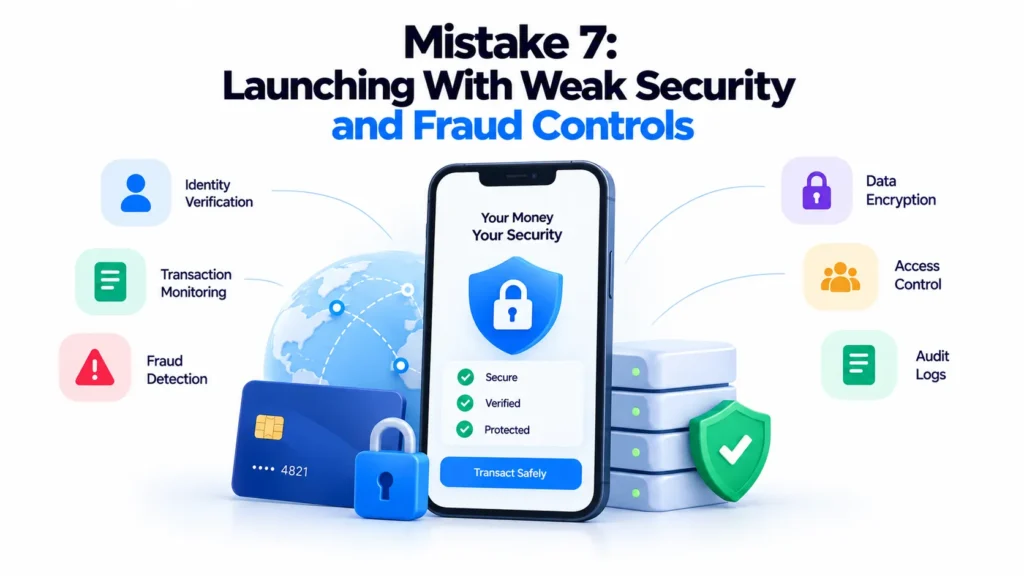
A cross-border payment platform handles identity records, transaction data, recipient details, payment information, wallet balances, and financial activity.
Security cannot be treated as a basic login feature.
A stronger platform should consider:
- Encrypted data transfer
- Encrypted data storage
- Role-based access control
- Two-factor authentication where relevant
- KYC and KYB workflow support
- AML workflow support
- Transaction monitoring
- Suspicious activity flags
- Admin approval controls
- Audit logs
- Device and session monitoring where relevant
- Secure API integration
- Fraud review workflows
- Activity history for users and admins
The goal is not to claim automatic compliance everywhere. The goal is to build a security-conscious and compliance-ready foundation that can be configured for the target market.
Mistake 8: Building Without Admin Visibility
A fintech product cannot run only from the user app.
The admin dashboard is where the operator manages the business. It should provide visibility into users, documents, transactions, fees, FX settings, payout states, refunds, reports, risk flags, disputes, and support issues.
Without admin visibility, the team may struggle to answer basic questions:
- Which transfers are pending?
- Which users failed verification?
- Which payout failed and why?
- Which transaction needs manual review?
- Which corridor is creating support pressure?
- Which fees are configured for each route?
- Which admin changed a transaction status?
- Which refund is still unresolved?
In a money movement business, operational visibility is not optional. It is part of trust.
For a deeper feature-level breakdown, this guide on money transfer app features explains the user, admin, wallet, transfer, and compliance workflows founders should consider.
Founder Decision Signals Before Launch
Corridor Readiness
Start when your first sending and receiving markets are clear, including payout route, expected user behavior, fee logic, and support needs.
Compliance Planning
Launch planning should include KYC, KYB, AML workflow support, audit logs, role-based access, and legal review for the target market.
FX and Fee Clarity
Users should see exchange rate, fee, recipient amount, and estimated delivery time before confirming a transfer.
Operational Control
The admin team should be able to review users, flagged transactions, payout failures, refunds, reports, and corridor-level performance.
Startup Checklist to Avoid Cross-Border Payment Platform Mistakes
Before launch, founders should confirm:
- First corridor and user segment are clearly defined
- KYC and KYB workflows are mapped
- AML and fraud monitoring workflows are planned
- FX rate logic and quote expiry are defined
- Fee display is transparent before confirmation
- Recipient management is reliable
- Payout rail selection is clear
- Failed transfer and refund flows are documented
- Admin dashboard covers users, transfers, reviews, and reports
- Role-based access control is in place
- Audit logs are available for sensitive actions
- Support teams can see transaction status clearly
- Revenue model is connected to corridor economics
- Launch scope is focused enough to operate safely
The safest launch is not the one with the longest feature list. It is the one that can handle real user money movement with clarity, control, and trust.
Mistakes Founders Should Avoid
Choosing the Broader Model Only Because It Looks Bigger
A wider product does not automatically create a better business. More modules can create more revenue paths, but they also increase compliance, support, and operational responsibility.
Ignoring Corridor Economics
For cross-border payments, each corridor has different rail costs, settlement timelines, support needs, risk signals, and profit potential. A blended view can hide weak routes.
Launching Without Admin Control
Founders need visibility over users, verification, transfers, fees, FX, payouts, refunds, risk flags, reports, and support workflows. Without admin control, operations become fragile.
Expanding Before the Core Use Case Repeats
Before adding cards, premium plans, advanced business tools, or extra corridors, founders should prove that users return for the first value proposition.
How Miracuves Helps Founders Launch Cross-Border Payment Platforms
Miracuves helps founders, fintech startups, and agencies launch ready-made and white-label fintech platforms with branded interfaces, admin dashboards, source-code ownership, payment workflows, and customization support.
For founders evaluating a launch-ready remittance product, Miracuves’ cross-border remittance platform can help review wallet flows, FX transfer logic, payout workflows, admin visibility, and compliance-ready controls.
Businesses exploring broader money transfer and payout models can also review Miracuves’ remittance app solutions for related fintech launch paths.
If you are comparing budget and rollout scope, review Miracuves’ guide on Cross-Border Payment Platforms development cost. For vendor evaluation, this page on choosing a fintech development partner can help you understand what to check before selecting a team.
When the ready-made scope fits the rollout requirement, Miracuves can support 6-day solution delivery, helping founders move faster without building every onboarding, wallet, FX, payout, reporting, and admin workflow from zero.
Final Thoughts: Avoiding Mistakes Is Really About Building Trust
The biggest cross-border payment platform mistakes happen when startups focus only on launch speed and interface design.
A money movement platform needs more than clean screens. It needs corridor planning, compliance-ready workflows, reliable FX logic, payout visibility, transparent pricing, fraud monitoring, audit logs, support readiness, and admin control.
The better founder approach is to start with a focused corridor, solve a real transfer problem, build trust into every transaction step, and expand only after the first market works reliably.
A strong platform does not hide complexity from the operator. It organizes complexity so the user experience can stay simple.
FAQs
What are the biggest mistakes startups make when launching a cross-border payment platform?
The biggest mistakes include trying to support too many corridors, delaying compliance planning, copying app screens without solving user trust, underestimating FX complexity, ignoring payout failures, hiding fees, using weak security controls, and launching without admin visibility.
Why should startups start with one payment corridor?
Each corridor has different currencies, payout rails, compliance expectations, transfer costs, support requirements, and user behavior. Starting with one focused corridor helps the startup validate demand and reduce operational risk.
Why is compliance planning important before launch?
Compliance planning affects onboarding, verification, transaction monitoring, AML workflow support, transfer limits, audit logs, admin roles, and reporting. It should shape the platform before users begin moving money.
What should an FX engine handle?
An FX engine should handle currency pairs, exchange-rate display, operator-set spread, quote expiry, fee logic, rounding, transaction limits, refund calculations, and corridor-level reporting.
Why is transparent pricing important in international transfers?
Transparent pricing helps users understand the exchange rate, platform fee, recipient amount, payment method cost, and expected delivery time before they confirm the transfer. This improves trust and reduces support friction.
What security features should a payment platform include?
A payment platform should consider encrypted data transfer, encrypted storage, role-based access control, KYC/KYB workflows, AML workflow support, fraud monitoring, suspicious activity flags, audit logs, secure API integration, and admin approval controls.
Why is the admin dashboard important?
The admin dashboard helps operators manage users, verification cases, transactions, payouts, refunds, fees, FX settings, reports, risk flags, and support issues. Without admin visibility, operations become difficult to scale.
Can Miracuves help launch a cross-border payment platform faster?
Yes. Miracuves helps founders launch ready-made and white-label fintech platforms with branded design, admin control, source-code ownership, and configurable workflows. A 6-day launch may apply when the ready-made scope matches the rollout requirement.
Miracuves is an independent software development company. We are not affiliated with, connected to, sponsored by, or endorsed by any company or product named in this article.
Terms such as “X Clone” are used descriptively. It is how the software industry refers to building a platform with functionality comparable to a known service, and how clients search for it.
The entire design and codebase of our products is built by our own team. Our products contain no code, design, graphics, or content originating from any third-party website or applications.
All third-party names and marks referenced in this article are the property of their respective owners, referenced solely to identify the services discussed.