Key Takeaways
- A cross-border payment platform marketing strategy should begin before launch by validating transfer corridors, target users, pricing expectations, trust requirements, and customer acquisition channels.
- Pre-launch marketing focuses on awareness, waitlists, partnerships, educational content, corridor demand, and early trust, while post-launch marketing shifts toward KYC completion, first transfers, repeat transactions, and referrals.
- Fintech startups should connect both phases because strong positioning, transparent FX messaging, and early user education can make post-launch acquisition and activation more efficient.
Pre-Launch Marketing Signals
- SEO content, corridor-specific landing pages, waitlists, financial communities, partnerships, referral programs, and educational campaigns can help build early demand for international transfers.
- Marketing should clearly explain exchange rates, transfer fees, payout methods, expected processing times, supported currencies, security, and compliance to reduce uncertainty before signup.
- Track waitlist growth, lead quality, corridor interest, landing-page conversion, partner signups, acquisition cost, content engagement, and early KYC intent to measure market readiness.
Post-Launch Growth Insights
- After launch, campaigns should focus on KYC completion, first funded transfer, beneficiary creation, successful payout, repeat transfers, referrals, and reactivation of inactive users.
- Lifecycle messaging, rate alerts, fee transparency, referral incentives, corridor-specific offers, transfer reminders, and personalized communication can support retention and repeat transaction behavior.
- Miracuves develops customizable cross-border payment platforms with multi-currency transfers, FX management, KYC workflows, payouts, referrals, notifications, analytics, compliance controls, and admin management.
Launching a cross-border payment platform is not only a product challenge. It is a trust challenge.
Users are not simply downloading another app. They are sharing identity details, checking exchange rates, adding recipients, moving money, and expecting transfer visibility. Businesses may also use the platform for vendor payments, contractor payouts, payroll, invoices, or multi-currency financial operations.
That is why marketing cannot start after the product goes live.
Pre-launch marketing builds awareness, credibility, waitlist demand, corridor understanding, and product confidence before users can transact. Post-launch marketing turns that early trust into verified accounts, first transfers, repeat usage, referrals, and long-term retention.
The best fintech startups do not treat marketing as a separate activity from product readiness. They connect messaging with onboarding, KYC, FX transparency, payout speed, fee clarity, support workflows, and admin visibility.
Why Marketing a Cross-Border Payment Platform Is Different
A normal consumer app can often win early attention with design, convenience, or discounts. A fintech platform needs more.
Before users send money, they want to understand:
- Is the platform trustworthy?
- What exchange rate will I get?
- What fees will be charged?
- How long will the transfer take?
- What documents are required?
- How will the recipient receive money?
- What happens if a transfer fails?
- Is support available if something goes wrong?
- How is my financial information handled?
This means fintech marketing must explain value and reduce anxiety at the same time.
A cross-border payment platform should not simply say “send money globally.” That message is too broad. Stronger marketing explains the exact audience, transfer corridor, use case, and trust promise.
For example, the platform may target:
- Freelancers receiving international payments
- Migrant families sending money home
- SMEs paying overseas vendors
- Agencies managing multi-currency client payments
- Remote teams handling contractor payouts
- Students receiving family support across countries
- Marketplaces managing seller or partner payouts
Each audience needs different messaging. A freelancer may care about payout clarity. A business may care about approval workflows and reporting. A family sender may care about speed, simplicity, and recipient trust.
What Pre-Launch Marketing Should Prioritize
Pre-launch marketing happens before the platform is publicly available. The goal is not only to create noise. The goal is to build confidence before asking users to share identity data or move money.
A strong pre-launch strategy should answer five questions:
- Who is the platform for?
- Which corridor or payment problem does it solve first?
- Why should users trust it?
- What product proof can be shown before launch?
- What user intent can be collected before the app goes live?
Build a Corridor-Specific Landing Page Before Launch
Many fintech startups make their landing page too broad. They describe themselves as a global money transfer platform without explaining the first market they will serve.
A stronger landing page should focus on the first practical use case.
Instead of saying:
“Send money anywhere.”
A clearer message could say:
“Help freelancers receive international payments with transparent fees and transfer tracking.”
Or:
“Support family transfers from one priority sending market to one priority receiving market.”
The landing page should include:
- Target audience
- Priority corridor or use case
- Core transfer problem
- Expected product benefit
- Waitlist form
- Demo preview or screenshot
- Verification explanation
- Fee and FX transparency message
- Support and dispute guidance
- Compliance-safe disclaimer
- CTA for early access or consultation
Pre-launch traffic should teach you something. If users join the waitlist, ask where they send money from, where they send money to, whether they are individuals or businesses, and what matters most: fees, speed, transparency, payouts, or reporting.
Create a Waitlist That Collects Useful Launch Data
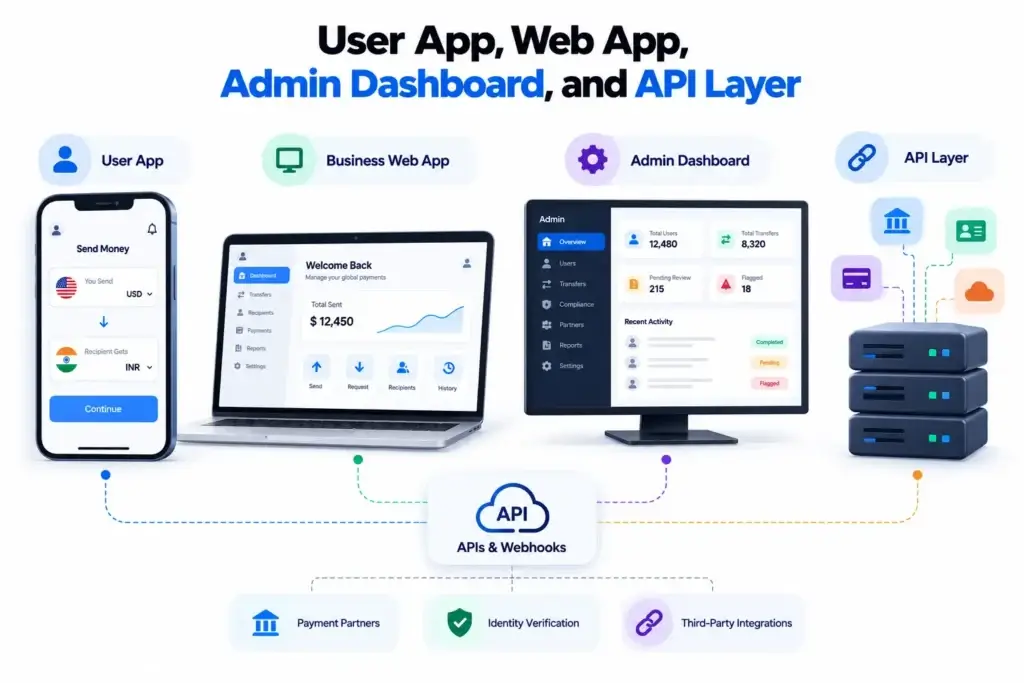
A waitlist should not only collect names and emails. It should help the founder understand demand.
Ask practical questions such as:
- Which country do you send money from?
- Which country should the recipient receive money in?
- Are you an individual, freelancer, business, student, or finance team?
- How often do you send or receive international payments?
- What frustrates you most about your current option?
- Do you care more about fees, speed, payout method, or tracking?
- Would you use the product for personal transfers or business payments?
This gives the marketing team stronger segmentation and gives the product team better launch signals.
If many users choose the same route, that corridor may deserve priority. If businesses show more interest than individuals, the messaging should include invoicing, payment requests, vendor payouts, approvals, and reporting.
Segment Pre-Launch Messaging by User Type
A cross-border payment product should not speak to every user the same way. Different users have different fears and expectations.
Pre-Launch Messaging by Audience Segment
| Audience Segment | Primary Concern | Pre-Launch Message Angle |
|---|---|---|
| Freelancers | Receiving international payments clearly | Explain payout visibility, currency conversion, transaction records, and client payment convenience. |
| SMEs | Managing vendors and business payouts | Highlight bulk transfers, business accounts, approval workflows, reporting, and finance-team control. |
| Migrant families | Reliable family transfers | Focus on simple recipient setup, transfer tracking, fee clarity, and support access. |
| Students | Receiving or sending funds across countries | Explain easy onboarding, transfer notifications, saved recipients, and transparent costs. |
| Agencies | Managing multi-currency client and contractor flows | Position the product around payment organization, account roles, statements, and workflow visibility. |
Segmentation makes early communication more useful. Users should feel that the platform understands their specific money movement problem.
Build Trust Before Running Heavy Paid Ads
Paid ads can drive traffic, but fintech users need proof before they convert.
Before spending heavily on acquisition, prepare:
- Landing page copy
- Product screenshots
- Demo walkthrough
- Waitlist form
- Security and verification explanation
- Clear pricing or fee positioning
- FAQ section
- Support workflow explanation
- Email nurturing sequence
- Compliance-safe messaging
- Founder or product updates
Do not promise guaranteed lowest fees, instant transfers everywhere, full compliance in every country, or approval in regulated markets unless those claims are verified and supported by the operating model.
Good pre-launch marketing is clear, practical, and honest. It builds credibility instead of hype.
Connect Pre-Launch Marketing With Product Readiness
Marketing should never promise what the product cannot support.
Before launch, the founder should confirm whether the platform can support the claims being made in landing pages, ads, investor conversations, and demo calls.
Important product readiness areas include:
- User onboarding
- KYC or KYB flow
- Multi-currency wallet experience
- Recipient management
- FX quote display
- Fee transparency
- Transfer tracking
- Notifications
- Admin dashboard
- Transaction monitoring
- Refund and support workflows
- Reporting and analytics
- Role-based access control
Founders planning product-led marketing can review the cross-border payment platform features needed to support user, business, compliance, finance, and admin workflows.
For a deeper feature-level explanation, this guide on money transfer app features can help founders understand which modules should support launch messaging.
What Post-Launch Marketing Should Prioritize
After launch, the marketing goal changes.
You are no longer only building awareness. You are trying to move users through measurable financial actions.
Post-launch marketing should focus on:
- Account creation
- Verification completion
- First transfer
- Recipient saved
- Payment method added
- Repeat transfer
- Referral sent
- Support satisfaction
- Trust recovery after failed or delayed transfers
- Business account activation
- Retention and reactivation
A fintech app does not win because users install it. It wins when users complete important money movement actions and return because the experience feels reliable.
Founder Decision Signals
Trust Before Traffic
Pre-launch marketing should build credibility before paid traffic begins. Users need to understand fees, verification, transfer visibility, and support before they move money.
Activation Over Installs
Post-launch marketing should focus on KYC completion, first transfer, recipient setup, and repeat transactions instead of only app downloads.
Corridor Clarity
Marketing should explain the priority sending and receiving markets clearly. Broad “send money globally” messaging is weaker than corridor-specific positioning.
Product-Market Alignment
Every campaign should match what the platform can actually support, including FX visibility, payout routing, admin workflows, and compliance-ready controls.
Improve KYC Completion With Lifecycle Messaging
Many users drop off during verification because they do not understand why documents are required, how long the process takes, or what happens next.
Treat KYC as a customer experience moment, not only a compliance step.
Use email, push, SMS, or in-app messages to explain:
- Why verification is required
- What documents are needed
- How long review may take
- How the user will be notified
- What features unlock after approval
- How data is handled
- Where to get support
The tone matters. Do not make verification feel like a barrier. Make it feel like a trust step that protects the user and the platform.
Drive First Transfer Conversion
A verified user is valuable, but the real activation moment is the first successful transfer.
Post-launch campaigns should help users complete that step with clarity.
Useful tactics include:
- First-transfer reminder emails
- Recipient setup prompts
- Transfer fee explainers
- FX quote education
- Saved-recipient guidance
- First-transfer support content
- In-app walkthroughs
- Corridor-specific transfer guides
- Trust messages around payment status
- Notifications when the transfer is completed
The first transfer is where marketing, product, support, compliance, and operations meet. If the user gets confused, they may not come back.
Use Retargeting Based on User Intent
Post-launch retargeting should not use the same message for every visitor.
A user who visited the landing page needs a different message from a user who started verification but dropped off.
| User Behavior | Better Retargeting Message |
|---|---|
| Visited landing page but did not sign up | Join the waitlist or view the product walkthrough |
| Started signup but did not verify | Complete verification to unlock transfers |
| Verified but did not send money | Set up your first recipient and check your transfer quote |
| Added recipient but did not confirm transfer | Review rate, fee, and expected arrival before sending |
| Completed first transfer | Save your recipient for faster repeat transfers |
| Business user viewed product pages | Book a business payments walkthrough |
| Dormant user | See what has changed since your last visit |
Retargeting should guide the user to the next meaningful action, not simply push downloads.
Build Referral Campaigns Around Real Transfer Value
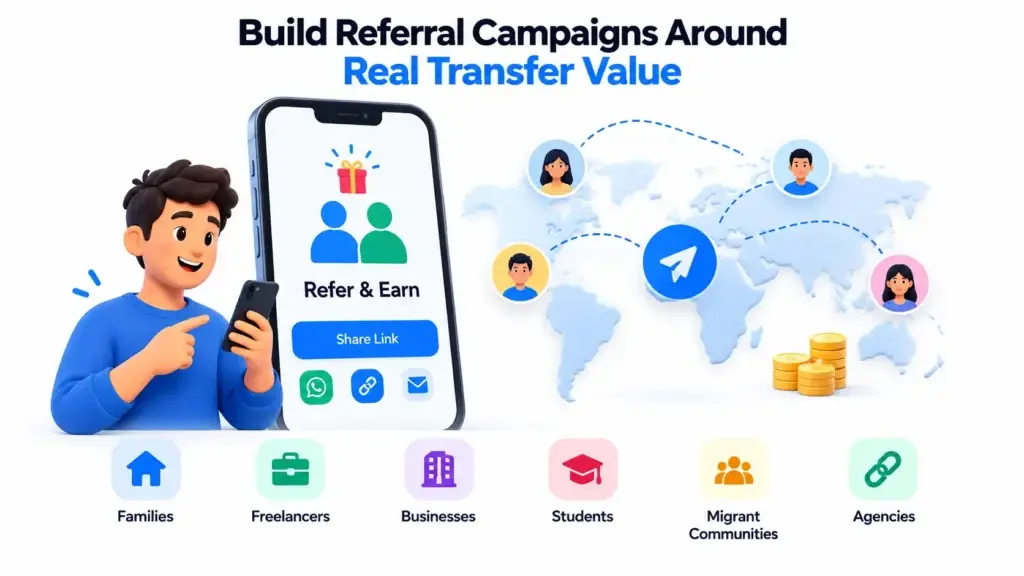
Referral programs can work well for money transfer platforms, but only after users trust the experience.
A user is more likely to refer the platform when:
- The first transfer worked smoothly
- Fees were clear
- Status tracking was visible
- Support was responsive
- The recipient experience was reliable
- The product solved a real recurring need
Referral campaigns can be built around:
- Family transfers
- Freelancer communities
- Business finance teams
- Student groups
- Migrant communities
- Agencies and contractor networks
- Corridor-specific user groups
Rewards should be designed carefully based on target market rules, business model, and legal review.
Publish Educational Content After Launch
Post-launch content should not only announce features. It should reduce confusion and increase trust.
Useful content topics include:
- How international transfers work
- How exchange rates affect received amount
- How fees are calculated
- How to prepare for verification
- How to add a recipient safely
- How business payouts work
- How freelancers can receive international payments
- How to track transfer status
- What to do if a transfer is delayed
- How to keep financial account access secure
This content supports SEO, reduces support pressure, and gives users confidence before they transact.
Pre-Launch vs Post-Launch Marketing: Practical Comparison
| Area | Pre-Launch Marketing | Post-Launch Marketing |
|---|---|---|
| Main Goal | Build trust, awareness, waitlist demand, and corridor clarity | Convert users into verified accounts, first transfers, repeat usage, and referrals |
| Primary Audience | Early adopters, niche communities, corridor users, partners, investors | Registered users, verified users, active senders, businesses, dormant users |
| Best CTA | Join waitlist, request demo, get early access, book consultation | Complete verification, send first transfer, save recipient, refer users |
| Core Content | Landing pages, explainers, product previews, trust content, email sequences | Lifecycle emails, app store content, referral campaigns, support guides, retention content |
| Main Risk | Overpromising before product readiness | Chasing installs without activation or retention |
| Metrics to Track | Waitlist signups, segment demand, demo requests, corridor interest, email engagement | KYC completion, first transfer, repeat transfers, referral rate, churn, support tickets |
| Founder Priority | Validate audience and message | Improve conversion and transaction behavior |
The strongest launch strategy uses both stages. Pre-launch creates the trust base. Post-launch turns that trust into measurable product growth.
Metrics Fintech Startups Should Track After Launch
Marketing performance should not stop at traffic or installs.
A cross-border payment platform should track:
- Website conversion rate
- Waitlist-to-signup conversion
- Signup completion
- KYC/KYB completion
- First transfer rate
- Recipient setup rate
- Transfer success rate
- Failed transfer rate
- Repeat transfer frequency
- Average transaction value
- Corridor-level activity
- Referral participation
- Customer support response time
- Dormant user reactivation
- Business account activation
- Churn or inactivity rate
For monetization planning, review the payment platform business model to compare transfer fees, FX spread, business accounts, payment links, bulk payouts, API access, and reporting-based revenue paths.
Common Marketing Mistakes Founders Should Avoid
Starting Marketing Only After Launch
Fintech users need trust before they move money. Waiting until launch means paid traffic may arrive before the market understands your value, verification flow, fees, or support process.
Using Generic “Send Money Globally” Messaging
Broad messaging does not explain why a specific audience should trust your platform. Corridor, use case, pricing clarity, and user segment should shape the message.
Promising More Than the Product Can Support
Do not claim instant transfers, guaranteed lowest rates, or universal compliance unless the product, partners, rails, and legal structure support those claims.
Measuring Only Installs
A fintech launch should track verification, first transfer, repeat usage, referrals, support satisfaction, and retention. Downloads alone do not prove trust.
Ignoring the Admin and Operations Layer
Marketing may generate demand, but operations must handle users, documents, transactions, flags, refunds, reports, and support. Growth without control becomes risky.
Founders can also review these mistakes fintech founders should avoid before planning corridors, compliance workflows, FX logic, payout operations, and launch campaigns.
Why Payment Infrastructure Should Support Marketing Claims
Marketing and payment infrastructure must stay aligned.
If your ads promise fast payouts, the product should support the payout route. If your landing page promises business payments, the dashboard should support business workflows. If your content talks about transparency, the app should show exchange rate, fee, recipient amount, and status before the user commits.
If your platform needs payment collection, wallet funding, gateway integrations, or payout routing, Miracuves’ payment gateway development service can support the transaction layer behind the product.
This does not mean every feature should be built before launch. It means your marketing should match your launch scope.
How Miracuves Helps Founders Plan Product-Led Fintech Marketing
Miracuves helps founders, fintech startups, and agencies launch ready-made and white-label cross-border payment platforms with admin control, branded design, source-code ownership, and configurable workflows.
A stronger launch plan connects product and marketing from the beginning.
That means:
- Pre-launch messaging is based on real product flows
- Landing pages show actual user journeys
- Waitlists collect corridor and audience data
- Demo calls explain admin control clearly
- Marketing claims stay aligned with compliance-ready workflows
- Post-launch campaigns guide users toward verification and first transfer
- Retention content supports repeat money movement
For founders evaluating a launch-ready product foundation, Miracuves’ cross-border remittance platform can help review multi-currency wallet flows, FX transfer logic, payout workflows, admin visibility, and compliance-ready controls.
Businesses exploring broader money transfer and payout models can also review Miracuves’ remittance app solutions for related fintech launch paths.
If you are comparing budget and delivery scope, review Miracuves’ guide on remittance platform development cost. For vendor evaluation, this page on choosing a fintech development partner can help you understand what to check before selecting a team.
When the ready-made scope fits the rollout requirement, Miracuves can support 6-day solution delivery, helping founders move faster without building every onboarding, wallet, FX, payout, reporting, and admin workflow from zero.
Final Thoughts: Market Trust Before Launch, Then Market Behavior After Launch
Pre-launch and post-launch marketing both matter, but they solve different problems.
Pre-launch marketing builds trust before users can transact. It helps founders validate audience demand, explain corridor value, collect waitlist data, prepare product proof, and position the platform carefully.
Post-launch marketing turns that trust into action. It improves verification completion, first transfer conversion, referral activity, repeat transactions, retention, and support confidence.
For a cross-border payment platform, the best marketing strategy is not only about ads, content, or app store keywords. It is about connecting every message to a product reality: fees, FX clarity, KYC, payout tracking, security, admin control, customer support, and operational reliability.
The fintech startups that grow stronger are the ones that market trust first, then optimize real transaction behavior after launch.
FAQs
What is pre-launch marketing for a cross-border payment platform?
Pre-launch marketing is the work done before the platform goes live to build awareness, trust, waitlist demand, product education, and audience clarity. For fintech startups, it should explain the target users, corridor focus, verification process, transfer value, and trust signals.
What is post-launch marketing for a fintech payment platform?
Post-launch marketing focuses on converting users after the app is live. It includes onboarding, KYC completion, first transfer conversion, recipient-saving prompts, referrals, lifecycle messaging, app store optimization, retention campaigns, and support education.
Which is more important: pre-launch or post-launch marketing?
Both matter. Pre-launch marketing builds trust and demand before users can transact. Post-launch marketing turns that trust into verified accounts, first transfers, repeat usage, referrals, and retention.
What should a fintech landing page include before launch?
Startups can improve KYC completion with clear lifecycle messaging, document guidance, status updates, security explanations, expected review timelines, and easy support access.
How can fintech startups improve KYC completion after launch?
Startups can improve KYC completion with clear lifecycle messaging, document guidance, status updates, security explanations, expected review timelines, and easy support access.
What marketing metrics should a cross-border payment startup track?
Track website conversion, waitlist signups, signup completion, KYC completion, first transfer rate, recipient setup, repeat transfer frequency, referral activity, support resolution, corridor activity, and dormant user reactivation.
Should fintech startups run paid ads before launch?
Paid ads can be useful before launch, but only when the landing page, waitlist, product proof, trust messaging, and audience segmentation are ready. Otherwise, ad spend may produce low-quality traffic.
Can Miracuves help launch a cross-border payment platform faster?
Yes. Miracuves helps founders launch ready-made and white-label fintech platforms with admin control, branded design, source-code ownership, and configurable workflows. A 6-day launch may apply when the ready-made scope matches the rollout requirement.
Miracuves is an independent software development company. We are not affiliated with, connected to, sponsored by, or endorsed by any company or product named in this article.
Terms such as “X Clone” are used descriptively. It is how the software industry refers to building a platform with functionality comparable to a known service, and how clients search for it.
The entire design and codebase of our products is built by our own team. Our products contain no code, design, graphics, or content originating from any third-party website or applications.
All third-party names and marks referenced in this article are the property of their respective owners, referenced solely to identify the services discussed.