Key Takeaways
What You’ll Learn
- Sending every frame wastes money because many video frames repeat the same scene.
- Smart frame sampling lowers API use by keeping only meaningful visual changes.
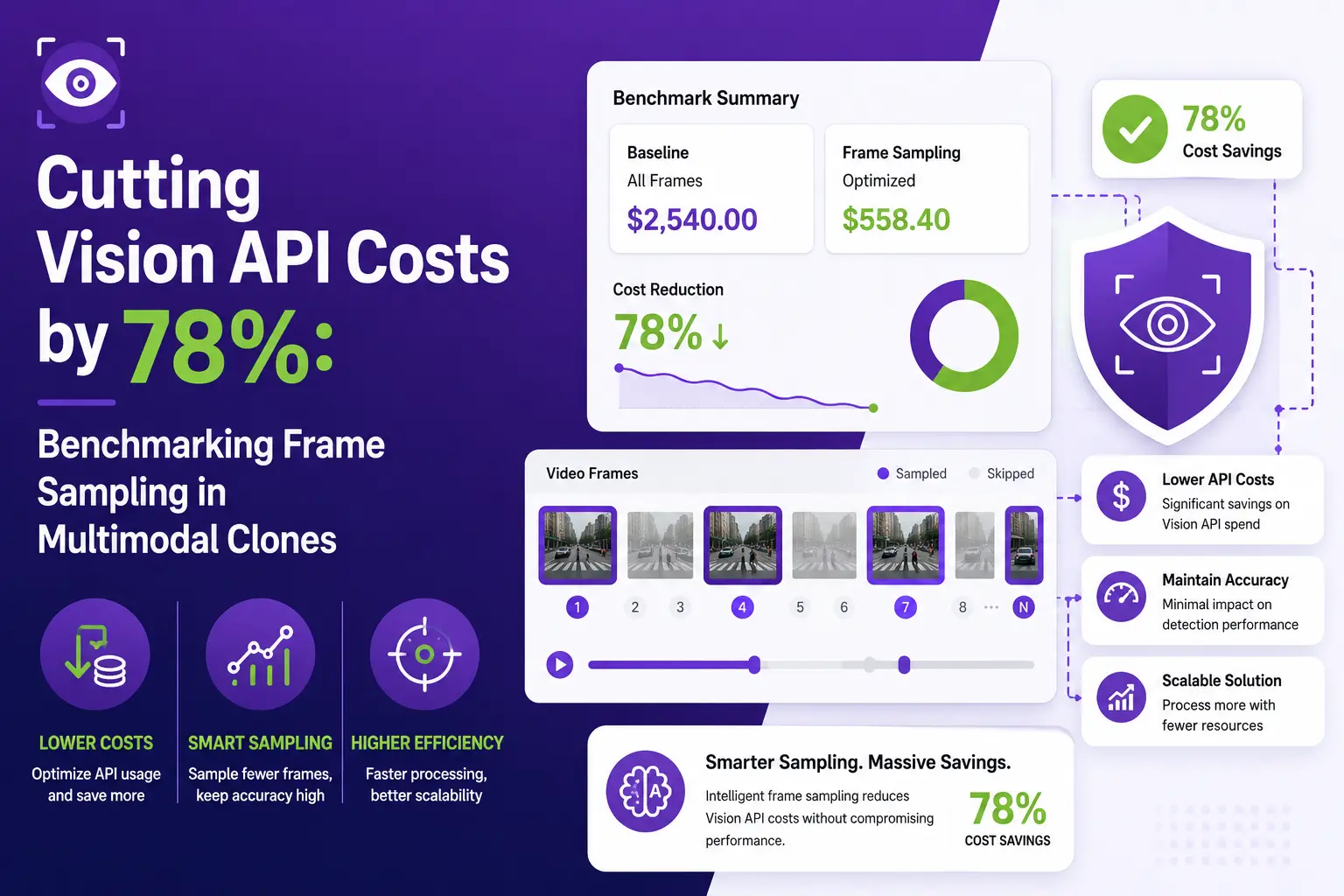
- The benchmark reduced vision costs by 78% compared with the baseline pipeline.
- Local filtering improves control before frames reach an external AI model.
- The main lesson is to reduce calls without losing important context.
Stats That Matter
- Only 22 frames were sent for every 100 frames sent by the baseline.
- External vision submissions fell by 78% in the normalized benchmark.
- Duplicate frame submissions dropped through motion and similarity checks.
- Frame sampling improves cost predictability by controlling the retained-frame ratio.
- Results can vary by video type, motion, resolution, thresholds, and model choice.
Real Insights
- Lower resolution is not enough because it reduces cost per image, not image count.
- Aggressive sampling can miss events such as short actions, text changes, or safety issues.
- Quality must be tested using event recall, false negatives, and human review.
- Dashboards should track usage including frames, tokens, retries, and cost per video.
- For founders, build a multimodal AI platform around intelligent frame sampling, model routing, usage limits, and cost monitoring.
Adding vision to a SaaS product creates an uncomfortable financial equation.
A text request may contain a predictable number of tokens. A video request can contain thousands of possible images before the system has generated a single answer. When every candidate frame is uploaded to an external vision model, an apparently simple feature—such as summarizing a product demonstration, moderating a creator video, or powering visual analysis inside a ChatGPT clone—can trigger hundreds of billable image inputs.
That is the vision token tax.
It does not become dangerous because one image is prohibitively expensive. It becomes dangerous because redundant frames are processed repeatedly across every video, every user, and every billing cycle.
OpenAI converts image inputs into tokens and charges according to the selected model’s token rules. Anthropic similarly counts each submitted image toward token consumption, with visual-token volume affected by image dimensions and model limits.
The infrastructure question is therefore not only:
Which vision model is less expensive?
A more important question is:
How many frames genuinely need to reach that model?
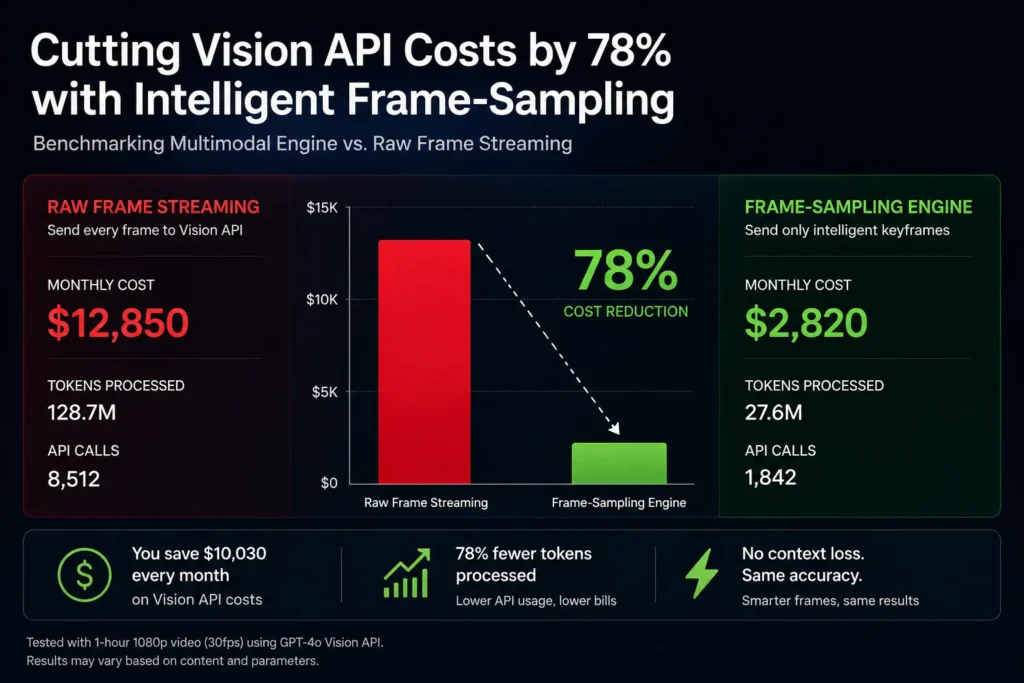
In Miracuves’ proprietary benchmark, an intelligent frame-sampling throttle reduced external vision API ingestion costs by 78% compared with a pipeline that submitted every frame selected by its baseline ingestion script.
The saving came from eliminating repeated visual information before the external API call—not from asking the model to do less reasoning after receiving it.
The Vision Token Tax: Why Video Processing Can Break an AI Startup’s Unit Economics
A video is not one input.
At 30 frames per second, a one-minute video contains 1,800 native frames. A ten-minute video contains 18,000. Most multimodal SaaS products do not submit every native frame, but even a reduced baseline of one image per second produces 600 candidate images for a ten-minute recording.
Multiply that by:
- Daily active users
- Videos processed per user
- Average video duration
- Retry calls
- Multiple analysis prompts
- Moderation passes
- Search indexing
- Regenerated summaries
- Higher-resolution analysis for uncertain events
The resulting API demand can grow faster than subscription revenue.
A founder may initially model the feature as “one video analysis.” The provider bill sees hundreds of image inputs, associated text prompts, model outputs, and possible follow-up calls.
The operational risk is hidden during product validation
Early usage often makes inefficient architecture look affordable. A team processing 100 short videos per month may tolerate redundant calls. At 10,000 or 100,000 videos, the same ingestion policy becomes a structural gross-margin problem.
This creates a dangerous SaaS pattern:
- The visual feature improves adoption.
- Higher adoption increases processed video minutes.
- Each minute produces excessive external API calls.
- Cost per customer rises with engagement.
- The company’s most active users become its least profitable users.
That is why vision cost control belongs in the product foundation, not in a later cloud-cleanup exercise.
Read more: How to Develop a Multimodal AI Chatbot Model Platform (2026 Guide)
The Cost Equation Founders Should Monitor
A simplified monthly vision-ingestion model is:
Monthly vision cost =
processed video minutes
× candidate frames per minute
× retained-frame ratio
× average visual tokens per frame
× model input-token rate
A production model should also include:
+ text prompt tokens
+ output tokens
+ retries
+ secondary-model calls
+ embedding or similarity costs
+ storage and network transfer
+ orchestration costs
The retained-frame ratio is the variable most teams fail to treat as a product control.
If a fixed sampler generates 60 candidate frames per minute and the throttle retains only 22% of them, external vision calls fall by 78%, assuming comparable image settings, prompts, retries, and model pricing.
Normalized example
| Pipeline | Candidate Frames | Frames Sent Externally | Relative Ingest Cost |
|---|---|---|---|
| Baseline ingestion | 100 | 100 | 100 cost units |
| Intelligent frame sampling | 100 | 22 | 22 cost units |
| Reduction | — | 78 fewer frames | 78% |
This table expresses the supplied benchmark as a normalized index. It does not claim that every workload will achieve the same saving. Actual results depend on motion density, scene frequency, UI activity, video style, resolution, model choice, and sampling thresholds.
Intelligent Frame Sampling vs Continuous or Blind Frame Submission
Not all frame-reduction methods offer the same balance of cost and context.
1. Native or near-continuous frame processing
This approach sends a dense frame sequence to the model or to an intermediary that still bills according to the submitted visual content.
It may be useful for specialized real-time workloads, but it is usually unsuitable for ordinary SaaS tasks such as:
- Video summarization
- Lecture indexing
- Product-demo analysis
- Meeting recording search
- Creator-content classification
- Basic visual moderation
- Property-video tagging
- Support-session review
Successive video frames often differ by only a few pixels. Paying a general-purpose vision model to rediscover the same scene repeatedly adds cost without equivalent informational value.
2. Fixed-interval sampling
A fixed sampler may keep one frame every second, every three seconds, or every five seconds.
This is simpler and substantially better than processing native frame rates. However, it has two weaknesses:
- It still captures repeated frames during static scenes.
- It can miss a short but important event between sampling points.
A five-second interval might retain five nearly identical presentation slides and miss the half-second error message that appeared between them.
3. Change-aware intelligent sampling
A change-aware sampler treats the interval as a ceiling, not the sole decision rule.
It evaluates candidate frames using signals such as:
- Pixel or feature-level motion
- Scene-boundary detection
- Perceptual similarity
- Embedding distance
- OCR or text-region change
- Object appearance or disappearance
- UI-state change
- Audio-event alignment
- Maximum time since the last retained frame
Only frames that cross a defined threshold—or are required by a safety interval—reach the external model.
AWS documents a comparable architectural principle: sample frames, remove similar or redundant images, and then apply a multimodal foundation model. Its example uses either semantic embeddings or OpenCV ORB feature matching, depending on the desired balance between semantic sensitivity, latency, and additional API cost.
Video Ingestion Strategy Comparison
| Strategy | Cost Behaviour | Context Risk | Best Fit |
|---|---|---|---|
| Dense frame submission | Very high and directly tied to duration and frame density | Low omission risk but heavy duplication | Specialized high-frequency monitoring where every movement matters |
| Fixed-interval sampling | Predictable but continues to bill for static or repeated scenes | Can miss brief events between intervals | Simple prototypes and visually consistent recordings |
| Change-aware frame sampling | Adapts call volume to informational change | Depends on threshold design and fallback rules | Scalable SaaS video analysis and multimodal assistants |
| Shot-based segmentation | Processes meaningful clips rather than isolated images | Higher temporal context but potentially heavier input | Narrative understanding and action analysis |
How the Frame-Sampling Throttle Works
The throttle sits between video decoding and the external vision provider.
Its purpose is not to understand the complete video itself. Its purpose is to estimate whether a candidate frame contains enough new information to justify a paid model call.
Step 1: Decode at a controlled candidate rate
The engine first avoids processing all native frames. It decodes candidates at a configurable rate based on the use case.
A lecture or screen recording might begin with a relatively low candidate rate. A sports clip, machinery feed, or fast interface demonstration may require denser candidates.
Step 2: Compare the frame with recently retained context
The engine calculates one or more change signals:
motion_score
scene_distance
perceptual_similarity
text_change_score
object_change_score
time_since_last_retained_frame
A lightweight local method can reject obvious duplicates without triggering another paid AI request.
Step 3: Apply the throttle policy
A simplified decision rule could be:
retain frame when:

scene_distance > scene_threshold
OR motion_score > motion_threshold
OR text_change_score > text_threshold
OR time_since_last_retained_frame > forced_interval
The forced interval is important. It ensures that a long static scene still contributes periodic context, even when no threshold is crossed.
Step 4: Preserve temporal metadata
Every retained frame should keep:
- Original timestamp
- Video identifier
- Segment identifier
- Previous retained-frame timestamp
- Triggering signal
- Similarity or change score
- Resolution used
- Model request identifier
- Token usage
- Estimated cost
This makes the pipeline observable. A CTO can then explain why a frame was retained, how much it cost, and whether the threshold is too aggressive.
Step 5: Submit grouped context to the model
Rather than issuing one isolated request per image, retained frames may be grouped into meaningful windows where supported by the selected model and use case.
The prompt can include:
- Ordered timestamps
- Transcript excerpts
- Audio-event labels
- Previous scene summary
- Current user question
- Required JSON schema
This gives the model temporal context without submitting every redundant frame.
Read more: Cracking the Code: How to Market Your Multimodal AI Platform Post-Launch
Hard Data: Slashing API Ingest Costs by 78% Without Losing Critical Context
The supplied Miracuves benchmark compared two video-ingestion configurations.
Benchmark A: Baseline ingestion
The baseline script submitted every frame generated by its predetermined extraction policy. It did not perform a meaningful motion, similarity, or context-change check before invoking the external vision model.
Benchmark B: Frame-sampling throttle
The optimized pipeline evaluated candidate frames locally and retained a frame only when a configured signal indicated a meaningful change or the maximum fallback interval had elapsed.
Normalized benchmark outcome
| Metric | Baseline | Frame-Sampling Throttle | Change |
|---|---|---|---|
| Candidate frames examined | 100 | 100 | No change |
| External vision submissions | 100 | 22 | −78% |
| Relative image-ingestion cost | 100 | 22 | −78% |
| Duplicate visual submissions | High | Substantially reduced | Improved |
| Local preprocessing work | Low | Higher | Intentional trade-off |
| External API dependency | High | Lower | Improved |
| Cost predictability | Weak | Stronger | Improved |
The benchmark indicates that the optimized engine required only 22 external submissions for every 100 sent by the baseline configuration.
The system did not eliminate processing. It shifted inexpensive filtering work into the application’s own control layer so that the expensive external model received a smaller, more relevant input set.
Why the saving can approach the frame reduction
Where the following variables remain constant:
- Model
- Image dimensions
- Detail setting
- Prompt structure
- Output length
- Retry policy
- Provider rates
…the reduction in submitted image inputs should broadly track the reduction in visual-ingestion cost.
This relationship is not perfectly universal. Provider tokenization, image resizing, batching, caching, model routing, and mixed text-image prompts can alter the final invoice. OpenAI’s pricing documentation notes that image tokenization can differ by model, while Anthropic calculates visual tokens according to image dimensions and model-specific limits.
“Without Losing Context” Needs a Measurable Definition
A cost-saving claim is incomplete unless the retained frames still support the target task.
Context retention should not be judged by whether the output “looks reasonable.” It should be measured against a labelled or independently reviewed reference set.
Recommended quality metrics
| Metric | What It Measures | Why It Matters |
|---|---|---|
| Event recall | Percentage of relevant visual events still detected | Prevents important moments from being filtered out |
| Summary agreement | Similarity between dense-input and sampled-input summaries | Tests whether the overall narrative survives |
| Timestamp accuracy | Difference between predicted and actual event time | Important for search and evidence retrieval |
| OCR retention | Percentage of material text changes captured | Critical for screen recordings and documents |
| Classification agreement | Consistency of labels across both pipelines | Useful for moderation and categorization |
| False-negative rate | Important events missed after sampling | Core safety and product-risk signal |
| Human preference | Reviewer comparison of output usefulness | Captures quality beyond automated scores |
| Cost per accepted result | API cost divided by outputs that pass quality review | Connects accuracy directly to economics |
A defensible benchmark protocol
A stronger version of the study should publish:
- Number and total duration of videos
- Video categories and motion profiles
- Candidate extraction rate
- Frame dimensions and compression settings
- External model and dated price reference
- Threshold values
- Number of frames retained
- Total input and output tokens
- Retry volume
- Human or labelled evaluation method
- Context-retention score
- Confidence interval or repeated-run variance
Without these fields, the 78% result is useful as an internal engineering result but should not be presented as a universal guarantee.
The Architecture of a Cost-Controlled Multimodal AI Engine
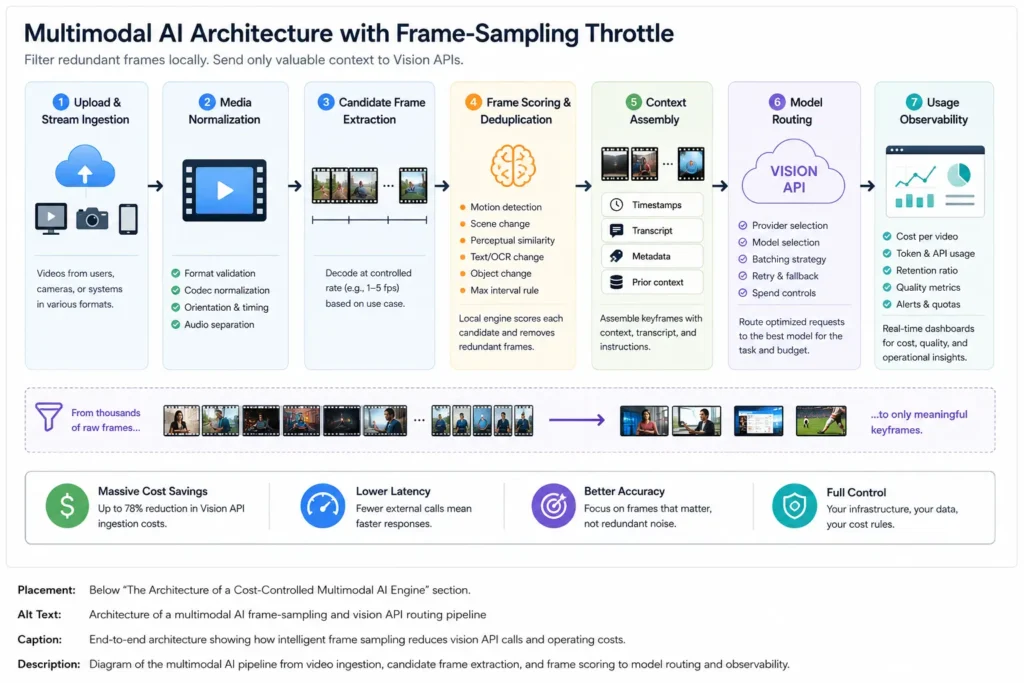
A production implementation can be divided into seven layers.
1. Upload and stream ingestion
The platform accepts stored videos, live streams, recorded calls, camera feeds, or user-generated media. It validates format, duration, access permissions, and upload limits.
2. Media normalization
The engine normalizes codec, orientation, timestamps, and resolution. Audio may be separated for transcription, while the visual track enters the frame-selection pipeline.
3. Candidate extraction
A local media worker decodes candidate frames according to a use-case policy rather than native frame rate.
4. Frame-scoring and deduplication
Local computer-vision operations score motion, structural difference, features, text regions, or scene boundaries. An optional embedding layer can improve semantic comparison, although it introduces additional compute or API expense.
AWS’s published architecture illustrates this trade-off: embedding-based comparison offers stronger semantic sensitivity, while OpenCV ORB can provide low-cost local feature matching without another external API call.
5. Context assembly
Retained frames are assembled with timestamps, transcript segments, metadata, and prior context. The system can apply task-specific policies for summarization, moderation, search, or question answering.
6. Model routing
A routing layer chooses:
- Provider
- Model size
- Image detail
- Prompt
- Batch size
- Retry policy
- Fallback model
- Maximum spend per asset
Not every frame requires the most capable model. An inexpensive classifier can sometimes triage inputs before escalation.
7. Usage observability
The admin dashboard should expose:
- Cost per video
- Cost per processed minute
- Retention ratio
- Candidate and submitted frame counts
- Average visual tokens per retained frame
- Cost by customer
- Cost by workspace or organization
- Cost by feature
- Retry rate
- Threshold overrides
- Quality-review failures
This is where an engineering optimization becomes a business-control mechanism.
Why Downsampling Alone Does Not Solve the Problem
Reducing image resolution can lower token consumption or latency, depending on the model’s image-processing rules. Anthropic explicitly recommends downsampling when high fidelity is unnecessary, and its documentation shows how visual-token usage varies with image size and model limits.
However, resolution optimization and frame optimization solve different problems.
- Downsampling reduces the cost of each retained image.
- Frame sampling reduces how many images are submitted.
The strongest pipeline does both:
total cost reduction
= fewer submitted frames
× appropriate image resolution
× controlled prompt and output length
× efficient model routing
Compressing 100 redundant images is less effective than deciding that only 22 of them carry material information.
Where Aggressive Frame Sampling Can Fail
The throttle should not use one threshold for every product.
Fast, brief events
A flash, collision, gesture, defect, or UI error may appear for less than a second. Sparse candidate extraction can miss it before similarity logic is applied.
Text-heavy screen recordings
A small text change may be operationally important even when the overall screen remains visually similar. OCR-aware sampling should supplement general motion detection.
Medical, legal, financial, or safety-sensitive evidence
Missing one visual event may carry disproportionate risk. These workflows need conservative thresholds, audit trails, human review, and market-specific legal assessment.
Continuous action analysis
Sports, physical movement, manufacturing, and behavioural analysis may depend on temporal progression rather than isolated keyframes. Shot-based or native video models may be more appropriate.
Adversarial or moderation workloads
A prohibited image could appear briefly between accepted frames. Sampling policy must be tested against evasive content and paired with appropriate moderation controls.
Mistakes Founders Should Avoid
Optimizing Only for the Lowest Frame Count
A low retention ratio is not automatically a good result. The correct target is the lowest cost that still meets event-recall, accuracy, and user-experience requirements.
Using One Threshold Across Every Video Type
A static webinar, a football match, and a security feed contain different motion and context patterns. Sampling policies should be selected by workload.
Ignoring Retries and Reprocessing
A pipeline may reduce initial frame calls while losing the saving through failed requests, repeated analysis, or regeneration. Measure the complete asset lifecycle.
Sending Frames to Another Paid Model Just to Save Vision Calls
Semantic filtering may improve quality, but its own API cost must be included. Use local methods where they meet the required accuracy.
Publishing a Cost Percentage Without the Benchmark Boundary
State the baseline, workload, model, settings, and quality test. Otherwise, a useful engineering result can become an unsupported marketing claim.
Founder Decision Signals: When the Throttle Becomes a Strategic Requirement
Founder Decision Signals
API Cost
Your vision bill grows almost directly with processed video volume, and highly engaged customers are reducing account-level margin.
Scale
You expect user-generated video, recorded calls, surveillance feeds, or visual documents to become a major share of platform activity.
Latency
Large frame batches delay answers or cause queues to grow during peak uploads.
Product Control
You need provider-independent logic for choosing what data leaves your infrastructure and when an external model is invoked.
Gross Margin
Your pricing plan does not adequately reflect the cost difference between light and heavy video-processing users.
Observability
Your team cannot currently explain cost per asset, retained-frame ratio, or why a specific frame triggered a paid request.
How to Benchmark Frame Sampling in Your Own Product
A practical evaluation should compare at least three configurations:
- Dense or current production baseline
- Fixed-interval sampler
- Change-aware sampler
Use the same video corpus, model, prompts, output schema, resolution policy, and evaluation criteria.
Phase 1: Build a representative corpus
Include:
- Static talking-head video
- Screen recording
- High-motion content
- Videos with rapid scene cuts
- Text-heavy video
- Low-light footage
- Long-form content
- Short clips with brief critical events
Phase 2: Establish a dense reference output
Create a reference analysis using the current baseline or a deliberately conservative frame policy. Human reviewers should label the important events that must survive sampling.
Phase 3: Sweep threshold values
Do not test only one setting. Evaluate a range of motion, similarity, and maximum-interval thresholds.
For each configuration, record:
retention_ratio
external_api_calls
input_tokens
output_tokens
total_cost
processing_latency
event_recall
summary_agreement
false_negative_rate
Phase 4: Choose a quality floor
Set minimum acceptable quality before optimizing cost.
For example:
event recall must remain above the product threshold
AND
false-negative rate must remain below the risk threshold
THEN
select the lowest-cost qualifying policy
Phase 5: Continue monitoring after deployment
Video behaviour changes as the customer base grows. A threshold tuned on product demos may perform poorly after users begin uploading gaming clips or security footage.
Monitor the distribution, not only the average.
Read more: Revenue Model for Multimodal AI Platform: How to Actually Make It Rain
Miracuves’ Approach to Multimodal AI Cost Control
A white-label multimodal product should not be a thin interface that forwards every image or frame to an external provider.
The stronger product foundation includes:
- Controlled media ingestion
- Adaptive frame extraction
- Local duplicate filtering
- Task-specific sampling profiles
- Provider and model routing
- Usage metering
- Organization-level quotas
- Admin cost dashboards
- Retry controls
- Spend alerts
- Source-code ownership
- Replaceable AI providers
- Audit and activity logs
- Privacy-conscious data handling
Miracuves helps founders develop AI products in which the application controls the workflow around the model. That distinction matters because model providers, capabilities, and prices can change, while the business still needs predictable margins and operational control.
Founders exploring a broader AI product can review Miracuves’ solutions ecosystem or discuss the required ingestion, routing, and administration layers through the Miracuves contact page.
Conclusion:
Multimodal SaaS products and an AI automation platform do not become expensive only because vision models have a price. They become expensive when the application has no disciplined policy for deciding what visual information deserves external inference.
Blind frame submission treats repeated pixels as repeated business value. They are not the same.
Miracuves’ normalized benchmark shows that a change-aware frame-sampling throttle reduced external vision API ingestion costs by 78% against its defined baseline. The result demonstrates the size of the opportunity, but the correct production target is not a universal percentage.
It is:
The lowest number of external vision calls that still meets the product’s measurable context, recall, accuracy, and safety requirements.
For founders, that turns frame sampling from a backend detail into a pricing, margin, scalability, and product-control decision.
Planning a multimodal AI product with tighter control over vision API costs? Contact Miracuves to discuss a white-label, source-code-owned solution with intelligent frame sampling, model routing, and usage monitoring built into the architecture.
FAQs
What is intelligent video frame sampling?
Intelligent video frame sampling is a preprocessing method that selects frames according to visual or contextual change rather than sending every frame or relying only on a fixed time interval. It can use motion scores, scene boundaries, similarity checks, OCR changes, object changes, and forced fallback intervals.
How does frame sampling reduce vision API costs?
External vision APIs charge according to submitted image inputs and model-specific tokenization rules. Reducing the number of redundant images sent to the provider lowers visual-token consumption and API-call volume, provided other variables remain comparable.
Did frame sampling reduce Miracuves’ API ingestion cost by 78%?
The proprietary benchmark supplied for this report states that Miracuves’ throttle reduced external vision API ingestion cost by 78% compared with its baseline script. The normalized result means 22 frames were submitted for every 100 submitted by the baseline. The result should not be treated as a guaranteed saving for every workload.
Is fixed one-frame-per-second sampling enough?
It may be adequate for some static videos, but it can still submit repeated scenes and miss short events between intervals. Change-aware sampling adds motion, scene, text, similarity, or object signals while retaining a maximum fallback interval.
Can frame sampling cause the model to miss important events?
Yes. Overly aggressive sampling can miss brief actions, text changes, safety events, or context that develops across multiple frames. Every implementation should be tested using event recall, false-negative rate, summary agreement, and human review.
Should video frames be compared with embeddings?
Embeddings can identify semantic similarity and may be more robust than pixel-level comparison, but generating them has computational or API cost. Local methods such as perceptual hashes, structural comparisons, or OpenCV features may be more cost-efficient for straightforward duplicate detection. AWS documents both semantic and local feature-based approaches.
Does lowering image resolution provide the same saving?
No. Lower resolution can reduce token consumption or latency per image, while frame sampling reduces the number of images submitted. A cost-controlled pipeline can combine adaptive frame selection with appropriate resizing.
What should a vision-cost dashboard show?
It should show processed minutes, candidate frames, retained frames, retention ratio, image tokens, input and output costs, retries, cost per video, cost per customer, model usage, quality failures, and threshold overrides.
Miracuves is an independent software development company. We are not affiliated with, connected to, sponsored by, or endorsed by any company or product named in this article.
Terms such as “X Clone” are used descriptively. It is how the software industry refers to building a platform with functionality comparable to a known service, and how clients search for it.
The entire design and codebase of our products is built by our own team. Our products contain no code, design, graphics, or content originating from any third-party website or applications.
All third-party names and marks referenced in this article are the property of their respective owners, referenced solely to identify the services discussed.