Key Takeaways
- An on-demand food delivery platform should connect customer ordering, restaurant management, rider operations, dispatch, live tracking, payments, commissions, payouts, promotions, and admin control.
- Development scope depends on user roles, order workflows, delivery logic, restaurant tools, rider features, payment integrations, analytics, security, automation, and customization requirements.
- Total cost is influenced by app complexity, backend architecture, real-time location services, third-party APIs, cloud infrastructure, scalability, testing, maintenance, and future feature expansion.
Feature & Cost Signals
- Core customer features can include restaurant discovery, menu browsing, cart management, coupons, checkout, multiple payment methods, live order tracking, ratings, refunds, notifications, and order history.
- Restaurant and rider modules may require menu control, availability, order acceptance, preparation updates, dispatch, navigation, proof of delivery, earnings, incentives, commissions, and payout workflows.
- Costs can increase with AI dispatch, personalized recommendations, dynamic delivery fees, wallet systems, subscriptions, loyalty programs, multi-region operations, fraud controls, automation, and advanced analytics.
Founder Planning Insights
- Founders should define target markets, delivery zones, restaurant model, rider strategy, commission structure, payment methods, monetization, MVP scope, and expected order volume before estimating development cost.
- A phased roadmap can prioritize ordering, restaurant operations, dispatch, tracking, payments, payouts, and essential admin controls before adding personalization, subscriptions, loyalty, automation, and advanced reporting.
- Miracuves develops customizable on-demand food delivery platforms with customer ordering, restaurant dashboards, rider management, dispatch, live tracking, payments, commissions, payouts, analytics, and admin controls.
Planning an on-demand food delivery platform is not only about building an ordering app. The real product sits across customers, restaurants, delivery partners, admin teams, payments, zones, commissions, refunds, support, and reporting. Founders evaluating food delivery app development services should first understand how these moving parts connect before finalizing the platform scope.
That is why many founders underestimate the scope at the beginning. A food ordering interface may look simple from the customer side, but the business depends on what happens behind the screen: how restaurants manage menus, how delivery partners receive jobs, how the platform calculates fees, how disputes are handled, and how the operator controls every moving part.
For founders, the smarter question is not just “How much does a food delivery app cost?” The better question is:
Which features actually affect launch quality, operating control, and long-term cost?
This guide breaks down the most important platform features and cost factors to consider before you build or buy an on-demand food delivery platform.
Why Feature Planning Matters Before Budget Planning
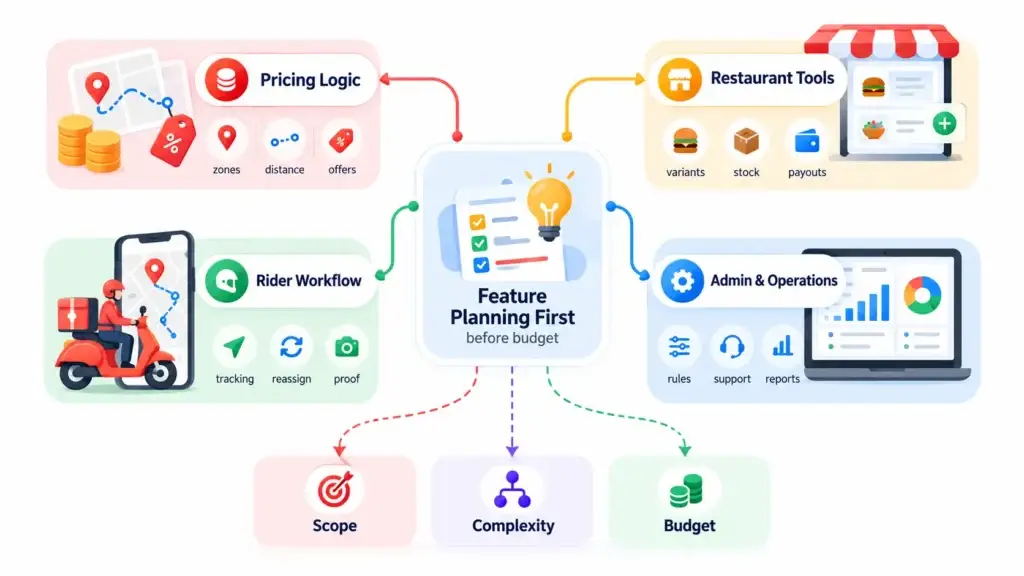
Many food delivery projects start with a list of visible features: restaurant listing, cart, checkout, tracking, ratings, and notifications. These are important, but they do not explain the full development scope.
A delivery platform becomes expensive when operational rules are unclear.
For example, a simple delivery fee may become more complex if the platform needs zone-based pricing, distance-based charges, free delivery campaigns, surge logic, restaurant-funded discounts, or separate charges by city. A basic restaurant panel may become more complex when restaurants need menu variations, add-ons, stock control, tax settings, payout history, and order cancellation rules.
The same applies to delivery partner workflows. Assigning an order is simple in theory. In practice, the platform may need rider availability, location tracking, acceptance timers, reassignment rules, proof of delivery, cash collection, wallet adjustment, and dispute support.
This is why founders should define the business model before finalizing the feature list. The cost of building a delivery platform depends on how the business will operate every day.
Core User Panels Every Food Delivery Platform Needs
A scalable food delivery platform usually has four core panels:
| Panel | What It Does | Why It Affects Cost |
|---|---|---|
| Customer App or Website | Lets users browse restaurants, order food, pay, track delivery, and manage profiles | Cost depends on UX depth, payment options, search, offers, wallet, and tracking |
| Restaurant Panel | Helps restaurants manage menus, orders, availability, pricing, and payouts | Cost increases with menu complexity, POS logic, staff roles, and reporting |
| Delivery Partner App | Allows riders to accept jobs, navigate, update status, confirm delivery, and track earnings | Cost depends on live tracking, routing, cash handling, proof of delivery, and incentives |
| Admin Dashboard | Gives the platform owner control over users, restaurants, riders, zones, payments, commissions, disputes, and reports | Cost rises with automation, permissions, analytics, settlement logic, and multi-location control |
Before finalizing the scope, founders should map the customer, restaurant, delivery partner, and admin workflows clearly. A detailed view of food delivery platform features can help separate must-have launch modules from advanced custom features.
The admin dashboard is often the most underestimated part. Without strong admin control, the founder depends on developers or manual spreadsheets for routine decisions. That slows operations and increases support costs after launch.
Customer-Side Features That Shape User Experience
The customer experience decides whether users complete the order and return again. At minimum, the customer side should make discovery, ordering, payment, and tracking simple.
Important customer features include:
- Restaurant discovery by location
- Cuisine and dish search
- Filters by rating, delivery time, price, and offers
- Menu browsing with item variations and add-ons
- Cart and checkout
- Multiple payment options
- Order scheduling
- Real-time order status
- Live delivery tracking
- Push notifications
- Ratings and reviews
- Offers, coupons, and loyalty rewards
- Support and refund request options
Cost increases when the customer experience needs deeper personalization, advanced search, wallet payments, loyalty systems, subscription plans, multilingual support, or highly customized UI flows.
For early launch, founders should focus on a clean ordering journey, accurate restaurant availability, reliable checkout, and transparent delivery updates. Fancy features can wait if the core order flow is not strong.
Restaurant Features That Keep Operations Smooth
Restaurants need more than a login screen. They need tools to run daily order operations without calling platform support for every change.
A good restaurant panel should include:
- Menu creation and editing
- Item variations and add-ons
- Opening hours and holiday settings
- Order acceptance and rejection
- Preparation time updates
- Order history
- Sales reports
- Payout visibility
- Coupon participation
- Customer feedback visibility
Restaurant-side complexity grows when the platform supports multiple branches, cloud kitchens, franchise accounts, item-level availability, tax rules, staff permissions, or direct POS-style ordering.
For founders, this matters because restaurant adoption depends on convenience. If restaurants cannot update menus, manage peak hours, or understand payouts easily, they may resist using the platform actively.
Delivery Partner Features That Affect Fulfillment Quality
Delivery partner workflows directly affect customer satisfaction. Even if ordering works well, poor dispatch or unclear rider communication can damage the platform experience.
Key delivery partner features include:
- Rider onboarding
- Availability toggle
- Order assignment
- Accept or reject job option
- Pickup and drop-off navigation
- Order status updates
- Customer and restaurant contact options
- Proof of delivery
- Cash collection record
- Earnings dashboard
- Incentives and payout history
The cost rises when the app needs advanced dispatch logic, batch orders, heat maps, route optimization, zone-based rider allocation, cash reconciliation, fraud checks, or multiple delivery modes.
A practical first version should focus on accurate assignment, clear order status, reliable location tracking, and simple payout visibility.
Admin Features That Decide Platform Control
The admin panel is where the business owner controls the platform. It should not be treated as an afterthought.
A strong admin dashboard should help manage:
- Customers
- Restaurants
- Delivery partners
- Orders
- Delivery zones
- Commission rates
- Delivery fees
- Coupons and campaigns
- Payment gateways
- Refunds and cancellations
- Ratings and reviews
- Payouts and settlements
- Reports and analytics
- Support tickets
- Role-based staff permissions
Admin control becomes more expensive when the platform needs market-level settings, different commission structures, custom payout cycles, automated dispute workflows, advanced reports, or multi-city operations.
This is where a ready-made foundation can reduce planning risk. If ordering, dispatch, payment, restaurant control, and admin workflows are already built, the founder can spend more time on branding, launch strategy, and restaurant onboarding.
Food Delivery Platform Features vs Business Value
| Feature | Business Value | Founder Impact |
|---|---|---|
| Location-Based Restaurant Discovery | Shows users only relevant restaurants | Reduces failed orders and improves conversion |
| Menu Variations and Add-Ons | Supports real restaurant menu complexity | Helps restaurants sell more accurately |
| Live Order Tracking | Builds customer trust after checkout | Reduces support calls and cancellation anxiety |
| Delivery Zone Management | Controls service areas and pricing | Helps expand city by city without chaos |
| Commission Management | Defines platform revenue per order | Makes monetization easier to control |
| Coupon and Offer Engine | Drives first orders and repeat purchases | Supports growth campaigns |
| Restaurant Payout Reports | Improves partner transparency | Reduces payout disputes |
| Rider Earnings Dashboard | Improves delivery partner trust | Supports rider retention |
| Admin Analytics | Shows order, revenue, and operational trends | Helps founders make better business decisions |
| Role-Based Access | Protects sensitive controls | Helps larger teams manage operations safely |
Miracuves On-Demand Food Delivery Platform Solution Cost and Tech Stack
Miracuves Pricing for an On-Demand Food Delivery Platform developed in PHP For $2,799 USD (One-Time Price) in just 6 days
mGet a fully developed, deployment-ready on-demand food delivery platform built for restaurant aggregators, cloud kitchen networks, local delivery startups, food marketplaces, and founders planning to launch a scalable ordering and delivery business. Built on a stable PHP foundation, this complete package includes everything you need to launch and scale:
Core Workflows: Customer registration, restaurant onboarding, menu management, food ordering, cart checkout, order confirmation, delivery partner assignment, real-time order status, cancellations, and customer notifications.
Built-in Revenue Logic: Restaurant commissions, delivery fees, service charges, small-order fees, promoted listings, subscription plans, advertising placements, promo campaigns, and platform service fees.
Management Hub: Centralized admin dashboard, restaurant management, customer management, delivery partner management, order monitoring, payment records, refund handling, dispute management, support controls, and marketplace analytics.
Launch-Ready: Fully prepared for your custom branding, configuration, payment gateway setup, restaurant onboarding, delivery partner setup, delivery zone configuration, menu categories, and immediate market entry.
Why Is On-Demand Food Delivery Platform Development More Affordable?
Most on-demand food delivery platforms become expensive when businesses choose fully custom development from scratch. Building separate workflows for customers, restaurants, delivery partners, admins, ordering, dispatch, payments, tracking, refunds, notifications, and reporting can significantly increase cost, timeline, and technical complexity.
We took a smarter, more practical approach:
You Aren’t Paying for Ground-Up Development: Our food delivery platform engine is already developed, tested, and ready to deploy. You skip the inflated cost and long development cycles normally associated with building a complete on-demand delivery ecosystem from scratch.
The Power of PHP: We built this solution on a reliable and cost-effective PHP architecture. This keeps the upfront price affordable while supporting essential ordering workflows, restaurant management, delivery operations, payment handling, customer accounts, and administrative controls.
You get a launch-ready on-demand food delivery platform with practical ordering, restaurant, delivery, monetization, and management features, source code access, and faster deployment without the high custom development price tag.
Note: This cost is for the solution, re-branding, deployment, and source code only.
Main Cost Factors in Food Delivery Platform Development
The final cost of an on-demand food delivery platform depends on scope. A small restaurant ordering platform and a multi-city marketplace do not require the same architecture. Founders comparing build options should review a clear food delivery platform cost breakdown before deciding which modules belong in the first launch.
The biggest cost factors usually include the following.
1. Number of Apps and Platforms
A full delivery marketplace may need:
- Customer mobile app
- Customer web ordering site
- Restaurant panel
- Restaurant mobile app
- Delivery partner app
- Admin dashboard
Building only a web ordering system costs less than building a complete marketplace stack. However, limited scope may restrict growth if the business needs restaurants, riders, and customers to interact in real time.
Founders should decide whether they need a complete launch-ready ecosystem or a smaller first release.
2. Delivery and Dispatch Logic
Dispatch is one of the most important cost drivers.
Basic platforms may allow manual assignment. More advanced platforms may need automatic rider matching based on location, availability, order size, delivery zone, distance, rating, or workload.
The more automated the dispatch engine becomes, the more testing it requires. Every order state must be handled properly: accepted, preparing, picked up, delayed, reassigned, cancelled, delivered, refunded, or disputed.
3. Payment Gateway and Wallet Requirements
Payment complexity depends on the business model and target market.
Common payment requirements include:
- Card payments
- Wallet payments
- Cash on delivery
- Split payments
- Refunds
- Rider tips
- Restaurant payouts
- Delivery partner payouts
- Platform commission deductions.
Because commissions, delivery fees, refunds, payouts, wallet activity, and promotions all affect revenue, founders should define the food delivery marketplace business model before locking the technical scope.
Payment logic affects cost because it touches checkout, invoices, refunds, settlements, reports, and admin controls. A payment feature is rarely isolated to one screen.
4. Restaurant and Menu Complexity
Simple menus are easy. Real restaurant menus are not.
Many restaurants need sizes, toppings, add-ons, meal combos, allergen notes, item availability, preparation times, special instructions, and scheduled availability. Some may need branch-level menus or different prices by location.
The more flexible the restaurant panel, the more valuable it becomes. But flexibility also increases development and testing scope.
5. Multi-City or Multi-Zone Operations
A single-location launch is easier than a multi-zone platform.
-Multi-zone operations may require different delivery charges, service areas, rider pools, taxes, payment methods, opening hours, languages, and promotional campaigns. If the platform is not built with zone control from the beginning, expanding later may require structural changes. After the first delivery zone is stable, founders should plan restaurant supply, customer acquisition, order density, and repeat-order campaigns through a practical local food delivery marketing strategy.
Founders planning regional expansion should avoid treating multi-location support as a future patch. It should be considered during the platform planning stage.
6. Offers, Loyalty, and Retention Tools
Discounts are simple when they apply to every order. They become more complex when rules vary by restaurant, order value, customer segment, delivery zone, weekday, category, or payment method.
Common retention features include:
- First-order discounts
- Free delivery campaigns
- Referral rewards
- Wallet cashback
- Loyalty points
- Subscription plans
- Restaurant-sponsored offers
- Featured listings
These features can improve growth, but they should be controlled from the admin panel. Hard-coded promotions can create operational dependency and technical debt.
7. Security, Access Control, and Trust Workflows
Food delivery platforms handle user data, payment activity, addresses, restaurant records, delivery partner details, and transaction history. Security should be part of the product foundation, especially when the platform manages customer accounts, restaurant access, rider verification, refunds, and admin permissions. Founders can also review this food delivery platform security guide for a deeper look at trust and operational safety controls.
Important trust features include:
- Secure payment gateway integration
- Role-based access control
- Admin activity logs
- Restaurant and rider verification
- Refund approval workflows
- Dispute management
- Encrypted data transfer
- Permission-based dashboards
These features may not look exciting in the UI, but they protect the business when operations grow.
8. Custom Branding and UI Personalization
Branding affects more than logo placement. A founder may need custom colors, app icons, splash screens, landing pages, email templates, notification wording, menu layout, and restaurant onboarding pages.
Basic rebranding is usually faster. Deep design customization takes more time because screens need to be redesigned, tested, and adjusted across customer, restaurant, delivery, and admin interfaces.
9. Third-Party Integrations
Integrations can improve the platform, but they also affect cost.
Common integrations include:
- Payment gateways
- SMS gateways
- Email services
- Push notification services
- Map and location APIs
- Analytics tools
- Customer support tools
- Accounting or tax tools
- Restaurant POS systems
Each integration needs setup, testing, error handling, and documentation. The cost depends on how deeply it must connect with order, payment, delivery, or reporting workflows.
10. Source Code Ownership and Long-Term Control
Source code ownership matters when founders want flexibility after launch. If the platform owner receives the full source code, future customization, hosting decisions, team handover, and product expansion become easier.
Without source code ownership, the business may depend heavily on the original vendor for every change, integration, or deployment decision.
For serious platform operators, source-code ownership is not only a technical preference. It is a business control decision. Founders who want a deeper technical planning view can also review this guide on how to create a food delivery app with marketplace workflows.
Founder Decision Signals
Speed
Choose a ready-made foundation when the core ordering, dispatch, payment, and admin workflows already match your launch plan.
Cost
Control cost by separating must-have launch modules from future growth features before development begins.
Scalability
Plan zone control, payment rules, restaurant onboarding, and reporting early if you want to expand beyond one location.
Market Fit
Start with the workflows your restaurants, customers, and delivery partners will actually use every day.
Ready-Made vs Custom Food Delivery Platform Development
Founders usually compare two paths: build from scratch or start with a ready-made foundation.
| Build Option | Best For | Strength | Watch-Out |
|---|---|---|---|
| Custom Development | Businesses with highly unique workflows | Maximum flexibility | Higher time, discovery, testing, and budget exposure |
| Ready-Made Delivery Platform | Founders who need faster launch with proven modules | Faster deployment and lower starting risk | Customization should be planned clearly |
| Hybrid Approach | Teams that want ready-made core plus custom changes | Balances speed and flexibility | Scope discipline is important |
A ready-made approach works well when the core business model is already clear: customers order, restaurants prepare, delivery partners fulfill, and the platform earns through commission, delivery fees, subscriptions, ads, or service charges. A white-label food delivery platform can help founders launch with branded apps, admin control, source-code ownership, and faster deployment without rebuilding every workflow from zero.
Miracuves supports this path with white-label delivery solutions designed for branding, admin control, source-code ownership, and faster launch. For founders who want a branded delivery marketplace without building every module from zero, the ready-made multi-market delivery platform can be explored as the next commercial step.
Where Miracuves’ 6-Day Delivery Helps Founders
Speed matters when the founder is trying to validate a market, onboard restaurants, show investors a working product, or enter a city before competitors occupy the space.
Miracuves’ 6-day solution delivery is useful when the selected ready-made platform already matches the core business requirement. In that case, the focus shifts from building every module from scratch to configuring branding, payment setup, delivery areas, admin settings, and launch preparation. If you are comparing vendors, choosing the right food delivery app development company becomes important because scope clarity, source-code ownership, delivery workflow experience, and post-launch support all affect the final outcome.
This does not mean every custom idea is completed in 6 days. Deep custom workflows, new integrations, special compliance requirements, or major design changes can affect scope. But when the ready-made foundation fits the model, founders can move much faster than a traditional ground-up build.
Mistakes Founders Should Avoid
Treating the Customer App as the Whole Product
The customer app is only one part of the platform. The business also needs restaurant tools, rider workflows, admin control, payout systems, support tools, and reporting.
Ignoring Admin Control
If the admin dashboard cannot control fees, zones, restaurants, riders, refunds, and campaigns, the operator will depend on manual work or development support for daily decisions.
Asking for Pricing Before Defining Scope
A vague requirement leads to vague pricing. Founders should define user panels, payment flows, delivery rules, restaurant workflows, and launch geography before asking for final cost.
Adding Too Many Growth Features Before Launch
Loyalty, subscriptions, referrals, advanced analytics, and AI features can be valuable. But the first priority should be a reliable ordering, payment, dispatch, and tracking flow.
Not Planning for Expansion
Even if the first launch is local, the platform should not block future expansion. Delivery zones, commission settings, restaurant onboarding, and reports should be planned with growth in mind.
Practical Feature Checklist for Founders
Before finalizing a food delivery platform, use this checklist:
- Do customers have a smooth ordering journey?
- Can restaurants manage menus and orders independently?
- Can delivery partners accept jobs and update delivery status?
- Can admins control restaurants, riders, customers, orders, and payouts?
- Are delivery zones and fees configurable?
- Are payment, wallet, refund, and cash-on-delivery flows clear?
- Can commissions and payouts be tracked properly?
- Are offers and coupons manageable from the admin panel?
- Is source code ownership included?
- Is the platform ready for future customization?
If the answer is unclear for any of these, the requirement should be discussed before the project is priced.
Final Thoughts
The cost of an on-demand food delivery platform depends on much more than the number of screens. It depends on how deeply the platform supports ordering, restaurant operations, delivery workflows, payments, admin control, reporting, and future expansion.
For founders, the strongest approach is to plan features around business operations first. A good platform should help customers order easily, restaurants operate smoothly, delivery partners complete jobs clearly, and admins control the business confidently.
Miracuves helps founders move from idea to launch faster with ready-made and white-label delivery platforms built for branding, admin control, monetization, and source-code ownership. If your goal is to launch a branded food delivery marketplace without starting from zero, a launch-ready solution can help you validate faster and build with more control.
FAQs
What features are most important in an on-demand food delivery platform?
The most important features are restaurant discovery, menu browsing, cart and checkout, multiple payment options, live order tracking, restaurant order management, delivery partner workflows, admin dashboard, commission control, payout tracking, and customer support tools.
What affects the cost of building a food delivery platform?
The main cost factors include the number of apps, user panels, dispatch logic, payment gateways, wallet features, delivery zones, restaurant workflows, custom branding, integrations, reporting, security, and source code ownership.
Is a ready-made food delivery platform better than custom development?
A ready-made platform is better when the founder wants faster launch and the core business model matches existing delivery workflows. Custom development is better when the business needs highly unique features or unusual operational logic.
How can founders reduce food delivery app development cost?
Founders can reduce cost by defining launch priorities clearly, avoiding unnecessary early features, choosing a ready-made foundation where suitable, using configurable admin settings, and separating must-have modules from future enhancements.
Why is the admin dashboard important in a food delivery platform?
The admin dashboard controls users, restaurants, riders, orders, zones, commissions, refunds, payouts, offers, reports, and support. Without strong admin control, the business becomes harder to operate as order volume grows.
Does a food delivery platform need multiple apps?
A full marketplace usually needs a customer app or website, restaurant panel, delivery partner app, and admin dashboard. Some businesses can start smaller, but a complete platform gives better control over the full order and delivery cycle.
How long does it take to launch a food delivery platform?
The timeline depends on scope. A custom build can take longer because every module must be designed, developed, tested, and deployed. A ready-made solution from Miracuves can be launched faster when the core platform already fits the business model.
Why does source code ownership matter?
Source code ownership gives founders more control over hosting, customization, future upgrades, integrations, and vendor flexibility. It helps turn the platform into a long-term business asset rather than a rented system.
Miracuves is an independent software development company. We are not affiliated with, connected to, sponsored by, or endorsed by any company or product named in this article.
Terms such as “X Clone” are used descriptively. It is how the software industry refers to building a platform with functionality comparable to a known service, and how clients search for it.
The entire design and codebase of our products is built by our own team. Our products contain no code, design, graphics, or content originating from any third-party website or applications.
All third-party names and marks referenced in this article are the property of their respective owners, referenced solely to identify the services discussed.