



Key Takeaways
- Starting coding at 25 is not too late, but founders should avoid treating syntax as the only path into tech.
- AI tools, frameworks, cloud hosting, and white-label platforms now make deployment-first learning more practical.
- System operators focus on understanding code, launching apps, running workflows, and turning software into revenue.
- Career-switchers should compare learning time, launch speed, business goals, and technical ownership before choosing a path.
- A smarter tech entry path helps founders build leverage instead of waiting for permission from the junior developer market.
Founder Signals
- Aspiring founders should learn enough coding to understand structure, logic, APIs, databases, and deployment workflows.
- Deployment skills help founders launch products, test ideas, manage hosting, review builds, and work better with developers.
- Business skills remain critical because customer acquisition, pricing, operations, and monetization decide startup outcomes.
- Ready-made app solutions help founders move faster when the business model follows proven marketplace or on-demand workflows.
- Source-code ownership gives technical entrepreneurs more control over customization, scaling, integrations, and long-term product direction.
Real Insights
- The question is not whether 25 is too late, but whether the next year is spent only learning syntax or building leverage.
- A founder who can operate software systems may create value faster than someone waiting to become fully job-ready.
- Coding knowledge becomes more powerful when combined with deployment, operations, marketing, and revenue strategy.
- Founders should choose learning paths that support real launch outcomes, not only beginner projects or tutorials.
- Miracuves helps founders launch app businesses faster with white-label solutions, source-code ownership, deployment support, monetization workflows, and admin control.
Is 25 too late to start coding?
No. But that is not the most useful question.
A better question is this: what kind of software opportunity are you trying to access?
If your only goal is to become a junior developer, then yes, you may need to spend time learning syntax, frameworks, Git, APIs, debugging, testing, data structures, and portfolio projects. That path can still work. The software market is not dead. The U.S. Bureau of Labor Statistics projects employment for software developers, quality assurance analysts, and testers to grow 15% from 2024 to 2034, with about 129,200 openings projected each year on average.
But for a 25-year-old professional who wants to enter the digital economy fast, the junior developer path is not always the highest-return play.
The high-value move is not simply learning how to write beginner code. It is learning how software businesses actually work: how apps are deployed, configured, monetized, operated, tested, improved, and scaled. For professionals who want a faster route into the software economy, exploring Miracuves’ ready-made clone app solutions can make the path more practical than starting from an empty codebase.
That is the shift from syntax learner to system operator.
And for professionals who already understand an industry, customer pain point, sales channel, or local market, that shift can be far more powerful than spending months competing for entry-level coding roles.
The Junior Developer Glut: Navigating the Crowded Entry-Level Syntax Market
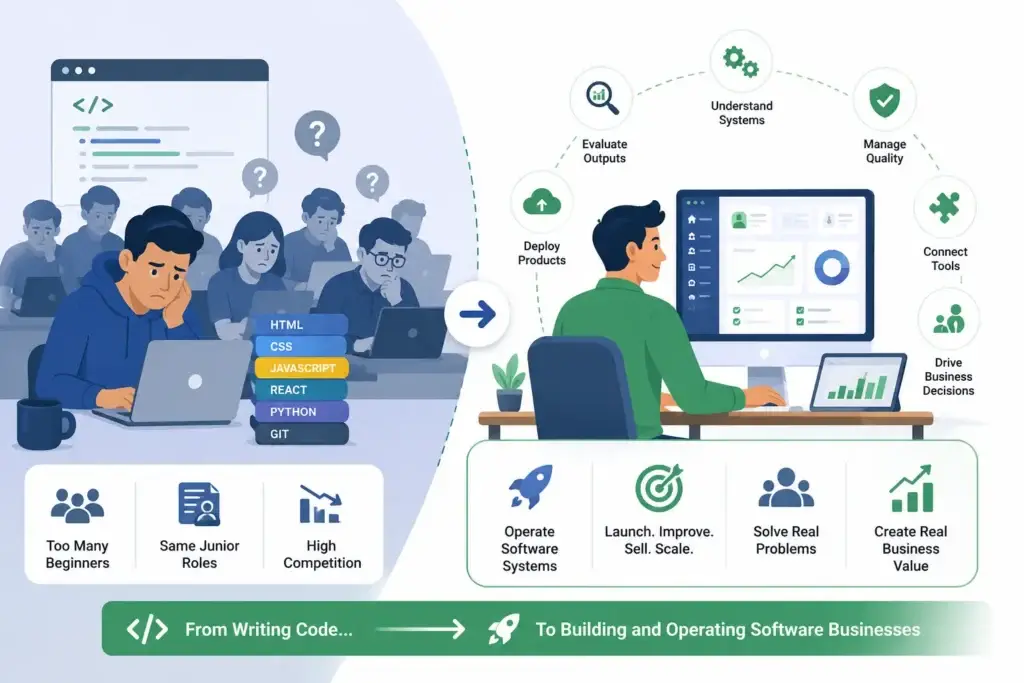
The traditional advice is simple: learn HTML, CSS, JavaScript, React, Python, Git, build projects, apply for junior roles, repeat.
That advice is not wrong. It is just incomplete.
The problem is that thousands of beginners are following the same playbook. Many are watching the same tutorials, building similar portfolio projects, applying for the same junior developer jobs, and trying to prove they can write basic code.
At the same time, AI tools have changed what employers expect. Stack Overflow’s 2025 Developer Survey shows that AI tools are now part of the development conversation, but trust remains a major issue. Positive sentiment toward AI tools dropped to 60%, and developers still rely on humans when they do not trust AI answers.
That matters because the value of a software professional is shifting.
Companies and founders do not only need people who can write a function. They need people who can understand systems, evaluate outputs, manage quality, deploy products, connect tools, interpret customer feedback, and make practical business decisions.
For a career-switcher, this changes the strategy.
If you spend all your energy trying to become “good enough to get hired as a junior developer,” you enter a crowded market where your competition is other beginners, bootcamp graduates, computer science students, AI-assisted builders, and offshore talent.
But if you learn how to operate software systems, you enter a different game.
You are no longer asking, “Who will hire me to write code?”
You are asking, “What software business can I launch, configure, sell, and improve?”
That is a more powerful question.
Read More: Beyond the Code: The DevOps Guide to Launching Production Architecture
Shifting the Paradigm: Moving from Syntax Learner to System Operator
A syntax learner focuses on the programming language, while a system operator focuses on the complete software machine.
A syntax learner asks, “What programming language should I learn first?” A system operator asks, “What business model can this software support?”
A syntax learner asks, “How do I build this feature from scratch?” A system operator asks, “Does this feature already exist in a reliable framework, and can I configure it for my market?”
A syntax learner asks, “How do I get a junior developer role?” A system operator asks, “How do I launch a software-powered business with the least wasted motion?”
This does not mean coding is useless. Coding knowledge is valuable because it helps you understand what is possible, communicate with developers, review technical decisions, and avoid being fully dependent on vendors.
However, learning syntax is not the same as building leverage. A professional entering tech at 25 should not only learn how software is written. They should also learn how software is shipped.
This means learning deployment, hosting, admin dashboards, app store submission, payment gateway setup, user onboarding, vendor or provider management, analytics, QA testing, bug reporting, feature prioritization, monetization logic, customer support workflows, security, and access control.
These are not side skills. These are the skills that decide whether software becomes a real business.
Read More: Cursor vs. Hiring a Dev Agency: The Honest Capital Comparison for Startups
What “Deployment” Actually Means for a Career Switcher
Deployment is not just pressing a button. A strong rapid app development process connects scope clarity, configuration, QA, admin readiness, and launch support so the product can move from software foundation to business use.
For a software operator, deployment means taking a working product from a codebase or ready-made framework and making it usable in the real world.
That includes setting up the app environment, connecting business logic, preparing the admin panel, configuring payments, adding branding, testing the user journey, managing app submissions, and making sure the product can support actual customers.
This is where many beginners misunderstand the software economy.
They assume the hard part is writing the first version of the code. But in business, the harder question is whether the product can be operated.
A food delivery app is not just code. It needs restaurant management, delivery partner workflows, customer ordering, payment handling, order tracking, cancellation logic, commission rules, support flows, and admin control.
A ride-hailing app is not just code. It needs rider flows, driver onboarding, fare logic, maps, real-time tracking, dispute handling, wallet or payment workflows, and operational visibility.
A marketplace app is not just code. It needs listings, provider verification, booking logic, secure payments, reviews, refunds, and trust management.
A fintech app is not just code. It needs user verification, transaction monitoring, wallet logic, admin risk controls, audit logs, and compliance-ready workflows depending on the target market.
That is why deployment is such a valuable skill. It forces you to understand software as a business machine, not a collection of tutorials.
Read More: The Maintenance Trap: Benchmarking the Long-Term Cost of Custom Code
Scaling Tech Ventures Fast by Customizing Finished White-Label Frameworks
For many professionals, the fastest entry into the software economy is not building from zero. It is starting from completed ready-made apps and customizing them around a real business opportunity.
That is where ready-made clone app solutions become strategically useful.
A clone app should not be understood as a blind copy of another company. The smarter interpretation is this: a clone app is a proven product pattern that gives you a working foundation for a known business model. That is why working with a clone app development company can help founders start with validated app logic while still customizing the product for their market.
The opportunity is not to copy. The opportunity is to customize.
For example:
| Business Opportunity | Finished Framework to Start From | Operator Focus |
|---|---|---|
| Local food delivery | Food delivery app foundation | Restaurants, delivery zones, commissions, customer acquisition |
| Creator economy | Short video or creator platform | Content moderation, creator onboarding, monetization |
| Ride-hailing | Taxi or ride-hailing app foundation | Driver supply, pricing, safety, local mobility demand |
| Marketplace | Rental, ecommerce, or services app | Listings, trust, payments, provider quality |
| Fintech/remittance | Wallet or remittance app foundation | KYC workflows, transaction logic, trust, support |
Miracuves helps founders launch ready-made and white-label app solutions with source code, admin control, branded design, and faster deployment. Instead of spending months rebuilding every standard module, founders can begin with a launch-ready foundation and focus on the market layer: acquisition, operations, monetization, partnerships, and customer feedback.
This is the practical shortcut most beginner coding advice ignores.
A 25-year-old career-switcher may not yet be able to architect a complete app from scratch. But they may already understand a market better than a junior developer does.
That market knowledge can become a software advantage when paired with a ready-made product foundation.
Read More: Can AI Build a Multi-Vendor Marketplace? The Real-Time Logistics Blueprint
Why Your Existing Career Experience Is a Software Advantage
Most people asking, “Is 25 too late to start coding?”, underestimate the value of their existing experience.
If you have worked in sales, you already understand customer objections, lead generation, and closing. If you have worked in logistics, you already understand routing, delivery delays, driver behavior, and operational bottlenecks. If you have worked in hospitality, you already understand bookings, cancellations, service quality, and customer retention. If you have worked in finance, you already understand trust, verification, onboarding friction, and transaction risk. If you have worked in education, you already understand learning gaps, tutor workflows, student engagement, and subscription behavior.
These insights matter. They are also why a white label reseller business can make sense for professionals, agencies, and consultants who understand a market but do not want to build every technical module from scratch.
Software does not become valuable simply because code exists. Software becomes valuable when it solves a painful problem for a specific market.
Instead of asking whether 25 is too late, you should ask yourself what market you already understand, what workflow you have seen break repeatedly, what app model already exists that could be adapted for that market, and what customers would pay for if it saved them time, increased revenue, reduced risk, or improved convenience.
That is how professionals convert career experience into digital leverage.
The Syntax-to-System Operator Shift: A Practical Roadmap
The goal is not to avoid technical learning. The goal is to learn the right technical layer for your outcome.
Here is a practical roadmap.
Step 1: Learn Software Concepts, Not Just Syntax
You should understand how apps work at a system level.
Start with:
- Frontend vs backend
- APIs
- Databases
- Admin panels
- Authentication
- Hosting
- Payment gateways
- Push notifications
- App store submission
- User roles
- Analytics
- QA testing
- Basic security concepts
You do not need to become a senior engineer before you can understand these ideas. You need enough fluency to make better business and vendor decisions.
Step 2: Choose a Business Model Before Choosing a Programming Language
Most beginners choose a programming language first, but operators choose a business model first.
Before you decide whether to learn JavaScript, Python, Flutter, or React, you should decide what kind of product you want to operate. You may want to launch a delivery platform, a marketplace, a creator app, a fintech tool, a booking platform, or a local service marketplace.
Your chosen business model will tell you what technical knowledge actually matters.
A marketplace founder needs to understand listing quality, provider verification, commissions, and dispute management. A short video founder needs to understand video uploads, moderation, creator incentives, and retention loops. A fintech founder needs to understand trust, transaction history, KYC workflows, and admin risk controls.
This kind of product direction is more useful than learning syntax without knowing what you want to build or operate.
Step 3: Study Completed Software Systems
Pick one app category and study it deeply.
Do not only study the user interface. Study the panels and workflows behind it.
Ask:
- What does the customer see?
- What does the provider, vendor, driver, creator, or merchant see?
- What does the admin control?
- Where does money move?
- Where can fraud happen?
- What support issues will appear?
- What data does the business owner need daily?
- What features are required at launch?
- What features can wait?
This is how you start thinking like a software operator.
Step 4: Use Ready-Made Frameworks to Reduce Build Risk
When the business model is already proven, building every standard module from scratch can be unnecessary.
A ready-made framework gives you a faster starting point.
The operator’s job is to customize the system around:
- Brand identity
- Target geography
- Payment methods
- Business rules
- Pricing strategy
- Commission model
- User onboarding
- Marketing funnel
- Support workflows
- Admin operations
- Growth experiments
Miracuves’ ready-made app approach is designed around this idea: reduce avoidable development risk, launch faster, and let founders focus on validation and operations instead of reinventing core app flows.
Step 5: Learn Enough Coding to Control the Conversation
You do not need to become a full-stack engineer before launching.
But you should learn enough coding and technical logic to avoid being blind.
Learn enough to:
- Read basic code structure
- Understand APIs
- Review feature complexity
- Communicate with developers
- Understand hosting and deployment
- Test user flows
- Spot vague technical explanations
- Estimate whether a request is simple, moderate, or complex
That level of technical fluency makes you dangerous in a good way.
You become the person who can connect business, product, operations, and technology.
Founder Decision Signals
Speed
If your goal is market entry, spending months on beginner syntax before testing demand may delay the real learning. Deployment-first thinking gets you closer to customers faster.
Cost
Building from zero can consume capital before the business model is validated. A ready-made foundation helps redirect more budget toward launch, marketing, and operations.
Scalability
The right question is not only whether the app works today. It is whether the admin, payment, user, provider, and support layers can grow with the business.
Market Fit
Your existing industry experience can help you identify a sharper niche, stronger positioning, and better operating model than a generic first-time software build.
Coding vs Deployment: Which Path Creates Faster Leverage?
Here is the strategic difference.
| Path | Main Skill | Time Is Spent On | Value Created | Best For |
|---|---|---|---|---|
| Beginner coding path | Syntax and frameworks | Tutorials, projects, junior job applications | Employability as a developer | People who want software engineering careers |
| Deployment-first path | System operation | App setup, workflows, monetization, launch readiness | Business execution and market validation | Professionals who want to launch or operate tech ventures |
| Hybrid path | Technical fluency + operation | Learning core concepts while deploying real systems | Founder control and faster iteration | Career-switchers with business ambition |
The best path depends on your goal. If your priority is faster validation, fast app development can help you understand why reducing time-to-market often matters more than spending months building standard modules from zero.
If you want to be a professional engineer, learn coding deeply.
If you want to build a software-powered business, do not wait until you become a professional engineer to start thinking like an operator.
The highest-return path may be hybrid: learn enough coding to understand the machine, but focus your energy on deploying, customizing, marketing, and monetizing the machine.
Read More: The 4 Types of Apps That Actually Generate High-Volume Revenue
Common Mistakes Career Switchers Make When Entering Tech
Mistake 1: Learning Without a Commercial Direction
Many beginners learn random syntax for months without choosing a business model or product category.
They finish courses but still do not know what to build, who to serve, or how software creates revenue.
A stronger approach is to choose a market first.
Then learn the technical concepts that help you operate in that market.
Mistake 2: Confusing Coding Ability With Product Judgment
A technically skilled person can still build the wrong thing.
A non-technical operator can still launch a useful product if they understand the customer, workflow, and monetization model.
The best founders develop both: enough technical understanding to make smart decisions and enough customer understanding to build something people actually want.
Mistake 3: Waiting Too Long to Touch Real Software
Tutorials feel safe because there is always another lesson.
Real software forces decisions.
What payment gateway should you use? What happens when a vendor cancels? Who handles refunds? What does the admin see? How do you prevent fake listings? What happens when users complain?
These questions teach faster than passive learning.
Mistake 4: Building From Zero When the Model Is Already Known
Not every app needs a blank-codebase build.
If the business model is familiar—delivery, marketplace, booking, ride-hailing, creator platform, ecommerce, fintech wallet, rental platform—the founder should ask whether clone app development for market validation can reduce time-to-market before committing to a long custom build.
Custom development makes sense when the product is truly novel or requires deep proprietary architecture.
But for many first launches, the smarter move is to validate faster with a customizable foundation.
Mistake 5: Ignoring Admin Control
Most beginners focus on the customer app.
Operators focus on the admin panel.
The admin layer decides whether the business owner can manage users, payments, vendors, content, disputes, commissions, reports, and operational issues without asking developers for every small change.
If you want to run a software business, admin control is not optional. It is the cockpit.
How Miracuves Helps Professionals Launch Software Ventures Faster
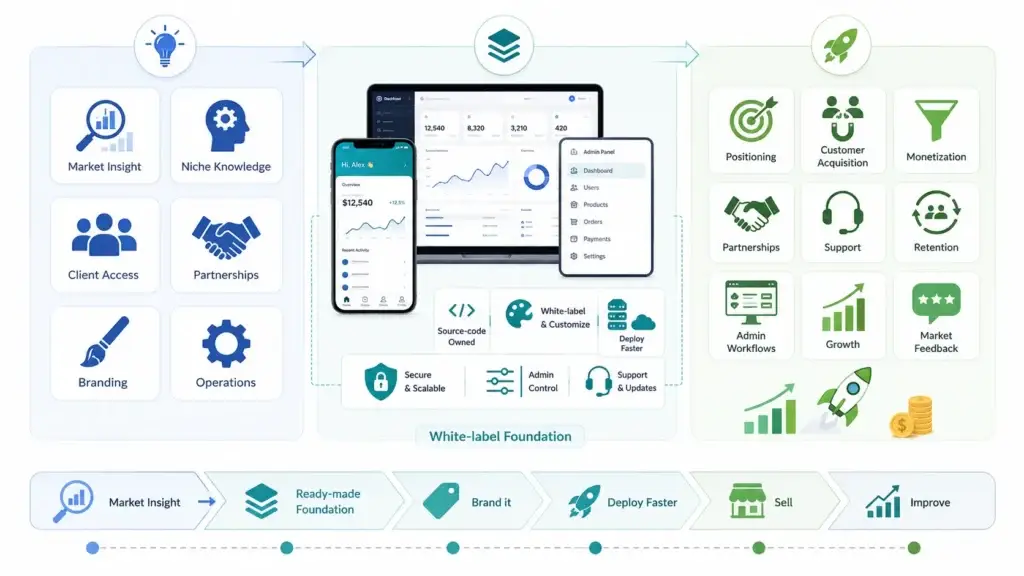
Miracuves helps founders, agencies, and professionals move from software idea to launch-ready product using ready-made, white-label, source-code-owned app solutions and practical software development services aligned with their launch scope.
For someone asking, “Is 25 too late to start coding?”, this matters because Miracuves offers a different way to enter the software economy. You do not have to spend years learning every layer of engineering before testing a business idea.
Instead, you can start with a ready-made app foundation, customize it around your market, and focus on the areas that create real business value. These areas include positioning, branding, customer acquisition, operations, monetization, partnerships, support, retention, admin workflows, and market feedback.
Miracuves’ ready-made solutions can include branded design, source-code ownership, admin dashboard control, deployment support, and faster launch workflows for applicable app categories.
This approach is especially useful for professionals who already understand a market but do not yet have a technical team. You bring the market insight, the ready-made foundation reduces the technical starting friction, and the operator mindset connects both.
Is Learning Coding Still Worth It at 25?
Yes, learning coding is still worth it at 25 if you want to understand software deeply, build technical confidence, work with development teams, or eventually create custom features yourself.
However, the reason to learn coding at 25 should not be fear. You should not learn because you think you are behind. Instead, you should learn because technical fluency gives you control.
The mistake is assuming that coding syntax is the only doorway into the digital economy. It is not the only path, and for many aspiring technical entrepreneurs, learning how to deploy, operate, and monetize software systems can create faster business leverage.
There are several ways to create value in software:
- Build software from scratch
- Deploy and operate existing software frameworks
- Customize white-label platforms
- Sell software-enabled services
- Build vertical marketplaces
- Manage product operations
- Own customer acquisition
- Design monetization models
- Improve workflows with automation
- Run app-based businesses in underserved markets
The software economy rewards people who can turn technology into outcomes.
Code is one tool.
Deployment is another.
Distribution is another.
Operations is another.
At 25, the advantage is that you are young enough to learn and old enough to have real-world context. That combination can be powerful.
Final Thoughts: At 25, Your Advantage Is Not Age—It Is Leverage
So, is 25 too late to start coding? No, it is not too late to start coding at 25.
However, it may be too late to believe that the only path into technology is memorizing syntax, building beginner projects, and waiting for permission from the junior developer job market.
The software economy has changed significantly. AI tools, ready-made frameworks, white-label platforms, cloud infrastructure, app deployment workflows, and source-code-owned solutions have made it possible for professionals to enter the tech industry from a different angle.
The smarter play is to become a system operator. You should learn enough coding to understand how the machine works, learn deployment so you can launch the machine, learn operations so you can run the machine, and learn monetization so the machine can become a real business.
For aspiring technical entrepreneurs, the real question is not whether 25 is too late to start coding. The real question is whether you will spend the next year only learning syntax or whether you will start building leverage.
Miracuves helps founders move from idea to launch faster with ready-made, white-label app solutions built for branding, admin control, monetization, and source-code ownership.
FAQs
Is 25 too late to start coding?
No. 25 is not too late to start coding. Many people enter tech after working in other industries. The better question is what outcome you want: a developer job, technical fluency, or the ability to launch and operate software businesses.
Is learning coding from scratch worth it at 25?
Yes, but it depends on your goal. Learning coding is valuable if you want to become a software engineer or understand product development better. But for entrepreneurs, learning deployment, app operations, monetization, and system configuration may create faster business leverage.
Should I become a junior developer or start a tech business?
Choose a junior developer path if you want employment as an engineer. Choose a tech business path if you already understand a market and want to launch a software-powered product. A hybrid approach works well: learn enough coding to make smart decisions while using ready-made frameworks to validate faster.
What is a software operator?
A software operator is someone who understands how to configure, deploy, manage, monetize, and improve software systems. They may not write every line of code, but they understand how the product works as a business machine.
Can I launch an app without being a programmer?
Yes, especially when using ready-made or white-label app foundations. You still need technical understanding, but you do not always need to build every module from zero. The key is choosing the right product foundation, deployment process, and operating model.
What should I learn instead of only coding syntax?
Learn software architecture basics, APIs, databases, admin panels, hosting, deployment, app store submission, payment gateways, QA testing, analytics, user roles, and monetization models. These skills help you understand software as a system.
How does Miracuves help career-switchers enter the software economy?
Miracuves helps professionals and founders launch ready-made, white-label, source-code-owned app solutions with branding, admin control, deployment support, and faster launch workflows. This helps career-switchers move from learning theory to operating real software ventures.