


Key Takeaways
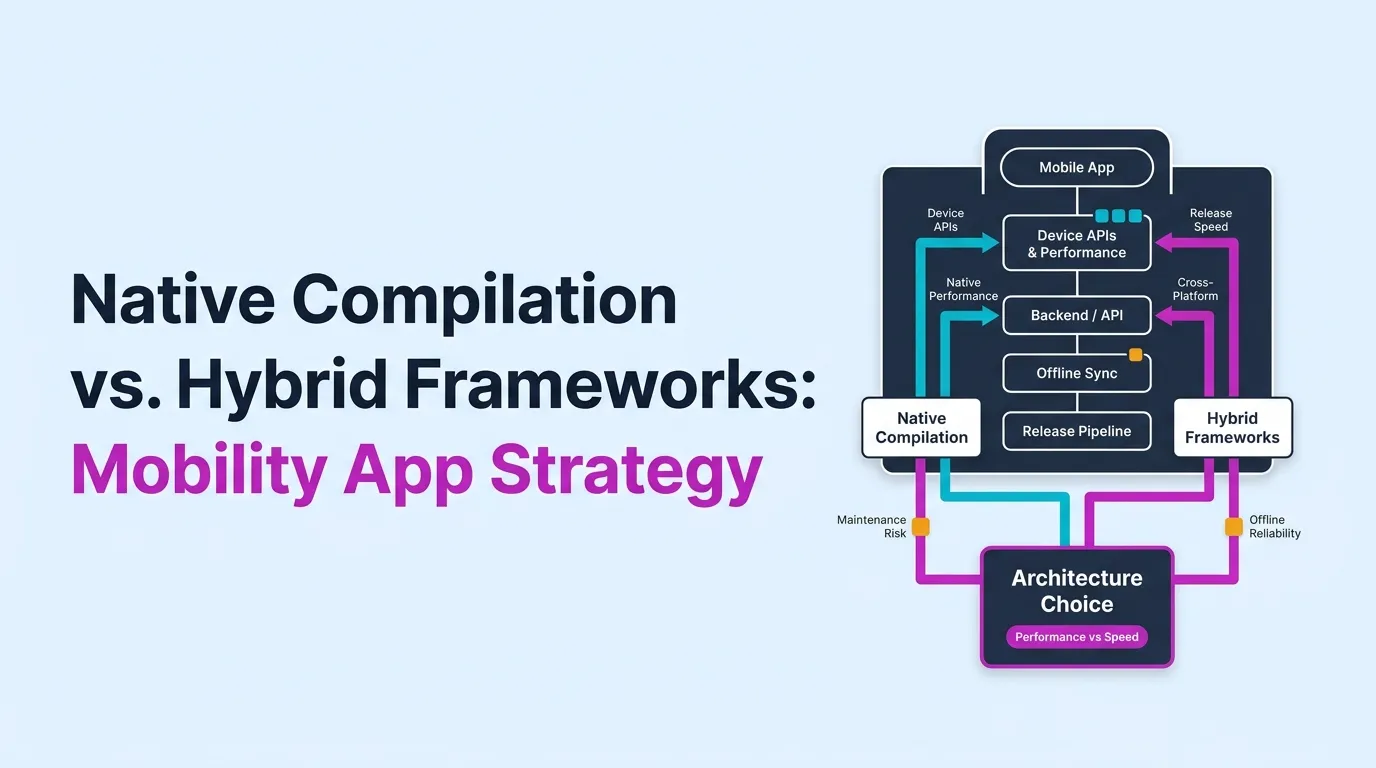
- Native compilation and hybrid frameworks affect app speed, device access, maintenance cost, and long-term scalability.
- Founders, developers, mobile teams, QA teams, and users need a framework choice that matches the app’s real workload.
- Performance, camera access, GPS tracking, push notifications, payment flows, and app store rules are core decision layers.
- Framework risk depends on feature complexity, device integration, update frequency, developer availability, and launch timeline.
- A strong mobile foundation helps founders avoid rebuilds when the app grows beyond simple screens and basic user flows.
Development Signals
- Native apps work well when products need high performance, deep device access, smoother animations, and platform-specific control.
- Hybrid frameworks help reduce development time when founders need shared code across iOS, Android, and web experiences.
- Developers need to evaluate SDK support, plugin reliability, offline handling, background tasks, and app store compatibility.
- Admins need stable dashboards, version control, crash reports, user analytics, feature flags, and release monitoring.
- Testing should cover device performance, permissions, payments, notifications, GPS accuracy, camera workflows, and real-user traffic conditions.
Real Insights
- The best framework is not always the trendiest one; it is the one that supports the app’s operational reality.
- Hybrid development can be efficient for marketplace, delivery, booking, and SaaS apps when architecture is planned correctly.
- Native development becomes more important when performance, hardware access, and platform-specific behavior define user experience.
- Founders should choose the mobile stack before scaling features, publishing apps, or adding complex real-time workflows.
- Miracuves builds mobile apps with native and hybrid development paths, scalable architecture, device integrations, app store deployment, and admin control.
Choosing between native compilation and hybrid frameworks is not really a technology debate. For founders, it is a product-risk decision.
A simple content app, booking app, marketplace app, or admin-heavy mobile product can often succeed with a strong cross-platform framework. But a mobility app with background GPS, live driver tracking, geofencing, biometric security, Bluetooth connectivity, or real-time messaging needs a deeper evaluation.
The wrong choice does not only affect development cost. It affects battery usage, app responsiveness, background reliability, release speed, device permissions, debugging complexity, and long-term maintenance.
That is why founders should not ask, “Should I build native or hybrid?” The better question is:
How much direct device access does my app need to deliver the experience users expect?
This blog introduces a practical framework called the Hardware Access Coefficient, designed to help startup teams choose the right compilation strategy before they commit to a build.
Vetting Performance Needs: Hardware Access and Background Processing Loops
Every mobile app uses the phone differently.
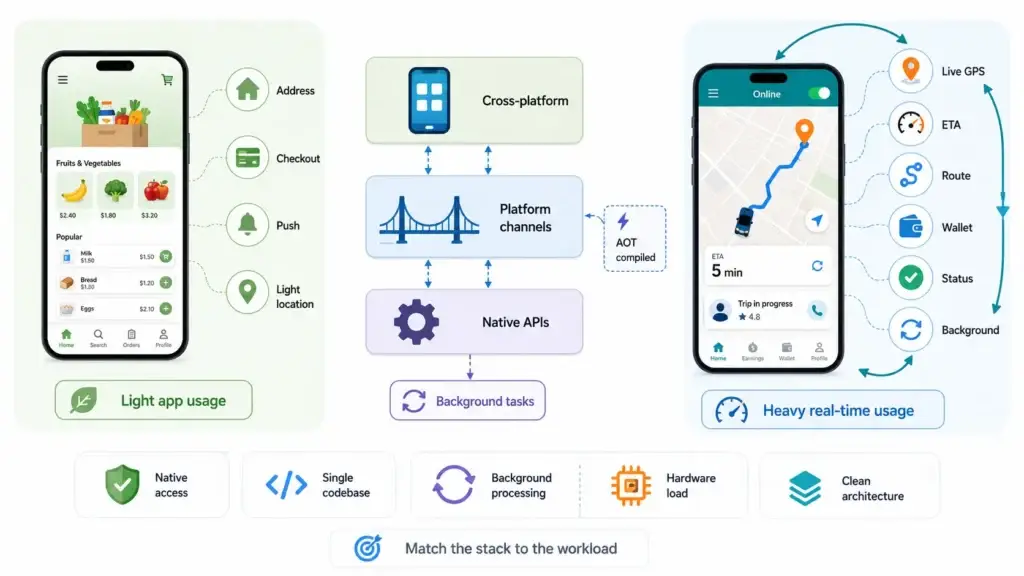
A grocery app may need location only when a user enters an address. A ride-hailing app may need continuous driver location, route updates, ETA refreshes, push notifications, wallet updates, and trip status changes while the app is open, minimized, or moving between network states.
That difference matters.
Native apps built with Swift for iOS or Kotlin for Android generally offer the closest access to operating-system-level APIs. Hybrid or cross-platform apps can still access device features, but the quality of implementation depends on the framework, plugins, native bridges, permissions, and background execution strategy.
Flutter is especially relevant here because it gives founders a single-codebase development model while still allowing platform-specific code through platform channels. Founders evaluating Flutter for production apps can also review Miracuves’ Flutter app launch guide for a broader view of planning, testing, and deployment. Flutter’s documentation explains that platform channels allow Dart code to communicate with platform-specific APIs written in languages such as Kotlin or Swift.
Dart also supports ahead-of-time compilation for production apps, producing native ARM or x64 machine code for deployment.
This is why the decision should not be reduced to “native is good, hybrid is bad.” The real question is whether the cross-platform stack is architected cleanly enough to handle your hardware-access load.
Read More: The Rise of the “Micro-Monopoly”: How Localized Apps Dominate Regional Commerce
The Hardware Access Coefficient: A Practical Founder Framework
The Hardware Access Coefficient measures how deeply your app depends on the phone’s native capabilities.
Use it as a strategic scoring method before choosing native, Flutter, React Native, Ionic, or another hybrid framework.
| Device Requirement | Low Coefficient | Medium Coefficient | High Coefficient |
|---|---|---|---|
| GPS usage | Address selection or one-time location | Periodic location updates | Continuous background tracking, geofencing, route monitoring |
| Background activity | Push notifications only | Scheduled sync or background refresh | Persistent trip, delivery, or safety monitoring |
| Bluetooth or sensor access | None | Occasional device pairing | Continuous Bluetooth, wearable, IoT, or sensor communication |
| Biometric security | Basic login convenience | Authentication for payments or private data | Sensitive wallet, medical, identity, or enterprise access |
| Real-time messaging | Basic chat | Delivery, booking, or support chat | Low-latency dispatch, live operations, emergency flows |
| Offline behavior | Not needed | Cached screens or temporary offline mode | Offline-first operations with sync conflict handling |
| Battery sensitivity | Low | Moderate | Critical to user trust and retention |
How to read the coefficient
If most of your app sits in the low column, a cross-platform or hybrid approach is usually enough.
If most of your app sits in the medium column, Flutter or React Native with careful plugin selection, backend architecture, and native-module planning can work well.
If your app sits heavily in the high column, you should still consider Flutter, but only with a serious native-layer strategy. That may include custom platform channels, native background services, native permission handling, and performance profiling before release.
For many mobility startups, this is where Miracuves’ Flutter-based white-label approach becomes useful. Founders can start from a pre-optimized mobile foundation rather than asking a new team to solve tracking, messaging, admin control, and deployment from zero.
Read More: The 4 Types of Apps That Actually Generate High-Volume Revenue
Background Logistics: Why Location Apps Need More Than a Good UI
Tracking apps fail when founders treat GPS as a screen feature instead of an infrastructure feature.
In logistics, taxi, courier, field-service, delivery, and mobility apps, background location is not simply “show user on map.” Founders building this type of product can connect the framework decision to real use cases such as delivery app development solutions or a ride-sharing app solution, where tracking, route updates, and dispatch visibility are core product requirements.
- Permission handling
- Battery-sensitive tracking intervals
- Foreground and background state changes
- Network loss recovery
- Geofence transitions
- Driver or agent status changes
- Backend event syncing
- ETA and route recalculation
- Admin visibility
Both Android and iOS apply platform-level restrictions to background location behavior. Android documentation notes that background location access depends on permissions and background execution rules, while Apple’s Core Location documentation includes specific guidance for background location updates and system battery behavior.
This is where weak hybrid implementations can break down. If the app relies on unstable plugins, poorly handled permissions, or untested background flows, users may see missed location updates, delayed driver movement, inaccurate ETAs, or battery drain. For a deeper technical example, see Miracuves’ guide to real-time GPS tracking architecture for Flutter and Laravel delivery apps.
A clean Flutter architecture can work well for many of these use cases, but founders should confirm that the implementation includes native-aware background handling, not just map screens and location buttons.
Read More: Designing a Peer-to-Peer Rental Engine: Solving the Availability Challenge
The Strategic Matrix: Latency, Cross-Platform Launch Speed, and Asset Maintenance
The right app framework should be judged across three business variables: latency, launch speed, and maintenance load.
| Build Strategy | Performance Strength | Launch Speed | Maintenance Load | Best Fit |
|---|---|---|---|---|
| Native Swift + Kotlin | Highest native control and platform-specific optimization | Slower because two codebases are needed | Higher because iOS and Android updates are separate | Apps with extreme hardware access, gaming, advanced sensors, or highly platform-specific behavior |
| Flutter | Strong performance with one codebase and native integration options | Faster than separate native builds | Lower than maintaining two fully native apps | Mobility, delivery, marketplace, fintech, messaging, and tracking apps needing speed plus performance |
| React Native | Good cross-platform productivity with broad ecosystem | Fast for teams already strong in JavaScript | Moderate, especially around bridges and native modules | Consumer apps, marketplace apps, social apps, and web-to-mobile teams |
| Ionic or web-hybrid | Fastest for simple app shells and web-first experiences | Very fast | Lower for simple apps, risky for performance-heavy apps | Content apps, dashboards, simple booking flows, internal tools |
| PWA | No app-store dependency and strong web reach | Fast | Lower mobile-store complexity | Lightweight products where deep hardware access is not central |
Native development makes sense when platform-specific behavior is the product. But many startup apps do not need two independent native codebases from day one.
A founder planning a delivery, booking, service marketplace, short-video, chat, or tracking app often needs a faster way to launch without giving up app-store deployment, admin control, and source-code ownership. That is the strategic opening for Flutter.
Read More: The Pre-Launch Compliance Checklist: Meeting Enterprise Security Standards
Why Flutter Often Works for Mobility Apps
Flutter is not a shortcut for weak engineering. It is a strong framework when the app is planned correctly.
Flutter’s architecture uses a platform-specific embedder to coordinate with the operating system for services such as rendering surfaces, input, accessibility, and the event loop. It also supports interoperability when teams need to access platform APIs or native code.
For founders, the practical value is simple: one mobile codebase can support iOS and Android while native modules can still be added where the business case requires them. This is why a strong Dart development foundation matters for Flutter apps that need clean architecture, predictable state management, and production-ready performance.
This is especially valuable for:
- Delivery tracking apps
- Ride-hailing platforms
- Courier and logistics apps
- On-demand service apps
- Field workforce apps
- Chat-heavy marketplace apps
- Location-based community apps
- Fintech apps needing biometric or secure device flows
The business advantage is not only “lower development cost.” It is faster iteration. A single product team can release updates, test flows, improve UI, fix bugs, and maintain shared logic without duplicating every mobile effort across two native teams.
Founder Decision Signals
Speed
Choose Flutter or another strong cross-platform framework when faster iOS and Android launch matters more than building two independent native apps from day one.
Hardware Access
Choose native or native-enhanced Flutter when your app depends on background GPS, Bluetooth, biometrics, sensors, or operating-system-level permissions.
Maintenance
Use a shared mobile codebase when your team needs faster updates, consistent UI, and lower long-term release complexity across platforms.
Market Fit
Start with a launch-ready foundation when the business model needs validation before investing in a long custom native build.
Production Ready: Leveraging Clean, Native-Compiled Flutter Frameworks
A Flutter app can be strong in production when the stack is clean, tested, and planned around real device behavior.
Founders should look beyond the sales phrase “cross-platform app” and ask what is actually inside the framework.
A production-ready Flutter structure should include:
- Clean state management
- API-ready backend architecture
- Push notification handling
- Location permission workflows
- Native modules where required
- Real device testing
- Performance profiling
- App-store submission readiness
- Admin dashboard integration
- Secure authentication flows
- Error logging and crash reporting
- Source-code ownership
This is where Miracuves’ approach can help founders avoid starting from a blank repository. A ready-made, white-label app foundation can already include common product flows, admin panels, branded app structure, and deployment-ready mobile builds.
For a founder planning a mobility or messaging-heavy product, the value is not only speed. It is reducing the number of unknowns before launch.
Explore Miracuves’ cross-platform app development services if your product needs shared iOS and Android delivery with performance-focused implementation. For founders who need a deeper product-specific build, Miracuves also supports custom mobile app development across native and cross-platform stacks.
Native vs Flutter vs Hybrid: Which One Should You Choose?
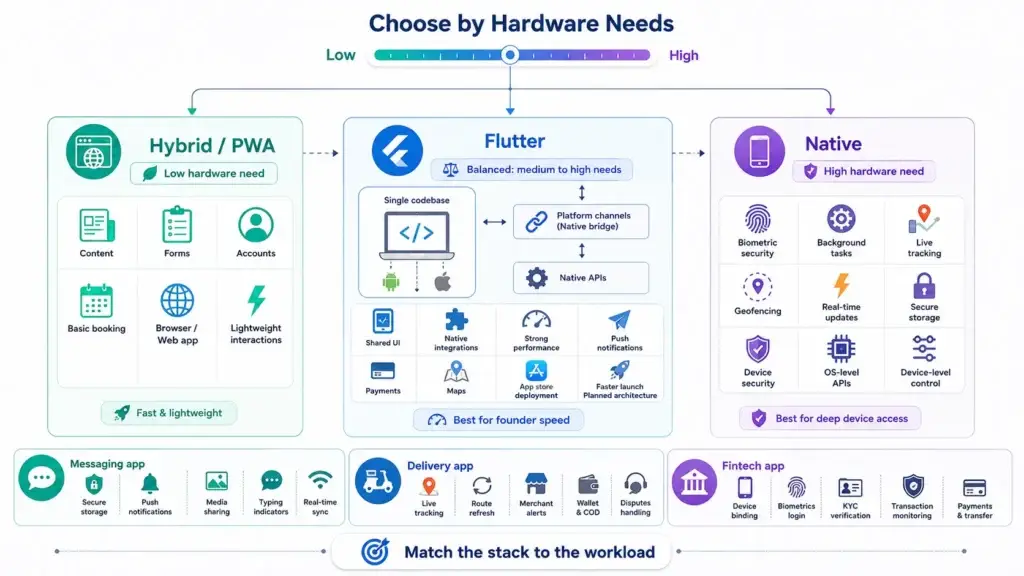
The right technology choice should depend on the Hardware Access Coefficient score, not on personal preference or development trends.
If the product requires highly platform-specific behavior, native development with Swift for iOS and Kotlin for Android may be the right path. This approach is especially suitable for applications where native hardware behavior is central to the overall user experience.
If the product needs highly platform-specific behavior, native Swift and Kotlin may be the right path. Founders building iOS-first products can explore Miracuves’ Swift development services, while Android-heavy apps with deeper device API needs may require dedicated Android app development services.
If the product is mostly focused on content, forms, account management, simple booking flows, or basic user interactions, a lighter hybrid structure or Progressive Web App may be enough. In these cases, deep native hardware access is usually not a major business requirement.
The biggest mistake founders make is choosing the technology stack before understanding how closely the product depends on the phone’s hardware, operating system, and background behavior.
A messaging app is not just a messaging app when it requires encrypted local storage, biometric login, media compression, push notification delivery, and real-time typing indicators. These features create deeper device-level requirements than a simple chat interface.
A delivery app is not just a delivery app when it requires geofencing, driver tracking, route refreshes, merchant alerts, wallet updates, and dispute workflows. These functions depend on background processing, location accuracy, and reliable communication between the mobile app and backend systems.
A fintech app is not just a fintech app when it requires device binding, biometric security, KYC workflows, transaction monitoring, and secure payment integrations. These requirements make security, compliance-ready workflows, and native device access part of the core product foundation.
The more your product depends on the device, the more carefully you should design the compilation strategy before development begins.
Mistakes Founders Should Avoid
Choosing a framework only because it is faster to build
Speed matters, but a fast build becomes expensive if background tracking, permissions, or device integrations fail after launch.
Treating Flutter as a simple hybrid wrapper
Flutter is stronger than a basic web-wrapper approach, but it still needs native-aware planning for location, biometrics, Bluetooth, notifications, and background processing.
Ignoring release-build performance
Development testing is not enough. Founders should ask for production build profiling, real-device testing, and app-store readiness checks before launch.
Building custom from zero without validating the model
For many mobility and marketplace apps, a ready-made foundation can reduce avoidable engineering risk while the founder validates demand, monetization, and operations.
Where Miracuves Fits Into the Decision
Miracuves helps founders evaluate whether their app should be built with native development, Flutter, React Native, or a ready-made app solution. For founders comparing launch speed against engineering complexity, the rapid app development process also shows how a controlled, source-code-owned foundation can reduce avoidable build risk.
For many mobility, delivery, marketplace, fintech, and messaging products, Flutter provides the strategic balance: faster cross-platform launch, native-level integrations where needed, and lower maintenance complexity than managing two separate native codebases.
A Miracuves-ready framework can help founders start with:
- iOS and Android app structure
- Admin dashboard
- Source-code ownership
- White-label branding
- Real-time workflows
- Payment or wallet integration where relevant
- Location and notification flows
- Faster deployment for ready-made solutions
- Customisation support after launch
The strongest build strategy is not always the most expensive one. It is the one that matches your app’s hardware-access reality and your startup’s validation timeline.
Final Thoughts: Choose the Framework That Matches the Phone-Level Reality
Native compilation vs hybrid frameworks is not a debate founders should answer with a trend list.
The right answer depends on how deeply your app depends on the phone itself.
If your app only needs simple screens, forms, content, and standard notifications, a lightweight hybrid structure may be enough. If your app depends on continuous background tracking, low-latency updates, biometric security, Bluetooth, or platform-specific behavior, native planning becomes much more important.
For many founders, Flutter offers the practical middle path. It supports fast cross-platform delivery while still allowing native integrations where the product needs them.
Miracuves helps founders make that decision with a launch-focused mindset: validate faster, own the source code, keep the admin layer under control, and avoid building from zero when a production-ready foundation can get the product to market sooner.
FAQs
What is the difference between native compilation and hybrid frameworks?
Native compilation usually means building apps specifically for iOS and Android using platform languages such as Swift and Kotlin. Hybrid or cross-platform frameworks use a shared codebase to deploy across multiple platforms. Modern frameworks like Flutter can compile production apps to native machine code while still supporting native platform integrations.
Is Flutter native or hybrid?
Flutter is commonly grouped under cross-platform development, but it is not the same as a basic web-wrapper hybrid app. Flutter uses Dart, supports production compilation to native machine code, and allows developers to connect with platform-specific APIs through platform channels.
Should I choose native development for a GPS tracking app?
Choose native development or native-enhanced Flutter if your app depends heavily on continuous background GPS, geofencing, route updates, and battery-sensitive tracking. A simple location feature does not always require full native development, but logistics and ride-tracking apps need deeper native-layer planning.
Can Flutter handle background location tracking?
Flutter can support background location use cases, but the implementation depends on plugins, native permissions, platform rules, and custom native code where required. Founders should confirm that background execution is tested on real iOS and Android devices before launch.
Is native app development always better for performance?
Native development offers the highest level of platform-specific control, but it is not always the best business decision. If the app does not require extreme hardware access, Flutter can provide strong performance with faster cross-platform delivery and lower maintenance complexity.
Why do mobility apps need a different framework decision?
Mobility apps often depend on live tracking, geofencing, route updates, push notifications, driver status, admin monitoring, and background activity. These requirements create more device-level complexity than simple content or booking apps.
How does Miracuves help with Flutter-based app development?
Miracuves helps founders launch ready-made and white-label mobile apps using performance-focused Flutter stacks, source-code ownership, branded design, admin dashboards, and customisation support. This can reduce time spent building standard mobile flows from zero.