Key Takeaways
- Localized apps can win faster by dominating one regional market instead of chasing broad global scale too early.
- A micro-monopoly strategy focuses on dense local demand, trusted providers, fast fulfillment, and repeat transactions.
- Regional commerce platforms need geofencing, local pricing, provider onboarding, payments, delivery logic, and admin control.
- Capital efficiency depends on service radius, customer density, acquisition cost, provider supply, and operational repeatability.
- A focused local marketplace can reach stronger traction when every user, provider, and transaction stays inside a controlled service area.
Regional Signals
- Founders need to define the city, service radius, customer segment, provider supply, and repeat-use category before launch.
- Customers need nearby availability, fast booking, local trust signals, secure payments, reviews, and reliable fulfillment updates.
- Providers need onboarding, service-zone control, booking alerts, earnings visibility, schedule tools, and payout tracking.
- Admins need control over zones, users, providers, pricing, commissions, disputes, payments, reports, and regional campaigns.
- Geofenced operations help reduce delivery delays, supply gaps, support friction, and wasted marketing spend outside the target market.
Real Insights
- A local app does not need millions of users to become valuable if it controls a high-frequency regional workflow.
- Micro-monopoly growth comes from density, not vanity reach; tighter service zones often create better fulfillment economics.
- Regional platforms gain defensibility when customers, providers, pricing, reviews, and operations become locally connected.
- Founders should expand city by city only after supply, demand, payments, and support systems are stable in the first market.
- Miracuves builds localized marketplace and on-demand apps with geofencing, provider workflows, regional pricing, payments, dispatch logic, and admin control.
When founders ask, “What kind of apps are popular right now?”, they usually expect a list of trending categories: AI apps, fintech apps, food delivery apps, rental apps, short video platforms, marketplace apps, or wellness apps.
That answer is not wrong. It is just incomplete.
The more useful question is: which type of app can create repeat transactions, local loyalty, and operational control without needing global-scale venture capital?
That is where the Micro-Monopoly model becomes important.
A Micro-Monopoly is not about owning the world. It is about owning a specific local demand loop better than anyone else. For example, a 10-mile service marketplace for home repairs, grocery delivery, pet care, equipment rentals, courier delivery, or local business commerce can become more defensible than a broad consumer app trying to serve everyone everywhere.
In 2026, app popularity is not only about downloads. Sensor Tower reported that global consumers spent 5.3 trillion hours in apps in 2025, showing how deeply mobile behavior is embedded in daily life. But for founders, the opportunity is not just attention. It is converting attention into repeat, profitable transactions.
For local entrepreneurs, regional business networks, aggregators, and founders with city-level knowledge, localized apps may be one of the most practical app opportunities right now.
Miracuves helps founders build ready-made, white-label app solutions that can be adapted for local delivery, rental, service marketplace, ecommerce, and on-demand business models. Instead of starting with a global ambition and burning capital on broad acquisition, founders can start with a focused regional commerce loop and expand after local density is proven.
The Illusion of Global Scale: Why Broad Consumer Apps Burn Venture Capital
Many founders are attracted to global consumer app ideas because the upside feels massive. Social apps, content apps, AI companions, dating platforms, fitness communities, and creator tools can all look exciting from the outside.
The problem is that broad consumer apps usually need huge distribution before the business model becomes clear.
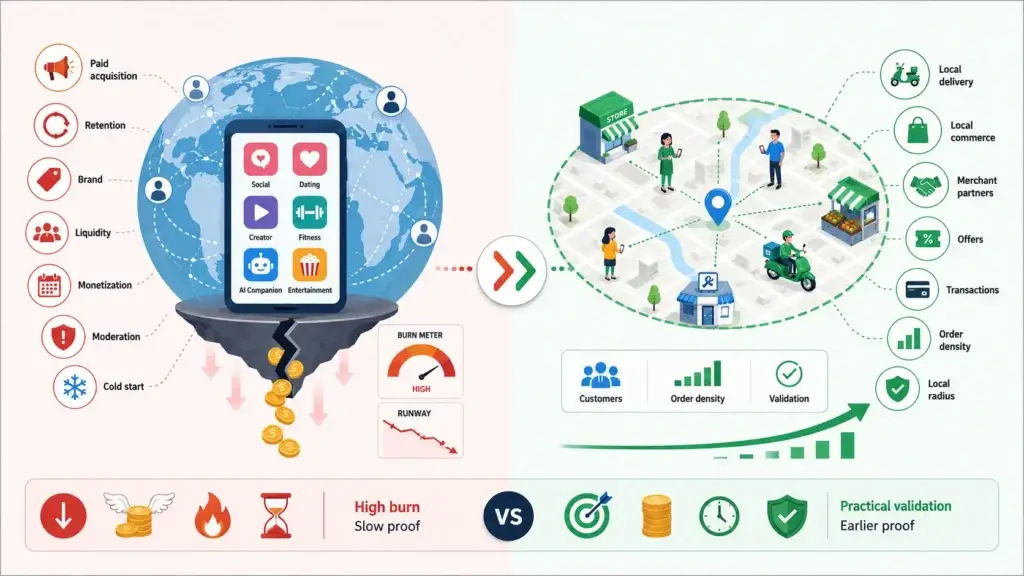
A global consumer app often requires:
- Large paid acquisition budgets
- Strong retention loops before monetization
- Heavy brand-building
- Content, creator, or community liquidity
- Constant product experimentation
- Long monetization timelines
- High infrastructure and moderation overhead
This is why “popular” does not always mean “practical for a founder.”
A social app may be popular as a category, but if every user expects a large existing network before they see value, the founder faces a cold-start problem. A food discovery app may look attractive, but if it has no local restaurant partnerships, no offers, and no transactional layer, it may become another directory. A delivery app can fail if the service area is too wide before order density exists.
Recent consumer app investment discussions show that AI-native social, social maps, dating, and entertainment apps still attract attention, but raising capital for new consumer platforms remains difficult because distribution and retention are hard to prove early.
That is why regional commerce apps deserve more attention, especially for founders evaluating clone app development for market validation before committing to a large custom build.
They do not need the whole world on day one. They need the right customers, vendors, and service providers inside a workable radius.
Read More: The 4 Types of Apps That Actually Generate High-Volume Revenue
The Micro-Monopoly Playbook: Dominating Logistics Within Local Geofences
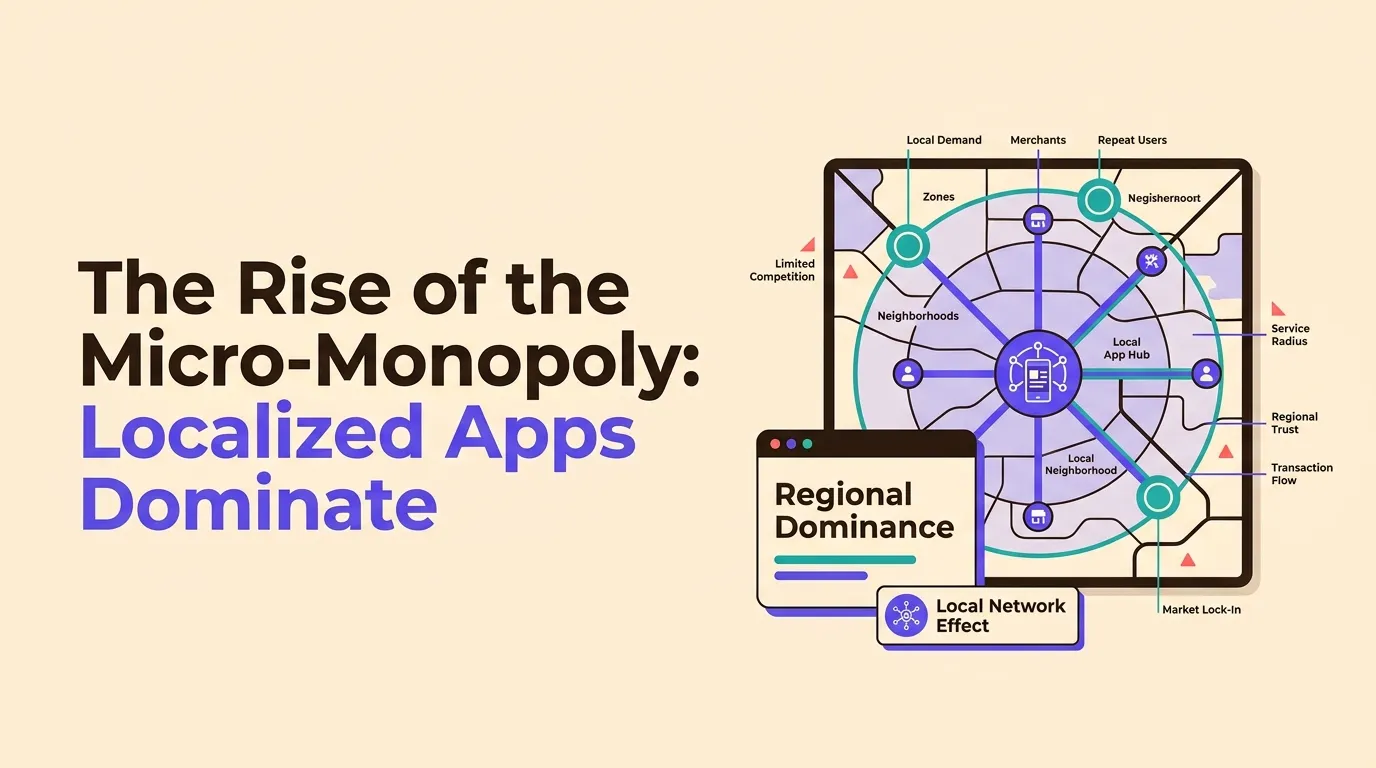
A Micro-Monopoly is a localized app model where the founder targets a narrow region and builds strong transaction density before expanding.
The model works best when the app controls a specific local loop:
| Local Loop | Example App | Why It Works |
|---|---|---|
| Need-based services | Home repair, cleaning, salon, pet care | Users repeat bookings when trust is built |
| Local delivery | Grocery, pharmacy, food, courier | Short routes improve fulfilment efficiency |
| Rentals | Cars, tools, boats, equipment, property | Supply is naturally local and discovery-driven |
| Regional ecommerce | Local shops, niche products, city merchants | Local sellers need digital demand without losing identity |
| Professional services | Tutors, trainers, consultants, healthcare bookings | Trust and proximity influence conversion |
The key is density.
Marketplace liquidity depends on having enough buyers and sellers in the same operational area. TechCrunch’s marketplace liquidity framework highlights density, balanced supply and demand, and category concentration as core drivers for local marketplace performance.
That is the foundation of the Micro-Monopoly Radius.
Instead of asking, “How do we launch in 50 cities?”, a founder asks:
Can we become the default app for this category inside this 10-mile radius?
That shift changes the economics.
A broad delivery platform may waste money acquiring users across disconnected neighborhoods. A Micro-Monopoly app focuses demand, vendors, and fulfilment inside a tighter zone. That can reduce wasted delivery distance, improve provider availability, and create stronger local brand recall.
Read More: Designing a Peer-to-Peer Rental Engine: Solving the Availability Challenge
The Micro-Monopoly Radius Variable: The Metric Founders Should Track
The Micro-Monopoly Radius is the geographic area where the app can reliably match demand with supply while maintaining acceptable fulfilment cost, response time, repeat usage, and service quality.
For a localized marketplace, this radius may be:
- 2–5 km for quick commerce or grocery delivery
- 5–10 miles for home services and professional bookings
- City-center focused for rentals, courier, or restaurant delivery
- Neighborhood-specific for local seller discovery
The exact radius depends on the category.
A food delivery marketplace needs short travel times. A pet care marketplace can operate across a wider area. A local equipment rental platform may need fewer suppliers but higher trust and better scheduling. A professional services app may rely more on reviews, availability, and repeat relationships than instant fulfilment, while a freelance services app may require stronger project matching, portfolios, payments, and collaboration workflows.
Verification-Dependent Case Study Block
The strategy brief mentions live telemetry showing a hyper-localized service marketplace clone operating in a 10-mile geo-fenced city center reaching profitability in under 90 days. Do not publish this as a factual claim unless Miracuves can provide verified first-party data, client permission, or anonymized proof.
Suggested publish-safe framing:
In a verified internal telemetry study, a hyper-localized service marketplace operating inside a defined 10-mile city-center radius showed how local density can improve capital efficiency. The platform concentrated vendors, customers, and fulfilment workflows inside one serviceable zone before expanding. This allowed the operator to focus acquisition spend, reduce operational waste, and measure profitability signals faster than a broad multi-city launch.
Suggested metrics to include after verification:
| Telemetry Metric | Why It Matters |
| Active service radius | Shows whether operations are focused or over-expanded |
| Customer acquisition cost by zone | Reveals whether local demand is affordable to acquire |
| Repeat booking rate | Measures retention and trust |
| Provider utilization | Shows whether supply is earning enough to stay active |
| Average fulfilment distance | Connects geography to cost efficiency |
| Contribution margin by order | Shows whether the model can become profitable |
| Payback period | Helps compare local efficiency against broad consumer app burn |
Without verified telemetry, this article should frame the Micro-Monopoly Radius as a founder decision framework, not as a guaranteed result.
Why Localized Apps Are Popular Right Now
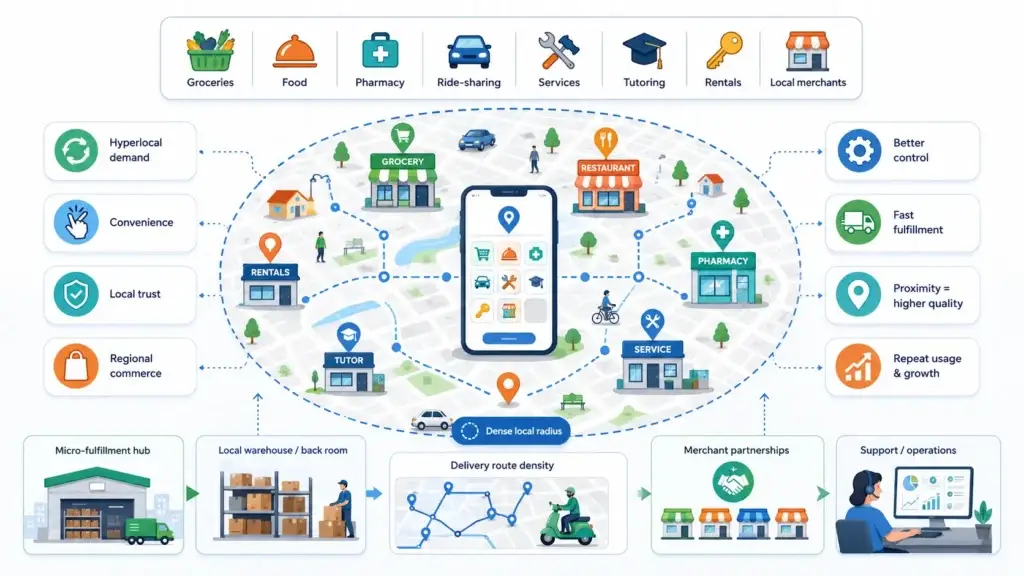
Localized apps are gaining attention because they sit at the intersection of convenience, trust, regional commerce, and mobile-first behavior.
The broad mobile market is still expanding in depth of usage. Sensor Tower’s India mobile market report notes that emerging app categories are growing by embedding into everyday routines, with total annual time spent exceeding 1.3 trillion hours in India by 2026.
But the most founder-relevant opportunity is not simply “build an app people use.” It is “build an app people need repeatedly in a specific context.”
That is why hyperlocal categories are attractive:
- People need groceries, food, medicine, repairs, rides, tutors, and rentals repeatedly, and regional mobility demand can also support a localized ride-sharing app when rider, driver, and route density exist inside a focused service area.
- Local merchants want digital demand but may not want to depend entirely on large platforms.
- Regional aggregators already understand supply relationships.
- Local trust can be built faster than global brand awareness.
- Smaller geographies make fulfilment, support, and operations easier to control.
Quick commerce also shows how geography shapes operations. Research and Markets notes that quick commerce platforms increasingly use micro-fulfilment hubs, dark stores, store-back rooms, and hyper-local warehouses close to dense urban neighborhoods.
That same principle applies beyond grocery.
The closer the app is to the transaction environment, the stronger its ability to control service quality.
Read More: The Pre-Launch Compliance Checklist: Meeting Enterprise Security Standards
Popular Localized App Categories Founders Can Launch
The strongest localized apps are not random trends. They are platforms where geography creates an advantage.
1. Local Service Marketplace Apps
A local service marketplace connects customers with verified providers for tasks such as cleaning, plumbing, beauty, repairs, pet care, wellness, tutoring, and personal services.
This model works because service quality, proximity, availability, and trust all matter.
A founder can begin with one city or category, then expand into adjacent services once repeat bookings are visible.
Useful monetization models include:
- Commission per booking
- Provider subscriptions
- Featured provider listings
- Lead fees
- Service packages
- Cancellation or convenience fees
A ready-made on-demand service app solution can help founders avoid building every user, provider, booking, payment, and admin workflow from zero.
2. Hyperlocal Delivery Apps
Hyperlocal delivery apps are strong candidates for regional entrepreneurs because fulfilment speed depends on local control.
Food, grocery, pharmacy, parcel, and courier delivery platforms all need:
- Customer app
- Merchant or store dashboard
- Delivery partner app
- Admin dashboard
- Real-time tracking
- Order allocation
- Payment integration
- Promotions and commissions
- Zone-based service control
Miracuves offers delivery app development solutions for founders who want a ready-made base for food, grocery, pharmacy, parcel, or multi-category delivery workflows.
The founder advantage is operational clarity. If one region produces enough order density, the same playbook can be repeated in the next zone.
3. Local Rental Marketplace Apps
Rental marketplaces are naturally localized because assets are tied to location.
Examples include:
- Car rental
- Bike rental
- Boat rental
- Equipment rental
- Property rental
- Event item rental
- Furniture rental
Unlike broad ecommerce, rental marketplaces require availability calendars, deposits, identity checks, booking rules, location search, reviews, and dispute workflows, which is why founders need a strong full stack app development foundation when the product requires deeper custom workflows.
A local rental marketplace can build supply depth faster by targeting a specific city, tourist region, campus zone, or business district, especially when supported by a broader listings platform that can manage availability, search, bookings, and location-based discovery.
Founders exploring this category can connect readers to rental marketplace app solutions as the next step.
4. Regional Ecommerce and Local Seller Apps
Local seller apps help regional merchants digitize catalogues, receive orders, manage delivery, and retain customers under a local commerce brand, which makes ecommerce app development a practical path for merchant associations and regional seller networks.
This model is especially useful when local shops have strong offline relationships but weak digital infrastructure.
The app can support:
- Storefronts
- Product catalogues
- Local delivery slots
- Customer accounts
- Offers and loyalty
- Digital payments
- Store ratings
- Admin-level category control
The opportunity is not to copy a global ecommerce marketplace. It is to create a regional commerce layer that helps local sellers stay visible and transact digitally.
5. Local Professional and Appointment Apps
Professional service apps connect users with consultants, tutors, doctors, trainers, lawyers, accountants, repair specialists, beauty professionals, or wellness experts.
These platforms need strong trust workflows:
- Profile verification
- Availability calendars
- Reviews
- Booking and rescheduling
- Video or chat consultation where relevant
- Secure payment
- Admin moderation
- Dispute handling
This model works well for regional business networks because supply relationships often already exist offline, especially in healthcare markets where a healthcare services app can structure appointment booking, provider discovery, and patient-facing workflows. The app turns those relationships into a structured digital marketplace.
Localized App Categories and Founder Fit
| App Category | Best Founder Type | Micro-Monopoly Advantage |
|---|---|---|
| Local Service Marketplace | Entrepreneurs with provider networks | Trust, reviews, and repeat bookings compound locally |
| Hyperlocal Delivery | Regional aggregators and delivery operators | Shorter routes and tighter fulfilment zones improve control |
| Rental Marketplace | Tourism, mobility, property, or equipment operators | Supply is location-bound, making regional depth defensible |
| Local Ecommerce | Merchant associations and local business networks | Existing offline trust can convert into digital transactions |
| Professional Booking App | Consultant, healthcare, coaching, or education networks | Availability, expertise, and reputation matter more than global scale |
Deploying Clean White-Label Frameworks to Capture Closed-Loop Regional Commerce
A localized app does not need to begin as a fully custom, multi-year product build.
For many founders, the smarter route is a clean white-label framework that already includes the core operational workflows:
- User onboarding
- Vendor or provider management
- Catalogue or service listing
- Booking or ordering
- Payments
- Notifications
- Ratings and reviews
- Admin controls
- Reports and analytics
- Service zone management
- Commission settings
- Dispute handling
This is where ready-made app foundations create leverage.
The founder can spend less time building generic modules and more time solving local execution problems:
- Which vendors should be onboarded first?
- Which neighborhoods have the strongest demand?
- What service radius is operationally profitable?
- Which category creates repeat usage?
- Which pricing model works locally?
- Which offline partnerships can reduce acquisition cost?
A white-label platform is not valuable because it copies another app. It is valuable because it gives the founder a launch-ready control layer that can be adapted to a specific regional market, which also makes the white-label reseller business model relevant for agencies and regional operators serving multiple local niches.
Miracuves’ ready-made clone app solutions are built around this idea: help founders launch faster with brandable, source-code-owned app foundations across delivery, rentals, services, marketplaces, fintech, entertainment, and more.
Founder Decision Signals: When a Localized App Makes Sense
Speed
A localized app makes sense when the founder can launch in one region quickly, onboard supply manually, and test demand before expanding.
Cost
The model is stronger when marketing, operations, and fulfilment can be concentrated in a limited service radius instead of spread across disconnected markets.
Scalability
Scalability should come after local density. Expanding too early can create operational waste before the marketplace has repeat demand.
Market Fit
The best signal is repeat usage within a local category: bookings, reorders, subscriptions, provider retention, and merchant participation.
Why Micro-Monopoly Apps Can Be More Capital-Efficient
Capital efficiency improves when the founder avoids unnecessary scale before the business model is ready.
A global consumer app may spend heavily to acquire users who do not transact, return, or invite others, which is why founders comparing launch models should understand how fast app development can reduce wasted time before market feedback. A localized commerce app can focus on users who have immediate intent.
For example:
| Broad Consumer App | Micro-Monopoly Local App |
| Needs large audience before value is clear | Can create value inside one region |
| Monetization may come late | Transactions can begin earlier |
| Acquisition is broad and expensive | Acquisition can be local, partner-led, and referral-driven |
| Harder to control trust and quality | Easier to verify vendors and providers locally |
| Expansion often precedes operational maturity | Expansion can follow density and repeat usage |
| Brand recall is difficult | Local identity can become a strength |
The difference is not just product. It is operating discipline.
The Micro-Monopoly founder asks:
- Can we own one category in one region?
- Can we onboard the best local suppliers before competitors?
- Can we measure repeat demand within weeks?
- Can we reduce fulfilment cost through route or zone control?
- Can we improve retention through local trust?
- Can we expand only after contribution margin improves?
This makes the app less dependent on hype and more dependent on execution.
Mistakes Founders Should Avoid
Launching Across Too Many Locations Too Early
A local marketplace needs concentrated supply and demand. Expanding before density is proven can increase marketing cost, weaken service quality, and make operations harder to manage.
Choosing a Trend Instead of a Transaction Loop
“AI app” or “delivery app” is not enough. The founder must know what users repeatedly pay for, who fulfils the demand, and what admin controls are needed to operate the marketplace.
Ignoring Provider Economics
If vendors, delivery partners, or service providers do not earn enough, supply quality drops. A strong localized app balances customer affordability with provider retention.
Building Custom From Zero Before Validating Demand
Custom development can be useful when the model is mature, but early founders often benefit from a ready-made foundation that helps them validate faster.
The Miracuves Perspective: Build Locally, Validate Faster, Expand Smarter
The next wave of popular apps will not only be global AI tools or entertainment platforms. Many strong opportunities will come from founders who understand a specific region better than large platforms do.
A localized app can win because it is closer to the customer, closer to the vendor, and closer to the operational problem.
Miracuves helps founders launch white-label and ready-made app platforms for local delivery, service marketplaces, rentals, ecommerce, on-demand services, and regional commerce models. For founders who want to move faster, a launch-ready solution can reduce the time spent on foundational workflows and create more room for market validation, local partnerships, and monetization strategy.
The strongest localized app is not the one with the widest launch map. It is the one with the clearest local transaction loop.
Final Thoughts: The Future of Popular Apps Is Local, Focused, and Transactional
The question “What kind of apps are popular right now?” should not push founders toward a superficial list of global tech trends.
A better answer is that the most practical app opportunities today are the ones that solve repeat, local, and transactional problems for a clearly defined audience. For regional entrepreneurs, localized apps can create stronger business value because they focus on real demand within a specific market instead of chasing broad, unfocused scale.
The Micro-Monopoly model gives founders a sharper and more disciplined path to growth. Instead of launching everywhere at once, founders can start with one focused radius, build supply density, control service quality, track repeat transactions, improve unit economics, and then expand into nearby markets when the model is proven.
For many founders, the smartest app opportunity is not the broadest one. It is the one they can understand deeply, serve consistently, and dominate locally before competitors notice the opportunity.
FAQs
What kind of apps are popular right now?
Popular app categories include AI tools, fintech apps, delivery apps, marketplace apps, wellness apps, creator platforms, and localized service apps. For founders, localized apps can be more practical because they target repeat transactions inside a specific region.
What is a Micro-Monopoly app?
A Micro-Monopoly app is a localized platform designed to dominate one category, city, neighborhood, or service radius before expanding. Examples include local delivery apps, home service marketplaces, rental apps, and regional ecommerce platforms.
Why are localized apps better for regional entrepreneurs?
Localized apps allow founders to use local knowledge, vendor relationships, and regional trust. They can focus marketing, supply onboarding, and fulfilment inside a smaller area instead of competing globally from day one.
What is the Micro-Monopoly Radius?
The Micro-Monopoly Radius is the geographic zone where a localized app can reliably match customers with suppliers while controlling cost, service quality, and response time.
Which localized apps are easiest to launch?
Service marketplaces, delivery apps, rental marketplaces, local ecommerce apps, and professional booking platforms are strong candidates because they solve repeat regional problems.
Can a white-label app support a localized marketplace?
Yes. A white-label app can provide the core foundation for users, vendors, providers, payments, bookings, deliveries, admin controls, and analytics. The founder can then customize branding, workflows, and regional operations.
Is a localized app cheaper than building a global consumer app?
It can be more cost-efficient because the founder focuses on a smaller service area, fewer acquisition channels, and a clearer transaction loop. Final cost depends on features, integrations, customization, and launch scope.
How can Miracuves help launch a localized app?
Miracuves helps founders create ready-made and white-label app platforms for delivery, rentals, service marketplaces, ecommerce, and on-demand services with source-code ownership, admin dashboards, and faster deployment.
Miracuves is an independent software development company. We are not affiliated with, connected to, sponsored by, or endorsed by any company or product named in this article.
Terms such as “X Clone” are used descriptively. It is how the software industry refers to building a platform with functionality comparable to a known service, and how clients search for it.
The entire design and codebase of our products is built by our own team. Our products contain no code, design, graphics, or content originating from any third-party website or applications.
All third-party names and marks referenced in this article are the property of their respective owners, referenced solely to identify the services discussed.