


Key Takeaways
- Noon’s revenue model is built around ecommerce sales, marketplace commissions, advertising, and seller services.
- The platform connects customers, sellers, logistics teams, payment partners, and admins through one marketplace ecosystem.
- Product sales, fulfillment services, promoted listings, delivery fees, and seller subscriptions are key revenue drivers.
- Its success depends on competitive pricing, fast delivery, product variety, and strong seller management.
- A Noon-like marketplace can help startups build a scalable ecommerce platform for multi-category online retail.
Revenue Signals
- Customers need product discovery, smart filters, discounts, secure checkout, reviews, and order tracking.
- Sellers need product listing tools, inventory control, pricing options, promotions, and payout visibility.
- Admins need control over users, sellers, products, commissions, payments, refunds, logistics, and reports.
- Sponsored products, featured placements, and seller campaigns help increase marketplace revenue.
- Fast delivery, clear return rules, and reliable support directly affect customer trust and repeat purchases.
Real Insights
- Noon shows that ecommerce revenue grows when pricing, fulfillment, and seller quality work together.
- Weak seller control can reduce product quality, delivery reliability, and customer confidence.
- Clear discounts, delivery timelines, return policies, and product details help customers buy faster.
- Advertising tools and seller visibility features create revenue beyond direct product transactions.
- Miracuves builds Noon Clone apps with ecommerce marketplace, seller management, payments, logistics, and admin workflows.
If you’re an entrepreneur exploring the booming world of e-commerce, understanding the revenue model of Noon — the Middle East’s answer to Amazon — can be incredibly insightful. Launched in 2017, Noon has grown into a multi-category digital marketplace serving millions across the UAE, Saudi Arabia, and Egypt.
Whether you’re building your own e-commerce platform or considering a Noon clone to fast-track your journey, learning how Noon earns money can guide your monetization strategy. From commissions to logistics services, Noon has built a robust and scalable income engine that supports its multi-billion dollar valuation.
In this blog, we’ll break down:
- What Noon does and its market influence
- How Noon makes money, with real-world monetization examples
- Why this model works now more than ever in 2026
- How startups can replicate Noon’s revenue model affordably with clone technology
Let’s dive into the powerhouse behind one of the MENA region’s fastest-growing e-commerce platforms.
Partner with a trusted eCommerce app development company to build your own Noon-like platform with advanced features, seamless UI, and scalable architecture.
What Noon Does and Its Market Impact
Noon.com is a digital shopping platform that connects buyers and sellers across multiple verticals — from electronics and fashion to groceries and home essentials. It operates as a multi-category marketplace, enabling both individuals and brands to sell directly to consumers through its web and mobile platforms.
Launched with a $1 billion investment backed by Saudi Arabia’s Public Investment Fund (PIF) and businessman Mohamed Alabbar, Noon has quickly carved out a dominant position in the MENA e-commerce space. It now competes head-to-head with global giants like Amazon and regional players such as Namshi and Carrefour Online.
Market Metrics (as of 2026):
- Estimated Annual Revenue: Over $2.5 billion
- User Base: 30+ million registered users across UAE, KSA, and Egypt
- App Downloads: 10M+ across Android and iOS platforms
- Valuation Estimate: $5–6 billion range (based on funding, market size, and regional dominance)
Noon’s strategy of local-first logistics, combined with its ecosystem of in-house services like Noon Express, Noon Pay, and Noon Food, allows it to offer competitive prices, fast delivery, and a consistent user experience.
Want to replicate Noon’s winning formula and achieve the same growth momentum?
Take the first step today and start building your own unstoppable marketing strategy.
Why Studying Noon’s Revenue Model Matters
For startup founders and SaaS entrepreneurs, Noon’s monetization strategy offers a blueprint on how to:
- Build a sustainable, multi-channel income model
- Monetize marketplace infrastructure, logistics, fintech, and digital services
- Balance low-margin high-volume commerce with scalable service fees and strategic partnerships
Understanding how Noon earns money is essential for anyone planning to launch a similar app — and with clone solutions like those from Miracuves, replicating this model is more achievable than ever.
Read More: How Safe is a White-Label Noon App? Security Guide 2025
How Noon Makes Money
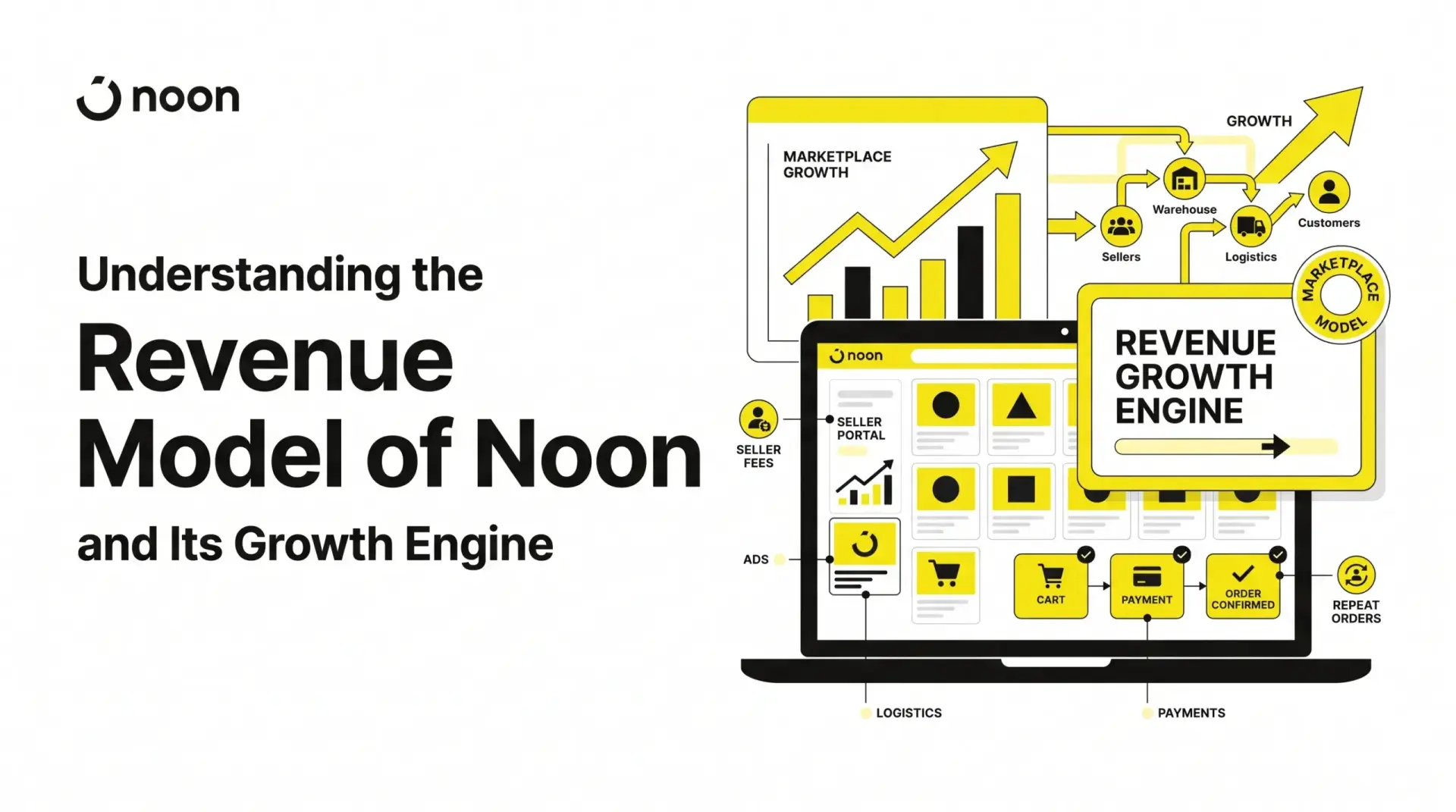
Noon’s revenue model is a diverse mix of direct and service-based monetization strategies designed for scale. Unlike single-channel businesses, Noon leverages multiple touchpoints within the digital commerce ecosystem — turning every interaction into a monetization opportunity.
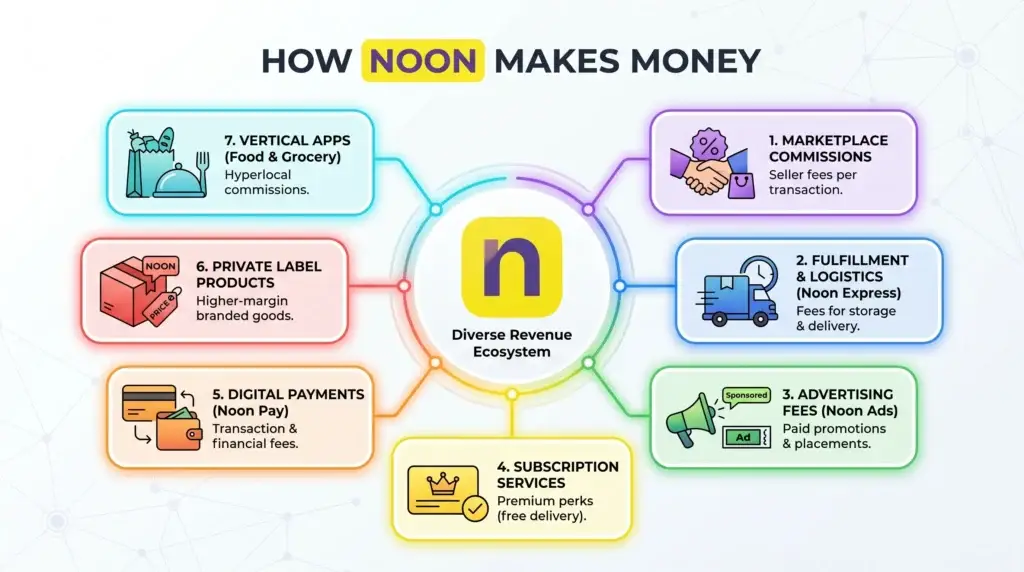
Here are the major income sources powering Noon’s billion-dollar business:
1. Marketplace Commissions
Noon charges sellers a commission for every successful transaction made through its platform. These vary by product category.
2. Fulfillment & Logistics (Noon Express)
Sellers pay for storage, packaging, and delivery through Noon’s own logistics arm — a revenue stream similar to Amazon FBA.
3. Advertising Fees (Noon Ads)
Brands can pay to promote their listings within the Noon ecosystem via sponsored placements and banner ads.
4. Subscription Services (Noon One)
Noon offers a premium membership service, Noon One, providing benefits like free delivery and exclusive discounts.
5. Digital Payment Processing (Noon Pay)
Transaction fees are collected through its integrated payment gateway, Noon Pay, which also offers wallet and BNPL (Buy Now, Pay Later) features.
6. Private Label Products
Noon sells its own branded products across categories like electronics, household goods, and fashion — capturing higher margins.
7. Vertical-Specific Apps (Noon Grocery, Noon Food)
Separate verticals like Noon Food and Noon Grocery offer hyperlocal services with their own monetization layers such as restaurant/delivery commissions.
Detailed Breakdown of Revenue Channels
To fully understand how Noon earns money, it’s important to look at each revenue stream in detail. Here’s a closer look at the mechanics, who pays, and why each model scales in the digital economy of 2026.
1. Marketplace Commissions
How it works:
Sellers list products on Noon’s platform and pay a percentage of every sale to Noon as a commission. These fees differ by product category — e.g., electronics may incur lower fees (~4–7%), while fashion and accessories might go up to 15–20%.
Who pays:
Sellers and merchants.
Why it scales:
The more sellers Noon attracts, the more inventory it offers, leading to higher sales volume and predictable commission revenue.
2. Fulfillment & Logistics (Noon Express)
How it works:
Noon offers warehousing, packaging, and delivery under the “Noon Express” badge. Sellers pay storage and logistics fees, while buyers enjoy faster and more reliable delivery.
Who pays:
Sellers for services; customers may also pay express delivery fees in some cases.
Why it scales:
It generates revenue while improving customer experience and reducing return rates — creating a win-win loop.
3. Advertising Revenue (Noon Ads)
How it works:
Merchants can buy promoted listings or banner placements on the Noon app and website. Noon uses data-driven targeting to ensure relevant ad exposure.
Who pays:
Brands, retailers, and sellers.
Why it scales:
As Noon’s traffic grows, so does ad inventory. High-converting ads increase seller ROI — justifying more ad spend.
4. Subscription Services (Noon One)
How it works:
Customers pay a fixed fee (e.g., ~$15/year) to join Noon One, unlocking perks like free delivery, priority access, and members-only offers.
Who pays:
End-users/customers.
Why it scales:
Recurring revenue, high retention, and increased basket size. Subscriptions also build brand loyalty and predictable cash flow.
5. Noon Pay – Digital Wallet & BNPL
How it works:
Noon Pay is Noon’s fintech arm that processes payments, wallet transactions, and BNPL (Buy Now, Pay Later) options. Noon takes a small transaction fee and possibly earns interest or service charges on deferred payments.
Who pays:
Customers and sellers (via transaction fees); BNPL partnerships may involve interest or fees.
Why it scales:
Fintech integrations deepen user stickiness, reduce cart abandonment, and open up financial service revenues.
6. Private Label Product Sales
How it works:
Noon has its own line of budget-friendly, in-house brands — often in electronics, home, and lifestyle. These offer higher profit margins as there’s no third-party seller involved.
Who pays:
End consumers.
Why it scales:
Noon controls pricing, margins, and inventory — optimizing profitability across high-demand verticals.
7. App-Specific Verticals (Noon Food, Noon Grocery)
How it works:
Noon has launched vertical apps (similar to Uber Eats or Instacart) where restaurants, grocers, and delivery partners are charged commissions and service fees.
Who pays:
Restaurants, stores, and in some cases, customers (for delivery fees or service charges).
Why it scales:
Hyperlocal services are in high demand. Noon leverages existing logistics to serve daily needs — increasing order frequency and user engagement.
Behind Noon’s dominance are tools that redefine online shopping experiences. Discover the full Noon app feature list and replicate its success in your store.
Revenue Breakdown (Illustrative Table)
| Revenue Stream | Primary Payer | Scalable? | Est. Contribution |
|---|---|---|---|
| Marketplace Commissions | Sellers | ✅ | 35–40% |
| Logistics & Fulfillment | Sellers/Customers | ✅ | 20–25% |
| Advertising Revenue | Sellers/Brands | ✅ | 10–15% |
| Subscriptions (Noon One) | Customers | ✅ | 5–10% |
| Digital Wallet / BNPL | Customers/Sellers | ✅ | 5–10% |
| Private Label Sales | Customers | ✅ | 10–15% |
| Vertical Services | Restaurants/Shops | ✅ | 5–10% |
Why This Revenue Model Works in 2026
The e-commerce landscape in 2026 is defined by hyper-convenience, digital-first payments, and vertically integrated ecosystems. Noon’s revenue model thrives because it aligns perfectly with these evolving market trends.
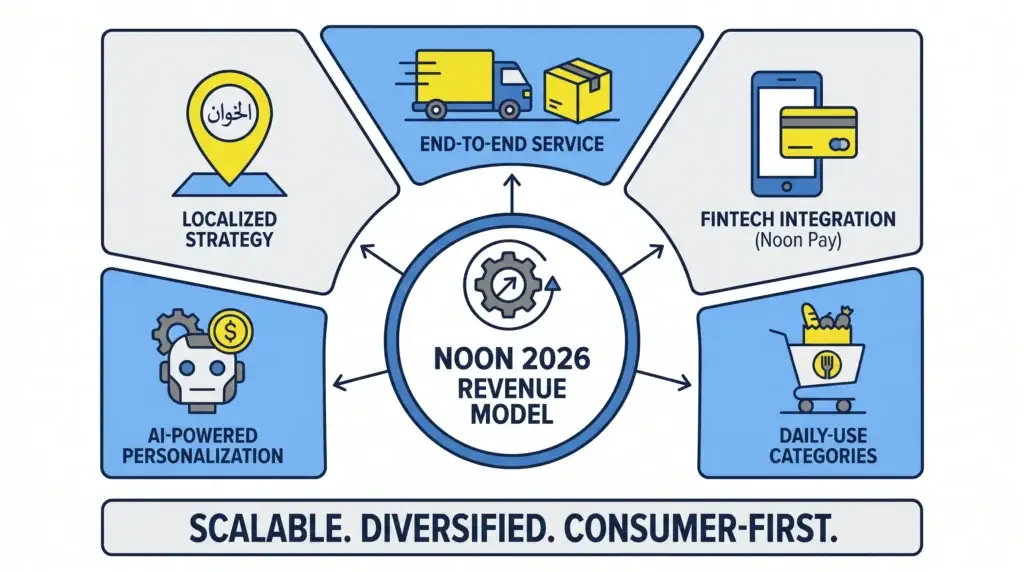
1. Rise of Full-Service Marketplaces
Modern consumers prefer end-to-end service under one roof — from discovery to delivery. Noon’s ability to control logistics, fulfillment, and post-sale service means they capture more value per transaction compared to drop-shipping platforms or open marketplaces.
2. Fintech Integration Is Now a Must
With digital wallets and Buy Now, Pay Later (BNPL) becoming mainstream, Noon’s launch of Noon Pay positions it not just as a store — but as a fintech player. It reduces third-party payment dependency and adds financial revenue layers.
3. Hyper-Verticalization = Higher Frequency
Noon isn’t just a general marketplace — it’s going vertical. With Noon Grocery and Noon Food, it taps into daily-use categories, increasing transaction volume and platform engagement.
4. AI-Powered Dynamic Pricing and Ads
Thanks to AI, Noon personalizes pricing, delivery estimates, and product recommendations. This boosts conversion rates, maximizes ad revenue, and supports premium offerings like sponsored placements and priority listings.
5. Regional Advantage and Localized Strategy
Noon’s focus on local infrastructure, Arabic-first UX, and regionally relevant products sets it apart from global giants. This localized model ensures higher seller participation and stronger customer trust — translating into more monetizable traffic.
In short, Noon’s revenue model is built not just to survive in 2026, but to scale, thanks to diversified streams, fintech layers, and consumer-first strategies.
The right script can save you time, money, and endless development headaches. Compare top Noon clone solutions to find the perfect fit for your business.
Read More: Business Model of Noon: How This Platform Makes Its Revenue
Can Startups Replicate Noon’s Revenue Model?
Absolutely — but not without challenges. Noon’s monetization engine is impressive, but replicating it from scratch would take years of development, huge capital, and intricate knowledge of logistics, payments, and e-commerce dynamics.
Key Challenges for Startups
- Building multi-vendor architecture with robust product, order, and commission management
- Integrating logistics modules for fulfillment, tracking, and express delivery
- Creating a wallet and payment gateway with fraud protection and compliance
- Developing ad monetization tools, dynamic pricing, and seller dashboards
- Launching and maintaining multiple verticals like grocery or food delivery
- Achieving mobile + web optimization to serve millions of users at scale
These obstacles can delay time-to-market and drain resources — especially for early-stage founders.
Global Cost of Development for a Noon-Like Marketplace App
Noon-Like E-commerce Marketplace Development — Market Price by Tech Stack
The tech stack affects product browsing, seller management, checkout speed, order tracking, and marketplace scalability in a Noon-like app. PHP/Laravel works well for cost-effective e-commerce launches, Node.js/React.js supports faster cart updates, inventory sync, and real-time notifications, while Go microservices suit large retail platforms with high traffic, multi-vendor operations, and regional delivery workflows.
PHP/Laravel is often the most practical choice for launching a Noon-like marketplace quickly and affordably. Node.js/Python fits better when real-time inventory, seller activity, and data-heavy commerce workflows become more important, while Go microservices are better suited for enterprise-scale ecommerce platforms with higher concurrency and more complex infrastructure needs.
These values reflect global development cost estimates. Final pricing varies based on product catalogs, seller panels, checkout flow, payments, logistics, discounts, subscriptions, ad modules, admin controls, and platform complexity.
Miracuves Noon-Like App Solution Cost and Tech Stack
Miracuves Pricing for a Noon-Like eCommerce Marketplace App developed in PHP/Laravel with Flutter Apps for $2,499 USD (One-Time Price) in just 6 days
Get a fully developed, deployment-ready online marketplace modeled after Noon. Built on a stable PHP foundation, this complete package includes everything you need to launch and scale a multi-category eCommerce business for electronics, fashion, beauty, groceries, home products, lifestyle items, and daily essentials:
- Core Workflows: Customer registration, seller onboarding, product listing, category browsing, cart checkout, order placement, inventory management, shipment tracking, returns, refunds, reviews, and customer notifications.
- Built-in Revenue Logic: Seller commissions, product listing fees, promoted products, marketplace service fees, delivery charges, subscription-based seller plans, advertising placements, coupon campaigns, and order-based monetization.
- Management Hub: Centralized admin dashboard, seller management, customer management, product approval, inventory control, order monitoring, payment records, refund handling, return requests, dispute management, and marketplace analytics.
- Launch-Ready: Fully prepared for your custom branding, configuration, payment gateway setup, product category setup, seller onboarding, delivery settings, and immediate market entry.
Why Is Noon-Like App Development More Affordable?
Most large eCommerce marketplace apps become expensive when businesses choose fully custom development from scratch. A Noon-style platform usually needs customer apps, seller panels, product catalogs, inventory systems, checkout workflows, payments, shipping logic, returns, refunds, coupons, reviews, advertising modules, and admin controls. Building all of this separately can increase both development cost and launch time.
We took a smarter, more practical approach:
- You Aren’t Paying for Ground-Up Development: Our eCommerce marketplace engine is already developed, tested, and ready to deploy. You skip the inflated cost and long waiting period usually required for building a Noon-style platform from scratch.
- The Power of PHP: We built this solution on a reliable and cost-effective PHP architecture. This keeps the upfront price affordable while supporting essential marketplace workflows such as product listings, seller management, checkout, payments, inventory control, order tracking, returns, refunds, and admin operations.
You get a launch-ready Noon-like marketplace with practical commerce features, source code access, and faster deployment without the high custom development price tag.
Note: This cost is for the solution, re-branding, deployment, and source code only.
Building your own ecommerce app doesn’t have to be a mystery. Explore our full guide on Noon clone app cost and understand exactly what you’ll spend.
Conclusion
Noon’s revenue model is a masterclass in multi-channel e-commerce monetization — blending marketplace commissions, logistics, subscriptions, fintech, and advertising into a seamless experience. Its ability to serve millions while generating income from each interaction makes it a reliable model for startups to emulate in 2026.
With Miracuves’ Noon like app, you don’t have to build it all from scratch. You get the foundation, the monetization features, and the customization freedom to tailor it to your market.
If you are planning to launch a Noon-style e-commerce marketplace, Miracuves can help you move faster with a scalable and business-ready solution. Let’s build together.
FAQs
How does Noon generate revenue?
Noon makes money through commissions on sales, logistics services (Noon Express), advertising, subscription services (Noon One), fintech (Noon Pay), and private label product sales.
Is Noon profitable in 2026?
While exact figures aren’t public, Noon is closing in on profitability due to its diversified revenue streams, high transaction volume, and strong market presence in the MENA region.
What are the main income sources for Noon?
Noon’s main income sources include marketplace commissions, seller advertising fees, subscription plans, digital payments, and its own branded products.
Can startups use the same revenue model as Noon?
Yes, but building it from scratch is complex. Using a clone solution like Miracuves’ Noon clone helps startups replicate Noon’s revenue strategy affordably and quickly.
Does Miracuves offer Noon clone with monetization features?
Absolutely. Miracuves’ Noon clone includes built-in monetization features like multi-vendor commission settings, seller ad modules, payment gateway, subscriptions, and more.