


Key Takeaways
- An online retail marketplace can generate revenue through seller commissions, fulfillment services, advertising, private labels, and financial partnerships.
- Category-based commissions allow the platform to earn from third-party transactions without owning every product.
- Warehousing, packaging, shipping, and last-mile delivery services create additional seller-facing revenue.
- Sponsored listings and promotional placements monetize seller demand for visibility during high-traffic shopping periods.
- Loyalty programs can increase repeat purchases, customer retention, and lifetime value even when membership is free.
Revenue Model Signals
- Define seller commissions according to product category, order value, seller level, and fulfillment method.
- Configure storage, packaging, shipping, return-handling, and delivery charges for participating sellers.
- Offer sponsored products, search placements, homepage banners, and campaign promotion tools.
- Plan private-label margins, loyalty rewards, payment partnerships, EMI options, and wholesale channels.
- Track earnings by transaction, seller, category, advertisement, logistics service, payment method, and promotional campaign.
Real Insights
- Marketplace scale becomes more sustainable when revenue extends beyond commissions on completed orders.
- Fulfillment services can strengthen customer experience while giving the platform greater control over delivery quality.
- Advertising revenue grows after the marketplace develops meaningful buyer traffic and purchase intent.
- Discount-led growth can weaken margins unless commissions, logistics costs, promotions, and repeat purchases remain balanced.
- Miracuves develops online retail marketplaces with seller commissions, advertising tools, logistics workflows, loyalty features, payments, and admin controls.
When founders study large ecommerce marketplaces, the first revenue stream they usually notice is seller commission. A seller lists products, receives orders, and pays the platform a percentage of each transaction. It is simple to understand, easy to model, and directly connected to gross merchandise value.
But seller commission alone rarely builds a resilient retail marketplace.
A serious online marketplace needs multiple income layers. Some revenue comes from sellers who want more visibility. Some comes from logistics control. Some comes from fulfillment services, subscription plans, payment flows, loyalty programs, affiliate partnerships, and data-led growth tools. The platform becomes more than a transaction engine. It becomes an operating system for sellers, buyers, delivery partners, and marketplace operators.
That is why studying the revenue model of Flipkart or any large ecommerce marketplace is useful only when founders look beyond the obvious commission layer. The stronger question is: how does a marketplace create monetization opportunities across the full commerce journey?
This guide explains the major revenue streams online retail marketplaces use beyond seller commissions and how founders can think about them while planning their own marketplace business model.
What Is an Online Retail Marketplace Revenue Model?
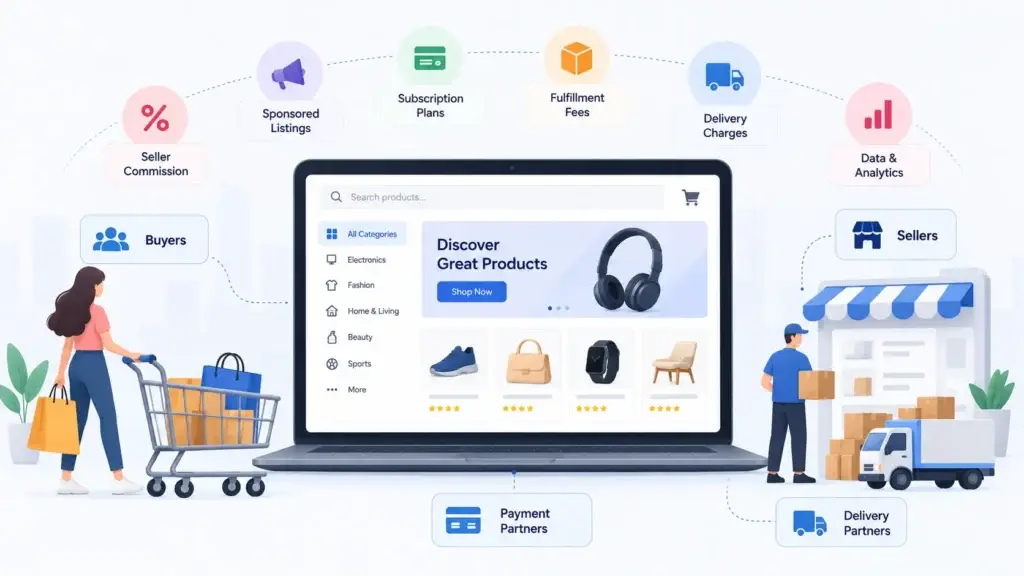
Image Source: AI-generated visual by Miracuves
An online retail marketplace revenue model explains how a platform earns money by connecting buyers, sellers, logistics partners, payment systems, and service providers inside one commerce ecosystem.
In a single-vendor ecommerce store, the business usually earns from product margins. In a marketplace, the operator may not own every product. Instead, the platform earns by enabling transactions, increasing product discovery, supporting fulfillment, managing trust, and helping sellers grow.
A marketplace revenue model may include:
- Seller commission on successful orders
- Sponsored product placements
- Vendor subscription plans
- Fulfillment and warehousing fees
- Delivery and logistics charges
- Payment processing margins
- Return handling or packaging fees
- Featured store placements
- Buyer loyalty programs
- Data and analytics tools for sellers
- Cross-selling and affiliate revenue
- Brand partnership campaigns
The real strength of this model is flexibility. A founder can start with commission and gradually activate more monetization layers as seller density, buyer traffic, order volume, and operational control improve.
Read More: What Is an Online Retail Marketplace and How Do Orders, Sellers, Payments, and Delivery Work?
Why Marketplaces Need Revenue Beyond Seller Commissions
Seller commission works well when order volume is strong, categories are profitable, and sellers accept the platform’s margin structure. But relying only on commission creates several risks.
First, commission pressure can push sellers away. If competing platforms offer lower fees, sellers may list elsewhere or reduce inventory quality. Second, commission revenue depends heavily on completed orders. If conversion drops, revenue drops. Third, high-growth marketplaces often need to spend heavily on acquisition, discounts, logistics, customer support, and seller onboarding before commission revenue becomes stable.
That is why mature platforms diversify revenue. Advertising monetizes product visibility. Fulfillment monetizes operational convenience. Subscriptions create recurring seller income. Premium analytics monetize business intelligence. Loyalty programs increase repeat purchases. Delivery fees support last-mile economics.
For founders, the lesson is clear: the marketplace should not be designed only around checkout. It should be designed around multiple value exchanges.
Main Revenue Streams Beyond Seller Commissions
| Revenue Stream | How It Works | Founder Impact |
|---|---|---|
| Sponsored Listings | Sellers pay to promote products in search results, category pages, or homepage sections. | Creates monetization from seller competition without increasing buyer fees. |
| Seller Subscriptions | Vendors pay monthly or yearly for premium dashboard tools, higher listing limits, or better visibility. | Builds recurring revenue and reduces dependence on order-based income. |
| Fulfillment Services | The platform charges for storage, packaging, dispatch, warehousing, or inventory handling. | Turns operational infrastructure into a revenue center. |
| Delivery Fees | Buyers or sellers pay delivery charges based on distance, order value, weight, or service speed. | Supports last-mile economics and helps protect margins on smaller orders. |
| Payment Flow Revenue | The platform may earn from payment gateway partnerships, wallet usage, COD handling, or settlement workflows. | Improves financial control and adds monetization around transaction infrastructure. |
| Seller Analytics | Vendors pay for insights on sales trends, customer behavior, inventory performance, and category demand. | Helps sellers grow while creating a premium software-style revenue stream. |
| Featured Stores | Sellers pay for branded storefronts, category highlights, seasonal banners, or campaign visibility. | Monetizes seller branding and marketplace discovery spaces. |
| Loyalty Programs | Buyers pay for membership benefits such as free delivery, early access, special prices, or reward points. | Increases repeat purchases and improves customer lifetime value. |
1. Sponsored Listings and Product Advertising
Advertising is one of the most powerful revenue layers in an online retail marketplace. Once a platform has buyer traffic, sellers are willing to pay for visibility.
Sponsored listings can appear in:
- Search results
- Category pages
- Homepage banners
- Product recommendation sections
- Deal pages
- Festival or seasonal campaigns
- Related product widgets
- Cart or checkout suggestions
This revenue stream works because seller competition increases as the marketplace grows. A seller selling electronics, fashion, beauty products, groceries, or home essentials may not want to wait for organic ranking. Paid visibility gives them a faster route to impressions and sales.
For the marketplace operator, this creates a high-margin monetization layer. The platform already owns the traffic. Advertising turns that traffic into revenue without requiring the operator to own inventory.
However, founders need to be careful. Too many sponsored placements can damage buyer trust. The platform should clearly balance paid visibility with relevance, product quality, ratings, price, delivery reliability, and return history.
2. Vendor Subscription Plans
Seller subscriptions help marketplaces generate recurring revenue. Instead of charging sellers only when they receive orders, the platform can offer premium plans that unlock additional tools or privileges.
A subscription model may include:
- Higher product listing limits
- Access to advanced analytics
- Featured seller badge
- Priority seller support
- Campaign participation
- Lower commission slabs
- Branded storefront page
- Bulk product upload tools
- Inventory alerts
- Promotional credits
This model is useful for marketplace operators because it creates predictable income. It is also useful for sellers because they can choose a plan based on their business stage.
A small seller may start with a free or low-cost plan. A growing seller may upgrade to get better reporting, more products, campaign access, or visibility tools. A large seller may pay for advanced inventory, catalog, and advertising controls.
For founders, seller subscriptions should be planned inside the admin dashboard from the beginning. The platform should be able to control plan limits, billing cycles, privileges, trial periods, upgrades, downgrades, and seller access.
3. Fulfillment, Packaging, and Warehousing Fees
A marketplace can earn revenue by helping sellers handle operational complexity. Many sellers want to sell online but struggle with storage, packaging, dispatch, returns, and delivery coordination.
This creates an opportunity for fulfillment-led monetization.
The platform can charge sellers for:
- Product storage
- Pick-and-pack services
- Packaging material
- Dispatch handling
- Return processing
- Quality checks
- Inventory movement
- Express fulfillment
- Warehouse-to-customer delivery
This model is especially useful when the marketplace wants to improve customer experience. Faster delivery, better packaging, and reliable inventory availability can increase buyer trust.
But fulfillment is not just a revenue stream. It is an operational commitment. The platform must manage stock accuracy, warehouse workflows, delivery assignment, return records, seller settlements, and customer support.
This is where founders should think carefully about product architecture. A marketplace that plans to monetize fulfillment needs more than basic product listings. It needs inventory logic, warehouse controls, delivery workflows, refund handling, seller ledgers, and reporting.
4. Delivery Charges and Logistics Monetization
Delivery can be a cost center or a revenue stream depending on how the marketplace is structured.
Some marketplaces charge buyers directly for shipping. Others charge sellers. Some offer free delivery above a minimum order value while recovering the cost through seller fees, platform margins, or membership plans. In cash-led and regional markets, delivery monetization can become even more important because the platform may need to manage both product handover and payment collection.
Delivery revenue may come from:
- Standard delivery fees
- Express delivery fees
- Distance-based charges
- Weight-based charges
- Zone-based delivery pricing
- Seller-paid logistics plans
- Buyer membership programs
- COD handling charges
- Return pickup fees
The founder’s challenge is to avoid making delivery fees feel like friction. If delivery charges are too high, conversion drops. If delivery charges are too low, margins suffer. The right model depends on order value, product category, delivery radius, customer expectations, and logistics ownership.
A strong retail marketplace platform should allow the operator to configure delivery rules by location, category, order size, seller, and fulfillment method.
5. Payment Processing, Wallets, and Settlement Workflows
Payment infrastructure can create both operational value and monetization opportunity.
A marketplace handles money between buyers, sellers, delivery partners, and the platform. That means every transaction needs clean records. Seller payouts, refunds, wallet balances, delivery collections, platform commissions, taxes, discounts, and COD reconciliation must all be tracked correctly.
Revenue opportunities may include:
- Payment gateway partnership revenue
- Wallet usage incentives
- Seller payout service fees
- COD handling charges
- Instant settlement fees
- Refund processing fees where appropriate
- Cross-border payment support fees
- Buyer convenience fees in selected models
Founders should treat payment logic carefully. Poor settlement workflows can create disputes, accounting errors, seller dissatisfaction, and support overload.
For a marketplace operator, the admin panel should make financial activity visible. The team should be able to track order value, platform fee, seller earnings, delivery charges, discounts, refunds, pending settlements, collected cash, and payout status.
This is one of the reasons Miracuves often positions marketplace development around admin control, source-code ownership, and business model flexibility rather than just storefront design.
6. Featured Seller Stores and Brand Campaigns
As marketplaces grow, sellers want more than product listings. They want brand presence.
A marketplace can monetize branded seller experiences through:
- Featured store pages
- Premium seller badges
- Homepage brand showcases
- Category sponsorships
- Seasonal campaign slots
- New launch promotions
- Festival sale participation
- Sponsored collections
- Email campaign placement
- Push notification campaigns
This model is especially powerful in competitive categories such as fashion, beauty, electronics, lifestyle products, and home goods. Sellers are not only paying for sales. They are paying for attention, credibility, and repeat buyer recognition.
For founders, this requires content and campaign management tools inside the operator dashboard. The platform should allow the admin team to approve campaigns, schedule placements, control banners, measure performance, and ensure that promoted sellers still meet service standards.
A marketplace that sells visibility without quality control can damage customer trust. A marketplace that combines visibility with seller performance rules can create a healthier advertising ecosystem.
7. Seller Analytics and Business Intelligence Tools
Many sellers do not only need traffic. They need insight.
A marketplace can monetize data by offering sellers premium analytics dashboards. These dashboards help vendors understand what is selling, where demand is increasing, which products are underperforming, and how pricing or delivery speed affects conversion.
Seller analytics may include:
- Sales performance by product
- Category demand trends
- Customer location insights
- Repeat purchase behavior
- Cart abandonment patterns
- Inventory movement
- Return rate analysis
- Campaign performance
- Product ranking visibility
- Pricing comparison insights
This revenue stream works well because it helps serious sellers make better business decisions. It also gives the platform a more software-like monetization layer.
However, data monetization must be handled responsibly. The platform should avoid exposing private customer information or unfairly sharing sensitive seller data. The best approach is to provide aggregated, permission-based insights that help sellers improve without compromising trust.
8. Buyer Membership and Loyalty Programs
A retail marketplace can also earn from buyers through loyalty or membership programs.
Buyer membership may include:
- Free or reduced delivery fees
- Faster delivery windows
- Early access to sales
- Exclusive discounts
- Reward points
- Priority customer support
- Cashback benefits
- Partner offers
- Subscription-based shopping benefits
This model works when the platform has enough purchase frequency. Grocery, fashion, electronics accessories, household goods, and daily essentials can support repeat shopping behavior if the marketplace offers a strong reason to return.
Membership revenue is not just about the subscription fee. It can increase customer lifetime value, reduce reliance on paid acquisition, and improve order frequency.
For founders, the loyalty system should be connected to checkout, wallet, coupons, product recommendations, and customer segmentation. A disconnected rewards system can become hard to manage and easy to abuse.
9. Affiliate, Partnership, and Cross-Selling Revenue
Marketplaces often sit at the center of customer purchase intent. That makes them valuable partners for other businesses.
Partnership revenue may come from:
- Credit card or wallet partnerships
- Insurance add-ons
- Warranty plans
- Installation services
- Product protection plans
- Financing offers
- Telecom or subscription bundles
- Brand collaborations
- Affiliate product recommendations
- Local service partnerships
For example, a marketplace selling electronics can offer extended warranty or installation services. A furniture marketplace can offer assembly services. A fashion marketplace can partner with payment providers for cashback campaigns.
These add-ons work best when they are relevant to the purchase journey. Random offers can reduce trust. Contextual offers can increase average order value and create additional revenue without disrupting the buyer experience.
10. Private Labels and Direct Retail Margins
Some marketplaces eventually introduce private label products or direct retail categories. This creates a different kind of revenue model because the platform starts earning from product margins, not only marketplace fees.
Private label can be attractive because the operator controls pricing, branding, inventory, packaging, and margins. But it also adds risk. The platform must manage sourcing, stock, demand forecasting, returns, and seller conflict.
For founders, this model should usually come later. A new marketplace should first validate buyer demand, seller supply, category performance, and logistics capability. Once the operator has enough data, private labels can be tested in high-demand categories where margins and repeat purchases justify the investment.
Founder Decision Signals: Which Revenue Streams Should You Build First?
Speed
Start with commission, delivery fees, and basic promoted listings if you need faster launch. These are easier to explain to sellers and simpler to manage in the early stage.
Cost
Avoid building advanced fulfillment, warehousing, or analytics modules before you validate order volume. Operational revenue streams need process maturity.
Scalability
Plan wallet, payout, seller plan, campaign, and logistics logic early because retrofitting monetization into a live marketplace can become expensive.
Market Fit
Choose monetization based on seller behavior. If sellers want visibility, ads work. If they want convenience, fulfillment works. If they want tools, subscriptions and analytics work.
Marketplace Monetization by Business Stage
Not every revenue stream should be activated on day one. A marketplace business model should evolve with traction.
| Marketplace Stage | Best Revenue Streams | Why It Works |
|---|---|---|
| Early launch | Seller commission, delivery fees, COD handling, basic listing fees | Simple to manage and easy for sellers to understand |
| Growth stage | Sponsored listings, featured stores, seller subscriptions, campaign fees | Seller competition increases as buyer traffic grows |
| Operational maturity | Fulfillment fees, warehousing, return handling, seller analytics | Platform has enough order volume to monetize operations |
| Scale stage | Loyalty programs, private labels, financial services, data-led seller tools | Stronger customer base and seller ecosystem create new revenue layers |
This staged approach helps founders avoid overbuilding. The goal is not to copy every revenue stream from a large ecommerce company immediately. The goal is to build the right monetization foundation and activate each layer when the business is ready.
Admin Features Needed to Manage Multiple Revenue Streams
A marketplace cannot monetize what it cannot measure or control.
If the platform plans to earn beyond seller commissions, the admin system should support:
- Seller plan management
- Commission rule configuration
- Sponsored listing controls
- Campaign scheduling
- Banner placement management
- Delivery fee configuration
- Zone-based shipping rules
- Seller payout tracking
- Wallet and ledger reports
- COD reconciliation
- Refund and return workflows
- Coupon and loyalty management
- Analytics and performance reports
- Role-based staff access
- Dispute management
- Tax and invoice records
This is where product planning becomes a business decision. A basic ecommerce website may handle product display and checkout. A serious marketplace needs a control layer that lets the operator adjust monetization without depending on developers for every small change.
For founders planning a marketplace business, Miracuves’ multi-vendor retail marketplace solution can be explored as a practical reference for how customer, seller, delivery, and operator workflows connect inside one platform.
Mistakes Founders Should Avoid
Depending only on seller commission
Commission is useful, but it leaves the platform exposed when discounts, returns, delivery costs, or seller negotiations reduce margins.
Adding ads before buyer traffic exists
Sellers will not keep paying for sponsored visibility if the platform cannot deliver impressions, clicks, or order potential.
Launching fulfillment without operational readiness
Warehousing and delivery monetization need inventory accuracy, trained teams, return workflows, and clear accountability.
Ignoring seller settlement transparency
If sellers cannot understand commissions, deductions, refunds, and payout timing, trust breaks quickly.
How Revenue Strategy Affects Marketplace Platform Development

Image Source: AI-generated visual by Miracuves
Revenue strategy should influence the platform from the beginning.
If a founder wants advertising revenue, the product needs sponsored listing logic, campaign reporting, placement rules, and seller billing. If the goal is fulfillment revenue, the platform needs inventory, warehouse, packaging, return, and delivery workflows. If the goal is subscription revenue, the platform needs seller plan management, access permissions, recurring billing, and usage limits.
This is why marketplace development should not begin only with screens. It should begin with business model clarity.
A strong marketplace platform should answer questions such as:
- Who pays the platform?
- When does the platform earn?
- What does the seller get in return?
- What does the buyer experience?
- How are refunds handled?
- How are delivery charges calculated?
- How are seller payouts recorded?
- Which features are free and which are paid?
- How does the admin team control each revenue stream?
When these decisions are made early, the platform becomes easier to scale. When they are ignored, the business may need expensive redevelopment later.
Commercial Perspective: Turning Marketplace Economics Into a Launch Plan
Understanding revenue streams is only the first step. The next step is translating them into product modules.
A founder planning an online retail marketplace should decide which monetization layers belong in the first version and which can wait. For many businesses, the first version should focus on product discovery, vendor onboarding, order management, delivery logic, payment workflows, commission rules, and admin reporting. Once the platform has traffic and seller activity, more advanced revenue streams such as advertising, subscriptions, loyalty, and analytics can be introduced.
Miracuves helps founders move from marketplace strategy to launch-ready execution with white-label app foundations, source-code ownership, branded design, admin control, and customizable workflows. The advantage is not just speed. It is starting with a product foundation that already understands marketplace operations.
Final Thoughts: Strong Marketplaces Monetize the Full Ecosystem
The most successful online retail marketplaces do not depend on one revenue source. Seller commission may start the business, but long-term monetization comes from the full ecosystem: advertising, logistics, fulfillment, seller tools, payment flows, memberships, analytics, and brand partnerships.
For founders, the key decision is not simply “How much commission should we charge?” The better question is: “What value can the platform create for buyers, sellers, and operators at every stage of the transaction?”
When the platform creates value across discovery, trust, fulfillment, payment, and retention, revenue becomes more diversified and more defensible.
FAQs
How do online retail marketplaces make money apart from seller commission?
Online retail marketplaces can earn through sponsored listings, seller subscriptions, fulfillment services, delivery fees, payment workflows, featured stores, loyalty programs, seller analytics, and brand partnerships. These revenue streams help reduce dependence on commission alone.
Are sponsored listings important for marketplace monetization?
Yes. Sponsored listings help sellers gain visibility in competitive categories while giving the marketplace a scalable advertising revenue stream. However, paid placements should be balanced with product relevance and buyer trust.
Can a new marketplace charge sellers a subscription fee?
Yes, but the platform must offer clear value. Sellers are more likely to pay when subscriptions include benefits such as higher listing limits, analytics, campaign access, branded storefronts, or reduced commission rates.
How can delivery become a revenue stream for an ecommerce marketplace?
Delivery can generate revenue through shipping fees, express delivery charges, distance-based pricing, seller-paid logistics plans, COD handling, and return pickup fees. The platform needs strong logistics rules to manage this properly.
What is the role of seller analytics in marketplace revenue?
Seller analytics can become a premium tool that helps vendors understand product performance, inventory movement, customer demand, campaign results, and pricing opportunities. This creates value for sellers while generating additional platform revenue.
Should founders add all marketplace revenue streams at launch?
No. Founders should start with revenue streams that match their launch stage. Commission, delivery fees, and basic promoted listings are easier to begin with. Advanced analytics, fulfillment, memberships, and private labels usually work better after traction.
Why is admin control important for marketplace monetization?
Admin control allows the platform operator to manage commissions, seller plans, advertising placements, payouts, refunds, delivery charges, campaigns, and financial reports. Without a strong admin layer, monetization becomes difficult to scale.
What should founders consider before building an online retail marketplace?
Founders should define their target categories, seller onboarding model, buyer acquisition strategy, delivery approach, payment workflows, commission logic, monetization layers, and admin reporting needs before development begins.
Miracuves is an independent software development company. We are not affiliated with, connected to, sponsored by, or endorsed by any company or product named in this article.
Terms such as “X Clone” are used descriptively. It is how the software industry refers to building a platform with functionality comparable to a known service, and how clients search for it.
The entire design and codebase of our products is built by our own team. Our products contain no code, design, graphics, or content originating from any third-party website or applications.
All third-party names and marks referenced in this article are the property of their respective owners, referenced solely to identify the services discussed.