


Fashion ecommerce marketplaces are not built on one revenue stream. A strong marketplace earns from multiple layers working together: commissions on seller transactions, paid visibility for brands, private label margins, fulfillment services, loyalty programs, and data-backed merchandising opportunities.
This is why fashion marketplaces can become more than online stores. They act as distribution engines for brands, discovery platforms for shoppers, logistics partners for sellers, and monetization systems for operators. The stronger the platform becomes, the more ways it can generate revenue without depending only on product margins.
For founders, the lesson is simple: a fashion ecommerce marketplace should not be planned only around catalog upload and checkout. The real business model sits behind the scenes — in how sellers are charged, how brands buy visibility, how inventory is controlled, how returns are handled, and how the operator creates repeat purchase behavior.
This guide explains how fashion ecommerce marketplaces generate revenue through commissions, brand promotions, private labels, fulfillment, and related monetization layers. It also shows what founders should consider before building or launching a multi-brand fashion commerce platform.
Key Takeaways
- Fashion ecommerce marketplace revenue models work best when income comes from several sources instead of one transaction fee.
- Commission revenue scales with seller volume, but it needs strong payout, refund, and reconciliation workflows.
- Brand promotions create high-margin revenue because sellers pay for visibility, campaign placement, and better product discovery.
- Private labels can improve margin control, but they also increase inventory, quality, and merchandising responsibility.
- Fulfillment and logistics revenue becomes powerful when the platform can support packaging, warehousing, delivery, returns, and seller service levels.
- Miracuves helps founders move from idea to launch faster with ready-made and white-label marketplace solutions built for admin control, monetization, and source-code ownership.
Why Fashion Ecommerce Marketplaces Need Multiple Revenue Streams
A fashion marketplace is different from a standard ecommerce store. In a simple online store, the operator usually buys inventory, lists products, sells to customers, and earns the difference between buying cost and selling price. In a marketplace, the operator often connects multiple sellers or brands with customers and earns by controlling the transaction environment.
This creates a more flexible business model. The platform does not need to own every product to earn from the sale. It can charge sellers for successful orders, offer paid brand promotion, provide fulfillment support, launch private labels, run loyalty programs, and build seasonal campaign revenue around festive sales or product drops.
For fashion, this matters even more because the category has high visual discovery, frequent style changes, seasonal demand, size and color complexity, return pressure, and strong brand competition. Sellers want visibility. Buyers want choice. The platform operator sits between both sides and can monetize that position in several ways.
The healthiest fashion marketplace revenue model usually combines four core layers:
- Transaction revenue from commissions and seller fees.
- Visibility revenue from brand promotions and sponsored placements.
- Margin revenue from private labels or owned inventory lines.
- Operational revenue from fulfillment, delivery, returns, and seller services.
When these layers are planned correctly, the platform is not dependent on only one income source. When they are planned poorly, the marketplace may grow order volume but still struggle with low margins, high return costs, delayed settlements, and seller dissatisfaction.
Read more : What Is a Fashion Ecommerce Marketplace and How Do Discovery, Product Variants, Orders, and Returns Work?
Commission Revenue From Third-Party Sellers
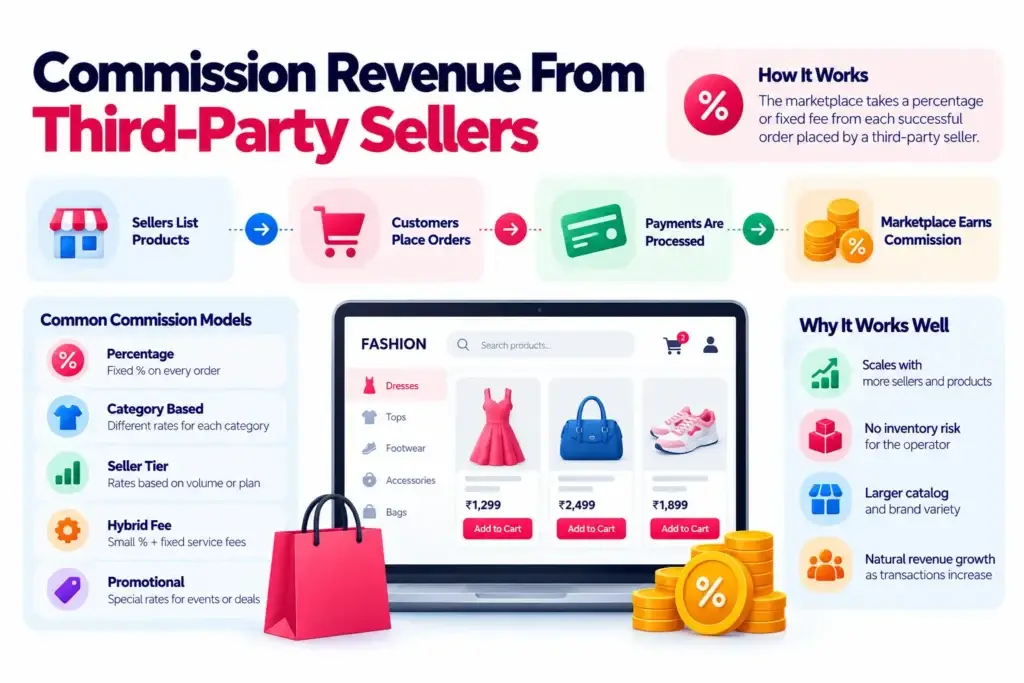
Commission is the most common revenue stream in a fashion ecommerce marketplace. Sellers list their products on the platform, customers place orders, and the marketplace earns a percentage or fixed fee from each successful transaction.
This model is attractive because the operator can expand catalog depth without owning every product. More sellers can bring more SKUs, more styles, more sizes, and more brand variety. The platform earns when transactions happen, so the revenue model is naturally tied to marketplace activity.
How Commission Models Usually Work
A fashion marketplace can set commission rules based on category, seller type, product margin, order value, brand agreement, or promotional participation. For example, accessories may carry a different commission from footwear. Premium brands may negotiate different terms from smaller independent labels. New sellers may receive temporary commission discounts to encourage onboarding.
The platform can use different commission structures:
- Percentage commission: The platform takes a fixed percentage of every completed order.
- Category-based commission: Different product categories have different commission rates.
- Seller-tier commission: Sellers pay different rates based on subscription level, volume, or marketplace status.
- Hybrid fee model: The platform charges a smaller commission plus fixed service, packaging, or transaction fees.
- Promotional commission: Sellers participating in special events may accept adjusted commission terms for higher visibility.
The commission model looks simple on the surface, but the backend logic must be strong. A fashion order may include multiple products from multiple sellers, different shipping rules, coupons, wallet payments, loyalty points, cash-on-delivery collection, partial cancellations, and returns. If the platform cannot calculate and reverse commissions correctly, financial reconciliation becomes messy very quickly.
Why Commission Revenue Is Powerful for Fashion Marketplaces
Commission revenue scales well because the platform earns as seller activity grows. It also reduces inventory risk because the marketplace operator does not need to purchase every item listed. This creates a more asset-light path compared to pure retail inventory models.
However, commission revenue depends on trust. Sellers must believe the platform brings orders, handles payments properly, gives them useful dashboards, and settles payouts transparently. Buyers must believe the platform offers reliable products, good delivery, easy returns, and customer support. The operator must balance both sides.
For founders, the key decision is not only “What commission should we charge?” The better question is: “Can our platform manage commission rules, seller payouts, refunds, return deductions, wallet adjustments, and reports without manual work?”
Brand Promotion and Sponsored Visibility Revenue
Brand promotion is one of the most valuable revenue streams in a fashion ecommerce marketplace because visibility directly influences sales. Fashion sellers do not only want to list products. They want to appear in the right places at the right time: homepage banners, category pages, search results, trend collections, festive sale pages, app notifications, and curated style edits.
As the marketplace gains traffic, its screen space becomes valuable. Brands may pay for better placement, campaign visibility, product boosts, influencer-led placements, or seasonal collection features. This creates advertising revenue that is not fully dependent on whether a single product sells.
Common Brand Promotion Revenue Formats
A marketplace can monetize brand visibility in several ways:
- Sponsored product listings: Sellers pay to appear higher in search or category pages.
- Homepage banners: Brands pay for premium homepage or app banner placement.
- Collection sponsorships: A brand sponsors a style collection such as festive wear, summer essentials, or workwear.
- Push notification campaigns: Sellers pay for targeted app notifications or campaign reminders.
- Deal event participation: Brands pay or accept special terms to participate in major sale events.
- Featured store pages: Sellers pay for enhanced brand storefronts with richer visuals, videos, or campaign modules.
- Influencer commerce tie-ins: Brands pay for creator-led product discovery inside the marketplace ecosystem.
Promotion revenue is attractive because it can have better margins than physical product sales. But it must be managed carefully. If every result becomes sponsored, customers lose trust. If only paying brands receive visibility, smaller sellers may feel the platform is unfair. A strong marketplace keeps the discovery experience useful while offering clear paid visibility options.
What Founders Should Plan Before Selling Promotions
Founders should define how sponsored placements will be controlled. The platform needs rules for campaign approval, display position, targeting, budget limits, start and end dates, creative assets, click tracking, performance reporting, and refund handling if a campaign does not go live as expected.
Brand promotion should not be an afterthought. If advertising modules are added later without clear admin control, the team may end up managing campaigns manually through spreadsheets, custom banners, or hardcoded placements. That may work for the first few sellers, but it breaks once dozens of brands start asking for campaign visibility.
A better approach is to treat promotions as a managed revenue product. The platform operator should be able to approve campaigns, control placements, track performance, and give sellers visibility into what they paid for.
Private Label Revenue and Owned Brand Margins
Private labels allow a marketplace to move from being only a distributor to also becoming a brand owner. In this model, the marketplace sells its own fashion lines under owned or controlled labels. Instead of earning only commission, the platform can earn product-level margins because it controls sourcing, pricing, branding, merchandising, and inventory strategy.
This model can be powerful in fashion because customer demand is often influenced by style, price, trend timing, and brand positioning. A marketplace with strong buyer behavior data can identify what shoppers search for, what sizes sell fastest, what colors convert, what price bands perform, and where supply gaps exist. Private labels can be created around those insights.
Why Private Labels Can Improve Marketplace Margins
Commission revenue may be limited by seller agreements and marketplace competition. Private labels give the operator more control. The platform can design product ranges, decide pricing, create exclusive collections, run sharper promotions, and use marketplace data to improve assortment planning.
Private labels can support revenue growth in several ways:
- Higher margin control compared to commission-only sales.
- Exclusive products that are not available on competing platforms.
- Better merchandising around seasonal trends and demand gaps.
- Stronger brand recall if the private label becomes popular.
- More control over pricing, discounts, packaging, and positioning.
However, private labels also create new operational responsibilities. The platform must manage sourcing, manufacturing, quality control, stock planning, size consistency, product photography, warehousing, returns, and unsold inventory risk. Unlike commission revenue, private label revenue is not asset-light.
Private Label Strategy Should Be Data-Led
A founder should not launch private labels only because large marketplaces do it. The better path is to first understand marketplace demand. Which product categories have high searches but limited seller supply? Which price bands convert best? Which products have repeat purchases? Which sizes face stockouts? Which styles receive high returns because fit or material expectations are not met?
These signals can help decide whether a private label opportunity is strong enough. A marketplace can start small with limited collections, test demand, measure return rates, and gradually expand into owned brands when the data supports it.
For early-stage founders, private labels are usually better as a second-stage monetization layer. First, build marketplace liquidity. Then use marketplace data to identify where owned inventory can improve margins.
Fulfillment, Delivery, and Logistics Revenue
Fulfillment revenue comes from the operational services a marketplace provides to sellers. In fashion ecommerce, sellers often need support with warehousing, packaging, delivery coordination, returns, quality checks, cash-on-delivery reconciliation, and customer communication. The marketplace can turn these operational services into revenue streams.
Many sellers want access to online demand but do not have strong logistics systems. If the marketplace can provide reliable fulfillment support, sellers may be willing to pay service fees because it reduces their operational burden and improves customer experience.
Types of Fulfillment Revenue
A fashion ecommerce marketplace can earn from fulfillment in several ways:
- Packaging fees: Sellers pay for standardized packaging or premium packing options.
- Warehousing fees: Sellers store inventory in marketplace-managed warehouses or partner facilities.
- Pick-and-pack fees: The platform charges for handling order preparation.
- Delivery service fees: The marketplace earns from last-mile delivery coordination.
- Return processing fees: Sellers pay for reverse logistics, inspection, restocking, or failed delivery handling.
- Cash-on-delivery handling fees: Where COD is common, platforms may account for collection and reconciliation effort.
- Service-level upgrades: Sellers pay for faster dispatch, premium handling, or priority fulfillment.
Fulfillment revenue is especially important in fashion because returns are not a rare exception. Size, fit, color expectation, fabric feel, and styling differences can all increase return rates. If the platform does not plan reverse logistics clearly, fulfillment costs can eat into margins.
Why Returns Must Be Built Into the Revenue Model
A fashion marketplace should treat returns as a normal part of the business model. When a customer returns an item, the platform may need to reverse commissions, adjust seller payouts, refund wallet credits, return loyalty points, deduct shipping fees, update inventory, and record the reason for return.
This is where many early marketplace operators underestimate complexity. They plan for checkout but not for what happens after delivery. In fashion, post-delivery workflows can decide profitability. If return costs, refund timelines, restocking rules, and seller deductions are unclear, the platform may face disputes from both customers and sellers.
Founders should define return monetization and cost allocation early. Who pays for return shipping? When is seller payout released? What happens if the product is damaged? Can wallet refunds reduce payment gateway costs? Does the platform charge sellers for avoidable return reasons such as wrong product, poor quality, or inaccurate size details?
Subscription and Loyalty Revenue
Subscription and loyalty programs help fashion marketplaces increase repeat purchases. While commissions and promotions focus on sellers, loyalty models focus on customers. The goal is to increase purchase frequency, improve retention, and reduce dependence on paid acquisition.
A marketplace can create free or paid membership programs that offer benefits such as free delivery, early access to sales, member-only discounts, reward points, faster refunds, exclusive collections, or birthday offers.
Paid loyalty can become a direct revenue stream. Free loyalty can become an indirect revenue stream by increasing customer lifetime value. Both models can work, but they need careful planning. A loyalty program that gives away too many benefits without improving retention can reduce margins instead of improving them.
What Makes Loyalty Work in Fashion Ecommerce
Fashion buying is seasonal, emotional, and trend-driven. Customers may shop for festivals, office wear, vacations, weddings, gymwear, winter collections, or everyday essentials. A strong loyalty system uses these moments to bring shoppers back with personalized offers and relevant recommendations.
The platform can use loyalty to encourage behaviors such as:
- Repeat purchases within a season.
- Higher average order value.
- Wishlist-to-cart conversion.
- App engagement during campaign periods.
- Reviews with photos after delivery.
- Referral activity and social sharing.
The loyalty model should connect with the marketplace’s commission and refund logic. If a customer earns points on an order and later returns the product, the platform should know whether points are reversed, retained, or adjusted. Without this logic, loyalty accounting becomes difficult at scale.
Seller Services and Marketplace Tools
As a fashion marketplace matures, it can earn revenue by offering value-added seller services. These services help brands improve their catalog quality, visibility, operations, and conversion rate. This is especially useful for smaller sellers that may not have advanced ecommerce teams.
Seller services can include product photography, catalog writing, size-chart creation, campaign design, account management, analytics dashboards, inventory planning, pricing support, and featured storefront upgrades.
For the platform operator, seller services create another monetization layer. For sellers, they reduce friction and help them perform better. The marketplace becomes not just a sales channel, but a growth partner for participating brands.
Examples of Seller Service Revenue
- Catalog optimization: Paid support for titles, descriptions, attributes, and category mapping.
- Photography support: Product image packages or quality guidelines for better conversion.
- Analytics access: Premium reporting on views, clicks, conversion, returns, and campaign performance.
- Storefront upgrades: Enhanced brand pages with visual sections, videos, and collection storytelling.
- Dedicated account support: Paid seller success support for larger brands.
- Seasonal launch packages: Campaign bundles for new collections, festive edits, or clearance events.
These services work best when the platform has enough seller demand. Early founders should avoid overcomplicating seller packages before the marketplace has strong transaction volume. Start with essential seller dashboards and add premium seller services when brands begin asking for more control and visibility.
Revenue Stream Comparison for Fashion Ecommerce Marketplaces
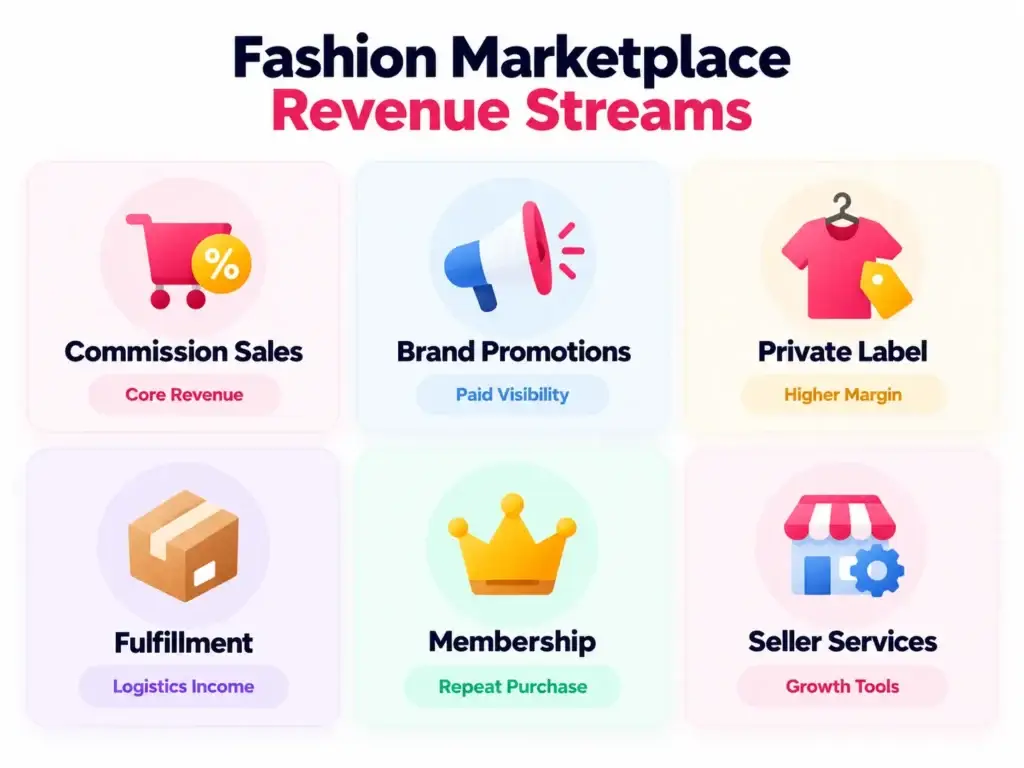
Fashion Marketplace Revenue Streams and Business Impact
| Revenue Stream | Who Pays? | Why It Works | Founder Risk to Manage |
|---|---|---|---|
| Commission on Seller Sales | Brands, sellers, or vendors | Scales with order volume and seller participation | Refunds, payout disputes, category-level commission rules |
| Brand Promotions | Fashion brands and advertisers | Turns marketplace traffic into high-margin visibility revenue | Over-commercialized discovery and unclear campaign reporting |
| Private Labels | End customers | Improves margin control and creates exclusive catalog value | Inventory risk, sourcing, quality control, and unsold stock |
| Fulfillment Services | Sellers or customers depending on policy | Monetizes warehousing, packing, delivery, and returns | Reverse logistics cost and operational complexity |
| Loyalty and Membership | Customers or platform-funded model | Improves retention, repeat purchase, and customer lifetime value | Over-discounting without retention lift |
| Seller Services | Sellers and brands | Helps sellers improve catalog quality and marketplace performance | Manual service burden if not systemized |
How Marketplace Technology Supports Revenue Growth
A fashion ecommerce revenue model is only as strong as the system supporting it. If the platform cannot manage commissions, campaigns, seller payouts, returns, product variants, and fulfillment workflows, the business model becomes difficult to scale.
Founders should think about monetization before development begins. Every revenue stream needs operational logic inside the platform. Commission needs payout rules. Brand promotions need placement control. Private labels need inventory visibility. Fulfillment needs delivery and return workflows. Loyalty needs points, tiers, and reversal rules.
This is why a fashion marketplace should include strong admin control from the beginning. The operator should be able to adjust commissions, manage seller plans, approve promotions, monitor returns, review payouts, track campaign results, and control catalog quality without depending on developers for every small business change.
For founders exploring faster launch options, a ready-made fashion marketplace foundation can reduce the time spent building core marketplace workflows from zero while still allowing branding, configuration, and monetization alignment.
Founder Decision Signals Before Choosing a Revenue Model
Speed
If the goal is to validate a fashion marketplace quickly, start with commissions and basic seller plans before adding advanced ad products or private labels.
Margin
If margins are thin, look beyond commissions. Brand promotions, fulfillment services, and private labels can create stronger revenue depth.
Operations
If returns, refunds, COD, and seller payouts are not planned early, revenue may look strong on paper but become difficult to reconcile.
Market Fit
If sellers need demand generation more than logistics support, brand promotion tools may matter more than fulfillment monetization in the early stage.
Mistakes Founders Should Avoid in Fashion Marketplace Monetization
Mistakes Founders Should Avoid
Depending Only on Commission Revenue
Commission is important, but it may not be enough to cover acquisition, operations, discounts, returns, and support costs. A stronger model combines commission with promotions, fulfillment, loyalty, and seller services.
Ignoring Return Economics
Fashion returns affect revenue, seller payouts, stock accuracy, customer trust, and logistics cost. If the platform does not handle reversals properly, profitability becomes difficult to measure.
Launching Paid Promotions Without Reporting
Brands will pay for visibility only when they can understand what they received. Campaign reporting, placement control, and performance visibility should be part of the promotion model.
Adding Private Labels Too Early
Private labels can improve margins, but they also create inventory and quality responsibilities. Founders should use marketplace demand data before investing heavily in owned inventory.
How Founders Can Build a Monetization-Ready Fashion Marketplace
A monetization-ready fashion marketplace should be planned around both business strategy and platform capability. The business strategy defines how the marketplace will earn. The platform capability defines whether those revenue streams can actually be operated without chaos.
Before launch, founders should answer these questions:
- Will sellers pay commission, subscription fees, or both?
- Will commission rates differ by category, seller tier, or campaign participation?
- Will brands be able to buy sponsored placements?
- Will the marketplace offer fulfillment, warehousing, delivery, or return services?
- Will private labels be launched immediately or after demand validation?
- How will refunds affect commission, loyalty points, seller payouts, and wallet balances?
- What admin controls are needed to update revenue rules without engineering delays?
- Which reports will sellers need to trust the platform?
These decisions shape the platform architecture. A fashion marketplace is not only a storefront. It needs buyer experience, seller operations, catalog depth, payment logic, settlement workflows, campaign tools, fulfillment control, and analytics.
For founders who want to evaluate the operational layer in more detail, the fashion marketplace features breakdown can help connect revenue streams with the product modules needed to support them.
Ready-Made vs Custom Development for Revenue-Focused Marketplaces
Founders usually have two broad paths. They can build a custom platform from the ground up, or they can start with a ready-made marketplace foundation and customize it for their brand, business model, and operating market.
Custom development gives flexibility, but it can take longer because every module must be planned, designed, built, tested, and integrated. A ready-made foundation can help founders move faster when the core marketplace flows already exist, especially for catalog, checkout, seller dashboards, payments, admin control, and delivery workflows.
The right choice depends on launch urgency, budget, differentiation, internal technical capacity, and how much of the business model is standard versus unique. If the goal is to validate a fashion marketplace quickly, starting with a ready-made foundation can reduce avoidable development time. If the model is highly experimental or operationally unusual, deeper custom development may be needed.
Miracuves supports founders who want a faster path with white-label marketplace solutions, source-code ownership, admin dashboards, and 6-day delivery for ready-made platforms where the scope fits. For broader ecommerce requirements, founders can also explore ecommerce app development services to align marketplace workflows with their specific business model.
Final Thoughts: Revenue Comes From the System, Not Just the Sale
A fashion ecommerce marketplace does not become profitable only because products are listed online. Revenue comes from the system around the sale: seller commissions, paid brand visibility, private label strategy, fulfillment services, loyalty programs, and operational control.
The strongest marketplaces are designed to monetize both demand and infrastructure. They help sellers reach customers, help customers discover products, and help the operator earn from transactions, promotions, logistics, and repeat engagement.
For founders, the practical takeaway is to plan monetization before platform development. Decide how sellers will be charged, how promotions will be sold, how returns will be handled, how fulfillment will be priced, and how admin teams will manage those rules. The earlier these decisions are built into the platform, the easier it becomes to scale without manual work.
FAQs
How do fashion ecommerce marketplaces make money?
Fashion ecommerce marketplaces make money through seller commissions, brand promotions, sponsored placements, private labels, fulfillment services, delivery fees, loyalty programs, and seller tools. The strongest models combine several revenue streams instead of depending only on transaction commission.
What is the most common revenue stream for a fashion marketplace?
Commission on seller sales is usually the most common revenue stream. The marketplace earns a percentage or fixed fee when a seller completes an order. However, commission revenue should be supported by strong refund, payout, and reconciliation workflows.
How do brand promotions generate revenue in ecommerce marketplaces?
Brands pay for better visibility through sponsored listings, homepage banners, category placements, push notification campaigns, sale event participation, featured storefronts, and collection sponsorships. This creates advertising-style revenue for the marketplace.
Are private labels profitable for fashion marketplaces?
Private labels can improve margins because the marketplace controls product sourcing, pricing, branding, and merchandising. However, they also bring inventory risk, quality control needs, warehousing responsibilities, and return management challenges.
Why is fulfillment important in fashion marketplace monetization?
Fulfillment allows the marketplace to earn from warehousing, packaging, delivery, return processing, and seller service levels. It also improves customer experience when delivery and returns are handled consistently.
Should a new fashion marketplace start with private labels?
Most new marketplaces should first validate demand, seller participation, customer behavior, and category performance. Private labels are usually stronger after the platform has enough data to identify profitable product gaps and repeat demand.
What technology features are needed to support marketplace revenue?
A monetization-ready marketplace needs seller dashboards, commission rules, payout management, product variant control, promotion management, refund workflows, loyalty logic, fulfillment tracking, analytics, and admin controls.
Can Miracuves help launch a fashion ecommerce marketplace faster?
Yes. Miracuves helps founders launch ready-made and white-label marketplace platforms with source code, branded design, admin control, and faster deployment. For ready-made solutions, Miracuves can support a 6-day launch when the selected scope fits the existing platform foundation.
Miracuves is an independent software development company. We are not affiliated with, connected to, sponsored by, or endorsed by any company or product named in this article.
Terms such as “X Clone” are used descriptively. It is how the software industry refers to building a platform with functionality comparable to a known service, and how clients search for it.
The entire design and codebase of our products is built by our own team. Our products contain no code, design, graphics, or content originating from any third-party website or applications.
All third-party names and marks referenced in this article are the property of their respective owners, referenced solely to identify the services discussed.



