
Key Takeaways
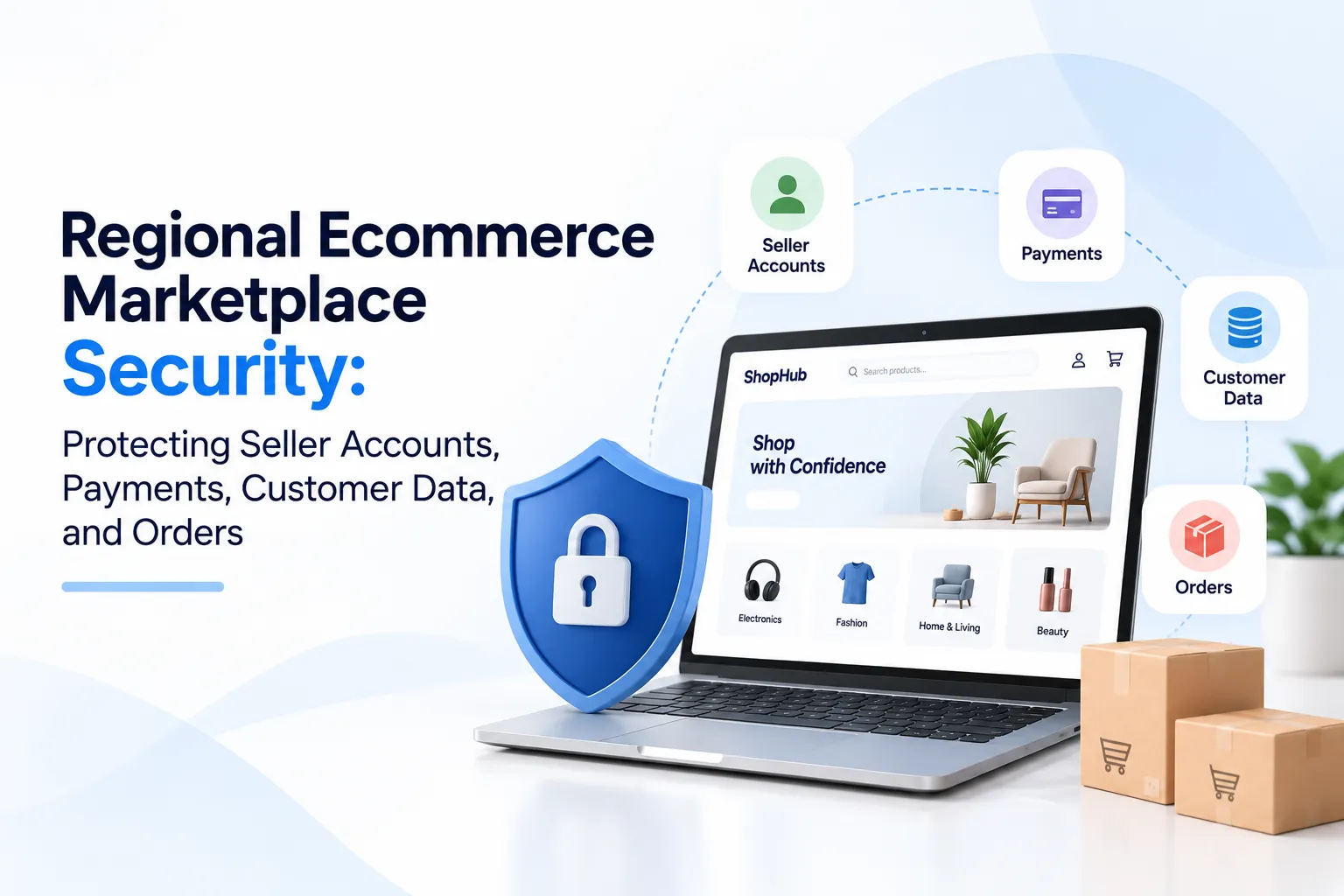
- Regional Ecommerce Marketplace Security should protect seller accounts, buyer data, payments, orders, refunds, admin access, and fraud-sensitive workflows from the beginning.
- Seller dashboards need secure login, verification, role-based permissions, activity logs, product controls, and clear payout visibility.
- Customer data should be limited to what the marketplace actually needs, with controlled access, secure transfer, and privacy-conscious handling.
- Payment security should include transaction logs, commission tracking, refund approvals, payout records, cash collection tracking, and audit trails.
- Role-based admin access, structured refund workflows, order integrity, and fraud monitoring help reduce both operational and security risk as the marketplace scales.
Security Signals
- Unusual seller edits, sudden pricing changes, repeated cancellations, refund spikes, coupon abuse, and payout changes can indicate marketplace risk.
- Buyers, sellers, support teams, finance users, catalog managers, and regional operators should only see the data required for their role.
- Order records should use clear status rules, timestamps, delivery logs, refund history, and controlled admin overrides.
- Returns and disputes should follow consistent approval, proof, seller-responsibility, escalation, and refund-recording rules.
- Third-party payment, delivery, CRM, messaging, analytics, and support integrations should be reviewed for permissions, data flow, error handling, and access protection.
Real Insights
- Marketplace security is not only a technical layer; it directly affects seller trust, buyer confidence, payment reliability, and operational stability.
- Security becomes harder to retrofit after launch because permissions, payments, seller workflows, refunds, and admin access may already be deeply connected.
- Full admin access should be limited because operations, finance, catalog, support, and marketing teams require different permissions.
- A first version does not always need advanced fraud scoring, but it should provide enough logs, reporting, and visibility to detect unusual patterns early.
- The strongest security flow is: verify users → assign role-based permissions → protect buyer and seller data → secure payments and orders → structure refunds and disputes → log sensitive actions → monitor fraud signals → review access as the marketplace grows.
Security is one of the most important foundations of a Regional Ecommerce Marketplace Security Guide. A marketplace does not only manage products and checkout. It manages seller accounts, buyer profiles, payment records, delivery updates, refund requests, order histories, admin permissions, and business-sensitive data.
For founders, security should not be treated as a feature added after launch. It should be part of the product architecture from the beginning because trust directly affects seller participation, buyer confidence, payment reliability, and long-term marketplace growth.
A regional commerce platform may need to handle multiple sellers, multiple currencies, cash-on-delivery workflows, local delivery zones, refund disputes, regional tax settings, and marketplace-led promotions. Each layer creates data, permissions, and transaction records that need protection.
This guide explains the security areas startups should evaluate before launching a marketplace platform, including seller account protection, payment security, customer data privacy, order integrity, refund controls, admin access, and fraud monitoring.
For founders who want a faster route to launch, Miracuves offers a multi-market retail marketplace solution that supports seller workflows, buyer journeys, payment logic, delivery operations, admin control, source-code ownership, and 6-day deployment where applicable.
Why Security Planning Matters Before Marketplace Launch
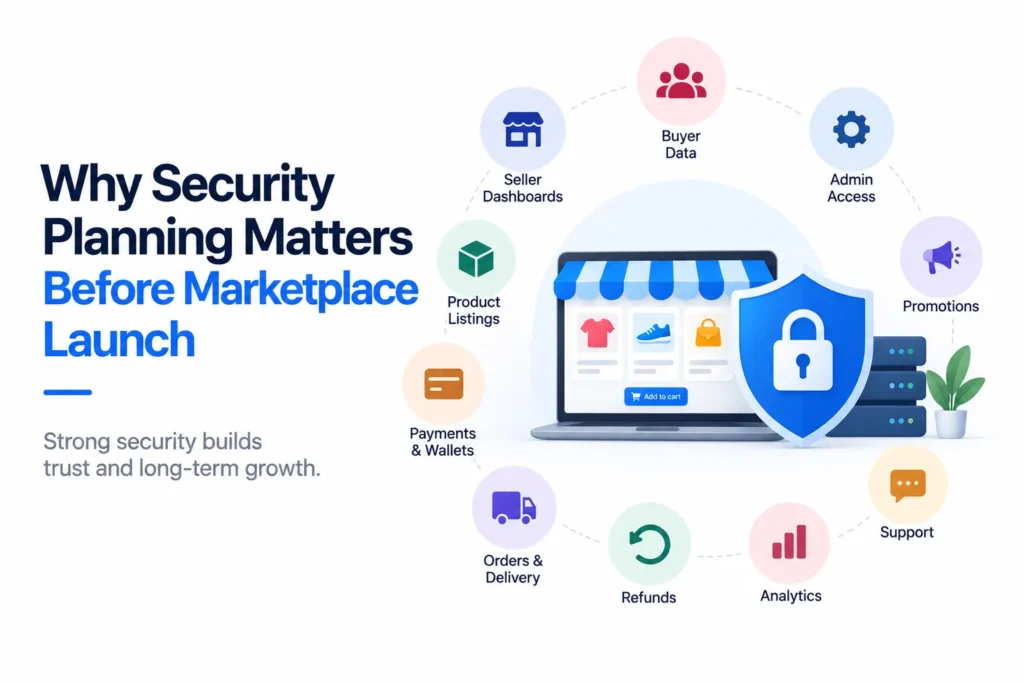
A marketplace becomes harder to secure when security is planned after the product is already built. By then, account permissions, seller workflows, payment records, customer data fields, refund rules, and admin access may already be scattered across the platform.
Founders should think about security before launch because a marketplace has several sensitive layers:
- Seller dashboards
- Buyer profiles
- Product listings
- Payment records
- Wallet or payout history
- Delivery details
- Order status updates
- Refund requests
- Admin permissions
- Promotional controls
- Support conversations
- Marketplace analytics
A small weakness in any one layer can create business risk. For example, weak seller access can lead to unauthorized product changes. Poor admin permissions can expose sensitive operational data. Weak refund controls can increase fraud. Poor order records can create disputes between buyers, sellers, and the platform operator.
Security is not only a technical issue. It is a marketplace trust issue.
Seller Account Security: Protecting Vendor Dashboards and Business Data
Seller accounts are one of the most important security layers in a multi-vendor commerce platform. Sellers manage products, inventory, pricing, order acceptance, shipment updates, returns, earnings, and payout records.
If seller account access is weak, the platform may face problems such as:
- Unauthorized product edits
- Fake discounts or price manipulation
- Stock changes without approval
- Order tampering
- Payout visibility issues
- Fake return approvals
- Seller identity misuse
- Disputes around account activity
A secure seller account system should include:
| Security Area | Why It Matters |
|---|---|
| Secure login | Helps prevent unauthorized dashboard access |
| Seller verification | Reduces fake or low-quality seller onboarding |
| Role-based access | Limits what each seller team member can view or change |
| Activity logs | Helps track product, order, payout, and account changes |
| Product approval controls | Prevents risky or unauthorized listings from going live |
| Payout visibility | Gives sellers clear records without exposing other seller data |
| Notification alerts | Helps sellers detect unusual activity faster |
Founders should also decide whether sellers can add team members, manage multiple warehouses, upload bulk products, or access financial reports. Each of these decisions affects permissions and security planning.
For a deeper feature-level view, review this multi-vendor marketplace feature breakdown before finalizing seller, buyer, order, delivery, and admin workflows.
Customer Data Protection: Building Buyer Trust From Day One
Buyers share personal and transactional data during marketplace activity. This may include names, phone numbers, email addresses, delivery addresses, order history, payment references, refund requests, support tickets, and product reviews.
Customer data protection should focus on practical access control and privacy-conscious handling. Founders should ask:
- What customer data is collected?
- Why is each data field needed?
- Who can access buyer information?
- Can sellers see only the data needed to fulfill orders?
- Can support teams access only relevant order records?
- Are sensitive records protected from unnecessary exposure?
- Are deleted or inactive accounts handled properly?
- Are customer notifications secure and accurate?
A strong buyer data strategy should include encrypted data transfer, secure account access, limited internal permissions, order-level visibility, and clear support workflows.
The goal is not to collect the most data. The goal is to collect what the marketplace needs and protect it properly.
Payment Security: Protecting Transactions, Refunds, and Payouts
Payment security is more than accepting online payments. A marketplace must manage buyer payments, seller earnings, commissions, delivery fees, refunds, cancellations, failed transactions, and settlement records.
You can also read this regional marketplace business model guide to understand how revenue streams, seller operations, payment flows, and marketplace controls connect.
Payment-related risks may include:
- Failed payment records not updating correctly
- Refund requests being approved without review
- Seller payout disputes
- Incorrect commission deductions
- Cash-on-delivery reconciliation issues
- Payment status mismatch between buyer, seller, and admin dashboards
- Unauthorized access to financial reports
A secure payment system should include:
| Payment Layer | Security Need |
|---|---|
| Payment gateway integration | Secure transaction processing through trusted providers |
| Transaction logs | Clear records for every order, refund, and payout action |
| Commission tracking | Transparent platform earnings and seller deductions |
| Refund controls | Admin approval where needed for refund requests |
| Seller payout records | Clear settlement visibility for sellers and finance teams |
| Cash collection tracking | Useful for markets where cash payment still matters |
| Audit logs | Helps investigate financial disputes or unusual changes |
Founders planning revenue logic can also study this marketplace revenue model to understand how commissions, seller plans, delivery charges, promoted listings, and settlement workflows can connect inside the platform.
Order Security: Keeping Checkout, Delivery, and Refund Records Reliable
Orders are the operational backbone of an ecommerce marketplace. Every order connects the buyer, seller, product, payment, delivery workflow, support team, and admin dashboard.
Order security means protecting the accuracy and visibility of order data.
Founders should secure:
- Order placement records
- Payment confirmation
- Seller order acceptance
- Shipment status
- Delivery assignment
- Delivery proof where relevant
- Cancellation requests
- Return requests
- Refund approval
- Customer notifications
- Admin changes
- Support activity
A weak order system creates confusion. Buyers may see one status, sellers may see another, and admins may not know which record is correct. That increases support cost and weakens trust.
A strong order security model should include clear status rules, permission-based updates, timestamped activity, refund history, delivery logs, and admin override controls.
Admin Access Control: Preventing Internal Security Gaps
The admin dashboard is where the marketplace operator controls the business. It may include users, sellers, products, categories, orders, payments, refunds, banners, reports, support tickets, commissions, and system settings.
Because the admin panel has broad access, it needs careful permission planning.
Founders should avoid giving every team member full admin access. Instead, use role-based access control so each team member sees only what they need.
Example roles may include:
| Admin Role | Access Needed |
|---|---|
| Marketplace owner | Full platform visibility and settings |
| Operations manager | Orders, sellers, delivery, returns, and support workflows |
| Finance manager | Payments, commissions, refunds, payout records, and reports |
| Catalog manager | Products, categories, attributes, images, and product approvals |
| Support agent | Buyer issues, order history, refund requests, and dispute records |
| Marketing manager | Banners, coupons, promotions, notifications, and campaign reports |
Good admin security includes role-based permissions, secure login, activity logs, export controls, approval workflows, and restricted access to financial records.
This is especially important for growing teams where more people need operational access after launch.
Refund, Return, and Dispute Security
Refund and return workflows can become weak points if they are not structured early. Fraud, unclear seller responsibility, missing proof, manual approvals, and inconsistent refund decisions can all damage marketplace trust.
A secure refund and dispute system should define:
- Which products are returnable
- Return request window
- Seller responsibility
- Buyer proof requirements
- Admin review steps
- Refund approval rules
- Partial refund conditions
- Delivery failure handling
- Reverse pickup logic
- Dispute escalation
- Refund transaction records
Refund security is not about making returns difficult. It is about making decisions consistent, trackable, and fair for buyers, sellers, and the platform operator.
Founders should also make sure that refund actions are recorded clearly in the admin dashboard. Without audit logs, teams may struggle to understand who approved what and why.
Fraud Monitoring Signals Founders Should Watch
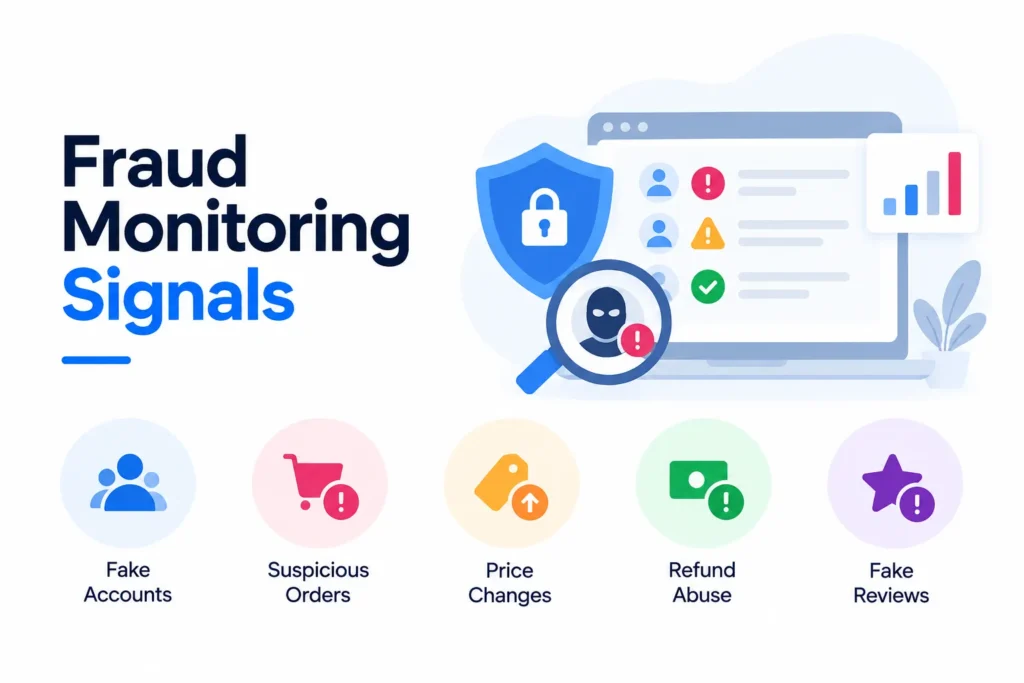
Fraud risk changes as the marketplace grows. In the early stage, fraud may appear as fake seller registrations, duplicate buyer accounts, suspicious orders, repeated refund requests, coupon misuse, fake reviews, or payout manipulation.
Founders should monitor:
- Multiple accounts from the same user pattern
- Unusual seller product edits
- Sudden pricing changes
- Repeated order cancellations
- High refund frequency
- Unusual cash payment patterns
- Suspicious delivery failure rates
- Coupon abuse
- Fake or manipulated reviews
- Repeated disputes involving the same account
A first version does not always need complex fraud scoring. But it should have enough reporting, activity logs, and admin visibility to detect unusual behavior.
Security improves when the team can see patterns early.
Marketplace Security Checklist Before Going Live
Pre-Launch Marketplace Security Checklist
| Security Area | What to Check | Founder Impact |
|---|---|---|
| Seller accounts | Secure login, seller verification, activity logs, product approval, payout visibility | Protects seller trust and reduces account misuse |
| Buyer data | Limited access, secure account flow, protected order history, privacy-conscious handling | Builds customer confidence and reduces data exposure risk |
| Payments | Secure gateway, transaction records, refund logs, commission tracking, payout records | Supports financial clarity and dispute resolution |
| Orders | Status rules, timestamps, delivery records, cancellation logs, admin override tracking | Keeps buyer, seller, and admin views consistent |
| Admin dashboard | Role-based access, permission controls, activity logs, restricted financial access | Prevents internal access risks as the team grows |
| Returns and refunds | Approval rules, proof handling, refund records, seller responsibility, dispute escalation | Reduces fraud and protects marketplace trust |
| Reviews and ratings | Moderation tools, abuse reporting, fake review signals, seller response controls | Improves trust in product and seller reputation |
| Notifications | Secure order alerts, payment updates, refund messages, seller notifications | Reduces confusion and support pressure |
Security Cost Factors Founders Should Evaluate
Security affects development cost because every sensitive workflow needs proper planning, implementation, testing, and maintenance. The cost is not only about adding security tools. It also depends on how many user roles, transaction workflows, dashboards, integrations, and approval rules the platform needs.
Key security-related cost factors include:
1. Number of User Roles
A basic buyer-seller-admin marketplace is easier to secure than a platform with buyers, sellers, delivery agents, finance teams, support agents, catalog managers, and regional operators.
Each role needs different permissions, dashboard visibility, and access rules.
2. Payment and Refund Complexity
Marketplace payment logic becomes more complex when the platform handles online payments, cash payments, wallet balances, seller payouts, delivery fees, commissions, refunds, partial refunds, and settlement reports.
The more financial scenarios the platform supports, the more careful payment security planning becomes.
3. Seller Verification Requirements
Some marketplaces allow open registration. Others need business verification, document checks, admin approval, product approval, category restrictions, and seller performance monitoring.
More verification steps can increase setup complexity but improve seller quality.
4. Admin Permission Depth
A simple admin panel may not be enough for a growing marketplace. If different teams need different access levels, the platform needs role-based dashboards, activity logs, and restricted controls.
5. Third-Party Integrations
Payment gateways, delivery APIs, SMS providers, analytics tools, email platforms, CRM systems, and support tools can all create security considerations. Each integration should be tested for data flow, permissions, error handling, and access protection.
6. Data Storage and Reporting
Order history, refund records, payout reports, customer support logs, and seller activity records need structured data handling. Poor reporting may create operational confusion during disputes.
For pricing and scope planning, founders can review this marketplace development cost guide before finalizing their launch requirements.
Ready-Made Marketplace Security vs Custom Development
Founders often compare ready-made platforms with custom development. Both options can be secure when planned properly, but they differ in cost, timeline, and flexibility.
If your next step is vendor evaluation, review how to choose a marketplace development partner based on source-code ownership, security planning, deployment support, customization, and technical fit.
| Build Path | Security Advantage | What Founders Should Check |
|---|---|---|
| Ready-made marketplace foundation | Core workflows may already include buyer, seller, payment, order, and admin security layers | Check source-code access, role permissions, payment flows, deployment process, and customization scope |
| Custom development | Security can be planned from scratch around unique workflows | Check timeline, budget, architecture planning, testing process, and long-term maintenance |
| Hybrid approach | Starts with a ready-made foundation and customizes priority security workflows | Check which modules are already built and which security changes need custom work |
A ready-made foundation can help founders move faster because standard marketplace workflows are already prepared. Custom development is useful when the business needs highly unique security logic, complex integrations, or special operating workflows.
If your marketplace requires a fully tailored build, Miracuves also offers custom mobile app development for unique product workflows.
Founder Decision Signals for Marketplace Security
Seller Risk
If sellers manage pricing, inventory, orders, and payouts, secure seller access and activity logs should be included before launch.
Payment Risk
If the platform handles commissions, refunds, cash payments, or seller payouts, transaction records and approval workflows become launch-critical.
Admin Risk
If several team members manage operations, role-based access control should be planned early to reduce internal exposure.
Data Risk
If buyer addresses, order histories, support tickets, and payment references are stored, privacy-conscious access rules are essential.
Common Security Mistakes Founders Should Avoid
Giving Too Many Users Full Admin Access
Full access should be limited. Operations, finance, catalog, support, and marketing teams need different permissions to reduce internal risk.
Ignoring Seller Account Activity
Seller dashboards should track important actions such as product edits, price changes, inventory updates, order handling, and payout-related activity.
Treating Refunds as Manual Exceptions
Refunds and returns need clear approval rules, records, and dispute workflows. Manual handling can increase fraud risk and operational confusion.
Launching Without Payment Visibility
Founders need clear transaction, commission, refund, and payout records. Without visibility, financial disputes become harder to resolve.
Where Miracuves Fits Into Secure Marketplace Launch Planning
Miracuves helps founders launch ready-made and white-label marketplace solutions with source-code ownership, branded design, seller workflows, buyer journeys, payment logic, delivery operations, and admin control.
For security-conscious founders, the benefit is practical. A structured marketplace foundation helps teams plan buyer access, seller dashboards, payment records, order visibility, refund workflows, role-based admin permissions, and operational controls before going live.
Where applicable, Miracuves supports 6-day deployment for ready-made marketplace solutions, depending on selected modules, branding, integrations, configuration, and final scope.
Related reading: regional e-commerce marketplace launch mistakes.
Final Thoughts
A secure marketplace is not built only with one payment gateway, one login form, or one privacy policy. It is built through careful control of seller accounts, buyer data, payment records, order status, refunds, admin access, and operational visibility.
For founders, the strongest security decision is to plan these workflows before launch. Seller permissions, customer data access, refund approvals, payout visibility, order records, and admin controls should be part of the product foundation—not emergency fixes after the platform goes live.
Miracuves helps founders move faster with ready-made, white-label, source-code-owned marketplace solutions designed for practical execution, admin control, and faster validation.
FAQs
What security features should an ecommerce marketplace include?
An ecommerce marketplace should include secure login, seller verification, encrypted data transfer, secure payment gateway integration, role-based access control, activity logs, refund records, dispute management, and admin access controls.
Why is seller account security important in a marketplace?
Seller accounts control product listings, prices, inventory, orders, and payout visibility. Weak seller security can lead to unauthorized changes, order disputes, payment confusion, and trust issues.
How can marketplaces protect customer data?
Marketplaces can protect customer data through secure account access, privacy-conscious data collection, encrypted transfer, limited internal permissions, protected order records, and clear support workflows.
What payment security checks should founders plan before launch?
Founders should check payment gateway setup, transaction logs, refund rules, seller payout records, commission tracking, failed payment handling, and cash collection workflows where relevant.
Why is role-based access control important?
Role-based access control limits what each team member can view or change. This helps prevent unnecessary exposure of customer data, seller records, payment information, and platform settings.
Are refunds and returns part of marketplace security?
Yes. Refunds and returns affect financial trust. A secure workflow should include approval rules, proof handling, seller responsibility, refund records, and dispute escalation.
Can Miracuves help launch a secure marketplace faster?
Yes. Miracuves helps founders launch ready-made and white-label marketplace solutions with source-code ownership, branded design, admin control, marketplace workflows, and 6-day deployment where applicable.
Does a marketplace become compliant automatically if security features are added?
No. Security features can support compliance-ready workflows, but final compliance depends on jurisdiction, legal review, payment providers, integrations, data handling practices, and the operating model
Miracuves is an independent software development company. We are not affiliated with, connected to, sponsored by, or endorsed by any company or product named in this article.
Terms such as “X Clone” are used descriptively. It is how the software industry refers to building a platform with functionality comparable to a known service, and how clients search for it.
The entire design and codebase of our products is built by our own team. Our products contain no code, design, graphics, or content originating from any third-party website or applications.
All third-party names and marks referenced in this article are the property of their respective owners, referenced solely to identify the services discussed.