


Building a regional ecommerce marketplace is not just about adding products, carts, sellers, and payments. The real complexity begins when the platform needs to support more than one city, country, currency, seller group, tax rule, delivery zone, and payment behavior from a single operating system.
For founders, this is where marketplace planning becomes a business decision, not only a development decision. A platform that works well in one region can break when the next region needs a different currency, VAT rule, delivery promise, refund process, payout cycle, or seller approval workflow.
This guide explains the architecture decisions behind a scalable regional ecommerce marketplace, including multi-currency pricing, tax zones, seller operations, payouts, delivery workflows, cash-on-delivery handling, and admin control.
For founders planning a regional retail or commerce platform, understanding the broader retail and ecommerce platform development landscape can also help align technology decisions with market operations.
If you are comparing build options, this article will help you understand what should exist under the surface before you invest in a launch-ready ecommerce platform.
Key Takeaways
- Regional ecommerce marketplace architecture helps founders manage multiple markets without rebuilding the platform for every location.
- Multi-currency ecommerce is not only a display feature. It affects pricing, checkout, refunds, seller payouts, tax records, and reconciliation.
- Tax zones should be configured as platform rules instead of being handled manually after orders are placed.
- Seller operations require onboarding, verification, catalog approval, commission logic, payout schedules, disputes, and return reserves.
- Delivery architecture should connect serviceability, warehouse routing, courier rules, COD handling, tracking, and returns into one controlled workflow.
- Miracuves helps founders move faster with ready-made and white-label marketplace solutions built for admin control, source-code ownership, and 6-day solution delivery where applicable.
Why Regional Ecommerce Marketplaces Need a Different Architecture
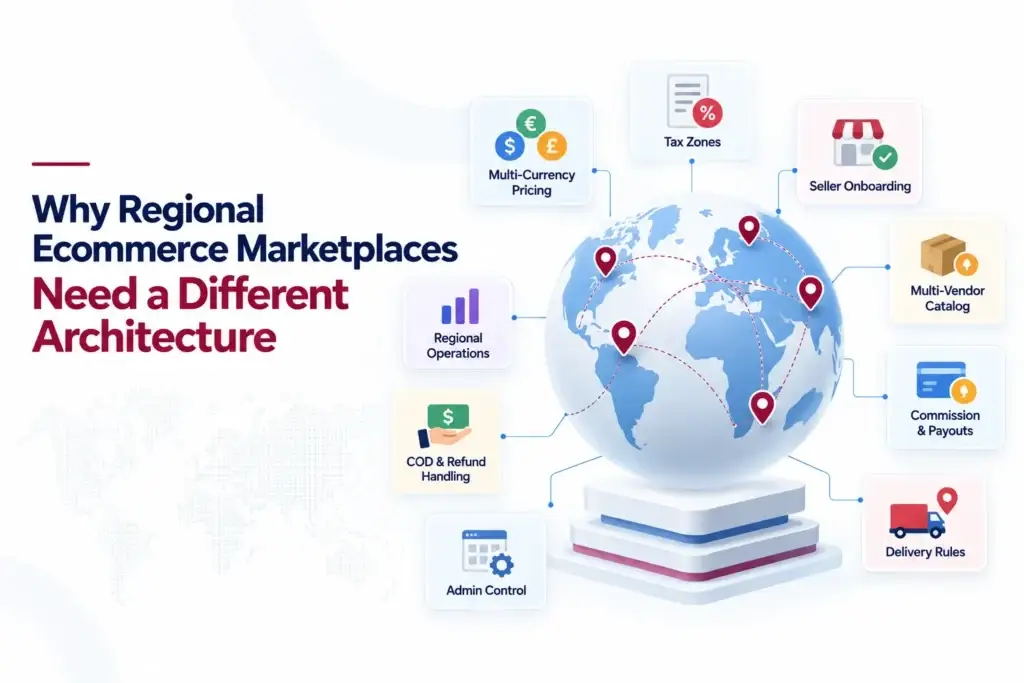
A single-market ecommerce app can often start with straightforward product listings, payment integration, inventory management, and order tracking. A regional marketplace needs more structure because every region can introduce a new business rule.
One country may require VAT-inclusive pricing. Another may need tax added at checkout. One city may support same-day delivery, while another may only support scheduled delivery. One seller category may need approval before products go live, while another may be allowed to publish instantly.
These decisions cannot sit in spreadsheets or support team notes. They need to be part of the marketplace logic.
A strong regional ecommerce marketplace usually includes:
- Market-wise currency and pricing rules
- Tax zones based on buyer location, seller location, product category, or delivery address
- Seller onboarding and verification workflows
- Multi-vendor catalog and inventory controls
- Commission and payout logic by seller, category, or region
- Delivery serviceability rules by country, state, city, area, or postal code
- COD reconciliation and refund handling where cash orders are common
- Admin dashboards for catalog, finance, logistics, customer support, and dispute management
This is why the architecture should be planned around operations first. Design matters, but operational logic decides whether the marketplace can scale without creating manual work for every order.
Core Architecture Layers of a Regional Ecommerce Marketplace
A regional ecommerce marketplace should be built as a connected system of business layers. Each layer solves a different operational problem, but they all need to communicate with each other. If you want to compare these operational layers with real product modules, review the regional marketplace feature set before finalizing your build scope.
Regional Marketplace Architecture Layers
| Architecture Layer | What It Controls | Founder Impact |
|---|---|---|
| Market Configuration | Countries, cities, currencies, languages, tax zones, serviceable areas, and operating rules | Lets the business expand into new regions without creating separate platforms for every market |
| Catalog and Product Data | SKUs, variants, categories, attributes, seller listings, approvals, and localized product content | Improves search, filtering, merchandising, and seller catalog quality |
| Pricing and Currency Engine | Base price, local price, conversion rules, rounding, discounts, commissions, and refund value | Protects margins when selling across markets with different currencies and pricing expectations |
| Tax Zone Engine | VAT, GST, sales tax, tax-inclusive pricing, invoices, exemptions, and reporting fields | Reduces manual finance corrections and supports cleaner marketplace accounting |
| Seller Operations | Seller onboarding, verification, commission plans, payout schedules, catalog review, and performance controls | Helps the marketplace maintain seller quality while scaling supply |
| Order and Settlement Ledger | Order totals, seller share, platform commission, tax lines, refunds, COD balances, and payout holds | Gives finance and sellers a reliable record of where money moved |
| Delivery and Fulfilment | Warehouses, delivery zones, courier rules, pickup flows, tracking, ETA, returns, and failed deliveries | Turns delivery promises into controlled operational rules instead of support tickets |
| Admin Control | Users, sellers, orders, payments, refunds, disputes, promotions, reports, permissions, and audit logs | Allows the operator to run the platform without relying on developers for every business change |
Multi-Currency Marketplace Logic: More Than Price Display
Many founders first think of multi-currency ecommerce as a simple storefront feature: show the buyer prices in their preferred currency. In a marketplace, the decision is deeper.
Currency touches pricing, checkout, refunds, seller payouts, invoices, reports, and accounting.
A marketplace must decide whether each product has one base price converted dynamically, region-specific prices controlled by sellers, or platform-approved prices for each market. Each model has tradeoffs.
Base Currency With Conversion
This approach stores one base price and converts it into the buyer’s local currency at checkout or display. It is easier to manage but can create margin issues if exchange rates, payment fees, or rounding rules are not handled carefully.
Region-Specific Price Lists
This model lets the marketplace or seller define separate prices for each region. It gives more control over local purchasing power, promotions, taxes, and seller margins. However, it needs stronger admin tools because product pricing becomes more complex.
Seller-Controlled Local Pricing
This is useful when sellers operate locally and understand their own market. The risk is inconsistency. Without approval flows, pricing limits, and category controls, the marketplace may show uneven pricing across regions.
A scalable ecommerce marketplace should also account for currency rounding, refund currency, partial refunds, wallet credits, COD collection currency, and seller settlement currency. These details become important when one buyer pays in one currency, the platform records revenue in another, and the seller expects payout in a third.
Tax Zones: The Rule Engine Behind Regional Commerce
Tax zones help the platform decide which tax rule applies to an order. For a regional ecommerce marketplace, tax cannot be a static percentage added to every checkout.
It may depend on the buyer’s delivery location, the seller’s registered location, the product category, the marketplace’s legal entity, or whether the price is tax-inclusive.
A practical tax zone engine should support:
- Country, state, city, postal code, or custom service area rules
- Tax-inclusive and tax-exclusive pricing
- Different rates by category or product type
- Seller tax identity fields where applicable
- Separate invoice fields for product value, delivery fee, discount, commission, and tax
- Refund tax reversal logic
- Admin reports for finance review
This does not mean the software alone guarantees tax compliance. Final tax handling depends on jurisdiction, legal review, payment providers, seller agreements, and operating model. But a compliance-ready foundation makes it easier to configure, audit, and update tax workflows as the marketplace expands.
Seller Operations: The Marketplace Layer Founders Often Underestimate
The success of a regional ecommerce marketplace depends heavily on seller quality. Sellers control product availability, catalog accuracy, pricing, fulfilment readiness, and customer trust.
That means seller operations should not be treated as a basic dashboard. It should be an operational system.
Seller Onboarding and Verification
Before sellers can list products, the marketplace needs a structured onboarding flow. Depending on the region and business model, this may include business details, identity records, tax numbers, bank information, pickup addresses, category permissions, and agreement acceptance.
For founders, this matters because poor seller data becomes a finance, delivery, and dispute problem later. A rejected payout, fake product listing, wrong pickup address, or missing tax detail can turn into a support issue that drains operations.
Catalog Approval and Product Quality
Regional marketplaces usually deal with different product naming styles, image quality, SKU structures, and seller catalog formats. The platform should support bulk upload, manual listing, product moderation, attribute rules, category-specific fields, and rejected-listing feedback.
A strong catalog system improves search, filters, merchandising, and conversion. A weak catalog creates duplicate listings, wrong variants, poor product discovery, and higher return rates.
Commission and Seller Plans
A marketplace can monetize through category commissions, seller subscriptions, featured listings, delivery fees, promoted placements, service fees, or value-added seller tools. Founders who want to map these options in more detail can explore the marketplace revenue model and seller monetization structure.
The architecture should allow the operator to configure commission rules without code changes.
For example, electronics may use one commission rate, fashion may use another, and grocery may require different logic because of lower margins and faster fulfilment expectations.
Payouts, Holds, Refunds, and Reconciliation
Seller payout logic should not be handled after orders are completed. It should be part of the transaction flow from the beginning.
Every order should clearly record:
- Buyer payment amount
- Seller gross value
- Platform commission
- Tax lines
- Delivery fee
- Discount contribution
- Refund value
- Reserve or hold amount
- Net seller payout
This is especially important for marketplaces with returns, COD orders, seller disputes, and category-specific payout cycles. Sellers need transparent statements, and the operator needs a reliable ledger.
Delivery Architecture: Where Marketplace Promises Meet Real Operations
Delivery is one of the hardest parts of regional ecommerce because every service area has different logistics capacity.
A marketplace may support express delivery in one city, scheduled delivery in another, pickup-only fulfilment in a third, and third-party courier integration in another region.
A scalable delivery engine should answer four questions before checkout:
- Is the product serviceable at the buyer’s location?
- Which seller, warehouse, or fulfilment point should handle the order?
- Which delivery method is available for that location and category?
- What promise can the platform honestly show to the customer?
Serviceability Rules
Serviceability can be managed by country, city, zone, postal code, radius, seller area, warehouse coverage, or courier availability.
The mistake is allowing customers to place orders that operations cannot fulfil. The better approach is to calculate delivery eligibility before checkout.
Order Routing
If multiple sellers or warehouses can fulfil an order, the platform needs routing logic. This may consider stock availability, seller rating, distance, delivery cost, warehouse priority, or promised delivery time.
Last-Mile Partner Workflows
A regional ecommerce platform may use in-house delivery agents, seller-managed fulfilment, third-party couriers, or a hybrid model.
Each option requires different workflows for assignment, pickup, proof of delivery, failed delivery, rescheduling, and returns.
Returns and Reverse Logistics
Returns should not be treated as negative orders. A return has its own lifecycle: requested, approved, picked up, received, inspected, refunded, rejected, restocked, or written off.
If this lifecycle is not built properly, support teams lose visibility and finance teams struggle to reconcile refunds.
Cash-on-Delivery and Regional Payment Behavior
In many regional ecommerce markets, cash-on-delivery is not an optional feature. It is part of buyer trust. But COD creates operational complexity because money moves outside the digital payment gateway before it reaches the platform.
A marketplace that supports COD should track:
- Order value collected by delivery partner
- Cash handover from delivery partner to seller or platform
- Failed delivery and refusal cases
- Partial payment or wallet adjustment rules
- Seller settlement after cash reconciliation
- Refund rules for mixed payment methods
If COD is only marked as “unpaid” in the system, finance teams will eventually depend on manual sheets. If COD has a proper ledger, the marketplace can track collections, settlements, disputes, and outstanding balances more clearly.
Read more: Regional Ecommerce Marketplace vs Global Marketplace: Which Business Model Fits Startups Better?
Admin Dashboard Controls Every Regional Marketplace Should Include
The admin dashboard is where the platform operator turns strategy into daily execution. Without strong admin control, even a well-designed ecommerce app becomes hard to manage.
A regional ecommerce marketplace should include admin controls for:
- Market, country, city, and service area configuration
- Currency, pricing, rounding, and exchange settings
- Tax zone and invoice rules
- Seller onboarding, approval, verification, and suspension
- Catalog moderation and bulk upload review
- Commission, subscription, and promotional rules
- Order tracking, refunds, returns, and dispute management
- Delivery partner assignment and fulfilment status
- COD reconciliation and seller payout reporting
- Role-based access control and activity logs
- Analytics by region, seller, category, payment method, and delivery status
This level of control helps founders adjust operations without needing developers for every pricing, tax, seller, or delivery change.
Founder Decision Signals
Speed
If the marketplace needs buyer, seller, delivery, and admin workflows quickly, a launch-ready foundation can reduce the time spent rebuilding common commerce modules.
Cost
Costs rise when tax, seller payouts, COD, and fulfilment logic are added late. Scoping these rules early protects the budget from rework.
Scalability
A regional platform should allow new markets, delivery zones, currencies, and seller groups to be configured instead of rebuilt.
Market Fit
The right architecture lets founders test a regional commerce model with local payments, seller operations, and delivery promises aligned to buyer behavior.
Build From Scratch vs Launch-Ready Marketplace Foundation
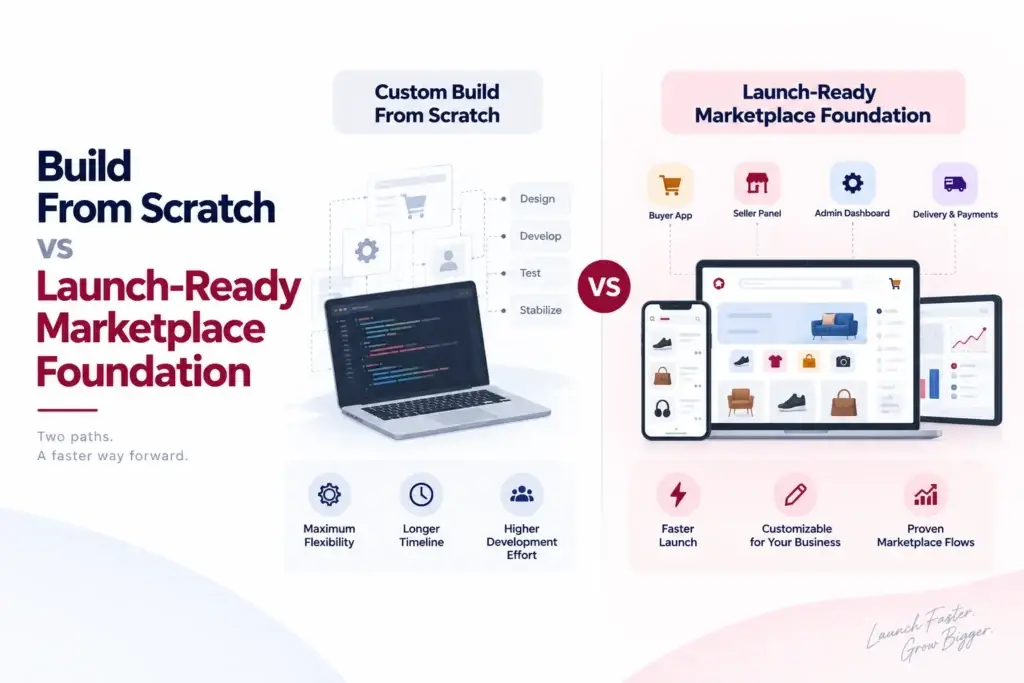
Founders usually have two paths when building a regional ecommerce marketplace: custom development from zero or starting with a ready-made marketplace foundation that can be customized.
Custom development gives maximum flexibility, but it also means the team must design, build, test, and stabilize every core workflow before launch.
A ready-made foundation can be more practical when the business needs standard marketplace flows such as buyer apps, seller panels, admin dashboards, cart, checkout, delivery, commission logic, and product catalog controls.
Custom Build vs Launch-Ready Marketplace Foundation
| Build Option | Best For | Tradeoff |
|---|---|---|
| Custom Build From Zero | Businesses with unusual workflows, proprietary logic, complex enterprise systems, or deeply custom supply-chain needs | More flexibility, but higher planning, development, QA, and timeline risk |
| Ready-Made Marketplace Foundation | Founders who need a working buyer-seller-admin platform and want to customize branding, operations, payments, and regional settings | Faster launch, but the final fit depends on customization scope and required integrations |
| Hybrid Approach | Businesses that want to launch standard flows first and add custom ERP, warehouse, analytics, or fulfilment logic later | Balanced path, but requires strong roadmap discipline |
For founders comparing options, Miracuves offers a launch-ready Gulf-market ecommerce marketplace solution that can support regional marketplace workflows such as seller operations, local delivery, multi-market configuration, admin control, and faster deployment.
The goal is not to copy another business blindly. The goal is to start with a proven commerce foundation and adapt it to your region, category, sellers, and monetization plan.
Security, Trust, and Compliance-Ready Marketplace Workflows
Security should be treated as part of marketplace architecture, not as a final checklist.
Regional ecommerce platforms handle customer data, seller records, payment activity, delivery information, refunds, disputes, and financial reports. That means the platform should be designed with trust controls from the beginning.
Important security and trust layers include:
- Encrypted data transfer
- Secure payment gateway integration
- Tokenized payment handling where supported
- Role-based admin access
- Seller verification workflows
- Activity logs and audit trails
- Fraud monitoring signals
- Dispute and refund records
- Admin permission controls
- Privacy-conscious data handling
A compliance-ready foundation helps the business prepare operational controls, but final compliance depends on the target market, legal review, payment providers, tax setup, and operating model.
Mistakes Founders Should Avoid in Regional Ecommerce Architecture
Adding Multi-Currency as a Frontend Widget Only
Currency must connect to pricing, refunds, settlement, reports, and seller payouts. Display conversion alone does not solve marketplace finance.
Handling Tax Rules Manually
Manual tax handling may work for a few orders, but it becomes risky when sellers, categories, locations, and invoice rules multiply.
Ignoring Seller Payout Holds
If sellers are paid before returns, disputes, or COD reconciliation are complete, the platform may carry financial risk without clear recovery logic.
Making Delivery Promises Without Serviceability Logic
A fast promise that cannot be fulfilled creates refunds, support tickets, and trust issues. Delivery estimates should reflect actual operational capability.
Using One Admin Role for Everything
Regional operations need permission-based dashboards. Finance, catalog, support, delivery, and seller teams should not all have the same access.
When a Ready-Made Regional Marketplace Platform Makes Sense
A ready-made marketplace foundation makes sense when your biggest risk is not inventing new ecommerce mechanics, but launching, validating, onboarding sellers, acquiring buyers, and tuning operations for your region.
It is especially useful when you need:
- Buyer, seller, delivery, and admin workflows already connected
- White-label branding under your own business identity
- Source-code ownership for future customization
- Marketplace monetization through commissions, seller plans, delivery fees, or featured placements
- Admin control over regional settings, catalog, orders, sellers, payouts, and delivery
- A faster launch path instead of waiting months for standard marketplace features
Miracuves helps founders move faster with ready-made and white-label app solutions designed for practical execution. For relevant ready-made marketplace solutions, Miracuves can support 6-day solution delivery, giving founders a faster route to test demand, onboard sellers, and start operating with a real platform foundation.
Final Thoughts: Architecture Decides How Fast a Marketplace Can Expand
A regional ecommerce marketplace succeeds when the architecture supports the way the business actually operates.
Multi-currency pricing, tax zones, seller onboarding, payout logic, delivery routing, COD reconciliation, refunds, and admin permissions are not secondary features. They are the foundation of regional commerce.
For founders, the smarter move is not always the longest build. It is the build that gives enough control to launch, validate, learn, and expand without creating operational debt.
A source-code-owned and white-label marketplace foundation can give teams a faster starting point while still leaving room for custom market logic.
If your goal is to launch a regional ecommerce marketplace with seller operations, delivery workflows, admin control, and monetization-ready architecture, Miracuves can help you evaluate the fastest practical path for your market.
FAQs
What is regional ecommerce marketplace architecture?
Regional ecommerce marketplace architecture is the technical and operational structure that lets a marketplace serve multiple cities, countries, currencies, tax zones, sellers, and delivery areas from one controlled platform.
Why is multi-currency support important in ecommerce marketplaces?
Multi-currency support helps buyers view and pay in familiar currencies, but it also affects pricing, refunds, seller payouts, exchange logic, reports, and marketplace reconciliation.
How do tax zones work in a regional ecommerce platform?
Tax zones apply different tax rules based on buyer location, seller location, product category, delivery address, or marketplace configuration. They help the platform calculate and record tax more consistently.
What seller operations should a marketplace app include?
A marketplace app should include seller onboarding, verification, catalog management, product approval, commission rules, payout tracking, refund adjustments, dispute handling, and seller performance reports.
How does delivery architecture affect ecommerce growth?
Delivery architecture affects serviceability, order routing, ETA accuracy, courier assignment, tracking, failed delivery handling, returns, and customer trust. Weak delivery logic creates support and refund problems as order volume grows.
Is cash-on-delivery difficult to manage in a marketplace?
Cash-on-delivery becomes difficult when cash collection, handover, failed delivery, refund, and seller settlement are not tracked properly. A COD ledger helps the platform reconcile collections and payouts more clearly.
Should founders build a regional marketplace from scratch?
Building from scratch can make sense for highly custom workflows. But if the business needs standard buyer, seller, delivery, checkout, admin, and marketplace monetization flows, a ready-made foundation can reduce launch time and avoid rebuilding common modules.
Can Miracuves help launch a regional ecommerce marketplace faster?
Yes. Miracuves helps founders launch ready-made and white-label marketplace platforms with source-code ownership, branding, admin dashboards, and faster deployment. For relevant ready-made solutions, 6-day delivery may be available depending on scope.
Miracuves is an independent software development company. We are not affiliated with, connected to, sponsored by, or endorsed by any company or product named in this article.
Terms such as “X Clone” are used descriptively. It is how the software industry refers to building a platform with functionality comparable to a known service, and how clients search for it.
The entire design and codebase of our products is built by our own team. Our products contain no code, design, graphics, or content originating from any third-party website or applications.
All third-party names and marks referenced in this article are the property of their respective owners, referenced solely to identify the services discussed.



