


Key Takeaways
- Airbnb operates as a two-sided marketplace connecting property hosts with travelers seeking accommodation.
- Its asset-light model allows the platform to expand inventory without owning most of the listed properties.
- Property discovery, availability, booking, payments, messaging, reviews, and payouts are core marketplace workflows.
- Airbnb primarily earns through fees connected to bookings, experiences, services, and related transactions.
- An Airbnb-style platform can help startups build a scalable vacation rental marketplace without operating like a traditional hotel company.
Business Model Signals
- Guests need map-based search, filters, verified listings, availability calendars, secure checkout, and booking management.
- Hosts need listing tools, pricing control, reservation management, guest communication, reviews, and payout visibility.
- Admins need control over users, properties, bookings, service fees, commissions, disputes, payouts, and reports.
- Identity checks, reviews, secure payments, cancellation policies, and dispute workflows help maintain marketplace trust.
- Revenue can come from booking fees, host commissions, guest charges, experiences, services, and additional travel offerings.
Real Insights
- Airbnb’s strength comes from coordinating property supply, traveler demand, payments, trust, and support within one ecosystem.
- An asset-light marketplace still requires strong operations because more growth creates more listings, disputes, payments, regulations, and safety concerns.
- Weak booking states, unclear fees, delayed payouts, or poor dispute handling can reduce confidence among both hosts and guests.
- Founders should validate their niche, host acquisition strategy, pricing model, market liquidity, and operational responsibilities before launch.
- Miracuves builds Airbnb Clone apps with property listings, map search, host management, booking workflows, secure payments, monetization, and admin control.
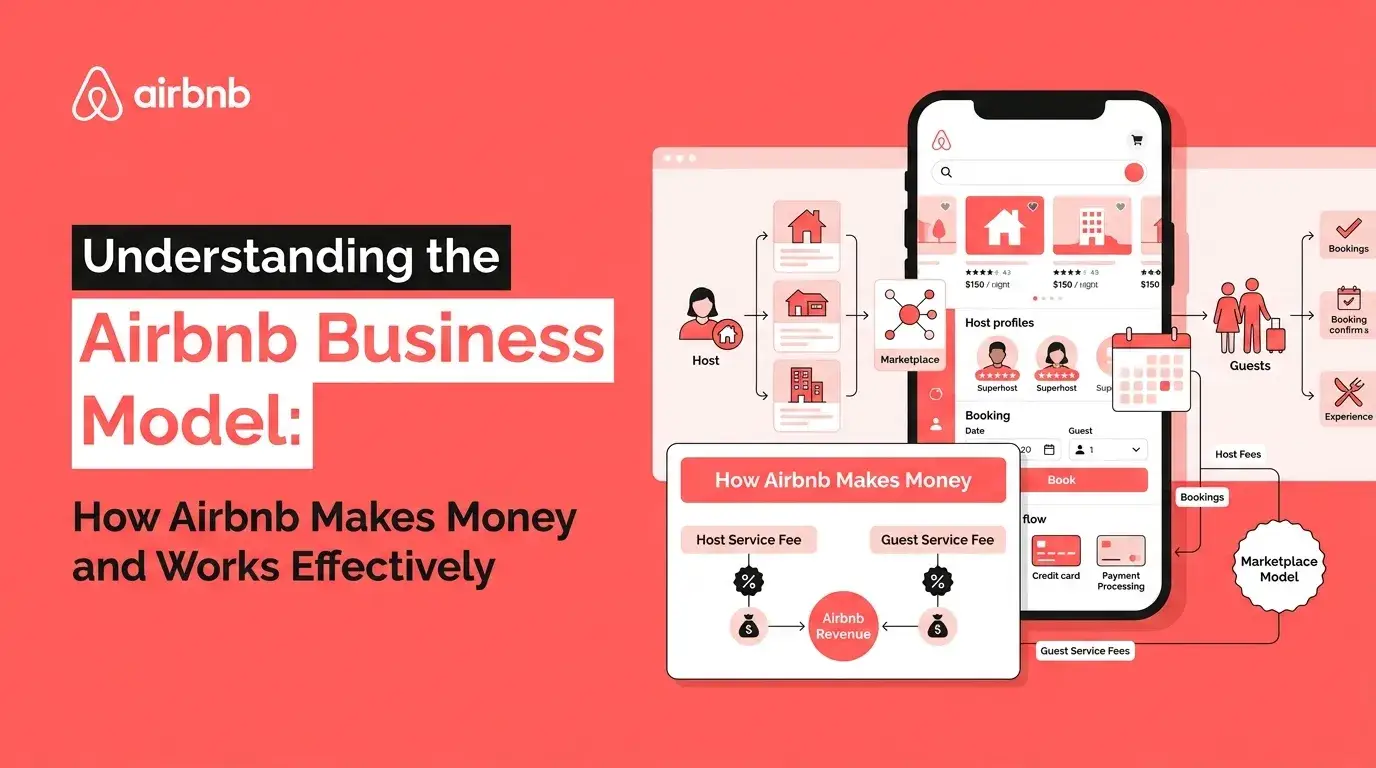
The Airbnb business model has changed how travelers discover accommodation and how property owners earn from homes, apartments, villas, and other spaces. Instead of building and operating hotels, Airbnb runs a digital marketplace that connects guests looking for places to stay with hosts who have properties or rooms to offer.
Airbnb provides the technology and operational framework required to make these transactions possible. Its platform supports property discovery, availability, booking, payments, communication, reviews, identity checks, customer support, and dispute handling.
This asset-light structure has made Airbnb an important business-model case study for founders. It demonstrates how a marketplace can create value without owning most of the inventory being sold.
Founders who are moving from business-model research to product planning can also explore how an Airbnb-style vacation rental platform brings guest, host, property, booking, payment, commission, and admin workflows together.
This guide explains how the Airbnb business model works, how Airbnb makes money, which challenges the platform must manage, and what entrepreneurs can learn when planning a vacation rental marketplace.
What Is the Airbnb Business Model?
The Airbnb business model is a peer-to-peer marketplace model that connects people who have accommodation to offer with travelers searching for a place to stay.
Hosts create property listings containing information such as:
- Property descriptions
- Photographs
- Location
- Amenities
- Availability
- Pricing
- House rules
- Cancellation terms
- Guest capacity
Travelers can search these listings by entering their destination, travel dates, number of guests, price range, preferred amenities, and property type.
Airbnb does not act like a traditional hotel company that owns, maintains, and operates most of its accommodation inventory. Instead, it provides the marketplace infrastructure that allows independent hosts and guests to find one another and complete bookings.
This structure allows the platform to expand its available inventory without purchasing or constructing every property listed on the marketplace.
How Does the Airbnb Business Model Function?
The model works through a sequence of connected marketplace activities:
- A host registers on the platform.
- The host creates a property listing.
- The platform collects information about availability, pricing, amenities, and booking rules.
- A traveler searches for accommodation.
- The platform displays relevant properties based on the traveler’s criteria.
- The traveler reviews property details, ratings, pricing, and policies.
- The traveler submits a booking request or completes an instant booking.
- The platform processes the payment.
- The host receives the reservation information.
- The guest completes the stay.
- The platform manages the payout according to its payment rules.
- Hosts and guests may leave reviews after the transaction.
Airbnb creates value by reducing the friction involved in each of these steps. Without a marketplace, hosts would need to market properties, manage inquiries, process payments, build trust, and handle reviews independently.
The platform combines these activities into one booking ecosystem.
What Are the Core Components of the Airbnb Business Model Canvas?
The Airbnb business model canvas can be understood through the following components.
| Business Model Component | Airbnb Application |
|---|---|
| Value proposition | Diverse accommodation, flexible booking, local experiences, and an accessible way for hosts to earn from property |
| Customer segments | Leisure travelers, business travelers, families, groups, long-stay guests, property owners, and professional hosts |
| Key partners | Hosts, payment providers, technology providers, support partners, local service providers, and professional property managers |
| Key activities | Marketplace development, booking management, payment processing, trust and safety, marketing, customer support, and product improvement |
| Key resources | Brand, platform technology, host inventory, guest demand, payment infrastructure, data, and marketplace trust |
| Customer relationships | Self-service booking, support, messaging, reviews, host tools, notifications, and personalized recommendations |
| Channels | Website, mobile applications, search engines, direct traffic, digital marketing, referrals, and partnerships |
| Revenue streams | Transaction-related service fees and fees from additional services or experiences |
| Cost structure | Product development, cloud infrastructure, payment processing, customer support, marketing, fraud prevention, insurance-related programs, and regulatory operations |
The strength of the model comes from the way these components reinforce one another.
More hosts create more accommodation choices. More choices can attract more travelers. More traveler activity can encourage additional hosts to join. This creates a marketplace network effect.
How Does Airbnb Connect Travelers With Hosts?
Airbnb connects travelers with hosts through search, property discovery, booking, communication, payment, and review tools.
A traveler normally begins by entering:
- Destination
- Check-in and check-out dates
- Number of guests
- Property type
- Preferred amenities
- Budget
- Accessibility requirements
- Booking preferences
The platform then displays relevant properties. Each listing may include photographs, descriptions, host details, previous guest reviews, house rules, cancellation conditions, pricing, and availability.
Travelers can compare listings and communicate with hosts before making a reservation. Messaging helps users clarify questions about the property, check-in, facilities, location, or specific travel requirements.
After a reservation is completed, the same ecosystem supports booking updates, reminders, check-in information, payment records, customer support, and reviews.
The value is not simply the property listing. It is the coordinated transaction experience surrounding that listing.
Why the Airbnb Marketplace Model Can Scale
Traditional accommodation companies often need to invest in properties, furniture, staff, utilities, maintenance, and local operations before expanding into a new market.
A digital marketplace follows a different growth model.
Airbnb can increase the number of available properties by attracting more independent hosts. The platform still incurs significant technology, support, marketing, risk, and compliance costs, but it does not need to own every property offered to guests.
This creates several scaling advantages:
- Inventory can be supplied by independent property owners.
- The platform can enter multiple locations without constructing hotels.
- Hosts can provide different property types and price points.
- Marketplace data can improve search and personalization.
- Technology can standardize many booking and payment activities.
- A single platform can support different traveler and host segments.
However, an asset-light model is not an effort-light model. As the marketplace grows, it must manage more listings, users, payments, disputes, reviews, regulations, and safety concerns.
The technology layer must therefore scale together with the operational layer.
Read More: What is Airbnb App and How Does It Work?
How Does Airbnb Make Money?
Airbnb primarily makes money by charging fees connected to transactions completed through its platform.
The platform creates the environment in which guests can discover accommodation, communicate with hosts, make payments, manage reservations, and receive support. Airbnb earns when it successfully facilitates these transactions.
The exact fee structure can vary according to the host arrangement, booking type, location, and product category. Current percentages should therefore be checked through Airbnb’s official service-fee documentation rather than treated as universal.
Main Airbnb Revenue Streams
| Revenue Stream | How It Works | Business Value |
|---|---|---|
| Home booking service fees | Airbnb collects fees connected to accommodation bookings completed through the platform | Revenue grows with marketplace transaction activity |
| Airbnb Experiences | Hosts can offer activities and experiences that users book through the platform | Expands the platform beyond accommodation |
| Airbnb Services | Users can book selected professional or hospitality-related services | Increases the number of transactions within the travel journey |
| Additional travel offerings | Airbnb can connect users with adjacent trip-related products and services | Creates opportunities to increase customer value and retention |
| Host ecosystem services | Booking, payment, support, communication, and trust tools help hosts operate | Strengthens the value supporting the platform’s transaction fees |
The central lesson is that marketplace revenue depends on transaction quality.
A platform may charge a commission, guest fee, host fee, or a combination of revenue streams. However, users will only accept those fees when the marketplace delivers enough value.
That value may include:
- Access to demand
- Secure payment processing
- Search and discovery
- Booking management
- Customer support
- Host–guest communication
- Fraud-reduction measures
- Review systems
- Cancellation management
- Dispute resolution
A fee without supporting marketplace value creates resistance. A fee connected to a trusted and convenient transaction is easier for users to understand.
How Does Airbnb Charge Service Fees?
Airbnb’s service-fee structure depends on factors such as the type of host, the selected fee arrangement, the booking, and the service category.
In some cases, the fee may be divided between the host and guest. In other cases, a larger portion may be deducted from the host payout.
Service and experience reservations may also follow different fee structures from home bookings.
For this reason, founders should not copy a percentage without considering their own economics. A new marketplace should calculate:
- Customer-acquisition cost
- Payment-processing cost
- Refund and dispute cost
- Host-support cost
- Guest-support cost
- Taxes
- Insurance or protection expenses
- Marketing cost
- Platform operating cost
- Desired contribution margin
The commission should support a sustainable business while remaining acceptable to both sides of the marketplace.
What Role Do Property Owners Play in the Airbnb Revenue Model?
Property owners and professional managers provide the accommodation inventory that makes the marketplace useful.
Hosts may list:
- Private rooms
- Apartments
- Houses
- Villas
- Cabins
- Holiday homes
- Farm stays
- Boutique properties
- Long-stay accommodation
- Unique or specialist properties
The quality, availability, location, and variety of these listings directly affect the platform’s appeal.
Hosts benefit by gaining access to traveler demand, booking tools, payment processing, communication features, and reputation systems. In return, the platform gains inventory and earns revenue when bookings occur.
This relationship is mutually dependent.
Without enough hosts, travelers have limited choice. Without enough traveler demand, hosts have little reason to remain active. A successful marketplace must attract and retain both groups.
Read More: How the World’s Largest Home-Sharing Platform Makes Money
What the Airbnb Model Teaches Founders Building a Rental Marketplace

The strongest startup opportunity is usually not to reproduce Airbnb’s entire global platform.
A founder can apply the same marketplace principles to a more focused customer group, property category, location, or operational problem.
Potential niches include:
- Corporate accommodation
- Employee relocation
- Student housing
- Long-term furnished rentals
- Luxury villas
- Rural tourism
- Farm stays
- Pet-friendly accommodation
- Accessible accommodation
- Religious or community travel
- Event and production spaces
- Medical-travel accommodation
- Professionally managed holiday homes
- Verified stays for solo travelers
- Regional tourism marketplaces
The niche should influence the product architecture, not only the marketing.
For example, a corporate accommodation platform may need:
- Company accounts
- Approval workflows
- Centralized billing
- Employee travel policies
- Long-stay discounts
- Reporting
- Invoice management
A luxury villa platform may need:
- Property inspection
- Request-based booking
- Concierge services
- Security deposits
- Premium host onboarding
- High-value payment controls
A student housing marketplace may need:
- Document verification
- Longer rental durations
- Recurring payments
- Guarantor information
- University-based search
- Contract workflows
Before deciding which features to develop, founders should answer several business questions:
- Who will supply the properties?
- Which traveler segment is most valuable?
- What problem does the marketplace solve better than existing platforms?
- Which market will be launched first?
- How will hosts be acquired?
- How will travelers be acquired?
- What trust problem must the platform solve?
- How will the business make money?
- What activities must the admin team control?
- Which local rental, tax, and payment requirements apply?
A ready-made platform can provide an initial product foundation, but it cannot replace business-model clarity.
The founder must still define the niche, value proposition, operating model, pricing strategy, acquisition plan, and market differentiation.
Turn Your Airbnb Business Model Into a Launch-Ready Platform
Blueground offers greater inventory control, while Airbnb scales through hosts and marketplace effects. Review the guest experience, host management, property listings, booking workflows, payments, commissions, admin controls, branding, and launch scope before choosing the right model for your startup.
What Challenges Does the Airbnb Business Model Face?
The Airbnb model creates significant marketplace opportunities, but it also introduces operational, legal, financial, and trust-related challenges.
The platform must balance the interests of:
- Guests
- Individual hosts
- Professional property managers
- Local communities
- Regulators
- Payment partners
- Support teams
- Insurance providers
- Investors
A policy that benefits one group may create friction for another. For example, strict cancellation protection may reassure guests but create revenue uncertainty for hosts. Flexible listing rules may increase inventory but create quality-control problems.
Marketplace operators must therefore make deliberate tradeoffs.
What Challenges Do Airbnb Hosts Face?
Hosts may face several challenges while operating short-term rental properties.
Competition
Popular destinations may have many similar listings. Hosts must compete through pricing, property quality, location, photography, amenities, reviews, and guest service.
Changing demand
Travel demand can change according to season, local events, economic conditions, weather, and transportation availability.
Local regulation
Short-term rental regulations can vary by city, state, or country. Hosts may need permits, registrations, tax arrangements, safety measures, or local approvals.
Property maintenance
Guests expect the property to match its photographs and description. Hosts must manage cleaning, repairs, supplies, check-in, and communication.
Pricing decisions
Hosts need to balance occupancy and nightly rates. Prices that are too high may reduce bookings, while prices that are too low may damage profitability.
Guest behavior
Hosts may experience property misuse, unauthorized guests, noise complaints, rule violations, or damage.
Review pressure
Negative reviews can influence future bookings. Hosts must provide consistent service while also managing unrealistic expectations.
A marketplace should provide tools that help hosts manage these issues efficiently.
How Does Airbnb Manage Accommodation Quality?
Quality management in a decentralized marketplace is more difficult than in a hotel chain because properties are operated by independent hosts.
Airbnb uses several marketplace mechanisms to support quality, including:
- Property information and photographs
- Host profiles
- Guest reviews
- Host reviews of guests
- Listing standards
- Verification processes
- Customer-support workflows
- Complaint handling
- Refund or rebooking processes
- Search-ranking signals
- Guest-favorite or quality-recognition systems
Reviews are especially important because they create a visible history of previous transactions.
However, reviews alone are not sufficient. A rental marketplace may also need manual listing approval, document verification, property inspections, moderation, suspicious-activity monitoring, and complaint escalation.
The appropriate quality-control process depends on the platform’s niche.
A budget accommodation marketplace may prioritize listing accuracy and safety. A luxury marketplace may require professional photography and property inspections. A student-housing platform may require landlord documentation and contract validation.
What Risks Do Property Owners Face?
Property owners can face:
- Property damage
- Theft
- Unauthorized parties
- Noise complaints
- Neighbor disputes
- Payment disputes
- Refund requests
- Fraudulent reservations
- Local-law violations
- Liability claims
- Unexpected maintenance
- Loss of availability caused by cancellations
Airbnb currently provides protections through AirCover for Hosts, which includes several host-focused protection and verification measures subject to its terms and limitations.
Hosts should still understand that platform protection is not necessarily a replacement for personal insurance, commercial insurance, local legal advice, or property-management procedures.
A new vacation rental marketplace should be equally careful with its wording. It should not promise unlimited protection unless verified insurance and legal arrangements support that claim.
Read More: Airbnb App Marketing Strategy: How to Make Your Rental App Unforgettable
How Does Airbnb Operate in the Market?
Airbnb operates as a technology-enabled marketplace rather than a traditional accommodation provider.
Its main operational responsibilities include:
- Maintaining the platform
- Managing search and discovery
- Processing payments
- Supporting hosts and guests
- Managing trust and safety
- Handling disputes
- Preventing fraud
- Monitoring marketplace activity
- Developing host tools
- Improving the guest experience
- Supporting regulatory requirements
- Marketing the platform
- Expanding into new services
The operational burden increases as the marketplace grows. More users create more transactions, but they also create more support requests, disputes, fraud attempts, payment issues, and policy decisions.
What Is Airbnb’s Cost Structure?
Airbnb’s cost structure differs from that of a hotel company, but it is still substantial.
Major cost categories include:
Technology development
The company must continuously develop its website, mobile applications, search tools, payment systems, messaging, host tools, recommendation systems, support systems, and internal infrastructure.
Cloud and data infrastructure
A large marketplace requires scalable hosting, databases, file storage, analytics, monitoring, security, backups, and content delivery.
Payment processing
Every booking can involve payment-gateway fees, currency conversion, refunds, payout processing, chargebacks, and financial reconciliation.
Customer support
Airbnb must support users before, during, and after bookings. Support may include cancellations, refunds, rebooking, safety issues, account access, host questions, and disputes.
Trust and safety
The platform invests in identity verification, fraud prevention, reservation screening, moderation, policy enforcement, and risk management.
Marketing
Airbnb needs to acquire guests, attract hosts, build brand awareness, and defend its position against hotels and competing marketplaces.
Insurance and protection programs
Host and guest protection measures can introduce insurance, claims, administration, and risk-management costs.
Regulatory operations
Short-term rental requirements differ between markets. The platform must monitor local rules and support tax, reporting, and policy obligations where applicable.
Airbnb’s asset-light model reduces the need to own accommodation inventory, but it does not remove the cost of running a trusted global marketplace.
Airbnb Business Model vs. Traditional Hotels
| Area | Airbnb Marketplace | Traditional Hotel |
|---|---|---|
| Property ownership | Most properties are supplied by independent hosts | Hotel company or operator controls the property |
| Accommodation types | Rooms, apartments, houses, villas, cabins, and unique stays | Mainly standardized rooms and suites |
| Inventory expansion | Attract additional hosts and listings | Build, buy, lease, franchise, or manage additional properties |
| Revenue model | Transaction-related marketplace fees | Room charges and on-property services |
| Customer experience | Varies by host and property | More standardized service model |
| Operations | Distributed across independent hosts | Managed through hotel employees and operating procedures |
| Trust system | Reviews, profiles, verification, support, and platform policies | Hotel brand, staff, service standards, and physical management |
| Pricing | Controlled by hosts within platform rules | Controlled by the hotel or property operator |
| Local experience | Often connected to residential areas and host recommendations | Often centered around hotel services and tourism infrastructure |
| Scalability | Can add inventory without owning every property | Expansion usually requires significant property investment |
Neither model is automatically better in every situation.
Hotels may provide more predictable service and operational control. Vacation rentals may provide greater variety, space, local character, and flexibility.
Travelers choose according to the purpose of the trip, required amenities, group size, budget, location, and desired level of service.
Why Do Some Business Travelers Use Vacation Rentals?
Business travelers may choose vacation rentals when they need:
- More space
- Kitchen facilities
- Longer stays
- Accommodation for teams
- Residential locations
- Separate work areas
- Laundry facilities
- Flexible check-in
- A home-like environment
Corporate accommodation also creates a distinct product opportunity.
A platform serving companies may need features such as:
- Business accounts
- Employee profiles
- Approval workflows
- Central billing
- Travel-policy controls
- Reporting
- Tax invoices
- Extended-stay pricing
- Account management
- Duty-of-care information
This illustrates why founders should define the audience before deciding the feature set.
Read More: Airbnb Like App: Revolutionizing Travel Experience and Rental Platform Opportunities
Why App Development Is Central to Airbnb’s Success
Airbnb’s marketplace would not function effectively without a reliable technology layer.
The platform must support several complex activities in a simple user experience:
- Searching thousands of listings
- Filtering properties
- Displaying availability
- Managing multiple time zones
- Calculating prices
- Processing payments
- Sending notifications
- Supporting host–guest messaging
- Displaying maps
- Managing cancellations
- Collecting reviews
- Handling refunds
- Updating calendars
- Preventing conflicting bookings
Users generally see a simple search and booking flow. Behind that experience are multiple systems coordinating inventory, availability, payments, communication, identity, policies, and support.
This is why app development is not only a design exercise. It is the product foundation of the marketplace.
Founders researching implementation can also review this guide on how to build a vacation rental website like Airbnb.
Core Features of a Vacation Rental Marketplace

A scalable rental marketplace normally requires separate experiences for guests, hosts, and administrators.
Guest App or User Panel
The guest experience should help travelers move from discovery to booking with minimal friction.
Core guest capabilities may include:
- User registration
- Profile management
- Destination search
- Map-based discovery
- Date selection
- Guest-count selection
- Property filters
- Property details
- Photographs
- Amenities
- Host information
- Availability calendar
- Pricing breakdown
- Booking request
- Instant booking
- Secure payment
- Host messaging
- Booking history
- Cancellation request
- Saved properties
- Ratings and reviews
- Notifications
- Support access
The booking flow should make the total price, policies, and important property rules clear before payment.
Host App or Host Dashboard
Hosts need tools for managing properties and reservations.
Core host capabilities may include:
- Host registration
- Identity or document verification
- Property creation
- Image upload
- Amenities management
- Location details
- Availability calendar
- Nightly pricing
- Seasonal pricing
- Minimum-stay settings
- Cancellation policies
- Booking approval
- Instant-booking controls
- Guest messaging
- Reservation management
- Earnings overview
- Payout records
- Review management
- Notifications
- Property-performance information
A weak host experience can restrict inventory growth. If listing and managing a property is difficult, hosts may stop using the marketplace.
Admin Panel
The admin panel is the operational control center of the business.
It can help the platform operator manage:
- Guests
- Hosts
- Properties
- Listing approvals
- Bookings
- Cancellations
- Refunds
- Transactions
- Host payouts
- Platform commissions
- Disputes
- Reviews
- Reports
- Customer support
- Notifications
- Content pages
- Promotional campaigns
- User access
- Staff permissions
- Platform settings
Admin control matters because marketplace policies change.
A founder may need to adjust commission rates, approve a listing, suspend an account, issue a refund, investigate a complaint, review payment records, or update content without waiting for a development team.
The more routine activities administrators can safely manage themselves, the easier the platform is to operate.
Feature-to-Business-Value Table
| Feature | Business Value | Founder Impact |
|---|---|---|
| Advanced property search | Helps guests find relevant inventory quickly | Can improve discovery and booking conversion |
| Availability calendar | Reduces booking conflicts | Improves operational reliability |
| Secure payment integration | Supports trusted transactions | Creates a foundation for platform revenue |
| Host dashboard | Helps hosts manage properties and bookings | Supports inventory growth and host retention |
| Guest–host messaging | Reduces uncertainty before and after booking | Can lower support pressure |
| Ratings and reviews | Builds visible marketplace trust | Helps users evaluate unfamiliar hosts and guests |
| Admin commission controls | Allows revenue rules to be managed | Gives the founder flexibility to test monetization |
| Listing approval | Helps maintain marketplace quality | Reduces low-quality or misleading inventory |
| Dispute management | Creates a structured resolution process | Protects marketplace reputation |
| Reports and analytics | Shows booking, revenue, and user activity | Supports better operating decisions |
| Multi-language support | Makes the platform accessible to more users | Supports regional expansion |
| Multi-currency support | Simplifies cross-border transactions | Helps serve international markets |
| Notifications | Keeps users informed about booking activity | Reduces missed actions and confusion |
| Role-based access | Limits internal access according to responsibility | Strengthens operational security |
How Can a Vacation Rental Marketplace Make Money?
A new platform does not need to copy Airbnb’s exact revenue structure.
The right monetization model depends on the target users, transaction value, market competition, and operating cost.
Host Commission
The platform deducts a percentage or fixed amount from the host payout after a completed booking.
This model aligns revenue with transaction activity. However, the host must understand what value the commission provides.
Guest Service Fee
The platform adds a fee to the guest’s booking total.
This can increase platform revenue but may also increase the displayed checkout price. Fee transparency is important.
Split Fee
A portion of the marketplace fee is collected from the guest and another portion from the host.
This spreads the fee between both sides but can make pricing more difficult to explain.
Host Subscription
Professional hosts or property managers pay a recurring fee for access to the platform or advanced tools.
Subscription plans may include:
- More listings
- Advanced analytics
- Staff accounts
- Automated pricing
- Priority support
- Calendar integrations
- Featured placement
Featured Listings
Hosts pay to increase the visibility of selected properties.
Featured placement should be clearly disclosed so users can distinguish promotional results from organic recommendations.
Listing Fees
The platform charges hosts to publish or renew properties.
This may create early revenue but can make host acquisition more difficult when the marketplace has limited demand.
Property-Management Services
The platform may offer or coordinate:
- Cleaning
- Photography
- Property inspection
- Guest communication
- Check-in management
- Maintenance
- Pricing support
These services can create additional revenue but require stronger operations.
Related Travel Services
A mature marketplace may add:
- Experiences
- Airport transfers
- Car rentals
- Grocery delivery
- Concierge services
- Travel insurance integrations
- Local services
Adjacent services should support the core trip rather than distract from the primary booking experience.
Read More: Reasons startups choose our Airbnb clone over custom development
Trust, Security, and Operational Control
Security should be treated as part of the platform foundation, not as a promotional add-on.
Guests need confidence that listings are genuine and payments are handled safely. Hosts need confidence that users can be identified, bookings are recorded, and disputes can be reviewed.
A practical vacation rental platform should consider:
- Secure user authentication
- Encrypted data transfer
- Encrypted data storage
- Secure payment-gateway integration
- Tokenized payment methods where supported
- Guest verification
- Host verification
- Property-document verification
- Listing approval
- Role-based admin access
- Activity logs
- Transaction histories
- Booking histories
- Suspicious-activity monitoring
- Fraud signals
- Review moderation
- Abuse reporting
- Refund workflows
- Dispute management
- Account suspension controls
- Backup and recovery procedures
- Privacy-conscious data handling
The appropriate controls depend on the country, business model, payment provider, property category, and customer base.
A technology provider can create a compliance-ready foundation and support required workflows. Final compliance still depends on local law, legal review, integrations, data practices, insurance arrangements, and the operating model.
Read More: How Our Airbnb Clone Prevents Calendar Deadlocks and Double-Bookings
What Affects the Cost of Building a Vacation Rental Platform?

The cost of building an app like Airbnb depends on the required scope rather than the name of the reference platform.
The main cost drivers include the following.
Number of User Roles
A basic product may have guest, host, and admin roles. More complex platforms may also require:
- Property managers
- Corporate accounts
- Support agents
- Inspectors
- Cleaning providers
- Concierge partners
- Affiliate partners
Each role introduces additional screens, permissions, workflows, and testing.
Number of Platforms
The product may include:
- Web platform
- Android app
- iOS app
- Host application
- Guest application
- Admin dashboard
More platforms require more development, testing, deployment, and maintenance.
Booking Logic
Cost increases when the platform needs:
- Instant booking
- Request-based booking
- Hourly booking
- Nightly booking
- Monthly rental
- Recurring stays
- Group bookings
- Split payments
- Deposits
- Partial payments
- Negotiated pricing
Payment and Payout Integrations
A marketplace may require:
- Guest payment collection
- Platform commission deduction
- Host payouts
- Refunds
- Partial refunds
- Currency conversion
- Tax calculation
- Invoice generation
- Payment reconciliation
The complexity depends on the selected payment provider and country.
Third-Party Integrations
Common integrations may include:
- Maps
- Geolocation
- Payment gateways
- Identity verification
- SMS
- Push notifications
- Analytics
- Customer-support tools
- Calendar synchronization
- Cloud storage
Third-party services may also create recurring usage costs after launch.
Customization
Customization may involve:
- Branding
- Color system
- Navigation
- User-interface changes
- Booking rules
- Commission logic
- Property categories
- Search filters
- Payment methods
- Verification processes
- Local languages
- Currencies
- Tax rules
- Admin permissions
Infrastructure
The platform needs hosting, databases, media storage, backups, monitoring, security, and scalable APIs.
Infrastructure cost can increase with traffic, listing photographs, search volume, messaging activity, and transaction volume.
For a deeper budgeting explanation, review the Airbnb-style app development cost guide.
Final pricing should be confirmed against the selected modules, integrations, branding requirements, platforms, and support scope.
What Is the Typical Launch Process?
A structured launch process helps founders avoid building features before the business rules are clear.
Step 1: Define the Target Market
Decide:
- Launch country or city
- Traveler segment
- Host segment
- Property type
- Rental duration
- Initial supply strategy
Step 2: Finalize the Business Model
Define:
- Commission
- Guest fees
- Host fees
- Subscription options
- Refund policies
- Cancellation rules
- Payout schedule
- Dispute policy
Step 3: Map the User Workflows
Document the journey for:
- Guest registration
- Host onboarding
- Property listing
- Listing approval
- Search
- Booking
- Payment
- Payout
- Cancellation
- Refund
- Review
- Dispute
Step 4: Select the Product Approach
Choose between:
- Custom development
- Ready-made foundation
- Hybrid customization
Step 5: Configure Branding and Features
Apply:
- Brand identity
- Colors
- Logo
- Property categories
- Filters
- Booking rules
- Payment provider
- Notifications
- Admin permissions
Step 6: Test the Complete Transaction
Testing should cover the full journey rather than isolated screens.
Important test scenarios include:
- Successful booking
- Failed payment
- Date conflict
- Booking cancellation
- Partial refund
- Host rejection
- Listing approval
- User suspension
- Dispute escalation
- Host payout
- Notification failure
Step 7: Onboard Initial Supply
A marketplace should not launch with empty search results.
Founders need an initial host-acquisition plan involving direct outreach, property managers, local partnerships, or a focused regional launch.
Step 8: Launch and Measure
Track:
- Host registrations
- Approved listings
- Search-to-property-view rate
- Property-view-to-booking rate
- Booking completion
- Cancellation rate
- Average booking value
- Platform revenue
- Repeat booking
- Host retention
- Support volume
- Dispute rate
The first release should create enough value to complete real transactions and generate reliable market feedback.
Ready-Made Platform vs. Custom Development
| Decision Area | Ready-Made Foundation | Custom Development |
|---|---|---|
| Starting point | Existing marketplace workflows | Product built from the beginning |
| Launch speed | Faster when the required workflow already exists | Longer because discovery, design, development, and testing begin from zero |
| Initial cost logic | More cost-efficient for standard marketplace modules | Higher when extensive custom engineering is required |
| Customization | Branding, rules, integrations, and selected workflows can be configured | Maximum flexibility |
| Product risk | Core flows may already be tested | More technical and product assumptions must be validated |
| Best suited for | Founders seeking faster market validation | Businesses with highly specialized requirements |
| Ownership | Depends on provider and commercial terms | Depends on the development agreement |
| Maintenance | Existing product updates may be available | Business is responsible for the complete product roadmap |
Miracuves offers a ready-made, white-label vacation rental foundation with source code, guest and host workflows, admin control, rebranding, and customization. Eligible ready-made configurations may follow a six-day deployment path, while final timing depends on integrations and customization scope.
The important decision is not simply which option is faster. It is which option provides enough control, differentiation, ownership, and scalability for the intended business.
How Should a Vacation Rental Platform Be Customized?
Customization should begin with the business model rather than visual design alone.
Changing the logo and colors creates a branded interface, but it does not create a differentiated marketplace.
A platform can be customized around:
Property Type
Examples include:
- Villas
- Apartments
- Cabins
- Student housing
- Farm stays
- Corporate accommodation
- Luxury properties
- Long-term rentals
Booking Model
The platform may support:
- Instant booking
- Host approval
- Inquiry before booking
- Hourly booking
- Nightly booking
- Weekly booking
- Monthly booking
Pricing Logic
Options may include:
- Fixed nightly price
- Seasonal pricing
- Weekend pricing
- Long-stay discounts
- Last-minute discounts
- Extra-guest fees
- Cleaning charges
- Negotiated rates
Revenue Model
The platform can configure:
- Host commission
- Guest fee
- Split fees
- Subscriptions
- Featured listings
- Property-management fees
- Service commissions
Host Verification
Verification may involve:
- Identity documents
- Business documents
- Property ownership
- Rental authorization
- Bank details
- Property inspection
Regional Requirements
Customization may include:
- Local language
- Local currency
- Regional payment methods
- Taxes
- Rental permits
- Invoice formats
- Cancellation rules
- Data-storage requirements
Additional Services
A platform may add:
- Cleaning
- Photography
- Concierge
- Airport transfers
- Car rentals
- Local experiences
- Grocery delivery
- Property management
Every customization should support at least one business outcome:
- Better acquisition
- Higher booking conversion
- Stronger trust
- Improved retention
- More revenue
- Lower operational effort
- Better market differentiation
Read More: How Airbnb Makes Money: The Complete Business Model Behind the Short-Term Rental Giant
What Is the Future of the Airbnb Business Model?
Airbnb’s model continues to move beyond basic property booking.
The platform has expanded its customer journey through Homes, Experiences, Services, and additional travel-related offerings. Airbnb’s 2026 product release also highlighted areas such as car rentals, airport pickups, grocery delivery, boutique hotels, and expanded experiences.
This indicates a broader strategic direction: becoming part of more stages of the trip.
For founders, the lesson is not to launch every travel service from the first day.
A stronger approach is:
- Build a reliable core booking transaction.
- Establish enough property supply.
- Attract a focused traveler segment.
- Improve trust and operational consistency.
- Study customer demand.
- Add adjacent services with clear business value.
Expansion should follow demonstrated demand and operational readiness.
How Could AI Influence Vacation Rental Platforms?
AI may support:
- Personalized property recommendations
- Search-result ranking
- Dynamic pricing suggestions
- Fraud detection
- Customer-support assistance
- Listing-description improvement
- Image moderation
- Review analysis
- Demand forecasting
- Host-performance insights
AI should support user decisions rather than hide important pricing or policy information.
A marketplace should still provide transparency, human escalation, and administrator control.
Why Will Trust Remain Important?
As marketplaces expand, users face more listings, hosts, services, and transaction types.
Trust mechanisms will continue to influence:
- Booking conversion
- Host retention
- Guest retention
- Platform reputation
- Regulatory confidence
- Payment-provider relationships
- Dispute costs
Marketplaces that grow without strengthening verification, moderation, support, and administrative controls can create larger operational risks.
Are There Alternatives to Airbnb?
Yes. Several platforms compete with Airbnb directly or serve specific rental-market segments.
Vrbo
Vrbo is strongly associated with whole-home vacation rentals and family or group travel.
Booking.com
Booking.com combines hotel inventory with apartments, holiday homes, and other accommodation categories.
Tujia
Tujia serves the Chinese travel market and adapts its product to local users, property supply, and market requirements.
FlipKey
FlipKey is associated with vacation rentals and traveler-review ecosystems.
Specialist Marketplaces
Other businesses focus on:
- Luxury properties
- Long-term furnished stays
- Student housing
- Corporate travel
- Rural tourism
- Home exchanges
- Pet-friendly stays
- Accessible travel
These competitors show that a platform does not need to serve every traveler.
A focused marketplace may compete through better specialization, stronger inventory, local partnerships, verification, or operational service.
For a more detailed comparison, see these vacation rental apps like Airbnb.
How Do Airbnb Alternatives Differentiate Themselves?
Rental marketplaces can differentiate through:
- Target audience
- Property category
- Geographic specialization
- Booking duration
- Host requirements
- Verification standards
- Pricing model
- Customer support
- Property-management services
- Community positioning
- Corporate tools
- Loyalty programs
Differentiation should be visible in the product experience.
For example, a marketplace claiming to serve accessible travel should include detailed accessibility filters and verified property information. A marketplace serving corporate travelers should provide billing and policy controls. A luxury marketplace should create stronger property-review and service workflows.
A generic product with generic inventory will struggle to create a clear reason for users to switch.
Mistakes Founders Should Avoid
Trying to Serve Every Market Immediately
Launching across too many cities or property categories can create empty inventory and inconsistent operations.
Start with a market narrow enough to build meaningful supply and demand.
Building Features Before Defining the Revenue Model
Commission, payouts, refunds, and cancellation rules affect core product architecture. They should not be postponed until the final development stage.
Ignoring the Admin Panel
The customer-facing design may attract attention, but the admin panel controls the actual business.
Without strong admin tools, the team may struggle to manage users, listings, transactions, disputes, and policies.
Launching Without Initial Property Supply
Travelers cannot book a marketplace with no relevant inventory.
Host acquisition must begin before the public launch.
Copying Airbnb Without Differentiation
Airbnb already has brand recognition, inventory, reviews, and customer demand.
A new business needs a specific market advantage rather than a smaller copy of the same proposition.
Treating Security as a Later Feature
Payment, verification, access control, and activity records should be planned from the beginning.
Overcomplicating the First Release
Features should support the core transaction. Complex add-ons can be introduced after the platform proves demand and operating capability.
Using Unsupported Legal or Insurance Claims
Do not claim that the platform is fully compliant everywhere or that every transaction is insured unless verified agreements and legal analysis support those statements.
Final Thoughts: Build Around the Marketplace Opportunity
The real strength of the Airbnb business model is not the appearance of its application.
Its strength comes from coordinating several marketplace layers:
- Property supply
- Traveler demand
- Search and discovery
- Booking
- Payment
- Communication
- Reviews
- Trust
- Support
- Administrative control
Founders can apply these principles without building a direct copy of Airbnb.
The stronger opportunity is to select a focused market, solve a specific accommodation problem, attract the right property supply, design a sustainable revenue model, and create enough operational control to support growth.
A ready-made foundation can reduce the need to develop every standard marketplace workflow from zero. However, the long-term success of the business will still depend on positioning, supply acquisition, customer experience, trust, monetization, and execution.
Miracuves helps founders turn these decisions into a branded, source-code-owned vacation rental platform with guest, host, booking, payment, monetization, and admin workflows aligned with the selected market.
FAQs
What is the Airbnb business model?
Airbnb operates a two-sided marketplace connecting property hosts with travelers. It provides the search, booking, payment, communication, review, support, and trust infrastructure needed to complete accommodation transactions.
How does Airbnb make money?
Airbnb primarily earns revenue from fees connected to bookings and other transactions completed through its platform. The exact fee arrangement varies according to the host, booking, market, and service category.
Does Airbnb own the properties listed on its platform?
Airbnb does not own most of the accommodation available through its marketplace. Independent property owners and managers provide the listings, while Airbnb provides the digital marketplace and transaction infrastructure.
What revenue models can a vacation rental marketplace use?
A rental marketplace can use host commissions, guest service fees, split fees, host subscriptions, listing fees, featured-property placements, property-management services, and commissions from related travel services.
What features are essential for an app like Airbnb?
Important features include user registration, host onboarding, property listings, location search, availability calendars, booking management, secure payments, messaging, cancellations, reviews, notifications, and an admin panel.
How can a startup differentiate itself from Airbnb?
A startup can focus on a particular region, property category, traveler segment, rental duration, service level, or verification standard. Examples include corporate stays, student housing, accessible accommodation, luxury villas, rural tourism, and long-term furnished rentals.
Check out our popular rental app solutions offered by Miracuves – built for versatility, performance, and scale:
- Airbnb Style Platform – A powerful platform like rental app for booking stays, ordering food, hailing rides, making payments and more.
- Zillow Style Platform – A powerful property listing solution inspired by Zillow, offering advanced search filters, map-based browsing, and real-time updates for buyers, sellers, and renters.
- Blueground Style Platform– An inspired platform like Blueground for booking fully furnished, long-term rentals through an easy-to-use app built for modern.
- Buildium Style Platform – An all-in-one app like Buildium for property managers and landlords to handle rentals, payments, maintenance and more.
- Dream Yacht Charter Style Platform – A platform like yacht booking we have Dream Yacht Charter that lets users easily reserve bareboat or crewed charters.