


Key Takeaways
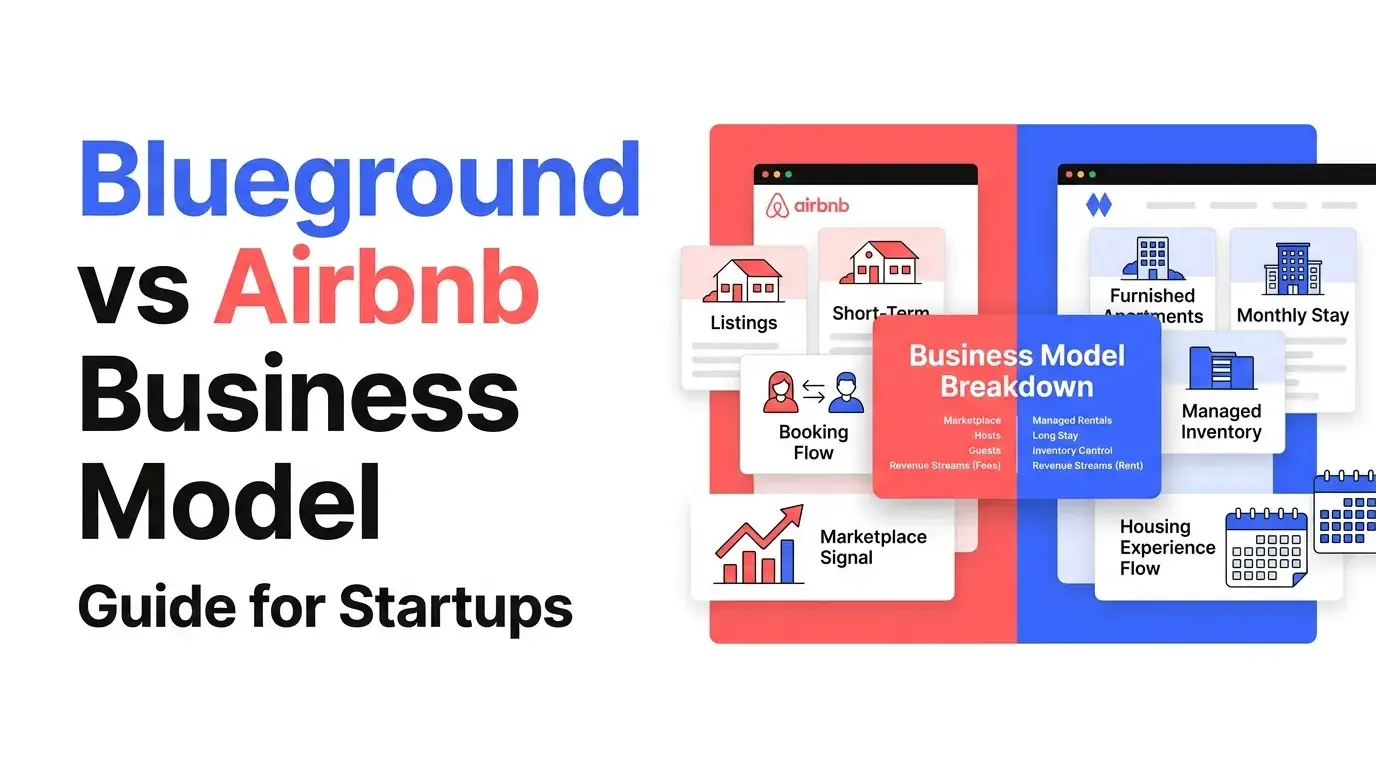
- Blueground and Airbnb use different rental models to serve property owners, guests, hosts, and business travellers.
- Blueground focuses on professionally managed, furnished apartments for medium- and long-term stays.
- Airbnb operates as a peer-to-peer marketplace connecting independent hosts with short-term and flexible-stay guests.
- The right model depends on property control, target audience, operational capacity, revenue goals, and stay duration.
- A startup can adapt either model or combine managed inventory with marketplace-based property listings.
Business Model Signals
- Airbnb-style platforms need host onboarding, property listings, search, booking, payments, reviews, and commissions.
- Blueground-style platforms need property acquisition, furnishing, pricing control, maintenance, leasing, and inventory management.
- Guests need verified listings, map search, availability, secure checkout, messaging, and booking management.
- Admins need control over users, properties, bookings, commissions, payouts, disputes, reports, and platform settings.
- Revenue can come from booking commissions, service fees, rental margins, subscriptions, and property-management services.
Real Insights
- Airbnb offers faster marketplace expansion because property ownership and daily operations remain with individual hosts.
- Blueground provides greater control over property quality and guest experience but requires heavier operational investment.
- A marketplace model depends on host supply and trust, while a managed-rental model depends on inventory utilization and operational efficiency.
- Founders should choose the model that matches their capital, market demand, property access, and desired level of control.
- Miracuves builds Airbnb Clone apps with property listings, booking workflows, host management, secure payments, monetization, and admin control.
Blueground and Airbnb both operate in the rental economy, but they solve different business problems. Blueground focuses on furnished, professionally managed homes for medium- and long-term stays. Airbnb primarily follows a peer-to-peer marketplace model that connects independent hosts with guests searching for accommodation.
For founders, the difference is not simply long-term versus short-term rentals. It is a decision about inventory ownership, capital exposure, operational control, marketplace liquidity, customer experience, and scalability.
A Blueground-style business gives operators greater control over property quality, branding, pricing, and the overall guest experience. However, running a Blueground-style platform also requires deeper involvement in property leasing, furnishing, maintenance, housekeeping, and local operations.
An Airbnb-style marketplace can scale more quickly through third-party property supply, but its success depends heavily on host acquisition, booking coordination, payment workflows, user verification, dispute management, and strong marketplace governance.
Founders considering the marketplace route can examine how an Airbnb-style vacation rental marketplace converts the business model into guest, host, booking, payment, and admin workflows. Before evaluating the technology, however, it is important to understand which operating model fits your capital, market, and growth strategy.
This Blueground vs Airbnb business model comparison breaks down how each platform operates, earns revenue, manages costs, scales supply, controls quality, and creates opportunities for rental-marketplace startups.
What Is Blueground?
Blueground is a technology-enabled furnished rental platform designed primarily for medium- and long-term stays. Instead of operating only as a listing marketplace, the business leases or manages selected properties, prepares them for guests, and delivers a more standardized rental experience.
The model is designed for people who want a move-in-ready home without dealing with furniture, utilities, long paperwork processes, or inconsistent property conditions.
Typical customers include:
- Corporate professionals relocating for work
- Expats moving to a new city
- Digital nomads and remote workers
- Families requiring temporary accommodation
- Employees on extended assignments
- People between permanent homes
- Businesses arranging corporate housing
Blueground’s value comes from control. It can influence property selection, furnishings, maintenance, pricing, photography, utilities, check-in, and customer support more directly than a traditional listing marketplace.
How the Blueground Model Works
A simplified Blueground-style operating process looks like this:
- The company identifies suitable properties in target locations.
- It enters leasing, management, or partnership arrangements with property owners.
- Properties are furnished and prepared according to defined standards.
- Available homes are published through a booking platform.
- Guests select a property and book it for an eligible stay period.
- The business manages billing, support, maintenance, extensions, and move-out processes.
- Revenue is generated from rental margins and additional services.
The platform is therefore not just a booking website. It is also an operational system connecting inventory, pricing, property management, maintenance, customer service, and payments.
For a deeper examination of this model, read the Blueground business model and revenue strategy.
What Is Airbnb?
Airbnb is a peer-to-peer rental marketplace. It connects people who have accommodation or spaces to offer with guests searching for places to stay.
Unlike a managed-rental operator, Airbnb generally does not need to lease, furnish, or directly manage every property listed on the platform. Independent hosts create listings, define availability, set pricing, communicate with guests, and manage the physical accommodation.
The platform supports the transaction through search, discovery, booking, payments, messaging, reviews, policies, customer support, and trust systems.
Typical users include:
- Leisure travellers
- Families and groups
- Business travellers
- Remote workers
- Long-stay guests
- Property owners
- Professional property managers
- Hosts offering rooms, apartments, villas, cabins, or other spaces
How the Airbnb Model Works
A simplified Airbnb-style workflow looks like this:
- A host registers on the platform.
- The host creates a property listing with photographs, pricing, amenities, availability, and house rules.
- A guest searches using location, dates, budget, property type, and other filters.
- The guest sends a booking request or uses instant booking where available.
- Payment is processed through the platform.
- The host and guest communicate through messaging and notifications.
- The platform records the reservation and applies its service or commission rules.
- After the stay, both parties may leave ratings and reviews.
- The admin team handles escalations, refunds, policy violations, suspicious activity, and disputes.
Airbnb’s main strength is that its property supply can expand without the platform directly acquiring every rental unit. Its challenge is maintaining trust, quality, availability accuracy, and a balanced marketplace as independent hosts and guests join.
Read the complete guide to the Airbnb marketplace business model for a more detailed revenue analysis.
Blueground and Airbnb Solve Different Rental Problems
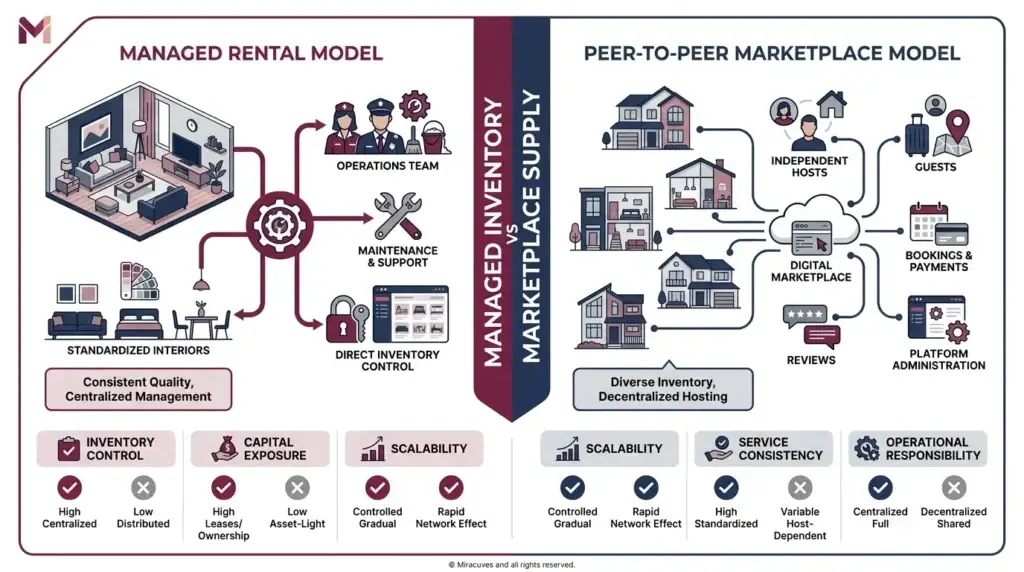
The two models may appear similar because both help people book accommodation. Their operational foundations, however, are very different.
Blueground behaves more like a technology-enabled rental operator. It aims to provide a consistent, professionally managed housing experience.
Airbnb behaves more like a technology-enabled marketplace. It enables independent supply and demand to transact through one platform.
This creates an important distinction for founders:
- Blueground’s advantage comes from operational control.
- Airbnb’s advantage comes from marketplace scale.
- Blueground manages inventory more directly.
- Airbnb organizes inventory supplied by independent hosts.
- Blueground carries greater property-level responsibility.
- Airbnb carries greater marketplace, trust, and governance responsibility.
Neither model is automatically better. The stronger choice depends on what the startup can operate effectively.
Business Model of Blueground
Blueground follows a managed furnished-rental model. The company secures access to suitable homes, prepares them for its target customer, and earns revenue by renting them for medium- or long-term periods.
The business creates value by reducing the friction normally associated with temporary housing. Guests receive a furnished property, a clearer booking process, defined support, and a more predictable living experience.
Blueground Revenue Streams
A Blueground-style platform can generate revenue through several channels.
Rental Margin
The business may secure a property under one commercial arrangement and rent it to guests at a higher effective rate. The difference contributes to operating revenue.
The margin must cover property commitments, furnishings, utilities, maintenance, support, vacancy periods, customer acquisition, and technology.
Corporate Housing Agreements
Companies may require temporary housing for relocating employees, project teams, consultants, or executives.
Corporate agreements can provide longer booking periods and more predictable demand than individual consumer bookings.
Cleaning and Maintenance Services
Additional cleaning, maintenance, premium support, or convenience services can be offered separately or included within a higher-priced package.
Utility and Connectivity Packages
Electricity, internet, water, and other services may be bundled into the rental price or offered through a managed package.
Stay Extensions and Renewals
Existing guests may extend their bookings. Extensions can reduce acquisition costs because the business earns additional revenue without finding a new guest immediately.
Premium Property Categories
Properties in high-demand locations or with premium furnishings, workspaces, services, or amenities can support higher pricing.
Blueground Cost Structure
The Blueground model gives the operator more control, but that control creates greater responsibility.
Major cost areas can include:
- Lease or property-management commitments
- Furnishing and interior preparation
- Property photography
- Utilities and internet
- Cleaning and maintenance
- Repairs and replacements
- Insurance
- Local operations
- Customer support
- Property inspections
- Technology and booking infrastructure
- Sales and marketing
- Vacancy periods
- Legal and contractual administration
A founder choosing this model must understand the relationship between occupancy, pricing, property costs, and operational efficiency. A property that remains unoccupied may continue creating costs even when it generates no booking revenue.
Key Partners in a Blueground-Style Business
A managed-rental platform may depend on:
- Property owners
- Real estate developers
- Property managers
- Furniture suppliers
- Interior-design partners
- Cleaning providers
- Maintenance teams
- Utility companies
- Corporate relocation agencies
- Insurance providers
- Payment providers
- Local operating partners
- Legal and compliance advisers
The quality and reliability of these partnerships directly affect the guest experience.
Blueground Growth Logic
A Blueground-style company normally expands by adding suitable inventory in carefully selected markets.
Growth can come from:
- Entering new cities
- Adding properties within existing cities
- Improving occupancy
- Increasing average stay duration
- Signing corporate housing agreements
- Improving renewal and extension rates
- Adding premium service packages
- Partnering with larger property owners
- Increasing operational efficiency
The major limitation is that each new market may require local property relationships, maintenance capacity, legal review, customer support, and operational infrastructure.
Read More: Business Model of Blueground Explained: Revenue & Strategy
Business Model of Airbnb
Airbnb follows a two-sided marketplace model. It connects hosts who have accommodation with guests who want to book it.
The platform does not need to directly furnish or operate every property. Its main product is the marketplace infrastructure that helps both sides discover, evaluate, communicate, book, pay, and resolve problems.
Airbnb Revenue Streams
An Airbnb-style marketplace can support multiple revenue channels.
Booking Commissions
The platform can charge a percentage or fixed fee when a reservation is completed.
The commission may be charged to the host, the guest, or distributed between both sides according to the platform’s pricing model.
Guest Service Fees
A service charge can be added to the guest’s booking total to cover platform operations, support, payment processing, and marketplace services.
Host Subscription Plans
Professional hosts or property managers may pay for plans that provide additional listings, analytics, team access, automation, featured placement, or operational tools.
Promoted Listings
Hosts can pay for greater visibility in search results, category pages, or promotional campaigns.
Experience and Activity Commissions
The platform can expand beyond accommodation by allowing providers to offer activities, tours, classes, events, or local experiences.
Cancellation and Processing Fees
Fees may apply in certain cancellation, modification, or payment scenarios, depending on platform policies and applicable laws.
Value-Added Services
Additional revenue may come from insurance integrations, professional photography, cleaning partnerships, host tools, property services, or concierge offerings.
Airbnb Cost Structure
A marketplace avoids many direct property costs, but it has its own significant operating requirements.
Major cost areas can include:
- Web and mobile platform development
- Cloud infrastructure
- Search and recommendation systems
- Payment processing
- Identity and listing verification
- Customer support
- Refund and dispute operations
- Fraud monitoring
- Insurance arrangements
- Marketing and host acquisition
- Guest acquisition
- Legal and regulatory work
- Content moderation
- Data protection
- Platform security
- Map, messaging, notification, and verification integrations
The marketplace model is therefore not cost-free. It shifts investment away from physical property operations and toward technology, marketplace growth, trust, customer support, and governance.
Key Partners in an Airbnb-Style Business
A rental marketplace may depend on:
- Independent hosts
- Property managers
- Guests
- Payment providers
- Identity-verification services
- Mapping providers
- Messaging providers
- Insurance companies
- Cleaning and property-service partners
- Tourism organizations
- Affiliate partners
- Local advisers
- Customer-support providers
Airbnb Growth Logic
An Airbnb-style marketplace grows by increasing useful supply and demand within the same market.
Potential growth levers include:
- Recruiting more hosts
- Adding new property categories
- Entering underserved destinations
- Improving guest acquisition
- Increasing repeat bookings
- Improving booking conversion
- Adding long-stay inventory
- Supporting professional property managers
- Adding experiences or activities
- Improving recommendations
- Reducing cancellations
- Strengthening marketplace trust
The main challenge is liquidity. A marketplace needs enough relevant listings to attract guests and enough booking demand to keep hosts active.
Read More: How to Build an App Like Airbnb Clone Developer Guide
Blueground vs Airbnb Business Model Comparison
| Business Factor | Blueground-Style Model | Airbnb-Style Model |
|---|---|---|
| Model type | Managed furnished-rental platform | Peer-to-peer rental marketplace |
| Property supply | Properties secured or managed by the operator | Properties listed by independent hosts |
| Inventory control | High | Distributed across hosts |
| Capital requirement | Higher because of property and operational commitments | Lower property exposure but significant technology and marketplace investment |
| Primary customers | Corporate travellers, expats, relocating professionals, long-stay guests | Leisure travellers, families, groups, business travellers, short- and long-stay guests |
| Typical stay duration | Medium- and long-term | Short-, medium-, and long-term |
| Revenue model | Rental margin, corporate contracts, services, extensions | Booking commissions, service fees, subscriptions, promoted listings |
| Quality consistency | Easier to standardize | Varies across hosts and listings |
| Operational responsibility | High | Shared with independent hosts |
| Scalability | Requires local operational expansion | Can scale through host-supplied inventory |
| Main technology need | Inventory and property-operations management | Search, booking, payments, trust, and marketplace administration |
| Admin complexity | Property, maintenance, pricing, billing, and operational control | Users, hosts, listings, commissions, bookings, disputes, and moderation |
| Primary risk | Vacancy, fixed costs, property commitments | Marketplace imbalance, fraud, quality inconsistency, and regulatory restrictions |
| Competitive advantage | Service consistency and property control | Supply diversity, network effects, and marketplace reach |
Pros and Cons of the Blueground Model
Advantages of a Blueground-Style Model
Greater Quality Control
The operator can define standards for furnishings, property condition, photography, maintenance, communication, and support.
This can create a more consistent customer experience.
Stronger Brand Consistency
Customers interact with one operating brand rather than a large number of independent hosts.
That makes it easier to establish clear service expectations.
Suitable for Corporate Housing
Businesses arranging accommodation for employees often value reliability, billing clarity, support, and predictable property standards.
Longer Booking Periods
Longer stays may reduce the frequency of check-ins, cleaning cycles, remarketing, and booking turnover.
More Control Over Pricing
The operator can manage pricing, availability, extensions, and property packages according to its own commercial strategy.
Disadvantages of a Blueground-Style Model
Higher Capital Exposure
Furnishing, deposits, lease commitments, maintenance, and vacancy can create substantial financial pressure.
Operational Complexity
Every property may require cleaning, repairs, inspections, utilities, support, and local coordination.
Slower Geographic Expansion
New markets may require property partnerships and on-the-ground service capacity.
Vacancy Risk
The business may continue paying property-related costs when demand declines.
Dependence on Property Economics
A small difference between property cost and achievable rental revenue can significantly affect profitability.
Pros and Cons of the Airbnb Model
Advantages of an Airbnb-Style Model
Lower Direct Inventory Exposure
Independent hosts generally provide the accommodation, reducing the need for the platform to lease every property.
Wider Listing Variety
Hosts can supply rooms, apartments, homes, villas, cabins, event spaces, and other rental categories.
Faster Supply Expansion
A successful host-acquisition strategy can increase inventory without the platform directly managing every property.
Multiple Monetization Options
The business can generate revenue through commissions, service fees, subscriptions, promoted listings, and related services.
Strong Network-Effect Potential
More useful listings can attract more guests. More guest demand can then attract additional hosts.
Disadvantages of an Airbnb-Style Model
Inconsistent Quality
Property quality, photography, communication, cleanliness, and service can differ between hosts.
Marketplace Imbalance
Too few listings can make the app unattractive to guests, while too few bookings can cause hosts to leave.
Trust and Fraud Risk
The platform must manage fake listings, payment abuse, account takeovers, misleading descriptions, disputes, and policy violations.
Regulatory Complexity
Short-term rental rules may vary by city, property category, and operating market.
Dependence on Third Parties
The platform’s reputation is influenced by host behaviour, guest behaviour, payment services, and external providers.
Read More: 95ms Maps: Benchmarking Geospatial Queries in a High-Volume Airbnb Clone
Founder Decision Matrix: Control, Capital, and Scalability

Changing market statistics and company valuations may attract attention, but they do not determine whether a startup can successfully operate either model.
The more useful comparison is how each model affects control, capital, supply, operations, and growth.
Inventory Control
A Blueground-style business controls or manages a defined portfolio of properties. This makes it easier to standardize furnishings, maintenance, photography, pricing, and customer service.
An Airbnb-style marketplace distributes inventory control across independent hosts. This increases supply variety but requires stronger verification, moderation, review, and quality-management systems.
Capital Exposure
A managed-rental business may require lease commitments, furnishing, deposits, maintenance, utilities, and local teams before occupancy is guaranteed.
A peer-to-peer marketplace generally avoids carrying most direct property inventory. Its investment is concentrated in technology, host acquisition, guest acquisition, payments, verification, support, and marketplace operations.
Scaling Constraint
A Blueground-style platform often scales city by city because each location requires property supply and operational support.
An Airbnb-style marketplace can enter new locations more quickly when it can attract sufficient hosts and guests. Its constraint is not primarily property ownership. It is marketplace liquidity.
Primary Operating Risk
For a managed-rental business, the central risk is carrying property and operating costs when occupancy falls.
For a peer-to-peer marketplace, major risks include weak supply, low booking demand, fraudulent activity, inconsistent quality, cancellations, disputes, and regulatory restrictions.
Best Founder Fit
A managed-rental model may fit founders with strong access to:
- Property owners
- Real estate developers
- Corporate housing demand
- Local operations
- Maintenance networks
- Relocation partnerships
- Premium or specialized inventory
A marketplace model may fit founders with strong capabilities in:
- Community building
- Digital acquisition
- Host recruitment
- Marketplace operations
- Travel or rental partnerships
- Platform technology
- Trust and safety
- Niche positioning
Read More: Why Niche Inventory Is the Only Way to Beat Airbnb
Which Rental Business Model Fits Your Startup?
The right choice depends on the business advantage you already have or can realistically build.
Choose a Blueground-Style Model When:
- You are targeting corporate travellers, expats, or relocating professionals.
- Medium- and long-term stays are central to your strategy.
- You want greater control over property quality.
- You can build reliable local operations.
- You have access to suitable property inventory.
- You can manage furnishing, maintenance, utilities, and support.
- You are prepared for higher capital and operational responsibility.
- Your differentiation depends on consistency and service quality.
Founders following this direction can evaluate a Blueground-style corporate housing platform designed around managed inventory, longer stays, property operations, and customer support.
Choose an Airbnb-Style Model When:
- You want independent hosts to supply inventory.
- Your market contains fragmented property owners.
- You are targeting a specific travel or rental niche.
- You want to monetize transactions through commissions.
- Your strength is user acquisition or marketplace growth.
- You can build trust, verification, and dispute workflows.
- You want to expand without directly leasing every property.
- Your opportunity depends on supply variety and network effects.
Consider a Hybrid Model When:
A hybrid platform combines managed inventory with third-party host listings.
For example, the business may directly manage premium corporate apartments while also allowing verified property partners to list independent inventory.
This can provide stronger control in high-value categories while enabling broader marketplace growth.
A hybrid model needs clear rules for:
- Property ownership
- Listing approval
- Pricing control
- Availability
- Service responsibility
- Host payouts
- Maintenance
- Refunds
- Commission calculations
- Guest support
- Quality standards
Without these distinctions, operational responsibilities can become unclear.
See the Airbnb Clone Platform in Action
A feature list can help you shortlist options, but a live product walkthrough gives better clarity. Review the guest app, host panel, property listings, booking workflows, availability calendars, secure payments, commission settings, admin dashboard, branding, and launch scope before making your decision.
Startup Opportunities Beyond a General Rental Marketplace
A new rental platform does not need to compete across every destination, property type, and customer group from the beginning.
Founders can create stronger differentiation by focusing on a clear niche.
Potential opportunities include:
- Corporate housing
- Student accommodation
- Medical-stay housing
- Relocation rentals
- Long-stay remote-work accommodation
- Luxury villas
- Rural and nature stays
- Pet-friendly rentals
- Accessible accommodation
- Religious or pilgrimage travel
- Event-space rentals
- Film-location rentals
- Family-focused holiday homes
- Senior-friendly accommodation
- Sports and tournament housing
- University and internship housing
A focused category makes it easier to define supply standards, acquisition channels, pricing, booking rules, trust requirements, and product features.
The goal should not be to copy a large marketplace in every detail. It should be to use a proven marketplace structure to solve a more specific rental problem.
From Business Model to Product: What Founders Need to Build
Choosing the business model defines more than how the company earns revenue. It determines which users, workflows, controls, integrations, and operational tools the product must support.
Guest, Host, and Property Workflow

An Airbnb-style platform normally requires separate experiences for guests, hosts, and platform administrators.
Guest Features
Guests typically need:
- Account registration and profile management
- Location and date-based search
- Map discovery
- Property filters
- Property photographs and descriptions
- Amenities and house rules
- Pricing details
- Availability calendars
- Booking requests
- Instant booking where enabled
- Secure payment
- Messaging
- Saved properties
- Booking history
- Cancellation requests
- Refund information
- Ratings and reviews
- Notifications
- Customer support
Host Features
Hosts typically need:
- Registration and verification
- Host profiles
- Property listing creation
- Photograph uploads
- Amenities and house rules
- Pricing management
- Availability calendars
- Booking approval
- Instant-booking settings
- Guest communication
- Payout details
- Cancellation settings
- Earnings records
- Reviews
- Listing-performance information
- Calendar synchronization
- Support and dispute access
Founders defining their platform scope should review the essential vacation rental app features before deciding which functions belong in the first market version.
Blueground-Style Operational Features
A managed-rental platform may require additional operational modules, including:
- Property acquisition records
- Lease details
- Furnishing status
- Property inspections
- Maintenance tickets
- Utility management
- Cleaning schedules
- Recurring billing
- Stay extensions
- Corporate accounts
- Occupancy reporting
- Unit-level profitability
- Property partner records
- Local operations dashboards
The operational system must reflect who is responsible for each property and service.
Monetization Must Be Connected to Platform Controls
A rental marketplace can support several revenue models, but every revenue stream requires corresponding platform logic.
Booking Commission
The platform can charge hosts, guests, or both when a reservation is completed.
The admin team should be able to configure:
- Percentage commissions
- Fixed fees
- Category-based fees
- Location-based fees
- Promotional rates
- Tax treatment
- Refund effects
- Host payout timing
Host Subscriptions
Professional hosts can pay monthly or annual fees for:
- Additional listings
- Lower commission rates
- Advanced reports
- Team accounts
- Featured placement
- Automated tools
- Priority support
Promoted Listings
Hosts can pay to increase listing visibility. The platform must clearly label sponsored placements and maintain search relevance.
Value-Added Services
Revenue can also come from:
- Cleaning services
- Insurance partnerships
- Property photography
- Host verification
- Concierge services
- Airport transfers
- Local experiences
- Damage-protection programs
- Property-management tools
Managed Rental Revenue
A Blueground-style operator may earn through:
- Rental margins
- Corporate housing agreements
- Utility packages
- Cleaning services
- Premium support
- Stay extensions
- Property-management fees
The revenue model should be defined before development because it affects booking calculations, invoices, payouts, refunds, reports, and admin settings.
Why the Admin Panel Is a Business Tool
The admin panel is the operating control layer of the platform.
A rental marketplace admin dashboard should help authorized teams manage:
- Guests
- Hosts
- Property managers
- Listings
- Listing approvals
- Property categories
- Amenities
- Locations
- Bookings
- Commissions
- Payments
- Host payouts
- Refunds
- Cancellations
- Reviews
- Disputes
- Reports
- Promotions
- Notifications
- Content
- Support requests
- Suspicious activity
- Platform settings
The admin system should also support permission-based access.
A customer-support employee may need booking information but should not automatically control payment settings. A finance employee may require transaction reports but not access to identity documents. A content reviewer may need listing-moderation tools without access to sensitive financial controls.
This separation becomes more important as the platform adds employees, cities, property categories, or operational partners.
Security and Trust Affect Marketplace Conversion
Rental marketplaces depend on trust between people who may never have interacted before.
Guests are less likely to book when they do not trust the listing, host, payment flow, cancellation policy, or review system.
Hosts are less likely to join when guest verification, payout rules, property protection, or dispute handling appear unreliable.
A rental marketplace should therefore consider:
- Secure authentication
- Guest verification
- Host verification
- Property review and approval
- Encrypted data transfer
- Secure payment-gateway integration
- Permission-based admin access
- Activity and audit logs
- Fraud-monitoring signals
- Account-change alerts
- Booking-state validation
- Refund controls
- Review moderation
- Abuse reporting
- Dispute management
- Secure API integrations
- Backup and recovery procedures
- Privacy-conscious data handling
Calendar accuracy is also a trust issue. Incorrect availability can result in duplicate bookings, cancellations, refunds, negative reviews, and lost host confidence.
Read the guide to preventing double bookings through calendar synchronization for a deeper explanation of availability management.
The exact security and compliance requirements depend on the platform’s jurisdiction, payment providers, data practices, rental category, and operating model. A platform can support compliance workflows, but final legal responsibility requires appropriate local review.
The white-label rental platform security guide covers guest, host, payment, API, booking, and admin safeguards in greater detail.
Customization Should Follow the Business Model
Customization should not begin with colours and logos alone.
Branding is important, but the most valuable customization decisions are operational.
Founders may need to configure:
- Rental categories
- Stay-duration rules
- Instant or approval-based booking
- Hourly, nightly, weekly, or monthly pricing
- Host commission
- Guest service fees
- Deposit requirements
- Cancellation policies
- Refund rules
- Host payout schedules
- Property approval
- Identity verification
- Supported languages
- Supported currencies
- Maps and locations
- Payment services
- Taxes
- Promotions
- Reviews
- Messaging
- Notifications
- Corporate accounts
- Property-management roles
- Admin permissions
A student-housing platform does not need the same workflows as a luxury-villa marketplace. A corporate-housing product does not need the same booking rules as an hourly event-space platform.
Customization should support the business model rather than adding features without a clear operational purpose.
What Affects the Cost of Building a Rental Platform?
There is no single development cost that fits every rental marketplace.
The final scope depends on:
- Number of user roles
- Android, iOS, and web requirements
- Guest application features
- Host application features
- Admin-panel depth
- Property-management functionality
- Booking complexity
- Payment integrations
- Commission and payout rules
- Calendar integrations
- Maps and geolocation
- Messaging
- Notifications
- Languages and currencies
- Identity verification
- Security requirements
- Custom design
- Third-party services
- Reporting
- Data migration
- Custom business workflows
Custom Development
A fully custom build may suit a business with highly specialized workflows, unusual integrations, or a model that differs substantially from standard rental marketplaces.
The trade-off is that every major module must be designed, developed, integrated, tested, and maintained.
Ready-Made Product Foundation
A ready-made platform can reduce ground-up development when guest, host, booking, payment, listing, and admin workflows already exist.
It can then be configured around the business’s:
- Brand
- Market
- Rental category
- Commission model
- Payment system
- Operational rules
- Languages
- Currencies
- Required integrations
Founders preparing a budget should review the main development cost factors for an Airbnb-style app before choosing between ready-made and custom development.
A Practical Rental Platform Launch Process
A clear launch process reduces the risk of building features before the business model is defined.
Step 1: Select the Rental Category
Decide which supply and customer group the platform will serve.
Examples include holiday homes, corporate apartments, student rooms, event spaces, luxury villas, or long-stay rentals.
Step 2: Define the Supply Model
Clarify whether properties will come from:
- Independent hosts
- Professional property managers
- Directly managed inventory
- Property-development partners
- A hybrid of managed and third-party listings
Step 3: Define the Revenue Model
Decide how the platform will earn money through commissions, service fees, subscriptions, rental margins, promoted listings, or additional services.
Step 4: Map User and Admin Workflows
Document what guests, hosts, property managers, operations teams, finance teams, and administrators need to do.
Step 5: Configure the Product
Set up booking rules, pricing, payouts, cancellations, verification, property categories, locations, currencies, languages, and third-party services.
Step 6: Customize the Brand and Experience
Apply the brand identity, interface changes, content, emails, notifications, and market-specific customer journey.
Step 7: Test Complete Booking Scenarios
Testing should cover:
- Registration
- Listing creation
- Listing approval
- Search
- Availability
- Booking
- Payments
- Failed payments
- Cancellations
- Refunds
- Host payouts
- Messaging
- Reviews
- Notifications
- Admin actions
- Disputes
- Calendar synchronization
Step 8: Build Initial Supply
A marketplace should recruit enough relevant properties before investing heavily in guest acquisition.
Step 9: Launch in a Focused Market
Starting with a defined destination, property niche, or customer segment makes marketplace activity easier to measure.
Step 10: Improve Using Operational Data
Monitor:
- Active listings
- Search-to-booking conversion
- Booking value
- Host activation
- Cancellation rate
- Occupancy
- Repeat booking
- Support requests
- Refunds
- Disputes
- Customer acquisition
- Host retention
Mistakes Founders Should Avoid
Copying Every Feature Without a Market Strategy
A large feature list does not create marketplace demand. Founders first need a clear rental category, customer segment, supply strategy, and value proposition.
Launching Without Enough Property Supply
Guests will not return when relevant search results are unavailable. Initial supply should be secured before large-scale guest marketing begins.
Ignoring the Host Experience
Hosts need clear onboarding, property-management tools, booking visibility, payout information, communication, and support.
A platform that focuses only on guests may struggle to retain supply.
Underestimating Admin Operations
Bookings, cancellations, refunds, disputes, listing approvals, payment issues, and fraud reports require operational processes.
Admin functionality should be planned before transaction volume grows.
Using One Commission Model for Every Market
Different property categories, locations, and host types may require different fee structures.
The platform should support configurable monetization rather than hard-coded assumptions.
Treating Security as a Final Add-On
Verification, payment protection, permissions, booking integrity, and activity records should be part of the product foundation.
Expanding Too Early
Launching across many cities can create inactive listings and weak marketplace liquidity.
A focused market makes it easier to build useful supply and demand.
Depending Entirely on Paid Advertising
Rental marketplaces also need host partnerships, destination content, referrals, search visibility, local communities, and repeat customers.
The vacation rental app marketing strategy explains how acquisition channels can work together.
Final Thoughts: Choose the Model You Can Operate
The stronger business model is not automatically the one with the largest market or the lowest apparent operating cost. It is the model your team can supply, manage, differentiate, and scale effectively.
A Blueground-style approach gives operators greater control over property inventory, service quality, and the overall customer experience. However, launching a Blueground clone also creates property-level responsibilities related to leasing, furnishing, maintenance, housekeeping, pricing, and local operations.
An Airbnb-style approach can expand through independent hosts and marketplace effects, but it requires strong host acquisition, booking operations, trust systems, payment workflows, and admin governance. For founders considering this route, an Airbnb clone can provide a practical product foundation for launching guest, host, booking, payment, and admin workflows without building every module from scratch.
Founders should make the business-model decision before making the software decision.
Define:
- Who supplies the properties
- Who controls pricing
- Who manages availability
- How the platform earns revenue
- Which risks the operator carries
- How hosts are paid
- How guests are protected
- How disputes are resolved
- How quality is maintained
- How the marketplace will acquire supply and demand
The product can then be configured around these decisions.
Miracuves helps founders translate rental-business models into white-label and customizable product workflows, including guest experiences, host tools, property listings, bookings, payments, monetization, and admin control.
The objective is not to reproduce another platform feature for feature. It is to build the operating foundation that your chosen rental market actually needs.
FAQs
What is the main difference between the Blueground and Airbnb business models?
Blueground follows a managed-rental model in which the business controls or manages furnished properties and delivers a more standardized customer experience.
Airbnb primarily follows a peer-to-peer marketplace model in which independent hosts list properties and the platform facilitates discovery, booking, payment, communication, reviews, and support.
Which rental business model is easier for a startup to launch?
An Airbnb-style marketplace generally requires less direct investment in property inventory, but it still needs host acquisition, guest demand, booking technology, payment workflows, verification, customer support, and marketplace administration.
What features does an app like Airbnb need?
An app like Airbnb normally needs guest registration, host onboarding, property listings, availability calendars, location search, booking management, payments, messaging, cancellations, reviews, notifications, and an admin dashboard. The exact feature scope should be adapted to the rental category, geography, customer segment, and operating model.
How can a vacation rental marketplace make money?
Common revenue streams include host commissions, guest service fees, subscription plans, featured listings, cancellation charges, advertising, experiences, and value-added services. The platform should give administrators control over how fees are configured, collected, reported, refunded, and adjusted.
Why is the admin panel important in a rental marketplace?
The admin panel allows the platform operator to manage users, hosts, properties, bookings, commissions, payments, refunds, disputes, reviews, reports, content, and suspicious activity. It provides the control needed to enforce platform rules and operate the marketplace as booking volume grows.
How much does it cost to build a rental platform similar to Airbnb?
The cost depends on the required web and mobile applications, feature scope, booking logic, payment services, maps, messaging, design customization, integrations, security controls, and development route.
Can a startup combine Blueground and Airbnb business models?
Yes. A hybrid platform can allow independent hosts to list properties while the business directly manages selected premium, corporate, or long-stay inventory.
What security controls should a vacation rental platform include?
Important controls include user and host verification, secure payment-gateway integration, permission-based admin access, listing moderation, activity records, refund controls, dispute handling, fraud monitoring, protected APIs, secure authentication, and privacy-conscious data handling.