
Key Takeaways
- Online travel agency vs property marketplace is primarily a difference between transaction orchestration and discovery-led marketplace activity.
- An OTA typically manages time-sensitive inventory, booking, payments, supplier confirmation, fulfillment, cancellations, and refunds.
- A property marketplace may focus more on listings, search, inquiries, qualified leads, agent connections, subscriptions, and promoted inventory.
- The different transaction depths influence inventory architecture, supplier relationships, payment workflows, revenue models, customer support, and operational requirements.
- Founders should define their inventory type, conversion event, revenue event, and fulfillment responsibility before selecting a marketplace structure or platform.
Business Model Signals
- Travel inventory is often tied to specific dates, seats, rooms, vehicles, or activity slots, making availability and pricing more time-sensitive.
- Property marketplaces commonly work with listings that can remain active for longer periods and may convert through inquiries rather than immediate transactions.
- OTA revenue can include commissions, markups, service fees, advertising, ancillary products, and supplier arrangements.
- Property marketplaces can monetize through professional subscriptions, promoted listings, advertising, lead fees, premium tools, and partnerships.
- KPIs should follow the value each platform creates, such as booking conversion and confirmation rates for OTAs or qualified leads, listing activity, and professional retention for property marketplaces.
Real Insights
- An OTA must maintain clear transaction states because payment success does not necessarily mean supplier confirmation or completed fulfillment.
- A property marketplace can create substantial value before the final property transaction by improving discovery, generating demand, and connecting users with professionals.
- Copying an OTA or property marketplace interface does not reproduce its underlying business model; inventory, transaction depth, payments, and operational responsibilities must be designed separately.
- The more responsibility a platform retains after conversion, the greater its requirements for customer support, payment operations, cancellations, refunds, and fulfillment.
- The strongest decision path is: define inventory → identify the primary user action → determine transaction depth → choose the revenue event → map fulfillment responsibility → define required integrations → select the appropriate marketplace structure.
An online travel agency platform and a property marketplace can look surprisingly similar from the outside.
Both aggregate supply. Both help users search and compare options. Both connect demand with third-party providers. Both can monetize through commissions, advertising, subscriptions, or partnerships.
But beneath the interface, they can be fundamentally different businesses.
An online travel agency typically participates directly in a time-sensitive transaction. Availability can disappear, prices can change, payments need to be processed, suppliers must confirm reservations, and cancellations or refunds may follow.
A property marketplace can operate much closer to a discovery and lead-generation model. Its primary job may be to organize listings, attract buyers or renters, generate inquiries, and connect those users with property owners, agents, brokers, or other service providers.
Readers who want more context on the traveler journey can first explore how an online travel platform works, from travel search and comparison through booking and reservation management. That journey helps explain why an OTA participates more deeply in transactions than a discovery-led marketplace.
For founders, this difference affects much more than product features.
It changes inventory management, transaction architecture, supplier relationships, monetization, operations, customer support, and the economics of the marketplace itself.
OTA vs Property Marketplace at a Glance
OTA vs Property Marketplace: Core Business Differences
| Business Layer | Online Travel Agency | Property Marketplace |
|---|---|---|
| Inventory | Time-sensitive travel availability such as rooms, seats, cars or activities. | Property listings representing homes, rentals, developments or commercial spaces. |
| Primary User Action | Search, compare and complete a reservation. | Search, evaluate, save, inquire or contact an agent/owner. |
| Transaction Role | Often participates directly in booking and payment. | May stop at lead generation or facilitate selected transaction stages. |
| Supply Relationships | Hotels, airlines, activity providers, car suppliers and travel aggregators. | Agents, brokers, landlords, property managers, developers and listing sources. |
| Typical Revenue | Commissions, markups, service fees, advertising and partner revenue. | Subscriptions, promoted listings, advertising, lead fees and partner services. |
| Fulfillment | Reservation confirmation, tickets, vouchers, itinerary and post-booking support. | Often moves the user toward inquiry, viewing, agent engagement or an external transaction. |
The most important difference is not travel versus property.
It is transaction orchestration versus marketplace discovery.
Inventory Means Something Different in Each Marketplace
Every marketplace needs supply, but the meaning of “inventory” changes dramatically between these models.
In an OTA, inventory is usually bookable capacity attached to time.
A hotel may have three rooms available for a specific night. A flight has a limited number of seats for a particular departure. An activity has availability for specific dates or time slots.
That inventory can change between search and checkout.
A property marketplace generally deals with listings rather than perishable booking inventory.
A home can remain listed for days, weeks, or months. The listing may change status, price, photos, agent information, or availability, but the platform usually does not have to reserve one unit instantly every time someone views it.
That changes the technical and commercial requirements of the business.
OTA Inventory Requires More Real-Time Coordination
Travel marketplaces often obtain supply through external systems.
Hotel providers, airlines, transfer companies, activity operators, aggregators, and other sources may expose availability through APIs or distribution networks.
The OTA needs to query those sources, normalize their data, present useful search results, and frequently revalidate critical information before booking.
Property marketplaces also aggregate external information, but the freshness problem is different.
A stale property listing creates a poor discovery experience.
Stale travel availability can create a failed transaction after a customer has already attempted to pay.
This real-time coordination depends heavily on the underlying system design. Founders interested in the technical side can explore online travel agency platform architecture to understand how supplier APIs, inventory, booking engines, payments, and fulfillment work together behind the booking journey.
That difference makes inventory freshness directly connected to transaction reliability in an OTA.
Property Marketplaces Are Often Discovery-First
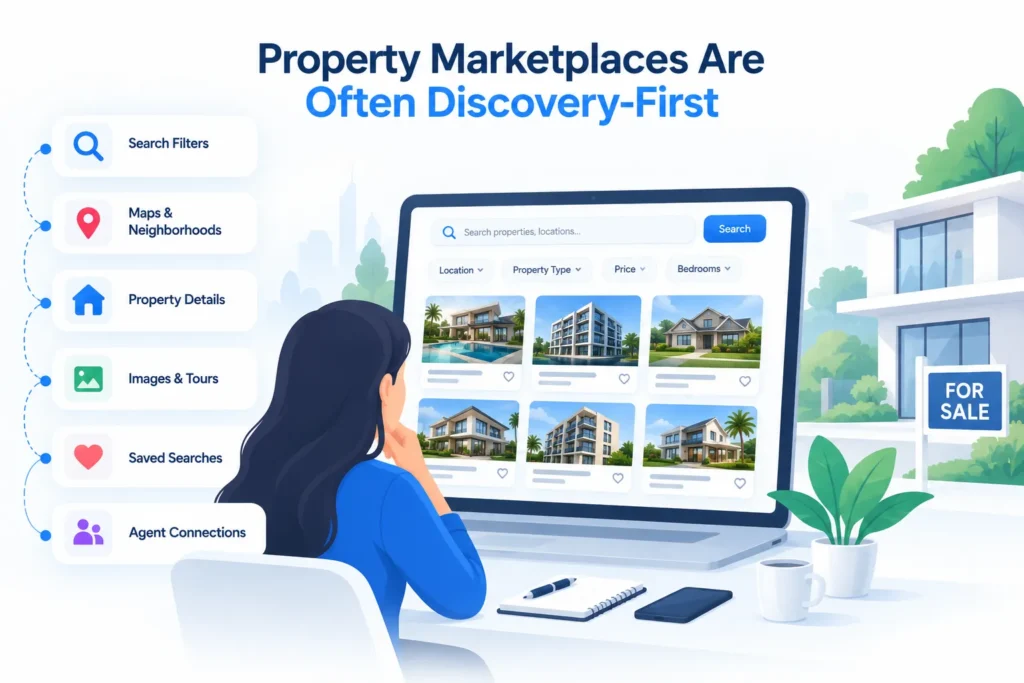
A property marketplace typically creates value by helping users reduce a large market into a manageable set of options.
Search filters, maps, property attributes, neighborhood information, images, saved searches, recommendations, price context, and agent connections can therefore be central to the product.
The conversion event may simply be an inquiry.
The user discovers a suitable property and contacts an agent or owner. The eventual rental or property transaction may occur partly or entirely outside the marketplace.
That makes qualified demand generation commercially valuable even when the platform does not process the final property transaction.
An OTA has a different expectation.
Users generally arrive intending to complete a reservation rather than merely identify a hotel or flight and contact the provider themselves.
OTAs Usually Operate Deeper Inside the Transaction
Consider what happens when someone books a hotel through an online travel agency.
The platform may need to verify the selected rate, collect traveler information, calculate the final payable amount, process payment, send a booking request to the supplier, receive confirmation, store the supplier reference, generate an itinerary, and support future cancellation.
That creates multiple transactional states.
The traveler may have paid while the supplier confirmation is still pending. A reservation can fail after a payment event. A cancellation can succeed with the supplier while a refund remains in progress.
An OTA therefore needs much stronger transaction-state management than a marketplace whose primary conversion is an inquiry form.
Supply-Side Relationships Shape the Business Model
Marketplace economics cannot be separated from the supply side.
An OTA might maintain relationships with accommodation suppliers, airlines, car providers, activity operators, wholesalers, aggregators, or distribution systems.
Commercial arrangements can influence inventory access, margins, cancellation conditions, payment timing, and customer-support responsibility.
A property marketplace’s supply network looks different.
Agents, brokers, property managers, landlords, developers, listing feeds, and other data providers may contribute inventory.
Their objective may be exposure and lead generation rather than immediate booking volume.
This changes what suppliers are willing to pay for.
A travel supplier may accept a commission tied to a completed reservation.
A property professional may instead pay for a subscription, promoted listing, premium placement, or qualified lead.
Payment Architecture Reflects Transaction Depth
Payments are another major point of separation.
A transactional travel marketplace can process substantial booking value directly through its checkout journey.
That introduces payment authorization, payment status, refunds, chargebacks, reconciliation, currencies, supplier settlement, and potentially other financial workflows.
A discovery-led property marketplace may not need to collect the value of the underlying property transaction.
Its payment system could primarily collect subscription charges, advertising fees, listing upgrades, or lead-generation charges from professionals.
That is a much different financial architecture from collecting money from a traveler for a reservation that an external supplier must subsequently fulfill.
Revenue Models Follow the Value the Platform Creates
A useful marketplace monetization question is:
What economic outcome does the platform create for its supply side?
For an OTA, that outcome is frequently a completed booking.
This supports revenue structures such as booking commissions, supplier commissions, markups, service fees, advertising, ancillary products, and B2B distribution.
For a property marketplace, the platform may primarily create visibility, demand, and qualified inquiries.
That supports promoted listings, professional subscriptions, advertising, lead-generation fees, premium placement, and partnerships with adjacent service providers.
Neither approach is inherently superior.
Founders evaluating transaction-led travel marketplaces can examine the online travel agency business model in greater detail, including how commissions, markups, service fees, supplier relationships, and other revenue streams can shape the economics of the platform.
They monetize different points in the customer journey.
Commission and Markup Models Fit Transactional Marketplaces Naturally
Suppose a travel supplier makes a room available at a particular commercial rate.
The marketplace may earn through an agreed commission, a markup structure, a service fee, or another arrangement defined by its supplier and payment model.
Revenue is therefore closely connected to gross booking activity.
This can create strong monetization opportunities, but it also means the platform participates more deeply in operational complexity.
A failed booking is no longer simply a failed lead.
It can involve collected money, supplier communication, customer support, cancellation rules, and refund processing.
Subscription and Lead Models Change Marketplace Economics
Property marketplaces can monetize without participating directly in the underlying property purchase.
For example, professionals might pay for greater exposure, enhanced profiles, premium tools, promoted inventory, or access to qualified demand.
This can produce recurring B2B revenue that is less directly tied to the final value of a property transaction.
But it introduces a different challenge.
If professionals are paying for visibility or leads, the marketplace needs to demonstrate that the audience and inquiries have commercial value.
That makes traffic quality, listing quality, lead quality, geographic density, and professional retention especially important.
Fulfillment Is Much Heavier in Travel
Fulfillment is where the operational differences become particularly clear.
After an OTA accepts a successful reservation, the traveler still needs the service to be delivered.
The platform may need to provide a confirmation number, voucher, ticket, itinerary, cancellation conditions, pickup information, or supplier contact details.
Greater transaction responsibility also creates additional trust requirements. Founders can review security in an online travel agency platform to understand how traveler accounts, payments, supplier connections, booking records, refunds, and staff access should be considered across the reservation lifecycle.
It may also need to handle changes before travel.
Property discovery typically has a different handoff.
After an inquiry, the next step could be a phone call, property viewing, broker interaction, application, mortgage discussion, negotiation, or another process outside the core marketplace.
That deeper role in the transaction also influences the features required in a travel marketplace. Search and discovery are only the beginning; booking management, supplier connectivity, payments, administrative controls, and post-booking operations become important as the platform takes greater responsibility for the reservation journey.
This makes OTA operations much more tightly connected to the post-conversion customer experience.
Transaction Frequency Changes the Economics
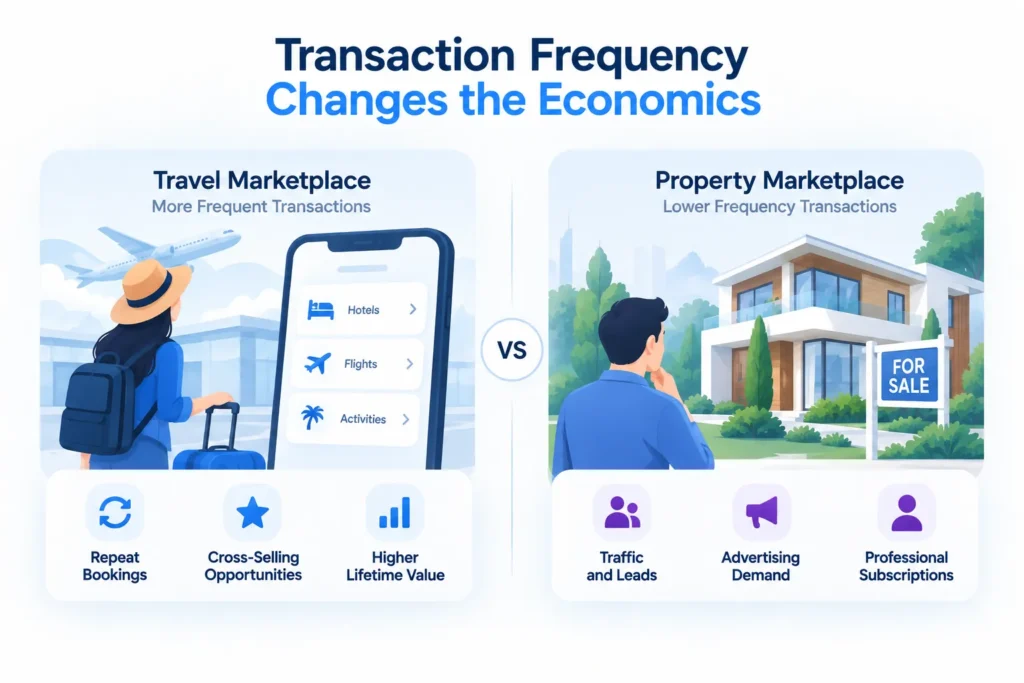
Travel can generate repeated transactions from the same customer.
A user might book multiple hotels, flights, activities, or trips over time.
Property purchases occur much less frequently.
Even rental searches are generally episodic compared with everyday commerce.
A property marketplace may therefore place greater economic importance on traffic, professional subscriptions, advertising demand, and lead monetization.
A travel marketplace can place more emphasis on repeat bookings, cross-selling, loyalty, ancillary products, and increasing booking value.
This difference influences customer acquisition strategy as much as platform architecture.
Marketplace Metrics Should Follow the Business Model
Founders should avoid evaluating both models with exactly the same dashboard.
A transactional OTA might care heavily about search-to-book conversion, gross booking value, booking margin, supplier confirmation rate, payment success, cancellations, refund rate, repeat bookings, and average booking value.
A property marketplace may care more about active listings, listing freshness, inquiry rate, qualified leads, agent response, paid-professional conversion, subscription retention, cost per lead, and geographic supply density.
Metrics become useful when they measure the value exchange the platform is actually designed to create.
Founder Decision Signals
Inventory Type
If supply is time-sensitive and must be reserved immediately, the platform needs stronger availability and transaction orchestration.
Conversion Event
Decide whether success means a completed booking, a qualified inquiry, a subscription, or another measurable marketplace action.
Revenue Event
Determine whether revenue occurs through transactions, commissions, markups, subscriptions, advertising, leads, or a combination.
Fulfillment Responsibility
The more responsibility the platform retains after conversion, the greater its operational and customer-support requirements become.
Which Marketplace Structure Fits Your Startup?
The right question is not which marketplace category is universally better.
It is what kind of value your business intends to coordinate.
A transaction-led OTA structure makes sense when users need to discover time-sensitive supply and complete reservations through the platform. The business must be prepared for supplier connectivity, payments, confirmations, cancellations, refunds, and fulfillment.
The chosen marketplace model also affects implementation scope and travel platform development costs. Supplier integrations, booking workflows, payment requirements, administrative systems, market coverage, and customization can all change the resources required to launch a transactional travel marketplace.
A discovery-led property marketplace structure makes sense when the primary value is organizing listings, attracting demand, improving property discovery, and connecting users with professionals or owners.
Some businesses can also combine elements of both.
For example, a rental marketplace might begin as a listing-and-lead platform and later introduce deposits, viewing reservations, applications, subscriptions, or other transactional services.
The important decision is to define the marketplace’s role before selecting features.
Common Marketplace Model Mistakes to Avoid
Choosing the Interface Before the Business Model
A marketplace can visually resemble another platform while having completely different inventory, revenue, transaction, and operational requirements.
Treating Every Listing as the Same Kind of Inventory
A property listing and a hotel room may both appear as cards in search results, but their availability, freshness and transaction requirements are fundamentally different.
Copying a Revenue Model Without Matching the Value Exchange
Commission, subscription and lead-generation models work when they correspond to a measurable outcome that suppliers or professionals are willing to pay for.
Underestimating Post-Transaction Operations
A business that processes reservations also inherits responsibilities around confirmations, changes, cancellations, refunds and customer support.
Measuring Both Models With the Same KPIs
Booking conversion and gross booking value can be critical for an OTA, while lead quality and professional retention may matter more to a property marketplace.
Moving From Business Model to Platform Implementation
Once founders know which marketplace structure fits the business, the next question is implementation.
A travel marketplace needs more than searchable listings. Its foundation may need supplier connectivity, live or frequently refreshed inventory, booking orchestration, payment processing, reservation management, administrative controls, and post-booking operations.
Founders still comparing different concepts can explore Miracuves’ travel booking solutions to see how different marketplace approaches can be structured around their target audience, inventory strategy, booking journey, and operating model.
A property marketplace may prioritize listing ingestion, search, maps, property data, professional accounts, inquiries, lead management, subscriptions, and promoted inventory instead.
Once the business model is clear, founders can evaluate the type of travel platform development partner required to implement it. The evaluation should consider supplier integrations, booking workflows, payments, administration, customization, deployment, and post-launch responsibilities—not simply the customer-facing interface.
This distinction matters when evaluating a ready-made platform because the fastest route to market is not simply the product with the most features. It is the foundation whose underlying transaction model most closely resembles the business being launched.
For founders pursuing the transactional travel model, Miracuves provides an online travel agency platform that brings core travel booking workflows into a ready-made foundation rather than requiring every standard marketplace component to be engineered from zero.
Founders considering a ready-made approach can also compare travel platform scripts, features, and pricing to understand how pre-built foundations differ in scope before deciding how much of the marketplace needs to be developed or customized.
For suitable ready-made solution scopes, Miracuves also offers a 6-day solution delivery path. Supplier integrations, market-specific requirements, payment configuration, and substantial customization should still be scoped according to the actual project.
Businesses that need a broader foundation can also evaluate a travel booking platform around their intended inventory, supplier relationships, payment flows, booking operations, and customer journey before selecting a specific implementation approach.
That lets founders spend more of their planning effort on the questions that differentiate the business: which inventory to offer, which suppliers to work with, which markets to enter, how to monetize transactions, and what experience will bring travelers back.
Final Thoughts
Online travel agencies and property marketplaces both connect supply with demand, but they create value at different points in the customer journey.
The OTA typically goes deeper into the transaction. It manages changing availability, payments, reservation states, supplier confirmation, fulfillment, cancellations, and refunds.
The property marketplace can create substantial value earlier in the journey by organizing listings, improving discovery, generating qualified demand, and connecting users with professionals.
Those differences explain why their revenue models diverge.
Commissions and transaction-based revenue align naturally with completed bookings. Subscriptions, promoted listings, advertising, and lead fees align naturally with visibility and qualified demand.
For founders, the useful decision is therefore not which marketplace model “wins.”
It is which inventory, transaction depth, revenue event, and fulfillment responsibility match the business you actually want to operate.
FAQs
What is the main difference between an OTA and a property marketplace?
An OTA generally participates directly in travel reservations and payments, while many property marketplaces focus more heavily on listing discovery, inquiries, and connecting users with agents, owners, or other professionals.
How does an online travel agency make money?
Depending on its commercial model, an OTA can generate revenue through booking commissions, markups, service fees, advertising, ancillary services, supplier arrangements, and B2B distribution.
How does a property marketplace make money?
Common models include professional subscriptions, promoted listings, advertising, lead-generation fees, premium tools, and partnerships with related service providers.
Why is travel inventory more time-sensitive?
Travel supply is frequently attached to specific dates, departures, rooms, seats, vehicles, or activity slots. Availability and pricing can therefore change between search and checkout.
Does a property marketplace need payment processing?
It depends on the model. A discovery marketplace may process professional subscriptions or listing fees without processing the underlying property transaction. More transactional property platforms can require additional payment workflows.
Which marketplace model has more operational complexity?
The complexity depends on the specific business. Transactional OTAs commonly require significant coordination around supplier availability, payments, confirmations, cancellations, refunds, and fulfillment, while property marketplaces can have substantial complexity around listing quality, data feeds, professional relationships, and lead operations.
Can a marketplace combine transaction and lead-generation revenue?
Yes. Marketplace revenue does not need to come from one source. A platform can combine transaction fees, subscriptions, advertising, promoted inventory, partnerships, or lead-generation revenue where those models fit the value it provides.
What should founders decide before selecting marketplace software?
Define the inventory source, target users, primary conversion event, transaction depth, revenue model, supply-side relationships, fulfillment responsibility, geographic market, and required integrations before selecting the platform.
Miracuves is an independent software development company. We are not affiliated with, connected to, sponsored by, or endorsed by any company or product named in this article.
Terms such as “X Clone” are used descriptively. It is how the software industry refers to building a platform with functionality comparable to a known service, and how clients search for it.
The entire design and codebase of our products is built by our own team. Our products contain no code, design, graphics, or content originating from any third-party website or applications.
All third-party names and marks referenced in this article are the property of their respective owners, referenced solely to identify the services discussed.