




Key Takeaways
- A thin wrapper AI app depends too heavily on external AI APIs without adding strong product value.
- Founders need proprietary data, workflow logic, caching, and business-specific intelligence to stay competitive.
- Vector caching, RAG, admin controls, data pipelines, and usage tracking are core AI product layers.
- API costs can rise quickly when every user message is sent directly to external models.
- A smarter AI app architecture can reduce token waste, improve margins, and protect long-term business value.
Architecture Signals
- Users need fast answers, accurate responses, saved context, and reliable AI-assisted workflows.
- Businesses need knowledge ingestion, vector search, cached answers, analytics, and prompt control.
- Admins need control over API usage, user roles, data sources, model settings, billing, and reports.
- Caching and retrieval layers help reduce repeated API calls and improve response consistency.
- Usage alerts help teams track token burn, failed prompts, expensive queries, and high-volume workflows.
Real Insights
- An AI startup becomes fragile when its only product layer is a chat interface connected to an external model.
- Weak data grounding can produce generic answers that users can get from any free AI tool.
- Smart vector caching helps avoid paying again for repeated questions, common workflows, and reusable responses.
- Proprietary data, workflow automation, and cost optimization make an AI app harder to replace.
- Miracuves builds AI chatbot apps with vector caching, RAG workflows, data pipelines, API cost controls, and admin dashboards.
A basic AI chatbot app can look impressive in a demo.
The user types a question. The interface sends the message to an LLM. The model responds in seconds. The founder shows the demo to investors and says, “We have built an AI product.”
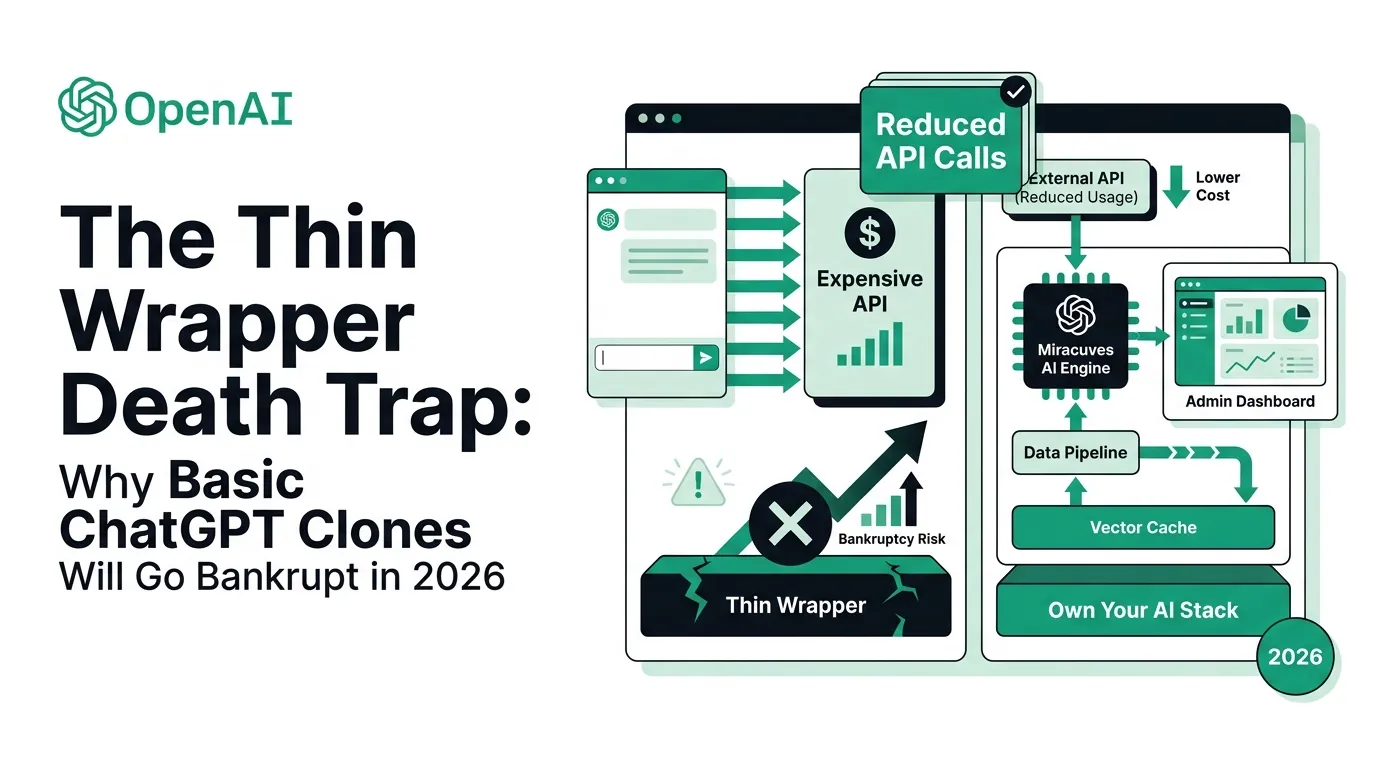
But under the surface, many of these products are not really AI businesses. They are thin wrappers: a user interface, a prompt, and an external LLM API doing almost all the actual work.
That model is dangerous for two reasons. First, it creates platform risk. If OpenAI, Apple, Google, Meta, or another platform releases the same feature inside a product users already use, the wrapper loses its reason to exist. Second, it creates cost risk. Every repeated user message becomes another paid API call unless the product has a smarter architecture.
OpenAI’s current API pricing shows why this matters. For example, GPT-5.5 is listed at $5.00 per 1M input tokens, $0.50 per 1M cached input tokens, and $30.00 per 1M output tokens. GPT-5.4 mini is lower, but still bills by input, cached input, and output tokens.
For founders, the lesson is simple: the winning AI chatbot is not the one with the prettiest chat window. It is the one with better data ingestion, smarter retrieval, caching discipline, model routing, admin control, and a clear business workflow.
Miracuves helps founders build white-label and source-code-owned app foundations, and for AI chatbot products, that means thinking beyond a basic ChatGPT clone. The real product is the intelligence layer around the model: the data pipeline, the cache, the controls, and the business-specific knowledge system.
The Illusion of the AI App Boom: Why UI Is Not a Moat
The fastest way to launch an AI chatbot is also the easiest way to build a fragile business.
Many new AI products follow the same pattern:
- Build a chat interface.
- Add a system prompt.
- Connect to an external LLM API.
- Save chat history.
- Add subscriptions.
- Call it a product.
This can be useful for validation, but it is rarely enough for long-term defensibility. A chatbot that only forwards messages to a model does not control the intelligence layer. It rents intelligence from the model provider and competes mainly on interface, pricing, and niche positioning.
That is the thin wrapper death trap.
A thin wrapper may work when the user need is narrow, the interface is unique, or distribution is strong. But if the product has no proprietary data, no workflow integration, no internal knowledge graph, no domain-specific retrieval, and no cost optimization, it becomes easy to copy and expensive to operate.
A defensible AI chatbot needs more than a chat screen. It needs proprietary context.
That context can come from:
| Proprietary Layer | Why It Matters |
|---|---|
| Business documents | Gives the chatbot answers competitors cannot generate from public model knowledge |
| Customer history | Enables personalized support and recommendations |
| Product catalogues | Supports commerce, marketplace, and SaaS workflows |
| Internal SOPs | Turns the chatbot into an operational assistant |
| Usage analytics | Helps founders understand what users ask, where the bot fails, and what to improve |
| Semantic cache | Prevents repeated prompts from triggering unnecessary external API calls |
The moat is not “we use AI.” The moat is “our AI understands our business data, our workflows, and our users better than a generic model does.”
Read More: What is ChatGPT App and How Does It Work?
The API Cost Problem Most AI Founders Underestimate
A basic chatbot has a silent cost problem: every user message can become a new external API request.
At small scale, this feels manageable. At growth scale, it becomes a margin problem. If the product charges users a low monthly subscription but allows heavy chat usage, the founder can end up subsidizing power users.
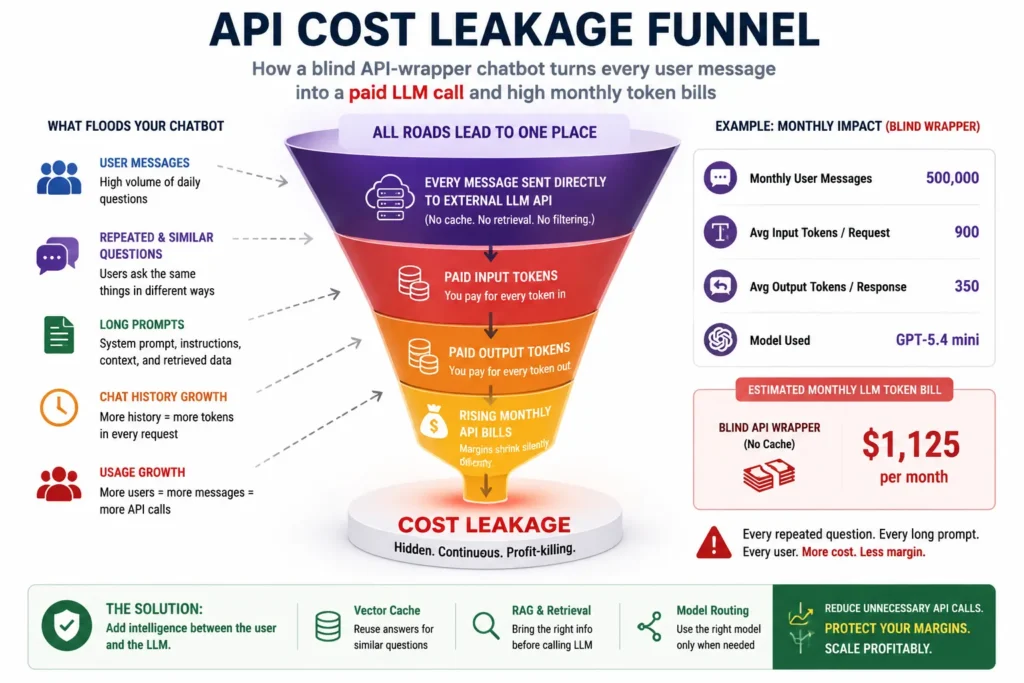
The cost structure usually has four layers:
| Cost Layer | What It Means | Founder Risk |
|---|---|---|
| Input tokens | User message, system prompt, prior chat context, retrieved content | Long prompts increase cost even before the model answers |
| Output tokens | The model-generated response | Detailed answers can be more expensive than expected |
| Retrieval cost | Embeddings, vector search, storage, indexing | Poor pipeline design adds infrastructure overhead |
| Redundant calls | Repeated or similar questions sent to the LLM again | Avoidable cost leakage |
OpenAI also provides prompt caching for repeated prompt prefixes. According to OpenAI’s documentation, prompt caching can reduce latency by up to 80% and input token costs by up to 90%, and it works automatically for supported requests. It is available for prompts of 1,024 tokens or more, with cache hits depending on exact prefix matches and prompt structure.
That is helpful, but founders should not confuse prompt caching with product-level semantic caching.
Prompt caching helps when the prompt prefix is repeated. A vector caching layer helps when different users ask similar questions with different wording.
Example:
- “How do I reset my account password?”
- “I forgot my password. What should I do?”
- “Can you help me recover login access?”
- “Where is the password reset option?”
A blind chatbot sends all four to the LLM. A smart chatbot can detect semantic similarity, reuse or adapt a verified answer, and avoid unnecessary external calls when confidence is high.
Modeled Benchmark: How Smart Vector Caching Can Reduce Monthly LLM Token Bills by 62%
This benchmark is a modeled cost scenario for a white-label AI chatbot engine. It is designed to show the business logic behind vector caching, not to claim a universal result.
Benchmark Assumptions
| Variable | Blind API Wrapper | Smart Vector Cache Architecture |
|---|---|---|
| Monthly user messages | 500,000 | 500,000 |
| Average input tokens per request | 900 | 900 |
| Average output tokens per response | 350 | 350 |
| External LLM call rate | 100% | 38% |
| Cache/retrieval handled responses | 0% | 62% |
| Model used for benchmark | GPT-5.4 mini | GPT-5.4 mini |
| Input price used | $0.75 / 1M tokens | $0.75 / 1M tokens |
| Output price used | $4.50 / 1M tokens | $4.50 / 1M tokens |
GPT-5.4 mini pricing is listed by OpenAI at $0.75 per 1M input tokens, $0.075 per 1M cached input tokens, and $4.50 per 1M output tokens.
Monthly Cost Model
| Metric | Blind API Wrapper | Smart Vector Cache | Difference |
|---|---|---|---|
| External LLM requests | 500,000 | 190,000 | -310,000 |
| Billable input tokens | 450M | 171M | -279M |
| Billable output tokens | 175M | 66.5M | -108.5M |
| Input token cost | $337.50 | $128.25 | -$209.25 |
| Output token cost | $787.50 | $299.25 | -$488.25 |
| Estimated LLM token bill | $1,125.00 | $427.50 | -$697.50 |
| Modeled savings | — | 62% | — |
What the 62% Really Means
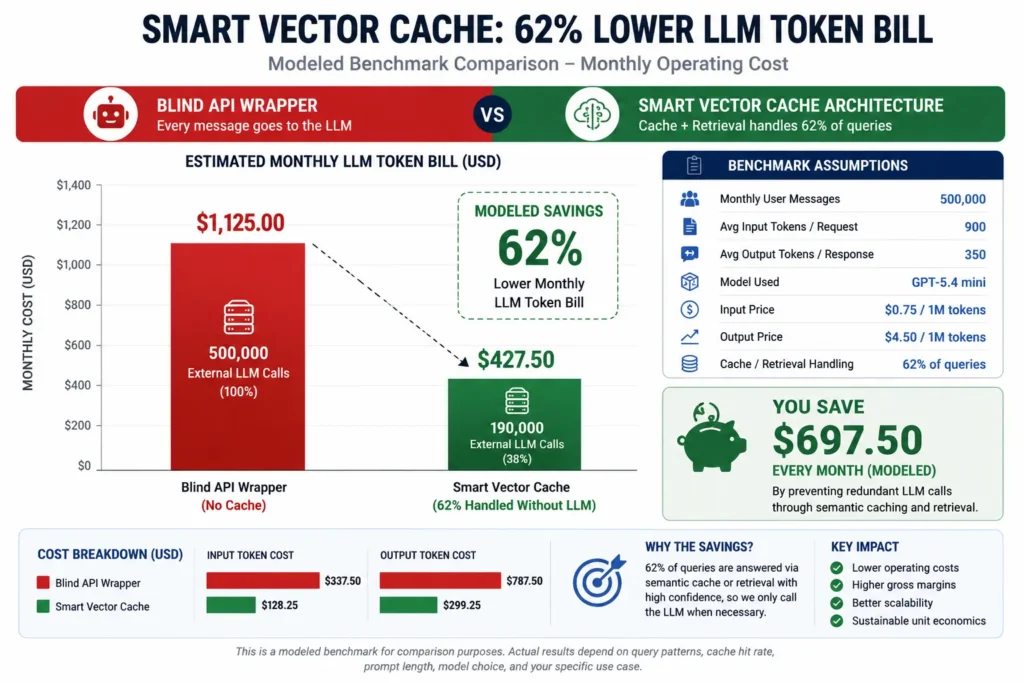
The 62% reduction comes from lowering the number of external LLM calls, not from making the LLM cheaper.
The formula is simple:
Savings = 1 - (smart-cache LLM calls / blind-wrapper LLM calls)
In this scenario:
1 - (190,000 / 500,000) = 62%
The founder does not save because the chatbot is less useful. The founder saves because the system stops paying the model to answer questions it has already answered safely.
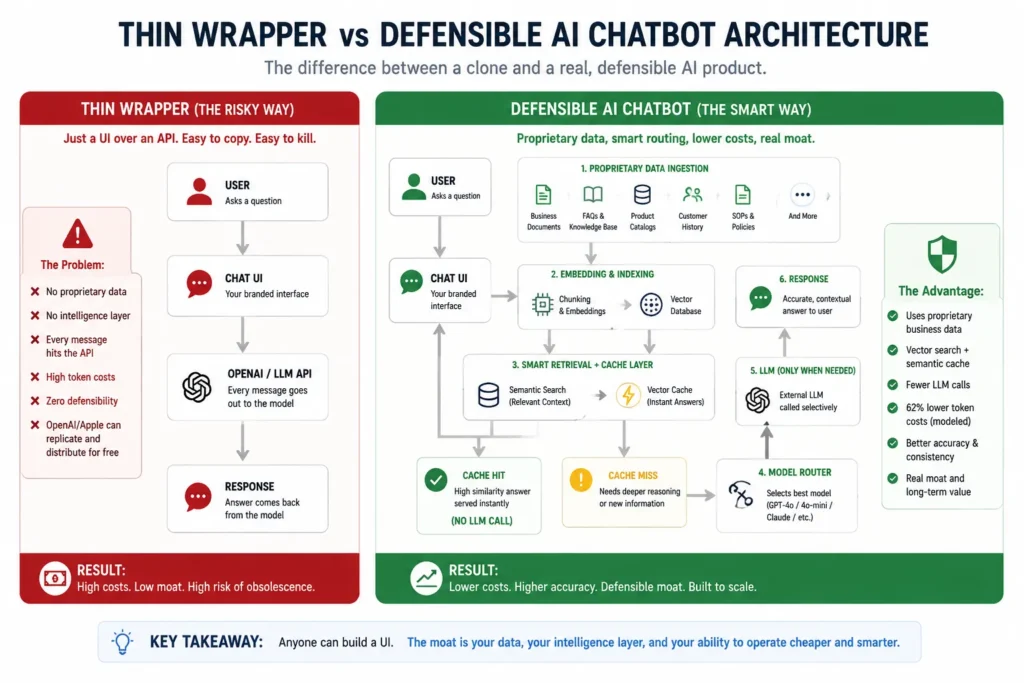
A semantic caching layer typically works like this:
- Convert incoming user query into an embedding.
- Search the vector cache for similar previous queries.
- Check similarity score, answer freshness, source validity, and policy constraints.
- Return cached or lightly adapted response when confidence is high.
- Route uncertain, sensitive, new, or low-confidence queries to the LLM.
- Store approved answers and metadata for future reuse.
This is where a white-label AI chatbot engine becomes more than a wrapper. It becomes an operating system for AI conversations.
AI Chatbot Architecture: Blind Wrapper vs Smart Vector Cache
| Layer | Blind ChatGPT Wrapper | Smart Vector Cache Chatbot | Founder Impact |
|---|---|---|---|
| User query handling | Sends every message to external LLM | Checks semantic cache before LLM routing | Reduces avoidable token burn |
| Business data | Often limited to prompt text | Uses indexed proprietary documents and structured knowledge | Creates a stronger product moat |
| Repeated questions | Paid again every time | Answered from verified cache when safe | Improves gross margin |
| Admin control | Minimal prompt editing | Knowledge uploads, cache rules, analytics, moderation controls | Gives founders operational control |
| Platform risk | High because product depends mainly on external model | Lower because value comes from business-specific data and workflows | Improves defensibility |
Platform Risk: What Happens When OpenAI or Apple Releases Your Core Feature for Free
Platform risk is not theoretical.
When a startup’s core value is “we give users access to a general-purpose AI assistant with a nicer interface,” the business depends on a feature gap staying open. But platform companies close feature gaps quickly.
Apple has already integrated OpenAI capabilities into its device ecosystem, and xAI has sued Apple and OpenAI over alleged anticompetitive conduct related to AI competition and App Store rankings. The legal claims are disputed, but the broader strategic signal is clear: AI distribution is moving into operating systems, app stores, browsers, productivity tools, and default consumer interfaces.
A founder cannot control what a platform releases next. But a founder can control whether the product has value beyond the model.
A thin-wrapper chatbot asks:
“Can we make the model easier to access?”
A defensible AI product asks:
“Can we make the model useful inside a specific business workflow using proprietary data, permissions, memory, analytics, and automation?”
That difference matters.
A basic chatbot can be replaced by a free feature. A business-specific AI system is harder to replace because it understands the company’s documents, customers, rules, products, and processes.
Read More: Top ChatGPT Features Every Startup Should Know
The Miracuves Blueprint: Building Defensible AI Using Proprietary Data Pipelines
Miracuves’ ready-made and white-label positioning focuses on source-code ownership, admin dashboards, scalable backend foundations, monetization-ready platforms, and faster market validation.
For AI chatbot products, that philosophy translates into a simple blueprint:
Do not build only the chatbot. Build the intelligence supply chain behind the chatbot.
A defensible white-label AI chatbot engine should include:
| System Layer | What It Does | Why Founders Need It |
|---|---|---|
| Data ingestion pipeline | Imports PDFs, help docs, product data, FAQs, CRM exports, SOPs, and web pages | Turns generic AI into business-specific AI |
| Chunking and cleaning layer | Breaks documents into searchable, structured units | Improves retrieval quality |
| Embedding engine | Converts text into vector representations | Enables semantic search and cache matching |
| Vector database | Stores searchable knowledge and previous answer patterns | Supports RAG and semantic caching |
| Cache policy engine | Decides when to reuse, refresh, or reject cached answers | Prevents unsafe or stale reuse |
| Model router | Sends only necessary prompts to external LLMs | Reduces token bills and supports model flexibility |
| Admin dashboard | Gives platform operators control over data, users, prompts, cache, and analytics | Reduces dependency on developers |
| Analytics layer | Tracks unanswered questions, token usage, cache hit rate, and user satisfaction | Helps founders improve margins and product quality |
Miracuves can help founders plan this architecture as part of a white-label app development or AI chatbot product strategy, especially when the goal is faster validation without giving up source-code ownership.
Read More: How to Build an App Like ChatGPT: Developer Guide
What a Defensible AI Chatbot Engine Actually Needs
A chatbot that sends messages to an LLM is a feature. A chatbot that manages data, cost, retrieval, and admin control is a product.
1. Proprietary Data Ingestion
The chatbot should be able to ingest business-specific knowledge, such as:
- Product documentation
- Support tickets
- Pricing rules
- Internal SOPs
- Training manuals
- Customer onboarding guides
- Policy documents
- Industry-specific knowledge bases
Without ingestion, the chatbot depends too heavily on general model knowledge.
2. Retrieval-Augmented Generation
RAG allows a chatbot to retrieve relevant business information before generating an answer, making responses more accurate, contextual, and grounded in trusted data. For enterprise chatbots, RAG is especially valuable because it connects AI responses with verified internal knowledge, governance rules, and structured data systems instead of relying only on generic model output.
For founders, the practical value is clarity. RAG reduces the gap between “the model can talk” and “the product can answer our users correctly.”
3. Semantic Vector Caching
Semantic caching checks whether a new question is similar to something already answered.
It is especially useful for:
- Customer support FAQs
- Onboarding questions
- Pricing explanations
- Product comparisons
- Troubleshooting steps
- Internal HR or operations questions
- Marketplace policy answers
- SaaS help desk automation
Research on conversational caching has also explored reusing responses for semantically similar prompts to reduce latency and cost. One ConvoCache paper reports that conversational caching can reuse responses under a coherence threshold and reduce generative AI usage in evaluated settings.
A production founder should still apply safeguards. Cache reuse should be confidence-based, source-aware, and controlled by admin settings.
4. Admin Controls and Human Review
An AI chatbot needs an admin dashboard because founders cannot rely on developers for every small correction.
Admin controls should include:
- Knowledge base upload and approval
- Prompt and instruction management
- Cache enable/disable rules
- Confidence threshold settings
- User role permissions
- Escalation rules
- Conversation logs
- Token usage analytics
- Failed query review
- Abuse reporting and moderation workflows
For AI products handling user-generated content, practical security language matters. Miracuves’ security rules recommend positioning security as a foundation and using careful terms such as encrypted data transfer, role-based access control, audit logs, secure API integration, admin access controls, content moderation, abuse reporting, activity logs, and privacy-conscious data handling.
5. Model Routing
Not every query needs the most expensive model.
A smart AI chatbot can route requests based on complexity:
| Query Type | Suggested Routing Logic |
|---|---|
| Repeated FAQ | Semantic cache |
| Simple classification | Smaller model |
| Business-specific answer | RAG + model |
| Sensitive or ambiguous answer | Higher-quality model + review rules |
| Policy or legal-like answer | Escalation or cautious response |
| Unsupported question | Safe fallback |
Model routing protects margins because it prevents every request from taking the same expensive path.
Founder Decision Signals
Speed
A ready-made chatbot foundation helps you launch faster, but speed only matters if the architecture can support real usage after launch.
Cost
If every user message becomes an external LLM call, your monthly token bill grows directly with usage. Semantic caching helps reduce repeated-call waste.
Scalability
Scalability is not only server capacity. It includes prompt structure, retrieval quality, cache hit rate, model routing, admin controls, and monitoring.
Market Fit
A defensible AI chatbot should answer business-specific questions better than a generic assistant. Proprietary data is the foundation of that advantage.
The Founder’s API Cost Dashboard: Metrics That Actually Matter
A non-technical founder does not need to inspect every vector embedding. But they should know which numbers decide whether the chatbot business is healthy.
Track these metrics from the first production release:
| Metric | Healthy Question to Ask |
|---|---|
| Cache hit rate | What percentage of questions are safely answered without a new external LLM call? |
| External API call rate | How many user messages still require paid LLM inference? |
| Average tokens per conversation | Is context growing too large as chats continue? |
| Cost per active user | Are heavy users profitable under the current pricing plan? |
| Cost per resolved conversation | Does AI automation cost less than manual support? |
| Retrieval success rate | Is the chatbot finding the right business knowledge? |
| Fallback rate | How often does the chatbot admit it does not know? |
| Escalation rate | Which queries require human review? |
| Stale answer rate | Are cached answers becoming outdated? |
| Revenue per token dollar | Does each dollar of API spend create enough user value? |
The goal is not only to make the chatbot cheaper. The goal is to make the chatbot economically scalable.
A founder who ignores token economics may celebrate user growth while silently destroying margins.
Mistakes Founders Should Avoid Before Launching an AI Chatbot
Mistakes Founders Should Avoid
Building only a chat UI over an LLM API
This creates a product that is easy to copy and highly exposed to platform updates. The defensible layer should come from business data, workflow logic, admin control, and proprietary retrieval.
Sending every message to the most expensive model
Not every query needs full LLM reasoning. Repeated FAQs, simple classifications, and known support answers can often be handled through cache, retrieval, or smaller models.
Ignoring cache safety and freshness
Semantic caching should not blindly reuse old answers. It needs confidence thresholds, source tracking, expiry rules, and admin review for sensitive topics.
Launching without token analytics
If the founder cannot see cost per user, cache hit rate, external API call rate, and token spend by feature, pricing decisions become guesswork.
White-Label AI Chatbot vs Custom AI Build: Which Route Makes Sense?
A custom AI build gives maximum flexibility, but it can take longer and require more upfront architecture decisions. A white-label AI chatbot foundation can help founders validate faster when the base modules already exist.
| Build Option | Best For | Strength | Risk |
|---|---|---|---|
| Basic API wrapper | Quick prototype | Fastest to demonstrate | Weak moat, high platform risk, poor cost control |
| White-label AI chatbot foundation | Founders validating a commercial AI product | Faster launch, admin control, source-code ownership, customizable workflows | Needs careful data and cache configuration |
| Full custom AI platform | Enterprise-grade, highly specialized AI workflows | Maximum control and tailored architecture | Higher planning, build, and maintenance complexity |
Miracuves’ custom app development and AI development service positioning includes white-label app development, clone app development, cloud integration, automation, and digital transformation use cases.
For founders comparing build paths, the practical question is not “Can we build a chatbot?” It is:
“Can we build a chatbot that owns enough workflow, data, and cost control to survive real usage?”
Read More: ChatGPT Clone Revenue Model: How AI Chat Platforms Make Money
How Miracuves Helps Founders Avoid the Thin Wrapper Trap
Miracuves helps founders think beyond the visible chatbot interface.
For an AI chatbot product, a stronger foundation may include:
- White-label branding
- Source-code ownership
- User and admin dashboards
- Knowledge base ingestion
- Vector database integration
- Semantic caching logic
- RAG workflows
- Model routing strategy
- Token usage analytics
- Role-based access control
- Secure API integration
- Conversation logs
- Content moderation and abuse reporting where relevant
- Monetization options such as subscriptions, usage tiers, team plans, or enterprise access
Founders exploring broader AI and automation products can start from Miracuves’ solutions hub, review related AI automation opportunities, or speak with the team through the contact page.
A ready-made foundation does not mean a generic product. The smart move is to start with proven modules, then customize the data layer, workflows, monetization, and operating controls around the target market.
Final Thoughts: Build the AI Layer, Not Just the Chat Window
The AI startup opportunity is real, but the easy version is crowded.
A basic ChatGPT clone script can be launched quickly, but if it has no proprietary data, no retrieval system, no caching layer, no token analytics, and no admin control, it is exposed from day one. It can be copied by competitors, pressured by API costs, or weakened when larger platforms release similar features for free.
The stronger decision is to build the AI layer, not just the chat window.
That means designing the product around proprietary business data, vector search, semantic caching, model routing, secure API integration, and founder-level operating controls. For founders planning to launch faster, Miracuves offers a practical path: start with a white-label, source-code-owned foundation, then customize the intelligence layer around the business model.
The future does not belong to thin wrappers. It belongs to AI products that know something, do something, and control their cost structure while they scale. Let’s build together
FAQs
What is a thin-wrapper AI app?
A thin-wrapper AI app is a product that mainly adds a user interface over an existing LLM API, such as OpenAI, without owning proprietary data, workflow logic, or a strong technical layer. These apps are fast to launch but risky because larger platforms can replicate their core functionality quickly.
Why are basic ChatGPT clone apps risky for founders?
Basic ChatGPT clone apps are risky because they often depend completely on external LLM APIs. If every user message is sent directly to the model, the business faces high token costs, weak differentiation, and platform risk when major AI companies release similar features for free.
How does vector caching reduce AI chatbot API costs?
Vector caching stores semantically similar questions and approved responses. When users ask repeated or similar questions, the chatbot can reuse a trusted answer instead of sending a fresh request to the LLM. This reduces redundant API calls and lowers monthly token bills.
Can vector caching really save 62% on LLM token costs?
A 62% saving is possible in a modeled benchmark when 62% of user queries are safely handled through semantic cache or retrieval instead of external LLM calls. Actual savings depend on query repetition, cache hit rate, prompt length, model pricing, answer freshness, and cache safety rules.
What is the difference between prompt caching and vector caching?
Prompt caching usually works when the same prompt prefix is repeated and recognized by the model provider. Vector caching works at the application level by identifying semantically similar user questions, even when the wording is different. Both can reduce costs, but vector caching gives founders more control over repeated business queries.
Why is proprietary data important for an AI chatbot business?
Proprietary data makes the chatbot more useful and defensible. Instead of giving generic answers, the chatbot can respond using a company’s documents, policies, product data, support history, SOPs, and customer workflows. This creates business-specific value that a generic AI assistant cannot easily replace.
What is RAG in AI chatbot development?
RAG, or retrieval-augmented generation, is an architecture where the chatbot retrieves relevant information from a knowledge base before generating an answer. This helps the AI provide more accurate, business-specific responses instead of relying only on the model’s general training data.
How can founders avoid the thin-wrapper death trap?
Founders can avoid the thin-wrapper death trap by building around proprietary data ingestion, vector search, semantic caching, admin controls, usage analytics, model routing, and workflow integrations. The goal is to create a product that owns useful business context, not just a chat interface.
What metrics should founders track in an AI chatbot dashboard?
Founders should track cache hit rate, external API call rate, average tokens per conversation, monthly token spend, cost per active user, fallback rate, escalation rate, retrieval success rate, and revenue per token dollar. These metrics show whether the chatbot can scale profitably.
Is a white-label AI chatbot better than building from scratch?
A white-label AI chatbot can be better for founders who want to launch faster and validate demand before investing in a fully custom platform. The stronger approach is to start with a launch-ready foundation, then customize the data pipeline, workflows, branding, monetization, and admin controls.
How does Miracuves help with AI chatbot development?
Miracuves helps founders build white-label and source-code-owned AI chatbot solutions with branded interfaces, admin dashboards, proprietary data ingestion, RAG workflows, vector caching strategy, and scalable backend logic. This helps businesses move beyond basic AI wrappers and build more defensible AI products.