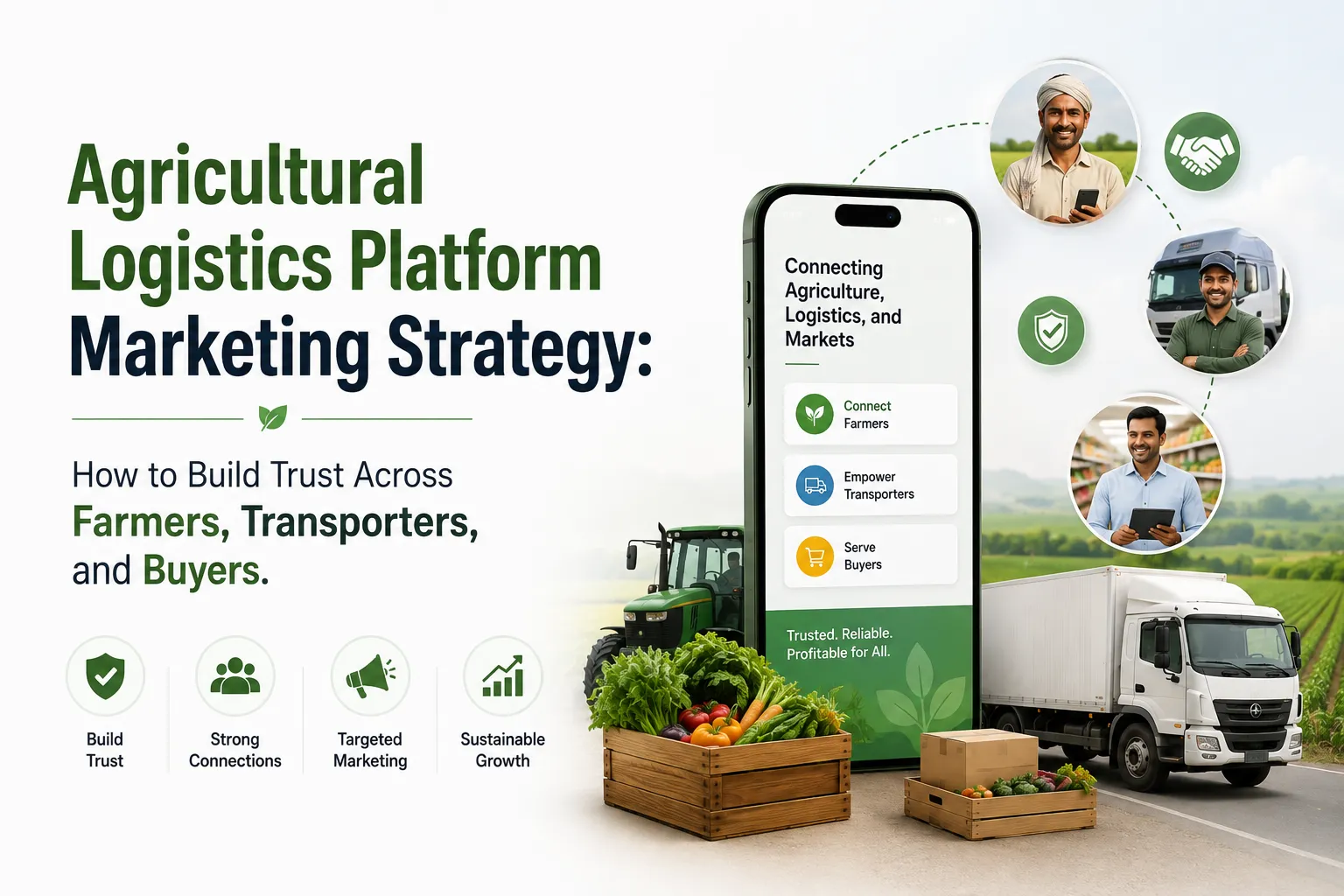
Key Takeaways
- agricultural logistics marketing strategy should focus on trust, route liquidity, local adoption, and repeat shipments rather than app downloads alone.
- Founders should start with one region, crop cluster, buyer segment, or active route before expanding marketing into multiple markets.
- Farmers, FPOs, transporters, and buyers need separate marketing messages because each group has different operational priorities.
- FPO partnerships, assisted onboarding, field demos, WhatsApp support, transporter referrals, buyer partnerships, and local SEO can support early adoption.
- Repeat load postings, active transporters, route fulfillment, buyer retention, and completed shipments are stronger growth signals than registrations alone.
Growth Signals
- Route liquidity exists when enough farmers or FPOs post loads, transporters accept shipments, and buyers create consistent demand on the same routes.
- Farmer onboarding works better with local-language support, clear rates, assisted first bookings, shipment updates, and proof of delivery.
- Transporter acquisition should emphasize verified loads, profitable routes, reduced empty trips, transparent shipment details, and settlement visibility.
- Buyer marketing should emphasize predictable deliveries, quality records, cold-chain visibility, proof of delivery, and supply consistency.
- Marketing campaigns should align with crop seasons so acquisition messages match pre-harvest planning, peak movement, and post-harvest retention needs.
Real Insights
- Running broad paid campaigns before route liquidity exists can create inactive farmers, transporters, and buyers instead of a functioning logistics marketplace.
- FPOs and cooperatives can act as trust multipliers because they already have established relationships with groups of farmers.
- Every successfully completed shipment can become operational proof that strengthens confidence among farmers, transporters, and buyers.
- Marketing cannot compensate for weak shipment workflows, tracking, admin control, settlement visibility, or unreliable fulfillment.
- The strongest growth path is: focused route → local onboarding → route liquidity → successful shipments → repeat usage → referrals → regional expansion.
Launching an agricultural logistics platform is only the first step. The real challenge is getting farmers, FPOs, transporters, buyers, warehouses, and cold-chain partners to trust the system enough to use it repeatedly.
Unlike a normal delivery app, farm logistics depends on relationships, route reliability, produce quality, payment confidence, and seasonal demand. A farmer will not shift from phone-based transport booking unless the platform proves reliability. A transporter will not stay active unless there are profitable loads. A buyer will not depend on the platform unless produce arrives on time and quality records are clear.
That is why marketing an agricultural logistics marketing strategy platform is not only about ads or app downloads. It is about building a trusted farm-to-market network where every participant sees practical value.
Why Marketing an Agricultural Logistics Platform Is Different
A standard logistics app usually markets speed, convenience, delivery visibility, and cost savings. An agricultural logistics platform must market something deeper: confidence across a fragmented supply chain.
The platform may need to serve:
- Farmers who need reliable crop transportation
- FPOs and cooperatives that aggregate produce from multiple growers
- Transporters who want steady loads and better route utilization
- Buyers who need timely delivery and quality visibility
- Warehouses and collection centres managing storage and handover
- Cold-chain operators handling temperature-sensitive produce
- Platform operators who need admin control, reports, and settlement clarity
This means one generic marketing message will not work for every user group. Farmers care about trust, transport availability, pricing clarity, and payment visibility. Transporters care about route profitability, verified loads, and fewer empty return trips. Buyers care about delivery reliability, produce condition, and quality records.
Founders planning this type of marketplace should also understand how agriculture and agritech platform development connects field users, produce workflows, and digital operating systems for farm businesses.
Start With Route Liquidity Before Scaling Ads
The biggest mistake founders make is running broad marketing campaigns before the platform has enough supply and demand in one region.
For a farm-to-market logistics network, early growth depends on route liquidity. That means there are enough farmers or FPOs posting loads, enough transporters accepting shipments, and enough buyers creating consistent demand on the same routes.
Without route liquidity, marketing spend gets wasted. Farmers may join but fail to find vehicles. Transporters may register but see no useful loads. Buyers may test the platform once and leave because fulfillment is inconsistent.
A better launch strategy is to start with one focused route or crop cluster.
For example:
| Launch Focus | Why It Works | Marketing Priority |
|---|---|---|
| One crop category | Easier messaging and partner targeting | Build campaigns around a specific produce movement problem |
| One region | Easier field onboarding and route management | Concentrate local awareness and support |
| One buyer segment | Easier demand generation | Build predictable shipment volume |
| One transporter network | Easier operational reliability | Improve load availability and response times |
| One FPO cluster | Faster farmer access | Use trusted local aggregation points |
Once the first route becomes active, the platform has real proof. Every completed shipment becomes a trust signal. Every repeat transporter strengthens supply. Every satisfied buyer improves demand confidence.
Read more – Farm-to-Market Logistics App Development Guide: Features, Cost Drivers, and Workflow Planning
Build Farmer Trust With Local Onboarding
Farmers do not adopt a new platform just because it has good features. They adopt when the platform solves a real problem in a way they understand.
For many farmers, the first concern is not app design. It is whether the vehicle will arrive, whether the rate is fair, whether produce will be handled properly, and whether payment status will be visible.
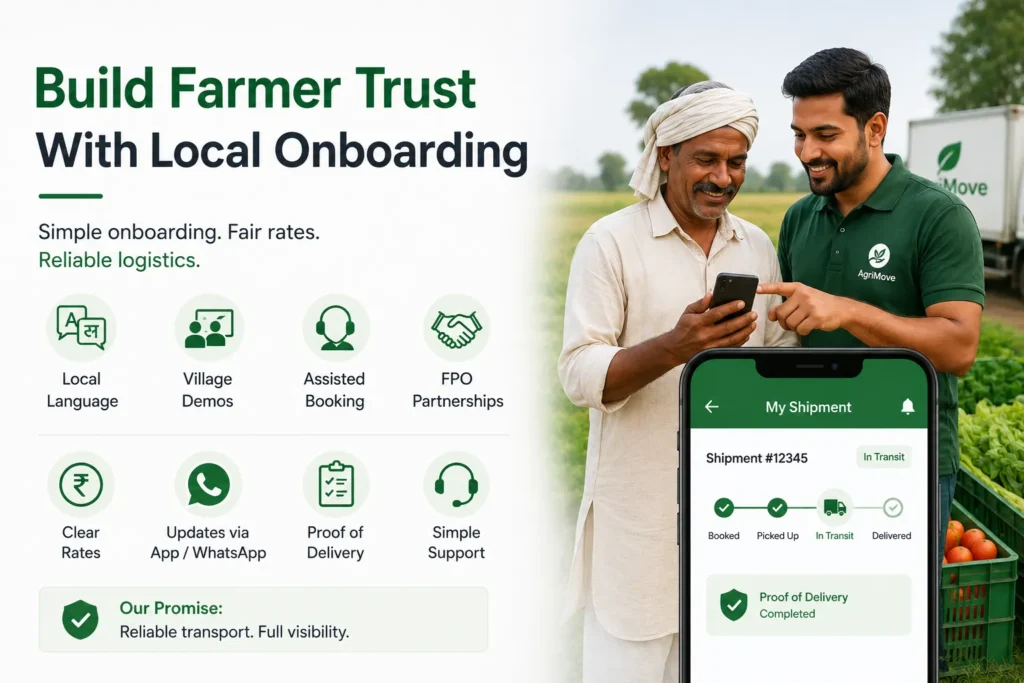
A strong farmer onboarding strategy should include:
- Local-language app screens and support material
- Village-level product demos
- Assisted first shipment booking
- FPO and cooperative partnerships
- Clear explanation of transport rates and service fees
- Shipment status updates through mobile notifications or WhatsApp
- Proof of pickup and proof of delivery visibility
- Simple support channels for disputes or delays
The message should be practical: “Book reliable transport for your produce, track movement, and get clear delivery confirmation.” Avoid overloading farmers with technical language.
Use FPOs and Cooperatives as Trust Multipliers
FPOs, cooperatives, and collection centres can become powerful acquisition channels because they already have relationships with farmers. Instead of convincing every farmer individually, the platform can work through trusted local organizations.
This works especially well when produce is aggregated before dispatch. FPOs can help farmers understand the platform, coordinate load creation, verify crop details, and reduce confusion during pickup.
Marketing to FPOs should focus on operational benefits:
- Better transport planning
- Reduced phone-call coordination
- Consolidated load visibility
- Clear pickup and delivery records
- Quality and grading visibility
- Easier buyer communication
- Settlement tracking
- Admin-level reporting for group activity
An agricultural logistics platform becomes more valuable when it supports the people already coordinating agricultural movement on the ground.
Attract Transporters With Route Profitability
Transporters will not remain active on the platform unless they see consistent earning potential. A logistics marketplace cannot grow if transporters sign up once and never return.
The transporter acquisition message should focus on:
- Verified agricultural loads
- Better route utilization
- Reduced empty return trips
- Faster access to nearby shipment opportunities
- Transparent load details
- Clear pickup and delivery points
- Settlement visibility
- Repeat demand from farmers, FPOs, and buyers
Transporters should know what type of loads are available, how often routes are active, what vehicle types are needed, and how payment or settlement records are handled.
For founders, this means transporter marketing should not be generic. Campaigns should be route-specific and vehicle-specific. For example, a campaign for refrigerated vehicles moving perishables should be different from a campaign for bulk vehicles moving grains.
Founders building stronger dispatch, tracking, and delivery operations can also explore Miracuves’ expertise in logistics and supply chain software development to understand how route visibility, shipment coordination, and fulfillment systems connect.
Build Buyer Demand With Reliability and Quality Visibility
Buyers need confidence before they depend on a new agricultural logistics network. Their core concern is not just transport. It is whether the produce arrives on time, whether the quality matches expectations, and whether the delivery record is transparent.
Buyer-focused marketing should highlight:
- Predictable delivery windows
- Crop and quantity visibility
- Quality inspection records
- Cold-chain handling where relevant
- Proof of delivery
- Dispute records
- Supplier or FPO coordination
- Repeat shipment reliability
The platform should not simply say, “We deliver farm produce.” A stronger message is: “We help buyers receive farm produce with better shipment visibility, quality records, and delivery accountability.”
When buyers trust the system, they create repeat demand. Repeat demand gives transporters more reasons to stay active. Active transporters give farmers more confidence to post loads. That is how the marketplace loop strengthens.
Create Separate Messaging for Each User Group
An agricultural logistics platform serves multiple sides of the market. Each side needs a separate value proposition.
Agricultural Logistics Marketing Message by User Group
| User Group | Main Concern | Marketing Message |
|---|---|---|
| Farmers | Reliable vehicles, fair rates, delivery confirmation | Move produce with trusted transport, live updates, and clear delivery records. |
| FPOs / Cooperatives | Group coordination, load aggregation, reporting | Manage member produce movement with better visibility and fewer manual follow-ups. |
| Transporters | Profitable routes, verified loads, payment clarity | Find agricultural loads on active routes and reduce empty vehicle movement. |
| Buyers | Timely delivery, quality records, supply consistency | Receive produce with shipment tracking, quality visibility, and delivery proof. |
| Warehouses | Receiving, storage, dispatch coordination | Track inbound and outbound produce movement with clearer handover records. |
| Cold-Chain Partners | Temperature-sensitive handling and alert visibility | Support perishable movement with cold-chain tracking and exception records. |
| Platform Operators | Growth, control, monetization, reporting | Operate a farm logistics network with admin dashboards, reports, and business rule control. |
Use Field Marketing Before Paid Scaling
Paid ads can help later, but agricultural logistics usually needs field trust first. In early markets, personal onboarding, local demonstrations, and partner referrals may outperform generic performance marketing.
Useful field marketing tactics include:
- FPO workshops
- Farmer group demos
- Transporter meetups
- Market yard onboarding booths
- Regional language explainer videos
- WhatsApp support groups
- Local agent-led first booking support
- Route-specific launch campaigns
- Buyer referral partnerships
- Crop-season awareness drives
This approach works because farm logistics decisions are practical. Users want to see that the platform works in their region, with their crop type, on routes they already use.
Build Growth Around Crop Seasons
Agricultural logistics demand is seasonal. Harvest windows, commodity cycles, weather changes, export demand, and local market prices can all affect shipment volume.
A strong marketing calendar should align with crop seasons.
For example:
- Pre-harvest: Educate farmers and FPOs about booking transport in advance.
- Harvest period: Promote route availability, vehicle access, and quick dispatch.
- Peak movement: Highlight tracking, delivery reliability, and buyer coordination.
- Post-harvest: Share success stories, repeat shipment offers, and partner retention campaigns.
- Off-season: Recruit transporters, onboard buyers, improve training, and refine routes.
This makes marketing more relevant. Instead of promoting the platform in the same way all year, the founder can match messaging to the supply chain’s actual urgency.
Use Local SEO for Regional Supply Chain Demand
Many agricultural logistics searches are local or route-based. A buyer may search for produce transport in a specific region. A transporter may look for farm loads near a mandi, district, warehouse, or growing cluster.
Local SEO can support the platform through pages and content around:
- Crop-specific logistics routes
- Farm-to-market transport in target regions
- FPO logistics support
- Cold-chain transport for perishables
- Warehouse-to-buyer produce movement
- Regional agricultural transport services
- Buyer logistics support for specific commodities
The goal is not to create thin location pages. Each page should explain the route, crop type, user need, and operational benefit clearly.
Turn Successful Shipments Into Trust Content
In agricultural logistics, proof matters. A completed shipment can become a marketing asset when presented ethically and without exposing private business data.
Trust content can include:
- Route success snapshots
- Anonymous workflow examples
- Before-and-after process explanations
- Farmer onboarding stories
- Transporter adoption insights
- Buyer delivery experience summaries
- Cold-chain handling explainers
- Quality inspection process guides
- Platform training videos
Avoid fake case studies or exaggerated claims. The goal is to show real operational clarity, not create hype.
Retention Matters More Than One-Time Downloads
An agricultural logistics platform does not grow because users install the app once. It grows when users return for repeat shipments.
Important retention metrics include:
- Repeat load postings by farmers or FPOs
- Active transporter frequency
- Route fulfillment rate
- Buyer repeat orders
- Shipment completion rate
- Cancellation reasons
- Dispute frequency
- Average response time
- Support ticket volume
- Payment or settlement completion status
These metrics tell the founder whether the platform is becoming a working logistics network or just collecting inactive users.
Trust
If farmers, buyers, and transporters do not trust the platform, marketing spend will not convert into repeat shipments.
Liquidity
Start with one active route or crop cluster before expanding into too many regions at once.
Retention
Track repeat usage, not only downloads. A returning farmer or transporter is more valuable than a passive signup.
Operational Proof
Every successful shipment, delivery proof, quality record, and resolved dispute becomes a stronger trust signal.
Marketing Channels That Work for Farm Logistics Platforms
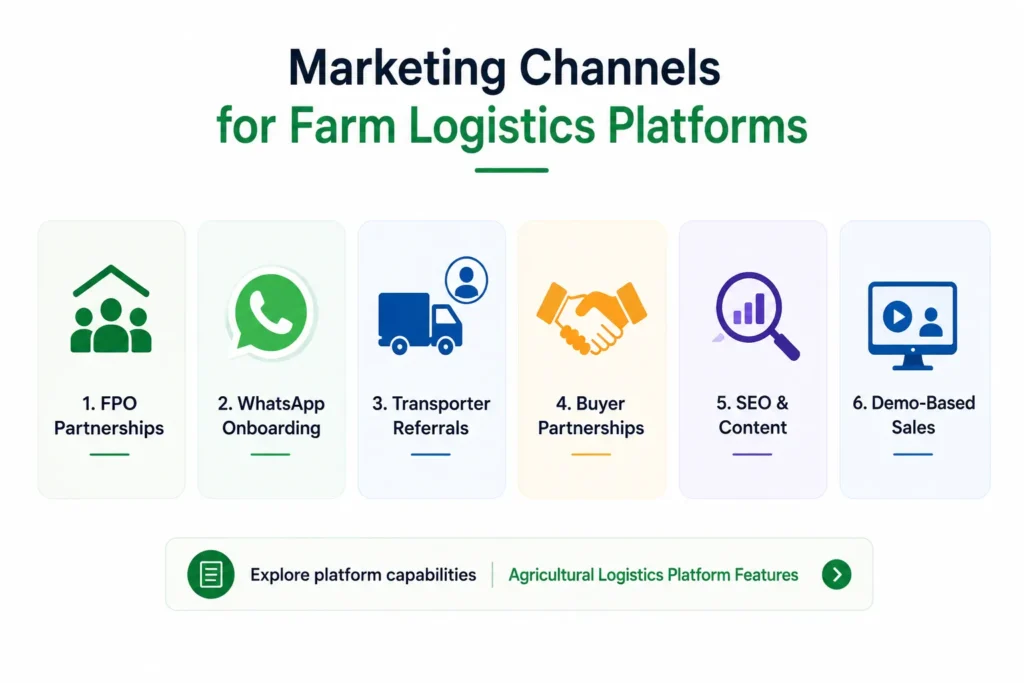
The best channel mix depends on region, crop category, and user behavior. However, most agricultural logistics platforms benefit from combining offline trust-building with digital acquisition.
1. FPO and Cooperative Partnerships
FPOs can help the platform reach multiple farmers faster. They also help reduce trust barriers because farmers are more likely to try a platform introduced through a familiar organization.
2. WhatsApp-Based Onboarding
WhatsApp is useful for reminders, shipment updates, support, driver coordination, and assisted bookings. It should support the app, not replace the product experience entirely.
3. Transporter Referral Campaigns
Transporters often know other vehicle owners on similar routes. Referral programs can help expand supply faster if the platform already has useful loads.
4. Buyer Partnerships
Buyers can create consistent demand. If buyers trust the platform, they can pull farmers, FPOs, and transporters into the network.
5. Local SEO and Educational Content
Content around route planning, crop transport, cold-chain logistics, FPO supply movement, and warehouse visibility can bring relevant search traffic without competing with the main solution page.
6. Demo-Based Sales
For commercial buyers, logistics operators, and regional platform operators, product demos are more effective than generic brochures. They need to see admin control, tracking, load management, proof of delivery, and settlement workflows.
Founders who want to compare module-level capabilities can review these agricultural logistics platform features before finalizing their launch scope.
How to Position the Platform Without Sounding Too Technical
Many agri logistics founders over-explain features and under-explain outcomes. Farmers, buyers, and transporters care about what improves for them.
Instead of saying:
“Our platform has GPS, dispatch, route planning, warehouse inventory, and admin dashboards.”
Say:
“Move produce with clearer pickup scheduling, better vehicle availability, live shipment visibility, delivery proof, and payment status tracking.”
The second message is easier to understand because it connects technology to the user’s daily problem.
Growth Strategy by Launch Stage
Marketing should change as the platform matures.
| Stage | Growth Goal | Best Marketing Focus |
| Pre-launch | Build trust and recruit early users | FPO partnerships, transporter outreach, buyer discovery |
| First route launch | Complete successful transactions | Assisted onboarding, route campaigns, first-shipment support |
| Early traction | Increase repeat usage | User education, support workflows, referral campaigns |
| Regional expansion | Grow route density | Local SEO, buyer partnerships, transporter networks |
| Scaling | Improve brand authority and retention | Case studies, analytics-led growth, enterprise partnerships |
The founder’s job is to avoid scaling before the first marketplace loop is healthy.
Cost and ROI Messaging Should Be Handled Carefully
Marketing should not promise unrealistic savings or guaranteed profit. Agricultural logistics buyers are practical. They respond better to clear operational benefits.
Strong cost-related messaging includes:
- Reduce manual coordination
- Improve shipment visibility
- Lower missed pickup risk
- Reduce communication gaps
- Improve transporter utilization
- Track proof of delivery
- Manage disputes with records
- Centralize route, user, and payment visibility
For a deeper pricing breakdown, founders can review this farm-to-market logistics app cost guide before requesting a final quote.
Monetization Messaging Should Match the Business Model
Marketing also depends on how the platform earns revenue. A commission-led marketplace needs high shipment volume. A SaaS model needs stronger software value. A managed logistics model needs operational reliability.
Common monetization angles include:
- Commission on completed shipments
- Subscription plans for transporters or buyers
- Service fees for FPOs or logistics operators
- Premium load placement
- Cold-chain handling fees
- Regional licensing
- Managed logistics support
To explore these revenue paths in more detail, founders can review this farm logistics business model breakdown and decide which model fits their market.
Read more – Load Matching and Live Tracking in Farm-to-Market Logistics Platforms: How the Workflow Works.
Where a Ready-Made Platform Fits Into the Growth Plan
Marketing cannot fix a weak product foundation. If the app does not support the right user roles, shipment workflows, tracking, admin control, and reporting, growth becomes harder after launch.
This is why founders should align product scope and go-to-market strategy before investing heavily in acquisition.
A ready-made foundation can help founders move faster when the core workflows are already available and customizable. For founders comparing build options, Miracuves’ ready-made app solutions can provide a faster starting point than building every workflow from zero.
If your operating model requires highly specific workflows, deeper integrations, or unique user journeys, custom mobile app development may be the better route for long-term flexibility.
For founders who want a launch-ready agricultural supply chain app foundation, Miracuves offers a white-label farm logistics platform that can support farmer, transporter, buyer, warehouse, tracking, and admin workflows while allowing room for branding and customization.
Mistakes Founders Should Avoid
Running Ads Before Route Liquidity Exists
If farmers cannot find vehicles or transporters cannot find useful loads, paid acquisition will create frustration instead of growth.
Using One Message for Every User Group
Farmers, transporters, buyers, and FPOs care about different outcomes. Each group needs a separate value proposition.
Ignoring Assisted Onboarding
Early agricultural users may need support during first bookings. Field demos, WhatsApp support, and local training can improve adoption.
Measuring Downloads Instead of Repeat Shipments
Downloads are not enough. The stronger growth signal is whether users return to create, accept, track, and complete shipments again.
How Miracuves Helps Founders Launch and Grow Smarter
Miracuves helps founders build ready-made and white-label app platforms with branded design, admin dashboards, source-code ownership, and faster deployment.
For agricultural logistics, the product and marketing strategy should work together. The app needs the right workflows, and the go-to-market plan needs the right trust-building sequence. Farmers need confidence. Transporters need useful loads. Buyers need delivery reliability. Operators need dashboard control.
Businesses that need expert support can work with Miracuves as an agricultural logistics app development company to plan, customize, and launch a platform aligned with their market.
Final Thoughts
A strong agricultural logistics platform marketing strategy is not built around generic app promotion. It is built around trust, route liquidity, farmer onboarding, transporter profitability, buyer reliability, and repeat shipment behavior.
The smartest founders start small: one region, one crop cluster, one route, one reliable user loop. Once that route proves demand, marketing becomes more credible because the platform has operational proof.
When the platform solves real coordination problems, every shipment becomes a growth asset. Every successful delivery builds trust. Every active transporter strengthens supply. Every repeat buyer improves demand. That is how an agricultural logistics platform moves from launch to long-term adoption.
FAQs
How do you market an agricultural logistics platform?
Start with one crop cluster, one region, and one active route. Onboard farmers and transporters manually, partner with FPOs, recruit buyers, use WhatsApp support, create local SEO pages, and track repeat shipments instead of only app downloads.
What is the best first growth strategy for a farm logistics app?
The best first strategy is route liquidity. Choose a high-demand farm-to-market route, onboard enough transporters, activate farmer groups, secure buyer demand, and complete successful shipments before scaling paid campaigns.
How can an agricultural logistics platform attract farmers?
Use village demos, FPO partnerships, local-language onboarding, assisted first shipments, transparent rates, proof of delivery, and payment visibility. Farmers adopt faster when they see practical value and local trust.
How can a farm logistics platform attract transporters?
Market the platform around profitable routes, verified loads, reduced empty return trips, faster communication, route alerts, and repeat demand from farmers, FPOs, and buyers. Transporters stay active when they see consistent earning opportunities.
Why are FPO partnerships important for agricultural logistics marketing?
FPOs already have farmer relationships and can help with education, aggregation, trust-building, and load coordination. Partnering with FPOs can reduce acquisition friction and improve early adoption.
What marketing channels work best for farm-to-market logistics platforms?
Useful channels include FPO partnerships, WhatsApp onboarding, field demos, transporter referral campaigns, buyer partnerships, local SEO, crop-season campaigns, and demo-led B2B sales.
What metrics should founders track after launch?
Track repeat load postings, active transporters, route fulfillment rate, buyer repeat demand, shipment completion rate, cancellations, disputes, response time, and settlement status. These metrics show whether the platform is becoming a real logistics network.
How can Miracuves help with agricultural logistics platform launch?
Miracuves helps founders build ready-made and white-label app platforms with source-code ownership, branded design, admin dashboards, shipment workflows, tracking, and customization support. Final scope depends on the target region, logistics model, user roles, and integration needs.
Miracuves is an independent software development company. We are not affiliated with, connected to, sponsored by, or endorsed by any company or product named in this article.
Terms such as “X Clone” are used descriptively. It is how the software industry refers to building a platform with functionality comparable to a known service, and how clients search for it.
The entire design and codebase of our products is built by our own team. Our products contain no code, design, graphics, or content originating from any third-party website or applications.
All third-party names and marks referenced in this article are the property of their respective owners, referenced solely to identify the services discussed.