Key Takeaways
- Agricultural logistics platform development requires more than basic pickup and delivery because farm produce involves transporters, FPOs, warehouses, buyers, quality checks, and settlement workflows.
- The first version should focus on load posting, transporter assignment, shipment tracking, driver workflows, admin controls, notifications, and basic settlement records.
- Development cost depends on user roles, matching logic, live tracking, warehouse workflows, cold-chain requirements, payments, integrations, and admin complexity.
- Founders should validate the core farm-to-market logistics app transaction flow before investing in IoT, predictive analytics, ERP integrations, or advanced automation.
- The strongest platform connects produce movement, transporter coordination, quality records, inventory visibility, delivery proof, and settlements in one operating system.
Planning Signals
- Fresh produce may require pickup scheduling, cold-chain alerts, quality checks, and faster delivery, while grain logistics may prioritize bulk transport and warehouse inventory.
- More user panels increase complexity because farmers, buyers, transporters, drivers, warehouses, inspectors, and admins require different permissions and workflows.
- Matching can range from simple manual dispatch to transporter bidding, automatic allocation, route-based recommendations, and vehicle-capacity logic.
- Offline-friendly workflows should be considered when drivers and collection agents operate in rural areas with inconsistent connectivity.
- Monetization can include shipment commissions, transporter subscriptions, buyer service fees, priority load placement, and SaaS licensing.
Real Insights
- Agricultural logistics should not be treated like standard parcel delivery because freshness, grading, storage, buyer acceptance, and multi-party settlements change the workflow.
- Founders should start by identifying the agricultural movement problem they need to solve rather than copying every possible logistics feature.
- A strong admin dashboard reduces operational dependency on developers by allowing teams to manage users, loads, rates, disputes, payments, and business rules.
- Cold-chain, IoT, telematics, ERP, and advanced analytics should be added when real operational demand justifies the extra complexity.
- The strongest development path is: define the transaction workflow → launch essential roles → validate shipments → improve operational control → add automation and intelligence.
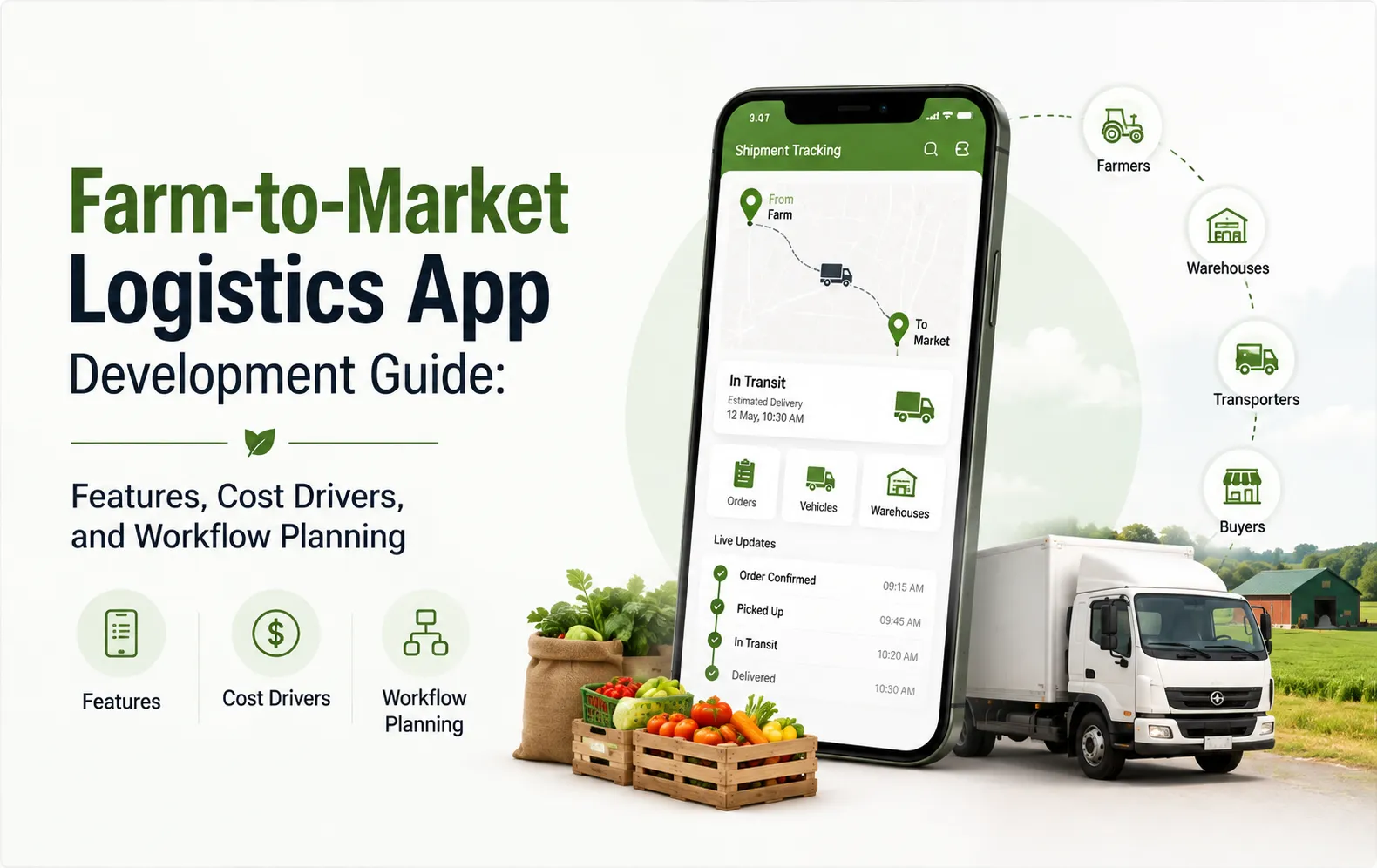
Moving produce from farms to buyers looks simple from the outside: a farmer harvests, a transporter picks up, a buyer receives, and payment follows. In reality, farm-to-market logistics is a chain of time-sensitive decisions involving collection centres, FPOs, transporters, warehouses, cold-chain handlers, quality inspectors, buyers, invoices, and settlement records.
That is why founders are increasingly looking at an agricultural logistics platform as more than a delivery app. The real value is not just tracking trucks. It is creating a digital operating layer where produce movement, load matching, quality checks, route planning, inventory visibility, and payment workflows work together.
This guide explains how to plan a farm-to-market logistics app which features matter first, what drives development cost, and how founders can avoid building an oversized product before validating the operating model.
What Is a Farm-to-Market Logistics App?
A farm-to-market logistics app sits at the intersection of agriculture, transportation, and digital supply-chain coordination. Since these platforms often involve farmers, FPOs, buyers, warehouses, and transport partners, founders should first understand how agriculture and agritech platform development supports real-world crop movement, producer onboarding, commodity workflows, and rural market operations.
Unlike a generic delivery app, a farm-to-market system must understand agricultural realities. Produce may need grading before dispatch. Some goods require temperature monitoring. FPOs may coordinate multiple farmers. Warehouses may hold inventory temporarily. Buyers may release payments after quality approval. Transporters may bid on loads based on route, vehicle type, and commodity handling needs.
A strong agricultural logistics platform usually connects these workflows:
- Harvest pickup scheduling
- Farmer or FPO load posting
- Transporter discovery and allocation
- Vehicle type selection
- Route and dispatch planning
- Cold-chain and reefer tracking
- Warehouse receiving and inventory updates
- Quality inspection and grading
- Digital proof of delivery
- Invoice and settlement tracking
- Admin control over users, loads, rates, disputes, and reports
The goal is not just faster transportation. The goal is operational visibility across the full supply chain.
Why Farm-to-Market Logistics Needs a Different App Strategy
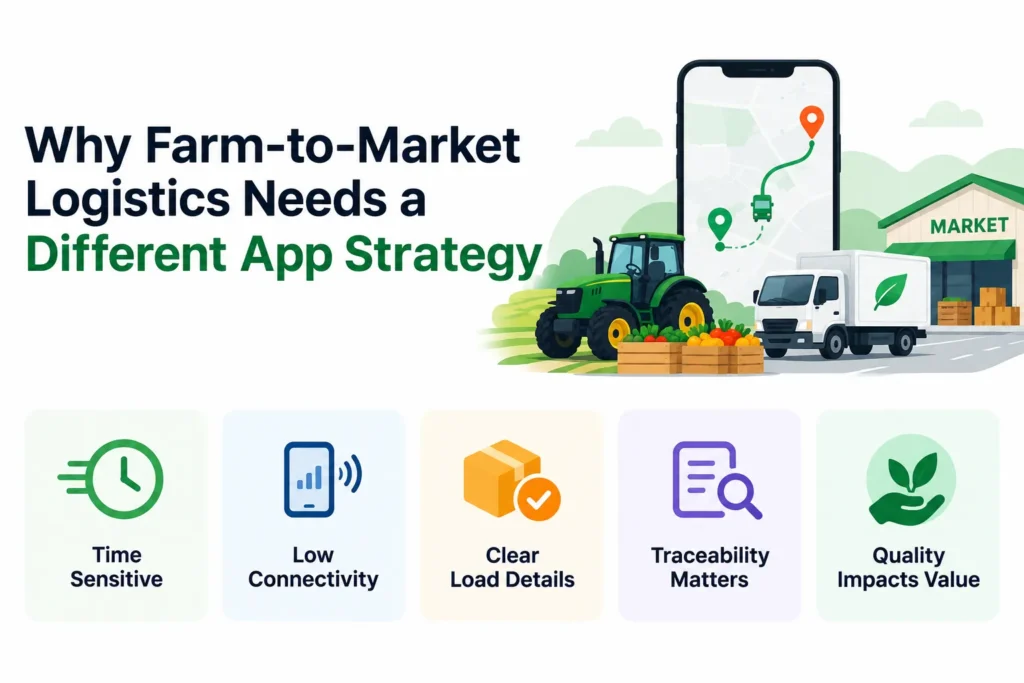
Agricultural logistics cannot be planned like a standard delivery app because produce movement depends on route planning, shipment visibility, storage conditions, transporter availability, and buyer acceptance. Founders building this type of operating system can also explore Miracuves’ experience in logistics and supply chain software development to understand how dispatch, tracking, fulfillment, and multi-party coordination connect inside a scalable logistics product.
Farm produce has time sensitivity. A delay can affect freshness, grade, buyer acceptance, and final settlement value. Many routes start in low-connectivity areas. Field users may need simple mobile workflows. Buyers may care about traceability. Transporters need clear load details before accepting a trip. Admin teams need visibility into exceptions, cancellations, quality disputes, and payment status.
That is why founders should not start by asking, “What features should we copy?” A better question is:
Which agricultural movement problem are we solving first?
A fresh vegetables platform may prioritize pickup scheduling, cold-chain alerts, and delivery speed. A grain logistics platform may prioritize bulk shipment, weighing records, warehouse inventory, and buyer settlement. An export-focused platform may need stronger documentation, quality checkpoints, and traceability records.
This is where planning matters. The right agricultural logistics platform should fit the business model before it expands into every possible module.
Core User Roles in a Farm-to-Market Logistics Platform
Before discussing features, founders should define who will use the platform. Agricultural logistics usually has more role complexity than standard delivery apps.
| User Role | What They Need | Why It Matters |
|---|---|---|
| Farmers | Pickup requests, crop details, shipment updates, payment visibility | Helps producers know when goods move and when settlement is expected |
| FPOs / Collection Centres | Member produce aggregation, load posting, grading, warehouse handoff | Supports group-based supply movement and better coordination |
| Buyers | Available loads, delivery status, quality records, invoices | Builds buyer trust and reduces manual follow-ups |
| Transporters | Load discovery, bidding, assigned trips, route details, payment records | Helps carriers accept the right loads and reduce empty vehicle movement |
| Drivers | Pickup location, delivery route, proof of pickup, proof of delivery | Keeps field execution simple and trackable |
| Warehouse Teams | Receiving, bin/location updates, inventory status, dispatch preparation | Helps prevent produce loss, misplacement, and manual reconciliation |
| Quality Inspectors | Inspection checklist, grade capture, rejection reason, photo proof | Creates a record for buyer approval and dispute resolution |
| Admin Team | User control, commission settings, trip monitoring, disputes, analytics | Gives the platform operator control over the business |
A founder does not always need to launch with every role. But the data model should be planned carefully so that future roles do not require rebuilding the product foundation.
Essential Features for a Farm-to-Market Logistics App
The best feature set depends on your market, produce type, buyer network, and logistics model. Still, most agricultural logistics products need a few core modules to work reliably.
The right feature set depends on whether the platform handles direct farm pickup, FPO aggregation, warehouse movement, buyer delivery, cold-chain transport, or transporter bidding. Founders who want to compare module-level requirements can review these agricultural logistics platform features before finalizing which workflows should be included in the first launch version.
Farm-to-Market Logistics Features and Business Value
| Feature | Business Value | Founder Impact |
|---|---|---|
| Load Posting | Allows farmers, FPOs, or buyers to create transport requirements with crop type, quantity, pickup point, and destination. | Creates the transaction base for the platform. |
| Transporter Matching | Connects available vehicles with active produce movement requirements. | Improves fulfillment speed and reduces manual calling. |
| Route Planning | Helps assign optimized pickup and delivery routes based on distance, stop sequence, and vehicle capacity. | Supports better delivery predictability. |
| Cold-Chain Monitoring | Tracks temperature-sensitive movement for perishables, dairy, floriculture, and export-grade produce. | Reduces risk of quality loss and buyer disputes. |
| Warehouse Inventory | Manages receiving, storage, stock movement, dispatch, and inventory visibility. | Helps scale beyond direct pickup-to-buyer delivery. |
| Quality Inspection | Captures grade, photos, acceptance status, rejection reasons, and checklist results. | Creates a transparent record between sellers and buyers. |
| Digital Proof of Delivery | Records delivery confirmation through photo, signature, OTP, or timestamped status updates. | Reduces disputes and improves settlement confidence. |
| Settlement Dashboard | Tracks payable amounts, commissions, transporter payments, refunds, and settlement status. | Helps operators manage revenue and partner trust. |
Feature Planning by Launch Stage
A common mistake is trying to build the entire agricultural supply chain stack from day one. That usually increases cost, delays launch, and creates features the market has not yet validated.
A better approach is to divide the platform into launch stages.
Stage 1: Market Validation Version
This version should prove whether users will actually post loads, accept trips, track shipments, and complete transactions through the platform.
Useful features include:
- Farmer or FPO registration
- Buyer and transporter onboarding
- Load posting
- Basic transporter assignment or bidding
- Pickup and delivery status tracking
- Driver app or mobile field view
- Admin dashboard
- Basic payments or settlement records
- Notifications through SMS, email, WhatsApp, or push alerts
At this stage, the focus is adoption. The platform should be simple enough for field users and clear enough for operators to manage daily work.
Stage 2: Operational Control Version
Once transactions start moving, the founder needs stronger control.
This stage may include:
- Commission configuration
- Transporter performance tracking
- Quality inspection workflows
- Dispute management
- Warehouse receiving and dispatch records
- Route optimization
- Multi-location operations
- Admin reports and analytics
- Role-based access control
This is where an agricultural logistics platform starts becoming a real operating system rather than a basic booking tool.
Stage 3: Scale and Intelligence Version
After the model is validated, advanced modules can create stronger differentiation.
These may include:
- Cold-chain IoT integrations
- Telematics integration
- Predictive ETA logic
- Price and demand analytics
- Automated transporter recommendations
- ERP or accounting integration
- Buyer credit workflows
- Multi-region reporting
- Advanced compliance and audit records
Founders should add these only when the business model, usage volume, and operational demand justify the complexity.
What Drives the Cost of Agricultural Logistics App Development?
The cost of building a farm-to-market logistics app depends on scope. Pricing should not be estimated only by screen count because the real cost sits inside workflows, rules, integrations, and operational exceptions.
The cost of building an agricultural logistics platform depends on the number of user roles, shipment workflows, route logic, payment requirements, warehouse modules, quality inspection flows, and third-party integrations. For a deeper breakdown of pricing factors, founders can review this farm-to-market logistics app cost guide before requesting a final development estimate.
The biggest cost drivers are:
1. Number of User Panels
A single admin dashboard with one mobile app costs less than a platform with separate farmer, buyer, transporter, driver, warehouse, inspector, and admin interfaces.
Each user role needs its own permissions, workflows, notifications, reporting views, and support logic. More role surfaces increase design, backend, QA, and maintenance effort.
2. Load Matching and Bidding Logic
A simple manual assignment model is easier to build. A transporter bidding system, auto-matching engine, route-based recommendations, or vehicle-capacity logic adds complexity.
Founders should decide early whether the platform will work as:
- Manual dispatch software
- Transporter marketplace
- Load bidding platform
- Contracted fleet management system
- Hybrid model with both owned and third-party carriers
The business model determines the matching logic.
3. Route Planning and Real-Time Tracking
Basic location updates are different from real-time route optimization. If the product needs live vehicle tracking, multi-stop routes, ETA calculations, driver location history, geofencing, or delivery exception alerts, development effort increases.
For rural routes, founders should also consider offline-friendly field workflows. If drivers or collection agents frequently move through low-connectivity areas, the app should handle delayed syncing gracefully.
4. Warehouse and Inventory Workflows
Warehouse features can significantly expand scope. Receiving, put-away, batch tracking, bin-level stock movement, dispatch planning, quality hold, and inventory reconciliation require deeper backend modeling.
A founder building a direct farm-to-buyer delivery app may not need advanced inventory in the first release. But a platform serving processors, exporters, or institutional buyers may need warehouse visibility early.
5. Cold-Chain and Sensor Integrations
Cold-chain logistics adds technical and operational complexity. Temperature records, alerts, threshold settings, device integrations, exception logs, and audit trails must be planned carefully.
This is especially relevant for fresh produce, dairy, meat, seafood, flowers, and export-grade agricultural products.
6. Payment and Settlement Workflows
Agricultural logistics often involves multiple parties: farmer or FPO, transporter, buyer, platform operator, warehouse partner, and sometimes a quality inspection partner.
If the platform only records settlement status, the scope is manageable. If it needs payment gateway integration, wallet logic, split payments, invoices, commissions, refunds, or reconciliation reports, the cost increases.
7. Admin Control and Reporting
The admin panel is where the platform operator manages users, rates, categories, routes, loads, payments, disputes, quality records, and business rules.
A weak admin panel creates long-term dependency on developers for every small operational change. A strong admin layer improves control, reduces manual intervention, and helps founders scale with better visibility.
Read more – Ready-Made vs Custom Agricultural Logistics Platform Development: Which Route Fits AgriTech Startups?
Cost Planning Table for Founders
| Cost Driver | Low-Complexity Version | Higher-Complexity Version | Planning Advice |
| User roles | Farmer, transporter, admin | Farmer, FPO, buyer, transporter, driver, warehouse, inspector, admin | Start with the roles needed for first transactions |
| Matching logic | Manual assignment | Bidding, auto-matching, route-based suggestions | Match the logic to your actual dispatch model |
| Tracking | Status updates | Live GPS, geofencing, ETA, route history | Add live tracking when it improves trust or reduces support load |
| Warehouse | Basic receiving | Bin-level inventory, batch tracking, dispatch planning | Avoid advanced inventory unless storage is core to your model |
| Quality checks | Simple checklist | Photos, grades, rejection reasons, approval flow | Useful when buyer acceptance depends on grade |
| Payments | Settlement record | Gateway, invoices, commissions, split payouts | Keep payments simple until transaction rules are clear |
| Integrations | SMS/email notifications | ERP, IoT, telematics, accounting, payment gateway | Integrations should follow operational demand, not assumptions |
Monetization Models for a Farm-to-Market Logistics Platform
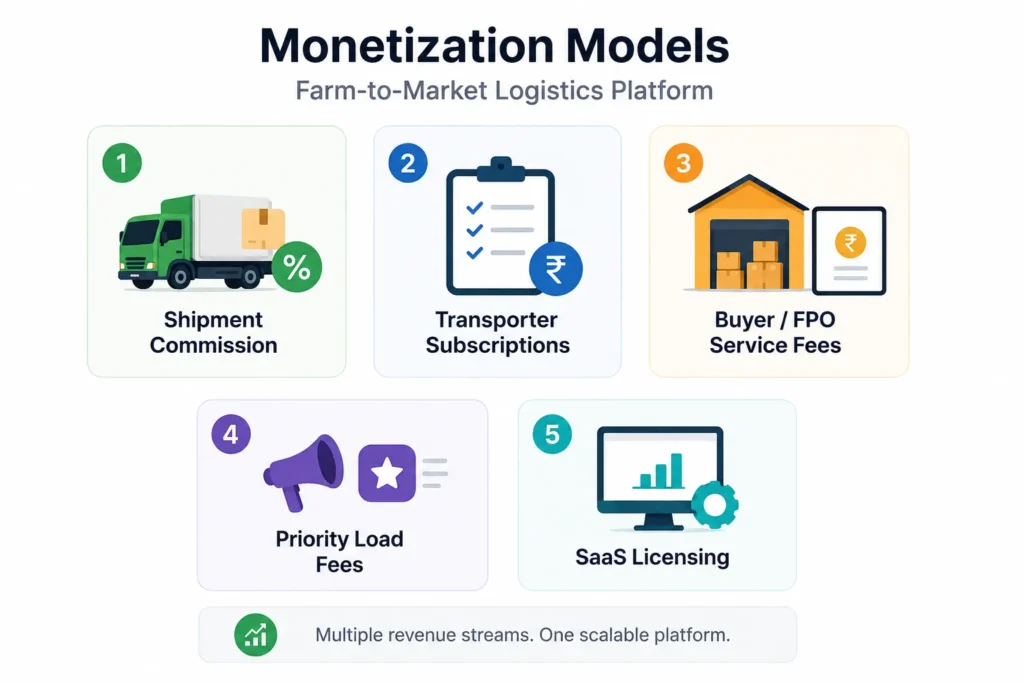
A farm-to-market logistics app can generate revenue in several ways. The right model depends on whether the platform acts as a marketplace, logistics operator, SaaS tool, or managed supply chain network.
A farm-to-market logistics app can generate revenue through shipment commissions, transporter subscriptions, buyer service fees, premium load placement, SaaS licensing, or managed logistics support. To explore these revenue paths in more detail, founders can review this farm logistics business model breakdown and decide which model fits their market.
Commission on Completed Shipments
The platform charges a percentage or fixed fee on every successful shipment. This works well when the platform controls transaction flow and can justify the fee through better access, faster fulfillment, or improved reliability.
Transporter Subscription Plans
Transporters pay a monthly or annual fee to access load opportunities, bidding tools, route visibility, or premium placement. This model works better when the platform has consistent load volume.
Buyer or FPO Service Fees
Buyers, FPOs, or collection centres may pay for logistics coordination, warehouse visibility, reporting, or quality records. This model suits B2B networks where reliability matters more than consumer-style convenience.
Featured Load or Priority Matching Fees
High-priority loads can be promoted to transporters or matched faster based on urgency, route, vehicle type, or commodity requirements.
SaaS Licensing for Regional Operators
A company may license the platform to regional agricultural businesses, cooperatives, agencies, or logistics operators under their own brand. This works when the founder wants a software-led model rather than directly operating every shipment.
Workflow Planning: From Farm Pickup to Settlement
A successful agricultural logistics platform should be designed around the full movement lifecycle, not isolated screens.
Here is a practical workflow:
- A farmer, FPO, or buyer creates a load requirement.
- The platform captures crop type, quantity, packaging, pickup location, delivery point, handling requirement, and preferred date.
- Transporters receive relevant load opportunities.
- The load is assigned manually, accepted directly, or awarded through bidding.
- A driver receives pickup details and updates field status.
- The shipment moves through collection, transit, warehouse, inspection, or direct delivery.
- Quality details and delivery proof are recorded.
- Buyer acceptance triggers invoice or settlement status.
- Admin reviews commissions, transporter payout, exceptions, and reports.
This workflow helps founders identify what needs to be automated and what can stay manual in the first version.
Founder Decision Signals
Speed
If your market already has active supply and transporter demand, launching a focused first version can validate transactions faster than building every advanced module upfront.
Cost
Cost rises when the platform needs many user roles, live tracking, warehouse logic, cold-chain integrations, payment automation, and custom reporting.
Scalability
A scalable agricultural logistics platform needs clean role permissions, flexible business rules, reliable APIs, and admin controls that can support more regions over time.
Market Fit
The first version should prove that farmers, buyers, FPOs, and transporters are willing to coordinate through your platform instead of phone calls and spreadsheets.
Ready-Made Foundation vs Custom Development
Founders usually compare two routes: building fully custom from zero or starting with a ready-made app foundation and customizing it.
A custom build gives deeper flexibility, but it usually requires more planning, development time, QA, iteration, and budget. It can be the right choice when the operating model is highly unique or when the product must integrate deeply with existing enterprise systems.
A ready-made foundation is useful when the founder wants to validate the market faster using proven logistics flows, user panels, admin controls, and common transaction logic. It can then be customized for branding, workflow rules, commodity categories, payment logic, language preferences, and region-specific operations.
Founders usually choose between building a custom platform from zero or starting with a ready-made foundation that can be customized for their market. Miracuves’ ready-made app solutions can help businesses launch faster with proven workflows, while custom mobile app development is better suited for highly specific operating models that need deeper flexibility.
Security and Trust Layers Founders Should Not Ignore
Trust is a major part of agricultural logistics. Users need to know who posted the load, who accepted the trip, where the produce moved, what quality was recorded, and how settlement was handled.
Important trust layers include:
- User and transporter verification
- Role-based access control
- Secure payment gateway integration
- Admin approval workflows
- Audit logs for important actions
- Proof of pickup and proof of delivery
- Quality inspection records
- Dispute management
- Activity history for shipments and settlements
- Privacy-conscious data handling
Security should not be treated as a decorative feature. In a multi-party supply chain, trust records can reduce disputes, improve partner confidence, and help the platform operator manage operational risk.
Mistakes Founders Should Avoid
Building Too Many Roles Before Validating Demand
Adding every possible user panel from day one can increase cost and slow launch. Start with the roles required for your first transaction loop.
Treating Agricultural Logistics Like Parcel Delivery
Farm produce often needs grading, storage, cold-chain handling, and settlement visibility. A generic delivery flow may not solve these operational needs.
Ignoring Admin Controls
If the admin dashboard cannot manage rates, users, disputes, categories, and reports, the platform operator may depend on developers for routine changes.
Adding Integrations Too Early
IoT, ERP, telematics, and accounting integrations are useful, but they should be added when the operational process is stable enough to justify them.
How Miracuves Helps Founders Plan Smarter
Miracuves helps founders, startups, agencies, and businesses launch app platforms faster using ready-made, white-label, source-code-owned solutions and custom development support.
Building a farm-to-market logistics product requires more than attractive app screens. Founders need workflow planning, role-based dashboards, dispatch logic, transporter coordination, payment visibility, and admin control. Businesses that need expert support can work with Miracuves as an agricultural logistics app development company to plan, customize, and launch a platform aligned with their market.
For a farm-to-market logistics business, the important decision is not only which screens to build. The real decision is how the platform will coordinate produce movement, transporter availability, quality records, warehouse visibility, and settlements in a way that matches your business model.
A ready-made solution from Miracuves can help reduce development time because the foundation already includes core app flows, admin control, and essential modules. Final pricing depends on selected features, integrations, branding, and customization requirements.
Final Thoughts
A farm-to-market logistics app should not be planned as a generic delivery product. It needs to reflect how agricultural supply chains actually work: produce aggregation, transporter coordination, route planning, storage, quality checks, cold-chain handling, proof of delivery, and settlement visibility.
The strongest approach is to begin with the workflow that matters most to your business model, validate real usage, and then expand into deeper automation. A well-planned agricultural logistics platform can help founders replace scattered calls, spreadsheets, and manual tracking with a more transparent operating system for farmers, FPOs, transporters, buyers, and administrators.
For founders who want to move faster, Miracuves can help create a white-label, source-code-owned platform foundation that supports agricultural logistics workflows while still allowing room for customization, monetization, and long-term growth.
FAQs
What is an agricultural logistics platform?
An agricultural logistics platform is software that helps manage the movement of farm produce from pickup points to buyers, warehouses, processors, exporters, or retailers. It usually includes load posting, transporter coordination, shipment tracking, quality records, proof of delivery, and settlement visibility.
How is a farm-to-market logistics app different from a normal delivery app?
A normal delivery app focuses mainly on pickup and drop-off. A farm-to-market logistics app often needs additional workflows such as crop grading, FPO coordination, warehouse inventory, cold-chain monitoring, transporter bidding, buyer approval, and multi-party settlement tracking.
What features should be included in the first version?
The first version should include user onboarding, load posting, transporter assignment or bidding, pickup and delivery status, driver workflow, admin dashboard, notifications, and basic settlement records. Advanced features such as IoT, ERP integration, and predictive analytics can be added later.
What affects the cost of farm-to-market logistics app development?
Cost depends on user roles, platform complexity, route planning, live tracking, warehouse management, cold-chain workflows, payment integrations, admin controls, third-party APIs, and customization depth. The final quote should be confirmed based on the selected modules and business model.
Can a farm-to-market logistics platform support cold-chain operations?
Yes, it can support cold-chain workflows if temperature tracking, threshold alerts, reefer vehicle details, exception logs, and quality records are included. The exact setup depends on whether the platform integrates with IoT devices, telematics systems, or manual inspection workflows.
Who can use a farm produce logistics app?
Farmers, FPOs, collection centres, buyers, transporters, drivers, warehouse teams, quality inspectors, exporters, food processors, and platform administrators can all use the system depending on the selected business model.
Should founders build custom software or use a ready-made foundation?
Custom development is useful when the operating model is highly unique. A ready-made foundation is useful when founders want to launch faster, validate demand, reduce initial development effort, and customize proven logistics workflows around their brand and market.
How can Miracuves support agricultural logistics app development?
Miracuves helps founders build ready-made and white-label app solutions with source-code ownership, branded design, admin dashboards, and customization support. For agricultural logistics, this can help businesses launch faster while still adapting the platform to their workflows.
Miracuves is an independent software development company. We are not affiliated with, connected to, sponsored by, or endorsed by any company or product named in this article.
Terms such as “X Clone” are used descriptively. It is how the software industry refers to building a platform with functionality comparable to a known service, and how clients search for it.
The entire design and codebase of our products is built by our own team. Our products contain no code, design, graphics, or content originating from any third-party website or applications.
All third-party names and marks referenced in this article are the property of their respective owners, referenced solely to identify the services discussed.