

Key Takeaways
- The best artificial intelligence apps often solve narrow, expensive B2B problems rather than chasing mass-market downloads.
- General consumer AI products face intense competition from established platforms with larger budgets and distribution.
- Hyper-vertical AI tools can create stronger value by automating one industry-specific workflow exceptionally well.
- Compliance files, claims, inspections, audits, and approval queues are strong opportunities for specialized AI.
- A focused enterprise AI app can generate recurring revenue without needing millions of consumer users.
Strategy Signals
- Founders should identify repetitive workflows connected to high labour costs, compliance risk, or operational delays.
- Enterprise users need role-based access, workflow automation, document analysis, reporting, and secure integrations.
- Admins need control over users, data sources, AI outputs, approvals, usage limits, and performance analytics.
- White-label deployment allows businesses to launch specialized AI tools under their own brand and processes.
- Human review, audit trails, and structured outputs help enterprises adopt AI inside critical workflows.
Real Insights
- A broad AI assistant is easy to compare with ChatGPT-like platforms and difficult for a startup to differentiate.
- A specialized AI engine becomes valuable when it understands proprietary documents, rules, terminology, and approval logic.
- Boring workflows often have clearer budgets, measurable outcomes, and stronger willingness to pay.
- The strongest AI products become embedded in daily operations instead of depending on occasional user prompts.
- Miracuves Solutions builds hyper-vertical B2B AI apps with workflow automation, secure integrations, white-label deployment, and admin control.
Every ambitious AI founder seems to receive the same advice: build a beautiful app, add a conversational interface, publish it in the app stores, and chase millions of users.
That advice sounds exciting. It is also a dangerous way to burn capital.
A general-purpose consumer AI application does not merely compete against other startups. It competes against OpenAI, Google, Microsoft, Meta, Anthropic, and every well-funded team capable of subsidising infrastructure, bundling AI into existing products, and acquiring users through distribution channels you do not control.
The most visible consumer AI market is already concentrated around large horizontal platforms. Current AI-app rankings are filled with products such as ChatGPT, Gemini, Claude, Copilot, DeepSeek, and Meta AI—companies competing on model quality, infrastructure, integrations, brand recognition, and distribution at enormous scale.
That does not mean founders should abandon artificial intelligence or avoid launching a ChatGPT Clone. It means they should stop treating a generic conversational interface as a complete business strategy.
The better opportunity is often much less glamorous: a specialised AI product that solves one expensive problem for one industry and becomes difficult to remove from that company’s workflow.
At Miracuves, this means designing AI platforms around specific operational outcomes rather than simply recreating the appearance of popular consumer applications.
The best artificial intelligence apps for independent founders may not be viral. They may be “boring” B2B tools used by drilling compliance teams, insurance investigators, pharmaceutical quality departments, commercial property managers, freight auditors, or specialist legal consultants.
They do not need 10 million downloads.
They need a small number of companies willing to pay because the software removes a painful operational bottleneck.
The App Store Graveyard: Why You Cannot Outspend Big Tech
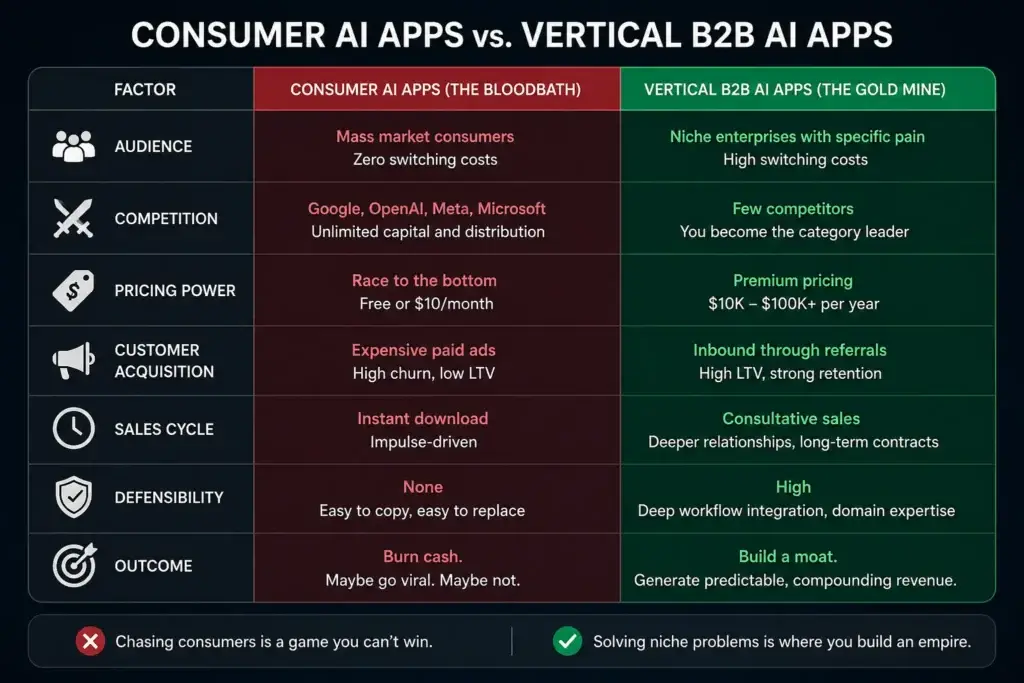
The consumer AI pitch usually begins with a massive addressable market.
Almost everyone writes, searches, studies, communicates, or creates content. Therefore, almost everyone could theoretically use a general AI assistant.
That is precisely the problem.
A market that broad attracts the most powerful competitors in technology. Google already positions AI as a tool intended to help individuals and organisations across a wide range of tasks. OpenAI is building at the foundation-model and infrastructure layers, while major technology companies continue investing in models, enterprise platforms, chips, cloud capacity, and distribution.
A startup entering this market must answer uncomfortable questions:
Can your assistant reason materially better than products from frontier-model providers?
Can you acquire users more cheaply than companies that can place AI inside search engines, operating systems, office suites, browsers, and existing productivity tools?
Can you survive when a platform provider adds your headline feature to its core product?
Can you fund inference costs while consumer users expect free access or a low monthly subscription?
Can you build enough brand trust for users to move their conversations, documents, and workflows into an unknown application?
Most founders cannot answer those questions convincingly.
They compensate by adding another interface, another prompt library, another collection of models, or another “AI for everything” promise. The resulting application may function perfectly well, but it has no durable reason to exist.
A polished wrapper is not a market position.
When the product serves everybody, its comparison set includes every major AI assistant. When it solves a specialised workflow, its comparison set may be an outdated spreadsheet, an overloaded analyst, a manual document review process, or a legacy enterprise system nobody enjoys using.
That second competition is much easier to beat.
Read More: What is ChatGPT App and How Does It Work?
The Value of “Boring” AI: Solving Niche Corporate Problems
Consumer founders often look for excitement. Enterprise buyers look for economic relief.
A compliance director does not care whether an AI product feels revolutionary. That director cares whether the system can identify missing documentation before an audit.
A freight company does not need another general chatbot. It may need a tool that compares carrier invoices against negotiated rate cards and flags costly discrepancies.
A healthcare administrator may not want a broad generative assistant. The organisation may need a controlled workflow that classifies referral documents, extracts structured information, routes cases, records human review, and preserves an audit trail.
A property insurer may pay for a system that analyses inspection notes, photographs, policy wording, and historical claims to help investigators prioritise complex cases.
These applications sound boring because they are close to operations.
That is what makes them valuable.
Enterprise software earns its place when it improves one or more of the following:
- Processing time
- Labour utilisation
- Error rates
- Revenue recovery
- Compliance preparation
- Risk detection
- Decision consistency
- Information retrieval
- Auditability
- Customer response time
The customer is not buying artificial intelligence as an abstract technology. The customer is buying a measurable operational result.
This is also why vertical AI can support stronger pricing than a consumer subscription. A consumer compares an application against free alternatives. A company compares it against salaries, missed revenue, regulatory exposure, operational delays, consultant fees, and the cost of incorrect decisions.
The willingness to pay comes from the cost of the problem, not the novelty of the interface.
Read More: How to Build an App Like ChatGPT: Developer Guide
The Hyper-Vertical Enterprise AI Model
“Vertical AI” is already becoming an overused phrase. Founders frequently describe any industry-branded chatbot as a vertical product.
That is not enough.
A hyper-vertical enterprise AI application should be narrow across several dimensions simultaneously.
One industry
Do not build “AI for energy.”
Build for offshore drilling operators, pipeline inspection teams, renewable asset managers, or petroleum regulatory consultants.
One business function
Do not build “AI for legal teams.”
Build for contract risk review, discovery document classification, insurance coverage analysis, clinical-trial agreement comparison, or construction claims preparation.
One workflow
Do not build “a healthcare assistant.”
Build a system that receives referral documents, extracts the relevant fields, checks them against intake rules, flags incomplete cases, routes the files to the appropriate reviewer, and records every decision.
One data environment
The application should understand the exact sources involved: PDF reports, scanned forms, sensor logs, policy documents, maintenance records, emails, enterprise databases, or industry-specific templates.
One buying trigger
A strong product is attached to an event that already creates urgency. That may be an audit, claim, inspection, regulatory submission, contract renewal, financial close, safety review, or customer escalation.
The narrower the context, the more useful the system can become.
A general AI assistant knows a little about millions of situations. A hyper-vertical tool can be designed around the terminology, permissions, exceptions, data sources, approval stages, and risk thresholds of one operational environment.
That specialised application layer—not the underlying model alone—is where a founder can create defensibility.
Read More: ChatGPT Clone Revenue Model: How AI Chat Platforms Make Money
What the Best Artificial Intelligence Apps Actually Do
The strongest enterprise AI products rarely depend on a single prompt. They combine intelligence with workflow control.
| Product capability | Corporate function | Business value |
|---|---|---|
| Document ingestion | Accepts reports, policies, forms, manuals, and records | Reduces manual collection and sorting |
| Structured extraction | Converts unstructured documents into usable fields | Improves speed and consistency |
| Retrieval with citations | Returns answers grounded in approved sources | Makes outputs easier to verify |
| Classification and routing | Sends cases to the right team or review queue | Reduces operational delay |
| Exception detection | Flags missing, unusual, or high-risk information | Helps specialists focus attention |
| Human approval | Keeps experts involved in consequential decisions | Reduces automation risk |
| Role-based dashboards | Limits data and actions by job function | Supports enterprise control |
| Audit logs | Records source, action, user, and decision history | Improves accountability |
| System integrations | Connects the AI workflow to existing software | Prevents another isolated tool |
| Usage analytics | Shows adoption, workload, exceptions, and outcomes | Supports renewal and expansion |
This distinction matters.
A chatbot answers a question.
An enterprise AI application receives information, interprets it, applies business rules, retrieves relevant evidence, creates an output, routes it for approval, records the decision, and updates another system.
The model is one component. The product is the controlled workflow around it.
Miracuves’ own LLM development positioning reflects this broader application layer through document ingestion, retrieval, cited answers, integrations, ongoing model work, and product development rather than an interface alone.
Read More: Best ChatGPT Clone Script in 2026: Features & Pricing Compared
Deploying Hyper-Vertical AI Engines for High-Ticket B2B Sales
A high-ticket enterprise AI product needs more than technical capability. It needs commercial credibility.
Start with paid discovery, not speculative development
Do not disappear for six months and return with what you believe an industry needs.
Interview the people who execute the workflow, supervise it, approve its budget, manage its risk, and deal with its failures.
Ask:
- What enters the process?
- Who touches it?
- Which steps require judgement?
- Where do cases wait?
- What causes rework?
- Which mistakes are expensive?
- Which systems contain the required information?
- What evidence must be preserved?
- Who can approve an automated recommendation?
- What would make the organisation refuse deployment?
The objective is not to collect feature requests. It is to identify the economic structure of the problem.
Sell one outcome
“AI-powered transformation” is not a practical sales proposition.
“Reduce the first-pass review time for offshore compliance packages” is.
“Help commercial insurers identify policy-document inconsistencies before manual assessment” is.
“Turn unstructured maintenance reports into searchable, cited equipment histories” is.
The narrower statement is easier to demonstrate, price, validate, and defend.
Build around the client’s operating environment
Enterprise buyers rarely want to abandon every existing system. Your application may need to connect with document repositories, CRM software, ticketing platforms, identity providers, internal databases, or industry systems.
Integration is not an afterthought. It is often the difference between an impressive demonstration and an operational product.
Keep humans inside consequential workflows
A model can support analysis without becoming the final authority.
For regulated, safety-sensitive, financial, legal, or healthcare use cases, the system should support controlled review, clear source attribution, approval stages, escalation paths, permissions, and audit records.
Security should be treated as part of the product foundation. Practical controls may include encrypted data transfer, role-based access, activity logs, secure API integrations, permission-based dashboards, and privacy-conscious data handling. Compliance depends on the jurisdiction, operating model, integrations, data policies, and legal review; it should never be presented as automatically guaranteed.
Use enterprise pricing logic
Do not price a specialised corporate tool as though it were a casual consumer application.
A B2B commercial model can combine:
- Initial implementation fee
- Annual platform licence
- Per-user or per-department access
- Usage-based processing
- Integration fees
- Custom workflow configuration
- Support and maintenance
- Private deployment options
- Additional modules
- Expansion into other departments
The price should reflect the value created, complexity supported, service commitment, infrastructure consumption, and risk accepted by the vendor.
Do not invent a premium price merely because the product contains AI. High-ticket pricing must be justified by a high-cost problem and a credible business case.
Read More: The Chat UI Death Trap: Why the Best AI Apps Don’t Look Like ChatGPT
Why White-Label AI Changes the Founder Equation
A hyper-vertical strategy does not mean every technical component must be built from zero.
Founders often waste months recreating standard product layers:
- Authentication
- User administration
- Conversation history
- Document upload
- Model API connections
- Access permissions
- Usage tracking
- Subscription logic
- Administrative controls
- Basic analytics
- Notification workflows
Those modules may be necessary, but they are rarely the source of differentiation.
The specialised value usually comes from:
- Industry terminology
- Proprietary workflow logic
- Approved knowledge sources
- Evaluation standards
- Data connectors
- Decision thresholds
- Exception handling
- Reporting formats
- Human-review design
- Domain-specific user experience
A white-label AI foundation allows the founder to begin with common product infrastructure and direct more energy toward the application layer customers will actually pay for.
Miracuves offers AI-development and white-label product foundations that can be customised around branding, workflows, integrations, administrative control, and specialised enterprise requirements. Its existing AI solutions include conversational products, document-ingestion workflows, retrieval-based systems, and generative AI application development.
The important word is foundation.
White-label software should not be treated as the final strategy. A generic foundation with a new logo is still generic.
The founder must add the vertical intelligence: the workflow design, industry knowledge, data model, integrations, evaluation criteria, governance, and commercial positioning that make the product difficult to replace.
Founder Decision Signals
Market
A strong opportunity serves a clearly identifiable group with a repeated, expensive workflow—not an undefined audience that “uses AI.”
Value
The application should affect cost, revenue, risk, speed, or compliance preparation strongly enough to support a business purchasing decision.
Defensibility
Your advantage should come from workflow depth, data access, integrations, expertise, and customer trust rather than a prompt hidden behind a new interface.
Delivery
Use a ready-made foundation for common modules, but customise the high-value operational layer around the target industry.
How to Find a Corporate Problem Worth Building Around
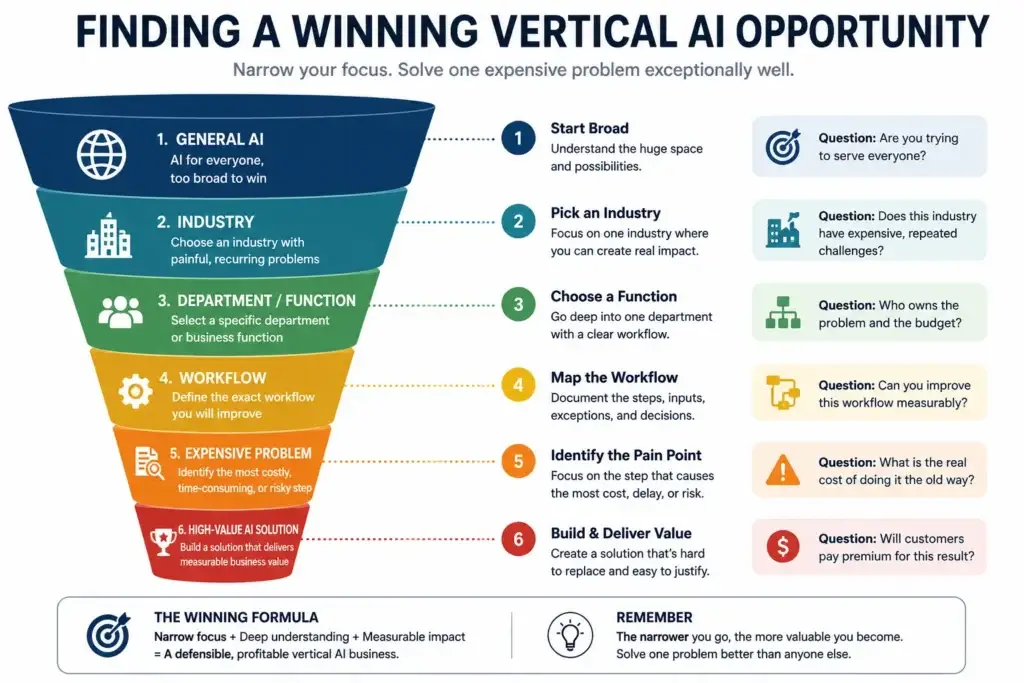
Not every niche deserves an AI company.
Some workflows are specialised but too infrequent. Others are painful but have no budget owner. Some require data that customers cannot legally, technically, or politically provide.
Use five filters before committing.
The problem is repeated
A workflow that occurs every day or every week creates more value than an annual inconvenience.
Frequency supports usage, habit formation, measurable return, and contract renewal.
The problem is expensive
Look beyond direct labour.
An inefficient workflow may cause missed revenue, delayed projects, regulatory preparation costs, slow customer response, consultant dependence, or poor resource allocation.
The information is difficult but accessible
The best opportunities often involve messy documents, fragmented records, specialised language, or multiple systems.
However, the customer must be able to provide lawful and practical access to the required information.
The output can be evaluated
You need a way to determine whether the system performs acceptably.
That may involve extraction accuracy, review time, exception recall, citation quality, routing accuracy, or percentage of cases resolved without rework.
Without evaluation, you cannot improve the product or build buyer confidence.
There is an identifiable budget owner
Users experiencing the pain are not always authorised to solve it.
Find the person responsible for the operational metric: a compliance leader, claims director, legal operations manager, maintenance head, finance controller, or business-unit executive.
A strong product without a reachable buyer is not a business.
Read More: Business Model of ChatGPT 2026
Hyper-Vertical AI Examples That Are Better Than Another General Assistant
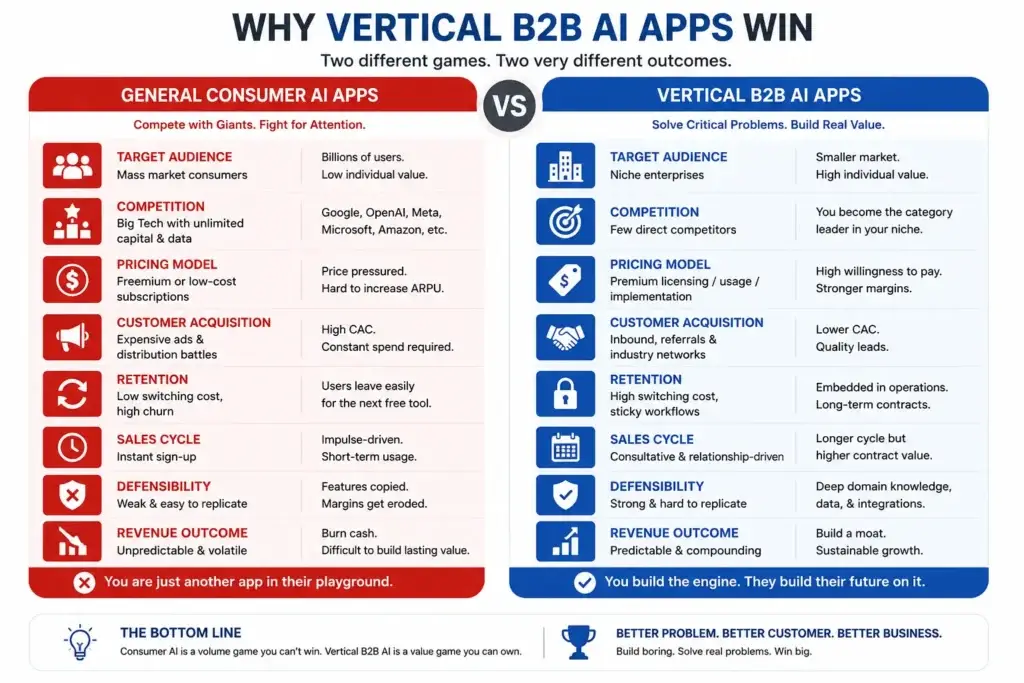
The opportunity is not limited to one sector.
Offshore drilling compliance intelligence
The application ingests operating procedures, inspection findings, equipment records, and regulatory documents. It retrieves cited requirements, identifies missing evidence, and prepares review queues for compliance specialists.
Commercial insurance document analysis
The system compares submissions, policy wording, endorsements, inspection reports, and claim documents. It highlights inconsistencies and routes high-risk cases to experienced reviewers.
Pharmaceutical quality investigation support
The platform organises deviation records, procedures, batch documents, and corrective-action histories. It helps quality teams retrieve relevant evidence while maintaining human approval.
Construction claims preparation
The tool analyses contracts, site diaries, change orders, correspondence, schedules, and delay records. It creates structured chronologies and evidence packages for specialist review.
Freight invoice auditing
The application compares invoices against negotiated rates, surcharges, service levels, and shipment records. It flags discrepancies for finance or logistics teams.
Industrial maintenance knowledge retrieval
The platform turns manuals, inspection notes, failure reports, and technician records into an evidence-backed troubleshooting environment.
None of these products will become the most downloaded application in an app store.
That is irrelevant.
They can become deeply embedded in a department that cannot afford to return to the old process.
Mistakes Founders Make When Moving Into Vertical AI
Choosing an industry without choosing a workflow
“AI for construction” remains too broad.
Specify the job, source information, user, buying event, output, and success metric.
Building a shallow wrapper
Calling a general model through an API and changing the interface does not create meaningful defensibility.
Customers need workflow control, integrations, specialised retrieval, permissions, reporting, evaluation, and support.
Automating before understanding exceptions
Standard cases are easy. Enterprise value often lives in the exceptions.
Study the failed cases, approval rules, escalation points, and edge conditions before designing automation.
Claiming compliance too aggressively
An application can support compliance-related workflows without being automatically compliant in every market.
Use careful language, involve relevant specialists, and define responsibility clearly.
Ignoring the cost of implementation
A lucrative contract can become unprofitable when every customer requires a completely different data pipeline, deployment architecture, and support model.
Build a reusable core while allowing controlled configuration.
Selling technology instead of financial impact
A prospect may admire a model demonstration and still refuse to purchase.
Connect the product to processing capacity, labour cost, risk reduction, revenue protection, or faster decision-making.
Trying to serve several verticals too early
A product for insurers, hospitals, law firms, manufacturers, and banks is not vertical.
Win one workflow. Build evidence. Refine the implementation. Expand only when the core system is genuinely repeatable.
A Practical Go-to-Market Sequence
The smartest path is not “build first, market later.”
Use a staged commercial process.
Step 1: Select a narrow operating problem
Choose an industry, department, recurring workflow, and measurable pain.
Step 2: Interview users and budget owners
Speak with both operators and decision-makers. Their priorities will differ.
Step 3: Collect representative inputs
Understand the real documents, data structures, terminology, exceptions, and approval requirements.
Step 4: Create a controlled demonstration
Show one end-to-end workflow using representative or properly authorised data.
Step 5: Sell a paid pilot
A paid pilot tests seriousness, access, adoption, technical feasibility, and purchasing behaviour.
Step 6: Define evaluation criteria
Agree on what success means before deployment.
Step 7: Productise repeated requirements
Turn common client needs into reusable modules and configurable workflows.
Step 8: Expand inside the account
After proving one use case, identify adjacent departments, document types, locations, and processes.
This is how a narrowly positioned tool can develop into a valuable enterprise platform without beginning as a vague platform for everything.
Read More: Why Basic ChatGPT Clones Will Go Bankrupt in 2026
Stop Asking Which AI App Can Go Viral
Virality is a distribution mechanism, not a business model.
For consumer applications, it can be valuable—but it also creates dependency on public attention, platform algorithms, continuous acquisition, and low-friction pricing.
Enterprise AI uses a different equation.
A founder can build a meaningful company with fewer customers when each account has a painful problem, a defined budget, a repeatable workflow, and a reason to remain.
The critical question is not:
What AI app will everybody download?
It is:
Which department has an expensive process that current software still handles badly?
That question leads away from the app-store bloodbath and toward a much more defensible opportunity.
Final Thoughts: Build the Tool a Department Cannot Operate Without
Attempting to defeat Big Tech at general-purpose consumer AI is not courageous merely because the market is large.
It can be strategically careless.
Building another ChatGPT-like platform may appear ambitious, but without a focused use case, it often leaves founders competing on model access, infrastructure costs, brand recognition, and distribution against companies with far greater resources.
The strongest founder opportunity is often hidden inside an industry outsiders consider dull: compliance files, inspection reports, claims documents, rate tables, maintenance records, audit evidence, or approval queues.
These workflows are unglamorous, but they are attached to real budgets and expensive consequences.
The best artificial intelligence apps do not need to impress everybody. They need to become indispensable to a specific group of people performing a specific, high-value job.
Miracuves Solutions help founders turn that specialised opportunity into a workflow-driven AI product designed around measurable business outcomes rather than generic conversations.
Do not build another AI assistant that can theoretically do anything.
Build the specialised tool one corporate department can no longer operate efficiently without.
FAQs
Are B2B AI applications more profitable than consumer AI apps?
They can be, but profitability is not automatic. B2B applications may support higher contract values because they solve operational problems connected to labour, revenue, risk, or compliance preparation. Profitability still depends on acquisition costs, implementation complexity, infrastructure usage, support requirements, and customer retention.
What is a hyper-vertical AI application?
A hyper-vertical AI application serves a narrowly defined industry workflow. It is designed around specialised terminology, data sources, user roles, approval rules, integrations, exceptions, and measurable business outcomes rather than general-purpose conversation.
What are the best artificial intelligence apps for enterprise markets?
The best enterprise AI applications usually help organisations process documents, retrieve trusted information, automate repetitive workflows, detect exceptions, support decisions, or connect fragmented business data. Their value comes from operational improvement, not merely model capability.
Can a founder build a vertical AI product without training a foundation model?
Yes. Many vertical products can use existing commercial or open models while differentiating through retrieval, workflow logic, proprietary data access, integrations, security controls, evaluations, user experience, and industry expertise.
What makes a vertical AI app defensible?
Defensibility can come from deep workflow integration, customer-specific configurations, proprietary datasets, domain evaluations, trusted relationships, embedded approvals, historical usage data, and integration with systems that are difficult to replace.
How should a specialised enterprise AI product be priced?
Pricing may include implementation, annual licensing, users, departments, usage, integrations, support, private deployment, or additional modules. The model should reflect measurable customer value and delivery cost rather than copying consumer subscription pricing.
Is a white-label AI application enough to enter an enterprise market?
A white-label foundation can accelerate common product development, but it is not a complete strategy. The founder must still add domain-specific workflows, integrations, safeguards, evaluation logic, industry positioning, and a credible go-to-market motion.
Which niche should an AI SaaS founder target?
Look for a repeated and expensive workflow with accessible information, measurable outputs, identifiable users, and a budget owner. Avoid niches where the pain is occasional, the required data is unavailable, or every implementation would become a completely different custom project.