



Key Takeaways
- A compliance-first alcohol delivery app must verify customer age before completing restricted orders.
- The deployment processed 10,000 alcohol orders while maintaining a 94% checkout completion rate.
- Biometric checks, document verification, consent capture, and audit records are core compliance layers.
- Age verification must balance legal protection with a fast and simple checkout experience.
- A structured verification gateway can reduce compliance risk without creating excessive customer drop-off.
Compliance Signals
- Customers need clear consent, guided document capture, biometric verification, and fast approval feedback.
- Delivery partners need verified handoff steps, recipient confirmation, and restricted-order instructions.
- Admins need control over failed checks, manual reviews, compliance records, disputes, and verification reports.
- Verification providers must support secure data handling, liveness checks, retry logic, and accurate age decisions.
- Real-time alerts help identify failed verification, identity mismatches, repeated attempts, and risky orders.
Real Insights
- Age verification should be measured at each checkout stage instead of relying on one overall abandonment rate.
- Poor capture instructions or slow verification responses can reduce legitimate customer completion.
- Consent logs, verification outcomes, timestamps, and delivery records create stronger compliance evidence.
- The case study reported zero underage-sale incidents during the measured deployment period.
- Miracuves builds alcohol delivery apps with biometric age verification, secure checkout, delivery controls, and admin workflows.
Age verification is often treated as a small feature in an alcohol delivery application: ask for a date of birth, display an “I am over 21” checkbox, and move the customer towards payment.
Operationally, that approach is weak.
An alcohol delivery platform must decide whether the person placing the order is eligible, whether the identity document appears valid, whether the person presenting it matches the document, and whether the order can legally proceed in that location and delivery window. It must also preserve enough evidence to investigate an exception without creating an unnecessary repository of sensitive identity data.
That creates a difficult product problem.
Add too little friction, and the operator may allow an ineligible order to enter fulfilment. Add too much friction, and legitimate customers abandon checkout before making a purchase.
This case study examines how Miracuves approached that trade-off while deploying a white-label alcohol delivery platform built around a Zero-Friction KYC Gateway.
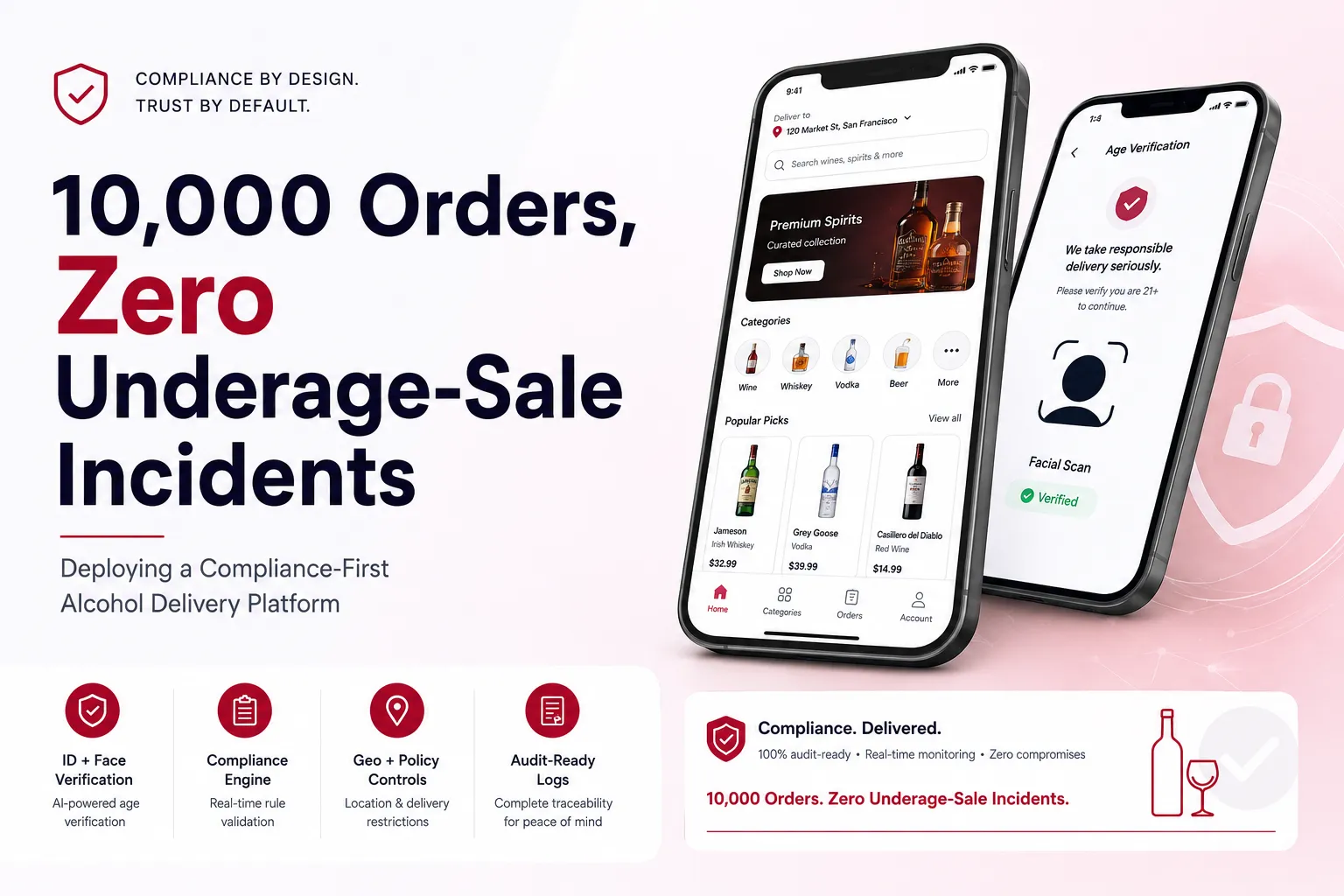
According to the deployment dataset supplied for this case study, the platform processed:
- 10,000 weekend alcohol orders
- 94% checkout completion after verification began
- Zero confirmed underage-sale incidents during the measured deployment window
- No reported regulatory fines connected to those measured transactions
Read More: What Is Nestor Liquor App and How Does It Work?
The Conversion Killer: Why Clunky Age Verification Destroys Sales
Every additional step in checkout creates a decision point.
A customer may need to find adequate lighting, locate an identity document, grant camera access, photograph the front and back of the document, complete a facial check, and wait for an external verification provider to respond. If the interface gives unclear instructions—or restarts after a minor failure—the customer may leave.
But removing those steps entirely is not a responsible alternative.
Alcohol regulators and delivery operators expect meaningful age controls. California Alcoholic Beverage Control guidance emphasizes careful inspection of identification and accurate age calculation. Major delivery platforms use layered verification before checkout and at the delivery location rather than relying entirely on self-declared age.
The product objective was therefore not to eliminate verification friction. It was to eliminate avoidable friction.
The deployment team separated friction into two categories:
| Friction Type | Example | Product Response |
|---|---|---|
| Necessary friction | Capturing an acceptable identity document | Make instructions clear and complete the task once |
| Avoidable friction | Re-entering details already extracted from the document | Pre-fill verified information |
| Necessary friction | Rejecting an expired or mismatched document | Explain the reason and provide a safe retry path |
| Avoidable friction | Restarting verification after an API timeout | Resume from the last valid state |
| Necessary friction | Rechecking identity at delivery | Make the driver workflow fast and unambiguous |
| Avoidable friction | Sending every valid customer to manual review | Use risk-based escalation |
The result was a verification journey designed around a simple principle:
A legitimate customer should move forward quickly, but no order should proceed merely because the customer wants to bypass the control.
The Business Risk Was Larger Than Checkout Abandonment
For an ordinary ecommerce platform, a failed checkout usually represents lost revenue.
For an alcohol marketplace, a control failure can create wider consequences:
- An order may be accepted from an ineligible buyer.
- A store may prepare inventory that cannot legally be handed over.
- A delivery partner may face an unsafe or ambiguous handoff.
- The operator may lack evidence explaining why an order was approved.
- A repeated control weakness may affect retailer confidence, payment relationships, insurance, or licensing exposure.
The laws and operational requirements differ by country, state, province, licence type, fulfilment model, and product category. Even within the United States, businesses need state-specific legal review rather than assuming one national workflow is sufficient. TTB directs businesses to consider applicable state and local requirements, while state regulators maintain their own identification and licensing rules.
For that reason, the platform was designed as a configurable compliance-control layer, not as a promise that one software configuration automatically satisfies every jurisdiction.
Read More: Business Model of Nestor Liquor : Complete Strategy Breakdown 2026
Engineering the Biometric KYC Gateway on Laravel
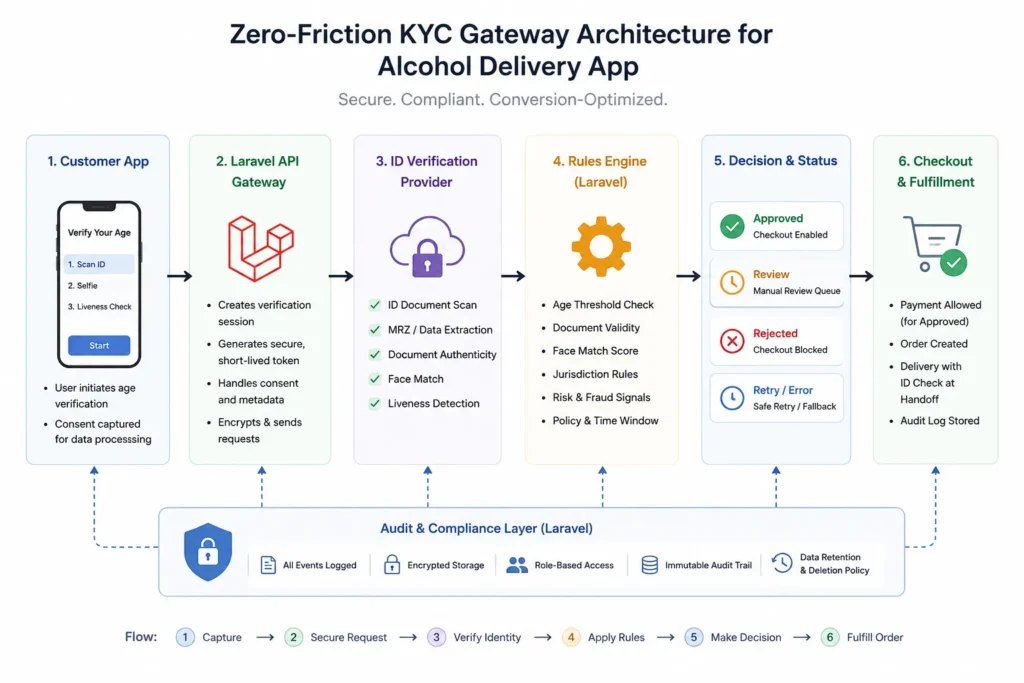
The Zero-Friction KYC Gateway sat between the cart and the payment-authorisation stage.
A user could browse products and build a cart without repeatedly encountering compliance prompts. However, an alcohol-containing order could not move into the payable state until the backend confirmed an acceptable verification status.
The Laravel application served as the orchestration layer.
It did not simply send an image to a third-party service and accept a yes-or-no response. It managed the full verification lifecycle:
- Create a verification session.
- Obtain clear user consent.
- Generate a short-lived upload or SDK token.
- Capture the identity document.
- Extract the date of birth and document-expiry date.
- evaluate document-authenticity indicators.
- Compare the live user with the identity-document portrait when enabled.
- Run liveness or presentation-attack checks when required.
- Apply jurisdiction and product rules.
- Store the decision and required audit metadata.
- Issue a reusable internal verification state.
- Permit, reject, or escalate the checkout.
Simplified Architecture
Customer App
    |
    | Start verification
    v
Laravel API Gateway
    |
    | Create short-lived session
    v
Identity Verification Provider
    |
    | Document + face + liveness result
    v
Laravel Rules Engine
    |
    |-- Age threshold
    |-- Document expiry
    |-- Identity match
    |-- Jurisdiction rule
    |-- Retry/risk policy
    |
    v
Verification Decision
    |
    |-- Approved -> Checkout enabled
    |-- Rejected -> Checkout blocked
    |-- Review -> Manual queue
    |-- Error -> Safe retry/fallback
This separation mattered because the external verification provider was only one part of the decision.
The application still had to decide:
- Which legal-age threshold applied
- Whether the document type was acceptable
- Whether an old approval could be reused
- Whether a user’s delivery location changed the rules
- Whether a failed liveness check required rejection or review
- Whether an expired verification should be repeated
- Whether the order contained restricted products
- Whether fulfilment was permitted at the selected time
The Checkout State Machine
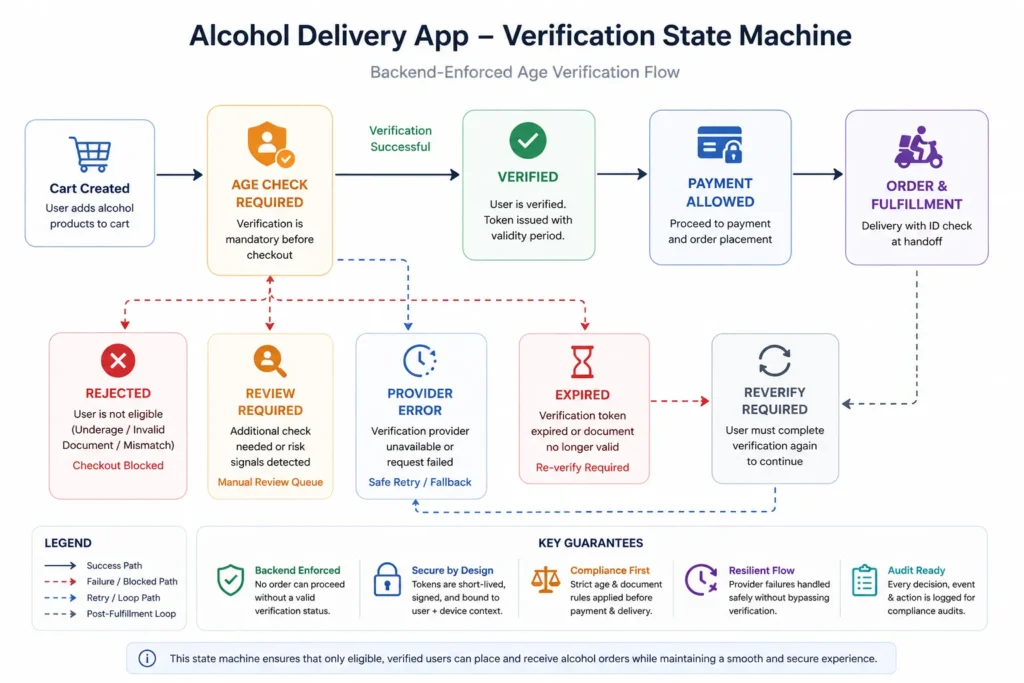
A common weakness in low-cost delivery scripts is that verification exists only in the interface. A user can sometimes bypass the screen, call an unprotected API endpoint, or continue after a provider failure.
The Miracuves implementation enforced verification server-side.
CART_CREATED
      |
      v
AGE_CHECK_REQUIRED
      |
      +----> VERIFIED --------> PAYMENT_ALLOWED
      |
      +----> REVIEW_REQUIRED -> PAYMENT_BLOCKED
      |
      +----> REJECTED --------> PAYMENT_BLOCKED
      |
      +----> EXPIRED ---------> REVERIFY
      |
      +----> PROVIDER_ERROR --> SAFE_RETRY
The client application could display the journey, but it could not independently mark an account as verified. Only the backend could produce an approval state after validating the signed provider response and applying the internal rules engine.
That prevented the compliance decision from becoming a front-end preference.
What the Gateway Checked
The verification gateway was designed to combine multiple signals rather than relying on one field.
1. Document data extraction
The system extracted relevant fields such as:
- Name
- Date of birth
- Document number or protected reference
- Expiry date
- Issuing jurisdiction
- Document type
The customer did not need to manually retype information that had already been read successfully.
2. Document validity indicators
Where supported by the selected verification provider, the workflow evaluated signs of tampering, unsupported document types, expired documents, image quality, and inconsistencies between machine-readable and visible data.
3. Facial comparison
The submitted facial capture could be compared with the identity-document portrait to reduce the risk of someone using another person’s document.
4. Liveness controls
A liveness check could be triggered to help distinguish a real person from a static image, replayed recording, or other presentation attempt.
5. Age and jurisdiction rules
The application calculated eligibility using the verified date of birth and the applicable market configuration. It did not depend on the user calculating or declaring their own age.
6. Account and transaction signals
The system could escalate suspicious behaviour such as:
- Repeated document failures
- Multiple accounts using the same document
- Sudden changes in identity details
- High-risk device or session patterns
- Mismatch between account and verification data
- Repeated attempts immediately after rejection
These signals supported manual review or rejection; they were not treated as automatic proof of wrongdoing.
The 94% Completion Benchmark: Balancing Speed With Strict Controls
The deployment brief reports a 94% checkout completion rate for customers who entered the age-verification flow.
That result was not achieved by weakening the decision criteria. It came from reducing wasted steps around the criteria.
Verification was requested at the right moment
The platform avoided demanding a full identity check before the customer could understand the store, catalogue, availability, or delivery area.
Verification was initiated when the customer had demonstrated meaningful purchase intent and the cart contained age-restricted products.
Previously approved users did not repeat the entire journey unnecessarily
After a successful check, the application stored a limited internal verification state with a validity period defined by the operator’s policy.
The system did not treat approval as permanent. Reverification could be triggered by:
- Verification expiry
- A changed or expired identity document
- Material account changes
- Elevated transaction risk
- A jurisdictional rule
- A compliance-policy update
The interface explained failures
“Verification failed” is not a useful recovery message.
The flow distinguished between:
- Blurred document image
- Glare or incomplete framing
- Expired document
- Unsupported document
- Age threshold not met
- Facial mismatch
- Liveness failure
- Provider timeout
- Manual review
Giving customers a specific, safe next step reduced abandonment caused by correctable capture problems.
External failures did not become approvals
When the identity API timed out, the system did not default to “verified.”
A temporary provider problem created a recoverable state. The customer could retry without rebuilding the cart, but payment remained blocked until an acceptable decision was available.
This is a critical architectural distinction: availability failures must not silently become compliance approvals.
Read More: How Nestor Liquor Makes Money in 2026
Checkout Verification Was Only the First Gate
A verified checkout does not guarantee that the verified customer will be the person receiving the delivery.
Someone else may answer the door. The identity document may be unavailable. The recipient may appear intoxicated. The order may be redirected to an unsupported location.
The delivery workflow therefore remained a separate control point.
DoorDash publicly describes a two-stage approach: a digital process before checkout and an in-person examination plus ID scan at delivery. Its merchant guidance also says delivery should not proceed when the customer is underage, visibly intoxicated, or unavailable.
The Miracuves delivery workflow followed the same defence-in-depth principle:
- The delivery partner received a clear age-restricted-order indicator.
- The app required the recipient to be physically present.
- The driver checked the recipient against an acceptable ID.
- The handoff could not be marked complete until the required delivery control was recorded.
- Failed handoffs entered a return, cancellation, or escalation workflow.
- The admin dashboard preserved the event trail.
Exact delivery requirements must be configured for the operating jurisdiction and reviewed by qualified legal counsel.
Read More: White-Label Nestor Liquor App Security: Risks, Compliance & Safety in 2026
Privacy Engineering: Verify More Without Storing Everything
Biometric and identity-document data creates significant privacy and security responsibilities.
The safest system is not the one that collects the most data. It is the one that collects the minimum information necessary for a clearly defined purpose, limits access, protects transmission, applies a documented retention policy, and deletes data when it is no longer needed.
The architecture used several privacy-conscious controls:
- Encrypted data transfer
- Short-lived verification-session tokens
- Signed webhook validation
- Role-based access control
- Restricted administrative visibility
- Redacted document references
- Configurable retention periods
- Separate operational and compliance logs
- Consent capture
- Purpose limitation
- Activity and access logging
Where possible, the application retained the provider’s decision, timestamp, verification reference, applicable rule version, and limited audit metadata rather than exposing raw identity images throughout the admin system.
Whether biometric processing is permitted—and what consent, notice, storage, deletion, or user-rights obligations apply—depends on the target jurisdiction. Legal and privacy review is required before launch.
Read More: Nestor Liquor vs Flaviar: Best Business Model to Clone
The Audit Trail Behind “Zero Confirmed Incidents
A claim such as “zero confirmed underage-sale incidents” is only credible when the platform can explain how each relevant transaction moved through the system.
For every approval, rejection, review, and delivery handoff, the audit layer should be able to reconstruct:
- Which account initiated the order
- Which verification session was used
- When the decision occurred
- Which provider response was received
- Which ruleset version was applied
- Whether the check was approved, rejected, or escalated
- Who performed any manual review
- Whether payment was allowed
- Which delivery control was completed
- Whether the order was delivered, refused, cancelled, or returned
The audit log should not become an unrestricted identity-data warehouse. It should preserve decision evidence with carefully limited access and retention.
Founder Decision Signals
Conversion
Measure completion by verification stage. A single overall abandonment number will not reveal whether users struggle with consent, capture, liveness, or provider latency.
Control Strength
Confirm that rejected, expired, inconclusive, and timed-out sessions are blocked by the backend—not merely hidden by the interface.
Privacy
Define what identity data is collected, where it is processed, who can access it, and when it is deleted before selecting a provider.
Jurisdiction
Make age thresholds, acceptable documents, delivery hours, geofencing, handoff rules, and record retention configurable by market.
Why Basic Alcohol Delivery Scripts Create Operational Exposure
A low-cost script may demonstrate product browsing, checkout, dispatch, and tracking. That does not mean its compliance controls can survive a real operational review.
Common weaknesses include:
A date-of-birth field presented as verification
A customer can type any date. This is an age declaration, not identity verification.
An “I am 21” checkbox
The checkbox may support notice and consent, but it does not establish that the person is eligible to purchase alcohol.
Verification performed only in the mobile interface
A control that is not enforced by the backend may be bypassed through direct API calls, modified applications, or inconsistent web and mobile implementations.
No safe response to provider failure
Allowing checkout when the verification provider is unavailable transforms a technical outage into a compliance gap.
No delivery-stage enforcement
Verifying the purchaser without checking the recipient leaves a major gap at the moment the product changes hands.
Indefinite storage of identity documents
Collecting raw documents without a defined purpose, access model, and deletion schedule increases privacy and security risk.
No ruleset versioning
When regulations or operating policies change, the business should know which rule approved an older transaction.
Results From the Measured Deployment Window
The project brief reports the following results:
| Deployment Metric | Reported Result | Why It Matters |
|---|---|---|
| Weekend orders processed | 10,000 | Demonstrates operation beyond a limited internal demo |
| Checkout completion | 94% | Indicates verification did not create excessive abandonment |
| Confirmed underage-sale incidents | 0 | Suggests the controls blocked or prevented identified underage transactions during the measured window |
| Regulatory fines tied to measured orders | 0 reported | Indicates no reported enforcement penalty for the measured transactions |
| Verification approach | Layered | Combined pre-checkout and delivery-stage controls |
These results should be published with the measurement dates, analytics definition, included markets, provider configuration, incident-detection method, and responsible internal owner.
Without that context, readers cannot distinguish an audited operational benchmark from a marketing statement.
What We Would Monitor After Launch
A high completion rate does not mean the system should stop evolving.
The admin and analytics layers should monitor:
- Verification-start rate
- Verification-completion rate
- Median and percentile verification time
- Document-recapture rate
- Provider-error rate
- Manual-review rate
- False-rejection complaints
- Duplicate-document attempts
- Delivery refusal rate
- Expired-document failures
- Orders blocked by geography or time
- Compliance incidents by store and driver
- Account appeals and review outcomes
The goal is not merely to increase approvals. The goal is to reduce avoidable rejection and friction without approving transactions that should be blocked.
Read More: Best Nestor Liquor Clone Scripts 2026
Miracuves’ White-Label Alcohol Delivery Foundation
Miracuves’ white-label alcohol delivery solution gives founders and liquor retailers a ready-made product foundation that can be configured around their brand, fulfilment model, store network, payment workflow, and target market.
The broader platform can connect:
- Customer ordering
- Liquor-store inventory and order management
- Delivery-partner operations
- Age and identity verification
- Payment processing
- Restricted product rules
- Geofencing
- Delivery time controls
- Order tracking
- Returns and failed handoffs
- Administrative reporting
- Role-based dashboards
For operators that want to understand the wider product model, Miracuves also provides guides covering how to build an alcohol delivery app and how the Drizly marketplace model works.
The final compliance configuration must be reviewed against the licences, delivery model, identity provider, privacy obligations, and laws applicable to the operating market.
Final Thoughts: Compliance and Conversion Are Not Opposing Goals
Strict verification does not have to mean a slow or confusing customer journey.
The stronger product decision is to make valid customers complete the necessary steps once, reuse approved verification states responsibly, explain recoverable errors clearly, and enforce every decision through the backend.
For alcohol delivery operators building a Nestor Liquor-like platform, the critical distinction is not whether the application simply has an “age verification” feature.
It is whether the architecture can answer five questions:
Who was verified?
What evidence supported the decision?
Which rule was applied?
Could an invalid or inconclusive session continue?
Was the recipient checked when the order was handed over?
Miracuves Solutions integrates these verification decisions across registration, checkout, order approval, dispatch, and final delivery rather than treating compliance as a separate feature.
When those answers are embedded into the transaction lifecycle, compliance becomes part of the product foundation rather than a disclaimer added after development.
FAQs
How does an alcohol delivery app verify a customer’s age?
A robust workflow captures a government-issued identity document, extracts the date of birth, checks document validity, and may use facial comparison and liveness detection. The backend then evaluates the result against the applicable age and jurisdiction rules before enabling payment.
Is a date-of-birth field enough for alcohol delivery?
No. A date-of-birth field records what the user claims but does not establish that the person owns a valid identity document or meets the required age threshold. Commercial alcohol delivery systems commonly use document and delivery-stage checks.
Should age verification happen at checkout or delivery?
A layered workflow can perform identity and age checks before checkout and repeat the required recipient check at delivery. The exact workflow depends on local laws, licence conditions, and fulfilment arrangements.
Can an approved customer skip verification on future orders?
The platform can reuse a time-limited verification status when the operating policy permits it. Reverification should be required after expiry, document changes, significant account changes, policy updates, or elevated risk.
What happens when the ID-verification API is unavailable?
The order should enter a recoverable error state rather than being automatically approved. The cart can remain intact, but payment and fulfilment should stay blocked until verification succeeds or an authorised review process resolves the case.
Does biometric verification guarantee legal compliance?
No. Biometric verification is one control within a broader operating model. Compliance depends on jurisdiction, licensing, privacy rules, delivery procedures, staff training, recordkeeping, technical configuration, and legal review.
What information should the platform retain?
Retention should be limited to what is necessary for the defined verification, audit, fraud-prevention, and legal purposes. Wherever feasible, store a protected decision reference and audit metadata rather than exposing raw identity documents throughout the system.
Can Miracuves integrate a third-party identity-verification provider?
A Laravel-based integration layer can connect to a suitable identity provider through APIs or SDKs, validate signed callbacks, apply internal decision rules, and connect the result to checkout and administrative workflows. Provider selection should follow market coverage, document support, latency, privacy, security, and legal-review requirements.