




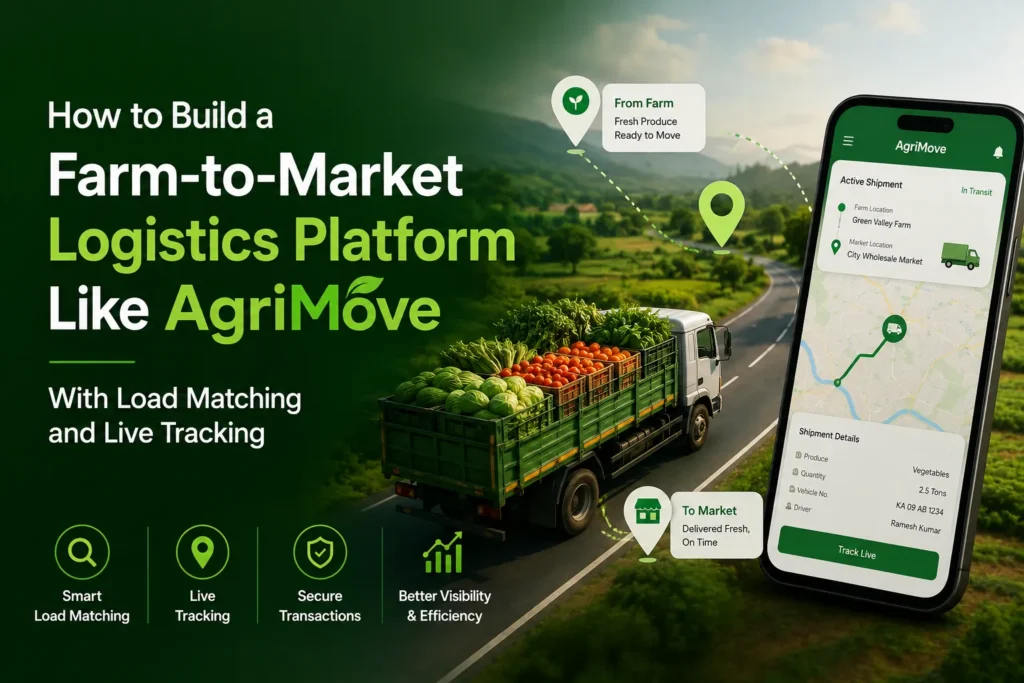
How to Build a Farm to Market Logistics Platform Like AgriMove With Load Matching and Live Tracking
Last Updated on August 10, 2026 by samruddhi kadam Key Takeaways AgriMove-style platforms connect farmers,…

No product name matched, so we are showing the categories that cover this topic.
Food Delivery/Grocery Delivery/Pharmacy Delivery/Parcel Delivery/Alcohol Delivery
Social Networks/Communication/File Sharing/AI & Automation/Website Builder
Every sector carries its own regulations, workflows and integration realities. We build to those, not around them.
No product name matched, so we are showing the categories that cover this topic.
Food Delivery/Grocery Delivery/Pharmacy Delivery/Parcel Delivery/Alcohol Delivery
Social Networks/Communication/File Sharing/AI & Automation/Website Builder
Every sector carries its own regulations, workflows and integration realities. We build to those, not around them.
A launch-ready agricultural logistics platform covering the whole chain – load marketplace and transporter bidding, dispatch and route planning, fleet and driver management, warehouse inventory down to bin level, cold chain monitoring, quality inspections, and an order-to-cash cycle that ends in multi-party settlement.
Ten role-based surfaces from one codebase: farmers and FPOs, buyers, transporters, drivers, warehouse and quality teams, finance, and platform administrators – each with a web dashboard and a role-specific view in the unified mobile app.
Go Live in 6 Days with Farm to ForkCold-Chain AwareOffline-FirstTen Role SurfacesMulti-LanguageWhite-Label
⚡ Platform at a Glance
Buyers post loads, transporters bid, and a weighted-scoring engine matches on lane compatibility, vehicle type, price and service history - the mechanism that attacks the 30-40% empty-miles problem.
Commodity-specific temperature ranges with severity-graded excursion detection and corrective-action workflows, so a breach is caught on the road rather than discovered at the receiving dock.
Lot-level tracking links a batch to its warehouse, its quality inspections, its dispatch and its delivery - which is what makes a recall a query rather than an investigation.
From order created through POD accepted, invoiced, paid and settled, with credit notes, debit notes and a formal dispute lifecycle for when the chain does not run clean.
Drivers, farmers and warehouse staff queue actions locally and sync on reconnect, because rural collection points do not have reliable signal and the work cannot stop while they wait.
English, Hindi, Marathi, Tamil, Telugu, Bengali and Gujarati ship as active locale bundles - not an architecture waiting to be switched on.
🚀 Ready to launch your own agricultural logistics platform?





Live in Action
Don’t just take our word for it – open the Miracuves AgriMove Clone yourself. Every role has a working login, no setup required. Post a load, award a bid, run a quality inspection, settle an invoice.
ADMIN CONSOLE
Full platform governance - users and roles, the KYC verification queue, security mode, feature flags, business rules, webhooks and platform-wide analytics.
FARMER & FPO
The supply side - schedule pickups for harvested produce, follow the shipment to warehouse or buyer, see quality grades, and track settlement status.
BUYER PORTAL
The demand side - post spot and contract loads, compare transporter bids or auto-match, track shipments live, accept POD and manage invoices.
TRANSPORTER & DRIVER
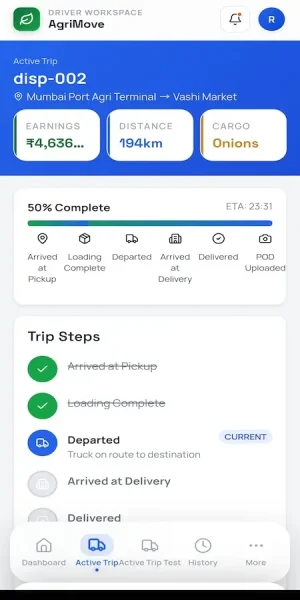
Carrier operations - register vehicles and drivers, discover and bid on loads, run active trips, and capture proof of delivery from the field.
WAREHOUSE OPS
Storage operations - inbound receiving, lot tracking across zones and bins, cycle counting, damage reporting and cold chain monitoring.
QUALITY CONTROL
Quality assurance - run digital checklists with parameter-level measurements, raise lab tests, place quarantine holds and drive CAPA to closure.
FINANCE & OVERSIGHT
The money and governance side - invoices and payments, multi-party settlements, credit and debit notes, disputes, and the compliance and export views.
ANDROID APP
A branded Android build of the unified field app, sharing the same platform APIs as the responsive web application.
Watch It Work
Want a guided tour? Book a 30-minute call with our team and map your logistics launch – partner onboarding, commodity model, cold chain thresholds, settlement cycles and go-live sequencing.
Every Screen Mapped
Over 150 API endpoints across roughly twenty route families, backing ten role dashboards on the web, a unified mobile app with a view per role, and a full administrative console.

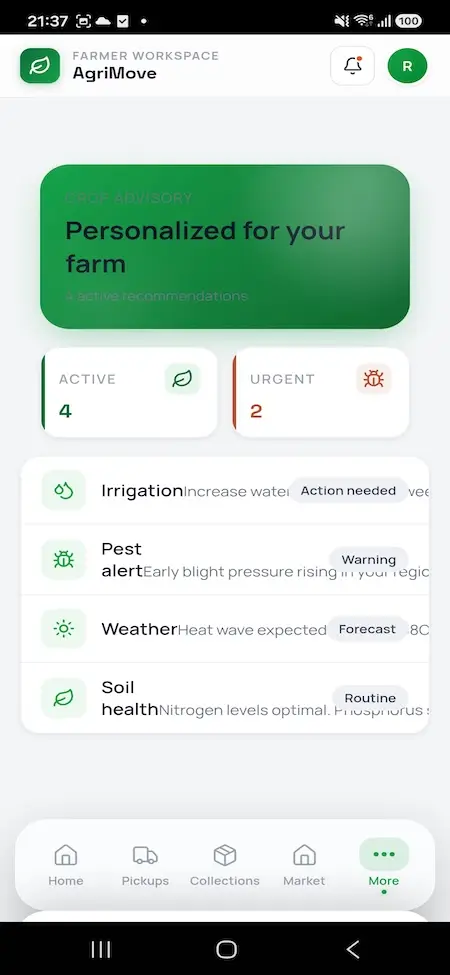
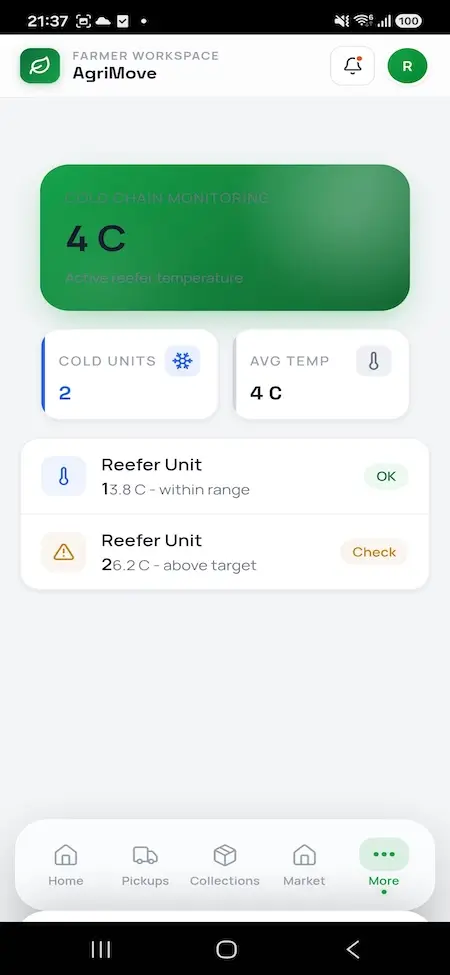
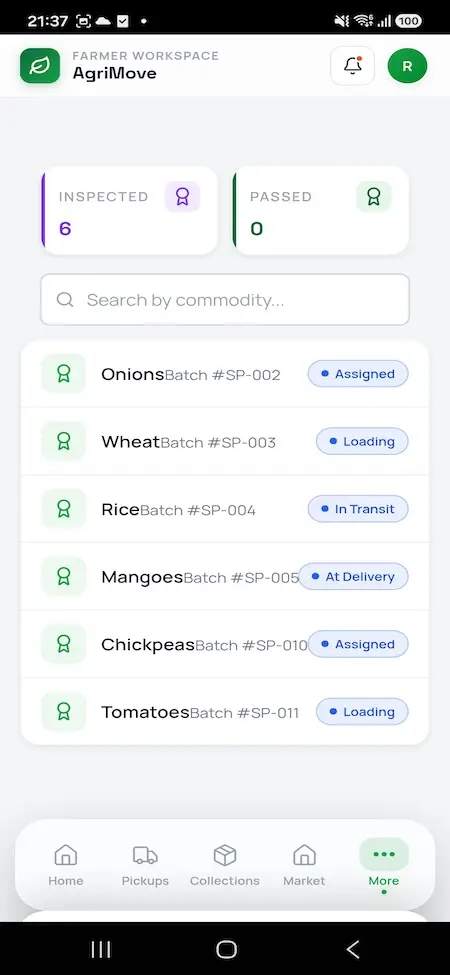
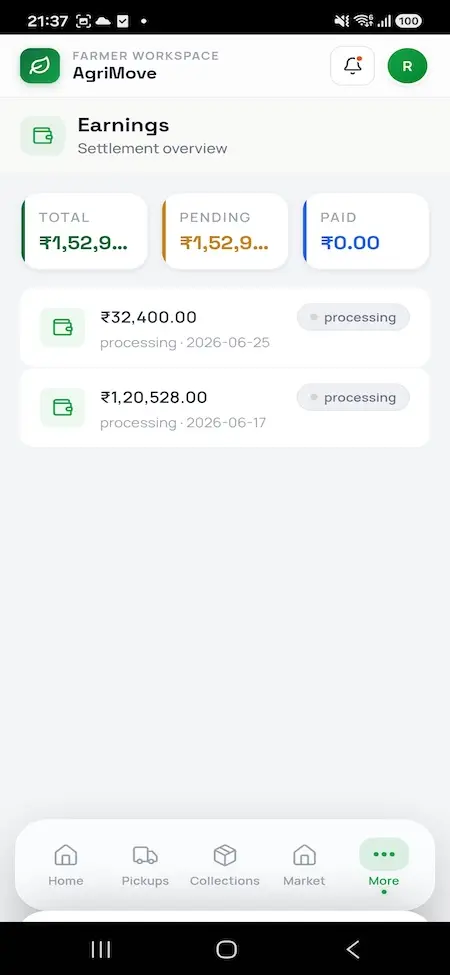
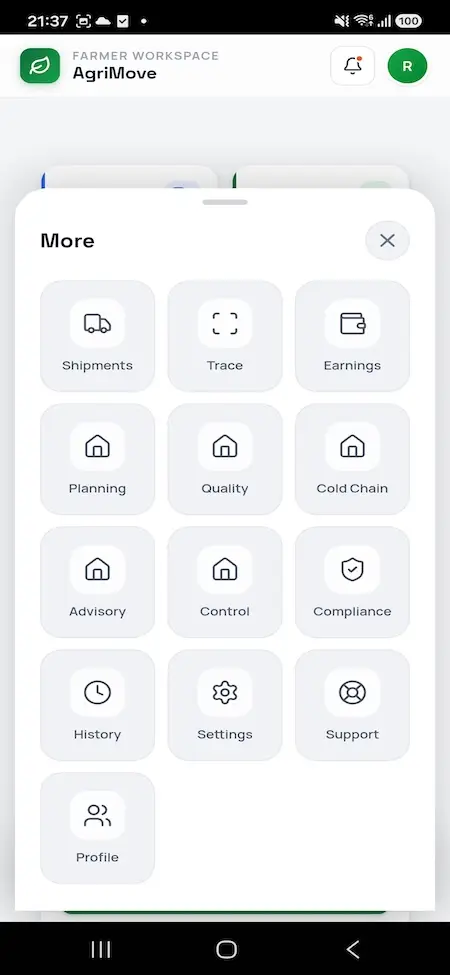
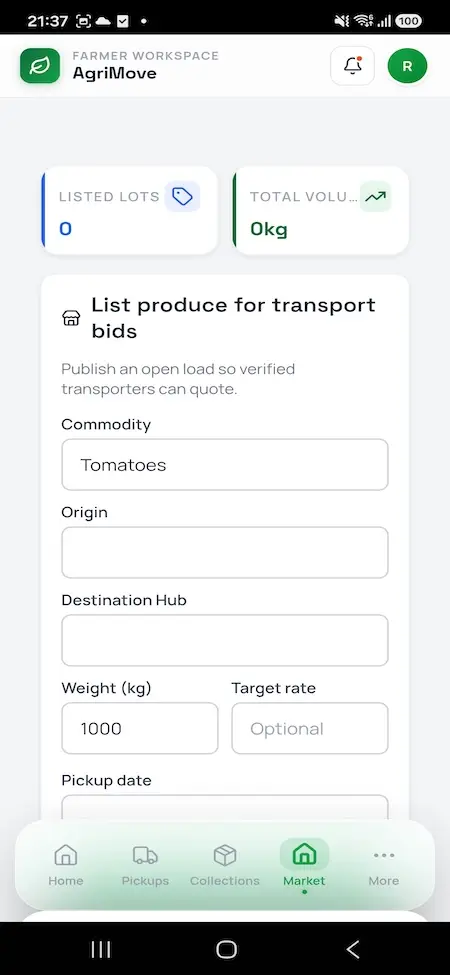
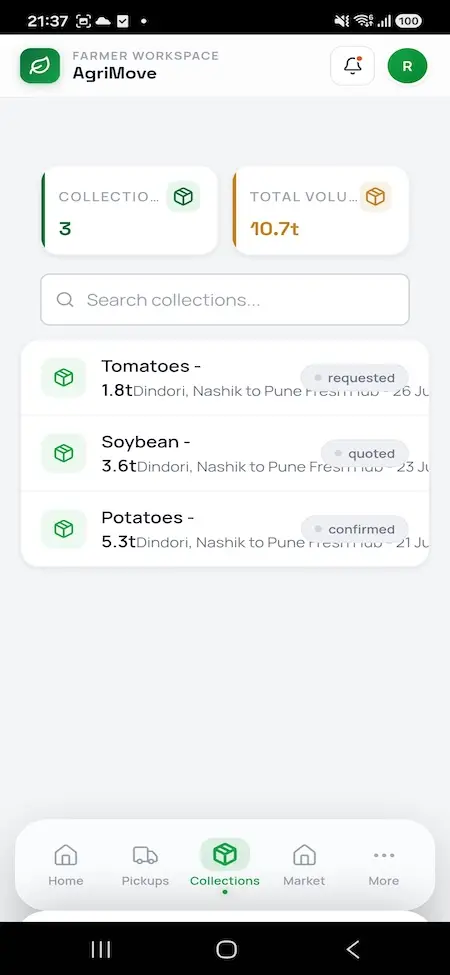
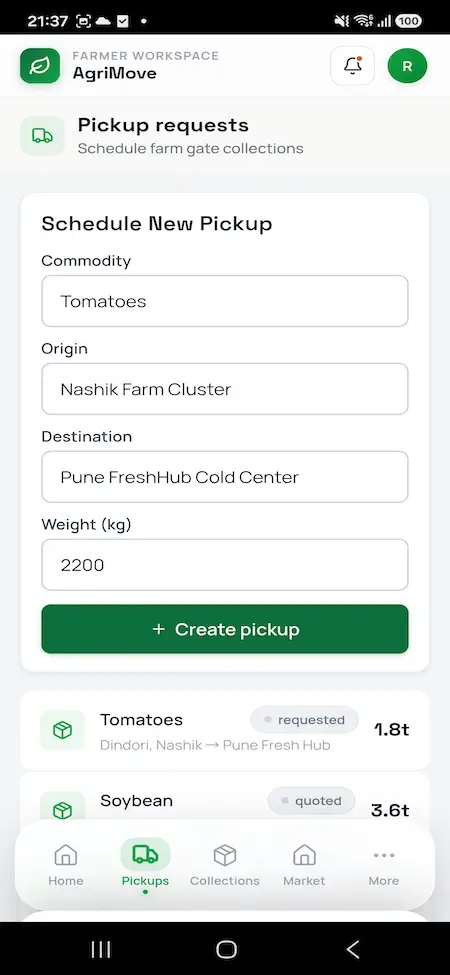
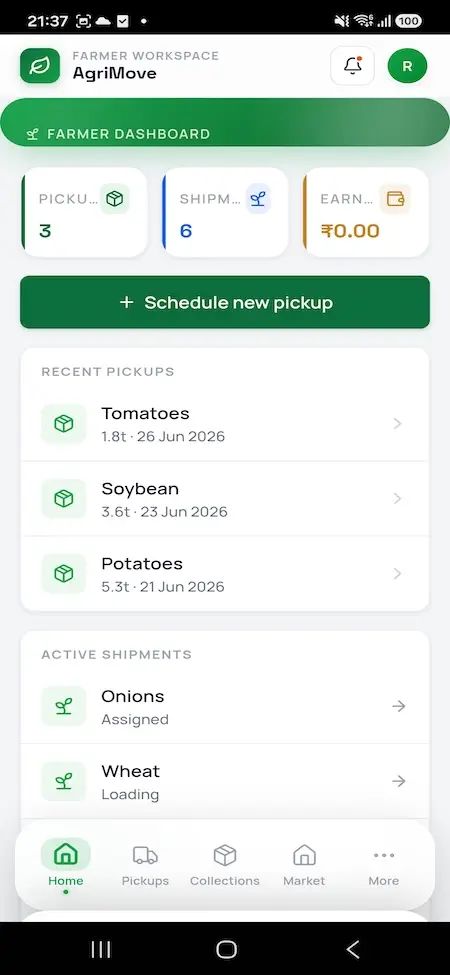
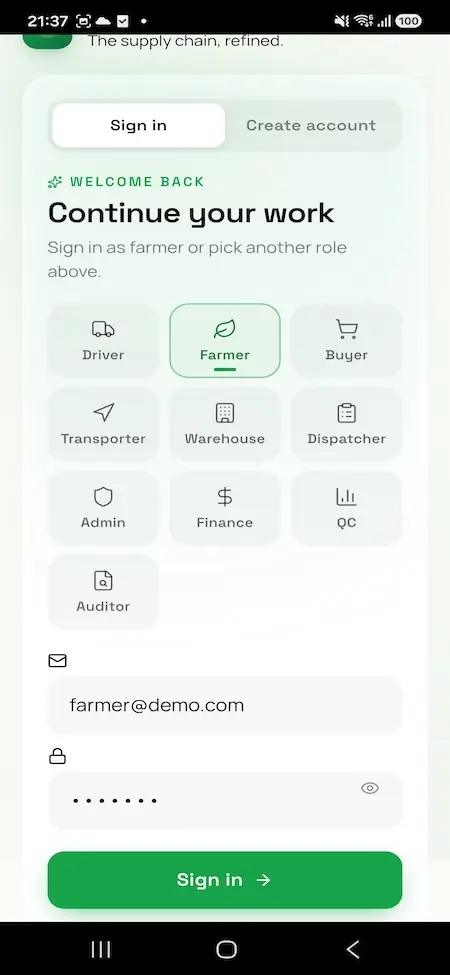
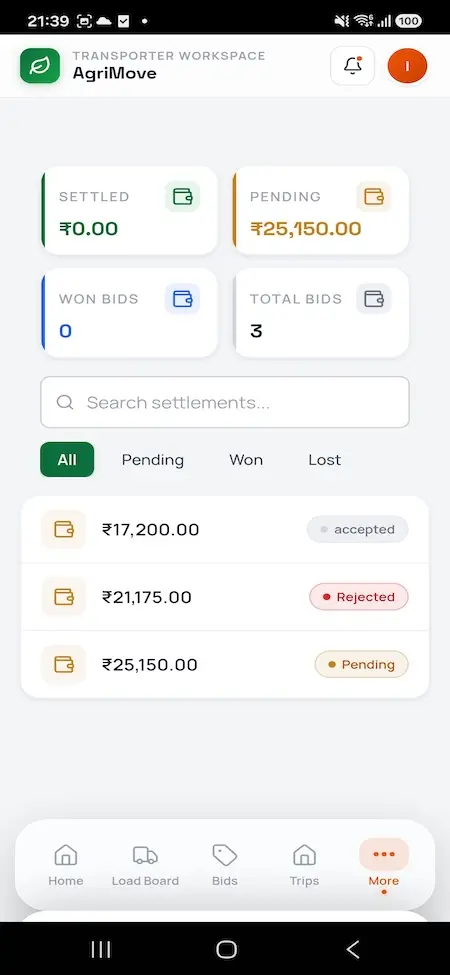
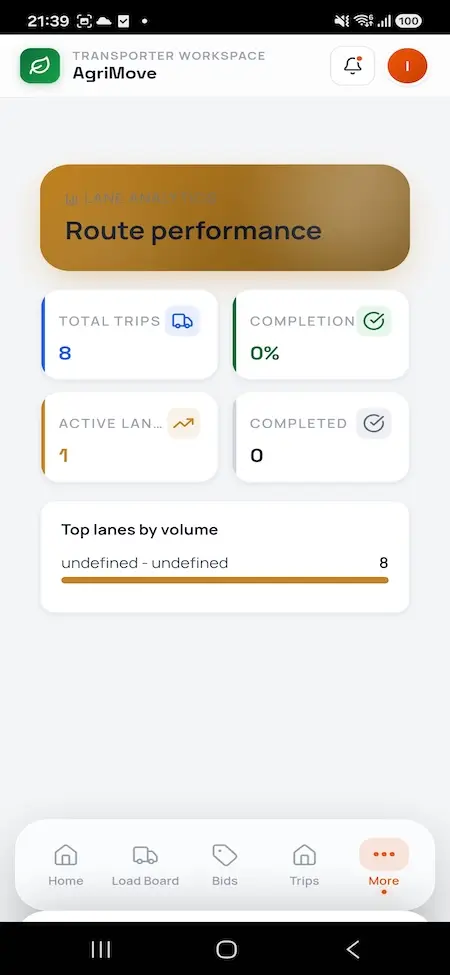
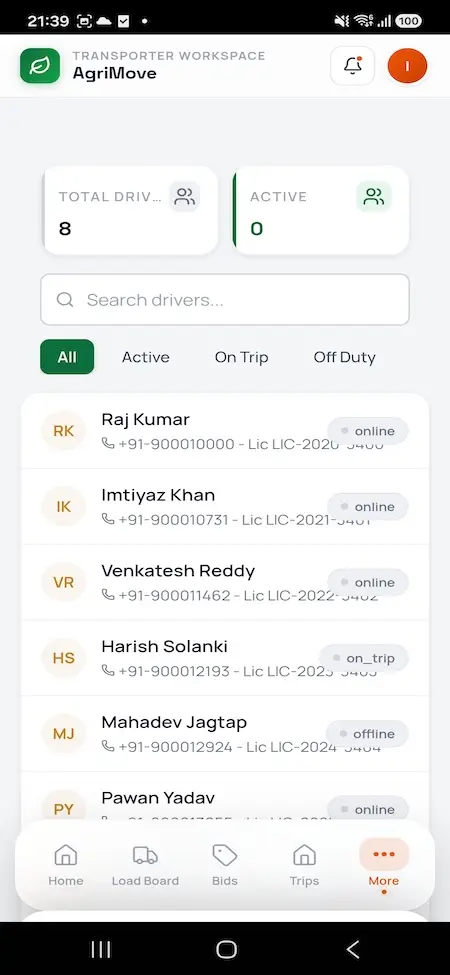
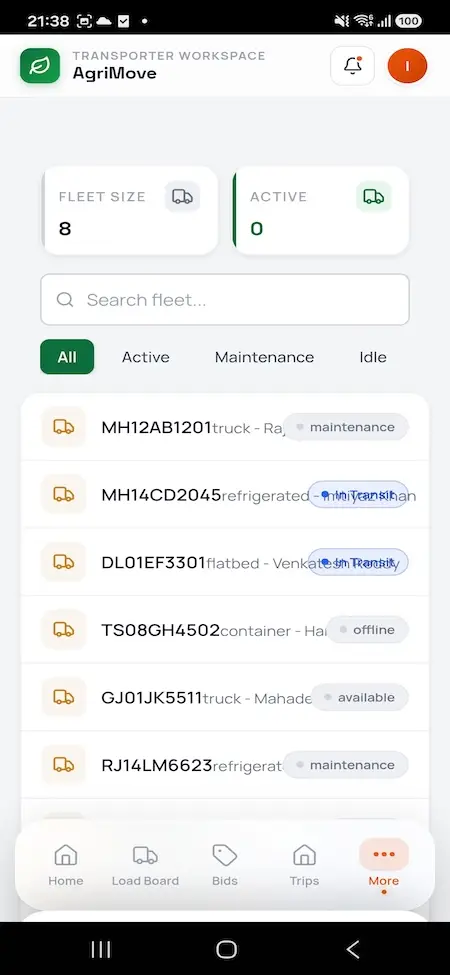
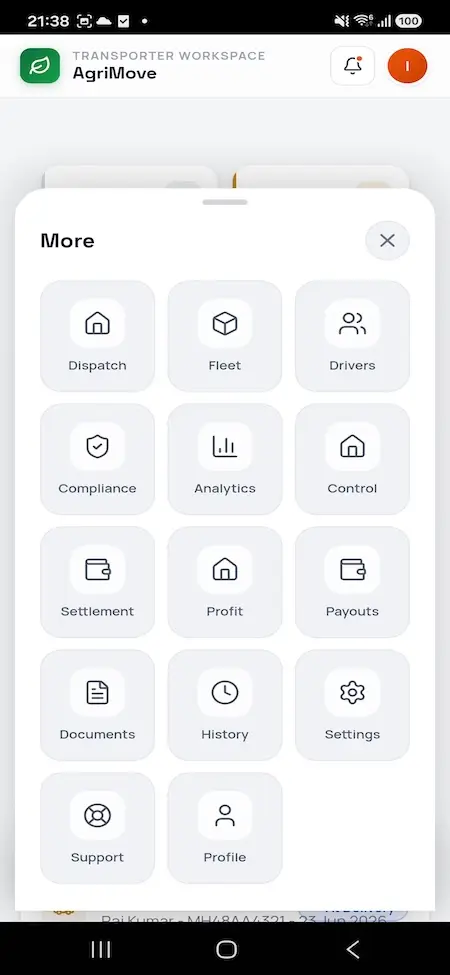
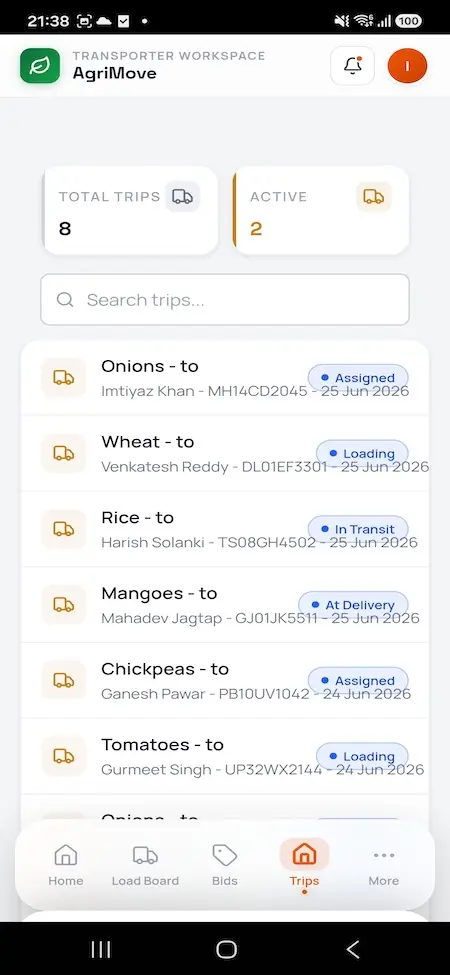
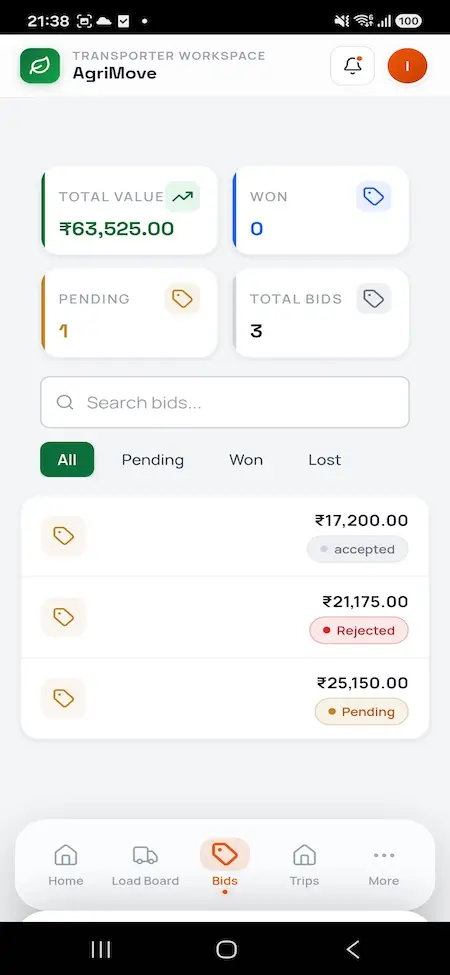
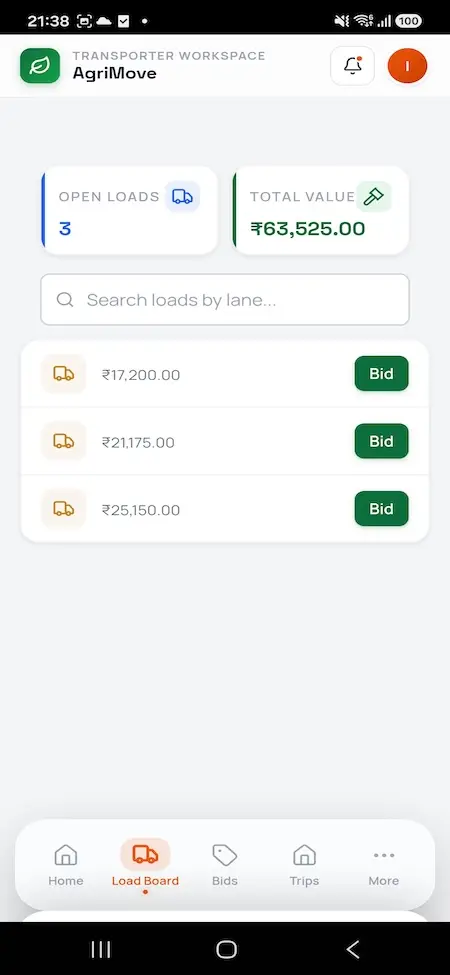
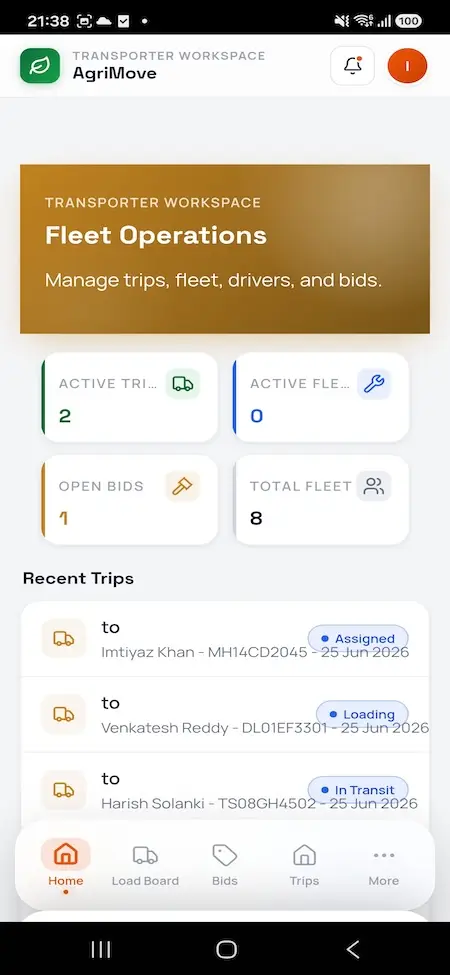
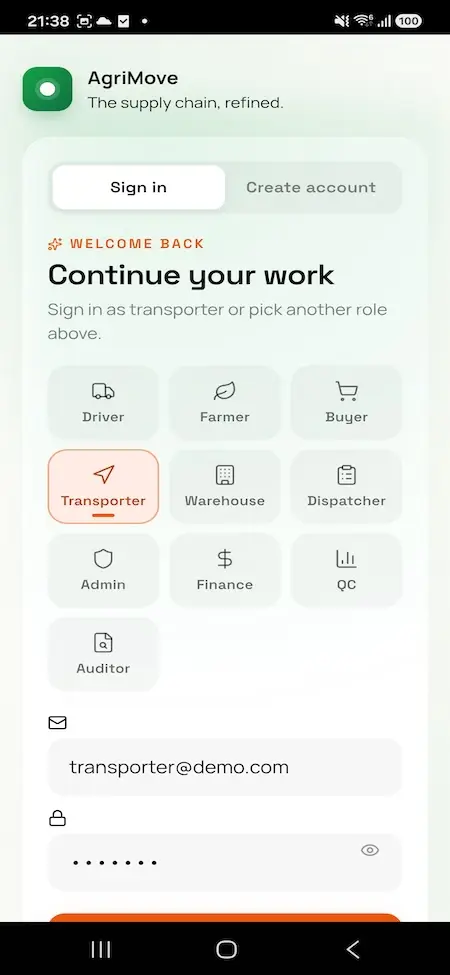
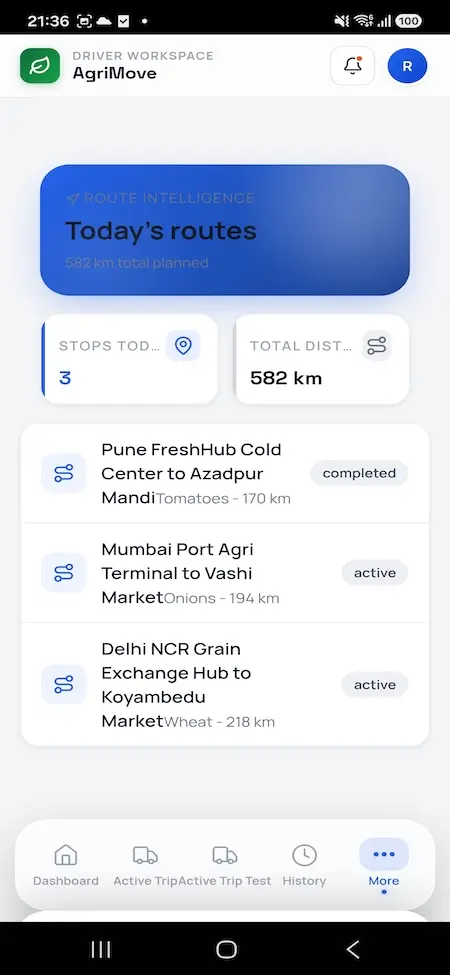
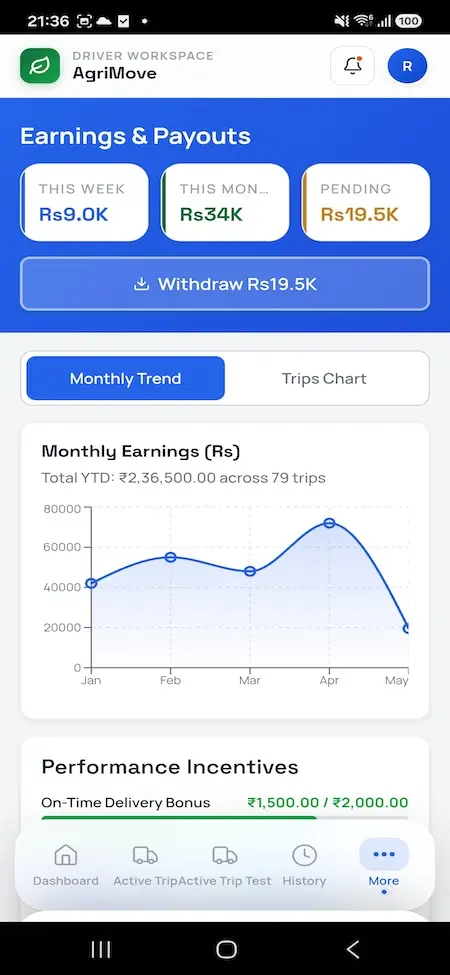
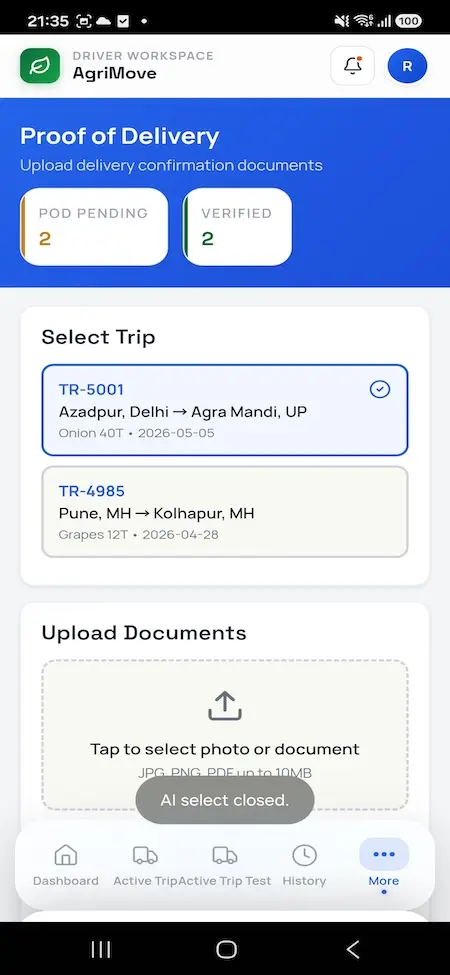
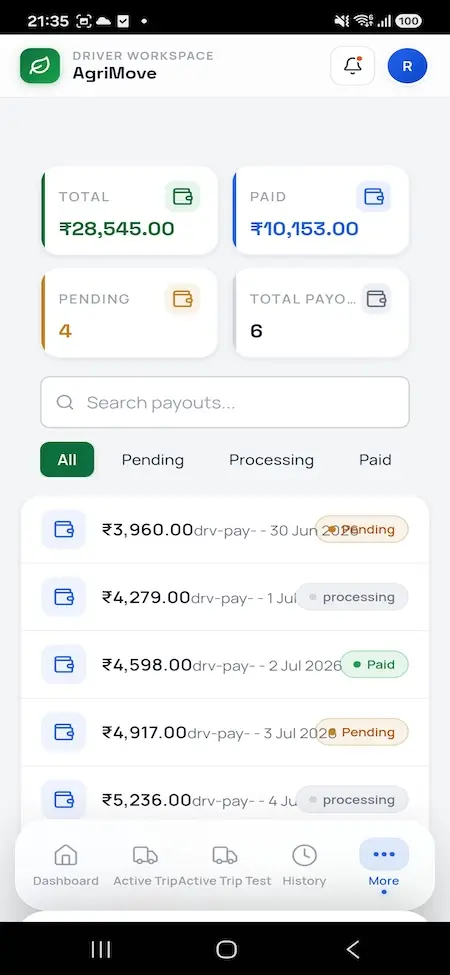
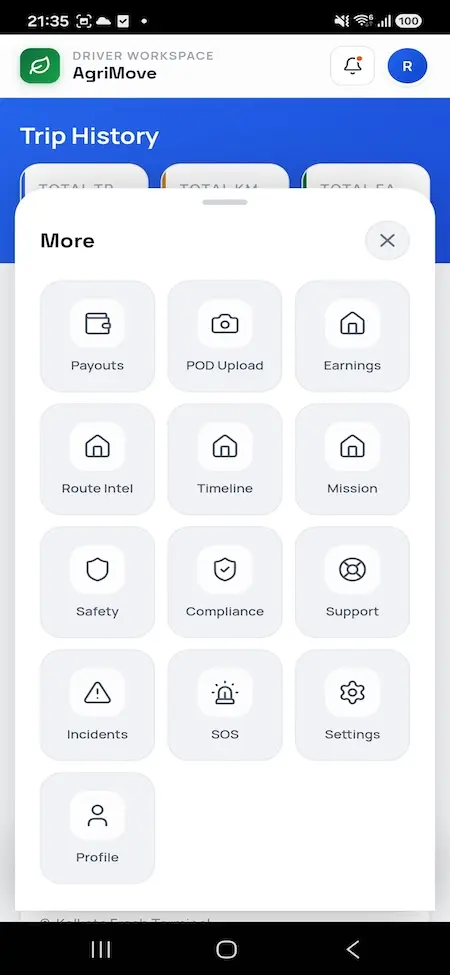
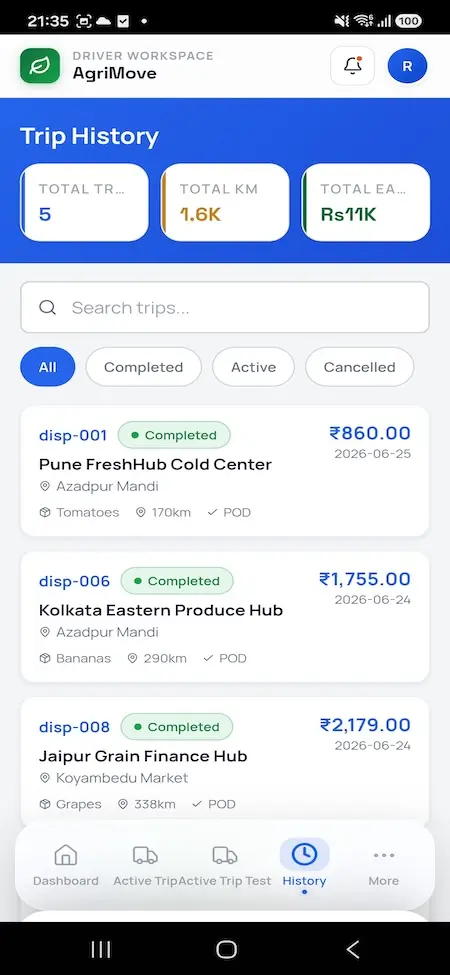
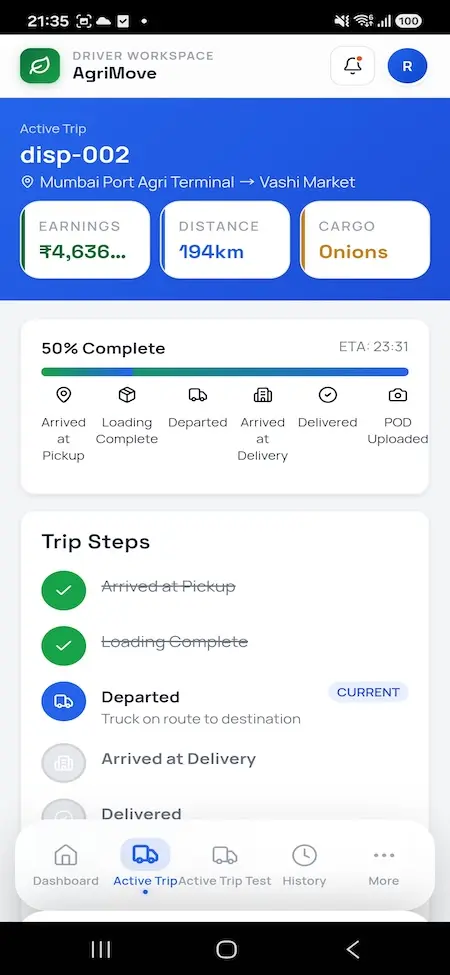
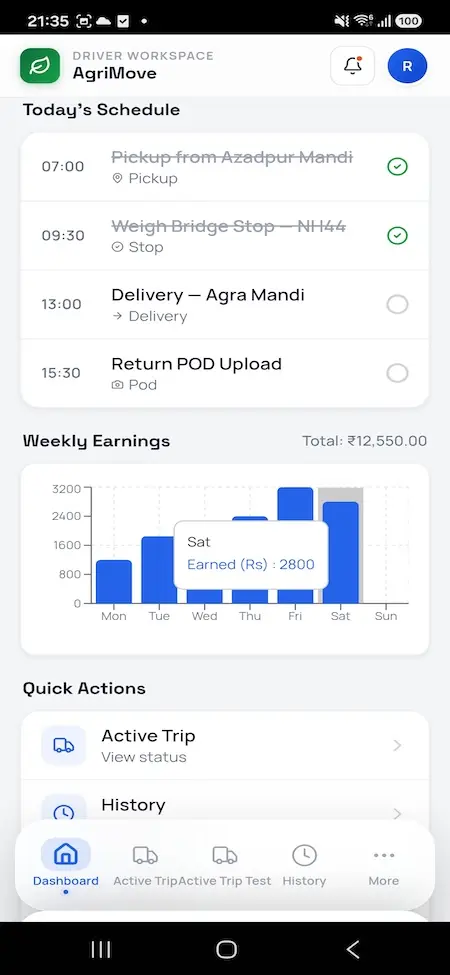
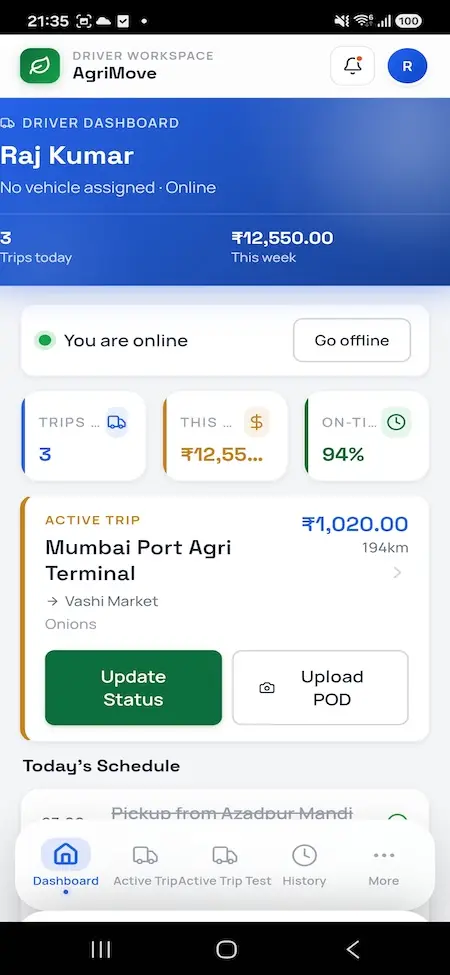
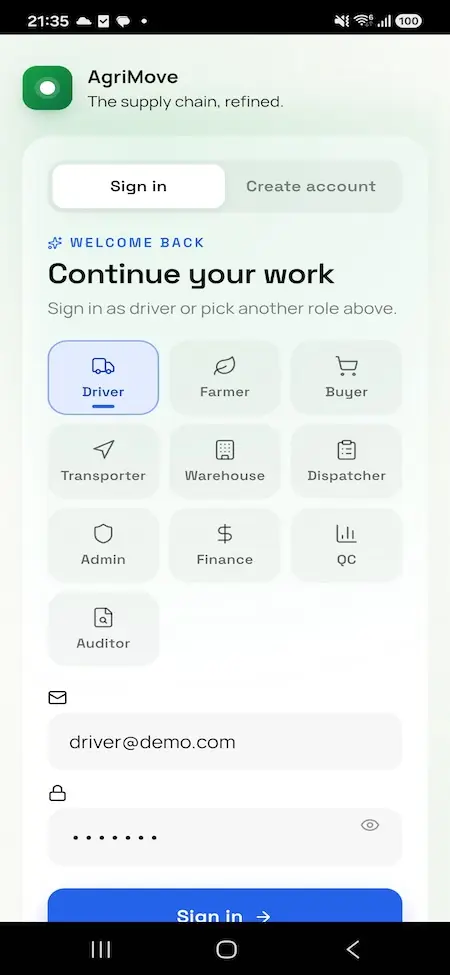
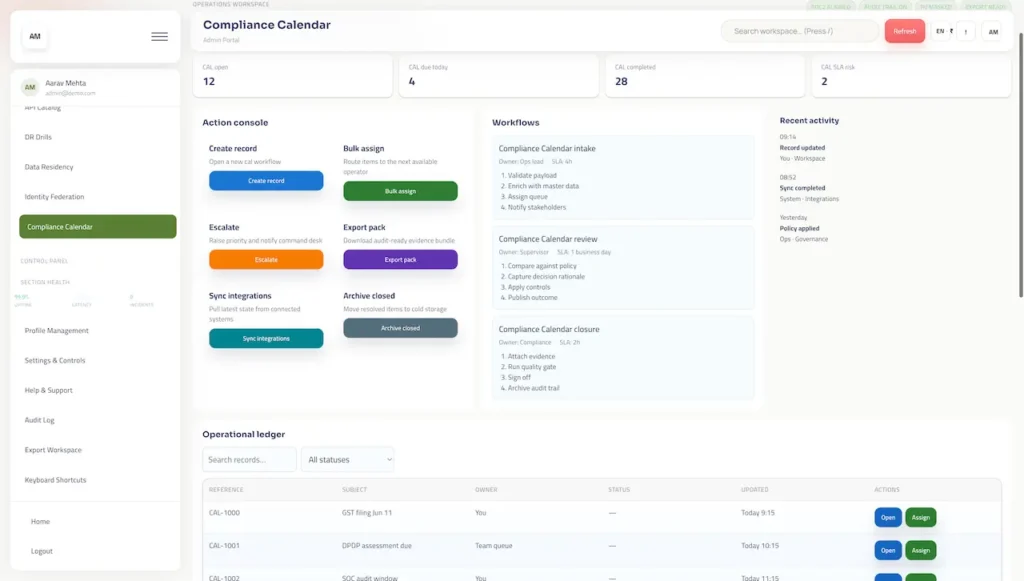
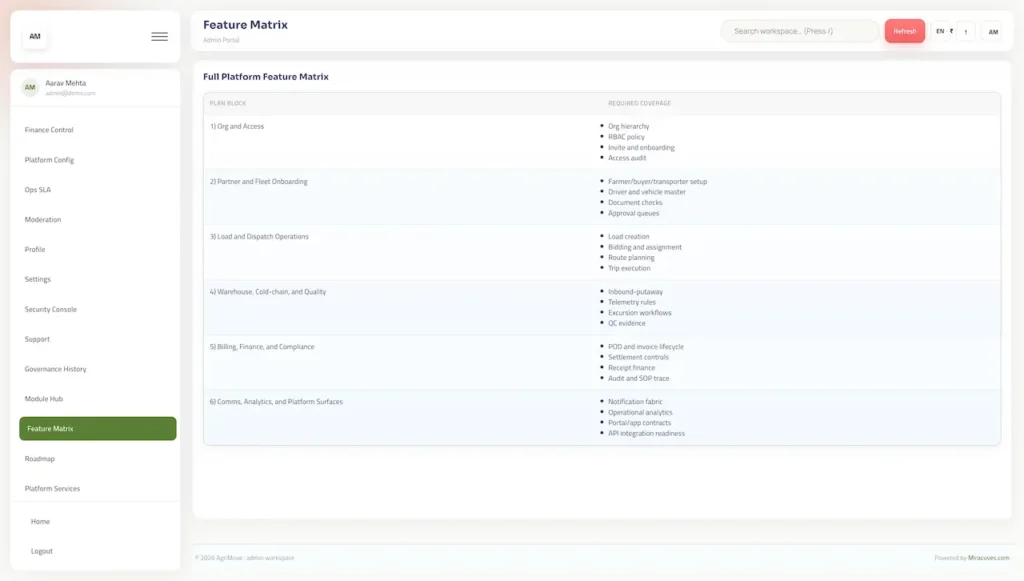
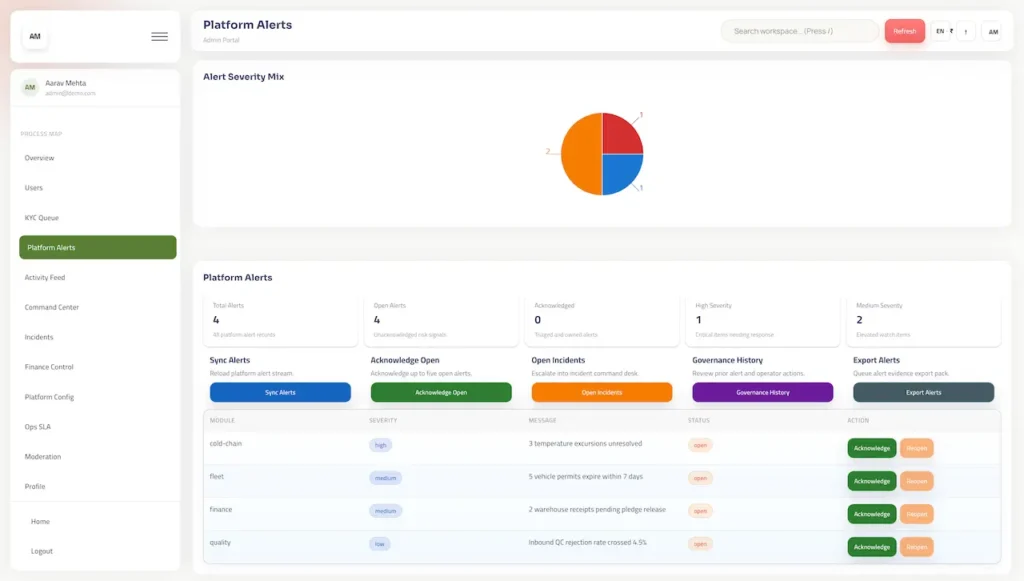
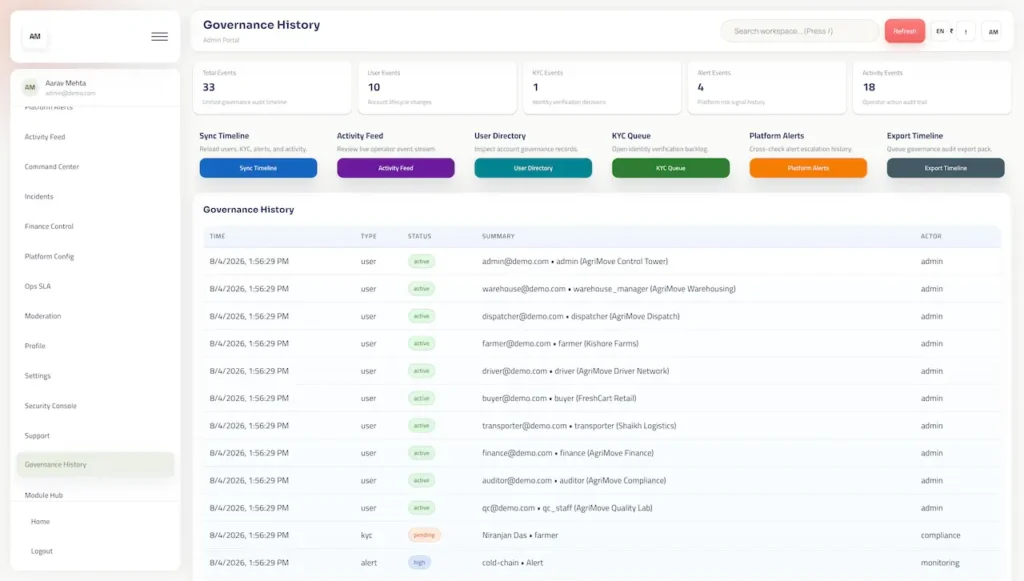
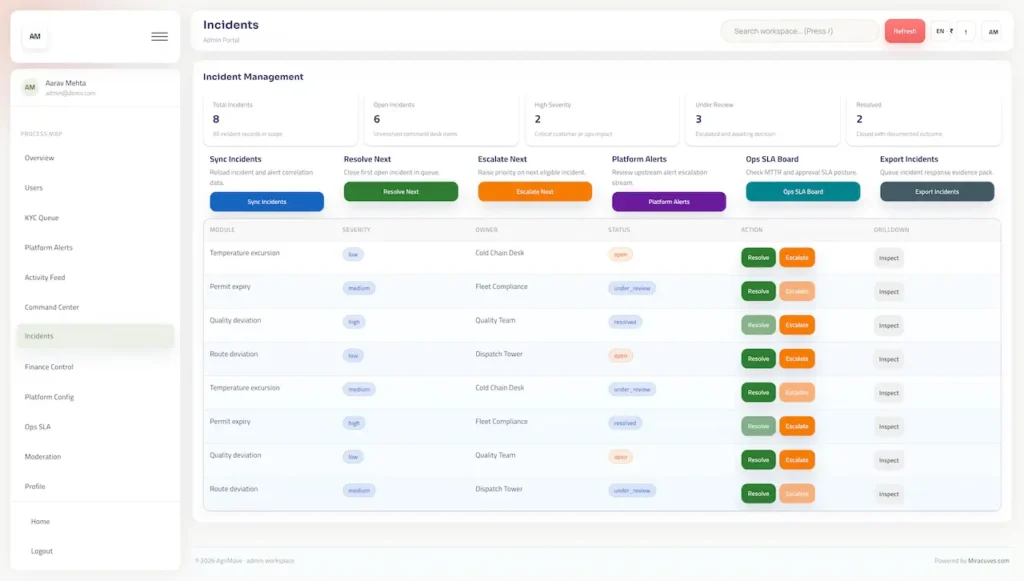
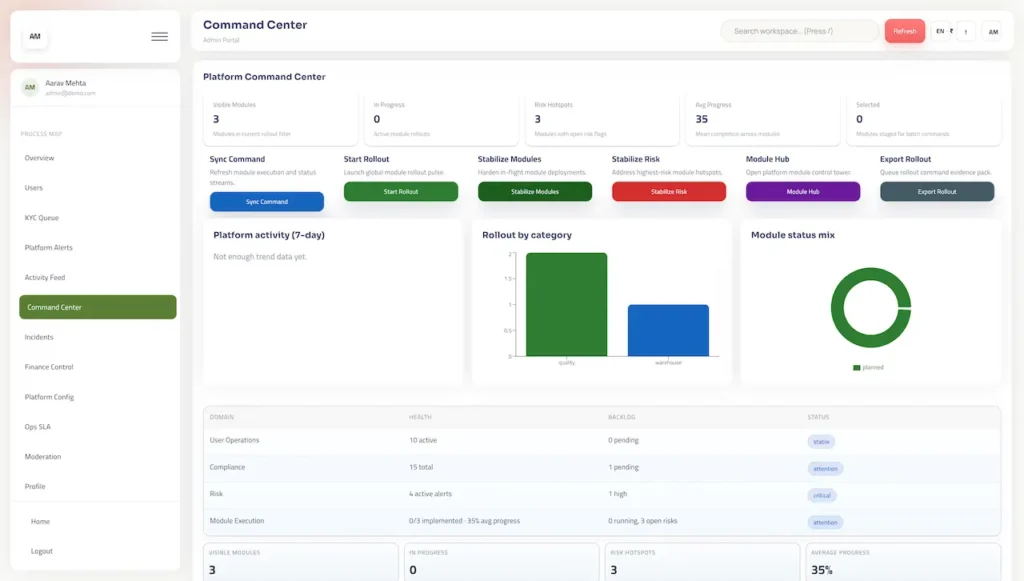
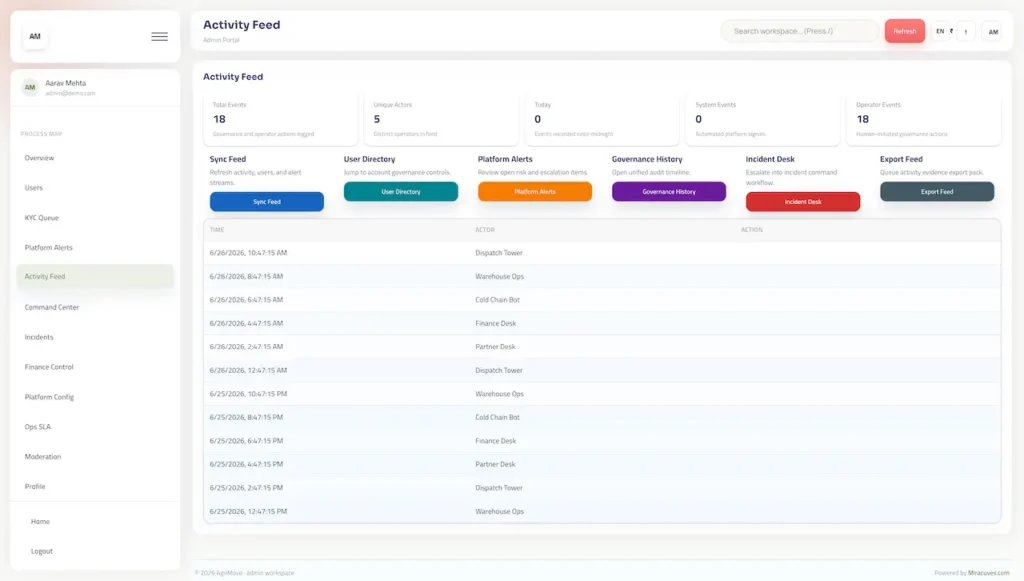
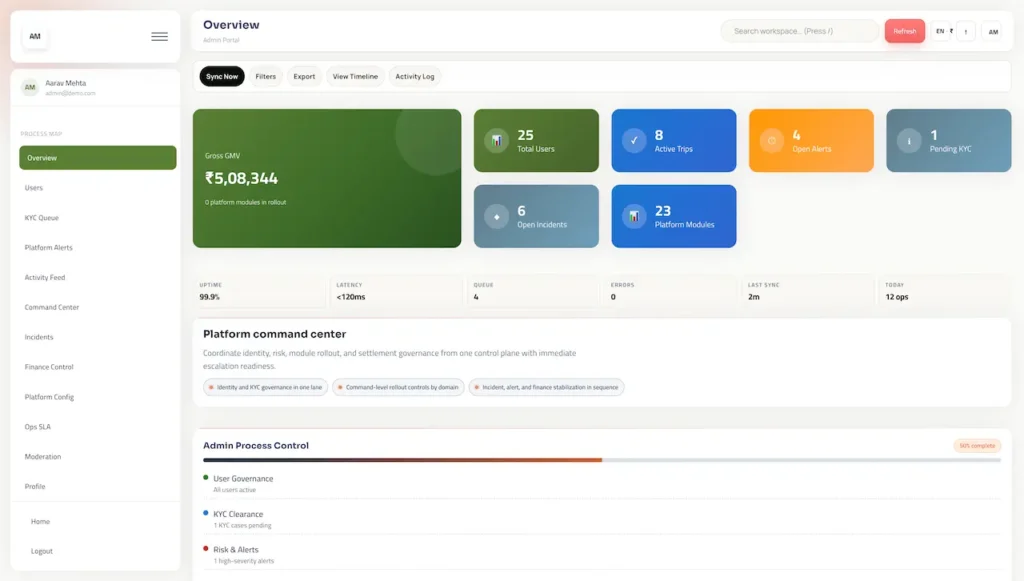
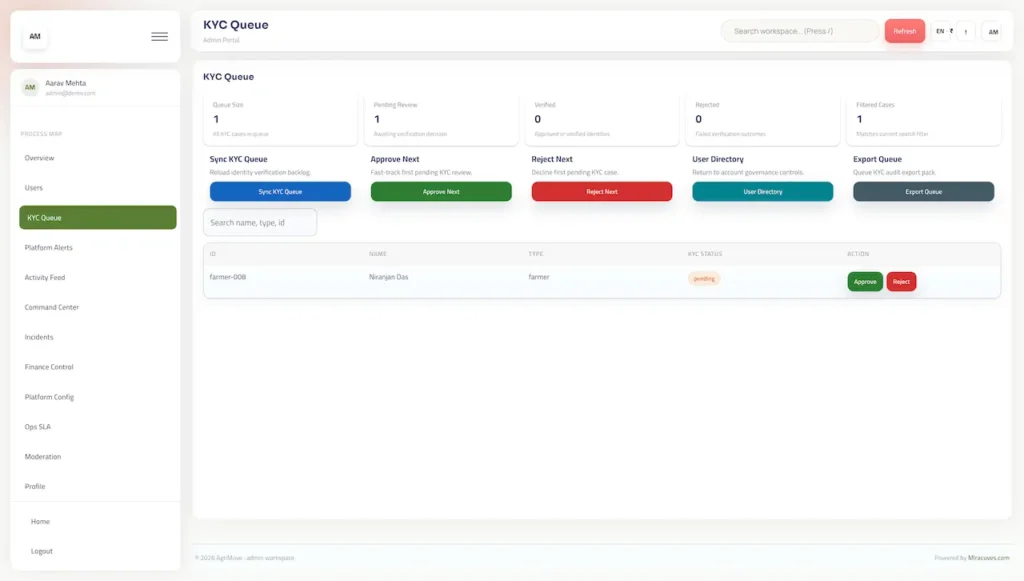
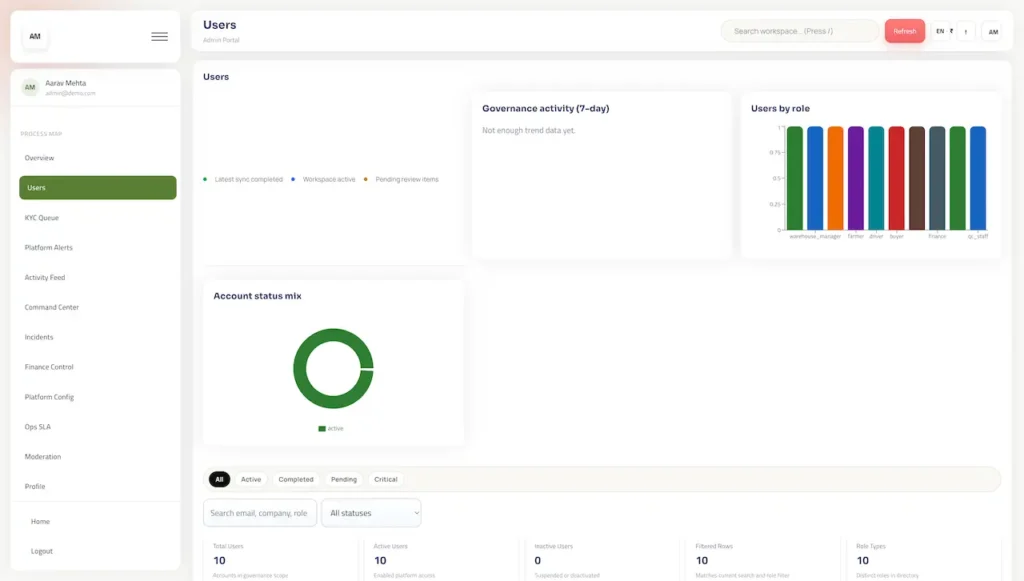
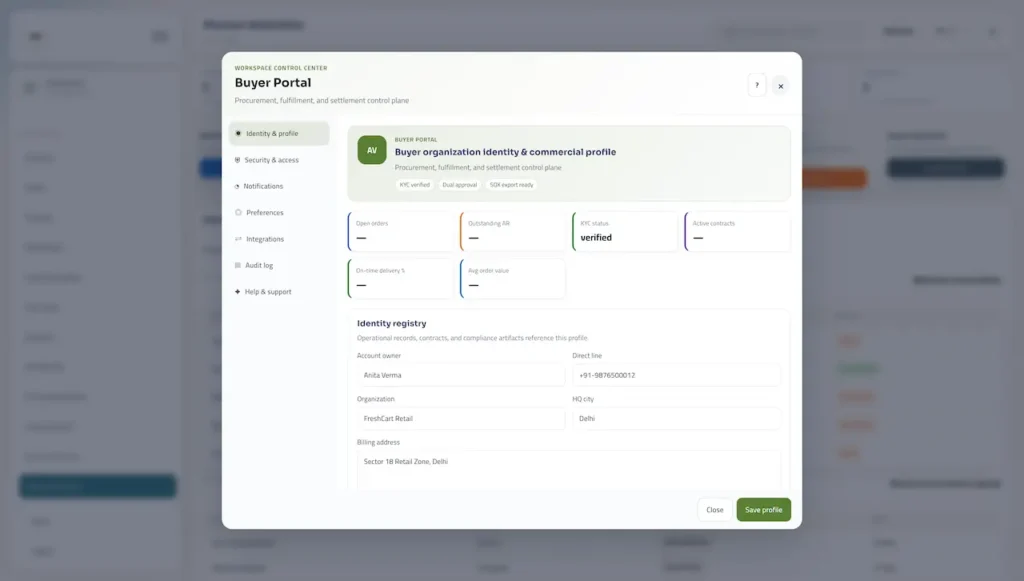
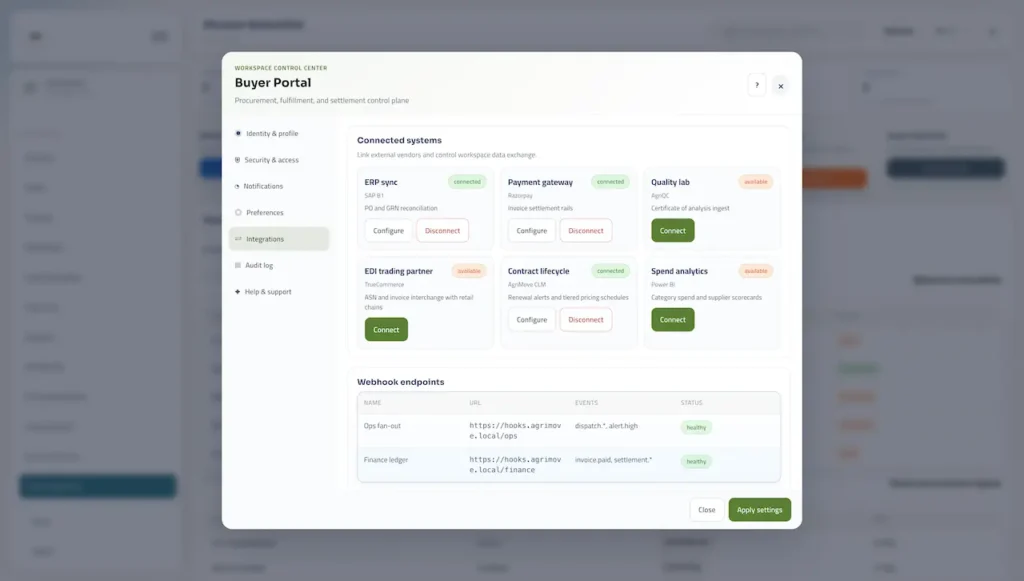
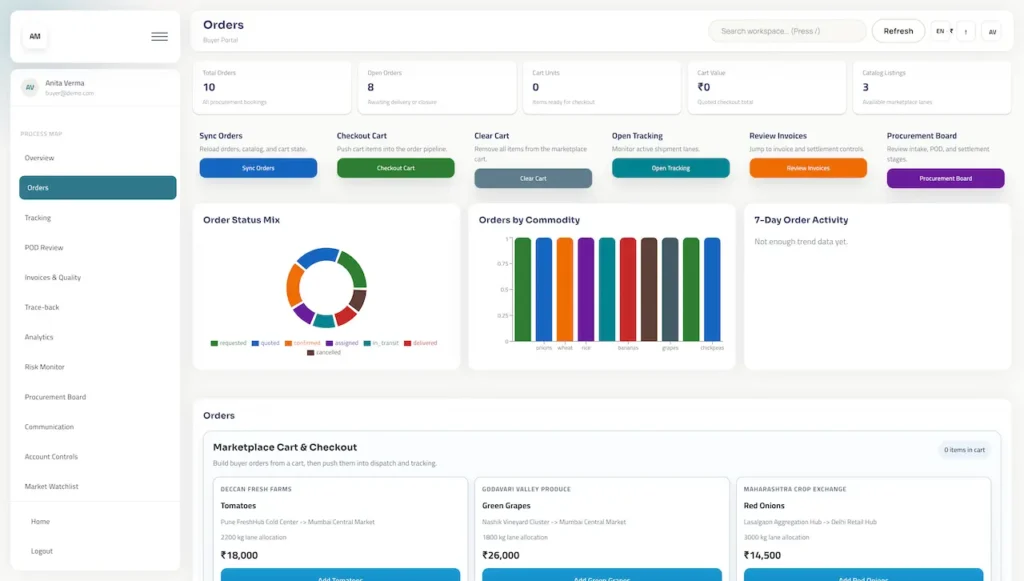
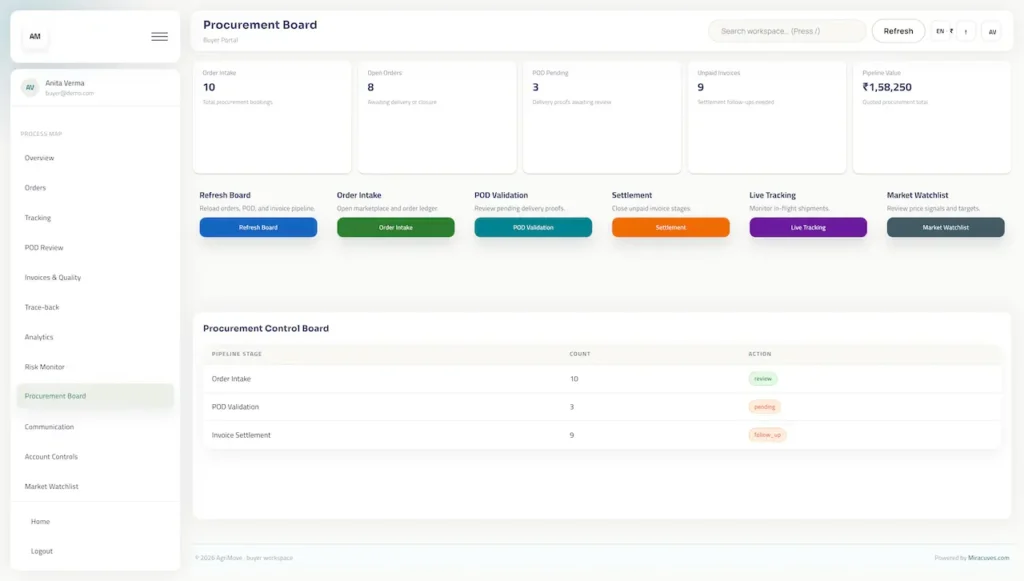
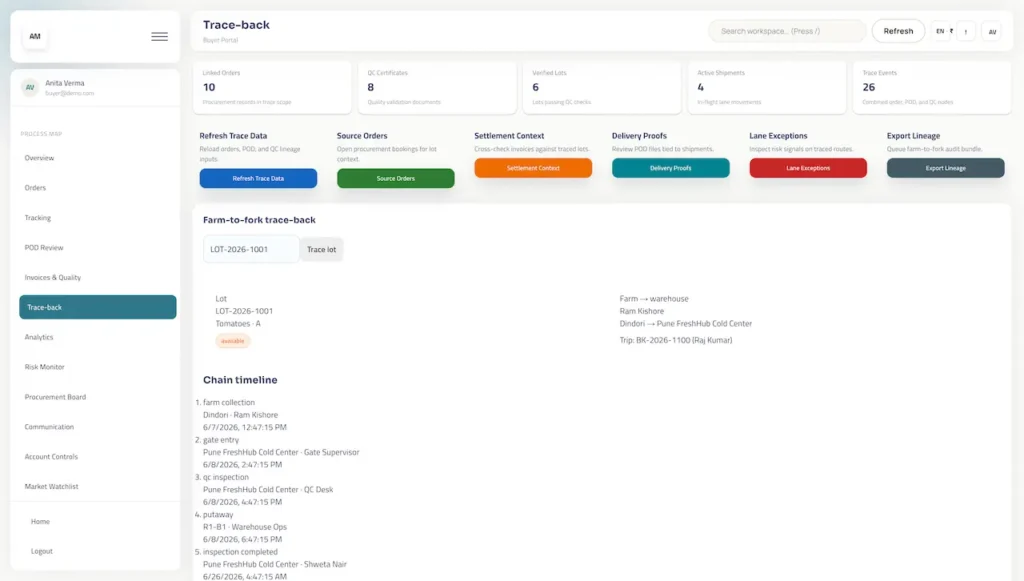
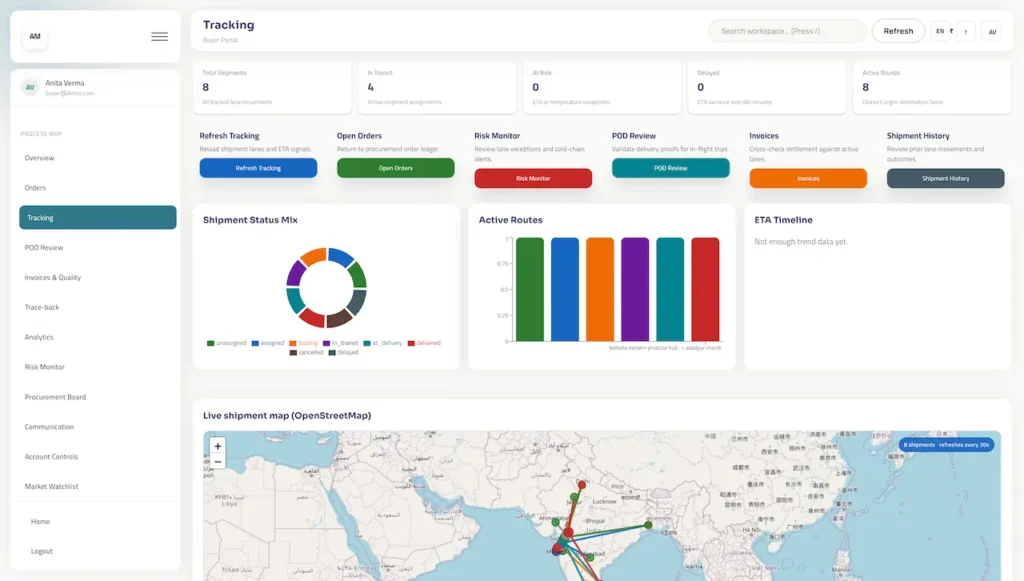
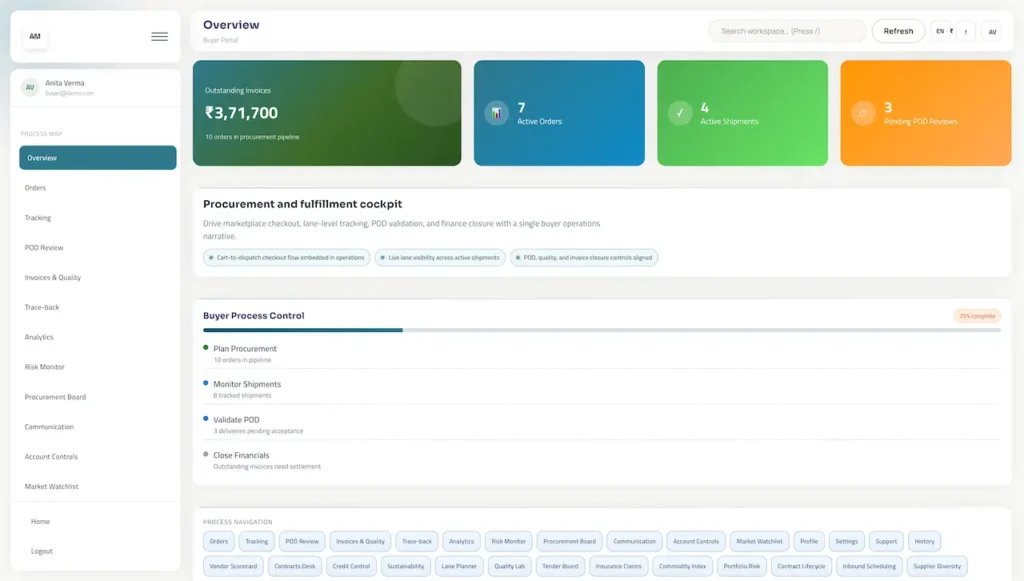
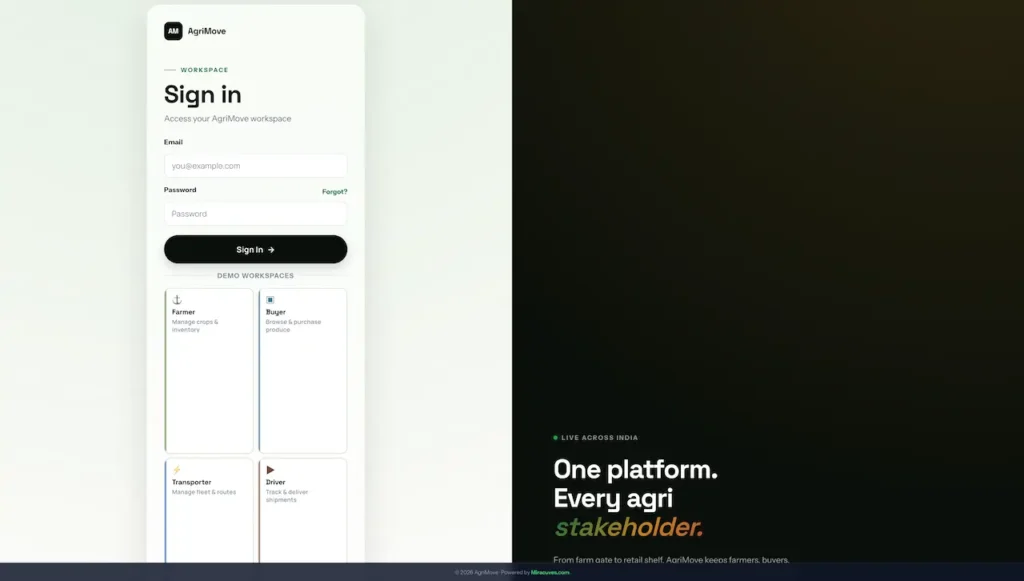
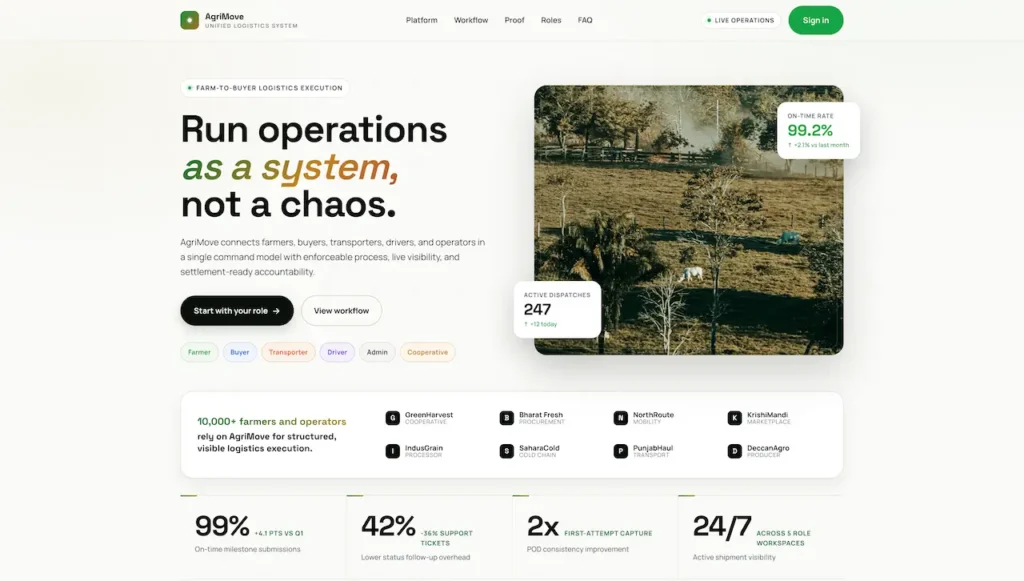
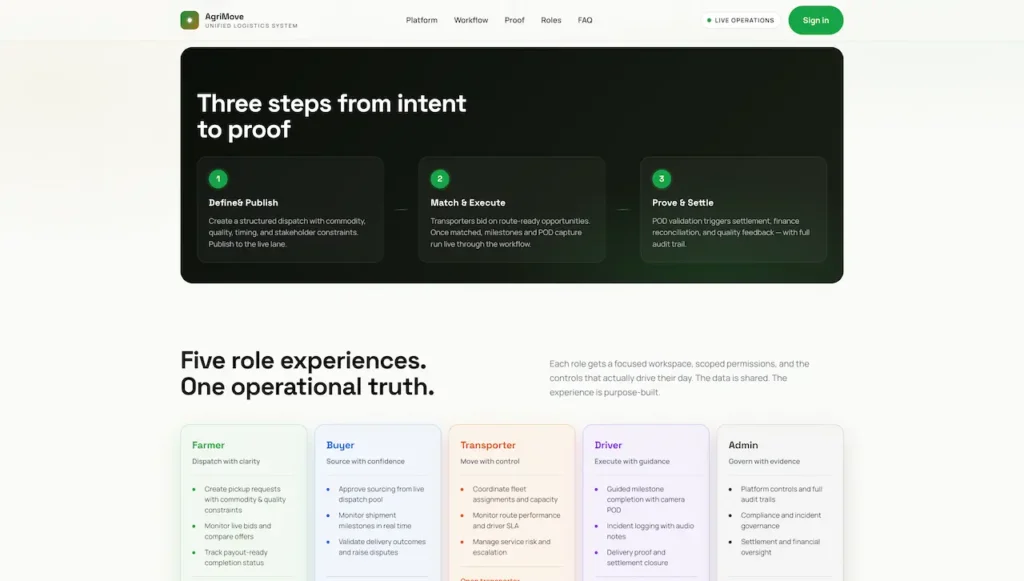
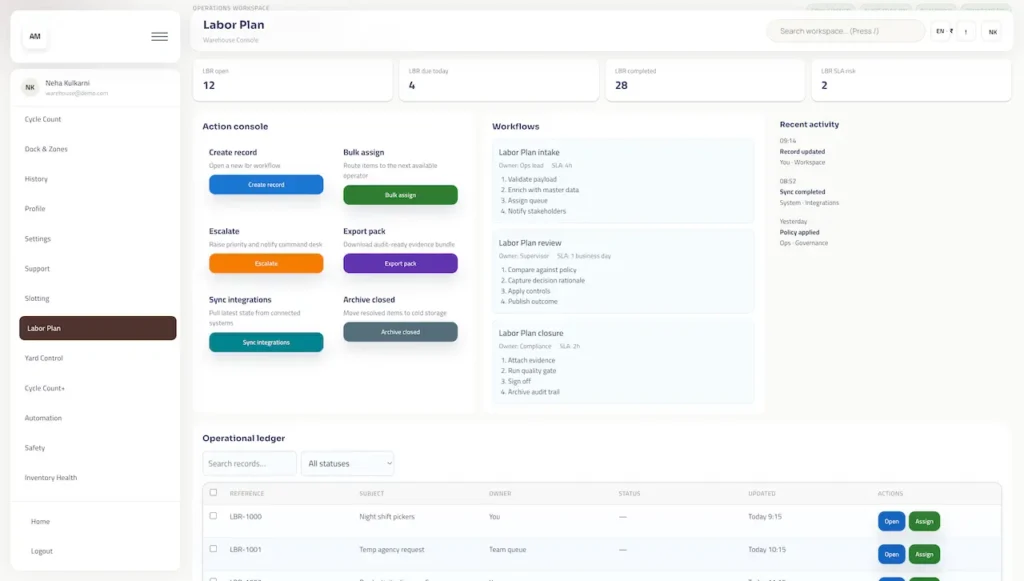
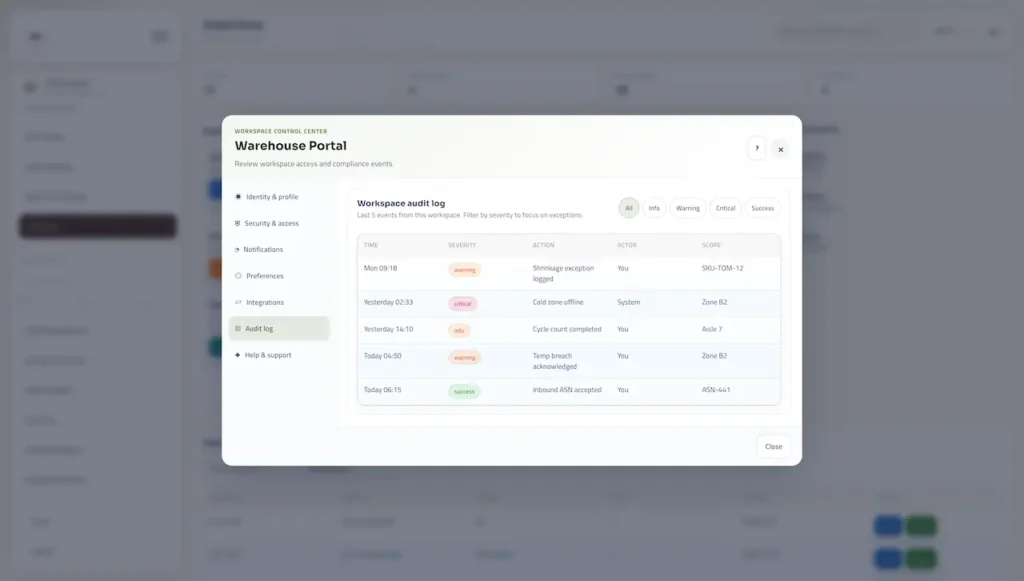
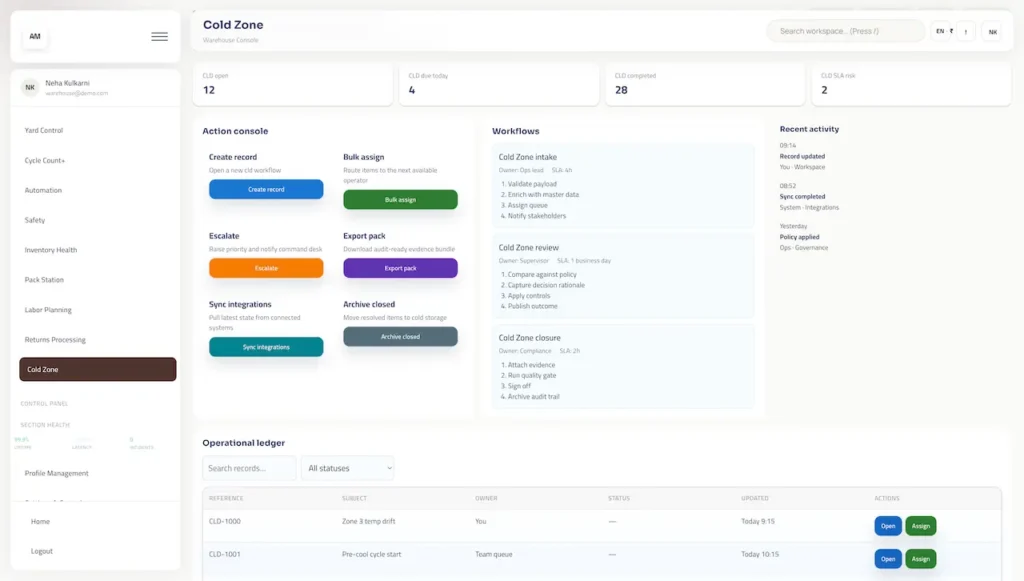
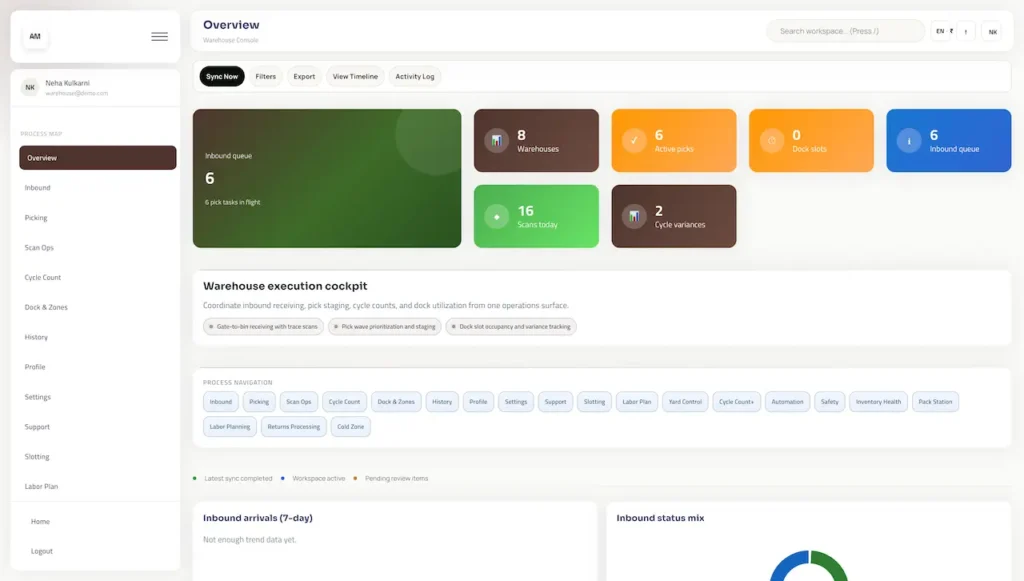
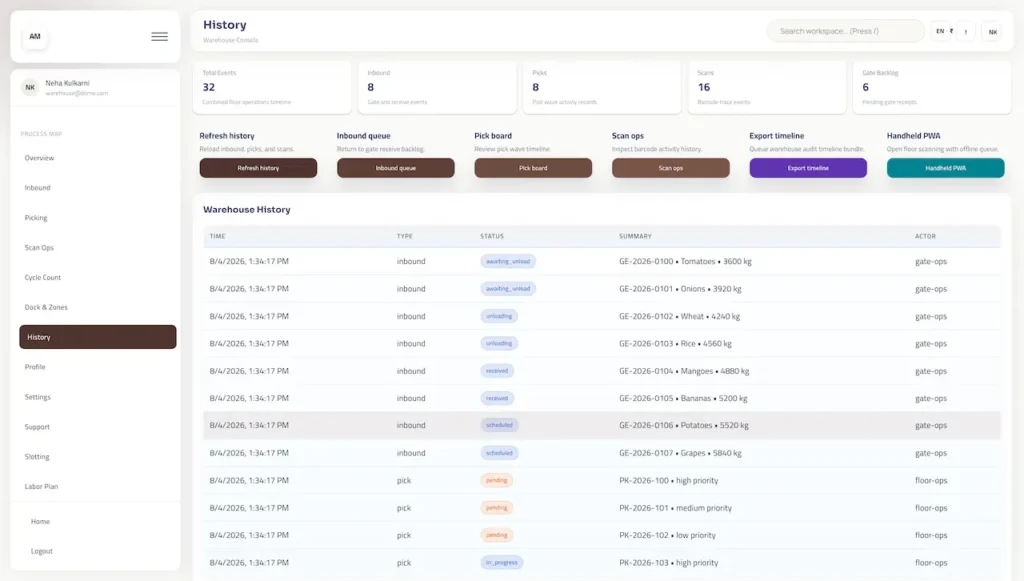
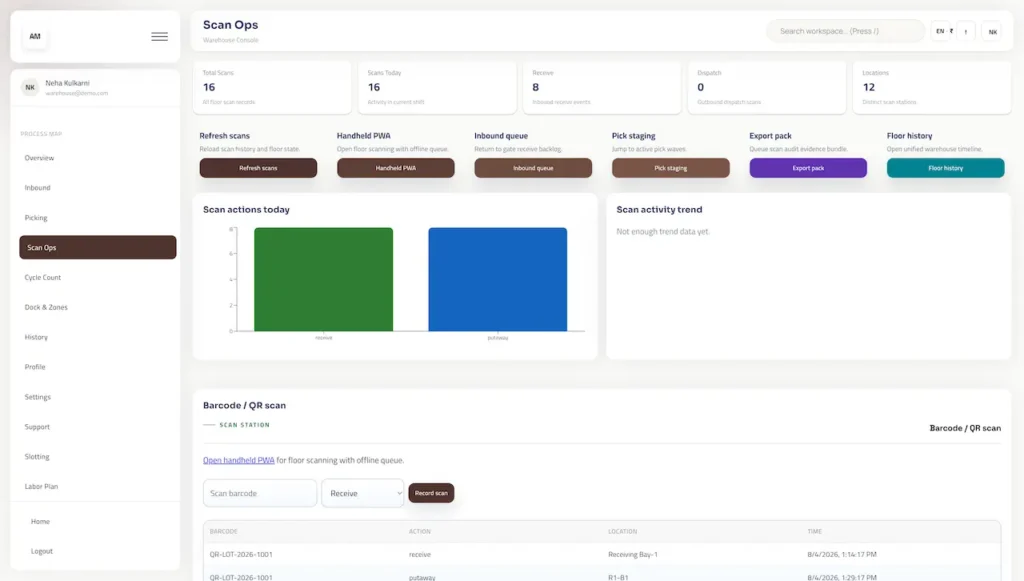
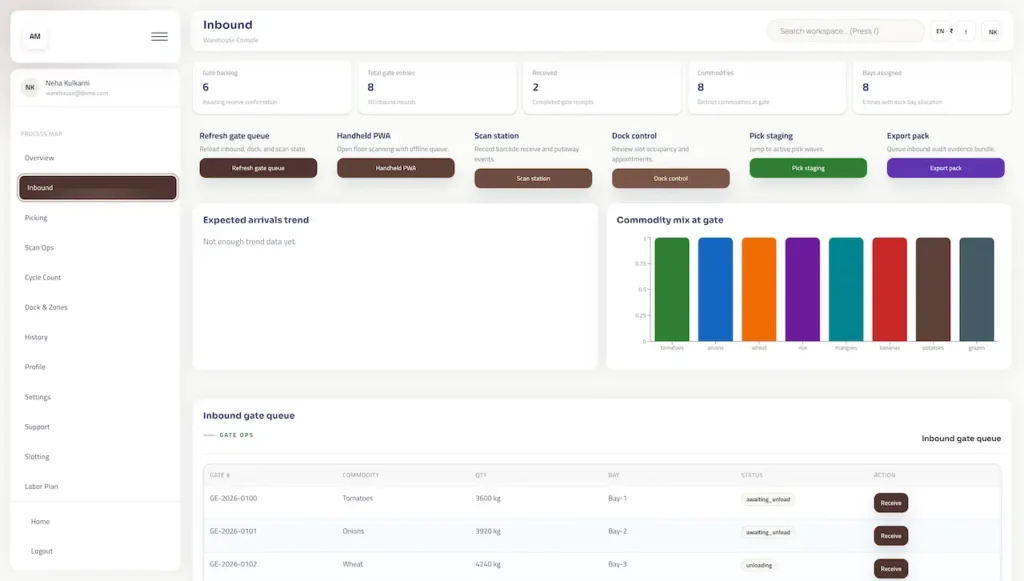
Follow a buyer from a posted load through bids to an accepted POD, a transporter from bid to settled payout, a warehouse team from inbound receiving to a released lot, and an inspector from checklist to closed quality hold.
Client Voices
Feedback from agri-logistics and cold chain operators who launched platforms with Miracuves. Client identities withheld under NDA.
Proof in Production
How an operator launched a regional agricultural logistics platform on the Miracuves AgriMove Clone. Client identity withheld under NDA.
Confidential Deployment
Agri Supply Chain Platform
A regional agricultural logistics platform launched on the Miracuves AgriMove Clone, connecting FPO collection centres to buyers with cold chain monitoring and automated settlements.
"Our transporters and FPOs were both on it inside a fortnight. Settlement accuracy is what kept them there."
The Basics
An AgriMove Clone is a ready-made agricultural logistics platform – a load marketplace connecting buyers to transporters, dispatch and route planning, warehouse and inventory management, cold chain monitoring, digital quality control, and the financial settlement that closes each transaction.
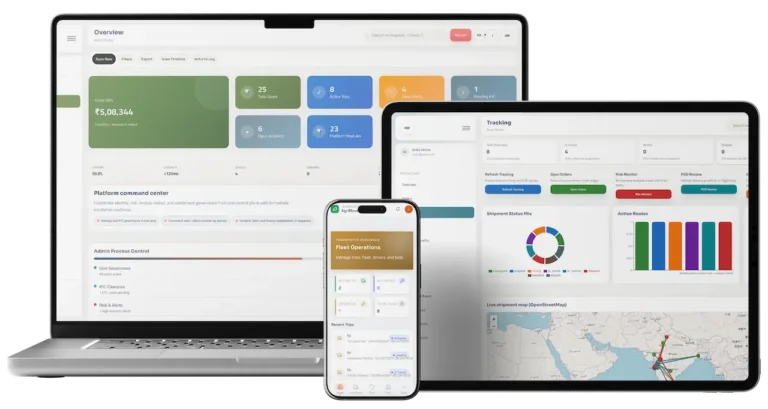
A load board matches freight and stops. This carries the load through dispatch, cold chain, quality inspection, proof of delivery and multi-party settlement, so the record of what happened is one chain rather than five systems.
You receive the source, the schema and the migrations. No per-seat fee, no vendor roadmap dependency, and standard PostgreSQL underneath.
The default runtime uses in-memory stores with PostgreSQL as an optional mode, payments run on a mock gateway, and password hashing is a documented pre-launch item. All of that is stated here rather than discovered later.
Built for Web, Mobile & API
The point is that it is not a transport marketplace bolted onto a spreadsheet. Agricultural supply chains fail at the seams: produce spoils because nobody saw a temperature breach, a consignment is rejected because quality was never recorded, and payment takes 45 to 60 days because three parties disagree about what was delivered. This platform closes those seams in one data model.
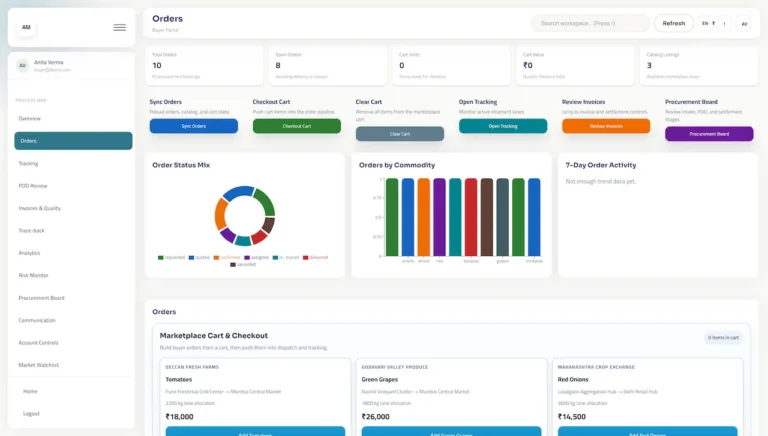
The build ships a PostgreSQL schema of 50+ tables across thirteen domains, over 150 REST endpoints, ten role-based surfaces, a unified offline-capable mobile app, and seven active Indian language bundles.
Everything Included
Every capability below is built and demonstrable in the live demo. Where a feature needs a third-party account before it moves real money or sends a real message, that is stated against the feature rather than implied away.
Invitation tokens, self-service registration, document upload and a structured approve-reject-activate workflow, so the partner network can scale without manual paperwork behind every addition.
Buyers post spot or contract loads; transporters discover, quote and bid. Awarding is explicit and the whole exchange is recorded rather than happening over the phone.
Loads matched to transporters on lane compatibility, vehicle type, price and service history - the mechanism that turns empty return legs into paid ones.
A daily dispatch board with driver and vehicle assignment, multi-stop sequencing, route optimization, dock scheduling and detention tracking.
Vehicle profiles with document expiry alerts, preventive maintenance scheduling, fuel analytics, and driver compliance scoring computed from operational metrics.
Zones and bins under each warehouse, lot-level inventory across cold, ambient, frozen and multi-temp storage, with cycle counting and occupancy analytics.
Commodity-specific ranges, severity-graded excursions and corrective-action workflows, backed by IoT endpoints for temperature, humidity, GPS and shock sensors.
Digital checklists producing parameter-level measurements with pass/fail logic, lab test records, quality holds and quarantine, plus certification tracking.
Live vehicle positions on a Leaflet map, geofence entry and exit events, ETA updates, route deviation detection and public tracking links for end customers.
A ten-stage lifecycle from order created to settled, with POD verification, invoicing, payments, multi-party settlement, credit and debit notes and disputes.
SOP versioning with acknowledgment tracking, compliance checklists mapped to regulatory bodies, CAPA workflows, recall management and an immutable audit trail.
One app, ten role views, with an action queue that holds work through dead zones and flushes on reconnect - plus SOS for drivers and farmers.
Note for buyers: The platform ships complete as software. SMS, email, WhatsApp, push, telematics, IoT sensors and ERP synchronization are integration-required – they need your own provider accounts. The payment path runs on a mock Stripe-like workflow until a real gateway is wired. The backend defaults to in-memory stores; PostgreSQL ships with migrations and is enabled as a deployment step. FEFO/FIFO rules and bulk partner import are configuration-required rather than switched on.
How Operators Earn
Agricultural logistics earns from several places at once, and the platform models each separately so an operator can tune one lever without disturbing the others.
A configurable percentage of booked load value, carried as commission fields on the settlement record and applied automatically rather than reconciled afterwards.
Free, Standard, Professional and Enterprise gated through the feature flag system, so capability tiers are a configuration rather than four codebases.
The weighted-scoring engine can prioritize premium lanes and preferred carriers, which is a paid placement mechanism rather than a discount.
Promotion and sponsorship fields in the marketplace model let a shipper pay for visibility when capacity is tight and their load needs to move first.
Branding, colours, company name, languages and currency are all configuration, so the same deployment can be licensed to an enterprise under their own identity.
Demand forecasting, empty-miles analysis, traceability analytics and the MIS report builder are the natural premium tier above operational access.
The two that move the numbers most are transaction commission and premium matching – one scales with volume, the other with how well the network is utilized.
Run It Without a Dev Team
The administrative surface spans identity, onboarding, operations, compliance and platform configuration, with authorization enforced in four tiers – public, authenticated, role-gated and permission-gated – at the route rather than by hiding navigation.
Every platform user across all ten roles, with permission arrays for granular access, activation state, and moderation actions where a partner needs suspending.
Pending partner submissions with document review, approve and reject actions, and activation - the gate that keeps unverified entities out of the marketplace.
The demo and strict security mode toggle, which switches demo credentials off, enables login rate limiting, restricts CORS and moves the token into an httpOnly cookie.
A platform-wide activity feed alongside system alert oversight, so an operations lead sees what happened and what needs attention in one place.
Live vehicle positions on a map with geofence events and speed monitoring, which is the control-tower view for everything currently moving.
Temperature and humidity readings by sensor, excursion history with severity, and the corrective actions logged against each breach.
Inbound, picking and cycle count dashboards on one side; vehicle register, fuel, maintenance, expenses and driver scorecards on the other.
Invoices, credit and debit notes, payment transfers and the settlement views that decide whether partners get paid correctly and on time.
Compliance checklists, CAPA records, recall events and audit evidence export - the pack an external auditor actually asks for.
MIS reports with CSV export, order and financial analytics, plus the notification console for preferences, ad-hoc sends, broadcasts and outbox monitoring.
Need deeper governance? Single sign-on through SAML or OIDC, machine-to-machine API keys, automated data retention and erasure endpoints, and a real-time streaming analytics pipeline are the extensions enterprise buyers most often ask for. Tell us the requirement and we will scope it.
Transparent Pricing
Building an agricultural logistics platform with Miracuves typically starts from around $4,899 for a launch-ready white-label AgriMove Clone and increases based on partner count, IoT and telematics integration, payment gateway selection, ERP connectivity and infrastructure complexity.
Not sure which option
is right for you?
Talk to us - we'll understand your goals, timeline, and budget, and point you to exactly what you need. No upselling, just honest advice.
The Full Package
You receive a complete, deployable platform – the application source, the schema behind it, and the documentation a technical buyer will ask for. Everything transfers with full ownership: no runtime licence, no per-seat fee, no dependency on our roadmap.
The complete Node.js 20 backend, React 18 and TypeScript web application, and the unified React mobile app - yours to modify, extend and redeploy without licence conditions.
A PostgreSQL schema of 50+ tables across thirteen domains with UUID keys, CHECK-constrained status fields, JSONB flexibility, plus migration and seed scripts.
Farmer, buyer, transporter, driver, warehouse, quality, finance, government, exporter and admin surfaces, each with its own sections, KPIs and workflows.
One React application serving every field role, with an offline action queue, POD capture, GPS reporting, SOS and push registration.
Sixteen management areas covering users, KYC, security mode, GPS, cold chain, warehouse, fleet, billing, compliance, analytics and notifications.
Over 150 REST endpoints behind a four-tier authorization model, sliding-window rate limiting, security headers and an immutable audit log.
Adapter classes for SMS, email, WhatsApp and push, IoT sensor endpoints, ERP bulk sync and configurable outbound webhooks, ready for your credentials.
Entity-relationship diagram, schema reference, complete API collection, developer and security handbook, VAPT posture, PRD, feature catalogue and dossier.
Want to see it running first? Open the demo with any of the ten role logins above, or book a walkthrough and we will take you through a load award, a cold chain excursion and a settlement run against your own commodity model.
Know Your Buyer
The platform suits operators moving perishable or graded produce against a schedule – where the hard problems are visibility in transit, proving quality at handover, and paying several parties correctly afterwards.
If your business depends on moving graded or perishable goods, coordinating several parties around each consignment, or proving what happened to a lot after the fact, an AgriMove-style platform becomes a long-term owned asset rather than a subscription you keep renewing.
Where It Fits
The same codebase serves quite different operators depending on which part of the chain leads. A fresh produce distributor leans on cold chain and quality; an FPO leans on collection and settlement; an exporter leans on traceability and audit evidence. Each is configuration rather than a fork.
Fresh Produce Distribution
Move fresh fruit and vegetables from collection point to buyer with commodity-specific temperature ranges, excursion alerts in transit, and quality inspection recorded before the consignment is accepted rather than argued about after.
FPO Collection Networks
Run an FPO collection network where smallholder pickups are scheduled, produce is graded on arrival, and every member can follow their consignment through to a settlement they can reconcile themselves.
Cold Chain & Reefer Logistics
Operate reefer transport and cold storage where temperature evidence is the commercial product, with IoT readings, severity-graded excursions and corrective actions forming a defensible compliance record.
Grain & Commodity Trading
Handle grain and bulk commodities through warehouse-heavy flows – zone and bin placement, cycle counting, lab testing for moisture and contaminants, and procurement plans against purchase orders.
Food Processing Procurement
Source raw material for processing at a defined grade, with supplier quality audits, parameter-level inspection results and rejection evidence attached to the lot rather than held in someone’s inbox.
Agri-Export & Government Procurement
Serve agri-export and government procurement where lot-level traceability, SOP acknowledgment, compliance checklists and exportable audit evidence packs are what the regulator actually asks to see.
One platform, many configurations. Every use case above runs on the same schema and the same ten role surfaces. What changes is which commodities you carry, the temperature thresholds, the quality checklists and the settlement cycles – not a fork you then maintain separately.
Market Timing
Agricultural supply chains lose value at every unmonitored handover – the documentation puts produce loss at 15 to 20 percent, rejection rates at 8 to 12 percent, and empty running at 30 to 40 percent of transport capacity. Every one of those is a visibility problem before it is a logistics problem.
Produce does not fail at rest, it fails in transit. Continuous temperature monitoring with in-transit alerting is what turns a total loss into a corrective action taken while there is still time.
A third or more of agricultural transport capacity runs empty. Weighted-scoring load matching and empty-miles analytics attack the single largest recoverable cost in the chain.
Payment cycles stretch to 45 or 60 days largely because parties disagree about what arrived in what condition. Parameter-level inspection records at handover remove the argument.
Food safety regimes increasingly require lot-level provenance and recall capability. Building that retrospectively is far harder than having it in the data model from day one.
Collection points and rural roads do not have reliable signal. An offline-first field app is not a nice extra here; it is the difference between adoption and abandonment.
A from-scratch equivalent is most of a year across marketplace, dispatch, warehouse, quality and settlement. A white-label deployment is live on your server in under six days.
Building this layer from scratch is the part that consumes the year. Load matching, cold chain telemetry, quality workflows and multi-party settlement are unglamorous, mandatory and slow to get right.
Under the Hood
Under the hood, an agricultural logistics platform needs a data model that can hold a lot from farm gate to invoice, a field app that survives no signal, and an API that ten different roles can be safely pointed at. Here is what sits behind it.
Node.js 20 · Raw HTTP Module
React 18 · TypeScript · Vite 5
PostgreSQL 16 · 50+ Tables
Leaflet · Recharts · Axios
Bearer Tokens · 10-Role RBAC
Docker · GitHub Actions · Nginx
Note for Tech Buyers: the backend defaults to in-memory stores with a snapshot and restore path; PostgreSQL ships with migration and seed scripts and is enabled as a deployment step rather than being the default runtime. SMS, email, WhatsApp, push, telematics, IoT sensors, ERP synchronization and the payment gateway all connect through documented adapter interfaces using your own credentials – each is integration work rather than something already live, and the payment path is a mock Stripe-like workflow until a real gateway is wired. The Prometheus, Grafana and ELK monitoring stack exists as an archived configuration rather than a running service. Every layer above is mainstream and widely hired for, with no proprietary framework and a schema portable to any PostgreSQL instance.
End to End
Agricultural logistics looks like transport from the outside and runs on a tightly sequenced matching, monitoring, verification and settlement pipeline underneath. Here is the path from a posted load to a settled payout.
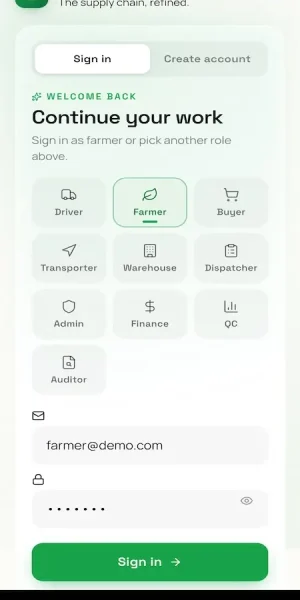
Nobody transacts before they are verified. Partners arrive by invitation or self-registration and progress through a structured verification workflow before they can post or bid.
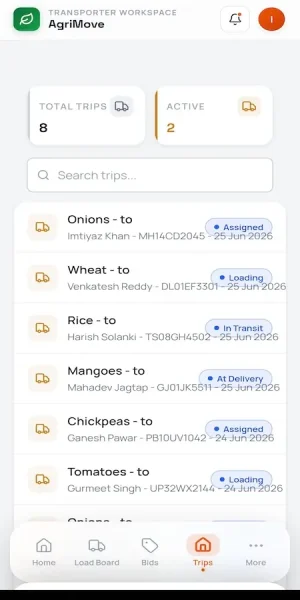
A buyer posts a load with commodity, weight, pickup and delivery. Transporters discover it, and the matching engine scores candidates rather than leaving it to whoever calls first.
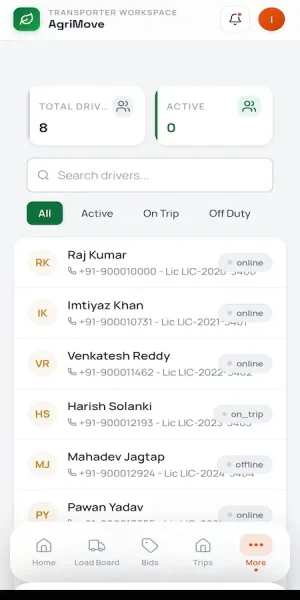
Dispatch turns bookings into a day of work - vehicles and drivers assigned, stops sequenced, docks booked and detention tracked.
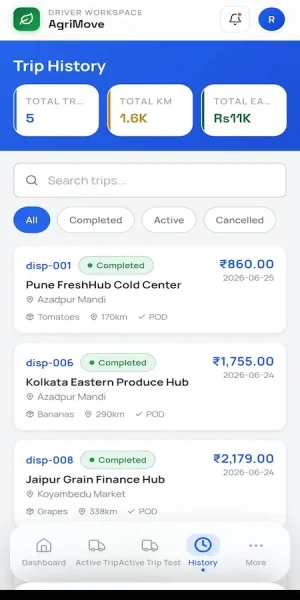
While the vehicle moves, two things are being watched: where it is, and what condition the cargo is in. A breach raises an alert while there is still time to act on it.
At handover, condition is recorded before acceptance. Proof of delivery is captured with signature, OTP and location, and the quality result is attached to the lot.
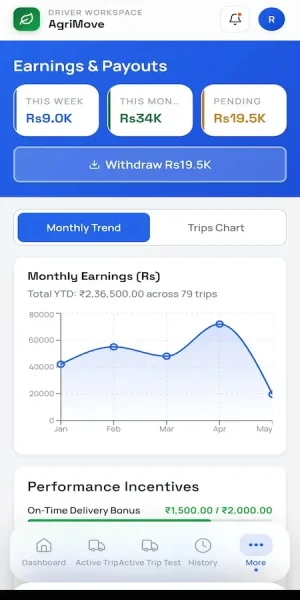
Accepted delivery triggers the financial tail - invoice, payment, and distribution to every party who has a claim on the transaction.
Visual Flow Diagram
Post Load → Match & Award → Dispatch → Track → POD → Settle
How It's Built
A single Node.js process with clear modular separation serves the web application, the unified mobile app and the API, so the ten role surfaces never disagree about what is true.
Every workflow entity carries a CHECK-constrained status field, so invalid state transitions are rejected by PostgreSQL itself rather than trusted to application code.
UUID v4 primary keys everywhere allow the mobile app to generate identifiers offline and sync later without collision, which is what makes the offline queue workable.
Certifications and CAPA records attach to any entity through an entity_type and entity_id pair, avoiding a join table per relationship as the domain grows.
The audit log is immutable with before-and-after snapshots in JSONB, so any financial or quality action can be reconstructed rather than taken on trust.
SMS, email, WhatsApp, push, telematics and ERP each sit behind an adapter interface, so adding a provider means implementing one contract rather than touching the core.
Performance Targets
The documented non-functional targets are read responses under 500 milliseconds, 99.5 percent uptime, 1,000+ concurrent users and 500+ simultaneous tracked dispatches. The architecture that supports those is deliberately conventional.
Rural collection points and highway stretches have no usable signal, so the mobile app is built to keep working and reconcile afterwards rather than block.
The offline model rests on:
Recall capability is only real if the chain was recorded as it happened, so lot linkage runs through the schema rather than being assembled later.
The traceability model provides:
Multi-party settlement is where agricultural platforms quietly consume finance headcount, so the ledger is designed to be queried rather than rebuilt.
The financial model covers:
Read volume in logistics is dominated by status lookups and foreign-key joins, so those are indexed as a matter of course rather than after a slow-query report.
The performance strategy runs across:
Foreign keys and frequently-queried status fields are indexed throughout, with GIN indexes available on JSONB columns where flexible fields are searched.
Stateless API handlers behind a load balancer, with an in-memory tier for reference data, mean adding instances requires no architectural change.
A local action queue with automatic flush on reconnect, underpinned by UUID keys so records created without signal never collide when they arrive.
Settlement records and the append-only audit log reconcile against each other, making a financial audit a query rather than an investigation.
Partition the high-volume telemetry and audit tables, add read replicas for analytics, and archive aged records - each step incremental rather than a rewrite.
Health and readiness endpoints with a database connectivity check, startup environment validation, rate limit headers and graceful shutdown handling.
Every operator ends up needing something specific to their commodities or their market. The stack is conventional so extending it is ordinary work.
Adding a role means a permission set, route policies and a dashboard; adding a module means a migration, business logic, route handlers and pages – both are documented step by step in the handbook. Node.js, React, TypeScript and PostgreSQL are all widely hired for.
Note for founders and operators: You can launch lean and scale the same deployment. What changes as volume grows is instance sizing behind the load balancer, read replicas for analytics, and partitioning on the high-volume telemetry and audit tables – not the architecture underneath.
Built to Be Audited
Security posture is mapped against the OWASP Top 10 in a dedicated VAPT document. What is unusual about it is the candour: rather than claiming coverage everywhere, it marks each control as available, configuration required or not implemented, and names the gaps directly.
OWASP Top 10 Mapping
Compliance Alignment
SOP Acknowledgment Tracking
Cold Chain Evidence
Privacy Position Stated
Deployment Hardening
A four-tier model - public, authenticated, role-gated and permission-gated - enforced at route level with a per-user permission array for granular access beyond the role.
Append-only audit logging with before-and-after JSONB snapshots, capturing financial transitions, quality actions and administrative changes for reconstruction.
A runtime toggle that disables demo credentials, enables login rate limiting, sanitizes error output, restricts CORS and moves the token to an httpOnly cookie.
A sliding-window limiter at 400 requests per minute per IP with rate limit headers returned, and stricter login throttling once strict mode is enabled.
X-Content-Type-Options, X-Frame-Options, Referrer-Policy, Permissions-Policy, Cross-Origin-Resource-Policy and a per-request identifier on every response.
Password hashing, CSP, HSTS, schema validation, request size limits and upload scanning are documented as pre-launch items, not presented as already shipped.
That matters more than a clean-looking table. The controls that are built – ten-role RBAC enforced at the route, an immutable audit trail, sliding-window rate limiting and security headers on every response – are real. The ones that are not, including password hashing, a content security policy, HSTS, schema-level input validation and request size limits, are listed as pre-launch hardening we complete with you during deployment rather than quietly omitted.
Go Further
Out of the box the platform is complete and demonstrable. The modules below are what operators most often add – either because they need a third-party account, or because their scale, security review or procurement process demands it.
Password hashing, a content security policy, HSTS, a schema validation library and request size limits are the named pre-launch items from the VAPT document, completed as part of deployment.
The payment path ships as a mock Stripe-like intent and confirm workflow. Wiring a real gateway with your merchant account and verified callbacks is a contained integration.
Endpoints for temperature, humidity, GPS and shock sensors are built and a mock telematics provider is included. Connecting real hardware and a provider API is the integration step.
Authentication is email and password today, with multi-factor listed as planned. SAML or OIDC for enterprise identity, plus machine-to-machine API keys, are the usual procurement requirements.
Bulk export and import endpoints exist for master data and transactions. Native synchronization into QuickBooks, Xero or an enterprise ERP is an integration module.
Automated retention policies, GDPR erasure endpoints and consent management are recorded as not implemented in the current build, and are scoped where a deployment requires them.
Dashboards query the database directly today, and the Prometheus, Grafana and ELK configuration is archived rather than running. A live observability stack is available as a deployment add-on.
A branded Android build is on its way. The mobile app is a React single-page application rather than native, so an iOS build is an additive step rather than a rewrite.
The AgriMove Clone is one platform in a complete logistics and commerce suite. If your roadmap extends beyond agricultural freight, these connect naturally.

Enterprise courier network with hub-and-spoke routing, tracking numbers and proof-of-delivery workflows.

Multi-vehicle on-demand logistics from bikes to trucks, with live matching and driver dispatch.

B2B commodity marketplace with supplier verification, bulk enquiries and trade assurance workflows.

Fresh grocery delivery with shopper apps, substitutions and perishable-aware fulfilment.
The Commercial Case
Agricultural logistics is a high-volume, thin-margin business where the recoverable value sits in losses rather than in price. Fifteen to twenty percent produce loss, eight to twelve percent rejection and thirty to forty percent empty running are the documented industry numbers, and each is addressable by visibility rather than by discounting.
Transaction commission, subscription tiers, premium matching, load promotion, white-label licensing and an analytics tier - revenue does not rest on a single lever.
Spoilage, rejection and empty running are large, measurable and attributable. A platform that reduces them has a value argument that does not depend on charging less.
Self-service onboarding, automated matching and scheduled settlement mean partner count can grow faster than the operations team, which is the whole economics of an aggregator.
The codebase and schema are yours, running on standard PostgreSQL. There is no proprietary format to unwind and no vendor to renegotiate with.
Most operators start with a single corridor or district – a handful of collection points, a small transporter panel and one buyer relationship – running the marketplace and dispatch modules while cold chain and IoT wait for hardware. Commission is collectible from the first awarded load. Quality inspections and settlement automation usually come online next because they are what remove the manual work. The analytics tier and multi-party settlement at scale tend to follow once volume justifies them.
Defensibility comes from supply density and switching cost rather than from the software. Transporters stay where loads are matched fairly and payouts arrive accurately; FPOs stay where their members can see their own settlements; buyers stay where quality evidence holds up. The platform contribution is making all three true from the first month, and making sure the data – the lot history, the quality records, the partner relationships – belongs to you rather than to a provider who can change terms.
Example Revenue Scenarios
The commercial argument for owning the platform is that in this market the software is the operating leverage. Partner count can grow faster than headcount only if onboarding, dispatch and settlement are automated – otherwise every new FPO or transporter adds a person.
Single Operator
Vehicles or Collection Points
Commission and subscription carry early revenue.
A regional operator where the platform replaces phone dispatch and paper POD, and quality records end the disputes that were previously settled by argument.
Regional Network
Partner Entities
Transaction commission dominates, with matching lifting utilization.
A multi-district network where settlement automation and self-service partner onboarding are what allow partner count to grow without operations headcount following it.
State-Scale Platform
Partner Entities
Commission plus data and analytics tiers, with payout accuracy deciding retention.
A marketplace whose growth is supply-led, where the partner surfaces and the settlement engine are effectively the product that FPOs and transporters experience.
Why Miracuves
There are many ways to get a logistics platform: generic scripts, freelancers, agencies, or owning the infrastructure.
Commodity-aware workflows, cold chain thresholds, grading and lot traceability are in the schema. A generic TMS gives you loads and stops and leaves the agricultural part to you.
Marketplace, dispatch, warehouse, quality and settlement share one data model, so a consignment has a single history rather than five partial ones that have to be reconciled.
The field app queues and syncs because rural connectivity is a design constraint, not an edge case. Retrofitting offline support onto an online-only app is a rewrite.
The complete Node.js, React, TypeScript and PostgreSQL codebase is yours to modify and deploy. No per-seat fee, no provider who can change terms on you.
ERD, schema reference, full API collection, developer and security handbook and VAPT posture - enough to pass a procurement review rather than a demo.
Included, supported, configuration required or integration required is stated per capability - including that persistence defaults to in-memory and payments run on a mock gateway. Nothing surprises you after purchase.
| Criteria | Miracuves AgriMove Clone | Generic Clone Script | Custom Dev Agency |
|---|---|---|---|
| Time to Launch | 6 days (Production) | Unknown / DIY | 6-9+ months |
| Source-Code Ownership | ✔ Full | Often limited / encrypted | Usually yes |
| Feature Depth (AgriMove-like) | High (load matching, cold chain & multi-party settlement) | Basic (dispatch & feed only) | Depends on budget |
| Security & Compliance | Strong (ISO mindset, GDPR-ready) | Minimal | Varies widely |
| Scalability & Performance | Cloud & CDN-optimised | Rarely considered | Depends on architecture |
| Monetization Options | Multiple (ads, gifts, subs) | Limited / needs custom work | Custom (more time & cost) |
| Admin & Analytics | Full-fledged dashboard | Very basic or missing | Custom build (extra cost) |
| Cost vs Speed vs Quality | Balanced | Cheap but risky | High cost, slow |
| Ongoing Support & Updates | Available with clear plans | Usually none | Depends on contract |
Not every route to an agri logistics platform survives contact with a rural collection point. Here is where we differ.
Industries
The AgriMove Clone suits any operator moving graded or perishable goods against a schedule. Fresh produce distributors use the full stack from collection through cold chain to quality-verified handover. FPOs and farmer collectives run pickup scheduling, grading and member-visible settlement. Cold chain and reefer operators lean on temperature evidence and corrective actions. Grain and commodity traders use warehouse zones, bins, cycle counting and lab testing. Food processors run procurement plans, purchase orders and supplier quality audits. Agri-exporters and government procurement bodies need lot traceability and exportable audit evidence. Third-party logistics firms use load matching and dispatch across multiple shippers. Dairy and floriculture operators apply the same cold chain spine to different thresholds.
Miracuves’ AgriMove Clone is built as a traceability-first agricultural logistics platform adaptable to any graded or perishable supply chain – multi-party where your network requires it, and white-labelled entirely under your brand.
Changelog
| Version | Date | What's New |
|---|---|---|
| v2026.1 | Jul 2026 | Initial release - agricultural logistics platform with load marketplace, dispatch, fleet, warehouse, cold chain, quality control and settlement. |
Blog & Resources
Stay updated with the latest trends, guides and case studies on agricultural logistics, cold chain technology and supply chain traceability.
How to Build a Farm to Market Logistics Platform Like AgriMove With Load Matching and Live Tracking
Last Updated on August 10, 2026 by samruddhi kadam Key Takeaways AgriMove-style platforms connect farmers,…
FAQ
Everything you need to know about the Miracuves AgriMove Clone.
A ready-made agricultural logistics platform covering the chain from farm gate to settled invoice – a load marketplace with transporter bidding and auto-matching, dispatch and route planning, fleet and driver management, warehouse inventory to bin level, cold chain monitoring, digital quality control, and order-to-cash through multi-party settlement, across ten role-based surfaces.
Yes. You launch under your own branding, commodity catalogue and commercial terms. The product replicates common agricultural logistics patterns rather than any protected asset, and you set your own policies for partner agreements, quality standards and settlement cycles.
The Miracuves AgriMove Clone starts from $4,899 for a launch-ready white-label deployment. Final scope varies with partner count, IoT and telematics integration, payment gateway selection, ERP connectivity and infrastructure.
Six days from our side. The platform is ready-made, so our work is rebranding it and deploying to your server – that is done in under six days. What extends the calendar is anything we need from you: brand assets, hosting access, your commodity and warehouse data, and provider accounts for SMS, email and any payment gateway.
Yes, and this is one of the reasons the platform exists. Field actions are queued locally and flushed automatically when connectivity returns, and because every record uses a UUID primary key, data created offline never collides on sync. Drivers, farmers and warehouse staff can keep working through dead zones.
A monitoring session is opened against a warehouse or a vehicle with a commodity-specific temperature range. Readings arrive through the IoT endpoints, and any deviation is recorded as an excursion graded low, medium, high or critical. Excursions trigger alerts and a corrective-action workflow, and the whole record forms the compliance evidence. Real sensors and a telematics provider are an integration step with your own hardware.
Both are supported, and we should be precise about it. The backend defaults to in-memory stores with a snapshot and restore path, which is what makes the demo instant. A full PostgreSQL schema of 50+ tables across thirteen domains ships with migration and seed scripts, and enabling database mode is a deployment step we perform for production. We state this plainly because it is the kind of thing that surprises buyers otherwise.
The settlement logic is complete – invoices with GST and tax configuration, payment recording, multi-party distribution across buyer, transporter and farmer, credit and debit notes, and a formal dispute lifecycle. The payment gateway itself ships as a mock Stripe-like intent and confirm workflow, so wiring a real gateway with your merchant account is an integration step before real money moves.
Seven Indian languages are active from launch – English, Hindi, Marathi, Tamil, Telugu, Bengali and Gujarati – as locale bundles rather than an architecture awaiting activation. Six currencies with conversion are also included: INR, USD, EUR, AED, GBP and SGD.
The mobile application is a React single-page app serving all ten roles with offline sync, POD capture, GPS reporting and SOS. A branded Android build is being published separately. Because it is a React application rather than native code, an iOS build is an additive step rather than a rewrite.
Yes. You receive the complete Node.js 20 backend, the React 18 and TypeScript web application, the unified mobile app, the PostgreSQL schema with its migrations and seed script, and all adapter and integration code – with full ownership to modify and extend.
It ships with a dedicated VAPT and compliance document mapping the OWASP Top 10, ten-role RBAC enforced at route level, an immutable audit trail, sliding-window rate limiting and security headers on every response. That document is deliberately candid: password hashing, a content security policy, HSTS, schema-level input validation and request size limits are marked as configuration required rather than claimed, and we complete them as named pre-launch hardening during deployment.
Let's turn your idea into
a live platform.
Get a free consultation, a clear timeline, and honest answers. We'd rather earn your trust than rush a sale.
Build Your Branded App - Clone or Custom

Envision. Decide. Deploy.
With Perfection in Just 6 Days
90+ readymade clone apps deployed in 6 days. Schedule a Live Walkthrough Now.
Custom development from 15 days. Free consultation