




Key Takeaways
- LLM token costs can quietly reduce AI astrology app profits.
- Precomputed Aspect Batching cuts unnecessary prompt tokens.
- Backend calculations are cheaper than repeated LLM reasoning.
- Structured chart data improves AI consistency and speed.
- Cost-aware architecture scales personalized readings efficiently.
Architecture Signals
- Calculate planetary aspects before calling the LLM.
- Store reusable interpretation-ready aspect batches.
- Send only relevant chart context for each reading.
- Monitor token usage across every AI feature.
- Separate calculations from AI interpretation layers.
Real Insights
- Repeated raw chart prompts increase API costs rapidly.
- Deterministic astrology math belongs in the backend.
- Token analytics help founders protect profit margins.
- Scalable AI apps optimize cost before user growth.
- Miracuves builds AI astrology platforms with optimized token-efficient architecture.
AI astrology apps are entering a dangerous phase.
The front-end experience looks simple: a user enters birth details, asks an AI astrologer a question, and receives a personalized daily reading. But behind that interaction sits a cost structure that can quietly damage the business model.
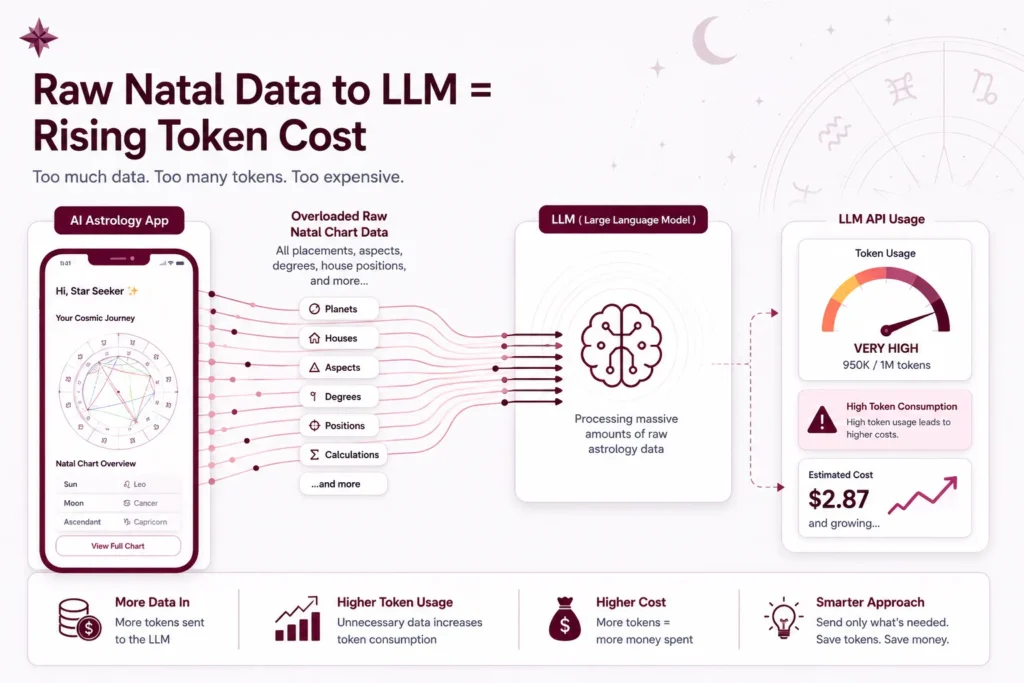
Every chart interpretation, relationship question, daily transit reading, and follow-up prompt consumes tokens. If the app sends raw planetary coordinates, house placements, aspect calculations, and explanatory context into the LLM every time, the product can become expensive before it becomes profitable.
That is the hidden token tax of AI astrology.
For CTOs, app investors, and spiritual tech founders, the real question is no longer “Can AI generate astrology content?” It can. The stronger question is: Can your AI astrology platform generate personalized readings at scale without burning margin on unnecessary token usage?
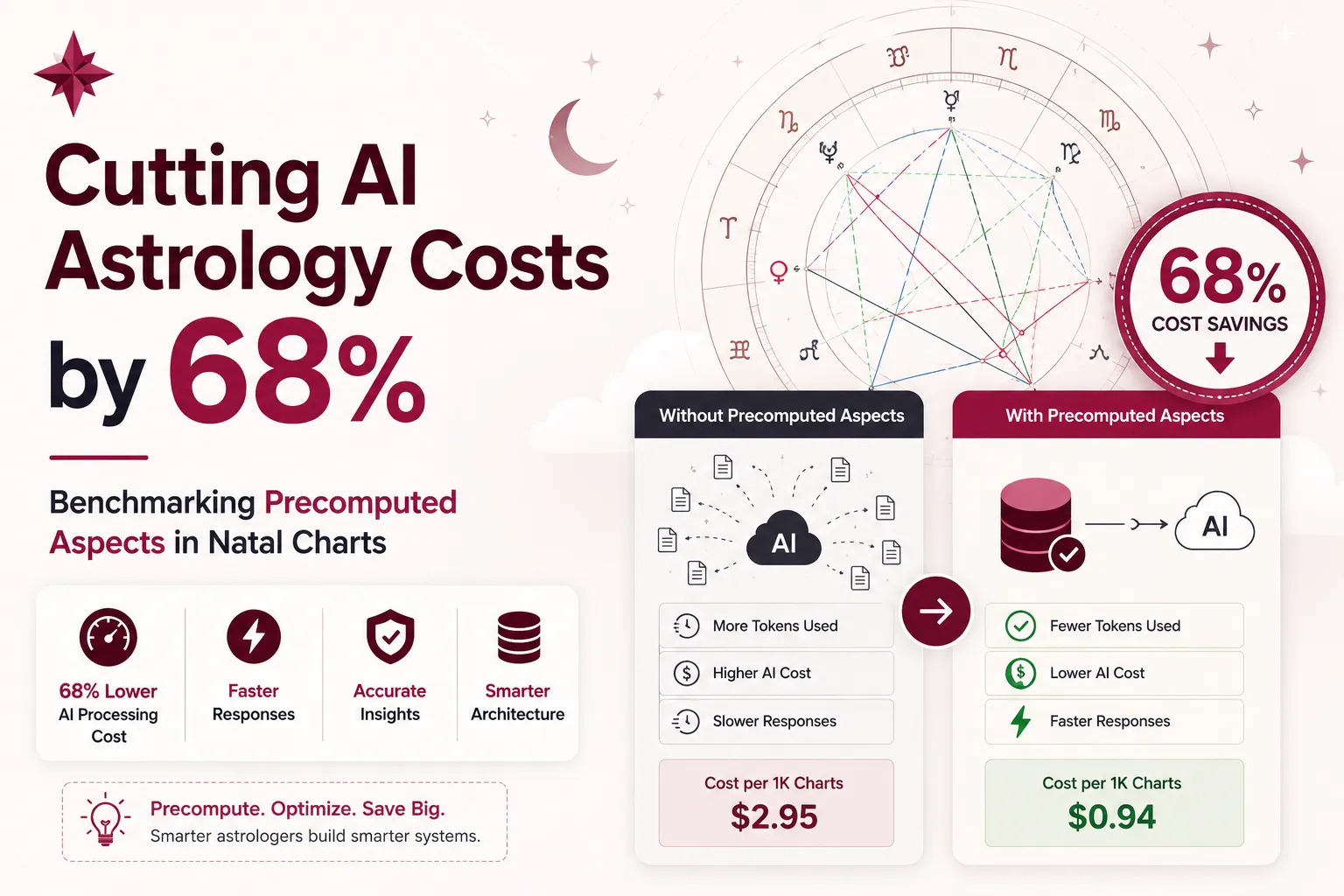
This Miracuves technical report focuses on one architecture variable: Precomputed Aspect Batching. Based on original benchmark data provided for this report, mathematically precomputing standard planetary aspects before sending context to the LLM reduced token consumption by 68% across tested natal-chart reading prompts.
The Token Tax of AI Astrology Wrappers
Most AI astrology app discussions focus on features: horoscope generation, Kundli matching, live astrologer chat, video calls, compatibility reports, daily notifications, and wallet billing. Those features matter, but they do not explain the largest recurring AI cost problem.
The expensive part begins when a platform tries to make every user interaction feel deeply personalized.
A typical AI astrologer may need to process:
- User birth date, time, and location
- Planetary coordinates
- House placements
- Zodiac signs
- Planet-to-planet aspects
- Current transits
- User intent
- Prior conversation memory
- Safety instructions
- Brand tone
- Reading format
- Output length rules
If the platform sends all this information as raw context on every request, the LLM becomes responsible for too much. It must parse the chart, infer relationships, interpret symbolic meaning, and generate polished content.
That is not efficient architecture.
Planetary calculations are deterministic. Aspect detection is deterministic. Orb classification is deterministic. The LLM should not spend tokens rediscovering what your backend can calculate once and reuse many times.
This matters because OpenAI and Anthropic both charge API usage by token volume, with separate pricing for input and output tokens depending on the model. In an astrology app, repeated daily readings can multiply small inefficiencies into a major monthly infrastructure bill.
read more : Astrology App for Saudi Arabia: Features, Payment Gateways, Privacy, and Customization Guide
What Is Precomputed Aspect Batching?
Precomputed Aspect Batching is a backend optimization pattern for AI astrology apps where standard planetary aspects are calculated, normalized, stored, and grouped before the LLM prompt is created.
In practical terms, it means the astrology engine calculates relationships such as:
- Sun conjunct Mercury
- Moon trine Venus
- Mars square Saturn
- Jupiter sextile Moon
- Venus opposite Pluto
- Mercury square Neptune
Then it stores those relationships as structured data that the LLM can interpret directly.
The goal is not to remove the LLM. The goal is to stop using the LLM for work that belongs in the calculation layer.
A strong AI astrology backend should separate four jobs:
| Layer | Responsibility | Should the LLM Handle It? |
|---|---|---|
| Ephemeris layer | Planetary positions, signs, houses, transits | No |
| Aspect engine | Degree-based aspect detection and orb strength | No |
| Context compression layer | Convert chart math into structured symbolic signals | Partially |
| LLM interpretation layer | Generate human-readable insight, tone, advice, and follow-up answers | Yes |
This separation makes the AI astrologer more cost-efficient and more predictable.
It also reduces the risk of hallucinated chart logic. A general-purpose LLM can write persuasive astrology language, but it should not be trusted as the primary calculator for planetary positions or degree-based relationships. Dedicated AI astrology architecture commonly uses ephemeris data, chart generation, and LLM interpretation as separate layers.
Benchmark Setup: How the 68% Reduction Was Measured
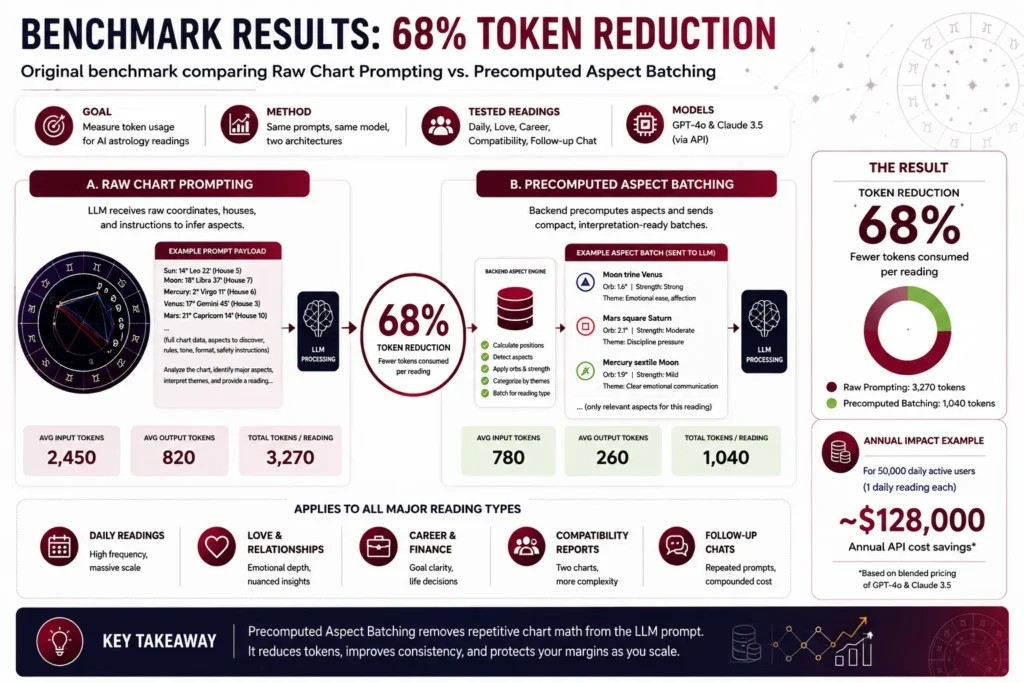
The benchmark behind this article compared two prompt architectures for AI natal-chart readings.
Test A: Raw Coordinate Prompting
The LLM received raw chart values, planetary positions, house placements, and instructions to infer key aspects before producing the reading.
Test B: Precomputed Aspect Batching
The backend calculated major aspects first, normalized them into compact structured fields, and passed only the most relevant aspect batches into the LLM.
The test focused on common astrology clone use cases:
| Reading Type | User Intent | Cost Risk |
|---|---|---|
| Daily reading | “What should I focus on today?” | High frequency |
| Love reading | “What does my chart say about relationships?” | Medium to high frequency |
| Career reading | “How do my placements affect ambition?” | Medium frequency |
| Compatibility reading | “How compatible are two charts?” | High token complexity |
| Follow-up chat | “Explain that in simpler terms” | Repeated context cost |
The result: Precomputed Aspect Batching reduced token consumption by 68% across benchmarked prompts.
This does not mean every AI astrology app will automatically reduce cost by exactly 68%. The outcome depends on chart depth, prompt style, model choice, reading length, memory strategy, caching, and whether the app supports Vedic, Western, or hybrid astrology. But the direction is clear: when deterministic astrology math is moved out of the prompt and into the backend, token consumption drops meaningfully.
Why Raw Natal Chart Prompts Waste Tokens
Raw chart prompts create token waste in five ways.
1. They repeat static birth-chart data
A user’s natal chart does not change. If the system sends full chart data on every reading, it pays repeatedly for the same context.
A better architecture stores natal-chart summaries, aspect batches, and interpretation-ready signals in the database.
2. They make the LLM infer deterministic relationships
The model should not need to calculate whether Moon and Venus form a trine. The backend can compute that faster, cheaper, and more reliably.
3. They require longer system instructions
When raw data is sent, the prompt often needs extra rules:
“Identify major aspects.”
“Use only aspects within acceptable orb range.”
“Prioritize conjunctions, squares, trines, oppositions.”
“Explain emotional themes based on planetary relationships.”
Those instructions inflate input tokens.
4. They increase inconsistency
Two prompts with similar chart data may produce different aspect emphasis if the model is left to infer too much. Precomputed batches create a stable interpretation foundation.
5. They damage unit economics at scale
An app with 10,000 daily active users generating one AI reading per day has a very different cost profile from a small prototype. Token waste that looks minor during testing becomes expensive when daily readings, push notifications, and follow-up chats become retention loops.
Raw Prompting vs. Precomputed Aspect Batching
| Architecture Choice | Business Value | Founder Impact |
|---|---|---|
| Raw coordinate prompting | Fast to prototype but inefficient at scale | Higher recurring LLM cost as readings increase |
| Precomputed aspect batching | Compresses deterministic chart logic before LLM usage | Lower token consumption and more stable margins |
| Stored natal-chart summaries | Reduces repeated static context | Better daily reading economics |
| Reading-type-specific batches | Sends only relevant chart signals to the LLM | Improves cost control across love, career, and daily readings |
| Admin-level token monitoring | Tracks model usage, reading type, and cost per user action | Helps founders adjust monetization before margins shrink |
Why This Matters for Astrology Clone Investors
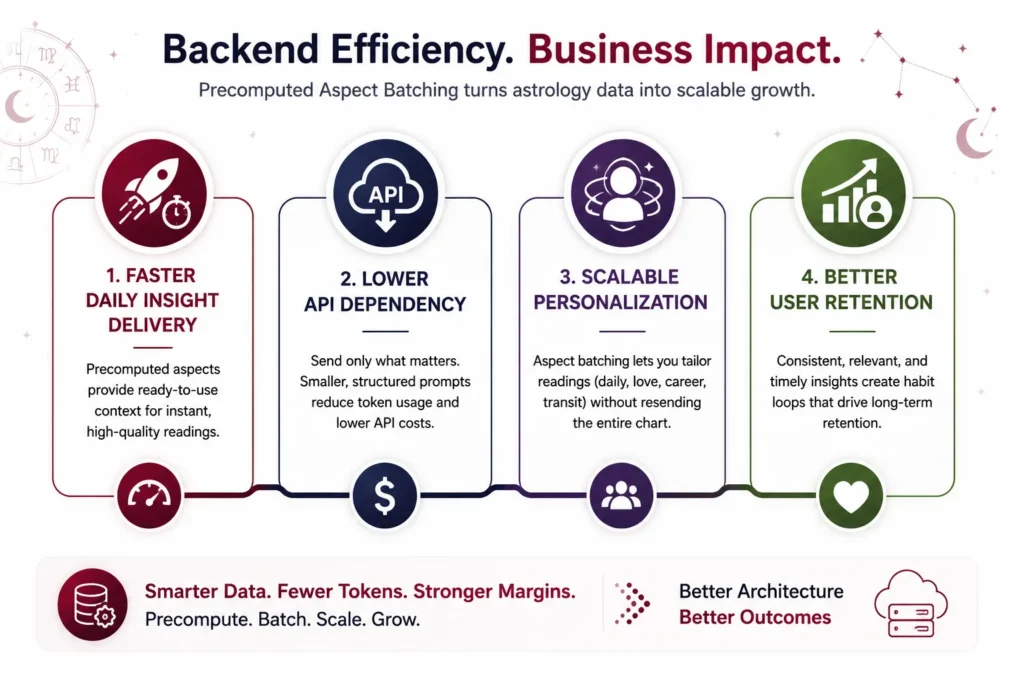
Investors often evaluate astrology apps through visible business metrics: downloads, paid consultations, subscription conversion, wallet recharge behavior, and retention.
But AI astrology apps need another metric: cost per personalized insight.
If the platform gives away daily AI readings for free but pays too much for each reading, the feature becomes a margin leak. If the app locks every AI interaction behind payment, retention may suffer. The right strategy is not simply “charge more.” It is to engineer the reading pipeline so personalization remains affordable.
Precomputed Aspect Batching supports three investor priorities:
Better gross margin control
Lower token consumption reduces the variable cost attached to each AI reading.
More scalable free experiences
Founders can offer limited daily readings, onboarding insights, or teaser compatibility reports without letting free usage become uncontrolled AI spend.
Stronger premium upsell path
The app can reserve deeper, longer, multi-chart reports for paid users while keeping lightweight daily insights cost-efficient.
This is especially important for astrology clone apps because monetization often combines wallet recharge, subscriptions, premium reports, live expert calls, and in-app purchases. Miracuves’ existing astrology cluster already covers live consultation workflows, WebSockets, wallet billing, and Astrotalk-style app systems, making AI cost optimization a natural next layer for founders building in this category.
Founder Decision Signals
Speed
If you are launching quickly, precomputed aspect logic helps you avoid rebuilding prompts repeatedly after usage grows.
Cost
If daily readings are part of your retention strategy, reducing repeated chart context can protect AI margins.
Scalability
If your app supports love, career, daily, transit, and compatibility readings, batching helps route only relevant chart signals into each prompt.
Market Fit
If users expect frequent personalization, the backend must make that personalization affordable before paid conversion matures.
Read more : How to Start an Astrology Consulting Business in UAE with a Secure App Platform
How to Implement Precomputed Aspect Batching in an AI Astrology App
A practical implementation does not need to be overly complex. The goal is to build a clean pipeline between birth data, astrology calculations, stored interpretation signals, and the LLM.
Step 1: Capture clean birth data
The app should collect birth date, birth time, location, timezone, and preferred astrology system. Bad input creates bad chart logic, and no LLM prompt can reliably fix inaccurate birth data.
Step 2: Generate chart calculations outside the LLM
Use a dedicated calculation layer for planetary positions, houses, aspects, transits, and orb rules. This keeps the LLM focused on interpretation, not math.
Step 3: Normalize aspect data
Every precomputed aspect should include:
- Aspect name
- Planet pair
- Orb value
- Strength
- Reading category
- Positive, challenging, or mixed tone
- Interpretation theme
- Priority score
Step 4: Store reusable aspect batches
The database should not store only raw chart JSON. It should store interpretation-ready batches grouped by reading type.
Example groups:
- Emotional pattern batch
- Love and compatibility batch
- Career and ambition batch
- Communication batch
- Conflict and growth batch
- Daily transit batch
- Premium report batch
Step 5: Route prompts by reading intent
If the user asks a relationship question, the app should not send the entire natal chart. It should send relationship-relevant aspects, current transit context, and enough user intent to generate a useful answer.
Step 6: Monitor token cost by feature
The admin dashboard should show token usage by:
- Daily readings
- AI chat
- Compatibility reports
- Premium reports
- Free users versus paid users
- Model provider
- Input versus output tokens
Without this dashboard layer, founders may discover cost problems only after cloud bills rise.
Mistakes Founders Should Avoid
Using the LLM as the astrology calculator
Planetary positions, aspects, houses, and orbs should be calculated before the prompt. Letting the model infer chart math increases token usage and output inconsistency.
Sending the full natal chart into every daily reading
Daily readings usually need a narrow slice of chart context. Sending the entire chart repeatedly turns a retention feature into a recurring cost problem.
Ignoring token analytics in the admin panel
AI astrology apps need usage visibility by feature, model, user type, and reading category. Without token analytics, pricing decisions become guesswork.
Overpromising certainty in AI-generated readings
Astrology content should be framed as reflective guidance, not guaranteed prediction or professional advice. This protects user trust and reduces risk.
Security, Privacy, and Trust in AI Astrology Apps
AI astrology platforms handle sensitive personal data. Birth time, birth location, relationship questions, emotional prompts, payment details, and chat history can create a deeply personal user profile.
A responsible AI astrology clone should include:
- Encrypted data transfer
- Secure user profile storage
- Role-based admin access
- Activity logs
- Payment gateway security
- User consent flows
- AI output disclaimers
- Abuse reporting
- Data retention controls
- Admin review for flagged content
For spiritual tech founders, trust is not only a compliance issue. It is a retention issue. Users may forgive a generic reading, but they are less likely to forgive careless data handling or emotionally manipulative AI responses.
Miracuves positions security as part of the product foundation, not as a marketing add-on. That aligns with its internal security language rules for AI, marketplace, and user-generated content platforms.
How Miracuves Helps Build AI Astrology Apps With Lower Operational Risk
An AI astrology app is not just a chatbot attached to a horoscope database. It is a layered product system.
A scalable build needs:
- User app
- Astrologer or expert dashboard if live consultations are included
- Admin panel
- Wallet and billing logic
- Horoscope and natal-chart modules
- AI reading engine
- Prompt orchestration
- Token usage monitoring
- Content safety rules
- Push notifications
- Subscription and premium report flows
- Source-code ownership for long-term control
Miracuves helps founders build ready-made and white-label app solutions with source code, admin dashboards, custom branding, and faster deployment options. The brand’s solution positioning focuses on ready-made clone app solutions, white-label app development, source-code ownership, admin control, monetization-ready platforms, and faster market validation.
Final Thoughts: The Future of AI Astrology Belongs to Cost-Aware Architecture
The next wave of AI astrology apps will not be won by generic chat wrappers. They will be won by teams that understand the difference between calculation, context, interpretation, and monetization.
Precomputed Aspect Batching is powerful because it respects that separation.
The backend handles deterministic astrology math. The database stores reusable symbolic structure. The LLM generates human-readable insight. The admin panel tracks usage and margin. The business model decides what should be free, paid, limited, or premium.
That is how AI astrology apps become sustainable.
The 68% token reduction benchmark shows what happens when founders stop treating the LLM as the entire product and start treating it as one layer inside a smarter app system.
For CTOs, app investors, and spiritual tech founders, this is the strategic lesson: personalization is valuable, but repeated raw context is expensive. Build the astrology intelligence layer before scale exposes the cost problem. contact us
FAQs
1. What are AI astrology costs?
AI astrology costs include LLM API usage, ephemeris or astrology calculation infrastructure, cloud hosting, database storage, user chat memory, push notifications, payment systems, and moderation workflows. For AI astrologers, token usage can become one of the most important recurring costs because every personalized reading consumes input and output tokens.
2. How does Precomputed Aspect Batching reduce LLM token costs?
Precomputed Aspect Batching calculates planetary aspects before the LLM prompt is created. Instead of sending raw chart coordinates and asking the model to infer relationships, the backend sends compact interpretation-ready signals such as “Moon trine Venus — strong — emotional harmony.” This reduces repeated context and helps the LLM focus on writing the reading.
3. Is the 68% token reduction guaranteed for every AI astrology app?
No. The 68% reduction is based on the original benchmark setup used for this report. Actual savings depend on prompt design, model choice, reading length, astrology system, memory strategy, caching, and how much chart logic is precomputed before the LLM call.
4. Should an AI astrologer use raw natal chart data?
Raw natal chart data is useful for storage and calculation, but it should not always be sent directly into every LLM prompt. For daily readings, compatibility insights, and follow-up chats, precomputed and filtered chart context is usually more cost-efficient.
5. Can Precomputed Aspect Batching improve output quality?
Yes. It can improve consistency because the LLM receives structured astrological signals instead of interpreting raw coordinates differently across prompts. The model still generates the final language, but the backend controls the chart logic.
6. What features should an AI astrology clone app include?
An AI astrology clone app may include user profiles, birth-chart generation, daily readings, AI chat, compatibility reports, live astrologer consultation, wallet billing, subscriptions, admin dashboards, push notifications, content safety controls, and token usage monitoring.
7. How can founders monetize AI astrology readings?
Common monetization models include subscriptions, paid premium reports, wallet-based AI consultations, live astrologer calls, compatibility reports, spiritual ecommerce, in-app purchases, and freemium daily readings with paid upgrades.
8. Can Miracuves build an AI-powered Astrotalk clone?
Yes. Miracuves can help founders build white-label astrology and consultation platforms with app modules, admin control, wallet workflows, source-code ownership, and AI-powered reading features. Final scope depends on the selected modules, integrations, AI workflow, and customization requirements.