




Key Takeaways
- Many startups overpromise AGI before solving real customer problems.
- Uncontrolled AI increases legal and operational risks.
- Focused AI products reach the market faster.
- Enterprise buyers prefer predictable AI over experimental AGI.
- Clear business outcomes matter more than AGI claims.
Risk Signals
- Build AI around measurable business workflows.
- Use guardrails to control autonomous decisions.
- Validate outputs before production deployment.
- Monitor AI performance with continuous analytics.
- Scale proven automation before expanding capabilities.
Real Insights
- AGI marketing alone does not create product-market fit.
- Reliable AI systems earn greater enterprise trust.
- Controlled automation reduces deployment risks.
- Successful AI startups solve one problem exceptionally well.
- Miracuves builds enterprise AI platforms with practical, production-ready architectures.
Founders love big language.
“AGI-powered.”
“Autonomous intelligence.”
“Self-running enterprise.”
“AI that can do anything.”
It sounds fundable. It sounds futuristic. It sounds like the kind of phrase that belongs in a pitch deck.
But after years of building and selling software into real business environments, one truth becomes painfully clear: enterprise buyers do not actually want unconstrained intelligence. They want reliable execution.
They want software that follows rules, respects permissions, logs decisions, avoids unsafe actions, and delivers a repeatable business outcome.
That is why the “AGI startup” pitch is becoming dangerous. Not because AI is useless. AI is incredibly useful when designed properly. The danger is promising open-ended intelligence where the buyer actually needs bounded automation.
The founder mistake is simple: trying to sell AGI when the customer needs a workflow.
Miracuves advises founders to treat AI not as a magical general brain inside the product, but as a controlled execution layer inside a defined SaaS system. The winning product is not “AI that can do anything.” The winning product is a highly deterministic, securely bounded agentic workflow that performs specific actions with measurable reliability.
The Threat of the Open-Ended Prompt
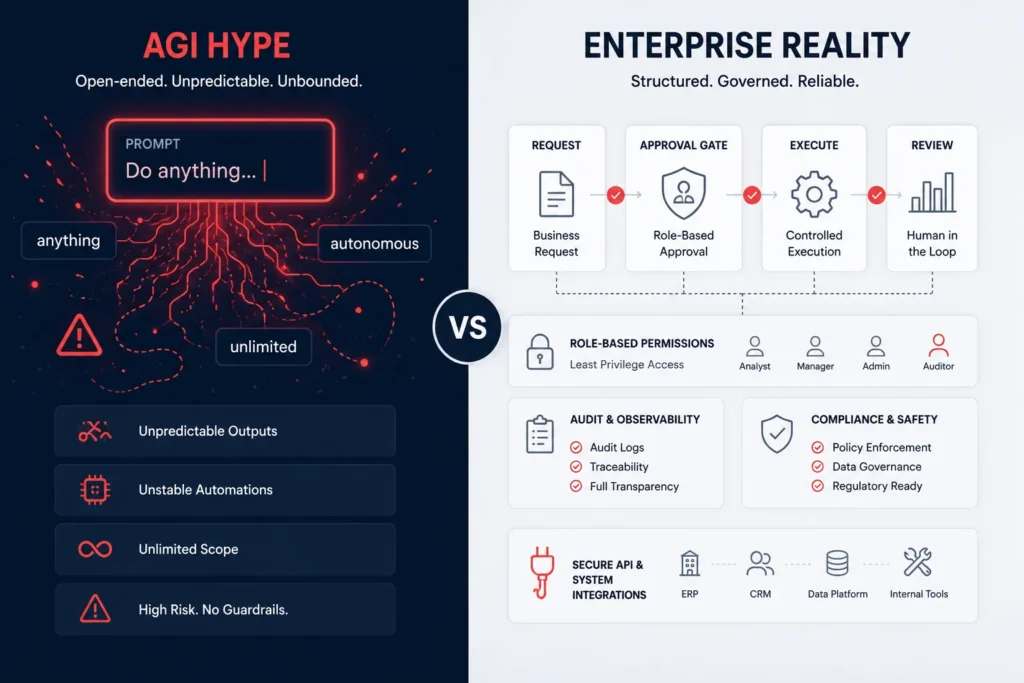
The open-ended prompt is seductive because it feels powerful.
A user types anything. The AI responds. The demo looks impressive. Investors nod. Early users are entertained. Product teams imagine a future where the AI handles support, sales, onboarding, legal review, operations, finance, and reporting from one text box.
But open-ended input is not the same as safe product behavior.
A chatbot can generate a confident answer. A SaaS product has to perform a controlled action.
That distinction matters.
When AI is only generating draft text, the risk is usually limited to poor output. But when AI is connected to databases, billing tools, CRM records, customer support systems, analytics dashboards, internal documents, or payment workflows, the risk changes completely.
Now the AI is not just speaking. It may be acting.
That is where founders get into trouble.
An open-ended AI agent might:
- Summarize the wrong customer record.
- Send an unauthorized email.
- Misclassify a refund.
- Expose private account data.
- Trigger an incorrect workflow.
- Make claims the company cannot legally support.
- Invent policy details during customer support.
- Execute a tool call against the wrong user or account.
This is not a branding problem. It is a product architecture problem.
IBM defines AI hallucinations as cases where models generate nonsensical or inaccurate outputs based on nonexistent or misread patterns. OWASP identifies prompt injection as a vulnerability where prompts can alter an LLM’s behavior in unintended ways, including through inputs that may not be visible to humans. These risks become more serious when the AI is allowed to operate across enterprise systems rather than simply respond in a sandbox.
Why “AGI” Is the Wrong Product Promise for B2B SaaS
AGI is a vision term. Enterprise SaaS is an accountability business.
That difference matters when a founder starts selling to companies.
A product manager may love the idea of a flexible AI assistant. A CIO may test it. A department head may sponsor it. But the legal, compliance, security, and operations teams will ask different questions:
- What can the AI access?
- What actions can it perform?
- Who approved those actions?
- Can we audit every decision?
- Can we restrict behavior by role?
- Can we prevent unsafe outputs?
- What happens if the AI is wrong?
- Who is liable when it causes business damage?
This is where the AGI pitch collapses.
“Unconstrained intelligence” sounds exciting until the buyer asks for controls.
In B2B SaaS, the more critical the workflow, the less tolerance there is for unpredictability. A finance workflow cannot “creatively interpret” a payment rule. A healthcare workflow cannot improvise patient guidance. A customer support workflow cannot invent refund policies. A legal operations workflow cannot hallucinate contract terms.
Enterprise buyers do not reject AI because they hate innovation. They reject AI when the product team cannot explain its boundaries.
Read more : The Chat UI Death Trap: Why the Best AI Apps Don’t Look Like ChatGPT
Liability in B2B SaaS Ecosystems
The fastest way to lose enterprise trust is to let AI behave like a senior employee without giving it senior-level accountability, supervision, and controls.
A human employee can be trained, disciplined, supervised, and held accountable. An unconstrained AI model cannot be trusted in the same way unless the product architecture wraps it inside clear operating limits.
For founders, liability appears in several layers.
1. Contractual Liability
If your SaaS product promises a business outcome and the AI produces a harmful action, the client may argue that your product failed to perform as represented.
This is especially dangerous if sales materials overpromise autonomy.
Words like “fully autonomous,” “self-managing,” “no human needed,” or “AGI-powered decision-making” can become liabilities when the system makes a wrong decision.
2. Data Privacy Liability
AI systems often require context. Context often includes customer records, documents, messages, transaction history, support notes, or internal data.
If the AI has excessive access, the risk multiplies.
The issue is not only whether the model “knows” something. The issue is whether the product exposes information to the wrong user, wrong workspace, wrong department, wrong integration, or wrong workflow.
3. Operational Liability
Enterprise SaaS products are usually connected to real operations.
A wrong recommendation may be annoying. A wrong automated action may cost money.
For example, an AI agent inside a logistics platform could assign the wrong route. An AI support agent could approve refunds incorrectly. An AI finance assistant could misclassify transactions. An AI HR workflow could send inaccurate candidate communication.
The product risk increases when the AI moves from suggestion to execution.
4. Compliance Liability
Regulated sectors care deeply about evidence.
They need logs, review trails, access controls, policy enforcement, and incident response processes. A vague “the AI decided” explanation is not enough.
NIST’s AI RMF is intended to help organizations incorporate trustworthiness considerations into AI design, development, use, and evaluation. That is important for founders because AI governance is not just a corporate checkbox; it affects whether enterprise buyers can safely adopt the product.
The Founder Mistake: Selling Intelligence Instead of Control
Most failed AI product pitches do not fail because the model is weak. They fail because the product promise is wrong.
Founders often sell intelligence:
“We built an AI agent that can handle your entire workflow.”
Enterprise buyers want control:
“Show me exactly what it can do, what it cannot do, who approves actions, and where the logs live.”
That is the gap.
A strong AI SaaS product does not need to pretend to be AGI. It needs to become operationally useful.
That means the founder should define:
- The exact workflow the AI supports.
- The allowed data sources.
- The tools the AI can call.
- The actions that require approval.
- The outputs that need validation.
- The escalation rules.
- The audit trail.
- The failure recovery path.
This is the difference between vaporware and a product.
Hardcoding Deterministic Boundaries Into Autonomous Agents
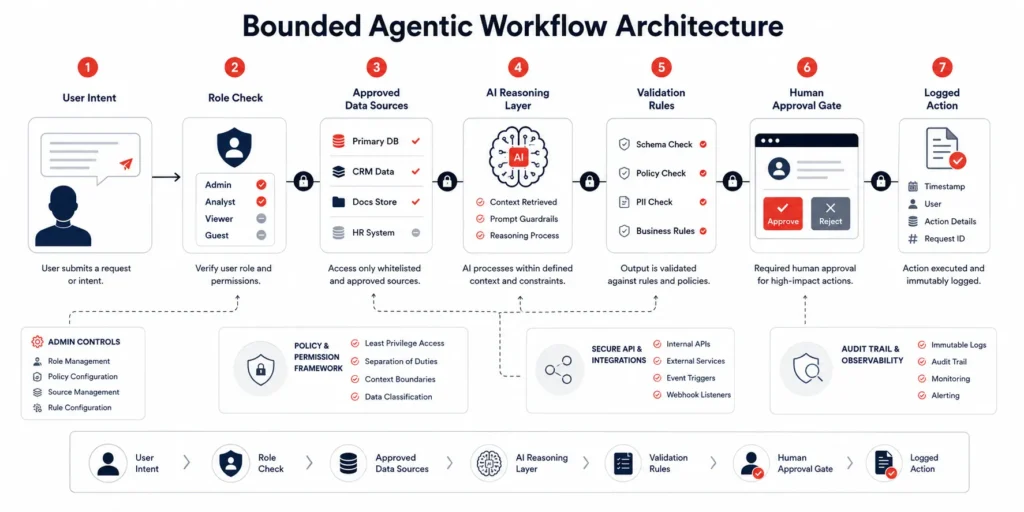
The safer path is bounded autonomy.
Bounded autonomy means the AI can help interpret, plan, recommend, and execute, but only inside pre-approved rules.
The AI should not have unlimited access. It should not freely choose any tool. It should not mutate business records without validation. It should not perform irreversible actions without permission.
A deterministic agentic workflow usually has five layers.
1. Scoped User Intent
The system should classify what the user is trying to do before allowing the AI to act.
For example:
- “Draft a reply” is low risk.
- “Send this reply to 8,000 customers” is high risk.
- “Analyze refund history” is moderate risk.
- “Approve all pending refunds” is high risk.
The same AI interface can support all of these, but the execution rules must be different.
2. Permission-Aware Tool Access
The agent should only see tools that match the user’s role and the workflow context.
A sales user should not access finance tools. A support agent should not edit billing rules. A junior operator should not approve high-value refunds.
This is where product architecture matters more than prompt engineering.
3. Structured Outputs
Free-form AI output is useful for brainstorming. It is weak for system execution.
If the AI is triggering actions, the output should be structured. It should return predefined fields, allowed values, confidence signals, reasoning notes where appropriate, and validation checks.
Structured output makes the system easier to test, monitor, and reject when unsafe.
4. Validation Before Side Effects
A side effect is any action that changes the system.
Examples include sending emails, updating records, approving refunds, deleting data, changing permissions, publishing content, or triggering payments.
Before side effects happen, the system should validate:
- Is the action allowed?
- Is the target entity correct?
- Is the user authorized?
- Is the data complete?
- Is the confidence threshold met?
- Does this require human approval?
- Is there a rollback path?
5. Human Approval for High-Risk Actions
Human-in-the-loop is not a weakness. In enterprise SaaS, it is often the feature that makes AI adoptable.
The goal is not to slow everything down. The goal is to separate low-risk automation from high-risk decisions.
A practical AI product may automate 80% of repetitive work while routing sensitive actions to a human reviewer.
That is a product enterprises can trust.
Founder Decision Signals
Speed
If your AI feature accelerates a known workflow without changing the risk profile, it is easier to sell and adopt.
Cost
Unbounded AI increases support, QA, legal review, and monitoring costs. Bounded workflows reduce avoidable rework.
Scalability
Enterprises scale AI when rules, permissions, logs, and admin controls are built into the product foundation.
Market Fit
Buyers trust AI products that solve one painful workflow clearly instead of claiming to automate everything.
AGI Vaporware vs Deterministic Agentic Workflows
AGI Vaporware vs Bounded Agentic Workflow Design
| Product Approach | Business Risk | Founder Impact |
|---|---|---|
| Unconstrained AGI promise | Creates unclear liability because the system appears capable of acting beyond defined limits. | Harder to sell to enterprises after security, legal, and compliance teams review it. |
| Open-ended prompt interface | Users may ask for actions the system should not perform or cannot validate safely. | Demo looks impressive, but production reliability becomes difficult. |
| Free tool access for agents | AI may access systems, data, or workflows outside the user’s role or business context. | Increases risk of data exposure, wrong actions, and enterprise rejection. |
| Deterministic workflow boundaries | AI actions are limited by role, intent, business rules, and validation layers. | Creates a more defensible SaaS product that buyers can evaluate and trust. |
| Human approval gates | High-risk actions are reviewed before execution. | Improves enterprise confidence without blocking low-risk automation. |
Read more : The Chat UI Death Trap: Why the Best AI Apps Don’t Look Like ChatGPT
What Enterprise Buyers Actually Want From AI SaaS
Enterprise buyers may enjoy ambitious AI language, but they purchase operational confidence.
They want AI that is:
- Useful enough to reduce workload.
- Narrow enough to govern.
- Transparent enough to audit.
- Secure enough to approve.
- Flexible enough to integrate.
- Controlled enough to trust.
This is why agentic workflows are stronger than AGI promises.
An agentic workflow can be mapped. It can be tested. It can be priced. It can be monitored. It can be improved. It can be explained to stakeholders.
AGI vaporware cannot.
When Miracuves works with founders on AI product ideas, the stronger product question is not “How intelligent can we make this?” The stronger question is “Which workflow can we automate safely, repeatedly, and profitably?”
That question leads to better SaaS products.
Practical Examples of Safer Agentic Workflow Design
Customer Support AI
Weak pitch:
“Our AI support agent can answer anything.”
Stronger product:
“Our AI support workflow classifies tickets, retrieves approved policy answers, drafts responses, escalates sensitive cases, and logs every interaction for admin review.”
Sales Operations AI
Weak pitch:
“Our AI can run your entire sales team.”
Stronger product:
“Our AI workflow enriches leads, drafts outreach, scores opportunities, updates CRM fields with approval, and flags high-intent prospects.”
Finance Operations AI
Weak pitch:
“Our AI handles financial decisions automatically.”
Stronger product:
“Our AI workflow categorizes transactions, highlights anomalies, prepares reports, and routes exceptions to finance managers.”
Healthcare Admin AI
Weak pitch:
“Our AI gives medical guidance.”
Stronger product:
“Our AI workflow helps collect intake information, route appointments, summarize records for authorized staff, and escalate clinical decisions to professionals.”
In each case, the safer version is not less valuable. It is more sellable.
The market does not need uncontrolled intelligence. It needs controlled automation.
Mistakes Founders Should Avoid
Mistakes Founders Should Avoid
Calling every AI feature “AGI-powered”
This creates expectations your product may not be able to meet. Enterprise buyers will ask for evidence, controls, and boundaries.
Connecting agents to tools before defining permissions
Tool access should be role-based, scoped, and logged. AI should not inherit unrestricted access to business systems.
Using prompts as the main safety layer
Prompts help guide behavior, but safety should also live in code, validation rules, workflow design, access control, and monitoring.
Skipping audit logs and admin controls
Enterprise buyers need visibility. If the product cannot show what happened, who triggered it, and why, adoption becomes harder.
How Miracuves Helps Founders Build Defensible AI SaaS
Miracuves helps founders move beyond vague AI hype and shape product ideas into launch-ready software systems.
For AI SaaS founders, that means building around:
- Workflow automation instead of generic AGI promises.
- Role-based admin dashboards.
- Secure API integrations.
- Source-code-owned product foundations.
- Custom AI workflows.
- Approval gates for sensitive actions.
- Usage analytics and monitoring.
- Scalable backend architecture.
- White-label product experiences.
- Compliance-ready workflow design where relevant.
A founder building an AI assistant, AI chatbot, AI workflow tool, or ChatGPT-style product should not start by asking, “How do we make this feel unlimited?” The better question is, “What bounded workflow will customers trust enough to use every day?”
Final Thoughts: Do Not Sell AGI. Sell Controlled Execution.
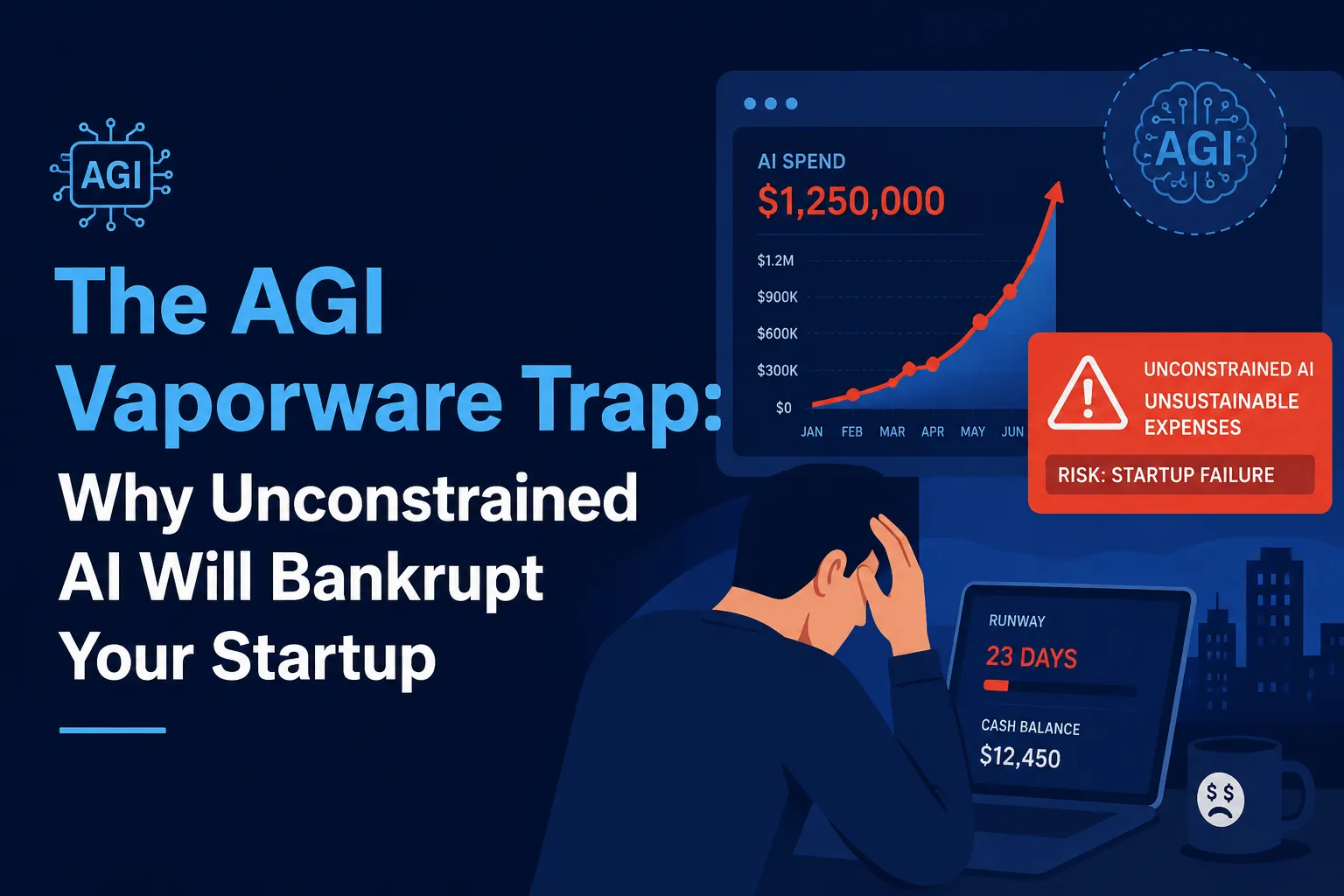
The AGI vaporware trap is not just a messaging mistake. It is a business risk.
Founders who promise unconstrained AI may win attention early, but enterprise buyers eventually ask for controls. They ask for proof. They ask for boundaries. They ask for accountability.
That is where many AI startups fail.
The stronger path is to build AI products that are narrow enough to trust and valuable enough to pay for.
A deterministic agentic workflow may sound less glamorous than AGI, but it is far more useful in the real world. It gives customers a clear workflow, clear permissions, clear outcomes, and clear accountability.
For founders, that is the product strategy that survives the hype cycle.
FAQs
1. What is AGI vaporware?
AGI vaporware refers to products that promise broad, general intelligence but cannot safely deliver reliable business outcomes. In SaaS, it usually appears when founders market an AI product as capable of doing almost anything without proving workflow reliability, governance, or execution control.
2. Why is unconstrained AI risky for startups?
Unconstrained AI is risky because it can hallucinate, misread user intent, access the wrong data, trigger unsafe actions, or generate unsupported claims. These risks become more serious when AI is connected to enterprise systems such as CRMs, billing tools, support platforms, healthcare systems, or finance workflows.
3. What are deterministic agentic workflows?
Deterministic agentic workflows are AI-assisted workflows that operate inside predefined rules. The AI can interpret intent and assist with execution, but permissions, tools, validation checks, approval gates, and system actions are controlled by the product architecture.
4. Do enterprise clients actually want AGI?
Most enterprise clients do not buy AGI as an abstract promise. They buy business outcomes such as faster support resolution, better reporting, lower manual workload, improved compliance workflows, or more efficient operations. They want AI systems that are reliable, secure, auditable, and governable.
5. How can founders make AI agents safer?
Founders can make AI agents safer by limiting tool access, using role-based permissions, validating structured outputs, logging actions, adding human approval for high-risk workflows, monitoring model behavior, and keeping business rules outside the model wherever possible.
6. Is agentic AI better than a chatbot?
Agentic AI can be more powerful than a chatbot when it is designed to complete workflow steps, not just answer questions. However, it also carries more risk because it may trigger actions across systems. That is why agentic AI needs stronger boundaries, permissions, and audit controls.
7. How does Miracuves help with AI SaaS development?
Miracuves helps founders build AI-powered SaaS products, chatbot platforms, workflow automation tools, and white-label app solutions with admin dashboards, source-code ownership, custom branding, secure integrations, and scalable backend architecture.