




Key Takeaways
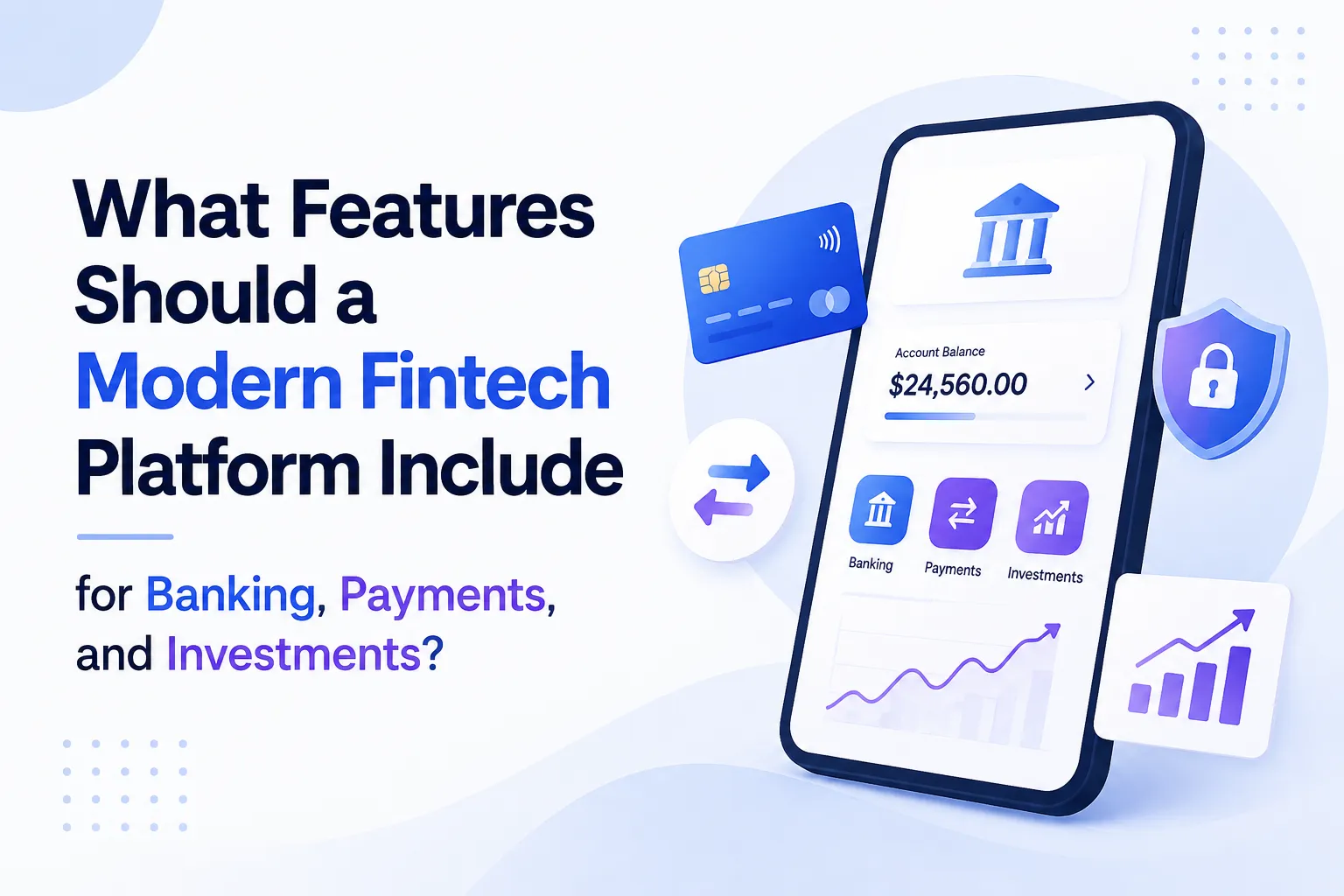
- A modern fintech platform should connect banking, payments, and investment workflows.
- Secure onboarding, KYC, wallets, transfers, and transaction tracking are essential.
- Real-time dashboards help users manage balances, payments, and portfolios.
- Modular architecture supports new markets, currencies, products, and integrations.
- Strong admin controls improve compliance, reporting, security, and operational visibility.
Feature Priority Signals
- Prioritize onboarding, KYC, account management, and role-based access.
- Review wallet ledgers, payment gateways, transfers, fees, and transaction history.
- Evaluate portfolio dashboards, market data, watchlists, and investment workflows.
- Verify encryption, fraud monitoring, audit logs, alerts, and compliance reporting.
- Choose features according to the product model instead of launching everything at once.
Real Insights
- User trust depends on secure, accurate, and transparent financial workflows.
- A feature-rich platform still needs a simple and intuitive user experience.
- Reliable integrations are as important as customer-facing fintech features.
- Scalable products begin with core journeys and add advanced capabilities gradually.
- Miracuves develops modern fintech platforms for banking, payments, and investment use cases.
A modern fintech platform is no longer just a digital wallet, payment app, or online banking interface. Today, users expect one connected experience where they can manage money, send payments, verify identity, track transactions, invest, receive alerts, and access support without friction.
For founders, the real challenge is not only deciding which features to include. The bigger decision is understanding which features create trust, which ones support revenue, and which ones help the platform scale without operational chaos.
That is why modern fintech products need a strong product foundation across banking, payments, remittance, investments, security, compliance-ready workflows, and admin control. For businesses planning to enter this space faster, Miracuves offers fintech app development solution that can be customized around digital banking, cross-border payments, and investment-led use cases.
Why Modern Fintech Platforms Need More Than Basic Money Movement
Early fintech products often started with one core use case: payments, wallet storage, lending, transfers, or trading. But user expectations have changed. A founder building a fintech app today has to think beyond the first transaction.
A customer may want to open an account, verify their identity, receive money, transfer funds, convert currency, view insights, invest, download statements, and raise support tickets from the same app. If these workflows feel disconnected, trust drops quickly.
This is why modern fintech platforms are becoming ecosystems. The strongest platforms usually include:
- Account and wallet management
- KYC and user verification
- Payments and transfers
- Multi-currency or FX workflows
- Card or banking integrations
- Investment and portfolio tools
- Transaction monitoring
- Notifications and alerts
- Admin dashboard controls
- Reporting and audit records
- Security and fraud monitoring workflows
For founders, the goal is not to build every feature from day one. The goal is to build the right foundation so the product can expand without requiring a complete rebuild later.
Core Banking Features Every Fintech Platform Should Include
If your fintech product includes accounts, balances, transfers, user onboarding, or financial records, it needs banking-grade thinking from the beginning. Even if you are not building a full bank, your users will still expect reliability, clarity, and safety.
A strong digital banking platform should include the following feature layers.
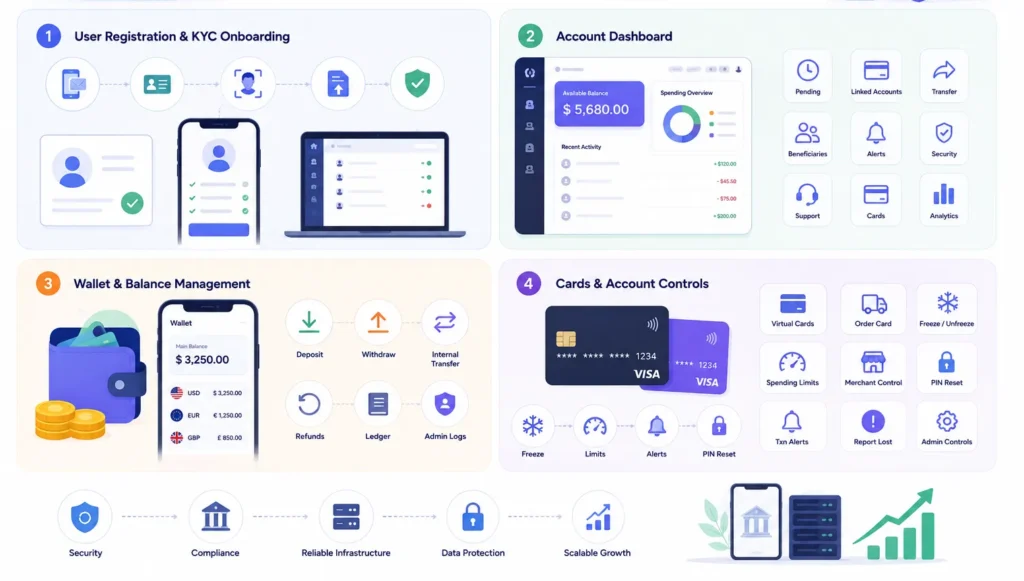
User Registration and KYC Onboarding
The onboarding flow is one of the most important parts of a fintech product. It decides how quickly users can enter the platform and how safely the business can verify them.
A modern fintech onboarding flow should include:
- Email or mobile registration
- Identity verification workflow
- Document upload
- Selfie or liveness check where required
- User profile creation
- Risk-based approval workflow
- Account activation status
- Rejection or resubmission flow
- Admin review controls
The process should feel simple for users but structured enough for the business to manage verification risks. Final KYC requirements depend on the target country, financial product, legal structure, and third-party verification provider.
Account Dashboard
The account dashboard is where users understand their financial position. A weak dashboard creates confusion. A strong dashboard gives users clarity within seconds.
Important dashboard elements include:
- Available balance
- Pending transactions
- Linked accounts
- Recent activity
- Spending overview
- Transfer shortcuts
- Saved beneficiaries
- Alerts and account status
- Security settings
- Support access
For neobank-style products, the dashboard may also include cards, rewards, budgeting, savings pots, FX balances, and investment snapshots.
Wallet and Balance Management
Wallet logic is central to many fintech platforms. Users need to see accurate balances, transaction states, holds, credits, debits, and refunds.
A fintech wallet should support:
- Main wallet balance
- Multi-currency balances where required
- Deposit and withdrawal flows
- Payment gateway integration
- Internal transfers
- Refund tracking
- Wallet ledger history
- Failed transaction handling
- Admin wallet adjustment logs
Ledger accuracy matters because users trust fintech products only when every transaction is traceable and explainable.
Cards and Account Controls
For platforms offering card-based experiences, account controls should be easy to access. Users should be able to manage spending, limits, and security without contacting support for every small action.
Useful card and account control features include:
- Virtual card management
- Physical card request flow
- Freeze and unfreeze card option
- Spending limits
- Merchant category restrictions
- PIN reset workflow
- Card transaction alerts
- Lost card reporting
- Admin-side card status controls
These features are especially relevant for founders building neobank apps, business banking tools, payroll cards, or expense management platforms.
Payment Features That Improve Trust and Repeat Usage
Payments are the heartbeat of fintech platforms. Users expect payment flows to be fast, transparent, and predictable. But founders also need to think about reconciliation, failed payments, dispute handling, fee logic, and admin visibility.
Send, Receive, and Request Money
Basic transfer functionality should be simple, but the backend logic needs to be reliable.
A modern payment flow should include:
- Send money
- Receive money
- Request payment
- Saved recipients
- QR or payment link support where relevant
- Transaction notes
- Payment confirmation
- Transfer status tracking
- Receipt generation
- Failed payment recovery flow
This is where user experience and operational control need to work together. Users want convenience. The business needs clear logs, status updates, and dispute visibility.
Payment Gateway and Bank Integration
A fintech app usually needs external integrations to move money safely. Depending on the market, this may include payment gateways, banking partners, card processors, wallet providers, open banking APIs, or payout partners.
Key integration features include:
- Secure API integration
- Payment gateway connection
- Bank account linking
- Payout partner integration
- Webhook-based transaction updates
- Payment status synchronization
- Tokenized payment handling
- Error and retry management
The platform should be built so new payment partners can be added without disrupting the core product.
Transaction History and Receipts
Users should never have to guess what happened to their money. Every transaction needs a clear record.
Transaction history should include:
- Date and time
- Transaction ID
- Sender and receiver details
- Amount
- Fee
- Currency
- Exchange rate where relevant
- Payment method
- Status
- Downloadable receipt
- Support or dispute option
This feature supports user trust and also reduces customer support volume.
Money Transfer and Remittance Features for Cross-Border Fintech Products
If the platform supports domestic transfers, international payments, or migrant remittance, it needs a dedicated transfer workflow. A generic wallet flow is not enough.
For founders building transfer-led products, a money transfer app structure can help organize the right flows for sender onboarding, recipient management, FX pricing, payout tracking, and transaction monitoring.
Recipient Management
Users sending money regularly should not have to enter recipient details every time. Saved recipient workflows improve repeat usage and reduce errors.
Useful recipient features include:
- Add recipient
- Edit recipient
- Delete recipient
- Bank account details
- Mobile wallet details
- Country-specific recipient fields
- Recipient verification status
- Favorite recipients
- Transfer history by recipient
For cross-border products, recipient fields may change by country, payout method, and compliance requirements.
Currency Conversion and FX Display
Currency transparency is critical in remittance products. Users want to know how much they are sending, how much the recipient receives, and what fees apply.
FX-related features should include:
- Source currency
- Destination currency
- Exchange rate display
- Transfer fee
- Estimated received amount
- Rate refresh logic
- FX margin visibility where appropriate
- Rate lock rules where applicable
For international payments, founders can also study a cross-border payment platform model to understand how multi-currency transfers, recipients, and payout workflows can fit together.
Transfer Tracking
Transfer tracking reduces anxiety. When users send money, especially across borders, they want to know where the payment is and when it will arrive.
A good transfer tracking flow includes:
- Transfer created
- Payment received
- Verification in progress
- Processing
- Sent to payout partner
- Delivered
- Failed or refunded
- Support escalation
This feature is not just a user experience improvement. It also helps support teams manage complaints with better context.
Investment and Trading Features for Wealth-Focused Fintech Platforms
A fintech platform that includes investments needs a different product layer from payments or banking. Investment users care about market data, risk, portfolio performance, order status, and reporting.
When a fintech product expands into stocks, mutual funds, ETFs, digital assets, or wealth tools, it needs an investment and trading platform foundation that supports financial decision-making, not just transactions.
Investor Profile and Risk Setup
Before users invest, the platform should understand their profile. This can support suitability workflows, personalization, and product recommendations where legally permitted.
Investor setup may include:
- Investment goals
- Risk preference
- Experience level
- Income range where required
- KYC status
- Bank account linking
- Tax or regulatory forms depending on market
- Product eligibility logic
This section should be designed carefully because investment suitability and disclosure requirements vary by jurisdiction.
Market Data and Watchlists
Users need easy access to market information before making decisions.
Useful market features include:
- Live or delayed market data
- Search by stock, fund, or asset
- Watchlists
- Price movement
- Charts
- Company or asset information
- Market news integration
- Alerts and notifications
The product does not need to overwhelm users with complex dashboards from day one. But it should provide enough clarity to support informed actions.
Portfolio Dashboard
The portfolio dashboard is the core experience for investment users.
It should include:
- Total portfolio value
- Holdings
- Profit and loss view
- Asset allocation
- Transaction history
- Dividends or returns where relevant
- Investment performance
- Cash balance
- Reports and statements
For brokerage-style fintech products, a stock trading app model can help founders think through watchlists, trading dashboards, order flows, and account reporting.
Order Placement and Trade Status
Trading features need precision. A confusing order flow can create serious user dissatisfaction and operational risk.
Core order features may include:
- Buy and sell flow
- Market and limit orders where applicable
- Order confirmation
- Order status tracking
- Order cancellation
- Trade history
- Settlement status
- Brokerage or fee display
- Risk warnings
- Admin monitoring
Final trading workflows depend on brokerage partners, market access, legal requirements, and the asset classes being offered.
Read More: FinTech Architecture: Evaluating Development Paths for Your Digital Wallet
Admin Dashboard Features That Founders Should Not Ignore
Many fintech founders focus heavily on the customer app and underestimate the admin dashboard. That is a mistake.
The admin panel is where the business controls users, transactions, fees, risk, support, reports, content, and operational workflows. Without strong admin control, even a well-designed fintech app can become difficult to manage.
A fintech admin dashboard should include:
| Admin Feature | Business Value | Founder Impact |
|---|---|---|
| User Management | Helps review users, account status, and verification progress | Reduces manual confusion during onboarding |
| KYC Review Panel | Lets the team approve, reject, or request resubmission | Supports safer identity workflows |
| Transaction Monitoring | Shows payment, transfer, wallet, and investment activity | Helps identify failed, delayed, or suspicious actions |
| Fee Management | Allows control over transfer fees, commissions, margins, or subscription plans | Supports flexible monetization |
| Dispute Management | Helps teams resolve complaints, refunds, failed transfers, and payment issues | Improves trust and support efficiency |
| Reports and Analytics | Tracks users, revenue, transactions, and operational activity | Helps founders make data-led decisions |
| Role-Based Access | Limits what each internal team member can view or change | Reduces operational and security risk |
| Audit Logs | Records important admin and transaction actions | Supports internal accountability |
For fintech products, admin control is not only a backend convenience. It is part of the operating model.
Security and Compliance-Ready Features for Fintech Platforms
Security should be treated as a product foundation, not as a marketing claim. Fintech users are trusting the platform with money, identity, personal records, and financial decisions.
A modern fintech platform should include:
- Encrypted data transfer
- Encrypted data storage
- Secure API integration
- Multi-factor authentication
- Role-based access control
- Audit logs
- KYC workflow support
- AML workflow support
- Transaction monitoring
- Suspicious activity flags
- Fraud monitoring workflows
- Device and login alerts
- Admin access controls
- Secure payment gateway integration
It is important to avoid claiming that any fintech app is automatically compliant everywhere. Final compliance depends on jurisdiction, licences, legal review, third-party integrations, data handling, and the operating model.
The right approach is to build a compliance-ready foundation that can support KYC, AML, reporting, and audit requirements based on the target market.
Monetization Features a Modern Fintech Platform Should Support
A fintech product should be planned with revenue logic from the beginning. Even if monetization starts later, the platform should have the controls needed to introduce it.
Common fintech monetization models include:
| Monetization Model | How It Works | Relevant Use Case |
| Transaction Fees | Charge users per transfer, payment, withdrawal, or payout | Payments and remittance |
| FX Margin | Earn from currency conversion spread | Cross-border transfers |
| Subscription Plans | Offer premium features for a monthly or annual fee | Neobanking, business finance, wealth tools |
| Card Fees | Charge for card issuance, replacement, or premium card tiers | Digital banking |
| Brokerage Fees | Earn from trades or investment transactions | Trading platforms |
| Asset-Based Fees | Charge based on portfolio or wealth management value | Investment and wealth apps |
| Merchant Fees | Charge businesses for accepting payments | Payment platforms |
| Featured Financial Products | Promote partner products where legally allowed | Banking and investment marketplaces |
The best model depends on the product category. A neobank, remittance app, and stock trading platform will not monetize in exactly the same way.
Feature Priority: What Should You Build First?
Founders often try to launch with too many features. That can delay validation and increase cost. A smarter approach is to prioritize the first market version around the core user journey.
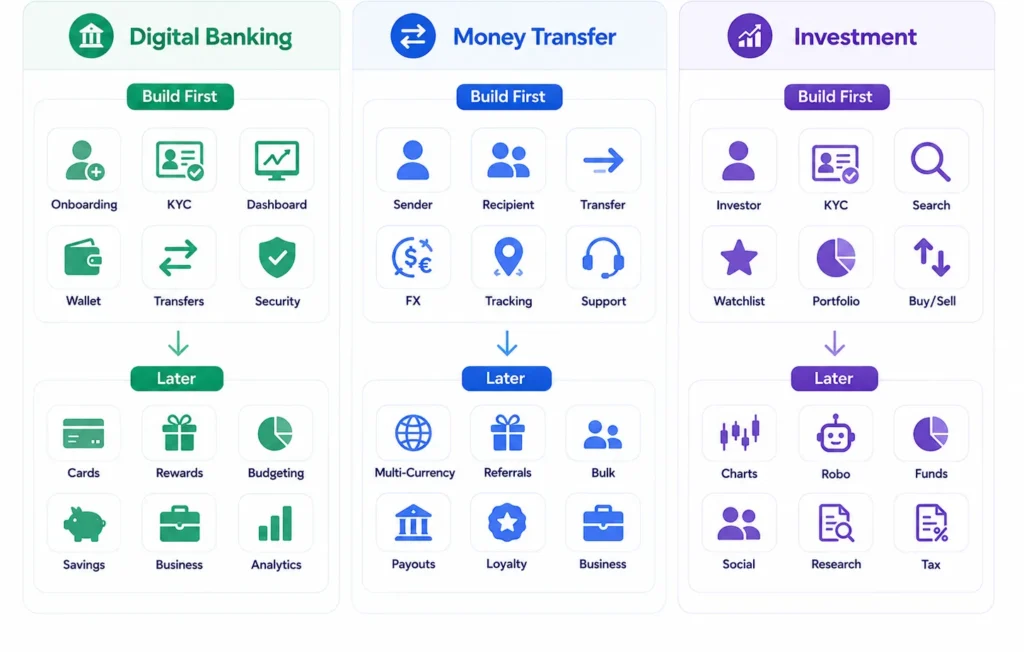
For a Digital Banking Product
Start with:
- User onboarding
- KYC workflow
- Account dashboard
- Wallet or balance management
- Transaction history
- Transfers
- Notifications
- Admin user management
- Security controls
Add later:
- Cards
- Rewards
- Budgeting tools
- Savings goals
- Business banking features
- Advanced analytics
For a Money Transfer Product
Start with:
- Sender onboarding
- Recipient management
- Transfer flow
- Fee and FX display
- Transfer tracking
- Payment gateway integration
- Transaction history
- Admin monitoring
- Support workflow
Add later:
- Multi-currency wallet
- Referral rewards
- Bulk transfers
- Partner payout network
- Loyalty features
- Business transfers
For an Investment Platform
Start with:
- Investor onboarding
- KYC workflow
- Market search
- Watchlist
- Portfolio view
- Buy and sell flow
- Transaction history
- Reports
- Admin risk controls
Add later:
- Advanced charts
- Robo-advisory logic
- Mutual funds
- Social investing
- Research tools
- Tax reports
Founder Decision Signals
Before adding more fintech features, founders should identify what the platform needs to prove first: faster validation, stronger control, safer financial workflows, or room for future expansion.
Launch Readiness
Start with the features that support the first usable product, such as onboarding, KYC flow, wallet or account dashboard, payments, transaction history, and admin visibility.
Operational Control
The platform should give the business clear control over users, fees, verification status, transactions, refunds, disputes, reports, and internal team access.
Trust and Security
Security should be part of the foundation, with encrypted data handling, secure APIs, role-based access, audit logs, transaction monitoring, and suspicious activity alerts.
Future Expansion
Choose a modular product structure so banking, payments, remittance, cards, and investment features can be added or scaled without rebuilding the platform from scratch.
Common Mistakes Founders Make While Planning Fintech Platform Features
Adding Too Many Features Before Validating the Core Use Case
A fintech app does not become stronger just because it has more modules. If the first version includes banking, trading, cards, remittance, lending, crypto, and rewards without a clear launch strategy, the product can become expensive and confusing.
Start with the strongest use case. Expand once user demand is clear.
Treating Compliance as a Final Step
Compliance-ready workflows should influence product architecture early. KYC, AML, audit logs, user verification, transaction monitoring, and reporting should not be patched in after launch.
Ignoring Admin Operations
A fintech platform may look good on the user side but fail operationally if the admin team cannot manage disputes, review users, monitor transfers, adjust fees, or export reports.
Building a Generic Wallet When the Business Needs a Specific Fintech Model
A neobank, money transfer app, and investment platform need different workflows. A generic wallet foundation may not support the business model properly.
Not Planning for Integrations
Fintech platforms often depend on payment gateways, KYC providers, banking partners, brokerage APIs, analytics tools, and notification services. The architecture should be integration-ready from the beginning.
Read More: Content Marketing for Fintech Apps: How Money Transfer Platforms Build User Trust
How Miracuves Helps Founders Build Modern Fintech Platforms Faster
Miracuves helps founders build ready-made and white-label fintech platforms with source-code ownership, branded design, admin dashboards, and customizable workflows. Instead of starting every module from zero, founders can begin with a launch-ready foundation and adapt it around their target market, business model, and compliance requirements.
For example, a founder building a neobank-style product may need accounts, cards, FX, budgeting, and KYC workflows. A remittance founder may need sender onboarding, recipients, currency conversion, fees, and payout tracking. An investment founder may need portfolios, watchlists, market data, order flows, and reporting.
The value is not in copying another fintech company. The value is in starting with a proven product pattern, customizing it for your operating model, and keeping enough control to scale.
Final Thoughts: Build the Fintech Features That Support Trust, Control, and Growth
A modern fintech platform should not be planned as a collection of random features. It should be designed around trust, money movement, user clarity, operational control, and future expansion.
Banking features create the account foundation. Payment and remittance features create transaction utility. Investment features create wealth engagement. Admin, security, compliance-ready workflows, and reporting hold the entire platform together.
For founders, the smartest fintech product is not always the one with the most features. It is the one with the right features for the first market, the right controls for the business, and the right architecture for what comes next.
FAQs
What are the most important features of a modern fintech platform?
The most important features include user onboarding, KYC verification, account dashboard, wallet or balance management, payments, transaction history, security controls, admin dashboard, reporting, and customer support workflows.
What features should a digital banking platform include?
A digital banking platform should include user accounts, KYC onboarding, balances, transaction history, transfers, card controls, spending insights, alerts, account settings, and admin-side user management.
What features are needed for a money transfer app?
A money transfer app should include sender onboarding, recipient management, domestic or international transfer flows, fee display, FX conversion, payment tracking, transaction receipts, status updates, and support workflows.
What features should an investment platform include?
An investment platform should include investor onboarding, risk profile setup, market search, watchlists, portfolio dashboard, buy and sell flows, order tracking, reports, transaction history, and security controls.
Why is an admin dashboard important in fintech apps?
The admin dashboard helps the business manage users, KYC approvals, transactions, fees, disputes, reports, roles, and audit logs. Without strong admin control, fintech operations become difficult to scale.
Do fintech platforms need KYC and AML workflows?
Most fintech platforms that handle money, accounts, transfers, or investments need KYC and AML workflow support. Final requirements depend on the jurisdiction, licensing model, financial partners, and legal review.
Can one fintech platform include banking, payments, and investments?
Yes, one fintech platform can include banking, payments, and investments if the architecture is planned properly. However, founders should usually launch with the strongest core use case first and expand in stages.
How can Miracuves help with fintech platform development?
Miracuves helps founders build white-label and ready-made fintech platforms with source-code ownership, branded user interfaces, admin control, security workflows, and customization support for banking, remittance, and investment use cases.