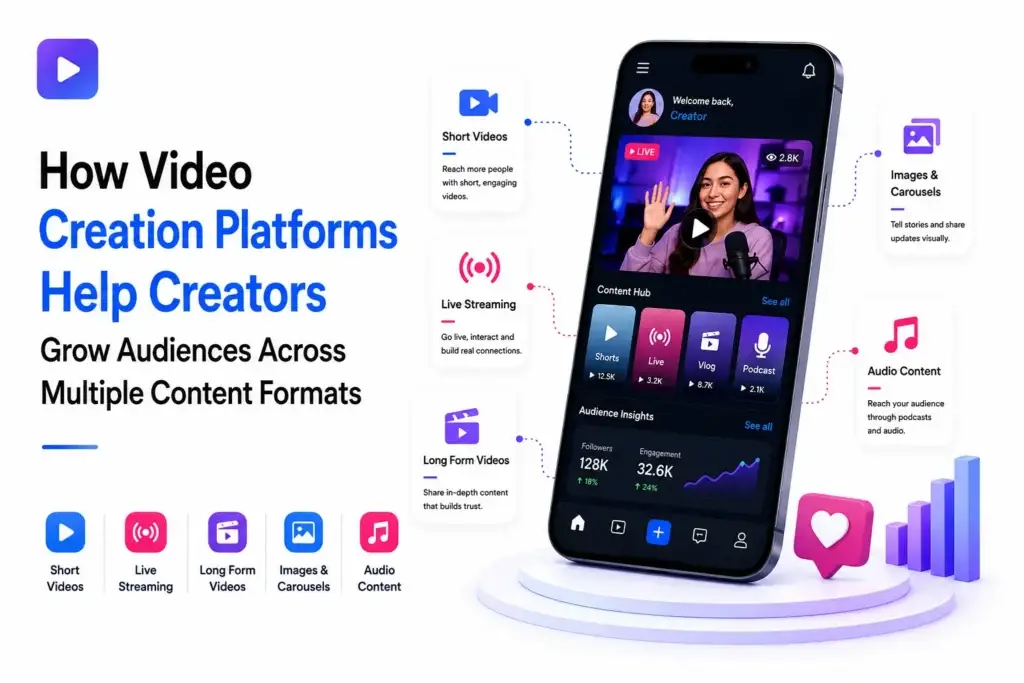


Key Takeaways
- AI-powered video creation platforms can monetize through subscriptions, usage credits, premium tools, creator revenue, and licensing.
- Core features include text-to-video generation, AI avatars, templates, voiceovers, editing tools, exports, and team workspaces.
- Revenue growth depends on AI usage frequency, video output quality, creator demand, enterprise needs, and pricing flexibility.
- A strong AI video platform foundation helps founders turn creative workflows into recurring and scalable monetization streams.
Monetization Signals
- Users need simple prompts, video templates, AI editing, export options, project storage, and clear usage limits.
- Creators need premium effects, branded assets, faster rendering, content libraries, monetization tools, and analytics.
- Businesses need team seats, brand kits, API access, bulk video generation, collaboration workflows, and enterprise billing.
- Admins need control over subscriptions, credits, AI model usage, payments, user roles, reports, moderation, and platform analytics.
Real Insights
- AI video platforms monetize best when users repeatedly generate, edit, export, and improve content inside the same workspace.
- Usage credits work well because AI rendering, avatars, voiceovers, and high-resolution exports create measurable platform costs.
- Enterprise licensing and API access can create higher-value revenue when brands need scalable video automation.
- Miracuves builds AI-powered video creation platforms with subscriptions, usage credits, AI avatars, editing tools, creator monetization, API access, analytics, and admin control.
AI-powered video creation platforms are no longer simple editing tools. They now sit at the center of marketing, creator workflows, training, localization, social media production, ecommerce videos, education content, and enterprise communication.
The demand is visible. Wyzowl’s 2026 video marketing data says 91% of businesses use video as a marketing tool, and 63% of video marketers have used AI video tools to help create or edit marketing videos.
For founders, this creates a clear opportunity. A strong AI video platform can monetize through recurring subscriptions, usage credits, enterprise contracts, API access, creator tools, template marketplaces, white-label licensing, and workflow add-ons.
But the best monetization model depends on the product. A prompt-to-video generator, AI avatar platform, video editing tool, short-video creation app, and enterprise training video platform should not all use the same pricing logic.
That is the real business question this guide answers: what monetization opportunities make the most sense for AI-powered video creation platforms, and how should founders choose the right mix?
Why Monetization Needs to Be Designed Before the Platform Is Built
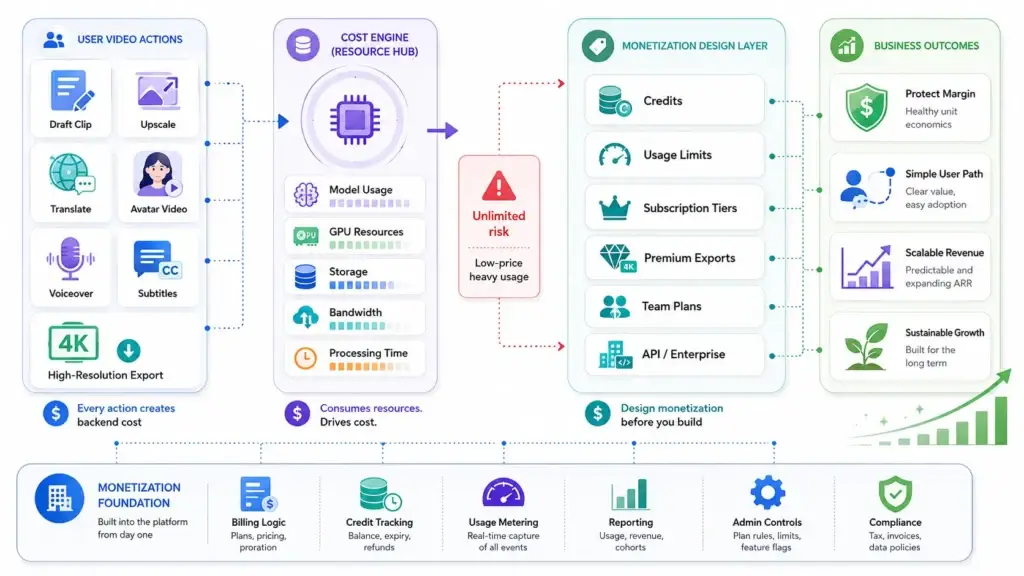
AI video platforms are different from normal SaaS products because every generation can create a real backend cost. A user may generate a 5-second draft, upscale a clip, translate a video, create an avatar, render a voiceover, generate subtitles, or export in high resolution. Each action may consume model access, GPU resources, storage, bandwidth, and processing time.
That means monetization cannot be added casually after launch. It affects the product architecture.
For example, Runway uses credits across generation workflows, with credit usage depending on model, duration, and resolution. Google’s Veo pricing also shows how video generation can be priced by generated seconds in API environments.
This matters for founders because a flat unlimited plan may attract users, but it can also create heavy usage from low-paying customers. A strong revenue model protects margin while still giving users a simple path to create.
1. Subscription Plans for Predictable SaaS Revenue
Subscription pricing is the most common starting point for AI video creation platforms. Users pay monthly or annually to access video creation tools, editing workflows, templates, storage, exports, collaboration, and AI features. A strong AI avatar video revenue model usually combines recurring SaaS plans with usage limits, premium AI features, team workflows, and enterprise licensing.
This model works because many users create videos repeatedly. Marketers need weekly campaign videos. Agencies create client assets. Educators produce course content. Creators publish regularly. Businesses need training, onboarding, and internal communication videos. For long-form libraries, premium lessons, entertainment content, or gated video access, an OTT video streaming platform can extend this model with subscriptions, rentals, pay-per-view, and branded content delivery.
A subscription model can be structured around user segments:
| Plan Type | Best For | Monetization Logic |
|---|---|---|
| Free or trial plan | New users testing the product | Reduces adoption friction |
| Creator plan | Solo creators and freelancers | Recurring revenue with limited credits |
| Team plan | Agencies, marketing teams, educators | Higher ARPU through collaboration |
| Business plan | Companies with brand workflows | Adds admin control and brand assets |
| Enterprise plan | Large organizations | Custom pricing, support, security, and integrations |
The founder advantage is predictability. Subscriptions make revenue easier to forecast and give users a clear reason to keep using the platform.
However, subscription-only pricing has one limitation: AI video generation can be expensive when users create high volumes. That is why subscriptions often work best when paired with credits or usage limits.
2. Credit-Based Monetization for AI Generation Usage
Credit-based pricing is one of the strongest monetization opportunities for AI-powered video creation platforms.
In this model, users receive a monthly credit balance or buy credit packs. Credits are consumed when they generate videos, upscale clips, create avatars, remove backgrounds, translate videos, clone voices, export in HD, or use premium models.
This works especially well because AI video output is not equal. A 5-second low-resolution draft does not cost the same as a longer HD video with audio, subtitles, lip sync, and translation.
Credit pricing helps founders:
- Control heavy usage
- Protect infrastructure margin
- Let users pay more as they create more
- Offer flexible plans without promising unlimited compute
- Create expansion revenue from serious users
Runway, Synthesia, Adobe Firefly, and other AI creation platforms use credit-style or usage-based access in different ways, which shows that credits have become a practical pricing language for creative AI products.
For a founder, the key is to make credits simple. Users should understand what each action costs before they click generate. Hidden credit deductions can create frustration and churn.
3. Pay-Per-Video or Pay-As-You-Go Pricing
Pay-as-you-go pricing is useful when users do not want a monthly subscription. Instead, they pay for each video, export, minute, generation, or project.
This model fits occasional users such as small businesses, one-time campaign teams, event marketers, students, or agencies testing the platform before committing.
Pay-per-video monetization can work for:
- Product promo videos
- Real estate listing videos
- AI avatar explainers
- Training videos
- Localized ad creatives
- Short social media clips
- Presentation-to-video exports
The advantage is low commitment. A user can create one video without subscribing. The downside is weaker retention unless the product has a reason to bring users back.
For this reason, pay-as-you-go works best as a secondary model beside subscriptions. It can capture one-time users while subscription plans serve repeat creators.
4. Enterprise Licensing for High-Value Contracts
Enterprise licensing is one of the most profitable opportunities for AI video creation platforms because businesses pay for more than generation. They pay for workflow control.
Enterprise buyers often need:
- Team workspaces
- Brand kits
- Private avatars
- Voice controls
- Approval workflows
- Admin roles
- Usage analytics
- Security controls
- Single sign-on
- API access
- Custom templates
- Dedicated support
- Training and onboarding
Synthesia’s pricing structure includes self-serve and enterprise options, and its enterprise-facing plan highlights team collaboration, brand kits, custom credits, SAML/SSO, support, onboarding, and integrations.
The founder lesson is simple: enterprise revenue grows when the platform solves operational problems, not just creative problems.
A solo creator pays for speed. A business pays for consistency, control, governance, and scale.
5. API Monetization for Developers and Platforms
API monetization lets other apps, SaaS platforms, agencies, LMS systems, ecommerce tools, CRMs, and marketing platforms use your AI video engine inside their own workflows. This is why studying an AI video platform revenue model can help founders understand how subscriptions, credit usage, API access, and enterprise contracts work together.
This can become a powerful revenue stream because customers are not only individual users. They are businesses embedding video generation into their products.
API monetization can be priced by:
- Generated seconds
- Video minutes
- Number of API calls
- Model type
- Rendering quality
- Concurrent jobs
- Storage and hosting
- Monthly committed usage
- Enterprise volume agreements
HeyGen’s API pricing documentation, for example, separates API usage from normal web subscriptions and describes credit-based usage for videos and translations. Google Cloud also prices Veo video generation by generated seconds in enterprise API environments.
API revenue is especially strong when your platform can support automation. For example, an ecommerce platform may generate product videos automatically. A learning platform may generate training modules. A CRM may generate personalized sales videos.
For founders, API monetization requires stronger backend controls: rate limits, billing dashboards, webhook support, usage logs, authentication, developer documentation, and scalable generative AI development services that can support model workflows, credit usage, and platform growth.
6. White-Label Licensing for Agencies and Businesses
White-label monetization allows other businesses to launch the AI video platform under their own brand. They may use your platform for their clients, employees, creators, or customers.
This model works well for:
- Marketing agencies
- Creator agencies
- Edtech companies
- Corporate training providers
- Media production companies
- Local SaaS resellers
- Industry-specific video tools
- Franchise or multi-brand businesses
The value is speed. Instead of building text-to-video, avatar generation, editing, templates, analytics, user management, and billing from zero, a business can launch with an existing foundation.
Miracuves offers video content platform solutions designed for streaming, content creation, monetization, subscriptions, pay-per-view, ad integration, adaptive streaming, and creator-focused workflows.
For founders, white-label revenue can create larger upfront payments and recurring license fees. It also expands distribution because partners can sell the platform into their own customer base.
7. Template Marketplace Revenue
A template marketplace lets designers, creators, agencies, and brands sell reusable video templates inside the platform.
This is a strong monetization layer because many users do not want to start from a blank prompt. They want ready-made structures for ads, reels, product launches, tutorials, course intros, explainers, podcast clips, testimonials, recruitment videos, and event promos.
The platform can earn through:
- Commission on template sales
- Premium template subscriptions
- Featured template placements
- Creator marketplace fees
- Brand template packs
- Industry-specific template bundles
Template marketplaces also improve retention. Users return because the platform gives them faster starting points.
The founder advantage is that marketplace inventory grows over time. The more templates available, the more useful the platform becomes for niche use cases.
8. Creator Revenue Sharing and Commission Models
If the AI video platform includes creators, public profiles, fan communities, video distribution, paid content, or gated access, a subscription-based creator platform model can help founders monetize through recurring subscriptions, paid unlocks, fan engagement, and creator commissions.
A creator-driven video sharing platform can monetize through paid creator subscriptions, tips and donations, virtual gifts, paid video unlocks, live session access, creator storefronts, premium community access, and platform commission on creator earnings.
Appscrip’s creator platform content argues that successful creator platforms usually need a hybrid model with subscriptions, pay-per-view, tipping, direct messages, live streaming, and agency tools instead of relying on a single revenue stream.
This is useful for AI-powered video creation platforms because creators may not only create videos. They may sell templates, AI avatars, prompt packs, stock scenes, video editing presets, or exclusive AI-generated content.
The platform earns when creators earn. That alignment can improve retention.
9. Advertising and Sponsored Content
Advertising can work for AI video platforms, but it should be used carefully.
Ads are strongest when the platform has high user traffic, strong engagement, and a free audience segment. For example, a short-video creation and sharing app may monetize through in-feed ads, creator sponsorships, branded challenges, sponsored templates, and promoted content.
Oyelabs notes that short-video platforms commonly generate revenue through in-app advertising, brand partnerships, creator monetization programs, virtual gifts, premium subscriptions, and sponsored content.
For an AI video generator, however, ads may not be the first monetization choice. If users are creating business content, training videos, or paid marketing assets, ads can reduce the professional experience.
A better approach is to use ads only in free plans or community areas while keeping paid creation workflows clean.
10. Premium Assets, Add-Ons, and Upgrade Packs
Add-ons are powerful because they increase revenue without forcing every user into a higher plan.
AI video platforms can sell:
- Premium avatars
- Custom voices
- Voice cloning
- Extra storage
- HD or 4K exports
- Brand kits
- Background music packs
- Commercial-use assets
- Advanced captions
- Translation minutes
- Watermark removal
- Team seats
- Priority rendering
- Private model access
This model works because different users value different features. A solo creator may pay for watermark removal. An agency may pay for brand kits. An enterprise may pay for private avatars and admin control.
Add-ons are especially useful when the platform has a broad audience and one fixed plan cannot serve everyone.
11. Localization and Dubbing Revenue
AI dubbing, translation, subtitles, and lip-sync localization can become a separate monetization layer.
This is valuable because video is increasingly global. A brand may create one master video and localize it into multiple languages. An educator may translate course videos. A creator may reach new audiences without recording again.
Localization can be priced by:
- Minutes translated
- Languages selected
- Voice quality
- Subtitle exports
- Lip-sync generation
- Bulk translation packages
- Enterprise localization contracts
This model works well for B2B platforms because businesses already understand the cost of manual localization. AI makes the workflow faster, and the platform can charge based on time saved.
12. Data, Analytics, and Performance Intelligence
Analytics can become a paid feature when users rely on the platform for business outcomes.
Basic users may only need downloads. Advanced users want to know which videos perform, which templates convert, which scripts retain viewers, and which formats drive engagement.
Paid analytics can include:
- Video performance dashboards
- Campaign-level reports
- Audience retention insights
- A/B testing
- Creative score predictions
- Best-performing templates
- Team productivity analytics
- Creator earning analytics
- Export and usage reports
This is especially valuable for agencies, marketing teams, education companies, and creator networks.
The opportunity is not only video creation. It is video intelligence.
13. Workflow Automation and Team Collaboration Revenue
As AI video platforms mature, the strongest revenue often comes from workflow automation.
A user may start with “generate a video from a prompt,” but a team eventually needs scripts, approvals, brand checks, version history, comments, asset libraries, scheduling, distribution, and reporting.
These collaboration features support higher-priced plans because they solve business friction.
Workflow monetization can include:
- Team seats
- Approval workflows
- Shared workspaces
- Brand governance
- Client review links
- Project folders
- Role-based access
- Publishing integrations
- Automated campaign generation
- Bulk video creation
This is where Miracuves can help founders think beyond the AI model. The product should not only generate videos. It should support the business process around video creation.
Best Monetization Model by Platform Type
| Platform Type | Best Primary Model | Best Secondary Model | Why It Works |
| AI avatar video platform | Subscriptions | Enterprise licensing and custom avatars | Business users need recurring training, marketing, and communication videos |
| Prompt-to-video generator | Credits | Pay-as-you-go | Generation costs vary by length, model, and output quality |
| AI video editor | Subscriptions | Add-ons and storage upgrades | Editing is a recurring creator workflow |
| Short-video creation app | Creator commissions | Ads, gifts, subscriptions | Monetization depends on audience engagement and creator retention |
| Enterprise training video platform | Enterprise licensing | Localization and admin controls | Companies pay for governance, consistency, and scale |
| AI video API platform | Usage-based API billing | Volume contracts | Developers need metered access and predictable infrastructure pricing |
| White-label AI video platform | License fees | Revenue share and support plans | Agencies and businesses want branded ownership and faster launch |
Founder Decision Signals
Use Subscriptions When
Your users create videos regularly and need ongoing access to templates, workspaces, storage, exports, and editing tools.
Use Credits When
Your backend cost changes by generation length, resolution, model quality, rendering time, or premium AI features.
Use Enterprise Licensing When
Your buyers need team control, security, brand governance, private assets, onboarding, and custom workflows.
Use Marketplace Revenue When
Your platform can attract creators, template sellers, agencies, or experts who add reusable assets to the ecosystem.
Mistakes Founders Should Avoid
Relying Only on Ads
Ads usually need large traffic volume before they become meaningful. If the platform serves creators, marketers, agencies, or enterprises, subscriptions, credits, and licensing usually create better early revenue.
Offering Unlimited AI Generation Too Early
Unlimited plans can attract usage-heavy customers who create high infrastructure costs. Founders should use fair-use rules, credits, generation limits, or plan-based caps.
Ignoring Enterprise Needs
Many AI video platforms start with creators but grow through teams and businesses. Missing admin roles, brand controls, audit logs, workspace management, and billing controls can block enterprise revenue.
Treating Monetization as a Post-Launch Feature
Pricing logic affects the database, billing system, credit tracking, admin panel, role permissions, usage logs, API controls, and reporting. It should be designed from the start.
Not Connecting Monetization to User Value
A user should understand why they are paying. Better resolution, faster rendering, more credits, private avatars, team seats, brand kits, analytics, and API access are clearer value drivers than vague “premium access.”
Miracuves Perspective: Build the Revenue Engine Into the Product Foundation
The best AI-powered video creation platforms are not built around a single monetization stream. They are designed as complete revenue systems where subscriptions, usage credits, enterprise licensing, API access, and creator marketplace commissions can work together.
For founders, this matters because monetization affects more than pricing. It shapes the product architecture, admin dashboard, billing logic, user permissions, creator workflows, and long-term scalability.
A platform that charges through subscriptions needs plan management, renewal logic, access limits, and upgrade paths. A platform that uses AI credits needs usage tracking, credit deductions, generation limits, and transparent billing. A creator-first platform needs wallets, payouts, commissions, gated content, and performance analytics. These revenue layers should be part of the foundation, not added later as disconnected features.
This is also where admin control becomes important. Founders need the ability to manage users, creators, subscriptions, credit packages, enterprise accounts, API usage, refunds, reports, and platform commissions without depending on developers for every business change. The stronger the control layer, the easier it becomes to test new pricing models and improve revenue over time.
Miracuves helps founders build AI-powered video, creator, and automation platforms with monetization logic planned from the beginning. For businesses exploring this space, Miracuves’ video content platform solutions and AI development services can help connect app architecture, admin control, source-code ownership, and revenue workflows into one launch-ready foundation.
Final Thoughts: The Best Monetization Model Is Usually Hybrid
The best monetization opportunity for an AI-powered video creation platform is not one fixed model. It is a smart combination.
Subscriptions create predictable revenue. Credits protect margins. Pay-as-you-go reduces entry barriers. Enterprise licensing increases account value. API access expands distribution. Marketplaces create ecosystem revenue. Add-ons increase expansion revenue. Creator monetization builds platform loyalty.
For founders, the practical decision is this: do not build an AI video tool first and think about monetization later. Build the revenue architecture into the platform from day one.
That is how an AI video platform moves from a creative feature into a scalable business.
FAQs
How do AI-powered video creation platforms make money?
AI-powered video creation platforms make money through subscriptions, credit-based usage, pay-per-video pricing, enterprise licensing, API access, template marketplaces, creator commissions, ads, premium add-ons, and white-label licensing.
What is the best monetization model for an AI video generator?
The best model is usually a hybrid of subscriptions and credits. Subscriptions create recurring revenue, while credits protect the platform from high AI generation costs.
Are ads a good revenue model for AI video platforms?
Ads can work for free users, short-video communities, and high-traffic platforms. For professional AI video tools, subscriptions, credits, enterprise plans, and API pricing are usually stronger early monetization models.
Why do AI video platforms use credits?
AI video platforms use credits because generation cost changes by video length, model type, resolution, rendering complexity, and export quality. Credits make pricing more flexible and help founders manage infrastructure costs.
Can AI video platforms sell to enterprises?
Yes. Enterprises often need team workspaces, brand kits, approval workflows, private avatars, admin control, usage analytics, SSO, API access, and security features. These needs support higher-value licensing.
What monetization model works for creator-focused AI video platforms?
Creator-focused AI video platforms can monetize through subscriptions, tips, virtual gifts, paid content, creator commissions, premium templates, live sessions, and marketplace fees.
Is API monetization useful for AI video platforms?
Yes. API monetization is useful when other platforms want to embed AI video generation into their own products, such as ecommerce tools, LMS platforms, CRMs, marketing automation systems, or agency dashboards.
How can Miracuves help build an AI-powered video platform?
Miracuves can help founders build AI-powered video platforms with branded design, admin dashboards, creator workflows, subscription logic, credit-based usage systems, API-ready architecture, and source-code ownership.