
Key Takeaways
- Autonomous agents can generate excessive API token costs.
- Semantic loop breakers prevent expensive infinite reasoning loops.
- Token monitoring improves AI infrastructure efficiency.
- Controlled workflows reduce unpredictable AI spending.
- Cost optimization improves long-term AI platform profitability.
Optimization Signals
- Detect repetitive reasoning before API costs escalate.
- Apply semantic thresholds to stop unnecessary loops.
- Monitor token usage across every autonomous workflow.
- Use human approval for high-cost AI actions.
- Track API usage with real-time dashboards.
Real Insights
- Runaway AI loops can quickly inflate cloud expenses.
- Cost controls should be built into agent architecture.
- Deterministic guardrails improve enterprise reliability.
- AI observability is essential for sustainable scaling.
- Miracuves builds autonomous AI platforms with intelligent loop-breaker architecture.
Autonomous agents look powerful in demos because they can reason, plan, call tools, retry failed steps, and continue working toward a goal without constant human input.
That same autonomy creates a financial problem.
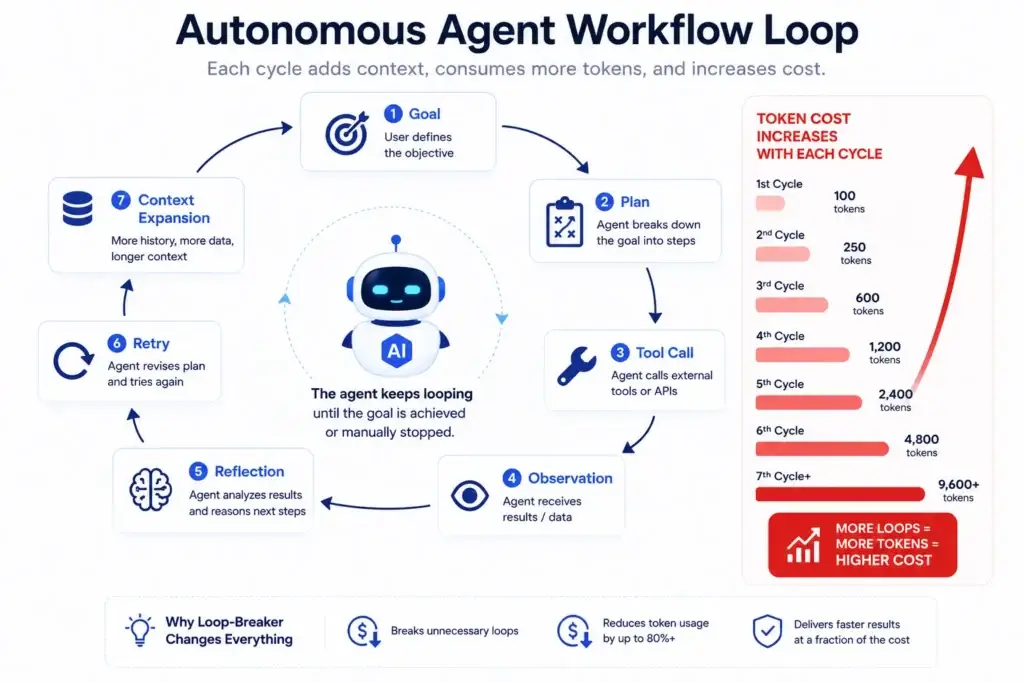
Every plan, tool call, retry, observation, reflection, and memory update can add tokens. When an agent gets stuck inside a repetitive logic chain, the product does not simply fail technically. It keeps spending.
For SaaS CFOs, tech investors, and AI application operators, this is the real debate around autonomous AI agents: not whether they are impressive, but whether their unit economics can survive production usage.
Basic AutoGPT-style scripts often rely on open-ended loops: think, act, observe, revise, act again. That structure can work for exploration, but it becomes dangerous when the agent repeats semantically similar reasoning steps without reaching a useful conclusion. Recent agentic AI research has highlighted the cost unpredictability of agentic tasks, including high token variability across runs and the fact that more token spend does not always produce better accuracy.
This is where Miracuves’ Autonomous Loop Breaker changes the economics.
Based on proprietary benchmark data provided for this report, Miracuves’ hardcoded semantic loop-breaker reduced infinite-loop API token burn by 82% when running autonomous agents across complex logic chains. The point is not that every workflow will cost 82% less. The point is more practical: when an AI clone or B2B agent enters a runaway loop, the loop breaker can stop the most expensive failure mode before it destroys margin.
The Infinite Token Drain of AutoGPT-Style Scripts
A traditional chatbot has a relatively predictable cost shape.
A user sends a message. The model returns an answer. The application may add retrieval, memory, or tool use, but the basic pattern is still request-response.
Autonomous agents are different.
An agent may perform multiple internal steps before the user sees the final output:
- Interpret the goal
- Generate a plan
- Select a tool
- Call the tool
- Read the output
- Reflect on whether the output is enough
- Update memory
- Revise the plan
- Call another tool
- Repeat until done
Each step can resend system instructions, task context, previous messages, observations, and intermediate reasoning summaries. That means the cost curve is not linear with user messages. It is driven by the number of agent steps.
A recent technical paper on agentic coding tasks found that token consumption can be highly variable and that different runs on the same task can consume dramatically different token volumes. It also found that higher token usage does not necessarily mean higher accuracy, which is exactly why cost governance matters in production AI applications.
For an AI clone business, that creates a painful operating question:
What happens when one user request triggers 40 agent steps instead of 6?
That is where SaaS margin starts leaking.
Read more : Best ChatGPT Clone Script in 2026: Features & Pricing Compared
Why Agentic Workflows Are More Expensive Than Normal LLM Calls
The cost of an autonomous workflow is usually a function of five variables:
| Cost Variable | What It Means | Why It Matters |
|---|---|---|
| Agent steps | Number of reasoning and action cycles | More steps mean more API calls |
| Input tokens | Context, memory, tool outputs, instructions | Often grows as the loop continues |
| Output tokens | Model-generated plans, summaries, actions | Adds cost at every step |
| Tool retries | Failed API calls, invalid outputs, repeated attempts | Can multiply cost without user value |
| Context carryover | Previous steps included in future prompts | Creates compounding token usage |
The simplified cost formula looks like this:
Total Agent Cost =
Σ over each step [
  (Input Tokens × Input Token Price)
  +
  (Output Tokens × Output Token Price)
]
+
Tool / Infrastructure Cost
For CFO modeling, this can be simplified into:
Cost Per Task =
Average Step Count × Average Tokens Per Step × Blended Token Price
The problem is that basic autonomous scripts rarely maintain a stable average step count. They may complete easy tasks in 4–6 steps but spiral into 25, 50, or 100 steps when they encounter ambiguity, tool failure, missing data, or contradictory instructions.
That variance makes pricing difficult.
A SaaS operator can price a chatbot plan around approximate messages per user. Pricing an autonomous agent is harder because one “task” can quietly become dozens of LLM calls.
The Runaway Loop: Where AI Clone Gross Margin Disappears
A runaway loop happens when the agent is technically active but commercially unproductive.
It may look like progress because the agent continues producing thoughts, summaries, tool calls, and revised plans. But underneath, the agent is circling the same semantic state.
Common runaway loop patterns include:
- Repeating the same search query with slight wording changes
- Calling a tool again even after receiving the same error
- Re-planning without adding new evidence
- Summarizing the same observation repeatedly
- Switching between two incomplete strategies
- Asking itself whether the task is complete but never terminating
- Rebuilding the context instead of executing the next useful action
For an AI application operator, this is dangerous because the backend sees activity. The billing meter sees usage. The user may see a loading state. But the business sees no completed value.
This is why Miracuves treats loop detection as part of AI agent architecture. A production-grade AI clone should not depend only on model intelligence to stop itself. It needs deterministic guardrails that protect cost, latency, and user experience.
Read more : ChatGPT Clone Revenue Model: How AI Chat Platforms Make Money
Mathematical Thresholds for Semantic Loop Breaking
A simple loop breaker counts iterations.
For example:
Stop agent after 15 steps.That is useful, but blunt.
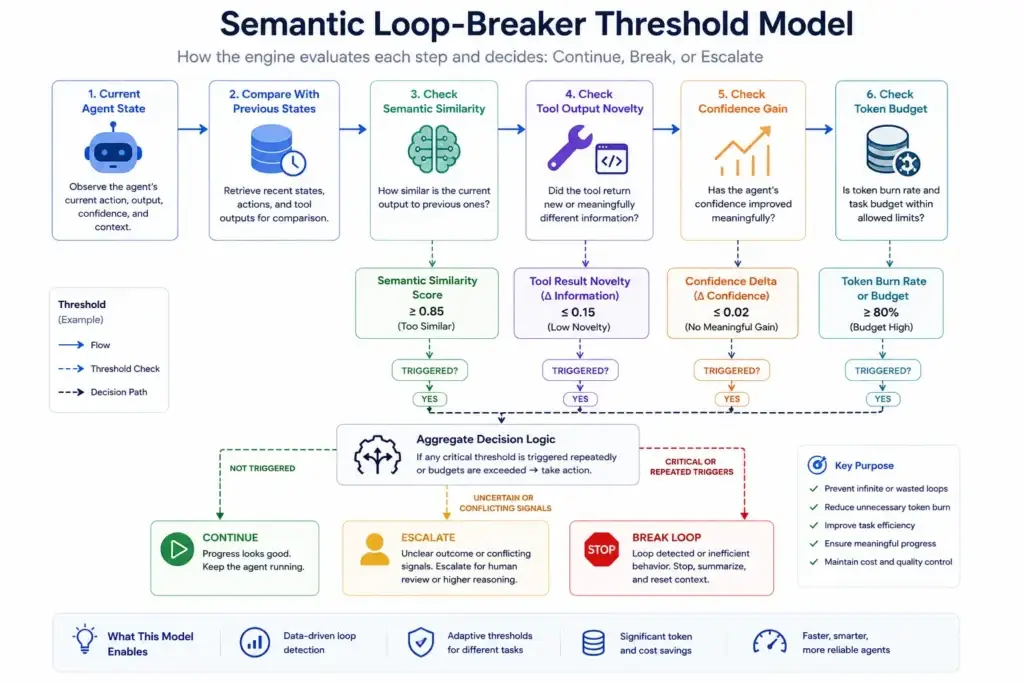
A semantic loop breaker is more intelligent. It checks whether the agent is making meaningful progress or simply re-entering the same reasoning state.
The core idea:
If the current agent state is too semantically similar to previous states
AND no new useful evidence has been added
AND the task confidence is not improving
THEN stop, escalate, summarize, or ask for clarification.
A production loop breaker can use variables such as:
| Variable | Meaning | Example Threshold |
|---|---|---|
| Semantic similarity score | How close the current step is to previous steps | Break if similarity > 0.92 across 3 cycles |
| Tool result novelty | Whether new tool calls return new information | Break if novelty < 10% |
| Confidence delta | Whether the agent’s completion confidence improves | Break if delta < 0.03 over 4 cycles |
| Token burn rate | Tokens consumed per useful state change | Break if burn exceeds task budget |
| Retry count | Number of repeated failures | Break after repeated identical failures |
| Max task budget | CFO-defined cost ceiling | Break before cost exceeds plan limit |
A practical semantic loop-breaker condition can look like this:
Loop Break Trigger =
(
  Similarity(Current_State, Previous_State_N) >= 0.92
  AND Novelty(Current_Tool_Output) <= 0.10
  AND Confidence_Gain <= 0.03
  AND Consecutive_Repetitions >= 3
)
OR
(
  Projected_Task_Cost >= Task_Budget_Cap
)
This matters because not every long-running agent task is bad.
Some complex workflows genuinely require many steps. The goal is not to kill autonomy. The goal is to stop useless repetition.
Benchmark Model: Basic Agent Script vs Miracuves Loop Breaker
The following benchmark model uses the proprietary 82% token-burn reduction variable supplied for this article. It is designed as a CFO-facing illustration of how runaway-loop control changes task economics.
| Benchmark Item | Basic AutoGPT-Style Script | Miracuves Loop Breaker Agent |
|---|---|---|
| Average runaway loop steps | 50 | 9 |
| Average tokens per step | 2,800 | 2,800 |
| Total runaway tokens | 140,000 | 25,200 |
| Token burn reduction | — | 82% |
| User-visible value | Low after repetition begins | Higher because failure is stopped earlier |
| CFO risk | Unbounded task cost | Budget-governed task cost |
| Operator control | Manual log review | Automated semantic break condition |
The token reduction math is straightforward:
Reduction % =
(Baseline Tokens - Optimized Tokens) / Baseline Tokens × 100

Reduction % =
(140,000 - 25,200) / 140,000 × 100

Reduction % =
114,800 / 140,000 × 100

Reduction % =
82%
This is the difference between an agent that keeps spending because it is confused and an agent that recognizes repetition, stops waste, and returns a controlled outcome.
Read more : How can I market my ChatGPT clone app successfully?
The CFO View: Why 82% Token Burn Reduction Protects Gross Margin
For SaaS CFOs, the important number is not only API spend. It is gross margin per workflow.
Assume an autonomous B2B workflow is priced at a fixed usage rate. The customer pays for an outcome, not for the agent’s internal confusion.
A simplified margin model:
Gross Margin Per Workflow =
Workflow Revenue - LLM API Cost - Tool Cost - Infrastructure Cost - Support Cost
When token burn rises unpredictably, gross margin compresses.
Example:
| Metric | Without Loop Breaker | With Loop Breaker |
|---|---|---|
| Revenue per workflow | $1.00 | $1.00 |
| Runaway LLM cost | $0.50 | $0.09 |
| Other infrastructure cost | $0.08 | $0.08 |
| Support / fallback cost | $0.07 | $0.05 |
| Gross profit | $0.35 | $0.78 |
| Gross margin | 35% | 78% |
This is why loop control is not only an engineering feature. It changes pricing confidence.
When a SaaS team can predict cost ceilings, it can build stronger plans, usage tiers, enterprise contracts, and investor-ready margin assumptions.
The Operator View: Loop Breaking Improves Reliability, Not Just Cost
AI operators care about more than token bills.
A runaway loop also damages:
- Latency
- Queue depth
- User trust
- Tool rate limits
- API quota availability
- Support workload
- Observability noise
- Completion quality
A loop breaker gives the system a controlled failure path.
Instead of letting the agent spin indefinitely, the application can respond with:
- A concise summary of what was attempted
- The missing input required from the user
- A fallback workflow
- A human escalation route
- A lower-cost model retry
- A structured partial output
That is a better product experience than a silent token drain.
The Investor View: Autonomous Agents Need Unit Economics Before Scale
Tech investors evaluating AI applications should ask a sharper question:
Does this agentic product have bounded execution cost?
A product can look impressive at demo volume and become financially unstable at production volume. If every new customer increases the probability of runaway agent loops, revenue growth can hide infrastructure risk.
Investor diligence should include:
| Diligence Question | Why It Matters |
|---|---|
| Is there a maximum cost per task? | Prevents unlimited API exposure |
| Are failed loops detected semantically? | Stops repeated reasoning that looks different but means the same thing |
| Are model tiers routed by task difficulty? | Avoids using expensive models for low-value steps |
| Are prompts and context pruned? | Reduces compounding input token cost |
| Is usage observable by customer, workflow, and agent type? | Enables pricing and margin analysis |
| Can the admin define budgets? | Gives operators commercial control |
Miracuves’ AI agent and LLM development positioning already emphasizes production LLM applications, RAG pipelines, AI agents, guardrails, observability, and source-code ownership, making this cost-governance angle a natural extension for AI clone operators
Founder Decision Signals
Speed
A ready-made AI clone can launch faster, but agentic workflows still need runtime controls before real users begin triggering expensive multi-step tasks.
Cost
The biggest cost risk is not the first LLM response. It is repeated reasoning, tool retries, and context-heavy loops that continue without producing new value.
Scalability
Agent scalability depends on budget caps, semantic loop detection, model routing, prompt compression, and observability across workflows.
Market Fit
Autonomous workflows become easier to monetize when the founder can price outcomes with predictable cost ceilings and controlled fallback paths.
How the Autonomous Loop Breaker Works Inside an AI Clone
Inside an AI clone, the loop breaker should not be treated as a single switch. It should be part of the orchestration layer.
A stronger architecture includes:
1. State Fingerprinting
Each agent step is converted into a compact state fingerprint.
This may include:
- Current goal
- Current subtask
- Latest tool result
- Reasoning summary
- Confidence score
- Next action
- Error code or failure state
The system compares this fingerprint against prior states. If the agent keeps returning to the same state, the loop breaker becomes active.
2. Semantic Similarity Checks
Exact string matching is not enough.
The agent may say the same thing in different words. Semantic comparison helps detect repeated meaning even when the wording changes.
Example:
Step 11: “Search again for pricing documentation.”
Step 14: “Look up the pricing page one more time.”
Step 17: “Try another search for pricing details.”
These are different phrases but the same operational state.
3. Novelty Detection
A loop breaker should ask:
Did the last step add new information?
If a tool call returns the same empty result or the same error, the agent should not keep retrying without changing strategy.
4. Confidence Delta Tracking
If the agent’s confidence is not improving, more tokens may not help.
A simple threshold:
Break if confidence improvement is below 3% across 4 repeated cycles.This prevents the agent from spending heavily while staying uncertain.
5. Budget-Aware Termination
CFOs and operators need task-level budget caps.
Example:
Maximum cost per workflow: $0.20
Warning threshold: $0.14
Forced fallback threshold: $0.18
Hard stop: $0.20
This turns autonomous execution into a managed cost center instead of an open-ended liability.
Cost Control Stack for Production AI Agents
A loop breaker is powerful, but it should sit inside a broader cost-control stack.
| Layer | What It Does | Business Value |
|---|---|---|
| Semantic loop breaker | Detects repetitive agent states | Prevents runaway token burn |
| Budget caps | Sets maximum cost per task, user, or workspace | Protects gross margin |
| Model routing | Uses cheaper models for simple steps and stronger models for complex reasoning | Reduces blended token cost |
| Prompt caching | Reuses static instructions where supported | Lowers repeated input cost |
| Context pruning | Removes unnecessary prior context | Reduces token payload |
| Tool error handling | Stops repeated failed calls | Prevents API waste |
| Observability dashboard | Tracks token cost by workflow and customer | Supports pricing decisions |
| Human escalation | Routes unresolved cases efficiently | Improves trust and support outcomes |
This is the difference between a demo agent and a commercially durable AI application.
Where AI Clones Burn the Most Tokens
Not every AI clone has the same cost profile.
The highest risk appears in workflows that combine reasoning, memory, retrieval, and tool use.
| AI Clone Type | High-Cost Workflow | Loop Risk |
|---|---|---|
| ChatGPT clone | Long-context Q&A with repeated clarification | Medium |
| Claude-style assistant | Deep reasoning across documents | Medium to high |
| AI research agent | Search, compare, summarize, verify | High |
| Sales automation agent | CRM lookup, enrichment, email drafting | High |
| Customer support agent | Policy lookup, refund logic, escalation rules | High |
| AI coding agent | Debugging, file edits, repeated test failures | Very high |
| B2B workflow agent | Multi-step API orchestration | Very high |
For a founder building an AI clone, the goal is not simply to integrate OpenAI, Claude, or another LLM provider. The goal is to build a monetization-ready orchestration layer where every workflow has cost, quality, and failure controls.
Miracuves helps founders build AI automation platforms, ChatGPT-style products, LLM applications, RAG assistants, and agentic workflows with source-code ownership and production-focused architecture.
Why Basic Agent Scripts Fail CFO Review
Basic scripts usually fail CFO review for five reasons.
1. No Cost Ceiling
The agent runs until it finishes, crashes, or times out. That means each task has unknown downside.
2. No Semantic Progress Check
The system counts steps but does not understand whether those steps are meaningful.
3. No Customer-Level Cost Attribution
Without per-customer cost tracking, SaaS teams cannot identify which accounts are profitable.
4. No Fallback Economics
If an agent fails, the platform may still spend heavily before routing to support.
5. No Pricing Feedback Loop
Without token analytics, pricing plans become guesses.
That is why an AI agent product should be designed with cost observability from the beginning.
The 82% Margin Win for Autonomous B2B Workflows
Autonomous B2B workflows are attractive because they can replace manual operational work.
Examples include:
- Vendor onboarding
- Lead research
- Compliance document review
- Internal knowledge retrieval
- Customer support resolution
- Sales proposal drafting
- Invoice exception handling
- Recruiting workflow automation
- Market intelligence monitoring
But these workflows often involve multiple tools and ambiguous data. That makes them vulnerable to repetitive agent loops.
The 82% benchmark matters because it shows what happens when the most wasteful loop behavior is removed.
A workflow that previously burned 140,000 tokens in a runaway state can be constrained to approximately 25,200 tokens under the benchmark scenario. That does not just reduce cloud cost. It creates a stronger commercial foundation for fixed-price tasks, usage-based billing, and enterprise subscriptions.
Ready-Made AI Clone vs Custom Agent Platform: Cost-Control Difference
| Build Option | Strength | Risk | Best For |
|---|---|---|---|
| Basic API wrapper | Fast prototype | No deep cost control, limited differentiation | Internal demos |
| Open-source AutoGPT-style script | Flexible experimentation | Runaway loops, weak governance, unpredictable token spend | R&D testing |
| Ready-made AI clone foundation | Faster launch, reusable modules, admin workflows | Needs customization for specific workflows | Founders validating AI products |
| Custom agent platform | Deep workflow control, enterprise integration | Higher planning and build effort | Complex B2B automation |
| Miracuves-style AI clone with loop breaker | Faster foundation plus cost-governed autonomy | Requires clear workflow design and benchmark tuning | SaaS founders, AI operators, and B2B agent products |
A ready-made AI clone should not mean a thin chatbot skin. For commercial viability, it needs backend controls: token budgets, workflow logs, semantic stopping rules, usage analytics, admin settings, and source-code flexibility.
Mistakes Founders Should Avoid
Mistakes Founders Should Avoid
Building autonomy before defining cost ceilings
An agent that can take unlimited steps is difficult to price. Define workflow-level token budgets before launching paid plans.
Using max-iteration limits as the only safety control
A hard step limit helps, but it does not detect whether the agent is making progress. Semantic loop detection gives a more precise control layer.
Ignoring failed tool-call economics
Repeated API errors, empty search results, or invalid tool outputs can burn tokens without moving the task forward.
Pricing AI workflows like normal SaaS seats
Autonomous workflows have variable compute intensity. Pricing should account for usage tiers, budget caps, and high-cost workflow types.
Miracuves Perspective: AI Clone Profitability Depends on Runtime Discipline
The next generation of AI clones will not win only because they have a chat interface.
They will win because they turn LLMs into controlled workflows.
For founders, that means thinking beyond prompts. The architecture needs:
- Workflow-specific agent planning
- RAG or private knowledge retrieval where needed
- Tool routing and permissions
- Semantic loop breaking
- Token budget controls
- Usage analytics
- Admin dashboards
- Escalation paths
- Source-code ownership
- Security-conscious data handling
Miracuves helps founders move from AI product idea to launch-ready execution with white-label and custom AI solutions. For agentic products, the advantage is not just faster development. It is building a controlled foundation where autonomy, cost, governance, and monetization work together.
Final Thoughts: Autonomous Agents Need Financial Guardrails Before They Scale
The debate around autonomous agents should not stop at intelligence.
For SaaS CFOs, investors, and operators, the more important question is whether the product can execute complex workflows without uncontrolled API exposure.
AutoGPT-style scripts proved that agents can plan, act, and retry. They also exposed a deeper problem: autonomy without stopping logic can become expensive very quickly.
Miracuves’ Autonomous Loop Breaker addresses the most dangerous cost pattern: repeated semantic loops that burn tokens without creating new value. Based on the proprietary benchmark model used in this report, the loop breaker reduced runaway token burn by 82% in autonomous agent workflows.
That is not just a backend improvement.
It is a margin strategy. The future of AI clones belongs to products that combine autonomy with control: strong orchestration, semantic loop detection, token budgets, observability, admin governance, and clear monetization logic. Founders who build those controls early will have a better chance of turning AI agents from impressive demos into profitable software businesses.
FAQs
1. What are autonomous agent API costs?
Autonomous agent API costs are the recurring expenses generated when an AI agent uses LLM APIs to reason, plan, call tools, read outputs, revise steps, and complete workflows. These costs are usually higher than normal chatbot costs because one user task can trigger many internal LLM calls.
2. Why do AutoGPT-style agents burn so many tokens?
AutoGPT-style agents often use recursive loops where the agent thinks, acts, observes, and retries until it reaches a goal. If the agent becomes stuck, it may repeat similar steps, resend growing context, and call tools repeatedly, causing token usage to rise quickly.
3. What is a semantic loop breaker for AI agents
A semantic loop breaker is a control mechanism that detects when an agent is repeating the same meaning or operational state, even if the wording changes. It can stop the loop, ask for clarification, escalate to a human, or switch to a fallback workflow before more tokens are wasted.
4. How did the Miracuves Loop Breaker reduce token burn by 82%?
Based on the proprietary benchmark model supplied for this report, a basic autonomous script consumed 140,000 tokens during a runaway loop, while the Miracuves Loop Breaker constrained the same failure pattern to 25,200 tokens. The reduction formula is (140,000 - 25,200) / 140,000 × 100 = 82%.
5. Does an 82% reduction apply to every AI agent workflow?
No. The 82% figure applies to the benchmarked runaway-loop scenario described in this report. Normal workflows, simple tasks, or already-optimized agents may show different savings. The main value is reducing the most expensive failure mode: repeated autonomous loops that do not create new progress.
6. How can SaaS CFOs control AI agent costs?
SaaS CFOs can control AI agent costs by setting task-level token budgets, customer-level usage caps, model-routing rules, context-pruning policies, retry limits, and loop-breaker thresholds. They should also require reporting by workflow, customer, model, and task outcome.
7. Why is loop breaking important for AI clone development?
AI clones that include autonomous workflows can become expensive if they rely only on open-ended model reasoning. Loop breaking helps protect latency, API spend, user experience, and gross margin by stopping repetitive reasoning before it becomes a runaway bill.
8. Can Miracuves build AI agents with cost-control architecture?
Yes. Miracuves builds AI clones, LLM applications, RAG assistants, and autonomous workflow agents with production-focused architecture, including guardrails, observability, admin control, and source-code ownership. Final architecture depends on the workflow, model provider, integrations, and business rules.
Miracuves is an independent software development company. We are not affiliated with, connected to, sponsored by, or endorsed by any company or product named in this article.
Terms such as “X Clone” are used descriptively. It is how the software industry refers to building a platform with functionality comparable to a known service, and how clients search for it.
The entire design and codebase of our products is built by our own team. Our products contain no code, design, graphics, or content originating from any third-party website or applications.
All third-party names and marks referenced in this article are the property of their respective owners, referenced solely to identify the services discussed.