

Key Takeaways
What You’ll Learn
- Negative balance risk can bankrupt brokers when losses exceed client deposits.
- Cheap forex scripts may process risk too slowly during sharp market moves.
- Stop-loss orders do not guarantee protection when prices gap or liquidity disappears.
- Real-time margin controls are essential for closing positions before losses grow.
- The main lesson is to evaluate risk architecture, not only platform price.
Stats That Matter
- News events can trigger thousands of liquidations within a very short period.
- Slow margin engines create queues while market prices continue changing.
- Risk checks must track equity, leverage, exposure, margin levels, and stop-out thresholds.
- Important metrics include liquidation latency, slippage, rejected orders, and negative balances.
- Stress testing should cover gaps, thin liquidity, volatile news, and provider disconnects.
Real Insights
- The interface can hide backend delays when positions appear closed before execution finishes.
- Liquidation speed matters most during volatility when every millisecond can increase losses.
- Exposure limits reduce platform-wide risk across symbols, users, and liquidity providers.
- Failover systems are critical when pricing feeds or liquidity connections become unstable.
- For founders, build a forex trading platform around real-time margin checks, fast liquidation, exposure limits, stress testing, and negative balance protection.
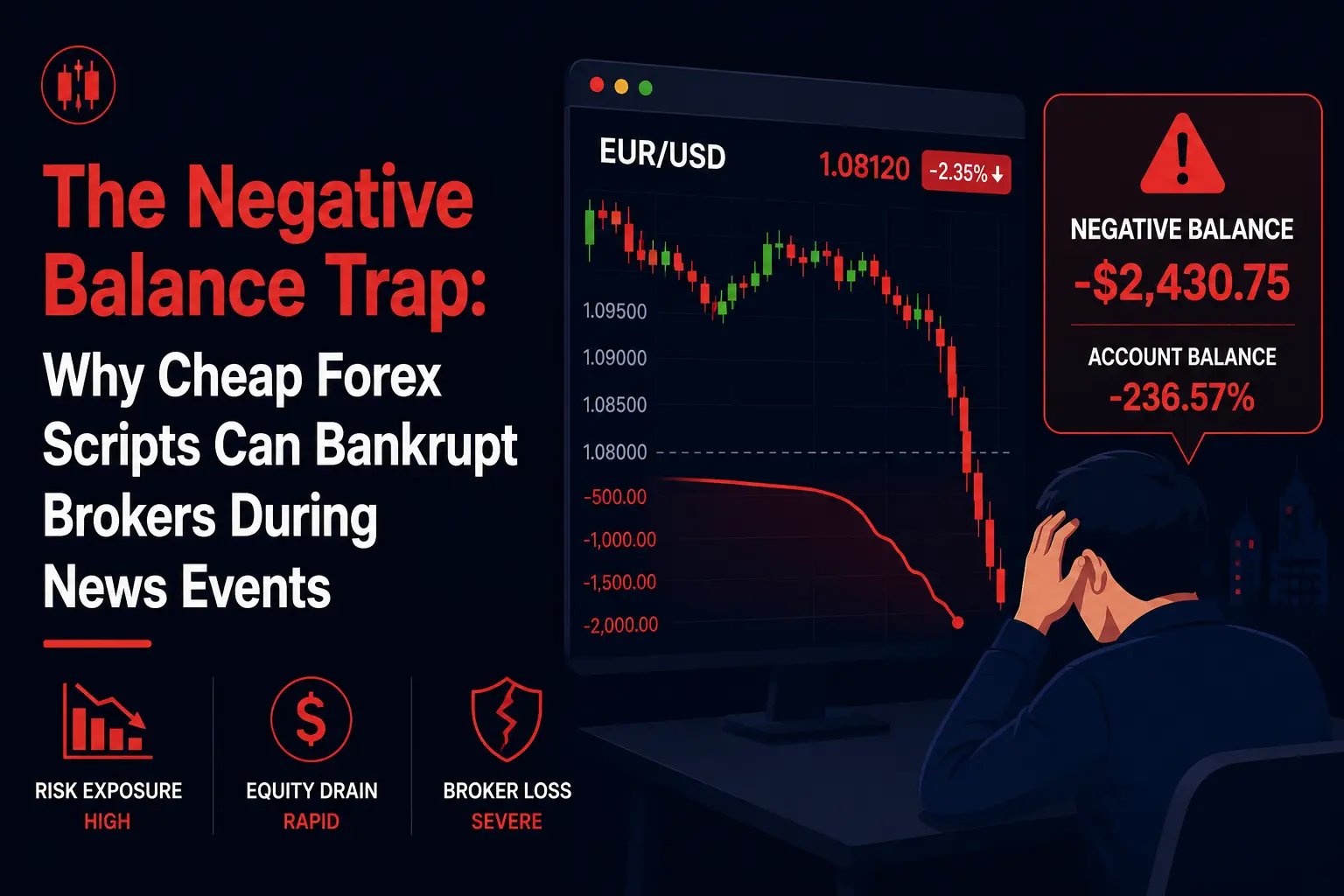
A forex platform can look stable for months and still contain a balance-sheet risk capable of surfacing in seconds.
The charts load. Orders open. Margin percentages update. The administrator can change leverage. Traders receive margin warnings. From the outside, the platform appears to have a complete risk-management system.
Then a major economic release hits.
Prices can move faster than the platform’s margin plugin can process account equity. In weak fintech platform development, thousands of leveraged positions may cross their stop-out thresholds almost simultaneously. Liquidation requests then enter a queue, available prices change, and some positions remain open long after the interface indicates they should have been closed.
The problem is not simply that a margin call arrived late. The problem is that the broker continued carrying market exposure while its software believed risk was already being handled.
For a B-book brokerage, that gap can become a direct financial liability.
Regulators in several markets require negative balance protection for covered retail products. Under the UK Financial Conduct Authority’s rules, a retail client’s liability for restricted speculative investments is limited to the money in the relevant trading account. That means a deficit cannot automatically be transferred to the protected client; depending on the operating model and jurisdiction, the firm may have to absorb it.
That is the negative balance trap.
The “Toxic Flow Leak” Hiding Inside Cheap Forex Scripts
“Toxic Flow Leak” is the term we use in this article for a specific architectural failure:
A broker’s real market exposure continues to grow or remains open after the platform’s risk layer believes a margin event has already been contained.
This is not the same as toxic flow in the conventional market-microstructure sense. Here, the leak is between the platform’s calculated risk state and its executed market state.
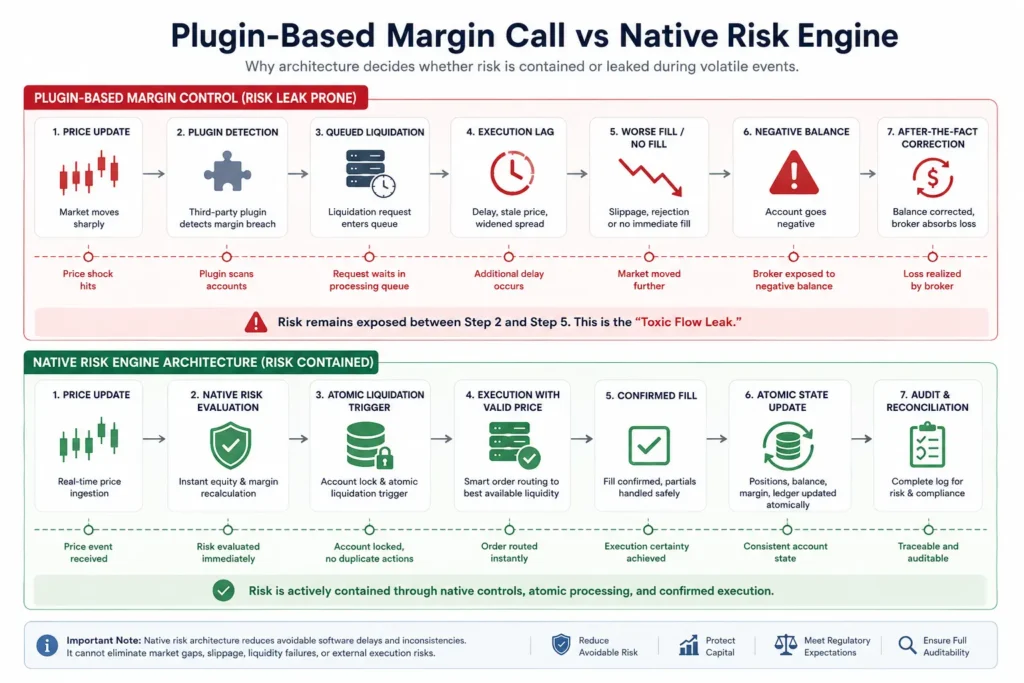
A simplified failure sequence looks like this:
- A price update sharply reduces an account’s equity.
- The account crosses its configured stop-out level.
- A separate plugin detects the breach.
- The plugin sends a close request.
- The request waits behind other events.
- The market moves again.
- The original price is no longer available.
- The trade closes at a materially worse price—or does not close immediately.
- The trader’s account enters a deficit.
- The broker’s negative-balance policy determines who ultimately absorbs that deficit.
The dangerous interval is between steps two and eight.
During normal conditions, it may last only milliseconds and never attract attention. During a concentrated volatility event, a weak architecture can turn that interval into a queue of unresolved exposure.
The Illusion of Automated Margin Calls on Legacy Plugins
Many platform buyers hear “automatic margin calls” and assume that risk is closed instantaneously.
That assumption combines several different events:
- Calculating account equity
- Comparing equity with used margin
- Detecting a threshold breach
- Selecting positions for liquidation
- Submitting close instructions
- Receiving an executable price
- Confirming the close
- Updating positions
- Updating realised profit and loss
- Updating account balance and available margin
- Recording the event in the ledger
A plugin may automate only part of this chain.
For example, some commercial broker tools are explicitly designed as separate plugins for detecting below-zero balances, adjusting leverage, withdrawing account credits, or initiating actions at margin-call and stop-out levels. These are legitimate tools, but their existence illustrates how fragmented the risk-control stack can become.
The brokerage operator must therefore ask a harder question:
Does the system merely notice that risk has exceeded a limit, or does it own the entire transition from threshold breach to confirmed and reconciled liquidation?
A warning message is not liquidation.
A database flag is not liquidation.
A queued close request is not liquidation.
Even a successful order submission is not liquidation until execution is confirmed and reflected consistently across the account, position, margin, and ledger states.
Read more: 0.30ms Execution: Deploying an Institutional Forex Clone in Equinix NY4
The NFP Volatility Scenario: What Happens When Risk Software Lags
Consider a hypothetical nonfarm payroll release.
A brokerage has thousands of retail accounts holding leveraged positions in USD-related currency pairs. Shortly after the release, prices move rapidly and spreads widen. Multiple accounts breach their stop-out thresholds within the same processing window.
At time zero: the price moves
The price-feed handler publishes a new quote. Based on that quote, hundreds of accounts are now below the required margin level.
After 100 milliseconds: the plugin begins scanning
A scheduled process or event consumer starts identifying accounts for liquidation.
Some accounts are processed immediately. Others remain in a queue.
After 500 milliseconds: available prices have changed
Close requests reach the execution layer, but the quote that triggered the stop-out is no longer tradable. The platform must use the next available price, subject to liquidity and execution rules.
After one second: the queue grows
New price events arrive while previous liquidations are still unresolved. The same account may receive multiple events. Without idempotent processing, duplicate close attempts or conflicting state transitions become possible.
After two seconds: the loss is no longer the calculated loss
Positions that should have been closed at the original threshold remain exposed to the continuing move.
The stop-out percentage displayed in the administrator dashboard may have been correct. The liquidation outcome was not.
This is why the phrase “the account will automatically close at 50% margin” can be misleading. A threshold defines when the platform should attempt action. It does not guarantee the price at which that action will be completed.
ESMA’s own guidance recognises this limitation. It describes negative balance protection as a backstop for cases in which the margin close-out mechanism fails to work effectively because of a sudden price movement.
Where the Negative Balance Actually Comes From
The liability does not arise from one isolated software bug. It often comes from several weaknesses combining under load.
Stale price evaluation
If margin is calculated from a delayed quote, the platform is making a risk decision about a market that no longer exists.
A risk engine should track price freshness, quote source, timestamp, and sequence. If the price becomes stale, the platform needs a defined response rather than silently continuing with unreliable equity values.
Serial account scanning
A scheduled plugin that scans accounts one after another may work during ordinary trading. It becomes dangerous when thousands of accounts cross thresholds together.
Risk evaluation should be event-driven and designed for parallel load, while still preventing conflicting actions on the same account.
Liquidation queue congestion
A stop-out engine can detect breaches faster than the order system or liquidity connection can close them. When that happens, detection performance becomes irrelevant. The real bottleneck is downstream execution capacity.
Non-atomic state changes
Suppose the position is marked closed, but the balance update fails. Or margin is released before realised loss is posted. Or two workers attempt to liquidate the same position.
Atomic database transactions help ensure that related state changes either complete together or fail together. In financial systems, this property is important because partial updates can create incorrect balances and mismatched positions.
Liquidity rejection or slippage
The platform cannot manufacture liquidity. During sharp moves, a requested close price may be unavailable, spreads may widen, and an execution venue may reject or reprice the order.
A sound risk architecture must therefore manage failure paths, not assume every close request succeeds on the first attempt.
Excessive leverage before the event
Liquidation is the last line of defence. If the brokerage allows excessive exposure into a known high-risk window, even a fast stop-out engine may have little room to act.
Specialist broker tools support scheduled margin increases and dynamic leverage changes for high-volatility periods because pre-trade exposure control can be more effective than relying solely on emergency liquidation.
Why Negative-Balance Correction Is Not the Same as Prevention
A negative-balance correction tool can detect a below-zero account and reset or compensate the balance afterward.
That may be necessary for customer protection or regulatory handling. It does not erase the broker’s economic loss.
Assume a protected retail account contains $1,000. After a severe price gap, the position closes with a $1,350 loss. The account is now negative by $350.
Resetting the displayed account balance to zero does not recover the missing $350. It determines how the loss is represented and allocated after the event.
This distinction matters because some operators evaluate risk tooling by asking:
“Does the platform support negative balance protection?”
The better questions are:
- How does it reduce the probability and size of deficits?
- When is margin evaluated?
- What happens when a quote is stale?
- How are simultaneous stop-outs prioritised?
- What happens when the liquidity provider rejects a close?
- Can two workers liquidate the same account?
- How are partial fills handled?
- Is the ledger updated atomically?
- How is residual exposure reconciled?
- Can the operator trace every risk decision afterward?
Negative balance protection is a necessary policy control in certain jurisdictions. It should not be mistaken for a substitute for strong exposure management. ESMA and FCA measures combine negative balance protection with leverage restrictions and account-level margin close-out requirements, reflecting that these controls serve different purposes.
Hardcoding Database-Level Liquidations: The Miracuves Protocol
The Miracuves approach is to avoid treating margin liquidation as an optional administrative add-on.
The control path should be embedded into the trading platform’s core architecture and aligned with the broker’s execution model, jurisdiction, liquidity setup, leverage policy, and negative-balance obligations.
“Hardcoded” does not mean inflexible. It means the platform’s central risk invariants cannot be bypassed simply because an external plugin is delayed, unavailable, or processing an outdated state.
1. Pre-trade margin validation
Before accepting a new order, the system should calculate:
- Required margin
- Existing used margin
- Account equity
- Available free margin
- Instrument-specific leverage
- Concentration exposure
- Current price freshness
- Any temporary event-risk rules
This prevents the platform from accepting exposure it already knows the account cannot support.
2. Continuous event-driven equity evaluation
Every material price update should trigger risk re-evaluation for affected accounts.
The architecture should avoid repeatedly scanning every account when it can instead identify which positions and portfolios are affected by the changed instrument.
3. Account-level concurrency control
Only one authorised liquidation workflow should control a specific account state at a time.
This can be implemented through appropriate locking, version checks, compare-and-update rules, or other concurrency controls. The purpose is to prevent two workers from using the same pre-liquidation balance and producing contradictory results.
4. Atomic state transitions
Related financial changes should be committed as a controlled transaction.
Depending on the architecture, this can include:
- Position status
- Filled quantity
- Execution price
- Realised profit or loss
- Account balance
- Used margin
- Available margin
- Liquidation status
- Ledger entry
- Audit metadata
Atomicity protects system consistency. It does not guarantee a market price, eliminate slippage, or ensure that an external execution venue will accept the order.
5. Idempotent liquidation commands
If the same event is delivered twice, the system should not liquidate the same position twice.
Every liquidation instruction needs an identity and a clear state machine so retries are safe.
6. Price-freshness controls
The risk engine should know whether it is evaluating exposure against a current, delayed, or invalid quote.
Defined responses may include:
- Rejecting new exposure
- Increasing margin requirements
- Disabling affected instruments
- Moving accounts into a controlled liquidation state
- Escalating to the risk desk
- Switching to a verified backup feed
7. Execution acknowledgement before final closure
A platform should not treat “request sent” as “position closed.”
The final state must reflect the actual fill, including partial execution, slippage, rejection, or remaining quantity.
8. Residual-exposure reconciliation
After liquidation, the platform should recalculate the account from confirmed executions.
Any remaining position, balance discrepancy, or unmatched ledger entry should enter a controlled exception process rather than being hidden behind a successful plugin status.
9. Event-time risk policies
Known high-impact events may justify temporary changes to:
- Maximum leverage
- Margin requirements
- Order size
- Symbol availability
- Spread configuration
- Exposure limits
- B-book retention thresholds
- A-book routing rules
This reduces the amount of risk that emergency liquidation must handle.
10. Complete auditability
The brokerage should be able to reconstruct:
- Which price triggered the event
- When the price arrived
- What equity was calculated
- Which rule was applied
- When liquidation began
- What execution response was received
- What price and quantity were filled
- How the ledger changed
- Whether manual intervention occurred
For a regulated or investor-backed brokerage, this evidence is operational infrastructure—not a reporting convenience.
Plugin-Dependent Margin Control vs Native Risk Architecture
| Risk Layer | Plugin-Dependent Model | Native Risk Architecture |
|---|---|---|
| Margin evaluation | May depend on scheduled scans or delayed event processing | Triggered within the core price and account-risk workflow |
| Liquidation authority | Split across plugin, platform, and execution systems | Controlled by a defined account-level state machine |
| Database consistency | Multiple updates may occur independently | Related financial updates are committed atomically where appropriate |
| Duplicate events | May produce repeated or conflicting close attempts | Idempotent commands make retries safer |
| Stale prices | Risk logic may continue without explicit freshness rules | Price age and sequence form part of the risk decision |
| Failed execution | A submitted request may be treated as completed action | Closure depends on confirmed fills and reconciliation |
| Operator visibility | Plugin status and basic logs | End-to-end timeline of quote, decision, execution, and ledger impact |
| Residual market risk | Can remain hidden between system boundaries | Explicitly measured, reconciled, and escalated |
Read more: 50ms Routing: Benchmarking Liquidity Aggregation in White-Label FX Engines
Atomic Liquidation Is Powerful—But It Is Not a Guarantee Against Loss
This distinction is essential for credible fintech communication.
Atomic processing can help prevent:
- A position being marked closed without its balance being updated
- Margin being released before the loss is posted
- Duplicate liquidation of the same position
- Partial ledger writes
- Conflicting account calculations
- Inconsistent administrative reporting
It cannot independently prevent:
- A market opening beyond the stop-out price
- A liquidity provider rejecting the request
- Severe slippage
- A feed becoming unavailable
- A network partition
- An external venue outage
- A flawed leverage policy
- Losses exceeding account funds before executable liquidity appears
The objective is therefore not to promise zero risk.
The objective is to remove avoidable software delay, preserve financial consistency, limit exposure before and during volatility, and give the risk desk accurate control over whatever residual risk remains.
Founder Decision Signals
Liquidation Ownership
Ask whether the core platform owns liquidation or merely sends events to an external plugin. Every additional handoff creates another failure and latency boundary.
Execution Reality
Verify that the system distinguishes between a submitted close request, a partial fill, a rejection, and a confirmed closure.
Ledger Integrity
Require a clear explanation of how positions, realised P&L, balance, margin, and audit records remain consistent during concurrent events.
Volatility Readiness
Demand load tests based on simultaneous stop-outs, stale quotes, duplicate messages, partial fills, and liquidity failures—not only normal order throughput.
Seven Questions to Ask Before Buying a Forex Platform
1. Where is the authoritative account balance stored?
There should be a clear source of truth. Multiple loosely synchronised balances create ambiguity exactly when the platform is under maximum stress.
2. Is margin evaluated on every relevant price event?
A periodic scan may be too slow for leveraged products during fast markets.
3. What happens when hundreds of accounts stop out together?
Ask for measured load-test results and failure behaviour, not a verbal assurance that the platform is “scalable.”
4. How does the platform handle partial fills?
Liquidation may require several executions. The account should remain in a controlled risk state until residual exposure is resolved.
5. What happens when the primary price feed becomes stale?
A platform without explicit price-freshness controls can continue accepting or evaluating orders against invalid market information.
6. Can the risk team alter leverage and exposure before scheduled events?
Margin policy should include preventive controls, not only post-breach liquidation.
7. Can every liquidation be reconstructed afterward?
The broker needs a complete audit trail covering price, calculation, decision, routing, fill, balance, and manual action.
Mistakes Brokerage Operators Should Avoid
Mistakes Founders and Risk Managers Should Avoid
Buying the interface instead of auditing the risk path
A polished terminal says little about how the backend behaves when thousands of leveraged positions cross their limits together.
Assuming “automatic stop-out” means instant execution
Automatic detection can still feed a delayed queue. Ask for the full latency path from price ingestion to confirmed fill.
Using negative-balance correction as the primary defence
Resetting a client account after a deficit does not recover the broker’s economic loss.
Ignoring price-feed age
Fast code acting on stale prices can make wrong decisions more efficiently. Price validity must be part of risk logic.
Testing average load instead of correlated stress
Brokerage failures emerge when many accounts, symbols, and liquidation requests become correlated during one market event.
Accepting absolute safety claims
No responsible platform provider should guarantee that software can eliminate all negative-balance exposure. Architecture can reduce avoidable risk, while leverage policy, liquidity, regulation, capital, and operations remain essential.
Why This Matters More for B-Book Operators
In an A-book flow, customer orders are generally routed or hedged externally according to the broker’s model. In a B-book model, the broker may internalise some or all client exposure.
That makes the risk engine part of the brokerage’s economic control system.
The operator must understand:
- Net exposure by instrument
- Concentrated directional risk
- Account-level leverage
- Correlated client positions
- Event-time exposure
- Hedge thresholds
- Liquidity-provider capacity
- Maximum tolerable residual loss
- Negative-balance obligations
- Capital available for stress conditions
A profitable dealing model under ordinary conditions can become unstable if the platform cannot liquidate or hedge exposure when volatility and order volume rise together.
The cheapest script is therefore not necessarily the lowest-cost platform.
A low purchase price can hide a much larger contingent liability.
Miracuves’ Perspective: Build the Risk Path Before the Visual Layer
A serious forex or leveraged-trading product should not begin with charts, themes, and account-registration screens.
It should begin with invariants:
- A trade cannot be accepted without valid margin.
- An account cannot be liquidated twice.
- A stale price cannot silently drive a new risk decision.
- A position cannot be considered closed without execution evidence.
- Financial state cannot be partially committed.
- Every exception must be visible to the risk desk.
- Every balance change must be traceable.
- Regulatory and negative-balance rules must be configured for the target jurisdiction and operating model.
Miracuves helps fintech founders design trading products around backend control, source-code ownership, scalable architecture, administrator visibility, and compliance-supporting workflows. The exact risk controls, licensing requirements, execution model, and negative-balance obligations must be validated for the brokerage’s jurisdiction and legal structure.
Readers exploring the wider product category can review Miracuves’ finance and investment solutions and its analysis of trading-engine security and liquidity. For broader source-code-owned platform engineering, see Miracuves’ software development services
Read more: Code Is Cheap; Trust Is Expensive: Build a Bank, Not Just an App
Final Thoughts: Your Stop-Out Percentage Is Not Your Real Protection
Brokerage operators often focus on the number configured in the administration panel: 50%, 30%, or another stop-out threshold.
That number is only a policy trigger.
Real protection depends on what happens next:
- How quickly the breach is detected
- Whether the price is valid
- Whether liquidation has exclusive control of the account
- Whether execution capacity is available
- Whether the order is filled
- Whether remaining exposure is detected
- Whether the ledger is updated consistently
- Whether failures are escalated
- Whether the broker has appropriate leverage, capital, hedging, and negative-balance policies
A cheap forex script may perform well during demonstrations and quiet markets. Its true cost appears when volatility compresses minutes of ordinary processing into seconds.
For brokerage founders and risk managers, the decisive procurement question is not:
“Does the platform have automated margin calls?”
It is:
“Can the platform prove that every threshold breach becomes a controlled, confirmed, consistent, and auditable risk-reduction event—even when the market is moving against us?”
That is the standard a serious brokerage platform should be designed to meet.
Ready to strengthen your brokerage risk architecture? Contact us to discuss a secure, source-code-owned fintech platform built around native margin controls and reliable liquidation workflows.
FAQs
Can automated margin calls prevent every negative forex balance?
No. Automated margin controls can reduce exposure by closing positions when equity falls below configured thresholds, but sudden price gaps, slippage, stale feeds, rejected orders, and unavailable liquidity can still produce losses beyond the account balance. Negative balance protection may serve as a backstop where required.
What is the difference between a margin call and a stop-out?
A margin call indicates that account equity has fallen near or below a required margin level. A stop-out is the point at which the platform begins closing positions according to the broker’s rules. Exact definitions and thresholds vary by platform, product, and jurisdiction.
Why can a forex liquidation plugin become dangerous?
A plugin is risky when it operates asynchronously, relies on periodic account scans, receives delayed prices, or lacks authority over the full execution and ledger workflow. The issue is not that all plugins are unsafe; it is that additional system boundaries can introduce latency and inconsistent state.
What does atomic liquidation mean?
Atomic liquidation means related financial updates are processed as one controlled transaction wherever appropriate. Position state, realised profit or loss, balance, margin, and ledger records should not be left partially updated. Atomicity improves consistency but does not guarantee execution at a particular market price.
Why are NFP announcements risky for forex brokers?
Major economic releases can produce rapid price changes, wider spreads, slippage, and a high concentration of simultaneous risk events. These conditions can stress price feeds, liquidation queues, execution connections, and account-processing systems.
Does negative balance protection transfer the loss to the broker?
Where applicable rules limit a retail client’s liability to the funds in the trading account, a deficit cannot simply be collected from that protected client. The firm must handle the financial effect according to its legal, capital, hedging, and operating arrangements. Requirements differ by jurisdiction.
What should a B-book broker test before launching?
The broker should test correlated stop-outs, sharp price gaps, stale feeds, duplicate events, partial fills, rejected orders, liquidity outages, database failures, account-lock contention, and reconciliation. Testing only average order volume does not reproduce event-driven brokerage risk.
Can Miracuves guarantee that a brokerage will never experience a negative balance?
No responsible development company should make that guarantee. Miracuves can design architecture intended to reduce avoidable software delays, preserve account and ledger consistency, strengthen exposure controls, and support auditable risk workflows. Final risk depends on market conditions, leverage policy, liquidity, integrations, regulation, capital, and brokerage operations.
Miracuves is an independent software development company. We are not affiliated with, connected to, sponsored by, or endorsed by any company or product named in this article.
Terms such as “X Clone” are used descriptively. It is how the software industry refers to building a platform with functionality comparable to a known service, and how clients search for it.
The entire design and codebase of our products is built by our own team. Our products contain no code, design, graphics, or content originating from any third-party website or applications.
All third-party names and marks referenced in this article are the property of their respective owners, referenced solely to identify the services discussed.