Key Takeaways
- Mobile-first trading software is designed around digital onboarding, real-time market access, app-based order execution, portfolio tracking, alerts, and self-service account management.
- Traditional brokerage systems often rely more heavily on legacy infrastructure, desktop workflows, manual operations, relationship-based support, and fragmented back-office processes.
- Fintech founders should compare scalability, user experience, integrations, operating efficiency, compliance workflows, customization, and long-term technology flexibility before choosing a brokerage model.
Platform Comparison Signals
- Mobile-first platforms prioritize fast KYC, live market data, watchlists, push notifications, instant order placement, digital payments, and portfolio visibility from smartphones.
- Traditional brokerage systems may depend on separate trading terminals, dealer-assisted orders, manual reconciliation, legacy databases, and less flexible integration layers.
- API connectivity, cloud infrastructure, automation, analytics, risk controls, security, and centralized admin tools give modern trading software greater flexibility for scaling digital brokerage operations.
Founder Insights
- Founders targeting digital-first investors should prioritize mobile usability, onboarding speed, transparent pricing, reliable execution, and self-service trading workflows.
- The right brokerage technology should support regulatory requirements, broker and market data integrations, modular feature expansion, operational automation, and future user growth.
- Miracuves develops customizable mobile-first trading platforms with KYC, real-time market data, order management, portfolio tools, payments, APIs, risk controls, analytics, security, and admin dashboards.
Choosing brokerage technology is not only a technical decision. For fintech founders, it affects how quickly users can onboard, how smoothly they can place orders, how reliably the app handles market activity, and how much control the business has over future product changes.
Traditional brokerage software was often built around back-office workflows, desktop access, compliance reporting, and operational stability. Those things still matter. But today’s retail investors expect something different. They want mobile access, simple dashboards, faster onboarding, real-time alerts, clean portfolio views, and a trading experience that feels easy to use without hiding the seriousness of financial decisions.
That is why many founders now compare mobile-first trading software vs traditional brokerage systems before committing to a product roadmap.
The stronger choice is not always the system with the longest feature list. It is the platform model that gives your business the right balance of user experience, API flexibility, operational control, security, scalability, and long-term product ownership.
What Is Mobile-First Trading Software?
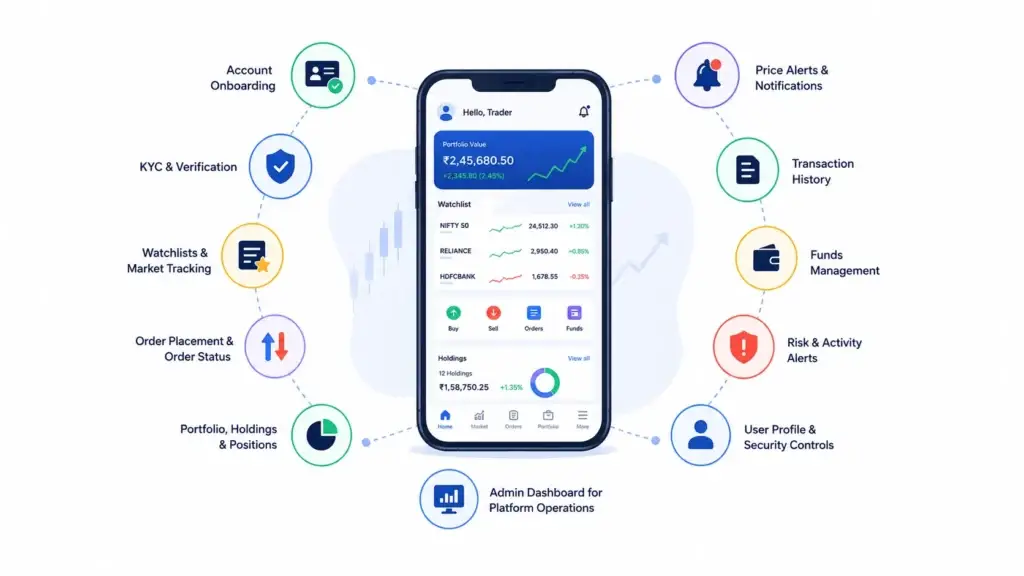
Mobile-first trading software is a brokerage or investment platform designed primarily around smartphone users. The mobile experience is not treated as a smaller version of a desktop terminal. It becomes the main product layer.
A mobile-first trading platform usually includes:
- Simple account onboarding
- KYC and user verification workflows
- Watchlists and market tracking
- Order placement and order status updates
- Portfolio, holdings, and positions
- Price alerts and push notifications
- Transaction history
- Funds management
- Risk and activity alerts
- User profile and security controls
- Admin dashboard for platform operations
For founders, the mobile-first approach matters because most new investors do not want a complex trading terminal on day one. They want clarity. They want to understand their portfolio, track opportunities, act quickly, and feel confident that the platform is secure.
Founders who want to review the user, admin, trading, security, and operational modules in more detail can explore this trading platform feature breakdown before finalizing their product scope.
A mobile-first trading product does not mean reducing functionality. It means designing the journey so users can take important financial actions without feeling overwhelmed.
What Traditional Brokerage Systems Usually Prioritize
Traditional brokerage systems are often built around institutional workflows, broker operations, reporting, desktop terminals, back-office processes, and regulatory documentation.
These systems may include strong operational features such as:
- Client account management
- Order management
- Trade reporting
- Risk controls
- Back-office reconciliation
- Compliance documentation
- Desktop or web-based trading access
- Broker and admin workflows
This can work well for established brokerage firms with existing processes and conservative technology roadmaps. However, it can become restrictive when the business wants to launch a modern retail-facing app, experiment with product design, introduce new investment journeys, or integrate multiple fintech services around the core trading experience.
The gap usually appears when founders ask questions such as:
- Can we redesign onboarding quickly?
- Can we add alerts, education, or portfolio insights?
- Can we connect new APIs without waiting months?
- Can the app handle traffic spikes during market volatility?
- Can our team control user, transaction, and support workflows from one admin dashboard?
If the answer depends entirely on a legacy vendor’s roadmap, the founder has less product control.
Mobile-First Trading Software vs Traditional Brokerage Systems: Quick Comparison
| Comparison Area | Mobile-First Trading Software | Traditional Brokerage Systems | Founder Impact |
|---|---|---|---|
| User Experience | Built around app-first onboarding, dashboards, alerts, and quick actions | Often desktop-first or operations-first | Better mobile UX can improve activation and retention |
| Product Flexibility | Easier to customize when built with modular architecture | Changes may depend on vendor roadmap or legacy workflows | Founders can test new journeys faster |
| API Integrations | Designed for broker APIs, market data, payments, analytics, and notifications | API access may be limited or more complex | Strong APIs reduce future integration friction |
| Scalability | Can be designed for traffic spikes, real-time updates, and cloud deployment | Stable for standard operations but may be harder to modernize | Better scaling supports market-open and volatility events |
| Admin Control | Platform operators can manage users, verification, transactions, risk flags, and reports | Back-office control may be strong but less product-focused | Better admin control improves operational speed |
| Monetization | Supports subscriptions, premium tools, research, advisory flows, and partner products | Monetization may be limited to brokerage-led models | More product layers create more revenue options |
| Ownership | Source-code-owned or customizable models offer more roadmap control | Vendor-controlled licensing can limit flexibility | Ownership affects long-term independence |
Why Mobile Experience Has Become a Brokerage Advantage
Trading software used to be judged mainly by execution access, reports, and operational reliability. Those still matter, but user expectations have changed.
A founder building a retail trading or investment platform now has to think about the entire journey:
- The user downloads the app.
- The user completes onboarding.
- The user verifies identity.
- The user explores markets.
- The user creates a watchlist.
- The user reviews risk.
- The user places or tracks an order.
- The user receives alerts.
- The user returns to check holdings or performance.
Every step affects trust. If the interface feels confusing, slow, or outdated, users may not stay long enough to discover the deeper value of the platform.
A mobile-first trading platform helps founders design around the investor’s daily behavior. The app can use push notifications, biometric login, simplified portfolio views, personalized alerts, educational prompts, and cleaner navigation to make the product more useful.
Founders studying modern investor behavior can also review this guide on mobile-first investing app workflows to understand how simplified onboarding, market access, portfolio visibility, and user-friendly investing experiences work together.
The business benefit is simple: better mobile experience can reduce friction between interest and action.
Where Traditional Brokerage Software Still Makes Sense
Traditional brokerage software should not be dismissed completely. It can still be a suitable choice for firms that already have established brokerage operations, internal teams trained on legacy systems, and workflows that prioritize stability over experimentation.
It may be useful when the business needs:
- Standard broker operations
- Conservative change management
- Existing back-office compatibility
- Desktop-heavy workflows
- Familiar reporting processes
- Long-term vendor support for legacy operations
However, this model can become less attractive for founders who want to build a user-facing fintech product around speed, design, integrations, and product differentiation.
In simple terms, traditional brokerage software may help a firm operate. Mobile-first trading software helps a founder compete on product experience.
API Flexibility: The Hidden Layer Behind Trading Product Growth
APIs decide how well a trading platform communicates with the rest of the fintech ecosystem.
A modern trading product may need APIs for:
- Broker connectivity
- Market data
- KYC verification
- Payment gateways
- Order placement
- Portfolio data
- Notifications
- Analytics
- Admin reporting
- Risk monitoring
- Customer support tools
When API architecture is weak, every new feature becomes harder. A simple product update may require vendor approvals, custom patches, delayed testing, or expensive development cycles.
When API architecture is strong, founders can add integrations more confidently. They can connect data sources, payment providers, verification tools, reporting systems, and product modules without rebuilding the entire platform.
For a deeper product planning view, founders can also read this guide on modern stock trading app architecture, which explains how features, integrations, backend workflows, and launch planning come together.
This is one reason mobile-first trading software is not just about the frontend. The mobile app may be what users see, but APIs are what make the product adaptable.
Scalability: Trading Apps Need to Handle Spikes, Not Just Daily Users
A trading platform does not scale like a normal content or ecommerce app.
Traffic can spike during:
- Market open
- Market close
- Major price movement
- IPO activity
- Options expiry
- Breaking financial news
- High-volume trading sessions
- Portfolio rebalancing events
During these moments, users expect the app to load, update, notify, and respond quickly. Delays damage trust because trading is time-sensitive.
A scalable mobile-first trading platform should be designed with backend performance in mind. This may include optimized databases, caching, WebSocket handling, queue-based processing, API rate controls, monitoring, load testing, and cloud deployment planning.
Since scalability, broker integrations, real-time market data, and compliance workflows can all affect build complexity, founders should review the development cost factors for trading platforms before comparing vendors only by price.
Traditional brokerage systems may be reliable for normal operations, but founders should check whether they can support real-time mobile behavior at scale. The question is not only “Can the system process trades?” The better question is “Can the product experience remain stable when users are most active?”
Admin Control: The Founder’s Real Operating Layer
Users interact with the mobile app. The business runs through the admin dashboard.
A strong admin layer helps the platform operator manage:
- User profiles
- KYC status
- Account activity
- Deposits and withdrawals
- Transaction history
- Order activity
- Risk flags
- Support tickets
- Notifications
- App content
- Reports and analytics
- Role-based team access
This matters because fintech operations need speed and traceability. When something goes wrong, the business should not depend on developers for every small change or report.
Traditional brokerage systems may include back-office tools, but they are not always designed for fast product experimentation. Mobile-first trading software should give the founder a more practical control layer for both operations and growth.
For example, a platform team may want to test a new onboarding message, review verification bottlenecks, monitor user segments, or adjust notification logic. These actions should be manageable from an admin environment, not buried inside vendor-controlled workflows.
Security and Compliance Workflows Should Be Built Into the Foundation
Trading platforms deal with sensitive user data, financial activity, and regulated workflows. Security cannot be treated as a feature added near launch.
Important security and compliance-ready layers may include:
- Encrypted data transfer
- Encrypted data storage
- Secure API integration
- Role-based access control
- Audit logs
- KYC workflow support
- Transaction monitoring
- Activity logs
- User verification
- Admin permission controls
- Risk flagging
- Secure payment gateway integration
- Compliance reporting support
For Indian securities-market contexts, founders should remember that trading access, broker relationships, KYC, investor disclosures, and platform permissions depend on applicable regulatory and exchange requirements. SEBI’s investor resources emphasize dealing with registered intermediaries, KYC responsibilities, investor awareness, grievance mechanisms, and secure handling of investor information. NSE also describes permissions and exchange requirements around internet-based trading and wireless/mobile trading facilities for registered members.
This blog is not legal advice. Final compliance depends on jurisdiction, licenses, broker partnerships, exchange requirements, legal review, integrations, and the operating model.
Product Flexibility: Why Founders Should Avoid Rigid Architecture
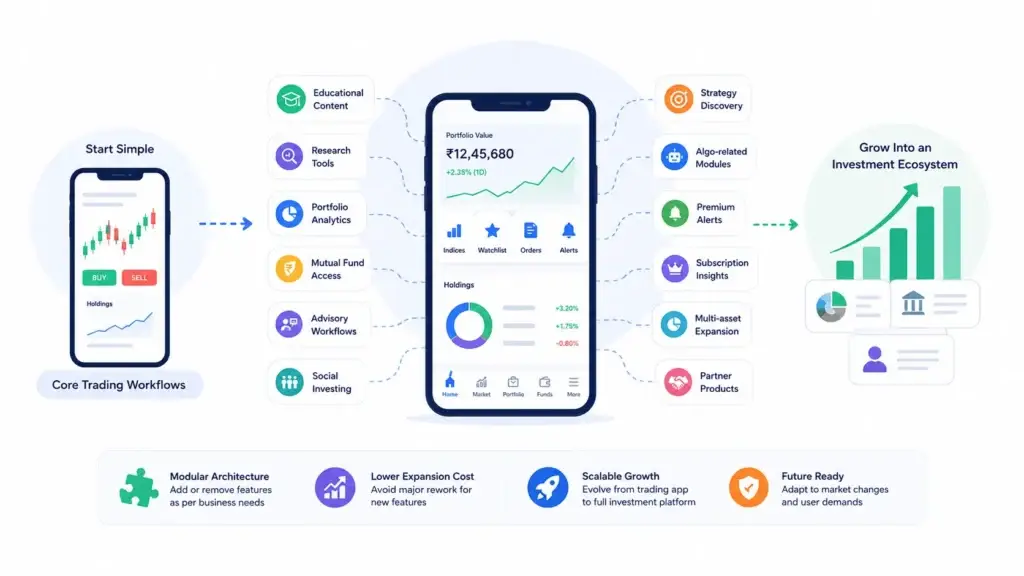
The first version of a trading platform rarely stays the same.
A founder may start with core trading workflows and later add:
- Educational content
- Research tools
- Portfolio analytics
- Mutual fund access
- Advisory workflows
- Social investing features
- Copy-free strategy discovery
- Algo-related modules
- Premium alerts
- Subscription-based insights
- Multi-asset expansion
- Partner financial products
This is where product flexibility becomes valuable.
If monetization is part of the roadmap, it helps to study the trading platform business model before deciding which revenue modules to prioritize after launch.
If the platform is rigid, every expansion becomes expensive. If the foundation is modular, the business can add features based on user behavior and market demand.
Mobile-first trading software gives founders a better chance to evolve from a basic trading app into a broader investment ecosystem. Traditional brokerage systems may support some expansion, but flexibility usually depends on the vendor’s technical model, licensing terms, and API openness.
Founder Decision Signals
Speed
Choose a mobile-first foundation when launch speed, app experience, and faster product validation matter more than maintaining legacy workflows.
Control
Prioritize source-code ownership, admin access, and customization rights when your roadmap depends on frequent product updates.
Scalability
Check whether the platform can support real-time data, push alerts, traffic spikes, and high-activity trading sessions.
Compliance Readiness
Review KYC workflows, audit logs, access permissions, transaction monitoring, and broker integration requirements before launch.
Mistakes Founders Should Avoid When Choosing Brokerage Technology
Choosing software only by feature count
A long feature list does not guarantee a stronger product. Founders should check how the features work together across user app, APIs, admin dashboard, broker integrations, and reporting.
Ignoring the mobile onboarding journey
Onboarding is where many fintech products lose users. If account setup, verification, and first-use experience feel confusing, users may leave before exploring the product.
Treating APIs as a developer-only issue
APIs affect product flexibility, monetization, user experience, and future integrations. Weak API planning can slow every future roadmap decision.
Underestimating admin dashboard depth
A trading platform needs operational control. Without a practical admin layer, support, reporting, risk monitoring, and user management become harder as the platform grows.
Assuming compliance is automatic
No trading platform should be marketed as automatically compliant everywhere. Compliance depends on the target market, licenses, broker partnerships, operational processes, and legal review.
When Should Founders Choose Mobile-First Trading Software?
Mobile-first trading software is usually the stronger choice when the founder wants to build a branded fintech product with modern user experience and room to grow.
It fits businesses that want:
- Faster go-to-market
- Better retail investor experience
- Branded mobile apps
- API-based integrations
- Admin dashboard control
- Flexible product roadmap
- Scalable backend workflows
- Support for future investment modules
- A source-code-owned foundation
- A more modern alternative to legacy brokerage systems
For founders comparing build options, Miracuves offers a ready-made trading app foundation that can support branded mobile, web, admin, broker, and trading workflows. The money page already covers the detailed product demos, trading flows, broker integrations, pricing, and deployment information, so this blog should simply guide readers toward that page when they are ready to evaluate the solution.
When Should Founders Choose Traditional Brokerage Software?
Traditional brokerage software may be suitable when the business already operates in a legacy environment and does not need aggressive mobile-first product experimentation.
It may fit teams that:
- Already have established broker operations
- Need conservative workflow continuity
- Prefer vendor-managed systems
- Have limited need for mobile-first redesign
- Do not plan frequent product changes
- Rely heavily on existing desktop or back-office processes
However, founders should be careful not to confuse stability with flexibility. A stable system can still become a growth bottleneck if it cannot support modern user journeys, API integrations, product experiments, and scalable mobile usage.
How Miracuves Helps Founders Launch Mobile-First Trading Platforms
Miracuves helps fintech founders build ready-made and white-label app solutions with branded design, source-code ownership, admin control, and scalable backend workflows.
Founders planning a broader fintech roadmap can also explore Miracuves’ finance and investment platform solutions to compare opportunities across trading, banking, remittance, wallet, and investment products.
For a trading platform, this means the product conversation should not stop at screens. The important questions are deeper:
- How will users complete onboarding?
- How will broker integrations work?
- How will market data flow into the app?
- How will users track holdings and positions?
- How will the admin team monitor activity?
- How will security, access control, and audit trails be handled?
- How will the platform expand after launch?
A ready-made foundation from Miracuves can help founders move faster because the core product structure is already in place. The final scope still depends on selected modules, integrations, compliance requirements, branding, broker partnerships, and customization needs.
Final Thoughts: Choose the Platform Model That Fits Your Growth Strategy
The comparison between mobile-first trading software and traditional brokerage systems is really a comparison between product flexibility and operational rigidity.
Traditional systems may work well for established firms with familiar workflows. But fintech founders building for modern retail users need more than basic brokerage functionality. They need fast onboarding, intuitive mobile screens, strong APIs, scalable infrastructure, admin control, and compliance-ready workflows.
The stronger decision is not always the most complex build. It is the platform foundation that helps the business launch, learn, adapt, and grow without losing control over the product roadmap. This is where Miracuves helps founders move faster with ready-made, white-label trading platform solutions that can be customized around branding, admin operations, integrations, and long-term product goals.
For founders, mobile-first trading software is not just a better interface. It is a more practical way to build a fintech product around how users actually invest, track, and make decisions today.
FAQs
What is mobile-first trading software?
Mobile-first trading software is a brokerage or investment platform designed primarily for smartphone users. It focuses on app-based onboarding, watchlists, order tracking, portfolio views, alerts, secure access, and simple navigation.
How is mobile-first trading software different from traditional brokerage software?
Mobile-first trading software is built around user experience, app speed, API flexibility, and product growth. Traditional brokerage software often focuses more on back-office operations, desktop workflows, reporting, and established broker processes.
Is traditional brokerage software still useful?
Yes. Traditional brokerage software can be useful for firms with established operations, conservative workflows, and existing back-office systems. It may not be ideal for founders who need fast mobile-first product experimentation.
Why do APIs matter in trading platform development?
APIs connect the trading platform with brokers, market data, payments, KYC tools, notifications, analytics, and admin reporting. Strong API architecture makes the platform easier to customize and expand.
What features should a mobile-first trading platform include?
A mobile-first trading platform should include onboarding, KYC workflow support, watchlists, order placement, portfolio tracking, holdings, alerts, transaction history, funds management, security controls, and an admin dashboard.
Can mobile-first trading software support compliance workflows?
Yes, it can be designed with KYC workflow support, audit logs, role-based access control, transaction monitoring, secure API integrations, and admin reporting. Final compliance depends on jurisdiction, legal review, broker partnerships, integrations, and operating model.
What should fintech founders compare before choosing brokerage software?
Founders should compare user experience, API access, admin control, scalability, broker integration options, security workflows, customization rights, source-code ownership, and long-term product flexibility.
Does Miracuves build mobile-first trading platforms?
Yes. Miracuves helps founders build branded fintech and trading platform solutions with mobile-first workflows, admin control, source-code ownership, broker integration planning, and scalable backend architecture.
Miracuves is an independent software development company. We are not affiliated with, connected to, sponsored by, or endorsed by any company or product named in this article.
Terms such as “X Clone” are used descriptively. It is how the software industry refers to building a platform with functionality comparable to a known service, and how clients search for it.
The entire design and codebase of our products is built by our own team. Our products contain no code, design, graphics, or content originating from any third-party website or applications.
All third-party names and marks referenced in this article are the property of their respective owners, referenced solely to identify the services discussed.