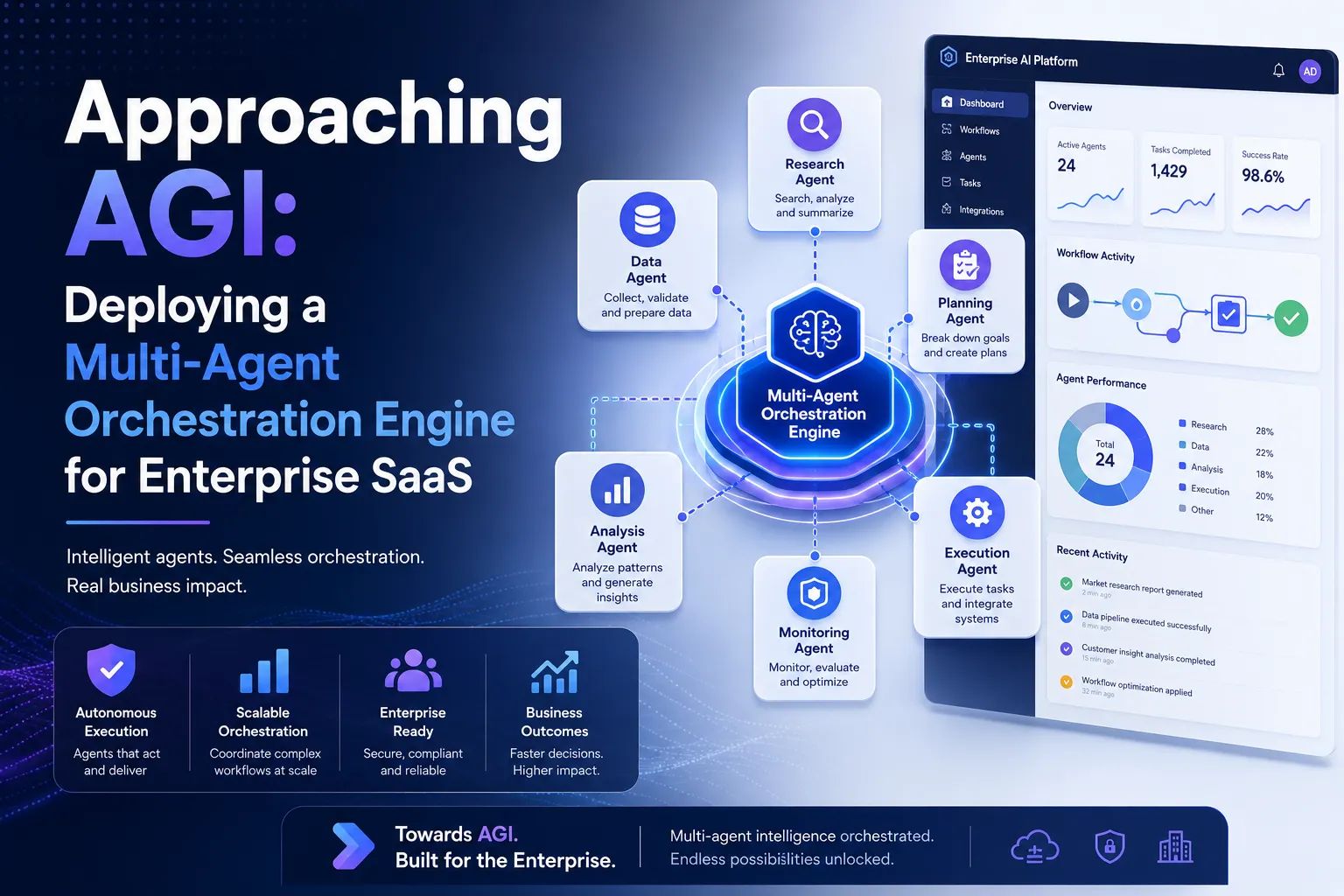
Key Takeaways
- Multi-agent orchestration improves complex AI task execution.
- Specialized agents deliver better accuracy than one general model.
- Role-based workflows reduce hallucinations and errors.
- Human review improves enterprise AI reliability.
- Audit logs strengthen governance and compliance.
Orchestration Signals
- Assign dedicated Researcher, Critic, Coder, and Reviewer agents.
- Route tasks through structured validation workflows.
- Maintain shared context across collaborating agents.
- Track every decision with logs and monitoring.
- Apply approval gates before executing critical actions.
Real Insights
- Single-model AI struggles with complex enterprise workflows.
- Multi-agent systems improve scalability and output quality.
- Governance is essential for enterprise AI deployments.
- Workflow orchestration matters more than model size alone.
- Miracuves builds enterprise AI platforms with scalable multi-agent orchestration engines.
Enterprise AI buyers are no longer impressed by a chatbot that answers questions. Founders, CTOs, and investors now want to know whether an AI product can plan, verify, execute, critique, and improve its own output inside a controlled business workflow.
That shift changes the architecture conversation. The real question is not whether a single large language model can sound intelligent. The question is whether a multi-agent orchestration engine can coordinate specialized AI agents, manage task state, enforce review loops, and produce more reliable outputs for open-ended enterprise SaaS tasks.
This case study explains how Miracuves approached that challenge by deploying a white-label backend that orchestrates four specialized LLM agents: Researcher, Critic, Coder, and Reviewer. The goal was not to claim AGI. The goal was more practical: build a controlled reasoning loop that mimics some AGI-style problem-solving patterns while reducing the operational risks of relying on one hallucination-prone model.
Why the Single “God Model” Approach Breaks in Enterprise SaaS
Many early AI SaaS products were built around a simple idea: take one powerful model, wrap it in a user interface, add prompt templates, and sell it as a productivity assistant.
That works for simple content generation. It starts to break when enterprise users ask the system to perform open-ended tasks such as:
- Researching a technical topic
- Comparing conflicting information
- Writing production-ready code
- Reviewing security implications
- Preparing a business recommendation
- Updating workflow systems
- Explaining why a decision was made
A single model can produce a confident answer, but confidence is not the same as correctness. In enterprise SaaS, the cost of a wrong answer can include wasted engineering time, compliance exposure, customer churn, or poor strategic decisions.
The “God Model” assumption creates three architectural risks.
First, the same model is expected to research, reason, execute, and verify. That creates role confusion. Second, there is often no structured opposition layer. The model may not challenge its own output deeply enough. Third, the audit trail is weak. Enterprise teams need to know which data was used, which decision path was followed, and which review checks were completed.
A multi-agent orchestration engine solves this differently. Instead of asking one model to do everything, the system assigns specialized responsibilities to different agents and forces them to communicate through structured protocols.
The Deployment Challenge: Turning Open-Ended Enterprise Tasks Into Controlled Agent Workflows
The client requirement was clear: build a white-label backend that could handle complex B2B SaaS tasks without depending on a single prompt-response loop.
The backend needed to support autonomous collaboration between multiple agents while still giving the platform operator control over permissions, logs, tools, and execution boundaries.
The deployment problem had four layers:
| Challenge | Why It Matters in Enterprise SaaS | Required Backend Capability |
|---|---|---|
| Open-ended tasks | Enterprise users rarely ask perfectly structured questions | Task decomposition and planning |
| Hallucination risk | Wrong outputs can damage trust and operations | Critique, validation, and review loops |
| Tool complexity | Agents may need APIs, documents, code repositories, or databases | Permissioned tool access |
| Business accountability | CTOs need traceability before production use | Logs, versioning, and audit trails |
The objective was not to create an uncontrolled autonomous system. The objective was to create a backend that could reason in stages, verify outputs, and expose enough operational control for enterprise SaaS deployment.
The Miracuves Multi-Agent Orchestration Engine: Four Specialized Agents, One Controlled Backend
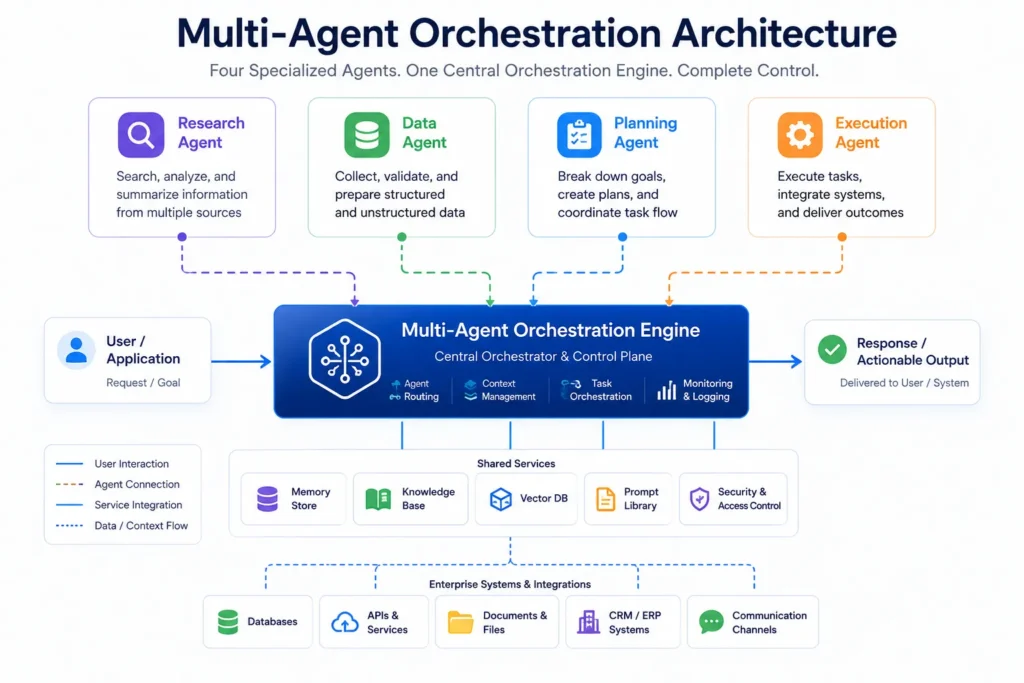
The deployed architecture used four specialized LLM agents inside a white-label orchestration backend.
Each agent had a clear responsibility, limited scope, and defined communication rules.
Four-Agent Orchestration Model
| Agent | Core Responsibility | Business Value |
|---|---|---|
| Researcher Agent | Collects context, retrieves relevant information, structures source material, and prepares task inputs. | Reduces shallow answers by grounding the workflow in available business or technical context. |
| Critic Agent | Challenges assumptions, identifies missing logic, flags contradictions, and tests output quality. | Creates a structured opposition layer before execution or delivery. |
| Coder Agent | Generates code, scripts, technical workflows, automation logic, or structured implementation assets. | Turns reasoning into executable business or engineering output. |
| Reviewer Agent | Checks the final output against task requirements, acceptance criteria, security constraints, and formatting rules. | Improves trust by adding a final validation layer before the output reaches the user. |
This structure changed the product from a chatbot into a controlled execution system.
The Researcher did not write the final answer. The Coder did not decide whether the logic was complete. The Critic did not execute changes. The Reviewer did not invent new requirements. Each agent operated inside a defined role, and the orchestration backend managed the flow between them.
That role separation is where the practical value begins.
Read more: Stop Trying to Build AGI: Why Narrow Autonomous Agents Command the Highest SaaS Valuations
Engineering the Agent Communication Protocol
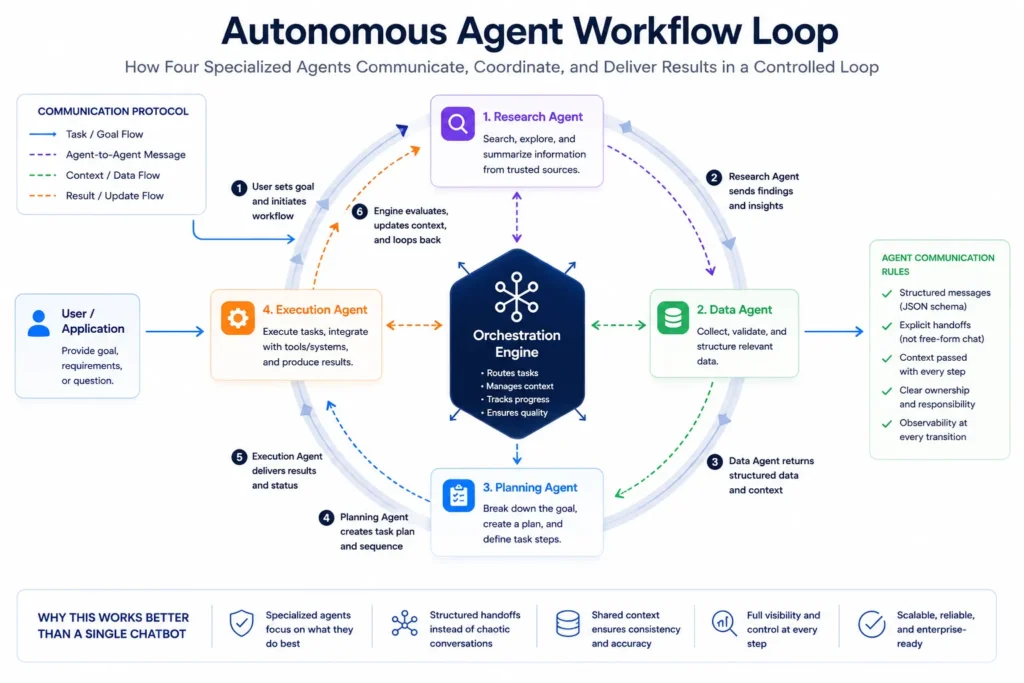
Multi-agent systems fail when agents are simply allowed to “talk” without structure. Enterprise workflows need predictable communication patterns.
The Miracuves backend used a structured agent communication protocol built around five workflow objects:
| Protocol Object | Purpose |
|---|---|
| Task Brief | Defines the user request, business goal, constraints, output format, and success criteria. |
| Context Packet | Contains retrieved documents, database references, API outputs, or user-approved knowledge. |
| Agent Message | Captures agent-specific reasoning, response, uncertainty, and required handoff. |
| Critique Note | Records objections, contradictions, missing evidence, or improvement requests. |
| Final Review Record | Stores approval status, unresolved risks, confidence notes, and delivery output. |
The important design choice was that the agents did not communicate as free-form personalities. They communicated through structured message types.
That made the system easier to monitor, debug, and improve.
For example, when the Researcher completed its work, it did not simply say, “Here is what I found.” It returned a context packet with source references, relevant constraints, confidence notes, and unresolved gaps.
The Critic then evaluated the context packet and flagged weak assumptions before the Coder generated implementation output.
The Reviewer checked whether the final result matched the task brief and whether any critique notes remained unresolved.
This is how multi-agent orchestration becomes useful for enterprise SaaS: not through theatrical AI debate, but through controlled, auditable communication.
Read More: Enterprise App Security in 2026: Why Secure Architecture Is Non-Negotiable
How the Verification Loop Reduced Hallucination Risk
Hallucination risk is not eliminated by adding more agents. In some cases, poorly designed multi-agent systems can amplify errors because one agent may build on another agent’s mistake.
The backend therefore needed a verification loop, not just a collaboration loop.
The verification design followed four principles:
- No agent owns the full truth.
Each agent contributes a scoped output that can be challenged by another agent. - Critique happens before execution.
The Critic Agent evaluates assumptions before the Coder Agent creates implementation output. - Review happens after execution.
The Reviewer Agent checks whether the final output satisfies acceptance criteria. - Unresolved risk is surfaced, not hidden.
If the system cannot verify an assumption, the backend records the limitation instead of presenting the result as certain.
This matters for enterprise AI because trust is not created by a perfect answer. Trust is created by showing how an answer was produced, what was checked, and where uncertainty remains.
For founders building AI SaaS products, this is a major product advantage. A user may tolerate an AI assistant that says, “I am not certain because the source data is incomplete.” They are less likely to tolerate a confident but wrong answer that quietly enters a business workflow.
Autonomous Execution Benchmark for B2B SaaS Tasks
To evaluate the orchestration engine, the deployment should be measured against enterprise task categories rather than generic chatbot prompts.
Use the benchmark table below with verified internal metrics before publishing.
| Benchmark Area | What to Measure | Insert Verified Deployment Metric |
|---|---|---|
| Task completion rate | Percentage of open-ended tasks completed without manual restructuring | [Insert verified %] |
| Critique correction rate | Percentage of outputs improved after Critic Agent review | [Insert verified %] |
| Reviewer rejection rate | Percentage of outputs rejected before final delivery | [Insert verified %] |
| Hallucination flag rate | Percentage of outputs where unsupported claims were detected | [Insert verified %] |
| Average orchestration latency | Average time from task intake to final reviewed output | [Insert verified seconds/minutes] |
| Tool-call success rate | Percentage of successful API, database, or document retrieval calls | [Insert verified %] |
| Human escalation rate | Percentage of tasks escalated due to uncertainty, missing data, or policy limits | [Insert verified %] |
Example Enterprise Task Categories
The benchmark should include real B2B SaaS workflows such as:
- Technical research synthesis
- Code generation and review
- API integration planning
- Internal knowledge retrieval
- Compliance document summarization
- Sales engineering response drafting
- Support escalation analysis
- Product requirement decomposition
- Competitive feature comparison
- Workflow automation planning
The goal is not to prove that the system is “AGI.” The goal is to prove that the orchestration layer improves execution reliability across complex business tasks.
Read more : Zero Downtime: How We Architected the “Best” AI App Using Multi-Model Fallbacks
White-Label Backend Architecture for Enterprise AI SaaS
A multi-agent orchestration engine becomes commercially valuable when it is packaged as a white-label backend that founders can brand, configure, and scale.
For AI SaaS founders, the backend needs more than agents. It needs product infrastructure.
A strong white-label architecture should include:
- User and workspace management
- Role-based access control
- Agent configuration panel
- Model provider configuration
- Prompt and policy versioning
- Memory and retrieval settings
- Tool access permissions
- Workflow templates
- Audit logs
- Usage analytics
- Billing or subscription readiness
- Admin dashboard control
- Human-in-the-loop escalation
- API integration layer
This is where Miracuves’ white-label approach becomes relevant. Instead of building every backend layer from zero, founders can start with a launch-ready product foundation and customize the orchestration logic, branding, workflows, and integrations around their target market.
For example, one founder may use the backend to launch a legal research assistant. Another may use the same orchestration foundation for DevOps support, sales engineering, financial analysis, or internal enterprise knowledge workflows.
The core engine remains reusable. The agent roles, tools, prompts, data sources, and user experience can be customized.
Founder Decision Signals
Founder Decision Signals
Speed
If your AI SaaS idea depends on complex workflows, building the orchestration backend from zero can delay validation. A white-label backend gives founders a faster way to test real enterprise demand.
Cost
The highest cost is not only model usage. It is engineering time spent rebuilding authentication, workflow state, agent logs, admin controls, and integration layers that should already exist.
Scalability
Multi-agent SaaS products need state management, queue handling, tool permissions, retries, and observability. Without those layers, agent workflows become difficult to scale beyond demos.
Market Fit
Founders should validate whether customers want reviewed autonomous execution, not just AI conversation. Orchestration creates a stronger product story for enterprise buyers.
Raed more : Slashing LLM Token Costs by 62%: Benchmarking Vector Caching in AI Chatbot Clones
What This Means for AI Founders and Enterprise CTOs
For AI startup founders, the opportunity is clear. The market is moving beyond simple chatbot wrappers. Buyers want systems that can work across documents, tools, APIs, and business rules.
A multi-agent orchestration engine gives founders a stronger product foundation because it creates differentiated capability at the backend layer.
For enterprise CTOs, the value is control. Multi-agent architecture is only useful if it can be governed. That means each agent needs defined permissions, each workflow needs traceability, and each output needs review logic.
For VC investors, the signal is defensibility. A startup that owns orchestration logic, workflow templates, verification loops, and enterprise deployment infrastructure is usually more defensible than a startup that only resells model access through a thin interface.
The real product moat is not the model. The moat is the system around the model.
Mistakes Founders Should Avoid When Building Multi-Agent AI Platforms
Mistakes Founders Should Avoid
Building a Demo Instead of a Backend
A multi-agent demo can look impressive during a pitch, but enterprise buyers need authentication, permissions, logs, retries, human escalation, billing, and admin control. Without the backend layer, the product cannot move from demo to deployment.
Letting Agents Communicate Without Protocols
Free-form agent conversations are difficult to debug. Structured communication objects make the system easier to audit, test, and improve.
Assuming More Agents Means Better Accuracy
Adding agents does not automatically reduce hallucinations. The value comes from role clarity, critique loops, source grounding, review checks, and escalation logic.
Ignoring Enterprise Integration
Enterprise SaaS users need AI systems that connect with documents, databases, CRMs, ticketing tools, repositories, and internal APIs. Orchestration without integration remains limited.
Security, Governance, and Enterprise Readiness
Multi-agent systems should not be positioned as uncontrolled autonomous intelligence. For enterprise SaaS, the safer and stronger positioning is controlled autonomy.
A production-ready orchestration backend should include:
- Encrypted data transfer
- Role-based access control
- Agent-level permissions
- Audit logs
- Secure API integration
- Prompt and policy versioning
- Human approval checkpoints
- Data retention controls
- Abuse and anomaly monitoring
- Admin access controls
- Activity logs
- Permission-based dashboards
This is especially important when agents interact with business systems. A Researcher Agent may only need document access. A Coder Agent may need repository context but not production deployment rights. A Reviewer Agent may need policy access but not write permissions.
Permission design protects the product from becoming over-autonomous too early.
Why This Is a Practical Step Toward AGI Without Making AGI Claims
The phrase “approaching AGI” can easily become speculative. The practical interpretation is more useful.
A multi-agent orchestration engine does not become AGI because it uses multiple agents. It becomes more powerful because it mirrors useful reasoning patterns:
- Break the task into parts
- Gather context
- Challenge assumptions
- Generate a solution
- Review the output
- Escalate uncertainty
- Record the process
That is not artificial general intelligence. It is engineered reasoning infrastructure.
For enterprise SaaS, that distinction matters. Buyers do not need AGI promises. They need systems that solve real business tasks with better control, traceability, and reliability than a single chatbot interface.
Miracuves helps founders build toward that practical future with white-label AI backends that can be customized for specific SaaS categories, user roles, workflows, and monetization models.
Final Thoughts: AGI Is Not the Product Strategy. Controlled Orchestration Is.
The strongest AI SaaS products will not win because they claim to be AGI. They will win because they turn complex business tasks into reliable, reviewed, measurable workflows.
A multi-agent orchestration engine gives founders a stronger foundation for that future. It separates research from critique, critique from execution, and execution from final review. It gives CTOs more control over how AI systems behave. It gives investors a clearer signal that the product is more than a model wrapper.
The practical path toward advanced enterprise AI is not one giant model pretending to know everything. It is a controlled backend where specialized agents communicate, challenge, verify, and execute with clear boundaries.
That is the infrastructure layer AI founders should be building now.
FAQs
What is a multi-agent orchestration engine?
A multi-agent orchestration engine is a backend system that coordinates multiple specialized AI agents to complete complex tasks. Instead of relying on one general-purpose model, it assigns roles such as research, critique, execution, and review to separate agents.
How is multi-agent orchestration different from a normal chatbot?
A normal chatbot usually follows a single prompt-response flow. A multi-agent orchestration system breaks a task into stages, routes work between agents, checks assumptions, reviews outputs, and records the workflow for better control.
Does a multi-agent system reduce hallucinations?
It can reduce hallucination risk when designed correctly, but it does not eliminate hallucinations automatically. The key is to use source grounding, critique loops, reviewer checks, audit logs, and human escalation when confidence is low.
Is multi-agent orchestration the same as AGI?
No. Multi-agent orchestration is not AGI. It is an engineering approach that allows specialized agents to collaborate on complex workflows. It may mimic some reasoning-loop patterns, but it should not be marketed as artificial general intelligence.
Why should AI SaaS founders care about orchestration?
Founders should care because orchestration can create stronger product differentiation. A SaaS product with structured agents, workflow memory, review loops, integrations, and admin control is more defensible than a simple chatbot wrapper.
What agents are useful in an enterprise AI workflow?
Common enterprise AI agents include a Researcher Agent, Critic Agent, Coder Agent, Reviewer Agent, Planner Agent, Tool Agent, Compliance Agent, and Human Escalation Agent. The right structure depends on the SaaS use case.
Can Miracuves build a white-label multi-agent AI backend?
Miracuves can help founders build white-label AI platforms with source-code ownership, branded user experience, admin dashboards, workflow automation, and customizable agent logic. Final scope depends on the target use case, integrations, and deployment requirements.
What metrics should a multi-agent AI platform track?
Important metrics include task completion rate, critique correction rate, reviewer rejection rate, hallucination flag rate, average orchestration latency, tool-call success rate, and human escalation rate.
Miracuves is an independent software development company. We are not affiliated with, connected to, sponsored by, or endorsed by any company or product named in this article.
Terms such as “X Clone” are used descriptively. It is how the software industry refers to building a platform with functionality comparable to a known service, and how clients search for it.
The entire design and codebase of our products is built by our own team. Our products contain no code, design, graphics, or content originating from any third-party website or applications.
All third-party names and marks referenced in this article are the property of their respective owners, referenced solely to identify the services discussed.