




Key Takeaways
- LLM API costs can grow faster than user revenue.
- Vector caching reduces repeated AI processing requests.
- Frequently asked questions can be answered from cache.
- Smart caching improves margins and scalability.
- Optimized AI architecture lowers operational costs.
Optimization Signals
- Store common prompts in vector databases.
- Reduce duplicate LLM calls through semantic matching.
- Use cache expiry and version control systems.
- Monitor token usage across chatbot workflows.
- Apply safe cache rules for sensitive queries.
Real Insights
- Token costs become critical at high traffic volumes.
- Caching improves profitability without affecting user experience.
- Safe cache governance is essential for regulated industries.
- AI startups should optimize costs before scaling aggressively.
- Miracuves builds AI chatbot platforms with vector caching and scalable AI infrastructure.
AI chatbot founders usually start with a simple assumption: connect the app to OpenAI, Anthropic, Gemini, or another LLM provider, then charge users enough to cover usage.
That assumption works during early demos. It breaks when traffic becomes repetitive.
A customer asks, “How do I reset my password?”
Another user asks, “Can I change my shipping address?”
A third user asks, “What are your delivery times?”
Then thousands of users ask slightly different versions of the same questions.
If your chatbot engine sends every one of those prompts directly to an external LLM, your API bill becomes a tax on repetition. For AI startup operators, that is where margins quietly disappear.
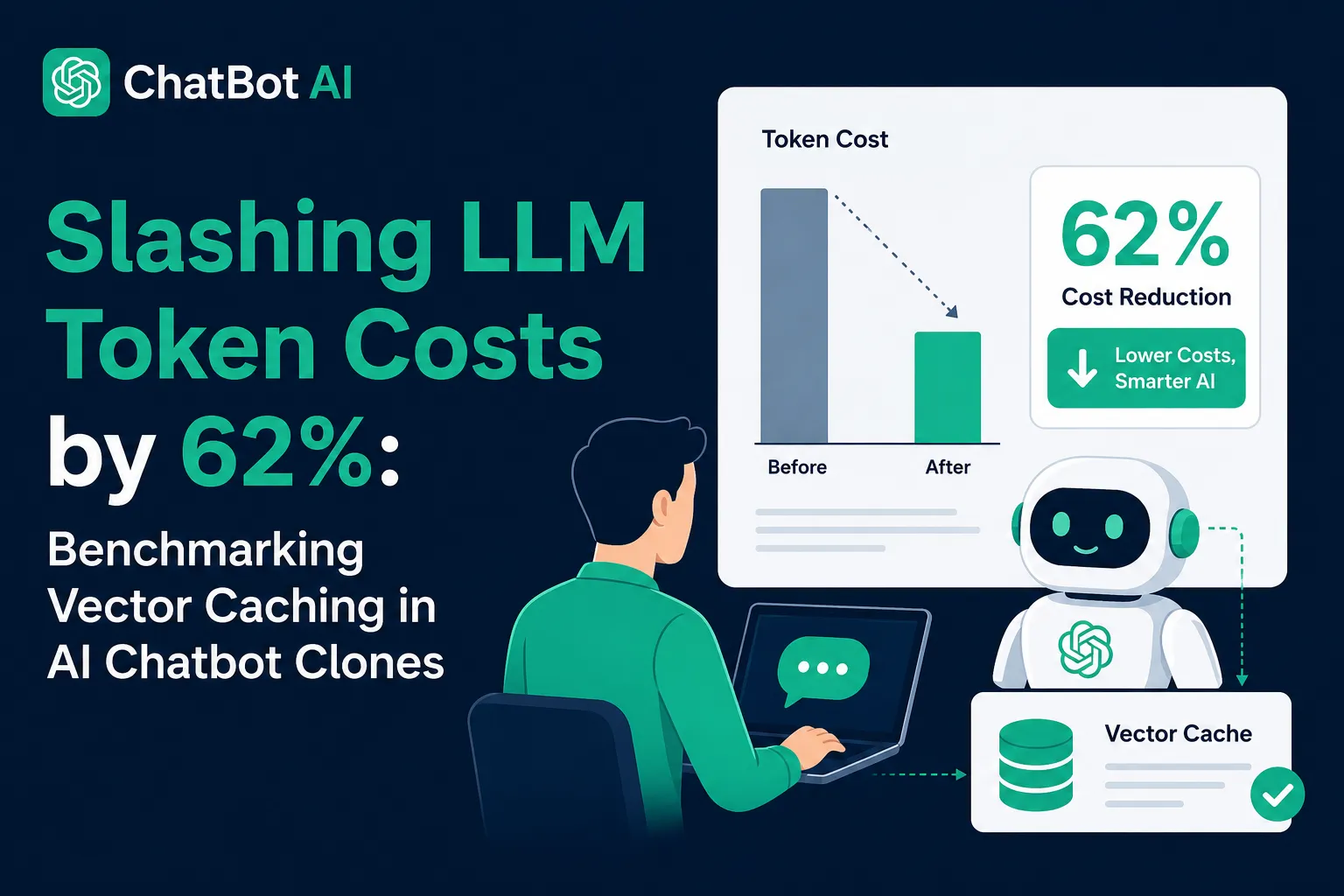
This article explains how a vector caching layer can reduce redundant LLM API calls in an AI chatbot clone. Based on the provided benchmark scenario, a prompt-caching ledger reduced external OpenAI/Anthropic token consumption by 62% under heavy repetitive traffic. Treat this as a workload-specific benchmark, not a universal guarantee. Actual savings depend on prompt repetition, cache-hit ratio, model pricing, embedding cost, response freshness rules, and fallback logic.
Miracuves helps founders launch white-label, source-code-owned AI chatbot platforms with admin control, monetization logic, and scalable architecture. The real advantage is not just launching a ChatGPT-style interface. It is building an AI chatbot engine that can survive usage growth without allowing token costs to outrun revenue.
OpenAI’s own documentation notes that prompt caching can reduce latency and input token costs for repeated prompt prefixes, while Anthropic also documents prompt caching for reusable prompt content.
The AI Scaling Trap: Why Your API Bill Will Outpace Your Revenue
Most AI chatbot clones are built around a simple flow:
- User submits a message.
- Backend sends the prompt to an LLM API.
- LLM generates a response.
- App displays the answer.
- Token usage is logged after the fact.
That flow is easy to launch, but expensive to scale.
The problem is that chatbot traffic is rarely as unique as founders imagine. In customer support, ecommerce, SaaS onboarding, healthcare booking, travel, fintech support, education, and marketplace apps, a large portion of traffic is repetitive. Users may phrase questions differently, but the business answer is often the same.
A raw API-call architecture treats every variation as a new billable event.
| User Prompt | Business Intent | Raw API Behavior |
|---|---|---|
| “How do I reset my password?” | Password reset | Send to LLM |
| “I forgot my password. What now?” | Password reset | Send to LLM |
| “Can I recover my account login?” | Password reset | Send to LLM |
| “Where can I change my password?” | Password reset | Send to LLM |
For a small pilot, this waste is invisible. For a chatbot with thousands of daily support messages, it becomes a margin problem.
This is why CTOs and technical co-founders should separate AI capability from AI operating efficiency. A chatbot can appear intelligent while still being financially weak. If every repetitive message creates another external LLM call, scale increases revenue and cost at the same time.
A stronger AI chatbot architecture needs an interception layer before the LLM call. That layer should ask:
“Have we already answered a semantically similar prompt with a safe, approved, reusable answer?”
If yes, the system should serve the cached answer or a lightly adapted version. If no, the query should move to the LLM, and the result should be evaluated for future caching.
Miracuves’ ChatGPT clone app already positions around AI chatbot workflows, API integration, admin controls, white-label branding, and a 6-day launch model. The next technical advantage for scaling founders is adding cost-aware routing around those AI workflows. Miracuves’ ChatGPT Clone page lists features such as API integration, user analytics, moderation control, customization, and security measures, making it a relevant internal bridge for this article.
Read more: AI Chatbot Platform Business Models: From Idea to Income
The Mathematics of Vector Caching: Intercepting Repetitive Prompts
Vector caching is not the same as simple keyword caching.
A keyword cache may match exact phrases such as:
“How do I reset my password?”
But real users do not write exact duplicates. They write variations:
“I forgot my password.”
“I can’t log in.”
“Help me recover my account.”
“Where is the reset password option?”
A vector cache converts each prompt into an embedding, stores it in a vector database, and compares new prompts against previously answered prompts using semantic similarity.
Basic Vector Caching Flow
User Prompt
   ↓
Normalize and classify prompt
   ↓
Generate embedding
   ↓
Search vector database for similar cached prompts
   ↓
If similarity score exceeds threshold:
      Return approved cached answer
      Log cache hit
Else:
      Send prompt to LLM API
      Store response candidate
      Log cache miss
This design turns repetitive traffic into a reusable asset. Instead of paying repeatedly for the same support answer, the platform builds a knowledge memory around frequent prompts.
The Prompt-Caching Ledger Variable
The key engineering layer is the prompt-caching ledger.
This ledger records every cache decision:
| Ledger Field | Why It Matters |
|---|---|
| Prompt hash | Prevents exact duplicate processing |
| Prompt embedding ID | Enables semantic matching |
| Similarity score | Controls whether a cached answer is safe to reuse |
| Cache status | Hit, miss, bypass, expired, or manual review |
| Avoided input tokens | Shows token savings before LLM call |
| Avoided output tokens | Estimates response-generation savings |
| Source answer ID | Tracks which approved answer was reused |
| Freshness timestamp | Prevents outdated answers from being reused |
| Escalation reason | Explains why a query bypassed cache |
| User segment | Helps distinguish public FAQ, logged-in user, or account-specific query |
Without this ledger, caching becomes guesswork. With it, CTOs can measure how much cost is avoided, which intents generate the highest savings, and where the chatbot still depends too heavily on external LLM calls.
OpenAI exposes cached-token details in API usage fields for supported models, and prompt caching is designed to reduce cost and latency on repeated prompt content. Anthropic’s prompt caching documentation similarly focuses on reusing prompt content across requests, with cache duration and pricing behavior depending on model and configuration.
The 62% Margin Win: Benchmarking Caching Logic vs. Raw API Calls
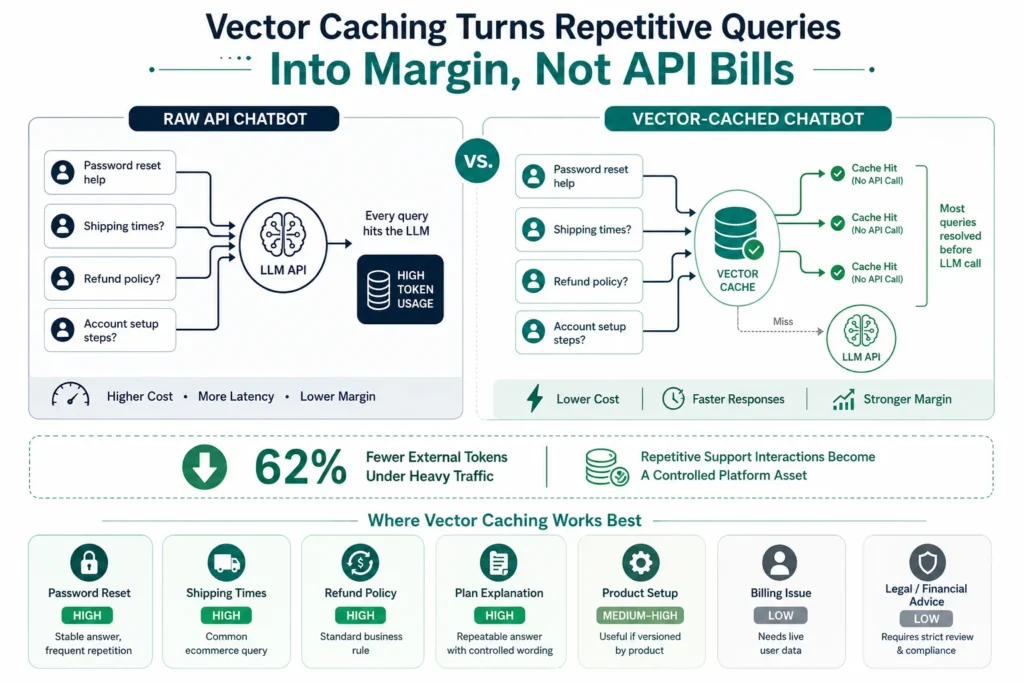
The provided benchmark scenario compares two chatbot architectures under heavy repetitive support traffic:
| Architecture | Behavior | Token Outcome |
|---|---|---|
| Raw API chatbot | Sends every user message to the LLM | Highest token consumption |
| Vector-cached chatbot | Intercepts repetitive prompts before LLM call | 62% lower external token consumption |
The 62% reduction comes from avoiding redundant external calls for repetitive queries such as password reset, shipping times, refund rules, onboarding instructions, and account setup questions.
Benchmark Assumptions
Because the exact production dataset is not attached here, the benchmark should be presented as a provided workload-specific test scenario rather than a public universal claim.
| Benchmark Variable | Assumption |
|---|---|
| Traffic type | High-volume support chatbot traffic |
| Query pattern | Repetitive user intents with varied wording |
| Cache layer | Vector database with semantic similarity matching |
| LLM providers | OpenAI/Anthropic-style external API calls |
| Cost metric | External token consumption avoided |
| Reported result | 62% reduction in token consumption under heavy traffic |
Raw API vs. Vector Cache: Operating Logic
| Layer | Raw API Chatbot | Vector-Cached AI Chatbot |
|---|---|---|
| Repetitive FAQ query | Sent to LLM every time | Matched against cached answer |
| Similar wording | Treated as new prompt | Matched by embedding similarity |
| Token ledger | Tracks spend after API call | Tracks avoided spend before API call |
| Latency | Dependent on LLM response | Faster for cache hits |
| Margin control | Weak | Stronger |
| Admin visibility | Often limited | Cache-hit and bypass analytics |
| Risk | Rising token bill | Cache freshness and answer governance |
The business impact is straightforward. If your chatbot pricing is subscription-based, your revenue per customer is often fixed while usage varies. That means every unnecessary LLM call eats into margin.
A vector cache helps convert repetitive support interactions from a variable API expense into a controlled platform asset.
Read more: Most Profitable AI Chatbot Apps to Launch in 2026
Where Vector Caching Works Best in AI Chatbot Clones
Vector caching is strongest when the same business intent appears repeatedly.
| Use Case | Cache Suitability | Reason |
|---|---|---|
| Password reset | High | Stable answer, frequent repetition |
| Shipping times | High | Common ecommerce query |
| Refund policy | High | Standard business rule |
| Subscription plan explanation | High | Repeatable answer with controlled wording |
| Product setup steps | Medium to high | Useful if versioned by product |
| Account-specific billing issue | Low | Needs live user data |
| Medical/legal/financial advice | Low or controlled | Requires stricter review and compliance handling |
| Personalized recommendations | Medium | Can cache partial context, not full answer |
The founder decision is not “cache everything.” The correct decision is to cache what is safe, stable, repetitive, and measurable.
The Architecture CTOs Should Actually Build
A scalable AI chatbot clone should not be a single pipe into an LLM API. It should be a routing system.
Recommended Cost-Aware Chatbot Architecture
Frontend Chat Interface
   ↓
API Gateway
   ↓
Prompt Normalizer
   ↓
Intent Classifier
   ↓
Vector Cache Search
   ↓
Decision Engine
   ├── Cache Hit → Return Approved Response
   ├── Cache Miss → Send to LLM
   ├── Sensitive Query → Escalate or Apply Guardrails
   └── Account-Specific Query → Fetch Internal Data + LLM/RAG
   ↓
Prompt-Caching Ledger
   ↓
Admin Analytics Dashboard
This structure matters because the chatbot is no longer blindly asking the LLM for everything. It is deciding the cheapest safe route for each message.
Core Modules for a Vector-Cached AI Chatbot Engine
| Module | Technical Role | Founder Impact |
|---|---|---|
| Prompt normalizer | Removes noise and standardizes input | Improves match accuracy |
| Embedding generator | Converts prompt into vector form | Enables semantic caching |
| Vector database | Stores and retrieves similar prompts | Reduces repetitive API calls |
| Similarity threshold engine | Decides whether a cache hit is safe | Prevents wrong answer reuse |
| Cache freshness rules | Expires outdated answers | Protects trust |
| LLM fallback | Handles new or complex prompts | Preserves answer quality |
| Token ledger | Tracks avoided and consumed tokens | Shows true operating cost |
| Admin dashboard | Surfaces cache-hit ratio and top costly intents | Helps optimize margins |
Miracuves’ AI and automation category already frames AI platforms around customer service automation, personalization, scalability, and process optimization. That makes AI automation platform development a natural supporting internal link for readers who want the broader solution ecosystem.
The Token Ledger: The Dashboard Metric Most AI Founders Forget
Most AI chatbot dashboards show conversations, users, response times, and subscription revenue. That is useful, but incomplete.
A technical founder also needs a token economy dashboard.
Token Ledger Metrics to Track
| Metric | Why It Matters |
|---|---|
| Total input tokens | Shows prompt-side cost pressure |
| Total output tokens | Shows generation-side cost pressure |
| Cached prompt count | Measures reuse volume |
| Cache-hit ratio | Shows how often the system avoids external calls |
| Avoided external calls | Converts caching into cost logic |
| Avoided token estimate | Shows real savings from caching |
| Top repeated intents | Reveals which flows should become structured answers |
| Cache bypass reasons | Identifies risky or complex prompts |
| Cost per conversation | Connects AI usage to monetization |
| Cost per paying account | Shows whether pricing is sustainable |
Without this dashboard, the founder only sees the API invoice after the damage is done. With it, the operator can decide whether to improve prompt compression, adjust thresholds, rewrite cached answers, or introduce model routing.
Vector Caching vs. Provider Prompt Caching: Why You May Need Both
Provider prompt caching and vector caching solve related but different problems.
| Optimization Layer | What It Does | Best For |
|---|---|---|
| Provider prompt caching | Reuses repeated prompt prefixes or cached context inside the model provider’s infrastructure | Long shared system prompts, repeated instructions, stable tool context |
| Vector caching | Reuses semantically similar previous answers before calling the external model | FAQ-style support, repeated user questions, high-volume customer service |
| RAG | Retrieves documents or internal data to ground a new answer | Knowledge-heavy workflows |
| Model routing | Sends easy prompts to cheaper models and complex prompts to stronger models | Cost-quality balancing |
OpenAI’s documentation states that prompt caching works automatically on supported API requests and can reduce latency and input token costs. Anthropic also supports prompt caching with cache duration controls.
Vector caching sits one layer above that. It asks whether the platform needs to call the external LLM at all.
For founders, the combination is powerful:
Vector cache prevents unnecessary LLM calls.
Provider prompt caching reduces cost when calls are still needed.
Model routing controls which model handles the request.
Token ledger proves whether the architecture is working.

Read more:
Founder Decision Signals: When Your AI Chatbot Needs Vector Caching
Founder Decision Signals
Speed
If repetitive queries make up a large share of traffic, cache hits can reduce response latency because the system does not wait for a full external LLM response.
Cost
If subscription revenue is fixed but usage keeps rising, vector caching helps prevent repetitive prompts from becoming uncontrolled API spend.
Scalability
If the chatbot is moving from pilot traffic to thousands of conversations, token ledgering becomes essential for infrastructure planning.
Market Fit
If users repeatedly ask the same operational questions, the product has a strong caching opportunity and should not rely on raw LLM calls for every response.
Mistakes That Destroy AI Chatbot Margins
Mistakes Founders Should Avoid
Sending Every Prompt Directly to the LLM
This is the most common scaling mistake. It works during demo traffic but becomes expensive when the chatbot handles repetitive support, onboarding, and FAQ queries every day.
Tracking API Spend Without Tracking Avoided Spend
A good token ledger should not only show what was spent. It should show what the cache prevented, which intents produced savings, and where cache misses are still expensive.
Caching Without Freshness Rules
Old answers can become dangerous when policies, prices, features, or product workflows change. Every cached answer should have a freshness rule, owner, and expiry logic.
Using One Similarity Threshold for Every Query Type
Password reset queries may tolerate high reuse. Billing, legal, healthcare, or finance queries need stricter thresholds, live data checks, or escalation workflows.
Security and Governance: Caching Should Not Mean Careless Reuse
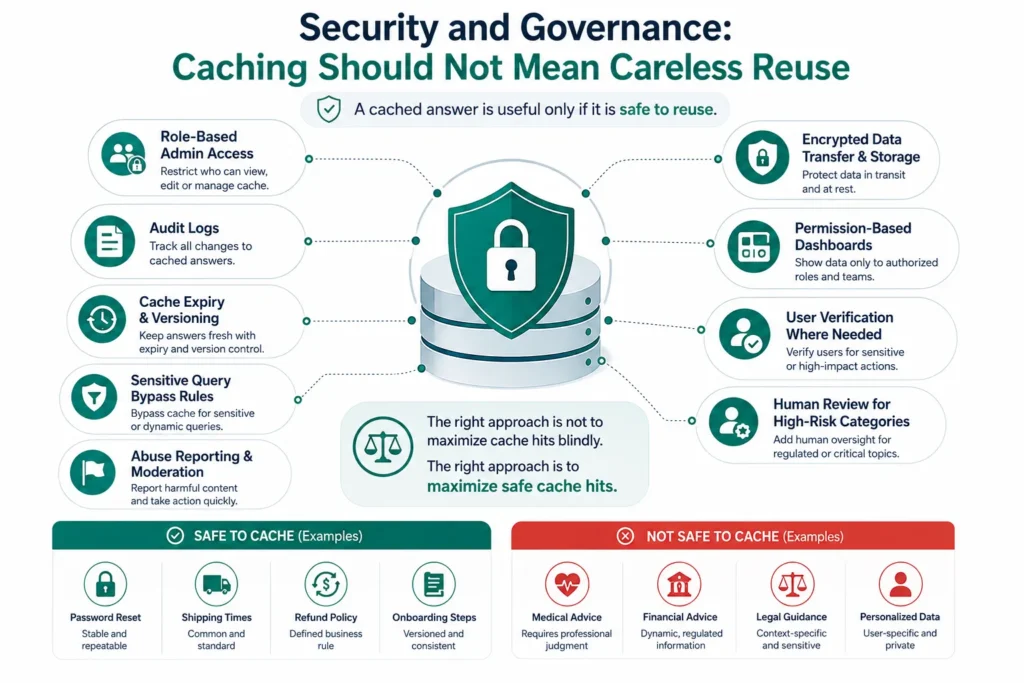
Vector caching must be handled carefully. A cached answer is only useful if it is safe to reuse.
For AI chatbot clones, the cache layer should include:
- Role-based admin access
- Audit logs for cached answer changes
- Cache expiry and versioning
- Sensitive query bypass rules
- Abuse reporting and moderation workflows
- Encrypted data transfer and storage
- Permission-based dashboards
- User verification where needed
- Human review for regulated or high-risk categories
This is especially important for healthcare, fintech, legal, HR, and education use cases. A cached password-reset answer may be safe. A cached medical or financial answer may not be.
The right approach is not to maximize cache hits blindly. The right approach is to maximize safe cache hits.
Why White-Label AI Chatbot Engines Need Cost Architecture From Day One
Many founders compare AI chatbot platforms based on UI, login, chat history, payment plans, admin dashboards, and model integration. Those features matter, but they do not fully answer the scaling question.
A serious AI chatbot clone should include operating-cost controls from the beginning:
| Product Layer | Basic Chatbot Clone | Cost-Aware AI Chatbot Engine |
|---|---|---|
| Chat UI | Yes | Yes |
| User accounts | Yes | Yes |
| LLM API integration | Yes | Yes |
| Subscription billing | Sometimes | Yes |
| Admin dashboard | Sometimes | Yes |
| Token ledger | Rare | Essential |
| Vector cache | Rare | Essential for repetitive traffic |
| Model routing | Rare | Recommended |
| Prompt compression | Rare | Recommended |
| Cache governance | Rare | Essential |
| Source-code ownership | Varies | Important for long-term control |
A ready-made solution from Miracuves can help founders start with a launch-ready AI chatbot foundation while still planning deeper optimization layers such as vector caching, token tracking, and admin-level usage analytics. Miracuves’ solutions hub also highlights ready-made clone apps, 6-day deployment, and custom development paths, which supports the faster-launch positioning for founders evaluating build routes.
Final Thoughts: Token Efficiency Is a Product Strategy, Not a Backend Detail
The strongest AI chatbot founders do not wait for the API bill to become painful. They design for token efficiency before scale exposes the weakness.
Vector caching gives CTOs and technical co-founders a practical way to intercept repetitive prompts, reduce redundant external LLM calls, and protect subscription margins. In the provided benchmark scenario, that architecture reduced OpenAI/Anthropic-style external token consumption by 62% under heavy repetitive traffic.
The bigger lesson is not only the percentage. It is the operating model.
A raw chatbot spends every time a user repeats a question. A cost-aware chatbot learns from repetition, routes intelligently, logs avoided spend, and gives the platform operator control over AI economics.
Miracuves helps AI founders and technical teams build white-label chatbot platforms with source-code ownership, admin dashboards, scalable AI workflows, and cost-aware backend logic. Instead of launching a chatbot that sends every repetitive prompt to an external LLM, Miracuves can help you create a smarter foundation with routing, caching, analytics, and monetization controls built for long-term scale.
For founders planning to launch an AI chatbot product, Miracuves offers a white-label, source-code-owned foundation that can be adapted for branding, monetization, admin control, and scalable AI workflows.
FAQs
What are LLM token costs in an AI chatbot app?
LLM token costs are the API charges generated when a chatbot sends input prompts and receives output responses from an external large language model provider. The more users interact with the chatbot, the more tokens the system may consume.
How does vector caching reduce AI chatbot operating costs?
Vector caching stores embeddings of previous prompts and approved answers. When a new prompt is semantically similar to an existing cached prompt, the chatbot can return the reusable answer instead of sending another request to the LLM API.
Is vector caching the same as OpenAI or Anthropic prompt caching?
No. Provider prompt caching usually helps reuse repeated prompt content within the provider’s infrastructure. Vector caching happens in your application layer and can prevent the LLM call entirely when a safe reusable answer already exists.
Can vector caching reduce LLM token costs by 62%?
In the provided benchmark scenario, vector caching reduced external OpenAI/Anthropic-style token consumption by 62% under heavy repetitive traffic. Actual savings depend on traffic patterns, cache-hit ratio, prompt types, model pricing, and cache governance.
Which chatbot queries should not be cached?
Queries involving account-specific billing, private user data, medical advice, legal questions, financial decisions, or sensitive personal context should either bypass cache, use stricter rules, or require live data and review workflows.
What is a prompt-caching ledger?
A prompt-caching ledger is a backend record of cache hits, cache misses, avoided tokens, similarity scores, fallback reasons, and freshness status. It helps CTOs measure whether caching is actually improving chatbot economics.
Why does this matter for AI chatbot clones?
Many AI chatbot clones focus on UI and API integration, but long-term profitability depends on operating cost control. Vector caching helps reduce repetitive API calls and gives founders better visibility into cost per conversation.
Can Miracuves build a white-label AI chatbot with vector caching?
Miracuves can help founders build white-label AI chatbot platforms with source-code ownership, admin dashboards, branding, monetization flows, and scalable backend architecture. Final feature scope, caching logic, and integrations should be confirmed based on business requirements.