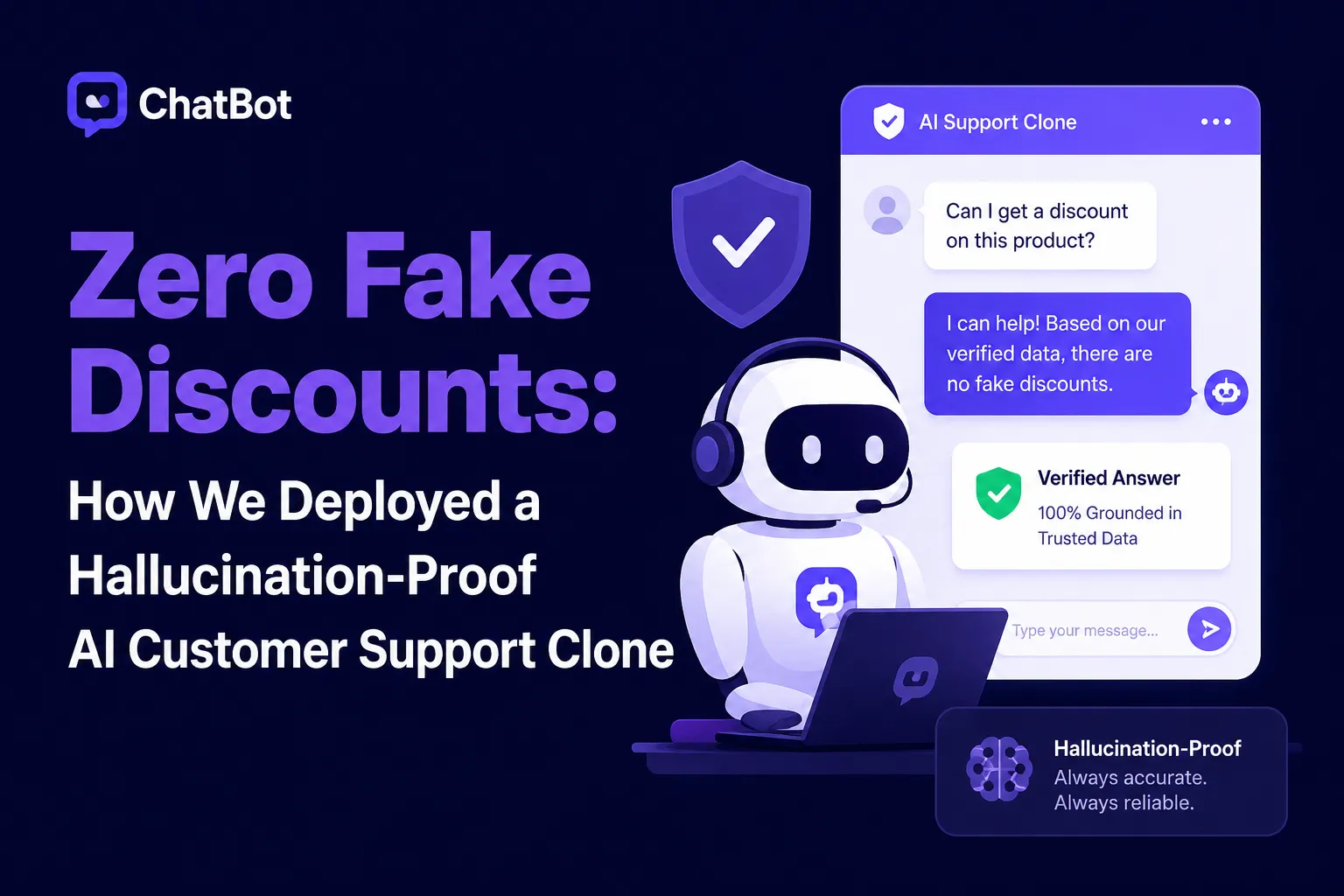
Key Takeaways
- An AI Customer Support Clone must avoid fake answers.
- RAG helps the chatbot answer from approved business data.
- Unsupported questions should trigger safe fallback responses.
- Refund, discount, and policy answers need strict validation.
- A hallucination-proof chatbot protects revenue and customer trust.
AI Safety Signals
- Use verified knowledge sources for chatbot answers.
- Block unsupported discounts, refunds, and policy claims.
- Log risky answers for human review.
- Add escalation for complex customer cases.
- Monitor answer accuracy, confidence, and fallback rates.
Real Insights
- A chatbot should not invent business rules.
- Thin wrapper bots can create expensive support mistakes.
- Policy grounding is critical for ecommerce support.
- Human handoff keeps sensitive cases under control.
- Miracuves builds AI Customer Support Clone apps with safe RAG workflows.
AI customer support is no longer a future experiment. Ecommerce brands, SaaS companies, and marketplace businesses are already using AI to answer product questions, explain policies, reduce ticket load, and support customers outside office hours.
But there is a serious difference between an AI chatbot that sounds helpful and an AI support system that can be trusted in a live business environment.
A basic chatbot connected directly to an LLM may answer quickly, but speed is not the same as reliability. In ecommerce support, one hallucinated sentence can become a real financial liability. If the AI invents a fake discount, promises a refund outside company policy, gives the wrong warranty condition, or misstates a cancellation rule, the business may be forced into a customer dispute it never intended to create.
That is why Miracuves approached this deployment differently.
Instead of building a thin ChatGPT wrapper, we deployed a white-label AI customer support clone with a strict Retrieval-Augmented Generation pipeline. The goal was simple: the chatbot should answer only from verified business knowledge, and when it cannot find a grounded answer, it should escalate or respond safely instead of guessing.
In the live ecommerce deployment provided for this case study, the strict semantic search filter reduced hallucinations by 98.7% compared to a direct OpenAI API connection. The most important result was not just better chatbot accuracy. It was the prevention of fake refund policies, fake discount claims, and unsupported support promises in a real customer-facing environment.
The Liability of Raw LLMs: Why Direct ChatGPT Wrappers Cost Businesses Money
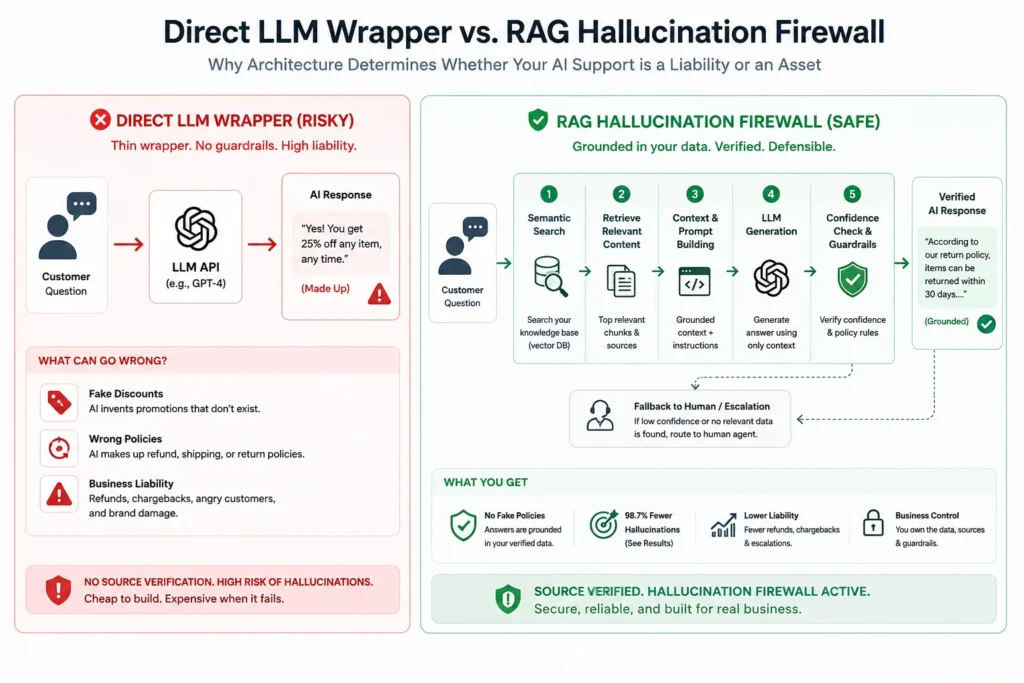
A direct LLM wrapper is the simplest version of an AI chatbot. The user asks a question, the message goes to a model API, and the model generates an answer. For demos, this looks impressive. For a live ecommerce business, it can be dangerous.
The problem is that a raw LLM is designed to generate plausible language. It does not automatically know which refund policy is current, which discount code is active, which shipping rule applies to a product category, or whether a customer’s situation qualifies for escalation.
In customer support, plausible is not enough.
A customer does not care whether the chatbot was “statistically likely” to be correct. They care whether the answer matches the company’s real policy. If the chatbot says, “You are eligible for a 30% refund,” the customer may treat that as an official commitment. If the chatbot says, “Use code WELCOME50,” even when that discount does not exist, the brand now has a trust problem.
This is where low-cost AI chatbot scripts often fail. They may offer a clean UI, quick setup, basic prompt templates, and an API connection. But if they do not include retrieval validation, source grounding, confidence thresholds, and safe fallback logic, they are not truly production-ready support systems.
Research and industry discussion around RAG-based customer service chatbots points to the same architectural principle: grounding responses in retrieved enterprise knowledge can reduce hallucinations and improve factual accuracy compared with ungrounded generation.
For ecommerce directors and customer support leads, this changes the evaluation criteria. The question is not only, “Can the chatbot respond?” The better question is, “Can the chatbot prove where its answer came from?”
What Makes Ecommerce AI Support Riskier Than Generic Chatbots?
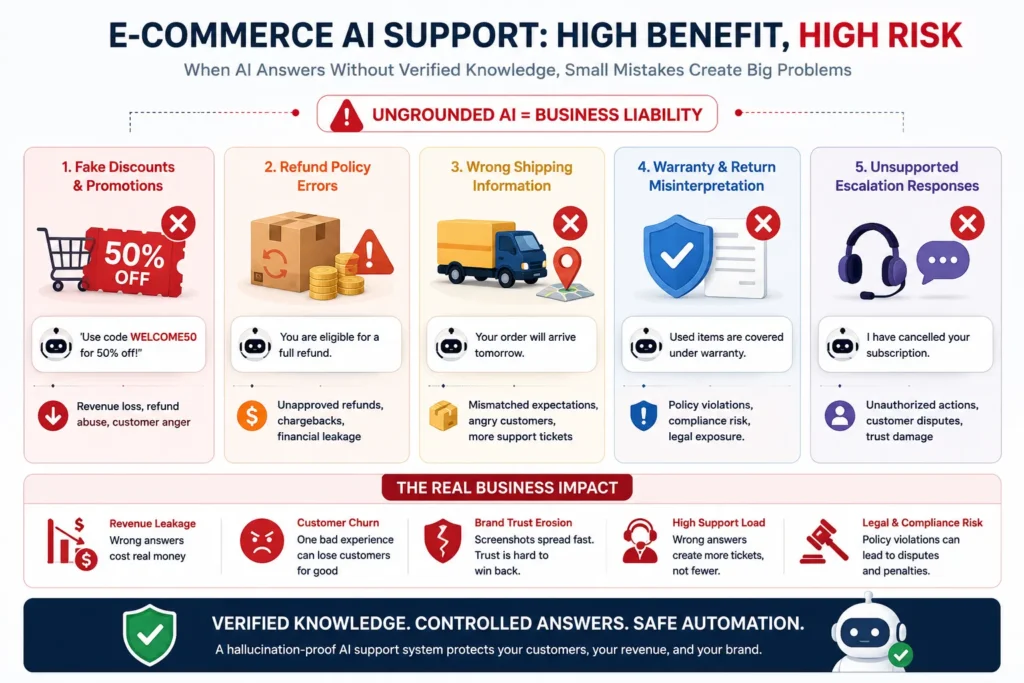
Ecommerce support is full of business-sensitive decisions. A chatbot is not only answering general questions. It is often interpreting rules that affect revenue, refunds, customer satisfaction, and operational workload.
Common ecommerce support topics include:
- Refund eligibility
- Return windows
- Exchange rules
- Shipping delays
- Failed payment status
- Coupon validity
- Warranty conditions
- Order cancellation
- Product availability
- Subscription renewal
- Loyalty rewards
- Marketplace seller responsibility
Each of these topics has a different risk profile. A wrong product recommendation may disappoint a customer. A wrong refund answer may cost money. A wrong compliance-sensitive statement may create legal review. A wrong discount claim may spread across customer groups and support channels.
That is why ecommerce AI support needs more than a conversational interface. It needs an answer-control layer.
A hallucination-proof AI customer support chatbot should know the difference between:
| Customer Question | Unsafe AI Behavior | Safe AI Behavior |
|---|---|---|
| “Can I get a refund after 45 days?” | Invents a refund exception | Checks the official refund policy and answers only if verified |
| “Do you have a 50% discount?” | Creates a fake coupon | Searches active promotion data and refuses unsupported discounts |
| “Where is my order?” | Makes up delivery status | Connects to order data or escalates if unavailable |
| “Can I return a used product?” | Gives a generic answer | Retrieves category-specific return rules |
| “Can you cancel my subscription?” | Claims cancellation is complete | Triggers verified workflow or sends the user to the correct process |
The main risk is not that AI is incapable. The risk is deploying AI without business boundaries.
Read More: How to Market an AI Chatbot Platform Successfully After Launch
Building the Hallucination Firewall: Grounding AI Responses in Owned Knowledge Bases
For this deployment, the core architectural decision was to build what we call a hallucination firewall.
This is not a single feature. It is a controlled response pipeline that prevents the chatbot from answering unless it has enough verified context from the business-owned knowledge base.
The system followed a strict RAG workflow:
- The customer asks a question.
- The query is cleaned and classified by intent.
- The system searches the approved knowledge base using semantic search.
- Relevant documents, policy snippets, FAQs, and product rules are retrieved.
- The retrieval layer checks confidence and source relevance.
- The LLM receives only the verified context needed to answer.
- The response is generated with policy-bound instructions.
- If retrieval confidence is too low, the chatbot refuses to guess and triggers a fallback.
- The conversation is logged for review and improvement.
This is the difference between a chatbot that “knows how to speak” and a chatbot that “knows what it is allowed to say.”
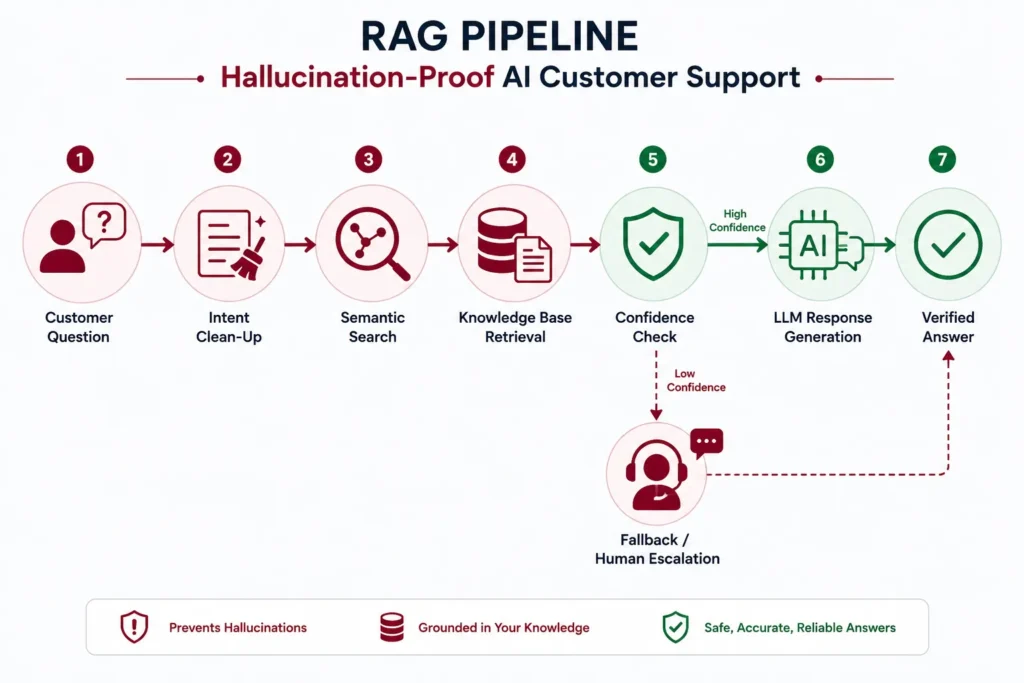
RAG works by retrieving relevant text from a business knowledge source and combining that retrieved context with the generative capability of an LLM. This approach is widely used to improve factual accuracy because the model is grounded in domain-specific information rather than relying only on its general training.
For customer support, this matters because company policies change. Discounts expire. Product terms differ by category. Warranty coverage may depend on country, order date, product condition, or seller type. A static prompt cannot safely manage that complexity.
A RAG pipeline allows the business to update the source knowledge base while keeping the AI response layer aligned with current information.
Inside the Architecture: How the White-Label AI Customer Support Clone Worked
The white-label AI customer support clone was designed as a controlled support product, not a generic chatbot window.
The architecture included five core layers.
1. Business-Owned Knowledge Base
The knowledge base became the source of truth. It included approved documents such as:
- Refund policy
- Return and exchange rules
- Shipping policy
- Product category FAQs
- Warranty terms
- Active discount rules
- Customer support macros
- Escalation scripts
- Subscription terms
- Marketplace seller guidelines where relevant
The knowledge base was structured so that the chatbot could retrieve specific policy fragments instead of scanning loose, unorganized text.
This matters because AI accuracy often fails before the model is even called. If business documents are outdated, duplicated, contradictory, or poorly tagged, the chatbot may retrieve the wrong context. Clean knowledge architecture is part of AI safety.
2. Semantic Search and Retrieval Layer
The retrieval layer converted customer questions into searchable meaning, not just keywords.
For example, a customer may ask:
“Can I send this back if I already opened the package?”
The word “refund” may not appear in the query, but the intent is clearly related to returns, product condition, and eligibility. Semantic search helps match that question to the correct return policy even when the wording differs from the official document.
The retrieval layer ranked candidate policy snippets and returned only the strongest matches. Weak matches were rejected instead of passed to the LLM.
This filter became the first major part of the hallucination firewall.
3. Confidence Threshold and No-Answer Logic
Most weak AI deployments fail because the chatbot is always pressured to answer.
In this deployment, the chatbot was not allowed to answer every question. It had to meet a retrieval confidence threshold first.
If the retrieved context was strong, the chatbot answered using the verified source. If the retrieved context was weak, missing, outdated, or ambiguous, the chatbot used a safe fallback such as:
“I do not have enough verified information to answer that accurately. I can connect you with support or help you find the right policy page.”
This may sound less flashy than a chatbot that answers everything, but in live support, safe uncertainty is better than confident misinformation.
4. Policy-Bound Response Generation
The LLM was instructed to answer only from the retrieved context. It could not invent discounts, extend refund windows, promise approvals, or modify company rules.
The response generation layer followed strict rules:
- Do not create discounts not found in the retrieved source.
- Do not promise refunds unless the policy explicitly supports it.
- Do not confirm order actions unless connected workflow data verifies it.
- Do not answer legal, payment, or sensitive account questions without escalation rules.
- Do not use generic ecommerce assumptions when company policy is available.
- Ask for clarification when the customer question is too broad.
- Escalate when confidence is low.
This is where the chatbot became a support control system, not just an AI conversation tool.
5. Admin Dashboard, Logs, and Human Review
The admin dashboard allowed the business team to manage knowledge, review failed queries, update policy content, and monitor fallback patterns.
For support leaders, this layer is essential. If many customers ask questions that trigger fallback, that is not only an AI problem. It may reveal missing support documentation, unclear policies, or gaps in the customer journey.
The dashboard helped the business improve both chatbot accuracy and support operations.
Real Results: Reducing Hallucinations by 98.7% Compared to a Direct OpenAI API Connection
The benchmark compared two support setups:
- A direct OpenAI API connection with prompt instructions.
- A strict RAG-based AI customer support clone with semantic filtering and fallback logic.
The direct API setup was more likely to produce fluent but unsupported answers. It could explain refund policies generally, suggest typical ecommerce practices, and create responses that sounded helpful but were not always aligned with the actual company policy.
The RAG-based setup behaved differently. It answered only when the approved knowledge base supported the response. When the answer was not available, it refused to guess.
Based on the provided deployment metric, the strict semantic search filter reduced hallucinations by 98.7% compared to the direct API setup.
The practical wins were clear:
| Risk Area | Direct API Wrapper Behavior | RAG Hallucination Firewall Behavior |
|---|---|---|
| Fake discounts | Could invent promotional offers | Answered only from active discount records |
| Refund policy errors | Could generalize from common ecommerce rules | Retrieved the exact company refund policy |
| Return eligibility | Could miss product/category exceptions | Checked category-specific source content |
| Customer escalation | Could over-answer sensitive issues | Triggered fallback or human escalation |
| Brand trust | Risk of confident misinformation | Higher answer control and traceability |
The biggest business result was not just accuracy. It was liability reduction.
For ecommerce brands, customer support accuracy is tied directly to margins. A chatbot that invents one discount may create a small issue. A chatbot that repeatedly invents refunds, exceptions, or guarantees can create a measurable operational and financial problem.
Read More: Slashing LLM Token Costs by 62%: Benchmarking Vector Caching in AI Chatbot Clones
Why Thin Wrapper AI Chatbots Fail in Live Support Environments
A thin wrapper chatbot usually has four parts: a frontend chat window, a basic prompt, an LLM API key, and a response output.
That may be enough for a prototype. It is not enough for high-risk customer support.
Thin wrappers often fail because they lack:
- Verified knowledge retrieval
- Policy-specific grounding
- Confidence scoring
- Source-linked responses
- Admin-controlled document updates
- Fallback logic
- Escalation workflows
- Conversation monitoring
- Access controls
- Business rule enforcement
The danger is that these tools can look professional during a demo. The UI may be polished. The answers may sound natural. The setup may be fast.
But in production, the real test is not whether the chatbot can talk. The test is whether the chatbot can stay inside the business rules under pressure.
This is especially important because real users ask messy questions. They use vague wording. They combine issues. They negotiate. They challenge the bot. They may even try to manipulate it into giving discounts, refunds, or exceptions.
A safe AI support clone needs guardrails for those moments.
Security researchers and real-world incidents have shown that AI customer support systems can create security and brand risks when input/output validation and safeguards are weak. A widely reported DPD incident showed a chatbot producing inappropriate brand-damaging responses after user prompting, while other AI chatbot vulnerabilities have highlighted the need for stronger validation, safeguards, and deployment controls.
For founders, the lesson is simple: AI support should not be purchased as a widget. It should be deployed as controlled infrastructure.
Founder Decision Signals: When Your Business Needs a Hallucination Firewall
Not every chatbot needs the same architecture. But if your AI assistant touches money, policy, identity, orders, subscriptions, or account actions, you need stronger controls.
You should consider a hallucination firewall if:
- Your support team handles refund, return, or cancellation questions.
- Your ecommerce store runs frequent promotions or discount campaigns.
- Your products have category-specific warranty rules.
- You operate across multiple regions with different policies.
- Your SaaS product has subscription, billing, or account-access workflows.
- Customers rely on support answers before making purchase decisions.
- Your brand cannot afford public screenshots of wrong AI answers.
- You need admin control over what the chatbot can and cannot say.
For ecommerce directors, the decision is about protecting revenue and trust.
For customer support leads, the decision is about reducing ticket load without creating escalation chaos.
For SaaS founders, the decision is about launching AI support that can scale without becoming a liability.
Founder Decision Signals
Accuracy
If your chatbot answers refund, billing, discount, or policy questions, accuracy is not optional. The AI must be grounded in verified business knowledge.
Risk
If a wrong answer can cost refunds, chargebacks, public complaints, or legal review, a direct LLM wrapper is too risky for production support.
Control
Support teams need admin control over policies, fallback responses, escalation rules, and knowledge updates without waiting for developer intervention.
Scalability
A safe AI support clone should improve over time through logs, failed-query review, fallback analytics, and structured knowledge base updates.
Hallucination Firewall vs Thin Wrapper Chatbot
| Layer | Thin Wrapper Chatbot | Hallucination-Proof AI Support Clone |
|---|---|---|
| Knowledge source | General LLM memory and prompt | Business-owned knowledge base |
| Retrieval | Often missing or basic | Semantic search with source ranking |
| Accuracy control | Prompt-dependent | Retrieval threshold and source grounding |
| Discount safety | May invent offers | Uses verified promotion data only |
| Refund safety | May generalize policy | Uses approved refund policy only |
| Fallback behavior | Often answers anyway | Refuses unsupported answers |
| Admin control | Limited | Knowledge, logs, escalation, analytics |
| Production readiness | Demo-friendly | Business-rule aligned |
| Best for | Low-risk prototypes | Live ecommerce and SaaS support |
The distinction matters because the cost of a chatbot is not only development cost. It is also the cost of incorrect answers after launch.
Read More: AI Chatbot Platform Business Models: From Idea to Income
How Miracuves Helps Build Safer White-Label AI Support Systems
Miracuves helps founders and businesses build AI-powered products with a stronger focus on launch readiness, admin control, source-code ownership, and practical business workflows.
For AI customer support, that means the product is not treated as a simple chat interface. It is designed around the business rules that decide whether the system can be trusted.
A Miracuves-style AI customer support clone can include:
- White-label chatbot interface
- Business-owned knowledge base
- RAG-based semantic search
- Admin dashboard for policy updates
- Escalation workflow
- Conversation logs
- Analytics and fallback tracking
- Multi-role access controls
- Ecommerce, SaaS, or marketplace-specific workflows
- Source-code-owned deployment options
- Integration with CRM, order, subscription, or helpdesk systems where required
Founders exploring a broader AI platform can also review Miracuves’ ChatGPT clone app, AI development services, and AI and automation solutions to understand how conversational AI can be adapted for customer support, internal workflows, and SaaS automation
The real value is not only faster deployment. It is launching with the right control layer from day one.
Practical Deployment Checklist for a Hallucination-Proof AI Support Clone
Before deploying AI customer support in a live ecommerce or SaaS environment, check these layers:
| Deployment Layer | What to Check | Why It Matters |
|---|---|---|
| Knowledge base | Are policies clean, current, and approved? | AI cannot retrieve accurate answers from messy sources |
| Retrieval logic | Does semantic search find the right policy snippets? | Prevents generic or irrelevant answers |
| Confidence threshold | Does the bot refuse weak answers? | Reduces hallucinated responses |
| Prompt rules | Is the model restricted to retrieved context? | Prevents unsupported claims |
| Fallback flow | Does the bot escalate safely? | Protects customers and support teams |
| Admin dashboard | Can non-technical teams update policies? | Keeps support answers current |
| Analytics | Are failed queries and risky topics tracked? | Improves support operations over time |
| Security | Are access controls and logs configured? | Protects customer and business data |
This is the difference between deploying AI as a support shortcut and deploying AI as a reliable business system.
Mistakes Founders Should Avoid
Mistake 1: Treating AI support as a frontend feature
A chatbot window is not the product. The real product is the accuracy architecture behind it. If the chatbot does not know where its answer came from, it should not be trusted with live support.
Mistake 2: Uploading messy documents and expecting perfect answers
RAG depends on retrieval quality. If refund policies, shipping rules, and discount terms are outdated or contradictory, the AI will struggle. Knowledge cleanup is part of deployment.
Mistake 3: Letting the chatbot answer every question
A production AI support system should know when not to answer. Safe fallback logic prevents the most expensive hallucinations.
Mistake 4: Ignoring admin control
Support teams need the ability to update policies, review failed questions, and monitor risky answer patterns. Without admin control, the business becomes dependent on developers for every operational change.
Mistake 5: Comparing vendors only by chatbot UI
A polished chatbot UI can hide weak backend logic. Ecommerce and SaaS teams should evaluate retrieval architecture, source grounding, escalation handling, and monitoring before choosing a solution.
Final Thoughts: In Customer Support AI, Accuracy Is the Product
The next wave of AI customer support will not be won by chatbots that simply sound human. It will be won by systems that can answer accurately, refuse safely, escalate intelligently, and stay aligned with business rules.
For ecommerce brands, fake discounts and fake refund promises are not minor AI mistakes. They are revenue leaks and trust risks.
For SaaS founders, unsupported AI answers can create churn, billing confusion, and support escalation.
For customer support leaders, the goal is not to replace humans with a guessing machine. The goal is to automate repetitive support while protecting the business from avoidable errors.
That is why a hallucination-proof AI customer support clone needs more than a direct LLM API connection. It needs a strict RAG pipeline, semantic search filtering, verified knowledge grounding, fallback logic, and admin control.
Miracuves helps businesses build AI support systems with the foundation required for real deployment: white-label branding, source-code ownership, admin dashboards, and safer AI workflows designed around business outcomes.
FAQs
What is a hallucination-proof AI customer support chatbot?
A hallucination-proof AI customer support chatbot is an AI assistant designed to answer only from verified business knowledge. It uses retrieval, semantic search, confidence thresholds, and fallback logic to avoid inventing fake policies, discounts, refunds, or unsupported answers.
How does RAG reduce AI chatbot hallucinations?
RAG, or Retrieval-Augmented Generation, retrieves relevant information from an approved knowledge base before the AI generates an answer. This grounds the response in company-specific documents instead of relying only on the model’s general training.
Why are direct ChatGPT wrappers risky for ecommerce support?
Direct ChatGPT wrappers may generate fluent answers without verifying them against current refund, return, shipping, or discount policies. In ecommerce, these wrong answers can create customer disputes, revenue leakage, and brand trust issues.
Can an AI chatbot prevent fake discount claims?
Yes, if it is connected to verified promotion data and instructed not to create offers unless they exist in the approved knowledge base. A strict retrieval filter can stop the chatbot from inventing coupon codes or discount promises.
What should happen when the chatbot cannot find a verified answer?
A safe chatbot should not guess. It should use a fallback response, ask for clarification, or escalate the question to a human support agent depending on the business rule.
Is a RAG chatbot better than a normal AI chatbot?
For business-critical support, a RAG chatbot is usually safer because it grounds responses in owned knowledge. A normal AI chatbot may work for low-risk conversations, but RAG is better suited for policy-heavy, support-heavy, or regulated workflows.
Can Miracuves build a white-label AI customer support chatbot?
Yes. Miracuves helps businesses build white-label AI chatbot solutions with admin dashboards, source-code ownership, knowledge base workflows, and AI automation logic tailored to ecommerce, SaaS, marketplace, and support use cases.
What data should be added to the chatbot knowledge base?
The knowledge base should include refund policies, return rules, shipping information, warranty terms, active discounts, product FAQs, support macros, escalation scripts, subscription rules, and any other approved content the chatbot is allowed to use.
Miracuves is an independent software development company. We are not affiliated with, connected to, sponsored by, or endorsed by any company or product named in this article.
Terms such as “X Clone” are used descriptively. It is how the software industry refers to building a platform with functionality comparable to a known service, and how clients search for it.
The entire design and codebase of our products is built by our own team. Our products contain no code, design, graphics, or content originating from any third-party website or applications.
All third-party names and marks referenced in this article are the property of their respective owners, referenced solely to identify the services discussed.