




Key Takeaways
- Closed-loop corporate chatbots answer from private business data.
- B2B AI apps can be stronger than public chatbot clones.
- HR, legal, finance, and compliance teams need controlled answers.
- Secure document ingestion improves chatbot accuracy and trust.
- Enterprise licensing can create higher-value AI revenue.
B2B AI Signals
- Use private PDFs, policies, contracts, and internal documents.
- Add role-based access for different corporate teams.
- Keep unsupported answers behind safe fallback rules.
- Track queries, sources, confidence, and user feedback.
- Admin dashboards should control documents, users, and permissions.
Real Insights
- General chatbot clones compete in a crowded market.
- Corporate chatbots win when they solve internal workflows.
- Data privacy is central to enterprise AI adoption.
- Source-grounded answers reduce hallucination risk.
- Miracuves builds B2B AI chatbot systems with secure knowledge workflows.
Most AI founders are walking into the wrong fight.
They see ChatGPT, Claude, Gemini, Perplexity, Grok, and a dozen fast-growing AI tools and think the opportunity is to build another general-purpose chatbot for consumers. That sounds exciting until the economics show up. A general-knowledge B2C AI App is not just a product. It is a war against Big Tech, model labs, cloud budgets, consumer acquisition costs, retention pressure, and user expectations that change every few weeks.
That is a brutal place for most founders to compete.
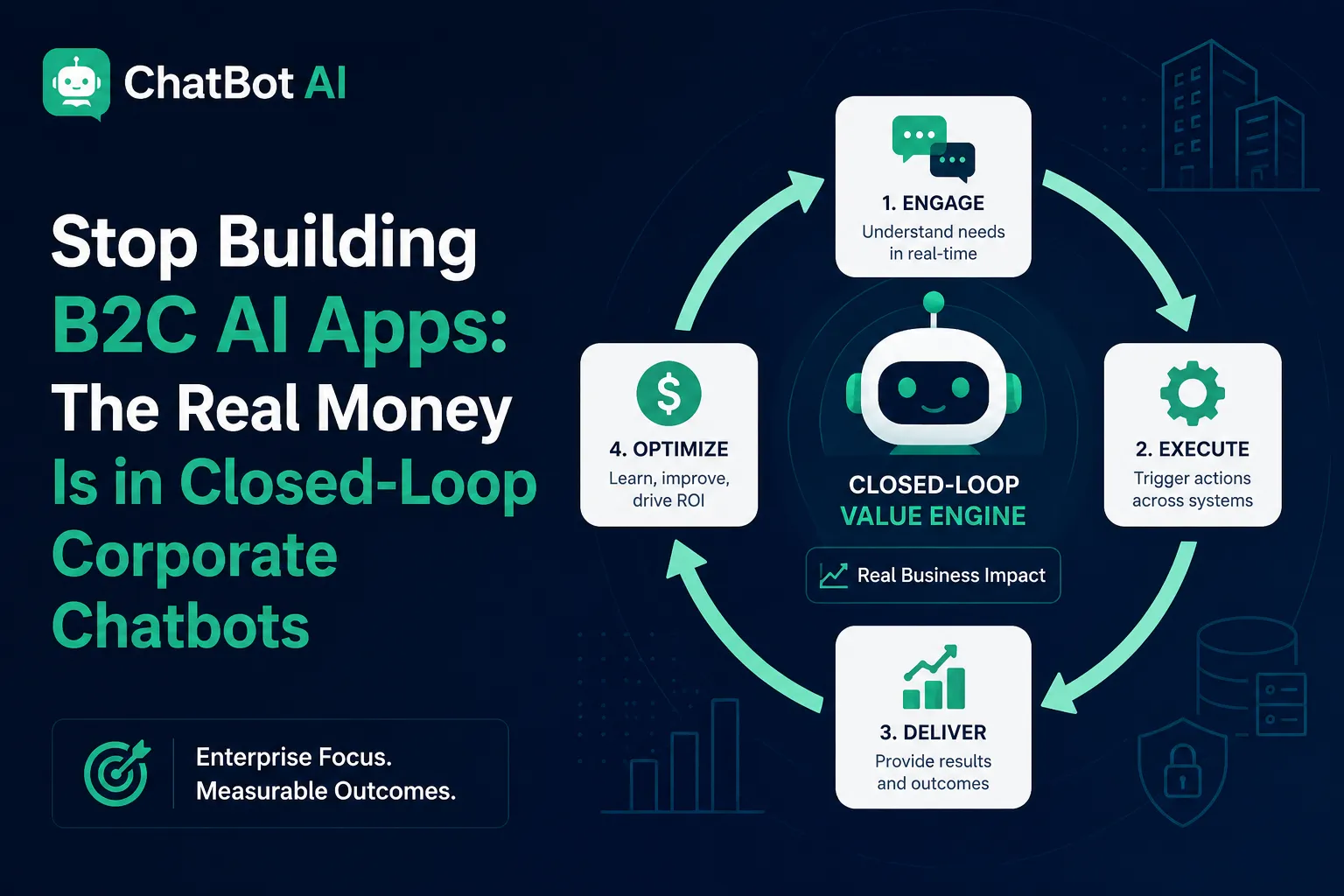
The more practical opportunity is not to build a public chatbot that answers everything for everyone. The stronger opportunity is to build a closed-loop corporate chatbot that answers very specific questions for very specific companies using their internal knowledge base, private PDFs, HR policies, legal documents, finance manuals, onboarding guides, compliance documents, and operational SOPs.
That is where the leverage is.
A B2B AI chatbot does not need to beat ChatGPT at general intelligence. It needs to help a legal team find the right clause faster. It needs to help HR answer employee policy questions accurately. It needs to help consultants create branded internal AI assistants for their enterprise clients. It needs to help corporate teams turn scattered documents into controlled, searchable, permission-aware knowledge.
That is a business. Not a toy.
For founders, agencies, and enterprise consultants, this is where a white-label AI chatbot model becomes powerful. Instead of burning capital trying to compete with public LLM platforms, you can sell dedicated AI infrastructure to companies that already have the pain, the budget, and the urgency.
Miracuves helps founders build ready-made and white-label AI solutions with branding, admin control, source-code ownership, and business-focused customization. For this category, the goal is not to copy a consumer AI app. The goal is to package AI into a closed-loop enterprise product that companies can actually trust.
The General Intelligence Graveyard: You Cannot Outspend Big Tech
The hardest AI market is the one that looks most obvious.
A public chatbot that answers general questions feels attractive because everyone understands it. Students use it. Marketers use it. Developers use it. Consumers use it. That visibility makes founders believe there is room for another consumer AI assistant.
But visibility is not the same as defensibility.
A general-purpose B2C chatbot competes on model quality, response speed, user experience, brand trust, integrations, pricing, memory, multimodal ability, and ecosystem distribution. Those are not small startup advantages. Those are infrastructure-heavy advantages.
Big Tech can bundle AI into browsers, phones, search engines, productivity suites, cloud accounts, email, operating systems, and messaging products. That means they do not always need to acquire users the way a startup does. They can place AI directly inside workflows that already have billions of users.
A founder building another public chatbot is usually fighting on the worst possible battlefield:
- users expect near-perfect answers,
- switching costs are low,
- free alternatives are everywhere,
- infrastructure costs can rise quickly,
- differentiation is hard to explain,
- retention depends on constant novelty,
- model providers can change pricing or access rules,
- paid conversion is difficult without a specialized use case.
This does not mean AI chatbot apps are dead. It means general-purpose B2C chatbot positioning is weak unless the founder has distribution, capital, proprietary data, a strong workflow, or a niche that creates real switching costs.
The better founder question is not, “How do I build another ChatGPT?”
The better question is, “Where does a chatbot create economic value that a company is willing to pay for every month?”
That answer usually leads to internal corporate knowledge.
Read More: Slashing LLM Token Costs by 62%: Benchmarking Vector Caching in AI Chatbot Clones
Why B2C AI App Burn Capital Faster Than They Build Moats
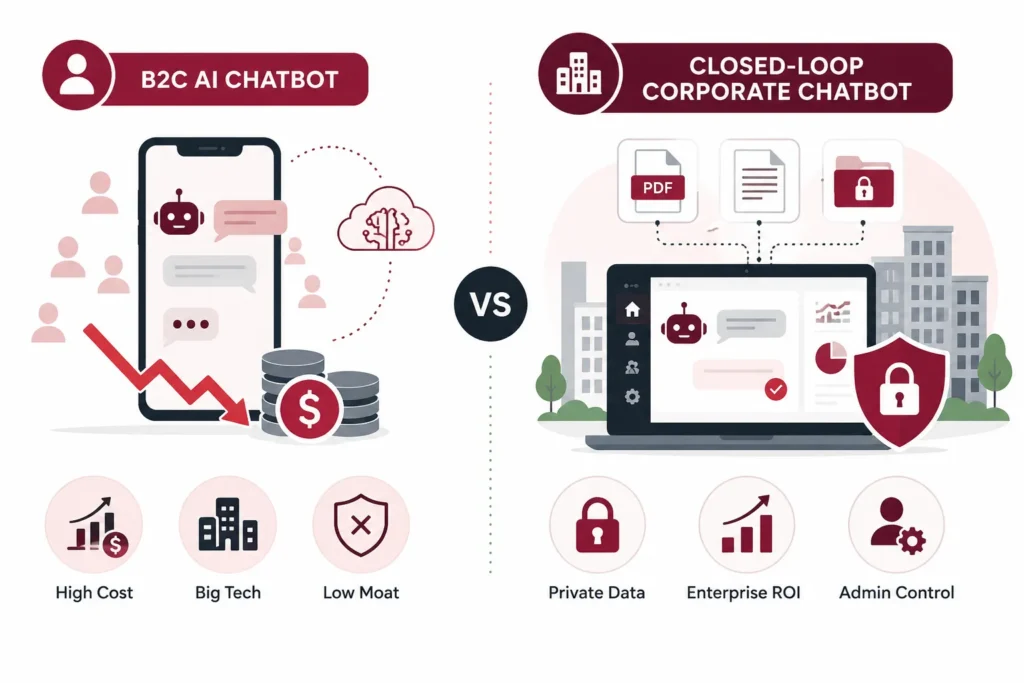
A B2C chatbot app has three dangerous cost centers: acquisition, inference, and retention.
Acquisition is expensive because consumer AI keywords are crowded, app stores are saturated, and users already have access to powerful free or low-cost tools. Even when a founder gets downloads, converting those users into recurring subscribers is difficult unless the product solves a specific painful workflow.
Inference cost is also a real issue. Every message has a cost somewhere. Even when the cost per response looks small, usage-heavy customers can create margin pressure. A consumer app that attracts free users but fails to convert them can become a cost engine instead of a revenue engine.
Retention is the third problem. Consumers try tools quickly and abandon them quickly. Unless the app becomes part of daily work, emotional identity, creator output, or business productivity, it becomes another forgotten icon on the phone.
That is why the “AI wrapper” criticism exists. Many chatbot startups are essentially interface layers over existing models. Without proprietary data, vertical workflow depth, or controlled distribution, they are easy to copy and hard to price.
A closed-loop corporate chatbot changes the equation.
The product is not sold as entertainment. It is sold as infrastructure. It is not judged by whether it knows everything. It is judged by whether it can answer company-specific questions safely, quickly, and accurately from approved internal sources.
That is a stronger sales story.
The Value of Privacy: Why Enterprises Will Not Freely Upload Their Financials to Public AI Tools
Enterprise AI adoption is not blocked by lack of interest. It is blocked by risk.
Companies want AI productivity, but they also care about confidentiality, legal exposure, data handling, access control, and internal governance. HR documents contain employee policies, salary structures, disciplinary processes, benefits data, and sometimes sensitive personal information. Legal teams work with contracts, clauses, disputes, negotiations, vendor agreements, and compliance notes. Finance teams manage forecasts, invoices, board decks, margin analysis, budgets, and tax documents.
These are not documents a serious company wants floating around uncontrolled AI workflows.
A private knowledge base chatbot solves a different problem from a public chatbot. It gives the company a controlled AI layer over its own information. The chatbot does not need to know celebrity gossip, write poems, or answer trivia. It needs to retrieve the right policy, summarize the right contract section, explain the right SOP, and point the employee toward the correct internal source.
That makes security and governance part of the product value, not just a technical feature.
A serious corporate chatbot should support:
- encrypted data transfer,
- encrypted data storage,
- role-based access control,
- document-level permissions,
- audit logs,
- admin access controls,
- source citation,
- human review workflows,
- secure API integrations,
- activity logs,
- privacy-conscious data handling.
This is where many AI chatbot products fail. They focus on the chat interface while ignoring the control layer. Enterprises do not buy the interface alone. They buy confidence.
For regulated or sensitive industries, the final compliance position depends on jurisdiction, legal review, integrations, hosting model, and operating process. A platform can support compliance workflows, but it should not claim universal legal approval without proof. Miracuves security guidance follows this careful approach: security should be positioned as a foundation, not as an unsupported guarantee.
The Closed-Loop B2B Model: Selling Dedicated AI Infrastructure to Corporations
A closed-loop corporate chatbot is a private AI assistant trained or grounded on a company’s approved internal knowledge sources.
The word “closed-loop” matters. It means the system is not designed as an open-ended consumer assistant. It operates inside a defined knowledge environment with controlled access, controlled documents, controlled users, and controlled outputs.
The ideal buyers are not random consumers. They are departments and service providers with recurring knowledge friction:
| Buyer | Pain Point | Chatbot Opportunity |
|---|---|---|
| HR teams | Employees repeatedly ask policy, leave, payroll, onboarding, and benefits questions | HR policy assistant trained on internal PDFs and employee handbooks |
| Legal teams | Contract clauses, past agreements, vendor terms, and compliance references are hard to search | Legal knowledge assistant for contract retrieval and clause explanation |
| Finance teams | Teams need controlled answers from budget docs, expense policies, procurement rules, and reporting manuals | Finance document assistant with permission-based access |
| Enterprise consultants | Clients need internal AI systems but do not want to build from scratch | White-label chatbot platform resold under consultant or agency branding |
| Agencies | Need recurring B2B SaaS offerings beyond websites and marketing retainers | Branded AI chatbot product with licensing and setup revenue |
| Operations teams | SOPs, escalation rules, process docs, and internal guides are scattered | Internal operations assistant connected to approved documents |
The beauty of this model is that the chatbot becomes specific.
Specificity increases value. A public chatbot can explain employment law generally. A private HR chatbot can answer, “What is our company’s maternity leave policy for employees in Mumbai?” using the company’s own HR policy document. A public chatbot can explain indemnity clauses generally. A legal chatbot can retrieve the company’s approved contract language and show where it appears.
That specificity is what enterprises pay for.
Read More: Zero Fake Discounts: How We Deployed a Hallucination-Proof AI Customer Support Clone
What a Closed-Loop Corporate Chatbot Actually Does
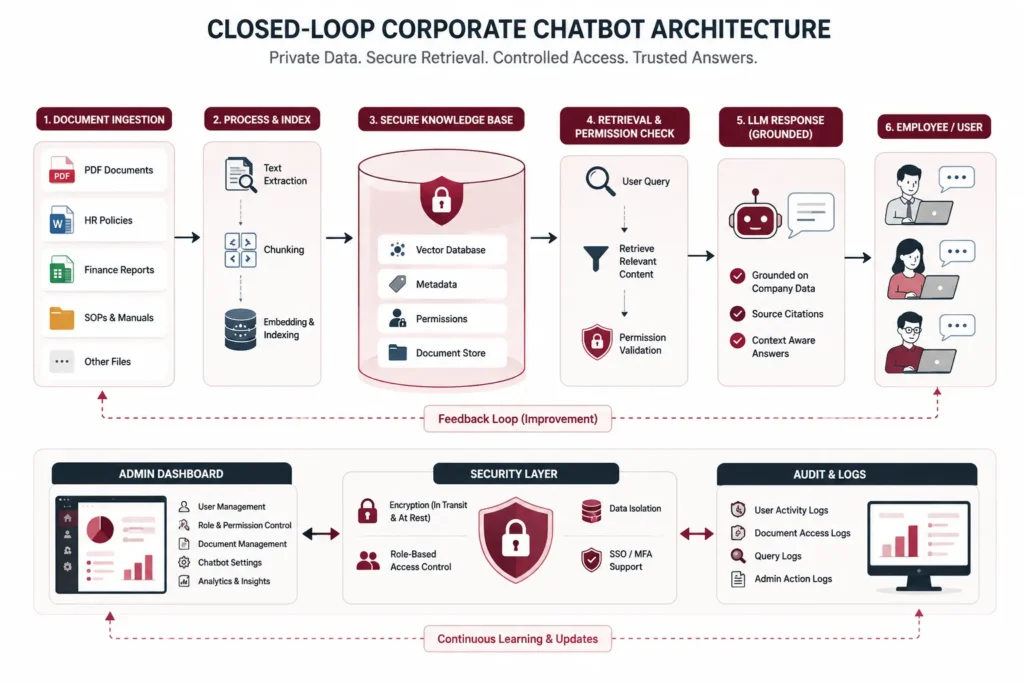
A closed-loop corporate chatbot is not just a chat box connected to an API.
It needs a complete knowledge workflow.
At a practical level, the system usually includes document ingestion, text extraction, chunking, indexing, retrieval, answer generation, permissions, analytics, and admin controls. For PDF-heavy companies, the ingestion layer matters because corporate documents are often messy. They include scanned files, tables, signatures, headers, annexures, policy pages, legal formatting, and inconsistent naming.
A strong enterprise chatbot should include:
| Product Layer | What It Does | Why It Matters |
|---|---|---|
| Document ingestion | Uploads PDFs, DOCX files, handbooks, contracts, SOPs, and internal manuals | Converts scattered company knowledge into usable AI context |
| Knowledge indexing | Organizes document chunks for retrieval | Helps the chatbot find the right source instead of guessing |
| Permission controls | Restricts answers based on user role, department, or document access | Prevents sensitive information from reaching the wrong users |
| Admin dashboard | Lets the company manage documents, users, roles, logs, and chatbot settings | Gives the platform operator control without constant developer dependency |
| Source citations | Shows which internal document informed the answer | Builds trust and supports review |
| Audit logs | Tracks usage, queries, uploads, and admin actions | Helps with governance, accountability, and internal monitoring |
| Branding controls | Allows agencies or consultants to white-label the product | Creates resale potential |
| Integration layer | Connects with HRMS, CRM, document storage, intranet, or ticketing systems where required | Moves the chatbot closer to daily enterprise workflows |
The market does not need another generic chat screen. It needs trusted AI infrastructure that sits between employees and corporate knowledge.
That is the difference between a chatbot demo and a B2B product.
Where the Money Is: Enterprise Licensing, Setup Fees, and White-Label Resale
The closed-loop corporate chatbot model gives founders several monetization paths.
A B2C chatbot often depends on low monthly subscription pricing and high user volume. A B2B chatbot can use premium pricing logic because it solves operational problems for teams with budgets.
Common monetization models include:
| Revenue Model | How It Works | Best For |
|---|---|---|
| Enterprise licensing | Company pays monthly or annually for chatbot access | SaaS founders targeting HR, legal, finance, or operations teams |
| Per-seat pricing | Company pays based on number of employee users | Internal knowledge assistants with broad employee adoption |
| Department-based pricing | HR, legal, or finance department pays for a dedicated chatbot environment | Specialized enterprise workflows |
| Setup and onboarding fees | Client pays for document setup, configuration, branding, and training | Agencies and consultants |
| White-label resale | Agency sells the chatbot under its own brand | Enterprise consultants, software resellers, digital agencies |
| Support and maintenance | Ongoing updates, document management, integrations, and admin support | Long-term B2B accounts |
| Custom integration fees | Additional billing for HRMS, CRM, ERP, or document management integrations | Larger enterprise clients |
The real margin opportunity is not just software access. It is packaged implementation.
Enterprises do not only need a chatbot. They need help deciding which documents to include, how to structure access, who can approve answers, what should be excluded, how to handle sensitive files, and how to measure usage.
That creates service revenue around the platform.
This is why the model is attractive for agency owners and enterprise consultants. They already understand client workflows. A white-label AI chatbot gives them a productized offer they can wrap with consulting, onboarding, internal training, and support.
Founder Decision Signals: When This Model Makes Sense
Founder Decision Signals
Speed
This model makes sense when you want to launch an AI business without building a general-purpose LLM product from zero. A ready-made white-label foundation can help you move faster into a specific B2B niche.
Cost
The strongest cost logic is avoiding a broad consumer AI battle. Instead of spending heavily on mass acquisition, you focus on fewer high-value corporate accounts with clearer pain points.
Scalability
Scalability depends on document handling, access control, answer quality, usage monitoring, and secure infrastructure. The backend matters more than the chat interface.
Market Fit
This is strongest when you target document-heavy teams such as HR, legal, finance, compliance, consulting, and enterprise operations.
A founder should consider this model if they have one of these advantages:
- access to enterprise decision-makers,
- consulting experience in HR, legal, finance, or operations,
- agency relationships with mid-market companies,
- ability to package onboarding and support,
- a strong niche positioning strategy,
- understanding of document-heavy workflows,
- willingness to sell B2B instead of chasing consumer downloads.
This is not the right model for founders who only want viral app growth, entertainment-style AI, or a low-touch consumer subscription business.
It is a better fit for founders who understand that B2B sales are slower but more valuable when the problem is urgent and the buyer has budget.
B2C Chatbot vs Closed-Loop Corporate Chatbot
| Factor | B2C General Chatbot | Closed-Loop Corporate Chatbot |
|---|---|---|
| Core user | Consumers, students, creators, casual users | HR, legal, finance, compliance, operations, consultants, agencies |
| Primary value | General AI conversation and content generation | Private company-specific answers from approved internal documents |
| Competitive pressure | Very high because Big Tech already dominates general AI access | More defensible when focused on niche workflows, integrations, and private data |
| Monetization | Low-cost subscriptions, ads, freemium upgrades | Enterprise licensing, setup fees, per-seat pricing, white-label resale, support retainers |
| Retention driver | Novelty, convenience, broad utility | Daily internal workflow dependency and trusted knowledge access |
| Technical priority | Model quality, UX, speed, consumer features | Retrieval quality, permissions, audit logs, admin control, secure document handling |
| Founder risk | High acquisition cost and weak differentiation | Requires B2B sales capability but has stronger pricing logic |
The Strongest Niches for Closed-Loop Corporate Chatbots
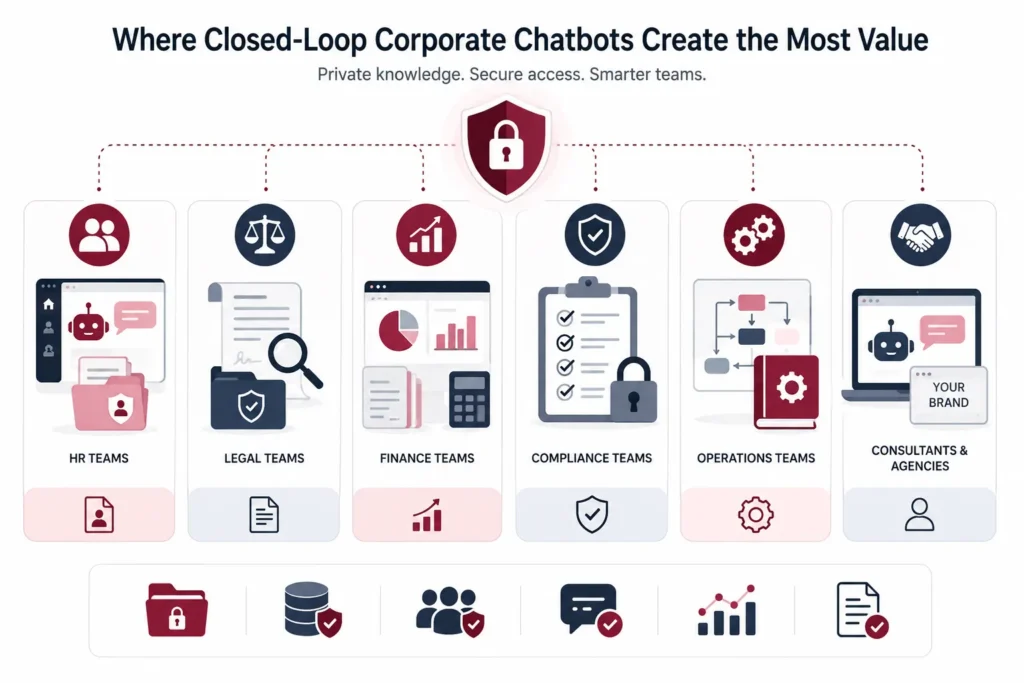
The best niche is not “AI chatbot for everyone.”
The strongest niche is a department where documents are painful, questions repeat often, and accuracy matters.
HR Knowledge Base Chatbot
HR teams are a natural starting point because employees repeatedly ask questions about leave, benefits, payroll, onboarding, holidays, remote work, reimbursements, performance reviews, and internal policies.
A private HR chatbot can answer from approved handbooks and policy PDFs. It can reduce repetitive HR queries while giving employees faster access to the right information.
Important modules include:
- employee policy document ingestion,
- department-specific access,
- escalation to HR,
- answer source references,
- admin approval controls,
- multilingual support where required,
- onboarding guide assistance.
Legal Document Chatbot
Legal teams deal with contracts, clauses, obligations, renewals, templates, vendor agreements, compliance files, and internal legal guidance.
A closed-loop legal chatbot can help users search approved documents faster. It should not replace legal review, but it can help teams retrieve relevant sections, summarize clauses, and understand where certain terms appear.
Important modules include:
- contract upload and indexing,
- clause search,
- document-level permissions,
- version control,
- audit logs,
- restricted access,
- human review workflows.
Finance and Compliance Chatbot
Finance and compliance teams need controlled information access. They work with policies, reporting rules, procurement guidelines, invoice processes, expense rules, approval workflows, and regulatory documents.
A private chatbot can help employees find the right policy without exposing sensitive files to unauthorized users.
Important modules include:
- role-based finance document access,
- audit-ready activity logs,
- secure storage,
- document update workflows,
- approval-based uploads,
- internal reporting dashboard.
Enterprise Consultant White-Label Chatbot
Consultants and agencies can use white-label AI chatbot infrastructure to create a productized B2B offer.
Instead of selling one-time strategy decks, they can sell setup, licensing, training, and ongoing support. The consultant becomes the AI implementation partner, while the white-label platform becomes the product foundation.
This model works well when the consultant already serves industries such as healthcare, legal services, real estate, fintech, HR, education, logistics, or enterprise operations.
Read More: The Thin Wrapper Death Trap: Why Basic ChatGPT Clones Will Go Bankrupt in 2026
The Technical Architecture Founders Should Understand
Founders do not need to become AI researchers, but they must understand the business impact of architecture.
A weak chatbot gives confident but unreliable answers. A strong corporate chatbot retrieves information from approved sources, respects permissions, and shows where the answer came from.
At a high level, the architecture includes:
- Document ingestion
The system accepts PDFs, DOCX files, spreadsheets, policy documents, and internal manuals. - Text extraction and cleaning
The platform extracts text, identifies sections, removes noise, and prepares content for retrieval. - Chunking and indexing
Documents are broken into searchable sections and indexed so the chatbot can retrieve relevant information. - Retrieval layer
When a user asks a question, the system searches the internal knowledge base for relevant document sections. - LLM response layer
The language model generates a response using retrieved company-specific context. - Permission filter
The system checks whether the user has access to the relevant document or answer category. - Admin dashboard
Platform operators manage users, documents, branding, logs, and settings. - Analytics and governance
The company tracks usage, repeated questions, failed answers, sensitive queries, and improvement opportunities.
Recent enterprise RAG research also shows why company-internal knowledge is a distinct problem from public web retrieval. Enterprise documents are scattered across tools, contain conflicting information, and require retrieval systems that handle realistic noise, permission boundaries, and absent information carefully.
That is why founders should not sell “AI magic.” They should sell controlled knowledge access.
Mistakes Founders Should Avoid
Building a Generic ChatGPT Alternative
Trying to compete as a broad consumer chatbot puts you against companies with stronger models, deeper infrastructure budgets, larger distribution channels, and faster release cycles.
Ignoring Permissions and Access Control
A corporate chatbot becomes risky if every employee can access every document. Role-based access control, audit logs, and admin permissions are not optional in enterprise environments.
Selling Features Instead of Business Outcomes
Enterprises do not buy chat interfaces. They buy faster internal search, fewer repetitive questions, controlled knowledge access, and better operational efficiency.
Uploading Messy Documents Without Governance
If outdated policies, duplicate files, and conflicting documents enter the system, the chatbot will produce weak answers. Document governance must be part of onboarding.
How Miracuves Helps Founders Build White-Label AI Chatbot Products
Founders do not need to build every AI chatbot module from zero to enter the enterprise AI market. In fact, starting from scratch can slow down validation, increase technical risk, and delay the most important part of the business: finding the right B2B use case.
The stronger path is to begin with a launch-ready AI chatbot foundation and customize it around a specific corporate workflow. That could mean building a private HR policy assistant, a legal document chatbot, an internal finance knowledge assistant, an employee onboarding bot, a compliance support tool, or a white-label AI product that consultants and agencies can resell to enterprise clients.
Miracuves helps founders, agencies, and businesses create ready-made and white-label AI chatbot solutions that can be tailored for branding, admin control, source-code ownership, private document workflows, and monetization strategy. This gives founders a faster way to move into the B2B AI market while still maintaining control over their niche, pricing, customer relationships, and product roadmap.
Instead of selling “another chatbot,” the goal is to sell a controlled AI knowledge system for businesses that already have valuable information locked inside PDFs, policies, contracts, SOPs, and internal manuals. With the right foundation, founders can position their product around enterprise outcomes: faster internal search, safer document access, reduced repetitive queries, and better knowledge visibility across teams.
For founders exploring this direction, Miracuves ChatGPT clone app AI automation solutions can provide a practical starting point for building a private, white-label corporate chatbot product
Final Thoughts: Stop Chasing Consumer AI Noise and Build Where Companies Already Have Pain
The real AI opportunity for most founders is not building a general chatbot for the public internet.
That market is crowded, expensive, and dominated by companies with massive model budgets and distribution power. The better opportunity is narrower, more practical, and more valuable: closed-loop corporate chatbots that help companies use their own internal knowledge safely.
HR teams need policy answers. Legal teams need contract search. Finance teams need controlled document access. Consultants need white-label AI products they can resell. Agencies need recurring SaaS offers that go beyond websites and campaigns.
That is where a closed-loop corporate chatbot becomes more than an AI feature. It becomes a B2B product foundation.
Miracuves helps founders move from idea to launch faster with ready-made, white-label app solutions built for branding, admin control, monetization, and source-code ownership. If you are planning an AI chatbot business, the smarter move is not to outspend Big Tech. It is to own a sharper enterprise use case.
FAQs
What is a closed-loop corporate chatbot?
A closed-loop corporate chatbot is a private AI assistant that answers questions using a company’s approved internal documents, such as HR policies, legal contracts, finance manuals, SOPs, onboarding guides, or compliance files. Unlike a public chatbot, it works inside a controlled knowledge environment with permissions, admin controls, and document governance.
Why is a closed-loop corporate chatbot better than a B2C AI chatbot business?
For most founders, a closed-loop corporate chatbot is more practical because it targets businesses with urgent internal knowledge problems and stronger willingness to pay. A general B2C chatbot competes with major AI platforms, while a corporate chatbot can focus on specific workflows such as HR, legal, finance, compliance, or operations.
Can agencies resell a white-label AI chatbot?
Yes. Agencies and enterprise consultants can use a white-label AI chatbot as a branded product for clients. They can charge for setup, document onboarding, branding, licensing, training, support, and custom integrations. This makes the model attractive for agencies that want recurring B2B SaaS revenue.
What documents can a private knowledge base chatbot use?
A private knowledge base chatbot can use PDFs, DOCX files, policy documents, employee handbooks, legal contracts, SOPs, onboarding manuals, internal FAQs, compliance documents, finance rules, and other approved company files. The quality of the output depends heavily on document quality, structure, permissions, and update workflows.
Is a corporate chatbot safe for sensitive company data?
A corporate chatbot can be designed with security-focused workflows such as encrypted data transfer, encrypted storage, role-based access control, admin permissions, audit logs, and secure API integrations. Final compliance depends on the company’s jurisdiction, legal review, hosting model, integrations, and operating process.
What teams benefit most from internal knowledge base AI?
HR, legal, finance, compliance, operations, customer support, procurement, and enterprise consulting teams are strong use cases. These teams often manage large volumes of repeated questions, policy documents, contracts, manuals, and internal process information.
How does a closed-loop AI chatbot make money?
The strongest monetization models include enterprise licensing, per-seat pricing, department-based subscriptions, setup fees, onboarding fees, white-label resale, support retainers, and custom integration fees. B2B monetization usually works better when the chatbot solves a measurable internal workflow problem.
How can Miracuves help build a white-label corporate chatbot?
Miracuves can help founders and agencies build white-label AI chatbot solutions with branded interfaces, admin dashboards, source-code ownership, document workflows, and customization support. The product can be positioned around specific B2B use cases such as HR policy search, legal document assistance, finance knowledge access, or consultant-led enterprise AI deployment.