




Key Takeaways
- GPS accuracy directly affects delivery performance.
- Poor tracking can create “ghost driver” issues.
- Real-time location updates require optimized architecture.
- Map APIs alone cannot guarantee tracking accuracy.
- Reliable GPS improves customer trust and retention.
Tracking Signals
- Use adaptive GPS refresh rates for efficiency.
- Combine GPS, network, and device location data.
- Monitor driver connectivity and signal quality.
- Use route validation to reduce tracking errors.
- Optimize map and location API usage.
Real Insights
- Inaccurate GPS can increase delivery complaints.
- Cheap scripts often struggle with location reliability.
- Tracking quality impacts operational efficiency.
- Location architecture should be tested at scale.
- Miracuves builds delivery platforms with enterprise-grade GPS tracking systems.
For a customer, live tracking is a convenience feature. For a fleet manager, it is an operational truth layer.
That difference matters.
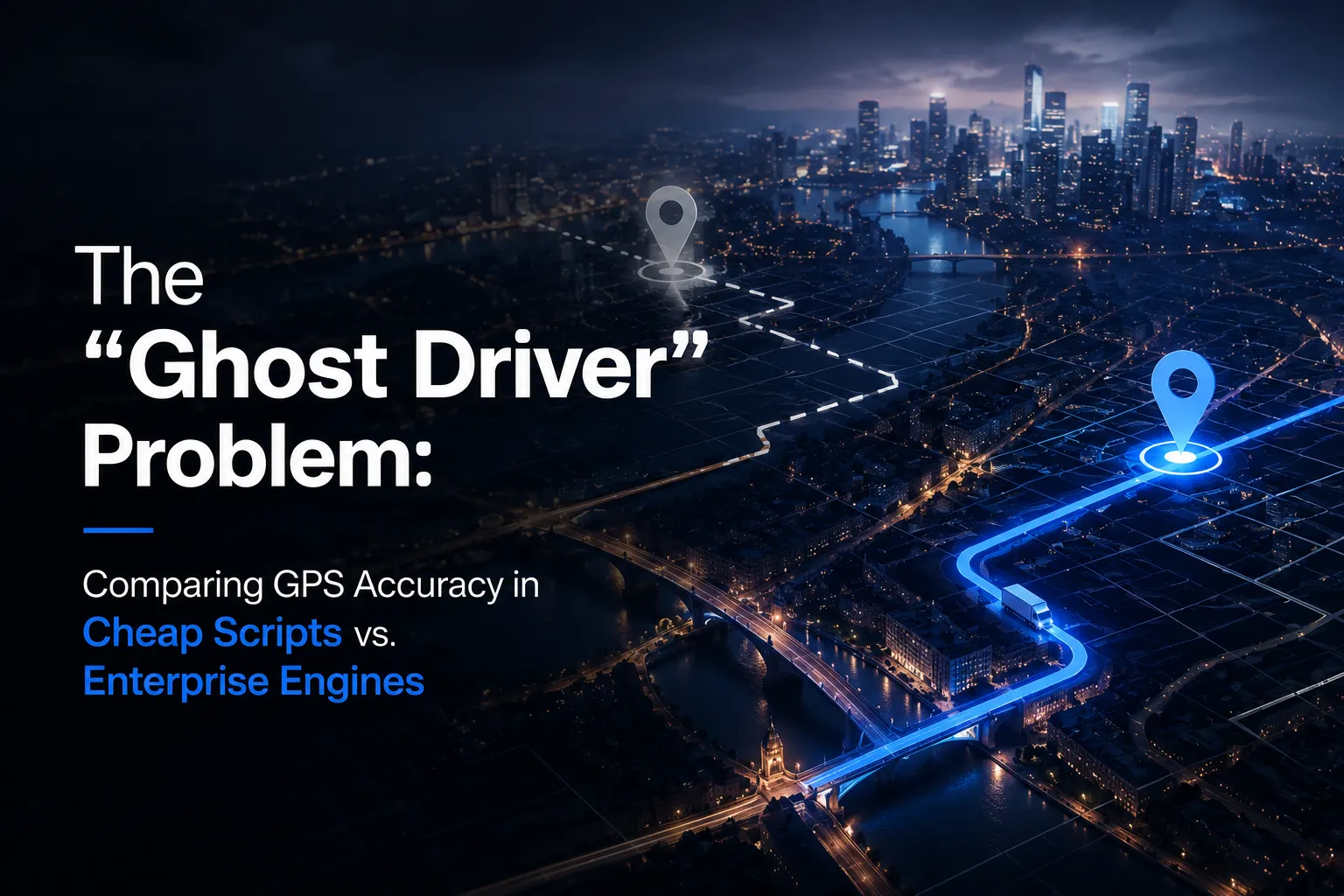
A low-tier delivery script may show a driver icon moving on the map, but that does not mean the dispatch engine is working with accurate driver proximity. In many cheap clone scripts, driver location is updated through delayed HTTP polling, cached GPS records, or poorly managed background location services. The result is a common but costly logistics failure: the “ghost driver.”
A ghost driver is a driver who appears closer on the dispatch map than they actually are. The system assigns the order based on stale coordinates, the driver receives a job that does not match their real position, and the operation loses time before anyone realizes the map lied.
For small order volumes, this may look like a minor delay. For a busy food delivery, courier, grocery, or hyperlocal logistics business, it becomes a dispatch nightmare.
Miracuves approaches delivery app architecture differently. Instead of treating GPS tracking as a decorative map feature, a scalable delivery engine must treat location freshness as a dispatch-critical system layer. That is why real-time communication, WebSocket-based updates, admin visibility, driver status logic, and clean backend event handling matter when building a white-label fleet app.
The Dispatch Nightmare: What Happens When Your Map Is 60 Seconds Late
A 60-second delay does not sound dramatic until you understand how fast last-mile operations move.
In one minute, a delivery driver may cross two intersections, enter a pickup zone, leave a parking area, take a wrong turn, accept another task, or lose network coverage. If your dispatch panel is showing that driver’s old position, your assignment engine is not making a decision based on reality. It is making a decision based on history.
That is where ghost drivers appear.
On the admin map, Driver A looks 800 meters away. Driver B looks 1.7 kilometers away. The system assigns Driver A because the cached location says Driver A is closer. But in reality, Driver A has already moved farther away, while Driver B is now the better option.
This creates a chain reaction:
- The wrong driver receives the order.
- Pickup time increases.
- Restaurant or warehouse wait time becomes harder to manage.
- Customer ETA becomes inaccurate.
- The driver feels blamed for a system mistake.
- Dispatchers lose confidence in the map.
- Operations teams start making manual calls instead of trusting automation.
That final point is the most expensive one. Once dispatchers stop trusting the system, the app becomes a record-keeping tool instead of an operations engine.
A cheap delivery script may still show “live tracking,” but live tracking is not the same as dispatch-grade tracking. A customer map can tolerate some smoothing or delay. A dispatch engine cannot.
Read more: Food Delivery App Development Guide: Features, Cost, Process & Business Insights
Why “Live Driver Tracking” Is Not Always Real-Time Tracking
Many low-cost scripts use the phrase “live tracking” because the driver marker changes position. But a moving marker does not prove that the backend is receiving, processing, and broadcasting fresh GPS events with operational accuracy.
There are three different layers to understand.
First, the driver device captures GPS coordinates. Second, the backend receives and stores that location. Third, the dispatch dashboard, customer app, and assignment engine consume that data.
The ghost driver problem appears when one of these layers is delayed, cached incorrectly, or refreshed too slowly.
For example, the driver app may collect a new GPS point, but the backend may only update the driver’s public location every 30 to 60 seconds. Or the backend may store the latest value correctly, but the dispatch dashboard may still show old data because it only fetches updates on intervals. Or the map may animate smoothly between old points, making the driver appear active even when the real location is stale.
That is why operations teams should not ask only, “Does the script have GPS tracking?”
They should ask:
- How frequently is driver location captured?
- How frequently is it sent to the backend?
- Is the backend using polling or persistent real-time communication?
- How does the system handle weak network zones?
- How does it mark stale location data?
- Can dispatchers see when a driver’s location is outdated?
- Does the assignment engine use fresh coordinates or cached coordinates?
- Are driver availability and driver movement treated as separate states?
These questions reveal whether the platform is built for real fleet control or just basic visual tracking.
HTTP Polling vs. Real-Time WebSockets: A Technical Comparison
HTTP polling is simple. The app repeatedly asks the server, “Do you have a new location?” The server replies. Then the app waits and asks again.
This can work for low-frequency updates. It is not ideal for busy delivery operations where driver location, order state, ETA, and assignment decisions change continuously.
WebSockets work differently. A WebSocket connection creates an open communication channel between the client and server, allowing data to move without the client repeatedly polling for every update. MDN describes WebSockets as enabling a two-way interactive communication session without needing to poll the server for a reply. AWS also explains that WebSocket APIs support two-way communication between client apps and backend systems.
For fleet dispatch, that difference is not theoretical. It changes how fast the operations layer can react.
| Architecture Layer | Cheap Script With HTTP Polling | Enterprise Engine With WebSockets | Operational Impact |
|---|---|---|---|
| Driver location updates | Sent or fetched at intervals | Streamed through persistent real-time connection | Fresher driver position for assignment |
| Dispatch dashboard | Refreshes periodically | Updates as events arrive | Less manual checking by dispatchers |
| Driver availability | Often mixed with location status | Can be separated into online, active, idle, assigned, unreachable | Better fleet visibility |
| ETA accuracy | Based on delayed or cached coordinates | Based on fresher location events | More reliable customer and operations estimates |
| Network recovery | May overwrite or delay updates | Can be engineered with event queues and stale-state handling | Fewer ghost drivers |
| Scalability | Polling load increases with fleet size | Event-driven model is better suited for high-frequency updates | More stable during peak hours |
A delivery platform is not judged during quiet hours. It is judged during lunch rush, evening peaks, bad weather, festival demand, and traffic disruption.
That is when polling-based systems often start exposing their limits. Every customer, driver, and dispatcher may be asking for updates at the same time. If the backend is not designed for this load, updates slow down exactly when the operation needs accuracy most.
Read more: How to Start a Regional Food Delivery Platform Business
The Ghost Driver Variable: Where Cheap Scripts Fail Operationally
The ghost driver variable is not one bug. It is a combination of architecture shortcuts.
The most common causes include delayed GPS caching, slow polling intervals, weak background tracking, missing stale-data indicators, poor driver state management, and map animation that visually hides backend delay.
A $100 clone script can look impressive in a demo because demos usually happen with one or two test drivers. The map moves. The driver accepts an order. The customer sees a route. Everything looks functional.
Real operations are different.
In production, drivers move through patchy mobile networks. Some drivers keep battery saver mode on. Some enter basements, malls, dense urban streets, kitchens, warehouses, or loading zones. Some apps get pushed into the background. Some drivers reject tasks while moving. Some accept orders and then lose signal.
A strong dispatch engine must handle all of that without pretending stale data is fresh.
This is where enterprise-grade thinking matters. A logistics platform should not only store latitude and longitude. It should understand timestamp freshness, driver state, last known movement, task assignment, device status, order priority, and operational confidence.
Hardcoding Dispatch Accuracy Into Your White-Label Fleet App
Dispatch accuracy should be built into the product foundation, not added later as a patch.
For a white-label fleet app, the architecture should define how location data behaves before launch. This includes how often the app captures location, how frequently it sends updates, how the backend validates freshness, how the dispatch panel displays uncertainty, and how the assignment logic avoids stale coordinates.
A stronger delivery engine should include:
- Real-time driver location streaming
- WebSocket-based communication for dispatch dashboards
- Driver online, idle, assigned, unreachable, and offline states
- Timestamp-based stale location warnings
- Last-known-location handling
- Route-aware assignment logic
- Admin controls for manual reassignment
- Driver app background tracking workflows
- Push notifications for assignment changes
- Audit logs for disputed assignments
- Analytics for failed dispatches and delayed pickups
Miracuves builds delivery and logistics app foundations around this kind of operational control. For founders planning food delivery, grocery delivery, courier delivery, or multi-service logistics platforms, the goal is not simply to launch a driver app. The goal is to launch a fleet control layer that dispatchers, drivers, and customers can trust.
Why Driver Trust Breaks When GPS Accuracy Fails
Fleet managers often focus on customer experience, but driver trust is just as important.
When a system assigns the wrong driver because of stale GPS data, the driver feels the operational pain first. They receive a task that does not make sense. They may be blamed for delays they did not cause. They may reject more orders because they stop trusting assignment logic. Over time, this creates friction between drivers and operations teams.
A good dispatch system protects driver trust by making assignments feel fair and explainable.
Drivers do not need to understand WebSockets, caching, or backend event handling. But they immediately understand whether the system is giving them reasonable jobs. If a driver is repeatedly assigned pickups that are farther away than expected, they assume the platform is poorly managed.
That affects acceptance rates, driver retention, support tickets, and operational culture.
This is why GPS accuracy is not just a technical issue. It is a workforce management issue.
What Operations Leaders Should Test Before Buying a Delivery Script
Before choosing a food delivery development or logistics clone app, operations teams should test the engine under realistic conditions.
Do not only watch a vendor demo. Ask for a workflow test.
A useful test should include multiple drivers moving at the same time, background app behavior, poor network simulation, rapid assignment changes, rejected orders, manual reassignment, and dashboard refresh behavior. The question is not whether the marker moves. The question is whether the dispatch decision remains correct when conditions change.
Use this checklist before selecting a delivery app architecture:
| Test Area | What to Check | Why It Matters |
|---|---|---|
| Location freshness | Does the dashboard show when driver data is stale? | Prevents ghost driver assignments |
| Assignment accuracy | Does the nearest driver logic use current data? | Improves pickup speed |
| Background tracking | Does the driver app continue updating during active delivery? | Reduces location gaps |
| WebSocket behavior | Are updates pushed in real time to admin/customer views? | Improves dispatch visibility |
| Network recovery | What happens when a driver reconnects? | Prevents wrong location overwrites |
| Driver states | Can the system distinguish idle, assigned, offline, and unreachable drivers? | Avoids false availability |
| Audit trail | Can admins review assignment and location history? | Helps resolve disputes |
| Peak load | Does tracking remain stable with many active drivers? | Protects rush-hour operations |
If the vendor cannot clearly explain these layers, the script may be a visual app package, not a dispatch-ready logistics engine.
Cheap Script vs. Enterprise Engine: The Real Difference
The difference between a cheap delivery script and an enterprise-grade engine is not only code quality. It is operational design.
Cheap scripts are often built to demonstrate features. Enterprise engines are built to preserve decisions under pressure.
A cheap script asks, “Can the user place an order and see a driver?”
An enterprise delivery engine asks, “Can the system assign the right driver, at the right time, with the freshest available data, while keeping dispatchers, drivers, merchants, and customers aligned?”
That is a very different product standard.
| Decision Area | Low-Tier Delivery Script | Enterprise-Grade Delivery Engine |
|---|---|---|
| Product mindset | Feature checklist | Operational reliability |
| GPS logic | Basic tracking | Location freshness and event handling |
| Dispatch model | Nearest driver from cached data | Real-time assignment logic |
| Admin panel | Order overview | Fleet command center |
| Driver experience | Accept/reject tasks | Trustworthy task allocation |
| Scaling | Works in demo or small market | Designed for peak-hour load |
| Ownership | Often limited or hard to modify | Source-code-owned foundation |
| Long-term fit | Useful for basic launch tests | Better for serious fleet operations |
Miracuves’ white-label delivery app approach is built for operators who need more than a customer-facing ordering app. It supports the deeper control layer required for dispatch accuracy, fleet visibility, admin decisions, and scalable logistics workflows.
Read more: Online Food Delivery Platform Development: Hidden Costs You Should Know
Founder Decision Signals
Founder Decision Signals
Speed
If your market requires fast launch, a ready-made platform can help. But speed should not come at the cost of stale dispatch data or weak GPS handling.
Cost
A low-cost script may reduce upfront spend, but wrong assignments, support escalations, and driver churn can create hidden operational costs.
Scalability
Polling-based tracking may work with a few drivers, but high-frequency fleet updates require stronger backend architecture and event handling.
Market Fit
If your business depends on fast pickup, reliable ETA, and driver acceptance, GPS accuracy should be treated as a launch-critical requirement.
How Miracuves Helps Hardcode Real-Time Dispatch Control
Miracuves helps founders and logistics operators build ready-made and white-label delivery app solutions with source-code ownership, branded design, admin control, and real-time operational workflows.
For delivery businesses, this means the app foundation can be shaped around customer ordering, merchant/vendor workflows, driver apps, dispatch dashboards, route visibility, payment flows, and operational reporting. Miracuves’ food delivery app category also includes content around sub-2-second tracking, GPS delivery updates, Flutter/Laravel workflows, and WebSocket-based tracking concepts, showing that tracking speed is already part of the Miracuves delivery content ecosystem.
For broader courier and logistics platforms, Miracuves also publishes logistics-focused content around real-time shipment tracking, route optimization, driver/courier workflows, admin dashboards, and scalable architecture.
The important point is this: a serious fleet app should not be purchased only by looking at screens. It should be evaluated by how accurately it supports operations when orders, drivers, traffic, and customer expectations are all moving at once.
Mistakes Fleet Teams Should Avoid
Mistakes Fleet Teams Should Avoid
Buying a script only because the demo map moves
A moving marker does not prove dispatch accuracy. Test stale data handling, driver state updates, background tracking, and assignment logic before choosing a platform.
Ignoring the difference between polling and real-time updates
Polling can create delayed location visibility during peak operations. WebSocket-based communication is better suited for live dispatch dashboards and high-frequency driver movement.
Not showing stale location warnings to dispatchers
If the admin panel does not show when driver location is outdated, dispatchers may assign orders based on false proximity.
Treating GPS accuracy as a post-launch upgrade
Location freshness affects the entire operating model. It should be part of the core architecture, not a patch added after drivers and customers lose trust.
Final Thoughts: Dispatch Accuracy Is a Business Decision
The ghost driver problem proves that delivery app architecture is not just a developer concern. It directly affects pickup speed, ETA reliability, driver trust, customer satisfaction, and operations team confidence.
Cheap scripts may help a founder see a basic product quickly. But when a business depends on real fleet movement, high-order volume, and accurate dispatching, the platform needs stronger GPS logic, real-time communication, admin controls, and backend reliability.
The smarter question is not, “Does this script include live tracking?”
The smarter question is, “Can this engine make the right dispatch decision from fresh location data during peak pressure?”
For founders and logistics teams that need a white-label delivery app with stronger operational control, Miracuves can help create a source-code-owned, scalable fleet app foundation designed around real dispatch accuracy instead of surface-level tracking.
FAQs
What is the ghost driver problem in delivery apps?
The ghost driver problem happens when a delivery app shows a driver as closer than they actually are because the system is using stale GPS data. This can lead to wrong order assignments, delayed pickups, inaccurate ETAs, and driver frustration.
Why do cheap food delivery scripts show wrong driver locations?
Cheap food delivery scripts may rely on slow HTTP polling, delayed GPS caching, weak background location handling, or simple map refreshes. These shortcuts can make the app look functional in a demo but unreliable during real fleet operations.
Is HTTP polling bad for delivery tracking?
HTTP polling is not always bad, but it is limited for high-frequency dispatch use cases. It repeatedly asks the server for updates at intervals, which can create delays. For real-time fleet dashboards and driver tracking, WebSocket-based communication is usually better suited.
Why are WebSockets important for delivery app GPS tracking?
WebSockets allow a persistent two-way communication channel between client and server. This helps driver location, order status, and dispatch updates move faster across the system without waiting for repeated polling requests.
How does GPS accuracy affect driver trust?
Drivers lose trust when the app assigns jobs based on wrong proximity. If a driver is blamed for delays caused by stale system data, acceptance rates and morale can suffer. Accurate dispatch logic helps make assignments feel fair and operationally reliable.
What should fleet managers test before buying a delivery script?
Fleet managers should test location freshness, background tracking, stale-location warnings, driver state management, WebSocket behavior, network recovery, assignment accuracy, and peak-load performance before choosing a delivery script.
Can a white-label delivery app support enterprise-grade tracking?
Yes, a white-label delivery app can support enterprise-grade tracking if the architecture includes real-time updates, strong backend event handling, driver state controls, admin dashboards, and scalable infrastructure. The quality depends on how the app is engineered, not only whether it is white-label.
How can Miracuves help with fleet app development?
Miracuves helps founders and logistics operators build white-label delivery and fleet apps with source-code ownership, admin dashboards, branded workflows, and real-time operational layers that support accurate dispatching and scalable fleet control.