




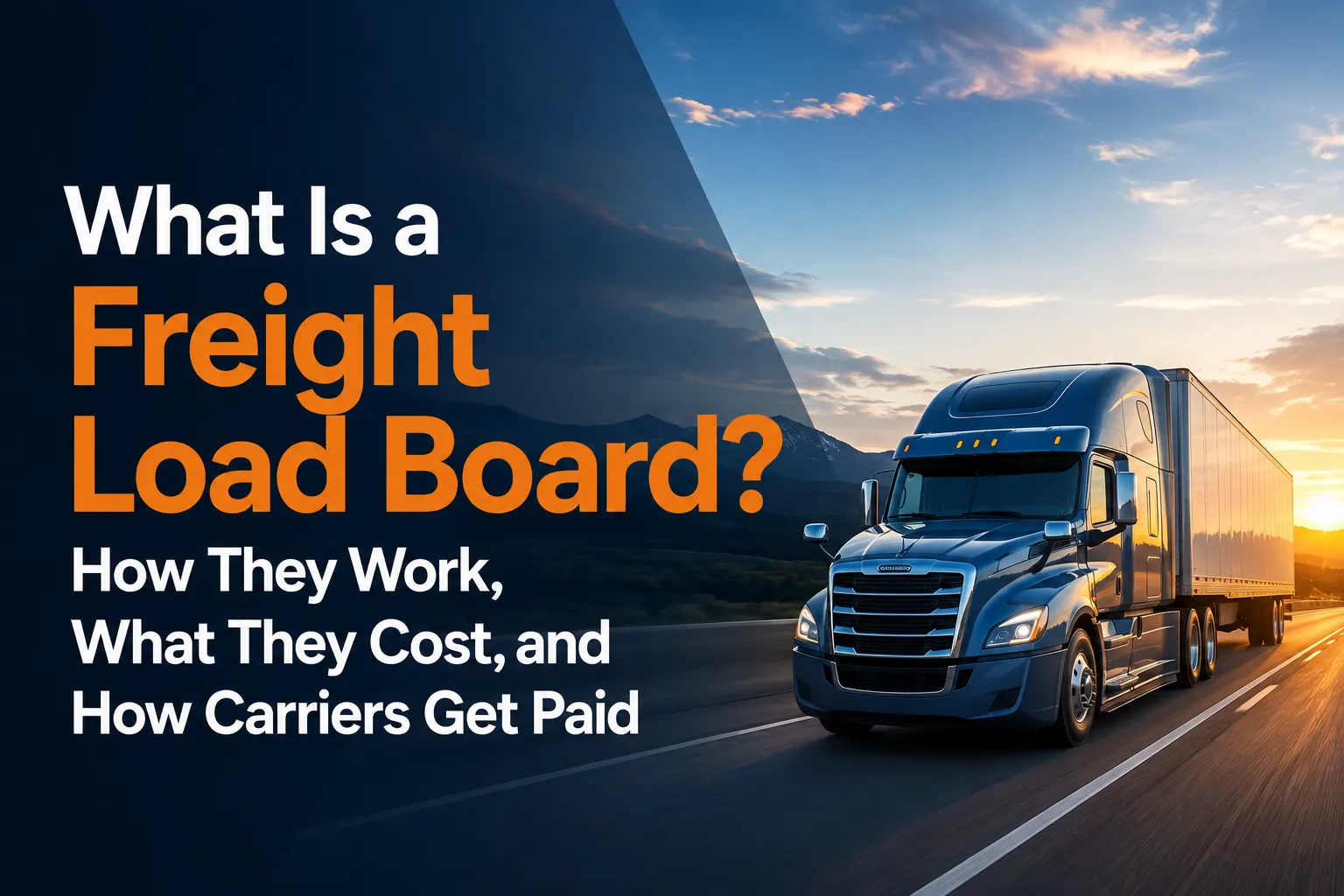
A freight load board is a digital marketplace where brokers and shippers post available freight, and carriers search for loads they can haul. It exists to solve one of the most expensive problems in trucking: trucks running empty.
At a basic level, a load board helps carriers find freight and helps brokers cover shipments faster. But in real logistics operations, the value goes much deeper. A strong freight load board affects route planning, deadhead miles, broker selection, payment timing, paperwork, fraud risk, and carrier cash flow.
That is why a modern freight load board is not just a listings page. It is a freight marketplace, a data product, a document workflow, and a trust system built around real transportation economics.
For founders and logistics businesses, this model has strong marketplace potential. A freight load board clone can generate revenue through carrier subscriptions, broker posting plans, premium rate data, featured listings, factoring partnerships, and enterprise tools. But success depends on more than building screens. The real challenge is creating liquidity, trust, verified users, clean data, and reliable workflows.
Key Takeaways
- A freight load board connects brokers, shippers, and carriers in a digital marketplace for available freight.
- Load boards are most useful in the spot freight market, where freight needs to move quickly and pricing changes by lane, capacity, timing, and urgency.
- The posted rate is not always the true earning rate. Carriers must calculate deadhead miles, fuel, accessorials, detention, and payment costs.
- Broker payment history matters as much as the load rate because a high-paying load from a risky broker can hurt carrier cash flow.
- For founders, the real cost of building a freight load board is not only app development. Data, verification, fraud prevention, integrations, and marketplace liquidity are the harder layers.
- Miracuves helps founders launch white-label, source-code-owned load board platforms with carrier, broker, shipper, and admin workflows.
What Is a Freight Load Board?
A freight load board is an online platform where freight brokers, shippers, and carriers connect around available loads. Brokers and shippers post freight that needs to be moved. Carriers search for loads based on origin, destination, equipment type, pickup time, rate, weight, and route preference.
Instead of calling multiple brokers manually, a carrier can open a load board and see available freight within a specific radius. This helps owner-operators, small fleets, dispatchers, and carriers reduce empty miles and find better-paying lanes.
Most freight load boards support three core user groups:
- Carriers and owner-operators who need freight to haul.
- Freight brokers who need available trucks to move customer freight.
- Shippers who need access to transportation capacity.
A basic load board may only show listings. A stronger freight load board includes broker credit data, lane rate insights, saved searches, alerts, carrier verification, mobile access, document upload, proof of delivery, and payment-support workflows.
For founders, this distinction matters. A simple board can be copied easily. A verified, data-driven freight marketplace with payment and trust workflows is much harder to replace.
Why Freight Load Boards Matter in Trucking
Trucking economics are heavily affected by deadhead miles. Deadhead means the truck is moving with an empty trailer. The carrier is still paying for fuel, driver time, insurance, maintenance, and equipment wear, but those miles generate no revenue.
A freight load board helps carriers reduce this problem by making nearby freight visible before or soon after delivery. If a driver is delivering in Atlanta today, they can search for outbound Atlanta loads before the truck becomes empty. This turns idle time into revenue opportunity.
Freight is also time-sensitive. A load that needs to move Tuesday may lose value by Thursday. Brokers often need to cover freight quickly to satisfy shipper commitments. Load boards help brokers reach available carriers faster than phone-based workflows.
This is why a load board solves two problems at once:
- It helps carriers reduce empty repositioning.
- It helps brokers cover time-sensitive freight faster.
The best load boards do not simply show freight. They help users make better freight decisions.
Read More: How Load Board & Freight Marketplace Apps Make Money: The Business Model Explained
A Simple Example: How a Carrier Uses a Load Board
Imagine an owner-operator running a dry van route.
On Monday, the driver delivers into Atlanta at 11:00 AM. Without a load board, they may wait for a dispatcher’s call or drive empty toward another market. With a load board, they can search for outbound freight within 100 or 150 miles and find a Tuesday pickup going toward Charlotte.
On Tuesday, they book Atlanta to Charlotte at a visible rate. Before accepting, they check deadhead miles, broker payment history, weight, pickup window, and delivery appointment.
On Wednesday, Charlotte looks weak for outbound freight. The carrier checks rate data and sees stronger freight near Greensboro. They may take a short repositioning load or move strategically toward a better-paying lane.
By Friday, the driver has completed several loaded moves with less waiting and fewer empty miles.
The result is not one perfect load. The real value is a better sequence of decisions. Visibility compounds across the week.
This is why rate data, broker data, and alert speed are often more valuable than listing volume alone.
How Does a Freight Load Board Work?
A freight load board works by matching available freight with available carrier capacity. The platform collects load information from brokers or shippers and makes it searchable for verified carriers.
The surface workflow looks simple, but the backend must support search, filtering, location matching, equipment matching, notifications, user verification, documents, payments, and risk controls.
Carrier Workflow
A carrier usually follows this process:
- Logs in through a mobile app or web dashboard.
- Sets current location, destination preference, pickup date, and radius.
- Filters by equipment type such as dry van, reefer, flatbed, tanker, power only, or hotshot.
- Reviews load details such as origin, destination, rate, miles, weight, commodity, and appointment time.
- Checks broker details, payment history, authority, bond status, and reviews.
- Contacts the broker, submits an offer, negotiates, or books instantly depending on the platform.
- Receives the rate confirmation after the load is awarded.
- Picks up freight, delivers it, submits proof of delivery, and invoices.
Broker or Shipper Workflow
A broker or shipper usually follows this process:
- Posts a load with lane, pickup, delivery, equipment, commodity, weight, and timing.
- Adds a rate or invites offers from carriers.
- Reviews available carriers or incoming bids.
- Checks carrier authority, insurance, safety data, and equipment fit.
- Awards the load to a carrier.
- Issues the rate confirmation.
- Tracks pickup, delivery, documents, and payment status.
Freight Load Board Workflow by User Type
| User | What They Do | Business Value |
|---|---|---|
| Carrier | Searches loads, checks rates, reviews broker payment data, negotiates, and accepts freight. | Reduces empty miles and improves route revenue. |
| Broker | Posts freight, finds available trucks, screens carriers, and issues rate confirmations. | Improves load coverage speed and shipper reliability. |
| Shipper | Posts freight directly or works through brokers to move goods. | Gets wider access to carrier capacity. |
| Platform Operator | Manages users, listings, verification, disputes, subscriptions, payments, and reporting. | Builds a scalable digital freight marketplace with recurring revenue potential. |
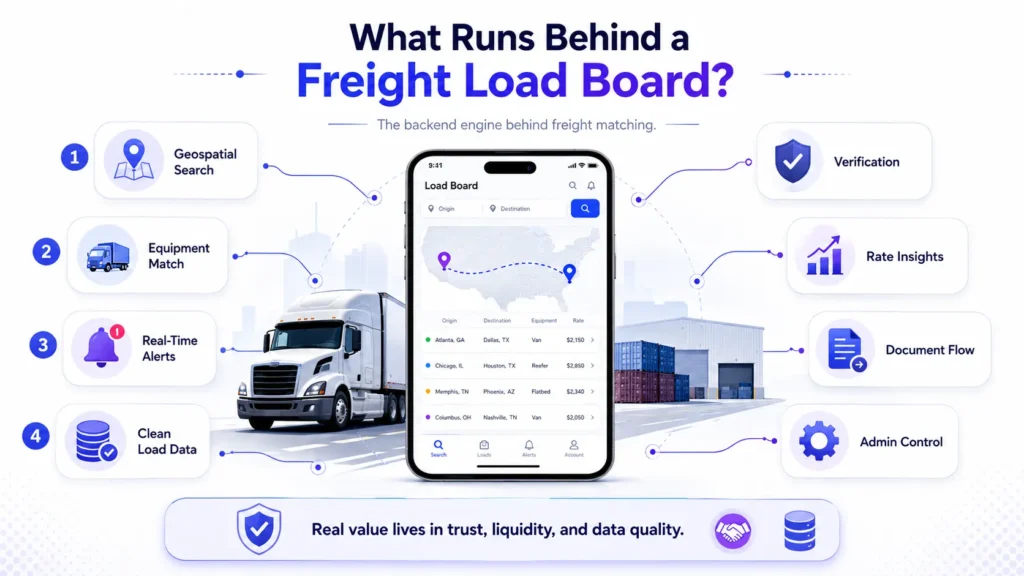
What Runs Behind a Freight Load Board?
The front end may look like a search tool, but the platform underneath must handle logistics-specific complexity. This is where working with a web app development company becomes useful, especially when the platform needs admin dashboards, broker portals, carrier panels, analytics, and document workflows.
A strong freight load board needs:
- Geospatial search so carriers can find loads within a selected radius.
- Equipment matching so a reefer load is not shown to an unsuitable carrier.
- Real-time alerts so carriers hear about relevant freight quickly.
- Load expiry and deduplication so stale or duplicate posts do not damage trust.
- Broker and carrier verification to reduce fraud and compliance risk.
- Rate data to help users compare offers against lane conditions.
- Document workflows for rate confirmations, BOLs, PODs, receipts, and invoices.
- Admin controls for disputes, user approvals, reports, subscriptions, and platform rules.
For a founder, these backend workflows are where the real product value lives. Screens can be built quickly. Freight trust, liquidity, and data quality take more planning.
From Booking to Bank: How Carriers Actually Get Paid
Finding a load is only the visible part of the transaction. Getting paid is the part that determines whether the carrier’s business stays healthy.
A carrier can book a load today and still wait 30 to 60 days for payment unless they use quick pay or factoring. That is why document handling and payment visibility are essential parts of a serious load board platform.
1. Rate Confirmation
The rate confirmation, often called the rate con, is the binding document issued by the broker after a load is awarded. It should include the agreed rate, pickup and delivery appointments, accessorial terms, reference numbers, and special instructions.
A carrier should never move freight without checking that the rate confirmation matches the verbal agreement. If the paperwork is wrong, payment disputes become much harder to resolve.
2. Bill of Lading
The bill of lading, or BOL, is issued at pickup. It documents the goods being transported, the parties involved, and the shipment terms.
The BOL is signed at pickup and again at delivery. The signed delivery copy becomes part of the proof of delivery.
3. Proof of Delivery
Proof of delivery, or POD, is usually the signed BOL and any supporting delivery receipt. Without POD, the carrier usually cannot invoice successfully.
This is why in-app document capture is valuable. A load board app that allows carriers to upload delivery documents, receipts, and photos can reduce paperwork delays and protect payment workflows.
4. Accessorial Charges
Accessorials are charges beyond the basic line-haul rate. These can protect carrier margins when delays or extra work happen.
Common Freight Accessorial Charges
| Accessorial | What It Covers | Why It Matters |
|---|---|---|
| Detention | Waiting beyond the free time at pickup or delivery. | Carriers must document wait time clearly or the charge may be denied. |
| Layover | Overnight delay caused by shipper or receiver issues. | Protects the carrier from losing a full operating day. |
| Lumper Fee | Third-party loading or unloading labor, common in grocery freight. | The carrier may pay upfront and need reimbursement with receipt. |
| TONU | Truck Ordered Not Used after dispatch. | Only recoverable if agreed in the rate confirmation. |
| Stop-off | Additional pickup or delivery points. | Should be priced before dispatch, not after delivery. |
5. Invoice and Payment Terms
After delivery, the carrier submits an invoice with the POD and required paperwork. Standard broker payment terms often run 30 days and may stretch to 45 or 60 days.
This creates a cash-flow gap because fuel, tolls, driver expenses, maintenance, and equipment costs happen immediately. Small carriers and owner-operators feel this gap more sharply than large fleets.
6. Quick Pay and Factoring
Carriers often use quick pay or factoring to get paid faster.
Quick pay is usually offered by the broker. The carrier accepts a small percentage fee in exchange for faster payment.
Factoring is usually offered by a factoring company. The factor advances payment to the carrier and collects from the broker later.
Carrier Payment Options After Delivery
| Payment Option | Typical Speed | Trade-off |
|---|---|---|
| Standard Terms | Usually 30 to 60 days | Carrier receives the full amount but waits longer for cash. |
| Broker Quick Pay | Often within a few days | Faster payment, but the broker deducts a fee. |
| Recourse Factoring | Often 1 to 2 days | Lower fee, but the carrier may carry risk if the broker does not pay. |
| Non-Recourse Factoring | Often 1 to 2 days | Higher fee, but the factor may carry approved credit risk. |
For platform founders, this payment gap creates a strong monetization opportunity. A freight load board that already sees the load, rate confirmation, delivery document, broker history, and invoice can support embedded finance, factoring partnerships, or quick-pay integrations more naturally than a generic financial provider.
How Carriers Calculate the Real Rate
A listed rate can look profitable until deadhead miles and operating costs are included.
For example, a load paying $2.40 per mile over 400 loaded miles pays $960. But if the carrier drives 90 empty miles to reach pickup, the real calculation changes.
$960 divided by 490 total miles equals about $1.96 per mile actually driven.
That is why experienced carriers do not only evaluate loaded miles. They calculate total miles, fuel cost, time, accessorial risk, broker payment history, and whether the load positions them for the next profitable move.
A strong freight load board should help carriers evaluate:
- Loaded miles
- Deadhead miles
- All-in rate
- Fuel impact
- Pickup and delivery wait risk
- Lane history
- Broker payment history
- Next-lane opportunity
A board that shows only the advertised loaded rate may make a load look better than it really is.
What Types of Freight Load Boards Exist?
Not all load boards work the same way. Some are open marketplaces. Some are private networks. Some focus on specific freight types or equipment categories.
Types of Freight Load Boards
| Type | Best For | Trade-off |
|---|---|---|
| Open Load Board | Carriers and brokers looking for broad market access. | More competition, more noise, and higher fraud exposure. |
| Private Load Board | Vetted carrier and broker networks. | Better trust, but lower listing volume. |
| Managed Marketplace | Users who want simplified booking and payment flow. | The platform may take a margin and reduce rate transparency. |
| Vertical Load Board | Specialized freight such as reefer, flatbed, tanker, auto transport, or hazmat. | Narrower market, but stronger fit for specific users. |
| Regional Load Board | Businesses focused on a corridor, country, state, or logistics region. | Limited geography, but better chance of building dense liquidity. |
Most working carriers use more than one board. One broad board may provide volume, while a specialized or regional board may provide better-fit freight.
For founders, this means differentiation matters. A new load board should not try to beat every existing platform on national listing volume from day one. It should start with a focused lane, equipment category, region, or workflow advantage.
Equipment Types and Why They Matter
Equipment type is not a preference in freight matching. It is a hard eligibility constraint.
A dry van carrier cannot haul a refrigerated produce load unless they have a reefer. A flatbed load may require tarps, chains, straps, and securement skill. A tanker load may require specific endorsements. A power-only move requires the carrier to pull someone else’s trailer.
Common equipment categories include:
- Dry van
- Reefer
- Flatbed
- Step deck
- Lowboy
- Tanker
- Power only
- Hotshot
- Box truck
- Car hauler
For platform builders, this has a direct design impact. Equipment should not be a free-text field. It should be structured, filterable, and connected to verified carrier capability. If a board repeatedly shows loads that a carrier cannot physically or legally haul, search quality collapses.
Compliance Requirements for Freight Load Boards
A freight load board should support practical compliance workflows. It should not claim to guarantee legal compliance across every market. Final compliance depends on jurisdiction, legal review, integrations, and the operating model.
Important compliance and verification areas include:
- Operating authority
- USDOT and MC number verification where applicable
- Broker authority checks
- Broker bond or financial responsibility verification
- Cargo insurance
- Auto liability insurance
- Carrier safety records
- Hours-of-service awareness
- Electronic logging device context where relevant
- Document and audit history
- Role-based admin access
Verification should not happen only once at signup. Authority, insurance, bond status, and safety data can change. A platform that verifies once and never refreshes gives users false confidence.
For freight marketplaces, trust is part of the product foundation. It is not only a legal checkbox.
Freight Fraud: Why Trust Infrastructure Matters
Freight fraud has become one of the most important design challenges for load board platforms. A marketplace that cannot protect users from fake identities, double brokering, or suspicious documents will lose trust quickly.
Common fraud risks include:
- Double brokering
- Identity theft of carrier authority
- Fake broker or carrier profiles
- Fictitious pickups
- Payment remittance changes
- Fake documents
- Suspiciously high rates on weak lanes
Double brokering happens when a party accepts a load as a carrier and then re-brokers it without authorization. If payment fails, the actual hauling carrier may go unpaid, and the shipper or broker may face confusion around cargo responsibility.
A strong freight load board should include:
- Identity verification
- MC/DOT verification where applicable
- Broker authority checks
- Insurance and bond checks
- Device and login pattern monitoring
- Audit logs
- Document history
- Dispute records
- Risk flags for suspicious account behavior
- Admin moderation workflows
For founders, trust and safety should be designed from the beginning. Adding fraud controls after launch is harder and more expensive.
Founder Decision Signals
Speed
If your target market already has brokers and carriers working offline, a ready-made load board can help digitize the workflow faster than building every marketplace module from zero.
Cost
The visible app is only one part of cost. Data, verification, notifications, document handling, integrations, and trust workflows drive long-term investment.
Scalability
Search and alerts must work in real time as listings, users, and lanes grow. Poor matching quality damages trust quickly.
Market Fit
The strongest launch strategy is usually corridor-focused, region-focused, or equipment-focused instead of a thin national board with weak liquidity everywhere.
How to Evaluate a Freight Load Board Before Paying
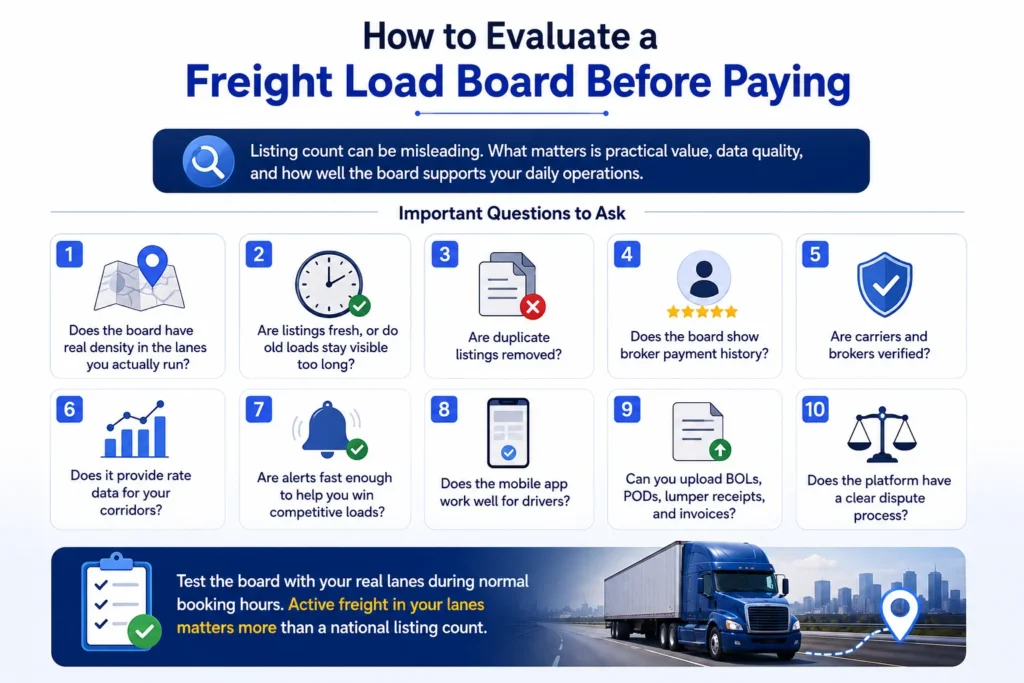
Listing count is one of the most heavily marketed metrics, but it is not always the most useful. A board with many duplicate or expired listings can waste more time than it saves.
Carriers should evaluate a load board based on practical operating value.
Important questions include:
- Does the board have real density in the lanes you actually run?
- Are listings fresh, or do old loads stay visible too long?
- Are duplicate listings removed?
- Does the board show broker payment history?
- Are carriers and brokers verified?
- Does it provide rate data for your corridors?
- Are alerts fast enough to help you win competitive loads?
- Does the mobile app work well for drivers?
- Can you upload BOLs, PODs, lumper receipts, and invoices?
- Does the platform have a clear dispute process?
A carrier should test a board using real lanes during normal booking hours. A national listing count is less useful than active freight in the lanes that matter to the business.
Miracuves Freight Load Board Solution Cost and Tech Stack
Miracuves Pricing for a Freight Load Board Platform developed in JavaScript For $4,899 USD (One-Time Price) in just 6 days
Get a fully developed, deployment-ready freight marketplace platform designed for carriers, brokers, shippers, dispatchers, owner-operators, and logistics companies. Built on a modern JavaScript foundation, this complete package includes everything you need to launch and scale:
Core Workflows: Carrier and broker registration, load posting, freight search, lane filtering, truck posting, load matching, rate negotiation, booking confirmation, shipment tracking, and delivery status updates.
Built-in Revenue Logic: Carrier subscriptions, broker plans, paid load postings, featured listings, transaction fees, premium search tools, advertising placements, and freight data access charges.
Management Hub: Centralized admin dashboard, carrier management, broker verification, shipper management, load monitoring, document controls, payment records, dispute handling, user reports, and marketplace analytics.
Launch-Ready: Fully prepared for your custom branding, configuration, payment gateway setup, carrier and broker onboarding, freight category setup, load-matching workflows, and immediate market entry.
Why Is Freight Load Board Development More Affordable?
Most freight marketplace platforms become expensive when businesses choose fully custom development from scratch. Building separate workflows for carriers, brokers, shippers, dispatchers, load listings, searches, booking, payments, document sharing, tracking, verification, and admin controls can increase cost, timeline, and technical complexity.
We took a smarter, more practical approach:
You Aren’t Paying for Ground-Up Development: Our freight load board engine is already developed, tested, and ready to deploy. You skip the inflated cost and long waiting period usually required to build a digital freight marketplace from scratch.
The Power of JavaScript: We built this solution on a modern JavaScript architecture that supports interactive freight searches, scalable load-matching workflows, real-time platform updates, fast frontend performance, API-driven integrations, and smooth admin operations.
You get a launch-ready freight load board with practical load posting, carrier discovery, broker management, monetization, and shipment coordination features, source code access, and faster deployment without the high custom development price tag.
Note: This cost is for the solution, re-branding, deployment, and source code only.
Read more: Best Load Board Software 2026: Launch a Scalable Freight & Trucking Platform
Core Features Every Freight Load Board Platform Should Include
A reliable freight load board should include modules for all major users: carriers, brokers, shippers, dispatchers, and admins.
Core features include:
- Carrier onboarding
- Broker onboarding
- Shipper onboarding
- Load posting
- Truck posting
- Search and filtering
- Equipment-based matching
- Location-based load discovery
- Saved lanes
- Real-time alerts
- Rate confirmation management
- BOL upload
- POD upload
- Invoice and receipt upload
- Broker payment data
- Carrier verification
- Insurance checks
- Subscription billing
- Featured listing controls
- Admin dashboard
- Dispute management
- Reporting and analytics
- Fraud monitoring
- Mobile apps for carriers and dispatchers
A platform without admin control can become difficult to operate. The admin dashboard is where the platform owner manages users, approvals, subscriptions, disputes, listings, documents, content, reports, and risk workflows.
How Freight Load Boards Make Money
A freight load board can generate revenue through multiple channels. For a platform-specific revenue example, the DAT Load Board business model shows how subscriptions, freight visibility, rate tools, and marketplace workflows can support monetization.
Common monetization models include:
- Carrier subscriptions
- Broker posting fees
- Premium rate data
- Featured loads
- Featured carrier profiles
- Enterprise dispatch tools
- API access
- Advertising from logistics vendors
- Factoring partnerships
- Fuel card partnerships
- Insurance referrals
- Payment processing fees
- Managed marketplace commissions
Freight Load Board Revenue Models
| Revenue Stream | How It Works | Why It Matters |
|---|---|---|
| Carrier Subscription | Carriers pay monthly for load search, alerts, mobile tools, broker data, and rate insights. | Creates recurring revenue. |
| Broker Posting Plans | Brokers pay to post loads, search trucks, and access carrier profiles. | Monetizes the freight demand side. |
| Premium Rate Data | Users pay for lane pricing, market insights, and rate trends. | Turns marketplace data into a high-value product. |
| Featured Listings | Brokers pay for better visibility on urgent or high-priority loads. | Improves monetization without owning freight. |
| Embedded Finance | The platform connects factoring, fuel cards, insurance, or quick-pay partners. | Captures value from the carrier cash-flow gap. |
| Enterprise Tools | Fleets, brokers, and dispatch teams pay for team accounts, analytics, and API access. | Supports larger accounts and stronger retention. |
The marketplace itself may attract users, but data and financial workflows often create stronger monetization opportunities. A load board that supports rate intelligence, broker payment history, document flow, and invoice timing can become more valuable than a basic load search tool.
White-Label Load Board vs Custom Development
Founders usually have three build options: custom development, white-label development, or a hybrid model. If the goal is to launch a DAT-style freight marketplace faster, reviewing a DAT load board clone script can help founders understand the feature, pricing, and workflow structure before choosing a build path.
White-Label Load Board vs Custom Development
| Build Option | Best For | Cost Logic | Founder Trade-off |
|---|---|---|---|
| Custom Development | Highly unique workflows, proprietary algorithms, or enterprise freight systems. | Higher cost because every module, integration, and workflow is built from scratch. | Maximum flexibility, but slower validation. |
| White-Label Load Board | Founders who want to launch a branded logistics marketplace faster. | Lower build risk because core marketplace workflows already exist. | Faster launch, with customization needed for differentiation. |
| Hybrid Approach | Businesses that want a ready-made foundation plus custom analytics, integrations, or niche workflows. | Balanced cost because custom work focuses on competitive advantage. | Often the most practical route for early market validation. |
For most founders, the question is not whether custom development is powerful. It is whether the business needs to spend months building basic marketplace workflows before testing demand.
A white-label load board can provide the foundation faster, while custom development can be used for the parts that actually differentiate the business, such as a specific freight vertical, regional workflow, pricing model, verification layer, or payment integration.
The Cold-Start Problem in Load Board Marketplaces
The hardest part of launching a load board is liquidity.
Carriers will not stay on a board with no useful loads. Brokers will not post on a board with no qualified carriers. This is the classic two-sided marketplace problem.
In freight, the problem is even harder because liquidity is local and lane-specific. A national board with thin coverage everywhere creates a weak experience for everyone.
Better launch strategies include:
- Start with one strong freight corridor.
- Focus on one equipment type such as reefer, flatbed, or power only.
- Target one regional market before expanding.
- Lead with a useful carrier tool such as fuel data, parking information, document storage, or rate insights.
- Build broker relationships before launch.
- Use verified carrier onboarding to improve trust.
- Add payment or factoring support to attract carriers even before load volume is high.
Density is more valuable than broad but weak coverage.
Mistakes Founders Should Avoid
Mistakes Founders Should Avoid
Building a listings page instead of a freight marketplace
A basic posting board does not solve payment risk, fraud, rate visibility, document flow, or matching quality. Users need workflow confidence, not only inventory.
Launching nationally with thin liquidity
Freight liquidity is local and lane-specific. A focused corridor or vertical can perform better than a broad board with weak density everywhere.
Ignoring trust and safety until after launch
Double brokering, fake documents, identity misuse, and suspicious payment changes can damage a load board before it reaches scale. Verification must be part of the product foundation.
Skipping document and payment workflows
Carriers care about getting paid, not only getting booked. Rate confirmations, BOLs, PODs, receipts, invoices, and payment status should be built into the workflow.
How Miracuves Helps Founders Build a Freight Load Board
Miracuves helps founders, startups, agencies, and logistics businesses launch ready-made and white-label load board platforms with source-code ownership, branded design, admin control, and faster deployment.
A Miracuves load board solution can support key marketplace workflows such as carrier onboarding, broker onboarding, load posting, search, matching, notifications, document handling, subscriptions, and admin management.
For founders planning a DAT-style, Truckstop-style, 123Loadboard-style, or regional freight load board clone, a ready-made foundation can reduce avoidable development time and help validate the market faster.
Final Thoughts: A Freight Load Board Is More Than a Search Tool
A freight load board may look like a search box, but the real value is much deeper. It helps carriers reduce empty miles, helps brokers cover freight faster, and helps logistics businesses turn fragmented freight activity into a structured digital marketplace.
For carriers, the right board improves visibility, route planning, broker selection, and payment confidence. For brokers, it improves coverage speed and access to verified capacity. For founders, it creates a business model with recurring subscription potential, premium data opportunities, and embedded finance possibilities.
The strongest freight load boards are not the ones with the most listings. They are the ones with the freshest listings, best lane density, strongest verification, useful rate data, smooth document handling, and reliable trust systems.
For founders, the smarter path is not to build a generic board with weak liquidity. It is to launch a focused, verified, monetization-ready freight marketplace that solves a specific operational problem better than the alternatives.
FAQs
What is a freight load board?
A freight load board is a digital marketplace where freight brokers and shippers post available loads, and carriers search for freight to haul. It helps match available truck capacity with freight demand.
How does a freight load board work?
Brokers post load details such as origin, destination, equipment type, weight, commodity, pickup time, delivery time, and rate. Carriers search by lane, location, date, and equipment type. After accepting a load, the broker issues a rate confirmation, the carrier hauls the freight, submits proof of delivery, and invoices for payment.
Are freight load boards free?
Some load boards offer free or limited access, but many useful features are included in paid plans. Paid features may include lane alerts, broker credit data, market rate insights, mobile tools, truck posting, and dispatch workflows.
How much does a freight load board cost for carriers?
The cost depends on the platform and feature level. Some boards charge a monthly subscription, while others offer tiered plans based on search tools, alerts, broker data, and analytics. Carriers should test a board based on their real lanes before paying.
How do carriers get paid from load board freight?
After delivery, the carrier submits an invoice with proof of delivery and required paperwork. Standard payment terms may take 30 to 60 days. Some carriers use broker quick pay or factoring to receive money sooner.
What is a rate confirmation?
A rate confirmation is the written agreement issued by the broker after awarding a load. It includes the agreed rate, pickup and delivery details, accessorial terms, reference numbers, and special instructions.
What is deadhead in trucking?
Deadhead refers to miles driven with an empty trailer. It matters because those miles still cost fuel, time, insurance, driver hours, and maintenance but generate no revenue.
What are accessorial charges in freight?
Accessorial charges are extra fees beyond the line-haul rate. Common examples include detention, layover, lumper fees, TONU, and stop-off charges. These must usually be documented clearly to be paid.