
Key Takeaways
- IoT integration enables contactless vehicle pickup and return.
- App-based lock and unlock improves renter convenience.
- GPS and telematics help fleet owners track vehicle activity.
- Trip verification protects against misuse and disputes.
- A contactless Turo clone needs both renter ease and operator control.
IoT Workflow Signals
- Verify renter identity before vehicle access is enabled.
- Use smart lock status for pickup and return confirmation.
- Track GPS, mileage, fuel, battery, and device health.
- Collect vehicle photos before and after each trip.
- Keep admin override logs for every unlock or lock action.
Real Insights
- Contactless rentals reduce handoff delays for fleet owners.
- Failed unlocks need fast support and fallback workflows.
- Device offline status can affect trip start and return flows.
- Strong logs help manage damage, late returns, and disputes.
- Miracuves builds Turo Clone apps with IoT-ready rental workflows.
Physical key exchange looks simple until a car-sharing business starts scaling.
At 10 vehicles, a host can coordinate calls, pickup points, handover photos, key boxes, and late-night renter support manually. At 100 vehicles, that same workflow becomes an operational bottleneck. At fleet scale, manual key handoff becomes a margin problem, a retention problem, and a security risk.
This is where a basic booking script fails.
A serious car-sharing platform needs more than listings, payments, and calendars. It needs a vehicle access layer that can connect software permissions to physical vehicle control. For fleet owners, mobility startups, and tech investors, the real question is no longer “Can we build a Turo-style app?” The stronger question is: “Can the platform safely unlock a real vehicle, for the right renter, at the right time, without a host standing there?”
Miracuves helps founders build white-label, source-code-owned mobility platforms that go beyond marketplace booking flows. For Turo-style car sharing, that means the app can be extended with telematics, GPS tracking, BLE-based proximity access, MQTT command messaging, admin controls, and audit-ready trip workflows.
In this technical case study, we break down how an IoT-integrated Turo clone can support 100% contactless handoffs using BLE and MQTT telematics hardware.
The Handoff Bottleneck: Why Physical Key Exchanges Kill Host Retention
A car-sharing marketplace is only as smooth as its handoff experience.
For renters, the handoff is the first real moment of trust. They have already selected the car, paid for the booking, uploaded documents, and planned their trip. If they now need to call the host, wait outside a building, find a lockbox, or reschedule because someone is late, the digital experience collapses into a manual operation.
For hosts and fleet owners, the pain is even deeper. Physical keys create recurring workload:
- confirming renter arrival times
- coordinating pickup and drop-off points
- replacing misplaced keys
- handling late-night support requests
- resolving disputes over who received or returned the key
- assigning staff for airport, hotel, or parking-lot handoffs
- managing fraud risk when a key leaves the host’s control
This is why keyless access is not just a convenience feature. It directly affects utilization, retention, operating cost, and fleet risk.
A standard Turo clone script may allow users to browse vehicles, book trips, make payments, and leave reviews. That is useful for marketplace validation. But once physical vehicles are involved, the platform must also answer operational questions:
Can the renter access the vehicle only during the approved booking window?
Can the system block access if payment fails, verification is incomplete, or the trip has ended?
Can the admin see who unlocked the vehicle and when?
Can a fleet manager revoke access instantly?
Can the vehicle be unlocked through Bluetooth if cellular connectivity is weak?
Can the platform support different telematics hardware vendors?
These are not cosmetic feature questions. They decide whether the platform can operate as a fleet-grade mobility business.
Miracuves’ Turo clone approach gives founders a ready-made software foundation that can be customized for booking, verification, payment, host control, admin workflows, and telematics-ready extensions. Instead of forcing founders to start from zero, the product foundation can be adapted around the real operating model: peer-to-peer hosting, owned fleet rentals, corporate mobility, airport rentals, residential car sharing, or subscription-based access.
Read More: AI Features for Car Rental Platforms: How Turo-Like Apps Boost Profitability
Deployment Snapshot: The IoT Keyless Handoff Variable
In the supplied deployment scenario, the core business requirement was clear:
The fleet operator wanted renters to unlock vehicles without meeting the host, without using physical keys, and without depending on manual staff coordination.
The platform had to support secure, sub-second remote unlocks through a white-label Turo-style car-sharing app integrated with Bluetooth Low Energy and MQTT telematics hardware.
The reported operational result was:
| Deployment Variable | Result |
|---|---|
| Handoff model | 100% contactless vehicle handoffs |
| Access technology | BLE and MQTT telematics integration |
| Unlock target | Secure, sub-second remote unlock processing |
| Host workload impact | 40% reduction in host operational hours |
| Key-risk impact | Stolen physical keys eliminated |
| Platform type | White-label Turo-style car-sharing clone |
| Target operator | Fleet owner / mobility operator |
This is the difference between a basic rental marketplace and an IoT-enabled mobility platform.
A booking script can confirm that a renter paid for a car. An IoT-integrated platform can turn that booking into controlled vehicle access.
Engineering the Telematics Bridge: BLE and MQTT Integration
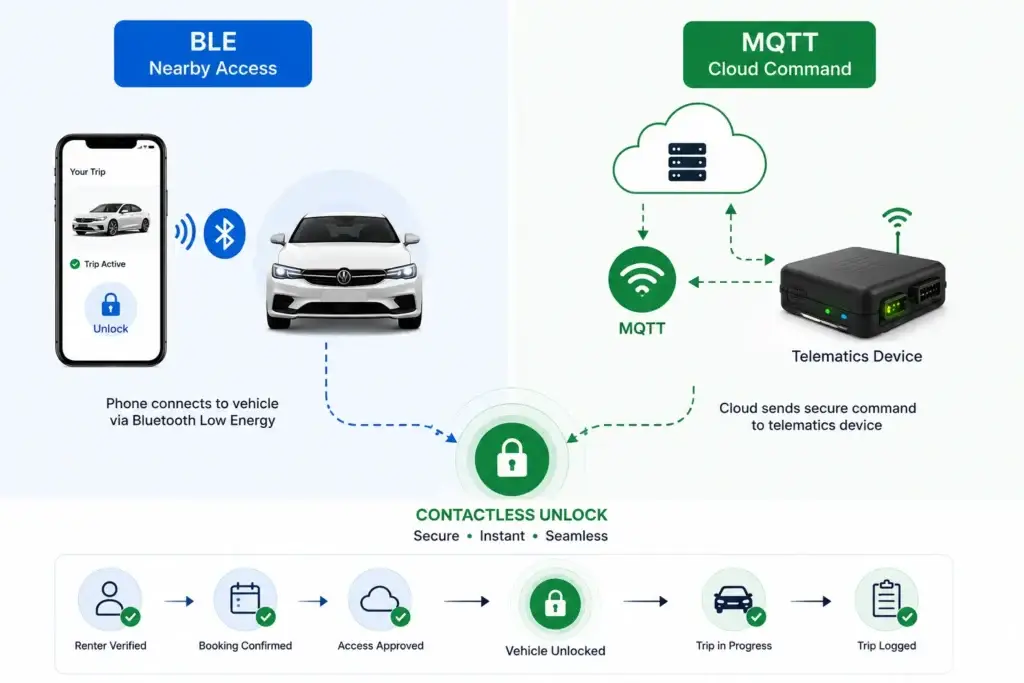
Image Source: AI-generated visual by Miracuves
The telematics bridge is the layer that connects the app, backend, vehicle hardware, and access permissions.
In a contactless car-sharing platform, the renter does not simply press “Unlock” and magically open the vehicle. Behind that button, the platform must validate multiple conditions in milliseconds.
A practical IoT handoff flow looks like this:
- The renter opens the app near the vehicle.
- The app checks booking status, identity, payment status, and access window.
- The backend verifies that this renter is allowed to access this specific vehicle at this specific time.
- The platform checks device status from the telematics unit.
- The access broker generates a time-bound unlock authorization.
- The command is routed through MQTT, BLE, or a hybrid fallback path.
- The vehicle device executes the unlock action.
- The system records the event in trip logs, device logs, and admin audit history.
- The renter receives confirmation inside the app.
- The host or fleet manager can see the access event in the dashboard.
MQTT is widely used for IoT messaging because it is a lightweight publish/subscribe protocol designed for remote devices and constrained network conditions. AWS also describes MQTT as a standards-based machine-to-machine messaging protocol that supports device-to-cloud and cloud-to-device communication for IoT systems.
BLE, on the other hand, is valuable for short-range mobile-to-device communication. In a car-sharing handoff, BLE can support proximity-based access when the renter is near the vehicle, reducing dependence on host presence and supporting unlock flows where the smartphone interacts with the vehicle-side hardware.
Together, BLE and MQTT create a stronger architecture:
| Layer | Role in Keyless Handoff | Why It Matters |
|---|---|---|
| Mobile app | Renter unlock request, proximity check, trip status | Gives renters self-service access |
| Booking service | Confirms valid booking window | Prevents early, late, or unauthorized access |
| Identity service | Confirms renter verification and account status | Reduces fraud and access misuse |
| Payment service | Checks payment and deposit status | Blocks access when payment rules fail |
| IoT access broker | Converts app permission into hardware command | Separates business logic from device logic |
| MQTT broker | Routes cloud-to-device commands | Supports lightweight telematics messaging |
| BLE module | Enables local proximity unlock | Helps when renter is physically near the car |
| Telematics unit | Executes vehicle unlock and reports status | Connects software to the real vehicle |
| Admin dashboard | Shows unlock logs, device status, exceptions | Gives fleet owners operational control |
The most important architectural decision is separation.
The booking app should not directly command the vehicle. The mobile app should request access. The backend should validate business rules. The IoT access broker should generate secure commands. The telematics device should execute only approved instructions.
That separation protects the platform from weak access logic.
Why Cheap Booking Scripts Break at the Vehicle Access Layer
A low-cost rental script can look attractive because the front-end screens appear complete. It may show vehicle listings, photos, calendars, booking forms, payments, and user profiles.
But physical fleet operations expose the missing layers quickly.
A booking-only script usually struggles with:
- real-time device provisioning
- vehicle-to-user access mapping
- IoT command logs
- offline fallback rules
- secure unlock tokens
- telematics vendor differences
- firmware compatibility
- Bluetooth pairing behavior
- device heartbeat monitoring
- failed unlock escalation
- admin override workflows
- post-trip access revocation
This creates operational debt.
For example, if a renter has an approved booking but the telematics unit is offline, what happens? Does the app retry? Does it switch to BLE? Does it alert the admin? Does it show the host? Does it open a support ticket? Does it block the renter from repeatedly sending unlock commands?
A booking script without an IoT state machine cannot answer these questions cleanly.
Fleet owners need a platform that treats vehicles as connected assets, not just listing cards. That means every vehicle should have a digital operational state:
| Vehicle State | Platform Meaning |
|---|---|
| Available | Vehicle can be booked |
| Reserved | Booking confirmed, access not yet active |
| Access pending | Renter is near trip start window |
| Unlock authorized | Renter is allowed to unlock |
| Active trip | Vehicle is in use |
| Return pending | Trip end workflow has started |
| Returned | Vehicle access revoked |
| Exception | Admin review required |
| Maintenance | Vehicle temporarily unavailable |
| Device offline | IoT access path requires fallback |
This state model helps the platform prevent messy edge cases.
Without it, the business ends up depending on support calls, manual overrides, and host improvisation.
Founder Decision Signals
Speed
If your launch depends on manual key exchange, your operations will slow down as fleet density grows. Keyless access helps renters start trips without host coordination.
Cost
Host time, support calls, missed handoffs, and key replacement are operating costs. IoT access reduces repetitive manual work when implemented with the right controls.
Scalability
A fleet-grade Turo clone should handle bookings, vehicles, devices, access windows, audit logs, and exception states from one control layer.
Market Fit
Contactless handoffs are strongest in airport rentals, city fleets, residential car sharing, corporate mobility, and high-frequency short-term rentals.
Speed
If your launch depends on manual key exchange, your operations will slow down as fleet density grows. Keyless access helps renters start trips without host coordination.
Cost
Host time, support calls, missed handoffs, and key replacement are operating costs. IoT access reduces repetitive manual work when implemented with the right controls.
Scalability
A fleet-grade Turo clone should handle bookings, vehicles, devices, access windows, audit logs, and exception states from one control layer.
Market Fit
Contactless handoffs are strongest in airport rentals, city fleets, residential car sharing, corporate mobility, and high-frequency short-term rentals.
The Sub-Second Unlock Benchmark: Securing Physical Assets Remotely
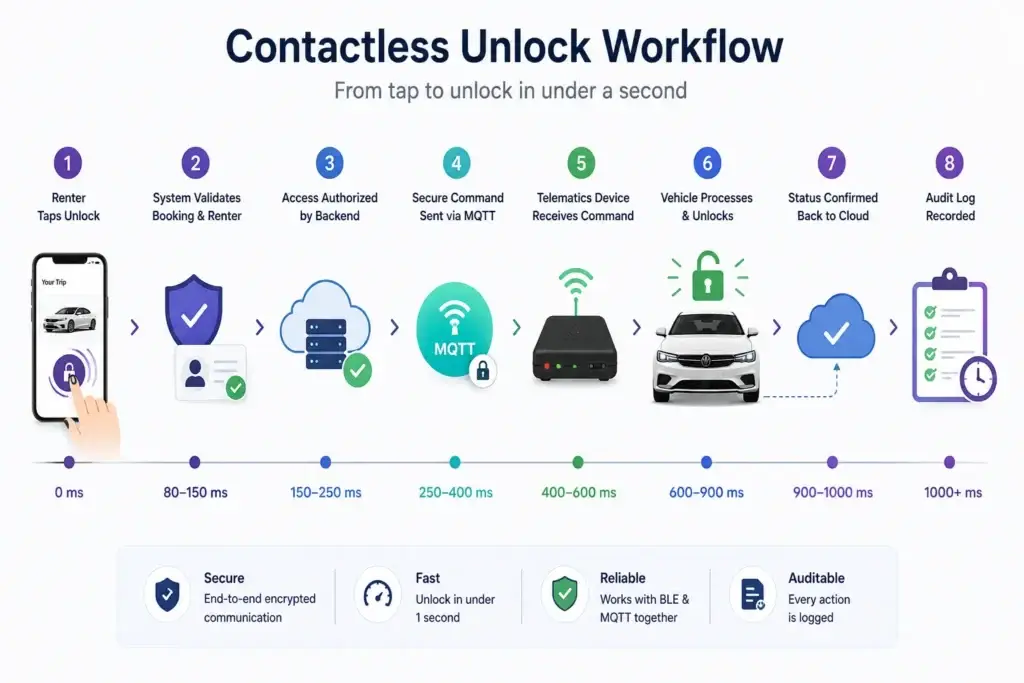
Image Source: AI-generated visual by Miracuves
Sub-second unlock performance is not only a speed metric. It is a trust metric.
When a renter reaches the car and taps “Unlock,” delay creates anxiety. The renter wonders whether the booking failed. The host receives a support message. The operator risks a bad first impression.
But speed cannot come at the cost of security.
A secure sub-second unlock workflow should verify:
- renter identity
- booking ID
- vehicle ID
- access start and end time
- payment status
- deposit or authorization status
- device ID
- vehicle state
- command expiry
- proximity, where BLE is used
- admin risk rules
- unlock attempt count
The unlock command should be short-lived. It should not remain reusable. It should be tied to the booking, vehicle, renter, and device state. If the renter tries to unlock outside the approved window, the command should fail. If the booking is cancelled, the access permission should be revoked. If the vehicle is reported stolen, the platform should block further renter-side access and escalate to the admin.
A good unlock system is not just “open car from app.” It is controlled authorization for a physical asset.
For fleet owners, this matters because every unlock event carries business risk. A failed access attempt can create a poor user experience. An unauthorized access event can create a serious loss event.
That is why the Miracuves approach should treat keyless handoff as a secure workflow involving app logic, backend rules, device commands, and admin visibility.
Read More: How to Integrate Telematics and GPS Tracking in Car Rental Applications
Recommended IoT Keyless Handoff Architecture
A scalable architecture for an IoT-integrated Turo clone should include these components:
| Component | Purpose | Founder Impact |
|---|---|---|
| Renter mobile app | Booking, verification, unlock request, trip start, return workflow | Gives renters self-service control |
| Host / fleet dashboard | Vehicle listing, calendar, availability, device status, trip history | Reduces manual coordination |
| Admin dashboard | User control, disputes, payments, commissions, vehicle states, access logs | Centralizes marketplace control |
| Booking engine | Manages reservations, time windows, extensions, cancellations | Prevents access conflicts |
| IoT access broker | Validates unlock requests and issues device commands | Keeps vehicle access secure |
| MQTT messaging layer | Routes telematics commands and status updates | Supports real-time connected fleet workflows |
| BLE access module | Enables short-range local unlock | Supports proximity-based access |
| Telematics device registry | Maps each vehicle to hardware identity | Prevents device/vehicle mismatch |
| Audit log service | Records unlocks, failed attempts, admin overrides, device status | Supports trust and dispute resolution |
| Notification system | Alerts renters, hosts, admins, and support teams | Reduces operational confusion |
| Exception handler | Handles offline devices, failed unlocks, late returns, trip disputes | Keeps edge cases manageable |
This architecture gives fleet owners the control needed to manage real vehicles, not just digital listings.
Security Rules for Remote Unlock Workflows
Security should be treated as a foundation, not a marketing add-on.
A Turo-style platform with IoT vehicle access should include:
- encrypted data transfer
- encrypted data storage
- role-based access control
- secure API integration
- device identity validation
- renter verification
- admin access controls
- audit logs
- trip activity logs
- suspicious activity flags
- payment and deposit validation
- unlock command expiry
- failed attempt throttling
- abuse reporting
- dispute management
- device heartbeat monitoring
BLE security also depends on correct implementation. The Bluetooth ecosystem supports modern security mechanisms, but poor implementation choices can create risk, which is why key exchange, pairing, authorization, and application-layer controls need careful design. Bluetooth SIG material discusses LE Secure Connections and pairing approaches, while security research continues to emphasize implementation quality as a major factor in BLE safety.
For founders, the takeaway is simple: do not treat Bluetooth unlock as a plug-and-play button. Treat it as an access-control system for physical assets.
Contactless Handoff Flow: From Booking to Vehicle Return
A contactless car-sharing journey should feel simple for the renter, even though the backend is managing verification, payment rules, vehicle access, telematics, and audit logs in real time.
The renter does not need to understand BLE, MQTT, or device communication. They only need a clear app-guided flow from booking to unlock to return.
1. Vehicle Discovery and Booking
The renter browses available vehicles by location, date, price, vehicle type, and pickup point. Once they select a car, the platform checks whether the vehicle is available, active, and ready for the selected time window.
This prevents bookings from being accepted for vehicles that are unavailable, under maintenance, or not ready for contactless pickup.
2. Verification and Payment Approval
Before access is enabled, the platform checks whether the renter is verified, the booking is confirmed, and payment or deposit rules are satisfied.
The unlock option should only become active when:
- renter verification is complete
- booking is confirmed
- payment conditions are met
- trip window has started
- vehicle and device status are valid
This keeps vehicle access controlled instead of allowing unlocks based only on a booking confirmation.
3. Pickup Instructions and Vehicle Arrival
After confirmation, the renter receives pickup instructions inside the app. These may include parking location, vehicle photos, access timing, and return rules.
When the renter reaches the vehicle, the app can use GPS, BLE proximity, or device checks to confirm that the renter is near the correct car before allowing access.
4. App-Based Unlock and Trip Start
The renter taps “Start Trip” or “Unlock Vehicle.” Behind the scenes, the backend validates the booking ID, renter ID, vehicle ID, payment status, access window, and telematics device state.
If everything is approved, the system sends a secure unlock command through BLE, MQTT, or the configured telematics path. Once the vehicle unlocks, the platform records the event with timestamp, renter, vehicle, device response, and trip status.
5. Vehicle Inspection Before Driving
Before the trip begins, the app should ask the renter to upload vehicle condition photos. This may include exterior, interior, fuel level, odometer, battery level, or visible damage.
This protects both the renter and the fleet operator because pre-trip evidence can be compared with return photos if a dispute occurs.
6. Active Trip Monitoring
During the trip, the renter sees a simple active rental screen with trip time, return instructions, support access, and lock/unlock controls.
The platform operator sees much more: booking status, GPS position, device connectivity, unlock history, mileage data, failed access attempts, and trip progress. This gives the fleet owner visibility without needing to manually manage every handoff.
7. Vehicle Return and Lock Confirmation
At the end of the trip, the renter returns the vehicle to the approved location, uploads return photos, locks the car through the app, and ends the trip.
The system should confirm that the vehicle is locked and returned correctly. If a door is open, the vehicle is outside the return zone, or the lock command fails, the app should alert the renter before the trip closes.
8. Final Billing and Trip Record
After return, the platform can process final billing or adjustments for extra mileage, late return, fuel difference, damage review, tolls, or cleaning fees depending on the business rules.
The admin dashboard should keep a complete trip record, including:
- renter verification status
- payment status
- pickup and return location
- unlock and lock timestamps
- failed unlock attempts
- device online/offline state
- mileage or telematics data
- return photos
- damage reports
- host payout
- dispute records
- admin override history
This is where the value of an IoT-integrated Turo clone becomes clear. The renter gets a smooth contactless experience, while the fleet operator gets control, visibility, security, and a reliable operational record.
Business Impact: Why Keyless Handoffs Improve Fleet Economics
Contactless handoffs can improve the business model in several ways.
First, they reduce host workload. If every booking requires a person to coordinate keys, the fleet cannot scale efficiently. In the supplied deployment scenario, the operator reduced host operational hours by 40% after moving to keyless handoffs.
Second, they improve booking flexibility. Renters can pick up vehicles earlier in the morning, later at night, or from unmanned locations, depending on local business rules. This can improve vehicle utilization.
Third, they reduce key-loss risk. Physical keys are expensive to replace and hard to track. Once access becomes digital, the platform can revoke, expire, and audit permissions.
Fourth, they improve trust. Hosts and fleet managers can see unlock logs, trip status, return evidence, and device activity. This reduces argument-based operations.
Fifth, they create enterprise readiness. Investors and fleet partners are more likely to take a platform seriously when the app can manage real-world vehicle access, not just booking screens.
White-Label Turo Clone vs Basic Booking Script
| Decision Area | Basic Booking Script | IoT-Integrated White-Label Turo Clone |
|---|---|---|
| Vehicle listings | Usually included | Included and customizable |
| Booking calendar | Usually included | Included with access-window logic |
| Payments | Usually included | Connected to unlock eligibility |
| Host dashboard | Basic | Fleet-aware with device and trip visibility |
| Key handoff | Manual or lockbox-based | App-based contactless access |
| IoT support | Limited or absent | BLE, MQTT, telematics-ready integration |
| Admin control | Basic user and booking management | Users, vehicles, devices, disputes, access logs |
| Security | Mostly account/payment level | Account, payment, device, trip, and command-level controls |
| Scaling risk | High manual workload | Lower host dependency |
| Founder fit | Small validation experiments | Fleet owners, mobility startups, enterprise pilots |
The point is not that every founder needs IoT on day one.
The point is that serious mobility operators should not build on a foundation that cannot support connected vehicle workflows later.
Where Miracuves Fits in the Mobility Stack
Miracuves helps founders and operators launch white-label, source-code-owned clone app solutions with admin dashboards, custom branding, monetization workflows, and faster deployment paths.
For a Turo-style car-sharing platform, Miracuves can support the software foundation around:
- renter app
- host or fleet owner dashboard
- admin dashboard
- vehicle listings
- availability calendar
- booking engine
- secure payments
- commissions
- user verification
- GPS and telematics-ready workflows
- ratings and reviews
- dispute management
- notifications
- access-control extensions
- source-code ownership
For ready-made Miracuves solutions, a 6-day launch can be relevant when the selected scope uses the existing white-label foundation. IoT hardware integration, custom telematics vendor work, advanced BLE flows, and fleet-specific access rules may require additional scoping depending on the hardware, APIs, firmware, testing environment, and deployment model.
Read More: How to Start a Car Rental Business in 2026: Complete Founder’s Guide
Mistakes Fleet Owners Should Avoid When Adding IoT Access
Mistakes Founders Should Avoid
Treating Keyless Unlock as a Simple App Button
Vehicle access must be tied to booking status, renter identity, payment rules, device identity, time windows, and admin controls. A simple button without access logic creates security and operational risk.
Choosing a Booking Script With No Device Architecture
A script that cannot manage device status, unlock logs, failed commands, and telematics integrations will struggle once the fleet moves beyond manual handoffs.
Ignoring Offline and Fallback Scenarios
Vehicles may sit in garages, basements, airports, or low-network areas. The platform should define fallback rules for BLE, cellular telematics, support escalation, and admin overrides.
Skipping Audit Logs
Every unlock, lock, failed attempt, admin override, and device event should be recorded. Audit history protects the operator during disputes, damage claims, and access-related incidents.
Final Thoughts: The Future of Turo Clone Platforms Is Contactless, Connected, and Fleet-Aware
The next generation of car-sharing platforms will not be judged only by how well they display vehicles.
They will be judged by how well they control real-world operations.
A founder can launch a marketplace with listings, bookings, and payments. But a fleet owner needs more. They need vehicle access control, trip logs, connected hardware, renter accountability, host workload reduction, and admin visibility across the entire rental lifecycle.
The IoT keyless handoff layer turns a Turo clone from a booking platform into a mobility control system.
For the supplied deployment scenario, BLE and MQTT telematics integration enabled secure, sub-second remote unlocks, helped the operator move to 100% contactless handoffs, reduced host operational hours by 40%, and removed the risk of stolen physical keys.
That is the strategic value of building on the right foundation.
Miracuves helps founders and fleet operators launch white-label Turo-style car-sharing platforms with source-code ownership, admin control, telematics-ready workflows, and customizable mobility features. For operators who want to reduce manual handoffs and build a scalable contactless rental experience, the stronger decision is not just to build an app. It is to build an access-ready mobility platform.
FAQs
What is an IoT-integrated Turo clone?
An IoT-integrated Turo clone is a white-label car-sharing platform that combines vehicle listings, bookings, payments, renter verification, admin controls, and connected vehicle access. It can integrate with telematics hardware, GPS tracking, BLE modules, and MQTT messaging to support contactless vehicle unlocks and fleet monitoring.
How does keyless handoff work in a Turo-style car rental app?
Keyless handoff allows renters to unlock a booked vehicle through the mobile app without meeting the host. The system checks the booking window, renter verification, payment status, vehicle state, and device identity before sending an approved unlock command to the vehicle hardware.
Why use BLE for car rental app unlocks?
BLE is useful for short-range proximity access between the renter’s smartphone and the vehicle-side hardware. It can help confirm that the renter is near the vehicle and support local unlock flows when designed with the right security and fallback controls.
Why use MQTT in telematics integration?
MQTT is a lightweight publish/subscribe messaging protocol widely used for IoT device communication. In car-sharing platforms, it can help route cloud-to-device and device-to-cloud messages such as unlock commands, lock confirmations, heartbeat status, and telematics updates.
Is keyless unlock secure for fleet car-sharing platforms?
It can be secure when implemented with proper controls. The platform should use encrypted communication, device identity validation, time-bound unlock tokens, booking-based authorization, role-based admin access, audit logs, failed attempt limits, and real-time access revocation.
Can Miracuves build a white-label Turo clone with telematics integration?
Yes. Miracuves can help founders build a white-label Turo-style car-sharing platform with booking workflows, admin dashboards, source-code ownership, and telematics-ready customization. Final integration scope depends on the selected hardware, APIs, firmware, and access-control requirements.
Is a 6-day launch possible for a Turo clone with IoT integration?
A ready-made Miracuves Turo clone foundation can support faster launch timelines where the selected scope fits the existing white-label product. Custom IoT hardware integration, BLE access flows, MQTT command logic, device testing, and fleet-specific workflows may require additional scoping beyond the standard deployment.
Who should use an IoT-integrated car-sharing platform?
This model is useful for fleet owners, car rental operators, mobility startups, airport rental businesses, residential car-sharing programs, corporate mobility operators, and investors building connected vehicle rental platforms.
Miracuves is an independent software development company. We are not affiliated with, connected to, sponsored by, or endorsed by any company or product named in this article.
Terms such as “X Clone” are used descriptively. It is how the software industry refers to building a platform with functionality comparable to a known service, and how clients search for it.
The entire design and codebase of our products is built by our own team. Our products contain no code, design, graphics, or content originating from any third-party website or applications.
All third-party names and marks referenced in this article are the property of their respective owners, referenced solely to identify the services discussed.