Key Takeaways
- Live shopping helps beauty and fashion brands demonstrate products and answer buyer questions.
- Group buying adds urgency by connecting discounts with collective participation.
- Creators can build trust through demonstrations, styling advice, tutorials, and product comparisons.
- Campaign success depends on clear pricing, limited availability, and reliable fulfillment.
- Brands should measure conversion, group completion, repeat purchases, and creator-led sales.
Campaign Readiness Signals
- Choose products that are visual, demonstrable, and suitable for limited-time promotions.
- Define group sizes, discount levels, campaign periods, and inventory limits.
- Prepare creators with product details, demonstrations, offers, and audience-specific messaging.
- Connect live sessions with product pages, group deals, checkout, and order tracking.
- Give admins control over creators, campaigns, inventory, pricing, refunds, and performance reports.
Real Insights
- Live viewers convert when demonstrations reduce uncertainty, not simply because a stream is active.
- Group discounts should protect margins while giving buyers a meaningful reason to invite others.
- Scarcity loses credibility when inventory and campaign limits are not accurate.
- Frequent campaigns require automation beyond manual livestream and coupon management.
- Miracuves develops social commerce platforms with live selling, group deals, seller tools, and admin controls.
Beauty and fashion purchases are rarely purely functional. A shopper may buy because they trust a creator, want to join a trend, see a limited drop, discover a bundle, or feel that a deal becomes better when friends participate.
That is why live shopping and group buying work so well for beauty and fashion brands. They combine product discovery, social proof, urgency, and community participation into one campaign experience.
For founders, the real opportunity is not just running a livestream or offering a discount. The opportunity is to design a repeatable campaign engine where live product demonstrations, limited-time drops, group discounts, referrals, and marketplace workflows all work together.
Miracuves helps founders think through this execution layer carefully because a social commerce campaign is only effective when the platform behind it can handle users, sellers, inventory, orders, payments, campaign rules, and admin control without manual chaos.
Planning to build in this space? Miracuves offers a ready-made social commerce platform that you can launch under your own brand.
Why Beauty and Fashion Brands Need More Than Static Ecommerce Pages
Traditional ecommerce depends heavily on product images, descriptions, reviews, and paid traffic. That works for simple purchases, but beauty and fashion shoppers often need more context before buying.
A skincare customer may want to see texture, finish, application style, and before-after expectations. A fashion customer may want to see fit, styling options, material movement, and how the product looks on different body types.
Static product pages do not always solve these doubts.
Live shopping adds the missing human layer. A host, creator, stylist, makeup artist, or brand representative can demonstrate products in real time, answer questions, compare variants, and explain why a specific product fits a specific use case.
Group buying adds the social layer. Instead of one shopper deciding alone, buyers are encouraged to invite friends, join an active deal, unlock a lower price, or participate in a limited campaign before it closes.
Together, these mechanics can turn passive browsing into active participation.
Read More: Group-Buying Marketplace Features and Pricing: What Founders Should Evaluate Before Launch
What Makes Live Shopping Powerful for Beauty Brands?
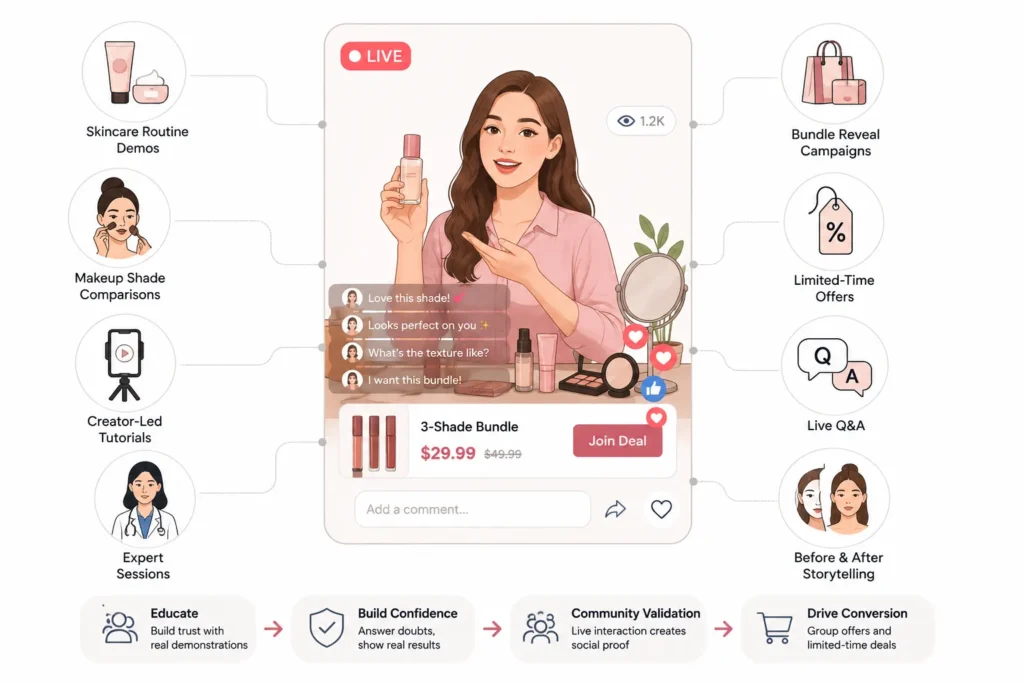
Image Source: AI-generated visual by Miracuves
Beauty is a trust-driven category. Shoppers want to know whether a product suits their skin type, tone, routine, budget, and personal preferences. Live commerce gives brands a stronger way to answer those doubts before checkout.
A beauty live shopping campaign can include:
- Skincare routine demonstrations
- Makeup shade comparison sessions
- Creator-led product tutorials
- Dermatologist or expert-led explanation sessions where appropriate
- Bundle reveal campaigns
- Limited-time launch offers
- Q&A around ingredients, usage, texture, and compatibility
- Before-and-after visual storytelling where claims are realistic and policy-safe
The founder advantage is clarity. Instead of pushing a discount first, the brand educates the buyer, builds confidence, and then introduces the offer.
For example, a cosmetics brand launching a new lip tint collection can run a live session where creators show each shade on different skin tones. During the stream, buyers can join a group offer for a three-shade bundle. The campaign does not rely only on discounting. It uses demonstration, creator trust, community validation, and urgency together.
That is a stronger conversion system than a static “20% off” banner.
How Fashion Brands Can Use Live Drops to Create Urgency
Fashion is highly responsive to timing, exclusivity, and social influence. Buyers often respond to limited collections, seasonal drops, creator styling, early access campaigns, and scarcity-driven launches.
Live drops work especially well when the product has a visual story.
A fashion brand can use live shopping to:
- Reveal new collections in real time
- Let stylists show multiple outfit combinations
- Launch limited inventory drops
- Offer early access to community members
- Allow group discounts for selected bundles
- Run countdown-based campaigns
- Promote creator-curated looks
- Encourage shoppers to invite friends before the offer unlocks
The key is to avoid discounting everything. If every campaign becomes a price cut, shoppers may wait for deals instead of buying at full value. A better approach is to use group buying on selected products, bundles, seasonal inventory, community launches, or creator-led collections.
This protects the brand while still creating urgency.
Where Group Buying Fits Into Beauty and Fashion Campaigns
Group buying works when a brand wants shoppers to act together. Instead of showing one fixed price to everyone, the campaign gives buyers a reason to participate, share, and complete checkout before the threshold closes.
For beauty and fashion brands, group buying can support several campaign types.
| Campaign Type | How Group Buying Works | Best Use Case | Founder Benefit |
|---|---|---|---|
| Product Launch Campaign | Buyers join a group to unlock a launch price | New beauty line, fashion capsule, limited collection | Creates early traction and social proof |
| Bundle Campaign | Group discount applies to curated bundles | Skincare kits, makeup sets, outfit packs | Increases average order value |
| Inventory Movement Campaign | Selected products are offered through group deals | Seasonal fashion, old stock, slow-moving SKUs | Clears inventory without sitewide discounting |
| Influencer Campaign | Creator promotes a group deal to their audience | Beauty tutorials, style drops, creator collections | Converts creator attention into measurable sales |
| Community Campaign | Buyers invite friends to unlock a better price | D2C communities, loyalty groups, niche fashion drops | Reduces dependence on paid acquisition |
| Flash Drop Campaign | Deal closes when time or stock runs out | Limited-edition products | Adds urgency and campaign discipline |
The most important rule is margin control. Group buying should not be treated as a random discount tool. It should be connected to a clear business goal: higher order volume, faster inventory movement, stronger launch data, or lower customer acquisition cost.
Live Shopping vs Group Buying: How They Work Together
Live shopping and group buying are often stronger together than separately.
Live shopping answers buyer hesitation. Group buying creates buyer participation.
Live shopping helps the shopper understand the product. Group buying gives them a reason to act now.
Live shopping builds trust through demonstration. Group buying builds urgency through shared incentives.
| Layer | Live Shopping Role | Group Buying Role | Combined Impact |
| Discovery | Product is demonstrated live | Viewers see an active deal | Higher attention and campaign momentum |
| Trust | Host answers questions | Buyers see others joining | Reduced hesitation |
| Urgency | Limited-time stream offer | Threshold or countdown closes | Faster decision-making |
| Sharing | Viewers invite others to watch | Buyers invite others to unlock pricing | Stronger organic reach |
| Conversion | In-stream product focus | Group price motivates checkout | Better campaign completion |
| Retention | Followers return for future streams | Buyers return for future group deals | Repeat engagement loop |
For founders, this combination is useful because it creates a campaign rhythm. Instead of depending only on ads, the brand can plan weekly live sessions, monthly drops, community campaigns, creator bundles, and seasonal group-buying events.
Founder Decision Signals Before Running These Campaigns
Speed
If your brand needs faster campaign testing, live shopping and group buying can help validate product interest before investing heavily in large-scale inventory or paid campaigns.
Cost
Group buying can reduce customer acquisition pressure when shoppers invite others, but founders must protect margins by setting clear thresholds, stock limits, and discount rules.
Scalability
A campaign that works manually once may break when multiple sellers, creators, products, orders, refunds, and payment flows are involved. Platform readiness matters before scale.
Market Fit
If shoppers respond to live demos, limited drops, bundle offers, or community deals, the brand gains stronger signals about demand, pricing, creator fit, and repeat purchase potential.
Read More: How to Reduce Fraud in Group-Buying Marketplaces: Seller, Payment, and Coupon Abuse Controls
Campaign Mechanics That Increase Conversion Without Damaging Brand Value
The mistake many brands make is assuming that group buying means “offer the lowest possible price.” That approach may create short-term sales but can weaken long-term positioning.
The smarter approach is to design campaigns around value, timing, and participation.
1. Use Group Discounts on Bundles, Not Every Product
Bundles work well because they increase order value while still giving shoppers a sense of savings. A beauty brand can group serum, cleanser, and moisturizer into a routine kit. A fashion brand can group a top, accessory, and seasonal add-on into a styled set.
This gives shoppers a reason to buy more without making the brand look discount-dependent.
2. Create Limited-Time Campaign Windows
A campaign should have a clear start and end. Open-ended discounts lose urgency. Live drops and group-buying campaigns work better when buyers know the offer is connected to a specific stream, creator event, or launch period.
3. Match Thresholds to Real Inventory
If the group threshold is too high, buyers may lose interest. If it is too low, the campaign may not improve unit economics. Founders should set thresholds based on available stock, fulfilment capacity, expected traffic, and margin.
4. Use Creator Trust Carefully
Creators can increase campaign reach, but the product must match their audience. A skincare creator may drive better conversion for routine-based products, while a fashion stylist may work better for capsule collections or seasonal edits.
The right creator does more than promote. They explain, demonstrate, answer questions, and reduce buyer hesitation.
5. Give Buyers a Reason to Share
Group buying becomes stronger when sharing feels natural. A buyer should understand why inviting friends helps them unlock value. This can include lower pricing, bundle access, early access, loyalty points, or community-only deals.
Platform Features Needed to Run Live Shopping and Group Buying Campaigns
A single manual campaign can be managed with spreadsheets, social media, and payment links. But once the brand wants repeatable campaigns, multiple creators, several product drops, or marketplace-style operations, the platform layer becomes important.
| Feature | Business Value | Founder Impact |
|---|---|---|
| Live Product Sessions | Allows hosts, creators, or sellers to showcase products in real time. | Turns product education into a conversion event. |
| Product Pinning During Live Sessions | Lets sellers highlight products while the stream is active. | Reduces friction between product discovery and checkout. |
| Group Deal Setup | Allows campaign owners to define group pricing, thresholds, and time limits. | Gives founders control over urgency and margin logic. |
| Inventory and Stock Limits | Prevents campaigns from overselling limited products. | Protects customer experience and fulfilment reliability. |
| Merchant or Seller Dashboard | Allows sellers to manage products, orders, campaigns, and performance. | Reduces dependence on the internal operations team. |
| Admin Dashboard | Controls users, sellers, campaigns, products, orders, payments, disputes, and analytics. | Helps the platform operator scale campaigns with visibility and control. |
| Referral and Sharing Tools | Encourages buyers to invite friends into active campaigns. | Supports organic reach and lowers campaign acquisition pressure. |
| Payment and Order Management | Connects campaign participation with checkout, order tracking, and refunds. | Prevents operational confusion after the campaign ends. |
| Analytics and Campaign Reporting | Tracks viewers, joins, purchases, conversion rates, and repeat buyers. | Helps founders decide which products, creators, and campaigns deserve more investment. |
How Beauty Brands Can Structure a High-Converting Live Group Campaign
A beauty campaign should begin with the product story, not the discount.
Here is a practical structure:
Pre-Campaign
The brand announces the live session, introduces the product theme, confirms the creator or host, and gives shoppers a reason to register or follow the event. This stage can include teaser videos, ingredient education, routine previews, and early-access reminders.
Live Session
The host demonstrates products, explains use cases, answers common doubts, compares variants, and introduces the group offer. Buyers can join the offer during the session, invite others, and complete checkout before the campaign window closes.
Post-Campaign
The brand follows up with order updates, usage tips, review requests, loyalty points, and invitations to the next live event. This matters because the goal is not only one campaign. The goal is repeat buyer engagement.
Example Campaign Flow
A skincare brand launches a “Glow Routine Week” campaign. During the live session, the host demonstrates a cleanser, serum, and moisturizer bundle. The group offer unlocks when a minimum number of buyers join within the campaign window. Shoppers who invite friends receive loyalty points or early access to the next product drop.
This approach connects education, urgency, social sharing, and retention.
Read More: Pre-Launch and Post-Launch Marketing Plan for Social Shopping Marketplace
How Fashion Brands Can Structure a Live Drop With Group Discounts
A fashion campaign usually benefits from stronger visual storytelling and urgency.
Pre-Drop
The brand teases the collection through short videos, creator styling previews, waitlists, and countdown reminders. The goal is to create anticipation before the live session starts.
Live Drop
The host reveals the collection, shows different combinations, answers fit and styling questions, and highlights limited-stock products. Group discounts can apply to selected looks, accessories, or bundles rather than the entire store.
Post-Drop
The brand can keep a small window open for late buyers, collect feedback on sizes or styles, and use campaign analytics to decide what to restock.
Example Campaign Flow
A fashion brand launches a limited summer capsule. During the live stream, a stylist shows five looks. Buyers can join a group offer for selected outfit bundles. The offer closes once the time window ends or stock runs out. The brand uses sales and join data to decide which pieces should return in the next drop.
This creates demand signals without relying only on guesswork.
Mistakes Founders Should Avoid
Using Group Buying as a Random Discount Tool
Group buying should support a business goal such as launch traction, higher order value, inventory movement, or community growth. If every campaign becomes a discount event, the brand may train shoppers to wait instead of buying at normal pricing.
Running Live Sessions Without a Clear Checkout Path
Live shopping loses power when buyers must leave the experience, search for products manually, or wait for payment links. The closer the product, offer, and checkout flow are connected, the stronger the conversion opportunity becomes.
Ignoring Inventory and Fulfilment Capacity
A successful campaign can still fail if stock, delivery, refunds, or customer support are not planned. Campaign design must match operational readiness.
Depending Only on Influencers
Creators can drive attention, but the brand still needs product-market fit, pricing discipline, platform control, and post-purchase retention. A creator campaign should support the commerce engine, not replace it.
When Should a Brand Move From Manual Campaigns to a Dedicated Platform?
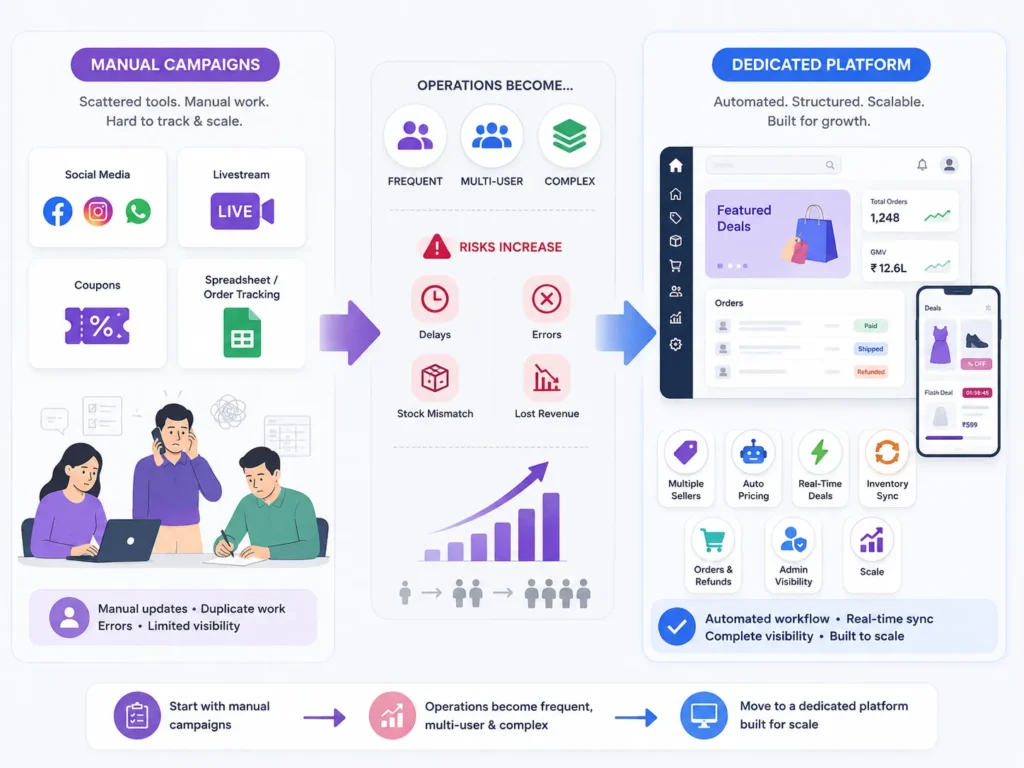
Image Source: AI-generated visual by Miracuves
Manual campaigns are useful for early testing. A founder can test demand through social media, livestream tools, limited coupons, and manual order management.
But manual execution becomes risky when campaigns become frequent or complex.
A brand should consider a dedicated platform when:
- Multiple sellers, creators, or product managers are involved
- Group pricing rules need to be automated
- Buyers need real-time deal status
- Inventory must sync with campaign limits
- Orders, refunds, and payments need structured tracking
- The brand wants its own app experience instead of relying only on social platforms
- Admin teams need visibility across users, campaigns, sellers, and revenue
- The business wants to scale beyond one-off promotional events
This is where a launch-ready social commerce foundation becomes useful. Instead of building every campaign module from zero, founders can evaluate a ready-made group-buying marketplace platform from Miracuves that already aligns with social commerce mechanics, merchant workflows, live selling concepts, and admin control.
For readers exploring that next step, Miracuves’ group-buying marketplace platform can be reviewed here: Explore the Miracuves social commerce and group-buying platform
Monetization Models for Live Shopping and Group Buying Platforms
Beauty and fashion brands may use these campaigns to sell their own products. Marketplace operators, however, can also use them to build a broader revenue model.
| Monetization Model | How It Works | Best For |
| Commission on Sales | Platform earns a percentage from every completed order. | Multi-seller beauty or fashion marketplaces |
| Featured Campaign Fees | Sellers pay for homepage placement, live event promotion, or drop visibility. | Marketplaces with multiple active merchants |
| Creator Collaboration Fees | Brands or sellers pay for creator-led campaign placement. | Influencer-driven commerce platforms |
| Subscription Plans | Sellers pay monthly for access to campaign tools, analytics, or premium features. | Platforms with repeat sellers |
| Advertising Slots | Brands promote products, streams, or bundles within the platform. | High-traffic social shopping platforms |
| Loyalty and Membership Programs | Buyers pay or earn rewards for early access, exclusive drops, or member pricing. | Community-led beauty and fashion platforms |
The right monetization model depends on whether the founder is building a single-brand commerce app, a multi-seller marketplace, a creator-led platform, or a niche shopping community.
Operational Checklist Before Launching a Live Group-Buying Campaign
Before running the campaign, founders should confirm:
- Product selection is clear and campaign-ready
- Group discount rules are connected to margin logic
- Inventory limits are defined before promotion starts
- Campaign start and end times are visible
- Creator or host script is prepared
- Product pinning or product spotlight workflow is ready
- Checkout flow is tested
- Refund, cancellation, and support policies are clear
- Order fulfilment team is prepared for campaign spikes
- Campaign analytics are tracked after launch
A strong campaign is not only a marketing event. It is a coordinated product, inventory, pricing, content, and operations workflow.
Final Thoughts: Campaign Strategy Comes Before Platform Scale
Live shopping and group buying can help beauty and fashion brands convert attention into action. But the strongest results come when founders treat these campaigns as structured commerce systems, not one-time promotional experiments.
Beauty brands can use live sessions to build trust through demonstration, education, and creator-led product explanation. Fashion brands can use live drops to create urgency, visual storytelling, and social participation. Group buying adds the community layer that encourages buyers to invite others and act within a defined window.
The platform decision comes after the campaign logic is clear. Once a founder knows the products, audience, pricing rules, creator strategy, and operational requirements, a ready-made social commerce foundation can help turn that strategy into a scalable app experience.
Miracuves helps founders make that move with white-label, source-code-owned solutions built for faster launch, admin control, and practical market validation.
FAQs
How can beauty brands use live shopping to increase conversions?
Beauty brands can use live shopping to demonstrate products, answer customer questions, explain routines, compare shades, and build trust through creators or experts. When live sessions are connected to limited-time offers or group-buying campaigns, shoppers get both confidence and urgency before checkout.
Why does group buying work for fashion ecommerce?
Group buying works for fashion ecommerce because shoppers often respond to trends, limited drops, peer influence, and time-sensitive offers. A group discount gives buyers a reason to invite friends, join campaigns, and complete purchases before the deal closes.
Should every beauty or fashion product be sold through group discounts?
No. Group discounts should be used selectively. They work best for bundles, launches, seasonal inventory, creator campaigns, or community events. Using them on every product can weaken brand value and reduce full-price purchasing behavior.
What features are needed for a live shopping campaign?
A live shopping campaign usually needs product showcasing, live chat, product pinning, in-stream purchase flow, inventory control, campaign timing, host or creator management, order tracking, and analytics. For marketplace models, merchant and admin dashboards are also important.
How do live drops help fashion brands?
Live drops help fashion brands create anticipation, urgency, and visual storytelling. A stylist or creator can show outfits in real time, explain fit and combinations, and drive buyers toward limited-stock products or group offers.
Can small beauty brands use group buying campaigns?
Yes. Small beauty brands can use group buying to test demand, launch bundles, activate communities, and encourage referrals. The key is to keep the campaign simple, protect margins, and measure whether buyers return after the first offer.
When should a brand build a dedicated social commerce platform?
A brand should consider a dedicated platform when manual campaigns become difficult to manage, especially when there are multiple sellers, creators, products, group deals, inventory rules, payments, refunds, and analytics requirements.
How does Miracuves support live shopping and group-buying business models?
Miracuves helps founders launch white-label and source-code-owned app platforms with admin control, marketplace workflows, campaign logic, and faster deployment. This gives founders a practical foundation for testing and scaling social commerce models.
Miracuves is an independent software development company. We are not affiliated with, connected to, sponsored by, or endorsed by any company or product named in this article.
Terms such as “X Clone” are used descriptively. It is how the software industry refers to building a platform with functionality comparable to a known service, and how clients search for it.
The entire design and codebase of our products is built by our own team. Our products contain no code, design, graphics, or content originating from any third-party website or applications.
All third-party names and marks referenced in this article are the property of their respective owners, referenced solely to identify the services discussed.