Key Takeaways
- A white-label Shein app can be safe with strong ecommerce security.
- User data protection matters for accounts, orders, and payments.
- Secure checkout helps build trust and reduce payment risks.
- Admin controls support product checks, refunds, and fraud prevention.
- Regular updates reduce bugs, attacks, and outdated code risks.
What You’ll Learn
- How safe a white-label Shein app can be for fashion ecommerce.
- Key risks include data leaks, fake products, and payment fraud.
- Security features include encryption, secure login, and role access.
- Product and seller checks help improve marketplace trust.
- Platform safety depends on code quality, hosting, monitoring, and support.
Real Insights
- Fashion apps need trust before users share data or make purchases.
- Payment protection matters for smooth and safe checkout.
- Product authenticity checks help reduce low-quality or fake listings.
- Security audits help find weak points before launch.
- The best strategy is to launch with secure code and ongoing monitoring.
You’ve heard the horror stories about data breaches, stolen payment details, and fashion apps leaking customer data.
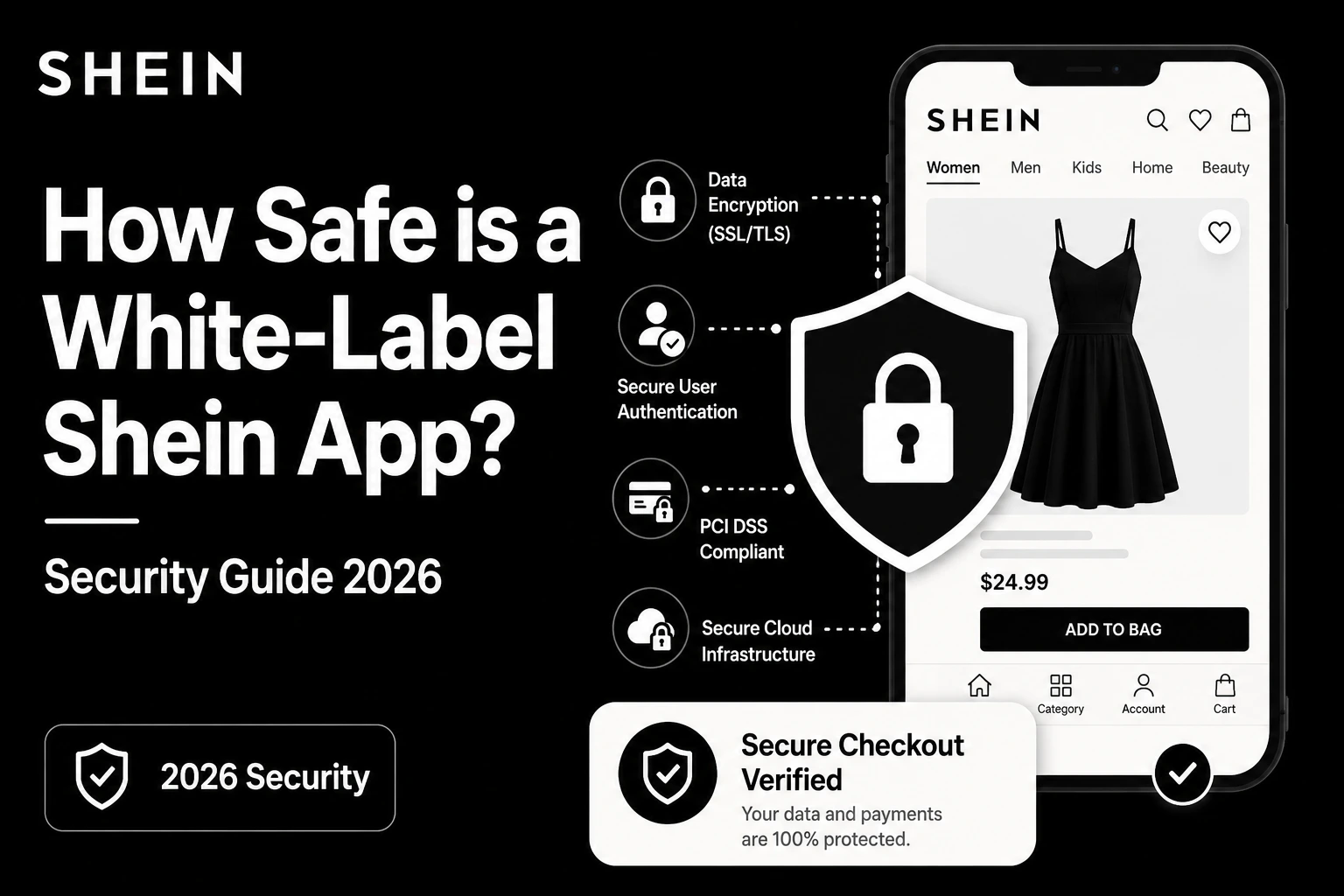
In 2026, eCommerce and fashion apps are prime targets for cyberattacks. A white-label Shein app handles sensitive user data, payment information, and inventory systems — making security non-negotiable.
This guide gives you an honest security assessment, real compliance requirements, and practical steps to launch safely — without risking your brand reputation.
Understanding White-Label Shein App Security Landscape
White-label Shein app security refers to the protection standards built into a ready-made fashion eCommerce app that multiple businesses can rebrand and launch. The security level depends entirely on the provider’s architecture, infrastructure, and compliance maturity.
It is not automatically less secure — but it is only as strong as the company that built it.
Why People Worry About White-Label Apps
- Shared infrastructure fears
- Data ownership confusion
- Compliance uncertainty
- Limited visibility into backend security
These concerns are valid — especially when providers lack transparency.
Current Threat Landscape for Fashion eCommerce Apps (2026)
White-label Shein app models face:
- Payment fraud attacks
- Credential stuffing
- API exploitation
- Fake discount abuse
- Inventory manipulation
- Bot-driven checkout abuse
Retail platforms continue to face high attack volumes due to stored payment data and large user bases.
Security Standards in 2026
In 2026, serious white-label providers follow:
- Zero-trust architecture
- End-to-end encryption
- Mandatory MFA authentication
- Continuous penetration testing
- Secure DevOps (DevSecOps)
- AI-based fraud detection
Anything below this baseline is outdated.
Real-World Statistics
- Retail accounts for roughly 24% of global cyberattacks.
- Over 60% of small-to-mid eCommerce platforms lack full PCI DSS compliance.
- API-based attacks have increased significantly due to mobile-first commerce.
Security is no longer optional — it is a business survival requirement.
Key Security Risks & How to Identify Them
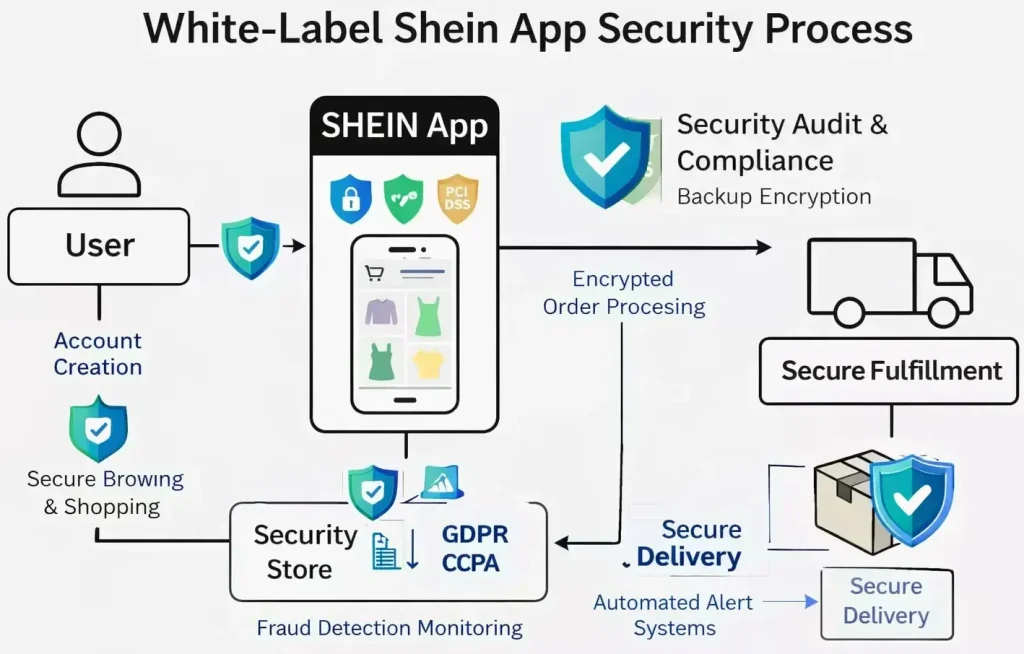
A white-label Shein app handles customer identities, payment credentials, addresses, and behavioral data. If security is weak, risks escalate quickly.
Data Protection & Privacy Risks
User Personal Information
Fashion apps collect:
- Names
- Emails
- Phone numbers
- Shipping addresses
- Order history
Without encryption at rest and in transit, this data becomes an easy breach target.
Payment Data Security
If your white-label Shein app processes payments:
- PCI DSS compliance is mandatory
- Tokenization must replace raw card storage
- Payment gateways must be certified
Storing card data improperly can trigger massive regulatory penalties.
Location Tracking Concerns
Many fashion apps track:
- Delivery locations
- Real-time shipment status
- IP addresses
Without proper consent management, this violates GDPR and CCPA regulations.
GDPR / CCPA Compliance Gaps
Common violations include:
- No data deletion mechanism
- Weak consent tracking
- Poor privacy policy structure
- No user data export feature
These gaps can lead to heavy fines.
Technical Vulnerabilities
Code Quality Issues
Low-quality code may contain:
- Hardcoded credentials
- Unvalidated input fields
- Injection vulnerabilities
- Weak session handling
Secure coding standards must be enforced.
Server Security Gaps
Risks include:
- Misconfigured cloud storage
- Open ports
- Weak firewall policies
- No intrusion detection
Cloud misconfiguration is one of the top breach causes globally.
API Vulnerabilities
White-label Shein apps rely heavily on APIs for:
- Product listings
- Payment processing
- User authentication
- Order management
Unsecured APIs are a major 2026 threat vector.
Third-Party Integration Risks
Common integrations:
- Payment gateways
- SMS providers
- Analytics tools
- Marketing automation
Every third-party integration increases attack surface.
Business Risks
Legal Liability
If customer data leaks, your business — not just the provider — may face lawsuits.
Reputation Damage
Fashion brands depend on trust. A single breach can permanently damage brand credibility.
Financial Losses
Costs may include:
- Regulatory fines
- Customer compensation
- Downtime losses
- Forensic investigation
Regulatory Penalties
Under GDPR, fines can reach up to 4% of global annual turnover.
Risk Assessment Checklist
Before launching your white-label Shein app, verify:
- Is data encrypted at rest and in transit?
- Is PCI DSS compliance documented?
- Are regular penetration tests conducted?
- Is there an incident response plan?
- Are APIs protected with authentication and rate limiting?
- Is user consent logged and auditable?
- Are backups automated and encrypted?
If any answer is unclear, security risk exists.
Security Standards Your White-Label Shein App Must Meet
ISO 27001 (Information Security Management System)
ISO/IEC 27001 is the best-known standard for running an information security management system (ISMS) that continuously manages and improves security risk.
SOC 2 Type II (Operational Security Controls)
SOC 2 reports evaluate controls against the AICPA Trust Services Criteria (security, availability, confidentiality, processing integrity, privacy). “Type II” specifically tests how controls performed over a period of time, not just whether they exist on paper.
GDPR (If You Touch EU/EEA Users)
GDPR penalties for serious violations can reach up to €20M or 4% of worldwide annual turnover (whichever is higher).
CCPA/CPRA (If You Have California Users)
CCPA (as amended by CPRA) gives consumers rights like correcting data and limiting use/disclosure of sensitive personal information, and it increases operational compliance expectations for businesses handling consumer data.
HIPAA (Only If Your App Handles Health Data)
Not typical for a fashion eCommerce app, but if you ever handle electronic protected health information (ePHI), HIPAA’s Security Rule requires administrative, physical, and technical safeguards.
PCI DSS (Mandatory If You Store/Process/Transmit Card Data)
PCI DSS is a security standard designed to ensure organizations that accept/process/store/transmit card data maintain a secure environment.
Technical Requirements That Should Be Non-Negotiable
Encryption and Transport Security
- TLS (SSL) everywhere (app, APIs, admin panels)
- Encryption at rest for sensitive data (PII, tokens, secrets)
Secure Authentication
- OAuth 2.0 / OpenID Connect where relevant
- Mandatory admin MFA (2FA)
- Strong session management and secure password policies
Ongoing Assurance
- Regular security audits (aligned to ISO/SOC expectations)
- Penetration testing (app + API + infrastructure)
- Vulnerability management and patch SLAs
Secure API Design
- Token-based auth, short-lived tokens, refresh rotation
- Rate limiting + bot protection
- Input validation, WAF protections, and strict access control
Security Standards Comparison Table
| Standard / Framework | What it proves | Most relevant for a White-label Shein app | Non-negotiable when |
|---|---|---|---|
| ISO 27001 | You operate a formal ISMS and manage security risk continuously | Vendor maturity + long-term security governance | You want enterprise buyers and repeatable security |
| SOC 2 Type II | Controls work in real operations over time | Hosting, monitoring, change management, incident response | You rely on a vendor to run your platform |
| GDPR | EU user privacy rights + strict fines | Consent, deletion, access requests, data minimization | Any EU/EEA user data is involved |
| CCPA/CPRA | California consumer privacy rights + obligations | Notices, opt-outs, sensitive data handling | You serve California residents |
| PCI DSS | Cardholder data security program | Checkout and payments protection | You process/store/transmit card data |
| HIPAA | ePHI safeguards requirements | Only if health data exists | The app handles ePHI in any form |
Read more : – Business Model of Shein : Complete Strategy Breakdown 2025
Red Flags: How to Spot Unsafe White-Label Providers
Choosing the wrong provider for your white-label Shein app can expose your entire fashion business to long-term risk.
Warning Signs You Should Never Ignore
No Security Documentation
If a provider cannot show:
- ISO or SOC reports
- PCI compliance documents
- Penetration testing summaries
That is a major red flag.
Cheap Pricing Without Explanation
Enterprise-grade security infrastructure is expensive. Extremely low pricing often means:
- Shared weak hosting
- No dedicated security team
- No audit process
No Compliance Certifications
If they claim “GDPR ready” but provide no:
- Data Processing Agreement (DPA)
- Security policy
- Compliance framework documentation
The claim is marketing, not reality.
Outdated Technology Stack
Older frameworks may:
- Lack modern security patches
- Be vulnerable to known exploits
- Fail API security standards
Poor Code Quality
Ask if they follow:
- Secure coding standards
- Code review protocols
- Static and dynamic testing
If not, vulnerabilities are likely hidden inside the app.
No Security Update Policy
A serious provider should have:
- Defined patch timelines
- Critical vulnerability response SLAs
- Version upgrade roadmap
Without updates, your app becomes obsolete quickly.
No Data Backup and Disaster Recovery
Look for:
- Automated encrypted backups
- Multi-region redundancy
- Recovery time objectives (RTO)
No Insurance Coverage
Professional providers carry:
- Cyber liability insurance
- Errors and omissions insurance
If they do not, you absorb the full risk.
Evaluation Checklist Before Signing
Questions to Ask
- Are you ISO 27001 certified?
- Do you provide SOC 2 Type II reports?
- How often is penetration testing conducted?
- Where is data hosted?
- What encryption standards are used?
Documents to Request
- Compliance certificates
- Security whitepaper
- Incident response policy
- Data retention policy
- Backup and recovery documentation
Testing Procedures
- Request staging access for security testing
- Perform independent vulnerability scanning
- Validate payment gateway certification
Due Diligence Steps
- Check public breach history
- Verify hosting provider certifications
- Review contractual security clauses
- Confirm data ownership terms
If a provider hesitates to share this information, reconsider immediately.
Best Practices for Secure White-Label Shein App Implementation
Security does not end with choosing the right provider. Implementation determines real-world safety.
Pre-Launch Security
Security Audit Process
Before going live:
- Conduct third-party penetration testing
- Review cloud configurations
- Validate API security controls
- Confirm PCI DSS scope
Code Review Requirements
Even in a white-label Shein app:
- Review custom modifications
- Scan for vulnerabilities
- Validate secure authentication flows
Infrastructure Hardening
- Enable Web Application Firewall (WAF)
- Enforce HTTPS everywhere
- Restrict admin access via IP policies
- Apply least-privilege access controls
Compliance Verification
- Confirm GDPR consent mechanisms
- Validate data deletion workflow
- Test privacy request handling
- Audit payment processing security
Staff Training Programs
Human error causes many breaches. Train teams on:
- Phishing awareness
- Secure password policies
- Admin panel access controls
Post-Launch Monitoring
Continuous Security Monitoring
- Real-time intrusion detection
- Log monitoring
- Fraud detection systems
Regular Updates and Patches
- Monthly patch cycles
- Emergency vulnerability updates
- API security upgrades
Incident Response Planning
Have a documented plan covering:
- Breach identification
- Containment procedures
- User notification process
- Legal reporting obligations
User Data Management
- Data minimization practices
- Retention period policies
- Automated data deletion workflows
Backup and Recovery Systems
- Daily encrypted backups
- Multi-region storage
- Disaster recovery testing
Security Implementation
| Phase | Key Security Actions |
|---|---|
| Planning | Compliance review, vendor verification |
| Development Setup | Infrastructure hardening, access control |
| Pre-Launch | Penetration testing, compliance validation |
| Launch | Enable monitoring, logging, fraud controls |
| Ongoing | Monthly audits, quarterly testing, patch updates |
Security is a process, not a one-time setup.
Legal & Compliance Considerations
Launching a white-label Shein app without legal preparation can create long-term liability.
Regulatory Requirements
Data Protection Laws by Region
- European Union: GDPR requires lawful basis for processing, user consent tracking, data portability, and breach notification within 72 hours.
- United States: CCPA/CPRA mandates consumer rights for access, deletion, and opt-out of data sharing.
- UK: UK GDPR mirrors EU standards with separate regulatory oversight.
- India: Digital Personal Data Protection Act (DPDP) requires consent-based data processing and grievance redressal mechanisms.
If your white-label Shein app serves global users, compliance must be multi-jurisdictional.
Industry-Specific Regulations
For fashion eCommerce apps:
- PCI DSS for payment processing
- Consumer protection and refund laws
- Advertising transparency requirements
User Consent Management
Your app must include:
- Cookie consent banners
- Opt-in tracking
- Clear privacy disclosures
- Easy withdrawal of consent
Consent logs must be auditable.
Privacy Policy Requirements
A compliant privacy policy must clearly state:
- What data is collected
- Why it is collected
- How long it is retained
- Who it is shared with
- How users can request deletion
Terms of Service Essentials
Your terms should define:
- User responsibilities
- Platform limitations
- Dispute resolution mechanisms
- Refund policies
- Intellectual property protection
Liability Protection
Insurance Requirements
Serious white-label Shein app operators carry:
- Cyber liability insurance
- Data breach coverage
- Technology errors and omissions insurance
Legal Disclaimers
Include:
- Limitation of liability clauses
- Force majeure provisions
- Payment processing disclaimers
User Agreements
Ensure:
- Clear acceptance mechanisms
- Age verification where required
- Explicit consent for marketing communication
Incident Reporting Protocols
Prepare:
- 72-hour GDPR breach notification process
- Regulator contact procedures
- Customer communication templates
Regulatory Compliance Monitoring
Assign:
- A compliance officer or DPO (if required)
- Regular internal compliance audits
- Legal review of updates
Compliance Checklist by Region
| Region | Required Actions | Critical Compliance Area |
|---|---|---|
| EU | GDPR compliance, DPA agreements, breach reporting | Data privacy |
| USA (California) | CCPA opt-out, privacy notices | Consumer data rights |
| UK | UK GDPR registration | Data handling |
| India | DPDP Act consent framework | User consent |
| Global | PCI DSS validation | Payment security |
Ignoring compliance is not just risky — it is financially dangerous.
Why Miracuves White-Label Shein App is Your Safest Choice
Security should never be an afterthought. At Miracuves, it is the foundation.
Miracuves Security Advantages
Enterprise-Grade Security Architecture
Our white-label Shein app is built on hardened cloud infrastructure with layered defense models and secure DevOps practices.
Regular Security Audits and Certifications
We follow structured security management aligned with global standards and conduct recurring audits and penetration testing.
GDPR and CCPA Compliance by Default
Built-in consent management, data export, and deletion workflows ensure privacy compliance across regions.
24/7 Security Monitoring
Real-time monitoring, intrusion detection, and fraud prevention systems actively protect your platform.
Encrypted Data Transmission
End-to-end encryption secures:
- User credentials
- Payment transactions
- Order information
Secure Payment Processing
PCI-aligned architecture with tokenization ensures cardholder data protection.
Regular Security Updates
Continuous patch management and proactive vulnerability remediation keep your app secure in evolving threat landscapes.
Insurance Coverage Included
Cyber liability protection reduces your financial exposure.
Miracuves has delivered 9k+ successful projects with zero major security breaches — because security is engineered from day one.
Don’t compromise on security. and Get a free security assessment and see why businesses trust Miracuves for safe, compliant platforms.
Final Thought
Security is not about fear — it is about preparation. A white-label Shein app can be highly secure if built on certified infrastructure, compliant systems, and continuous monitoring. The real risk is choosing the wrong provider. In 2026, trust equals survival. Build your fashion app on security first.
FAQs
1. Is white-label Shein app security weaker than custom development?
Not necessarily. A certified white-label app with ISO, SOC 2, and PCI alignment is often safer than poorly audited custom builds.
2. What happens if there is a security breach?
You must activate your incident response plan, notify regulators (if required), inform users, and remediate vulnerabilities immediately.
3. Who is responsible for security updates?
The provider manages core infrastructure security, while you must manage operational practices and user-side policies.
4. How is user data protected in a white-label Shein app?
Through encryption, access controls, secure hosting, tokenized payments, and regular security audits.
5. What compliance certifications should I look for?
ISO 27001, SOC 2 Type II, PCI DSS, GDPR compliance, and regional privacy law alignment.
6. Can white-label apps meet enterprise security standards?
Yes, if built with enterprise-grade infrastructure, audit frameworks, and continuous monitoring.
7. How often should security audits be conducted?
At minimum annually, with quarterly vulnerability scans and continuous monitoring.
8. What is included in Miracuves security package?
Encrypted infrastructure, compliance-ready architecture, monitoring, patch management, and fraud protection systems.
9. How do I handle security across different countries?
Implement multi-region compliance policies, localized privacy notices, and legal monitoring.
10. What insurance is needed for app security?
Cyber liability insurance, data breach coverage, and technology errors and omissions insurance.
Related Articles
Miracuves is an independent software development company. We are not affiliated with, connected to, sponsored by, or endorsed by any company or product named in this article.
Terms such as “X Clone” are used descriptively. It is how the software industry refers to building a platform with functionality comparable to a known service, and how clients search for it.
The entire design and codebase of our products is built by our own team. Our products contain no code, design, graphics, or content originating from any third-party website or applications.
All third-party names and marks referenced in this article are the property of their respective owners, referenced solely to identify the services discussed.