“A battle-tested matching engine, our brand, running inside a month.”“A Web3 family that finally shared one backbone, end to end.”“A battle-tested matching engine, our brand, running inside a month.”
WATCH · UNLOCK · EARN COINS · GO VIP · FIVE LOCALES · RIGHT TO LEFT · ONE CATALOG · WATCH · UNLOCK · EARN COINS · GO VIP · FIVE LOCALES · RIGHT TO LEFT · ONE CATALOG ·
WATCH · UNLOCK · EARN COINS · GO VIP · FIVE LOCALES · RIGHT TO LEFT · ONE CATALOG · WATCH · UNLOCK · EARN COINS · GO VIP · FIVE LOCALES · RIGHT TO LEFT · ONE CATALOG ·
WATCH · UNLOCK · EARN COINS · GO VIP · FIVE LOCALES · RIGHT TO LEFT · ONE CATALOG · WATCH · UNLOCK · EARN COINS · GO VIP · FIVE LOCALES · RIGHT TO LEFT · ONE CATALOG ·
WATCH · UNLOCK · EARN COINS · GO VIP · FIVE LOCALES · RIGHT TO LEFT · ONE CATALOG · WATCH · UNLOCK · EARN COINS · GO VIP · FIVE LOCALES · RIGHT TO LEFT · ONE CATALOG ·
v2026 - Production Ready
DramaBox Clone App - White-Label Short-Drama OTT Built for Multi-Language Markets
A launch-ready short-drama platform that runs one catalog across five locales, with Hebrew and Arabic laid out right-to-left on every surface. Episodes play in a vertical player after a free episode window, then unlock by coin balance, a rewarded ad or a VIP window, with per-country prices through the paid Regional Pricing module and a gateway chosen per country on the web store.
One Express and MongoDB API serves three clients. Interface copy belongs to the operator CMS, which means a new language market gets opened from the console instead of through a release, while a single wallet ledger settles every transaction underneath.
the source code is entirely yours, and there is no per-seat fee
Local
Prices & Rails
prices via the paid Regional Pricing module, a gateway per country on the web store
One Catalog, Many Markets
The same episode library launches in five locales with its own pricing, payment rails and interface copy per territory - so a new country is a configuration, not a rebuild.
Every Territory Pays Differently
Coin packs, VIP windows and rewarded ads are priced per market, because a wallet that converts in Jakarta will not convert in Riyadh or Los Angeles.
Live DramaBox Clone Demo: Viewer App, Store Build, Admin Console & Android
Open it yourself rather than taking our word for it, with working viewer and operator logins below. The demo worth running here is the language one: switch the interface to Hebrew or Arabic and watch the whole layout mirror, then look at the same catalog through a different region.
mxreelshort.mimeld.com
Live demo
Viewer-Facing Web App
DramaBox Clone - Browse in Five Languages
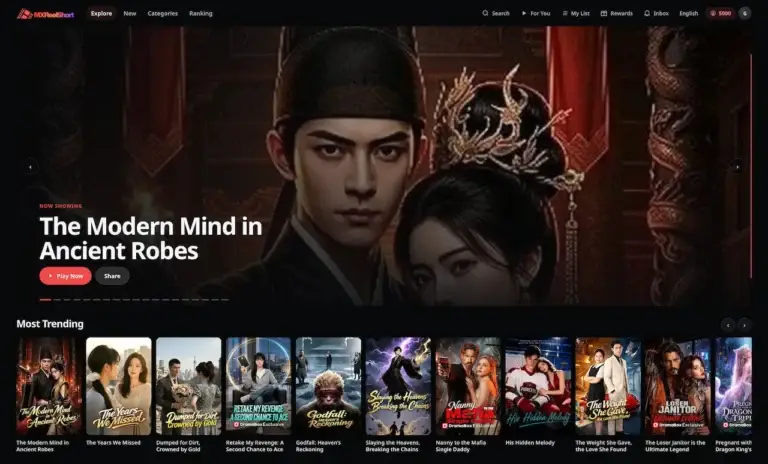
The viewer surface with the language picker live: rails and search rendered in any of five locales, right to left for Hebrew and Arabic, and a vertical player whose subtitle track is separate from the interface language.
The paid surface seen from a market: coin packs and VIP plans priced in the default currency from the currency catalog, per-country prices available through the Regional Pricing module, and the rewards ladder alongside.
1Sign in with the identical credentials shown below
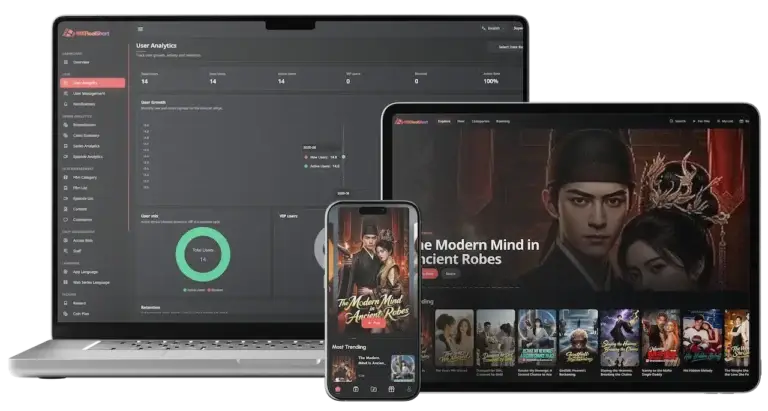
Where a multi-market service is actually run: region chips per title, language flags across five locales, the app language editor that owns client copy, the currency catalog, plus analytics, staff roles and reports.
1Start the admin console from your browser
2Explore: Language, Currency, Film List, Roles
Credentials:admin@demo.com | Admin_$321 (demo role with view-only access)
A single Flutter binary holds all five locales instead of a build per market. It has five tabs, reels that play episode by episode with comments, unlock by coin or ad, wallet histories, and the web's right-to-left handling.
1Install the app on your Android device
2Sign in using the viewer credentials listed below
Watch the DramaBox Clone Video Demo - a Walkthrough of Catalog, Coin Unlock & the Operator Console
Prefer a guided tour? Our team can take you through it on a 30 minute call to plan your launch. Topics cover go-live sequencing, gateway selection, VIP tiers, coin pricing, the free episode window and catalog ingest.
Three surfaces reading one API: a consumer web build, a Flutter store binary and a Next.js console, with around 250 handlers behind them divided between the client router and the admin side.
9 screens · scroll →
9 screens · scroll →
13 screens · scroll →
Trace one market end to end, from a viewer landing in Arabic with the layout mirrored, through a checkout quoted in that market’s own currency once Regional Pricing is on, to an operator changing the interface copy for that locale without waiting on a release.
How a DramaBox Clone Operator Might Work - Scenarios by Market
Each card is an illustrative scenario from the Miracuves product team, built on a real localization feature of this DramaBox Clone. They describe what a multi-market operator runs into, not what any client said.
RRight-to-Left LaunchArabic-language drama service
Arabic changes the layout. An operator opening a Hebrew or Arabic market needs more than translated menus. Here Hebrew and Arabic mirror the layout, not just the text, across the consumer web app, the Flutter build and the operator console. A single Flutter binary holds all five locales instead of a build per market. The right-to-left market opens on the same product as the English one, with nothing retrofitted.
PPaywall Copy Per MarketLanguage-community streaming platform
Same paywall, different reader. A paywall line that works in one market can land wrong in the next. On this platform client wording is an editable language JSON in the console, not a string table compiled into a build. Someone who speaks the language rewrites the copy for that locale, and the change reaches viewers without a release. Testing wording per territory becomes a routine edit.
LLicensed Territory OnlyLicensor with regional rights
Rights stop at borders. A licensor holds a series for some countries and not others, and one title on the wrong shelf is a contract problem. Region chips attach to every title, and territory targeting is resolved where each rail is built, so a title outside its licensed market never reaches a shelf there. Dated license windows publish and retire titles on schedule. One library serves every market.
CCheckout in Local CurrencyMulti-territory drama service
Converted prices feel foreign. A coin pack quoted through an exchange rate reads like an import. The currency catalog holds each currency's name, symbol and codes, with one default pricing checkout. Add the Regional Pricing module, a paid add-on, and each country gets its own plan price as a row entered per plan. On the web store, a matrix maps each region to its gateway, so every country settles on its own rail.
DramaBox Clone Reference Deployment - Modeled Short-Drama OTT
How an operator would launch a regional short-drama platform on this build, written as a modeled reference deployment rather than a client story. DramaBox Clone and ReelShort Clone ship from the same Miracuves short-drama codebase.
Short-Drama OTTIllustrative Reference Setup
Modeled Reference Deployment - Short-Drama OTT Platform
A regional short-drama OTT modeled on the Miracuves short-drama platform that this product ships from, with five locales, right-to-left layout, coin unlock and VIP windows live from day one.
Illustrative caseThis is not a client engagement
IndiaRegion
Micro-Drama Streaming & Coin RevenueIndustry
46Core Mongoose models in the shipped schema
5Languages on, RTL included
24Permission modules in the console
01Where This Market Pushes Back
Earn per episode instead of sending viewers to a subscription wall
Right-to-left layouts in Hebrew and Arabic on the web, the app and the console
A single catalog and a single wallet serve the web client, the store app and the operator console
02What Operators Tend to Ask For
Go live with a short-drama OTT service without writing the wallet and unlock engine from scratch
Operators work in a cinema console rather than a raw database
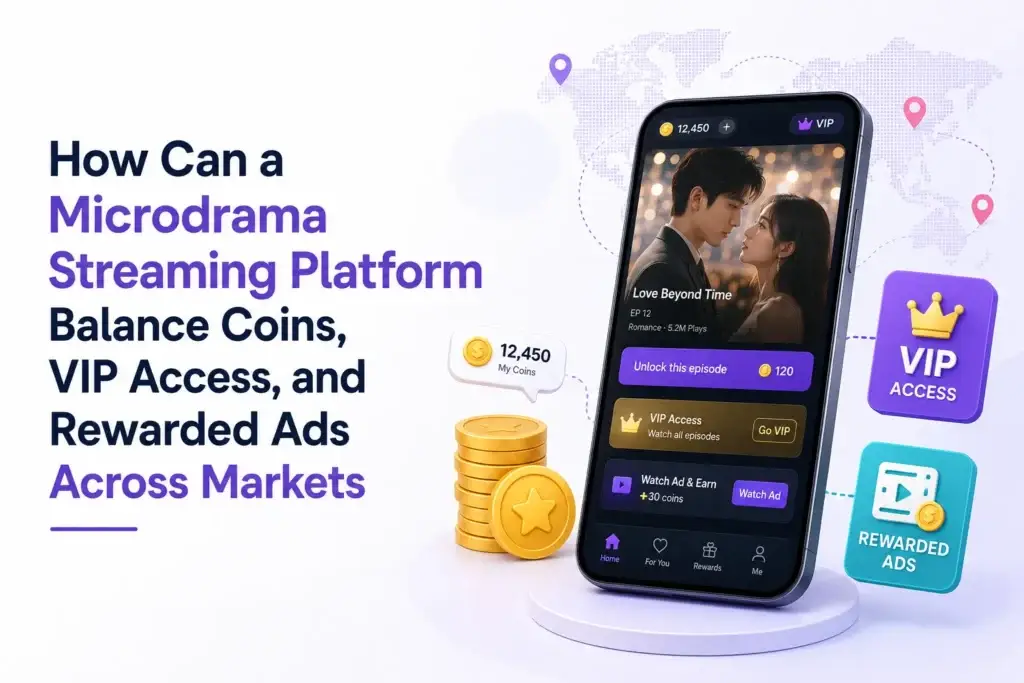
Coin, VIP and ad unlock operate side by side as three tenders
03Contents of the Base Build
Subtitle track and continue watching sit inside a vertical episode player
A seven day rewards ladder, plus coin packs and VIP windows
Right-to-left layout across five locales
My List, reports, episode comments and likes
A single Express API running behind nginx and PM2
What you see is a modeled reference deployment and not a client engagement. Figures listed above describe the platform as shipped, not as outcomes, and none of it quotes a client. To see real, named engagements, visit our portfolio.
Reach our specialistsSee how a short-drama OTT would be deployed end to end.
A DramaBox Clone is a short-drama platform, ready made, that serves several language markets at once. It brings one catalog holding titles, their categories and numbered episodes, a vertical player, and interface copy that belongs to the operator rather than being inherited.
Covers Web, Android, iOS & the API
The Copy Belongs to the Operator
Client wording is an editable language JSON in the console, not a string table compiled into a build. A market that phrases a paywall differently is a text edit, not a release.
Right-to-Left Is Not a Retrofit
Hebrew and Arabic layout runs across the web app, the Flutter build and the console. Retrofitting RTL into a player after launch is what disqualifies most alternatives from these markets entirely.
Candid Launch Status
Stated plainly here, so nothing surprises you later: viewer cash-out amounts to data architecture and nothing more, passwords use Cryptr and not bcrypt, and web ad unlock is just a simulated preview.
The Engine
What Does a DramaBox Clone Script Mean?
Localization is where most short-drama launches quietly fail. Translating a menu is easy. Laying out a player right-to-left, letting an operator rewrite the wording of a paywall for a market that reads it differently, targeting which titles appear in which region, and settling in a currency the buyer recognizes are four separate problems, and all four are solved here rather than left as an integration.
01Five locales, including right-to-left Hebrew and Arabic
02Interface copy edited as JSON from the operator console
03Region chips deciding which titles surface where
04Currency catalog, with per-country prices through Regional Pricing
05A region-to-gateway matrix so each country settles on its own rail
In practice: five locales (English, Hebrew, Hindi, Arabic and Spanish), with Hebrew and Arabic set right-to-left, an app language JSON the operator edits from the console, region chips on the catalog, a currency catalog with a default currency for checkout, and a region-to-gateway matrix on the web store. The data layer holds 46 core Mongoose models on MongoDB (66 counting every Plus module), with around 250 registered API handlers and a 24 module permission system.
Everything below is built and demonstrable in the live demo. Where something needs an account of yours, or ships as a preview rather than a live integration, it is marked against the feature instead of being glossed over.
01
Feature 01 / 12
Five Locales, RTL Included
English, Hebrew, Hindi, Arabic and Spanish, where the two right-to-left languages mirror the layout in the store build, the operator console and the consumer web app instead of only one of the three.
Five locales: English, Hebrew, Hindi, Arabic and Spanish
Hebrew and Arabic mirror the layout, not just the text
Applied on web, store build and console alike
A default locale chosen in settings
02
Feature 02 / 12
Interface Copy You Own
The app language editor puts client wording in the console as data. Changing how a market reads is an edit, not a release, which is what makes testing copy per territory practical.
App language JSON edited inside the console
Interface wording owned by you rather than the build
Series language catalog kept apart from UI copy
Titles and episode titles held per locale, English as fallback
03
Feature 03 / 12
A Currency per Market
The currency catalog holds each currency's name, symbol and codes, and one default prices checkout. Add the Regional Pricing module and each country gets its own plan price and currency, so a dirham price and a riyal price are both deliberate.
Currency catalog with names, symbols and codes
One default currency driving checkout
Per-country plan prices with Regional Pricing (paid)
Region-to-gateway matrix on the web store
04
Feature 04 / 12
Region Chips on Every Title
Territory targeting resolved inside the same clause that builds a rail, so a title outside its licensed market never reaches a shelf there in the first place.
Region chips attached to every title
Dated license windows that publish and retire on schedule
A title never surfaces outside its license
Coming soon titles held out of other rails
05
Feature 05 / 12
Titles & Content Formats
Everything is published from the console: categories, numbered episodes (episode 0 kept as the trailer) and titles marked as either a movie or a web series.
Categories, titles and numbered episodes
Content types for movies and web series
The trailer takes the Episode 0 slot
Poster, banner and animated hero switches
06
Feature 06 / 12
Browse Shelves
Category rails sit beside trending, new releases, coming soon and a banner carousel, while a title not yet released is kept off every other shelf on purpose.
Rails for trending and new releases, plus a banner carousel
Anime, Fandom and Interactive each get a Browse tab
Search across title and plot with a genre filter
History, My List and Remind Me on coming soon titles
07
Feature 07 / 12
Portrait Episode Player
Sequential playback with a subtitle track that is separate from the interface language, plus likes, capped comments, reports and immersive fullscreen on the store build.
Vertical player with sequential playback and auto advance
Several subtitle tracks, with audio tracks viewers can choose
VIP members get HD quality exclusively
Choices that branch the story within a single episode
08
Feature 08 / 12
Three Unlock Paths
A free window set globally and per title, coin pricing carried per episode, and rewarded ad unlock under a per-title daily cap, with auto-unlock covering the rest of a title.
A free episode window set per title
Coin price carried per episode
Rewarded ad unlock with a daily cap per title
Choice Pass and auto-unlock for the remainder
09
Feature 09 / 12
Expiring Coin Wallet
Earned and purchased balances held apart with spend drawing earned first, promotional coins expiring on a set window, and nine typed codes behind every movement.
Earned and purchased coins tracked apart
Gem SKUs are paid for from their own gem balance
Promotional coins carry an expiry
Typed ledger codes across every earn and spend
10
Feature 10 / 12
Coin Bundles & VIP Tiers
Coin SKUs that each carry bonus coins plus an offer price, VIP plans priced by their validity window, plus a currency catalog in which the default sets what checkout shows.
Coin packs may include bonus coins as well as an offer price
VIP and Premium plans defined by validity window
Redeem codes and coupons that grant coins or VIP days
Checkout is hosted, so card data never lands on the platform
11
Feature 11 / 12
Loyalty Reward Steps
A seven day check-in with a streak, rewarded tasks under a daily ceiling, social and email bonuses, a login bonus and a referral that credits the referrer.
A streak tracked across a seven day check-in ladder
Quests on a daily and weekly cycle that pay out claimable rewards
A playback heartbeat drives coin tiers based on watch time
Game Promos, referral and social follow rewards
12
Feature 12 / 12
Team Roles & Demo Login
24 permission modules across list, create, edit and delete, staff bound to one role, and a demo operator whose writes the server refuses rather than the interface hiding.
24 permission modules over four actions
The admin API enforces role checks as well as the menu
A demo operator the server refuses writes from
Hard delete, anonymize and account export are available on request
A word to buyers:
The software is complete as it stands; each deployment is then set up for the operator. During delivery, accounts you own are connected for the gateways, AdMob, Firebase push and mail, plus object storage, which has eight supported providers. Tell us which territories you are opening and we will map locales, currencies, license windows and plan pricing to them.
The console runs on its own subdomain with a one hour session and 24 permission modules across four actions. For a multi-market operator it is also where the market itself is defined: languages, currencies, territories and the words each audience reads.
Console Areas
01
Language & Localization
Flags for each of the five locales, the app language editor that owns client wording, per-language editors for titles and episode titles with Google auto-translate on your key, and a series language catalog kept separate from the interface layer.
02
Currency & Territory
The currency catalog and its default currency, the region-to-gateway matrix for the web store, region chips per title, and per-country plan prices when Regional Pricing is on.
03
Genre Setup & Title List
Genre buckets and titles carrying poster, banner and type, plus trending, coming soon, auto-animate and active switches, with territory chips per title.
04
Episode Roster & Sequencing
Each episode holds an image, a video, a duration, a coin price and a lock. Ordering is by drag and drop, which renumbers and relocks them, and there is a subtitle upload dialogue.
05
Overview
Counts bounded by date, user and revenue charts, and a paid revenue trend, all drawn from live operational data rather than a nightly warehouse job.
06
Viewer Account Controls
Viewers paginated with search and a country filter, which on a multi-market deployment is how you actually see one territory at a time, plus wallets, blocking and balance adjustment.
07
Earning Setup & Coins
Paid revenue monitoring, revenue split by series, the episodes earning most, and coin economy figures tied to the typed ledger codes.
08
Viewer Comments & Flags
Comments listed with a hide action, and a moderation queue built on reasons you write yourself, closing with a solved state that notifies the reporter.
Pricing for Coins & VIP
Coin SKUs that carry a coin amount, bonus coins, a price, an offer price and a store product key; VIP defined by validity; and the order history behind both.
Language flags across all five locales
Edit the app language JSON that holds client copy
A currency catalog, one of which is the checkout default
Report reasons that populate the client report sheet
Staff Access Levels
Roles that name their module and action grants, staff attached to one role each, and a sidebar that omits whatever a role has no claim to.
General settings with policy and store links
Storage across eight providers, one active
Payment switches and keys held per gateway
Android and iOS AdMob unit IDs
Want tighter control?
The admin API enforces role grants, not just the console shell. Work the documentation lists as not yet done includes a shared rate limiter, a health probe and a persistent audit collection. Let us know which of these your review process requires.
One deployment, every market it needs to serve, and the code underneath it transferred outright. No runtime license, no seat count, and no dependency on our release schedule afterwards.
01
Entire Source Package
Viewer application, operator console, Express API and Flutter build, all yours to change, rebrand and redeploy with no license conditions attached.
Vite and React viewer application
Next.js 14 operator console
Express API over Mongoose
Flutter build for iOS and Android
02
Five Locales, RTL Included
English, Hebrew, Hindi, Arabic and Spanish, with Hebrew and Arabic mirroring the layout on all three surfaces rather than on one of them.
Five locales shipped: en, he, hi, ar and es
Right to left layout for Hebrew and Arabic
Applied across web, store build and console
Default locale chosen in settings
03
Operator-Owned Interface Copy
An app language editor in the console means the words a market reads are data you edit, not strings frozen into a build you have to ship again.
App language JSON edited in the console
Interface copy owned by the operator, not the build
Series language catalog kept separate
Report reasons written per deployment
04
Currency & Territory Model
A currency catalog with one default currency, a region-to-gateway matrix for the web store, and region chips that keep a title inside the territories it is licensed for.
Currency catalog with a default currency
Region-to-gateway matrix with a default gateway
Region chips targeting titles to territories
Per-country plan prices via Regional Pricing (paid)
IdentityCatalogEngagementMessagingCommerceConfig
05
46-Model Core Schema
Identity, catalog, engagement, messaging, commerce and configuration collections on MongoDB, shipped with a seed script and indexed where reads concentrate.
46 core models, 66 with every Plus module
Seed script that populates a demo catalog
Indexes on the paths rails and ledger hit
Compound keys guarding the unlock rows
YYour app
06
Flutter Storefront App
One binary holds all five locales and offers five tabs of reels played episode by episode, unlock by coin or ad, wallet histories, rewards and native screenshot restriction.
Order history for the coin and VIP plan modules
PayPlus hosted checkout and four further switches
Reward tables across four console tabs
Nine typed codes behind every coin movement
$ console --modules 24
Staff rolesView-only demo
07
Operator Control Panel
Overview and analytics, catalog and episode modules, viewers and wallets, plans and orders, reports, staff roles, campaigns and every settings tab.
24 permission modules over four actions
A demo operator the server refuses writes from
Storage across eight providers, one active
Byte-level inspection on every upload
08
Handover Docs for Engineers
Entity relationship document, schema reference, the complete API collection, developer and security handbooks, VAPT posture, PRD and feature catalog.
Entity relationship and schema references
The full API collection for both routers
Developer and security handbooks
Feature catalog, PRD and VAPT posture
Would you like to see it in action first?
Use the viewer or operator login above, or book a walkthrough and we will switch the interface into Arabic, watch the layout mirror, requote a coin pack in a second currency and region-target a title, all against the markets you actually intend to open in.
What Will a DramaBox-Style Short-Drama App Cost to Build in 2026?
The white-label DramaBox Clone, launch-ready, costs $3,999 once, and it goes live in 6 working days. The price is final, not an opening figure. Anything beyond the base build is quoted on its own: viewer cash-out, store receipt verification, a CDN, additional locales and a live ad network. Delivery includes submitting the apps under your own developer accounts, though Apple and Google review fall outside it. Paid add-ons sit on top of that: DRM and the remaining Plus modules.
Most Chosen Route
Professional
ReadyMade Launch-Ready Package
$3,999/-paid once only
Go-live: 6 days
Suits best: App publishers, regional OTT operators & short-drama studios
The solution arrives just like our demo, carrying your branding and hosted on your own servers.
Which Operators Is the DramaBox Clone App Designed For?
These operators have one thing in common: the audience they are chasing does not all read the same language, and in at least one of their markets it does not read left to right.
Audience 01 / 06Diaspora and Language-Community Platforms
Audiences defined by language rather than geography, where the interface copy matters as much as the catalog and the operator wants to write it themselves.
01
MXReelShortSits on one product base
Audience 02 / 06Short-Series Producers
Producers holding vertical series who want a storefront, a wallet and a console instead of another distribution deal written on somebody else's terms.
02
MXReelShortSame product base underneath
Audience 03 / 06Rights Holders
Rights holders who need per-title region targeting and series analytics they can put in front of a licensor at quarter end without exporting collections by hand.
03
MXReelShortOne shared product base
Audience 04 / 06Rebranded Drama Networks
Operators running several branded services, where each one gets its database, a pair of domains and its store binary. No tenant discriminator exists, and that is deliberate.
04
MXReelShortRests on a single product base
Audience 05 / 06Operators Selling Into RTL Markets
Services targeting Hebrew or Arabic audiences, where layout runs right to left across the player, the store and the console rather than being bolted on after the first complaint.
05
MXReelShortSingle product base shared
Audience 06 / 06Multi-Territory Regional Services
One catalog, several language markets, region chips deciding what surfaces where, and local-currency prices per country through Regional Pricing, so nobody is asked to convert in their head.
06
MXReelShortProduct base is the same
If you are selling drama into more than one territory, the question is never whether the player works. It is whether the paywall reads naturally, whether the catalog shows the right titles, and whether the checkout is on a rail that market actually uses.
DramaBox Clone Use Cases: Regional OTT, Studios, Licensors & Publishers
Six shapes, one deployment model. What changes between them is which locales are on, which titles carry which region chips, and which rail takes the money.
Swipe · 6
RTLHebrew & ArabicRight-to-Left Market Launch
Open a market that reads right to left, with Hebrew or Arabic layout carried through the player, the store build and the console. This is the case most alternatives cannot serve at all, because RTL was never in the original build and cannot be added convincingly afterwards.
01
Multi-TerritoryOne CatalogSeveral Territories, One Catalog
Run several territories from one catalog and one database. Region chips decide what each market sees, Regional Pricing sets what they are quoted, and the region-to-gateway matrix decides how they pay. Adding the third territory costs what the second did.
02
DiasporaLanguageDiaspora and Language Communities
Serve an audience defined by language rather than borders, where the catalog is the draw but the interface copy is what makes it feel native. Because that copy is an editable JSON, the wording can be tuned by someone who speaks the language rather than someone who can rebuild the app.
03
StudioOwned CatalogStudios Holding Their Own Library
Publish an owned catalog of vertical series with coin pricing per episode, a free window movable from a settings screen, and analytics showing which titles convert and where viewers stop.
04
LicensorRegion RightsLicensors with Region Rights
Distribute licensed drama with per-title region targeting that respects the territories you actually hold rights in, plus series analytics and order history you can show a rights holder, with no need to export collections by hand.
05
White-LabelMulti-BrandRebranded Drama Networks
Operate several branded services, each with a database of its own, a domain pair and a store binary. The schema has no tenant discriminator at all, which keeps catalog and wallet isolation absolute between brands.
06
A single platform, varied setups. All the cases above sit on the same 46 core models and the same three clients. What differs is locales, region chips, coin prices, currency and gateway, none of which is a fork you then maintain separately.
Miracuves’ DramaBox Clone is built as a multi-market short-drama platform: one catalog, several languages, priced and settled per territory, white-labelled entirely under your brand.
12sectors one platformMXReelShort
01MrMENA & RTL Territories
02MtMulti-Territory Services
03DlDiaspora & Language Communities
04RoLocal Streaming Services
05SdShort-Series Producers
06ClRights Holders
07ApMobile App Publishers
08MbBroadcast Brands & Networks
09AlAd-Funded Operators
10VvPortrait Video Producers
11WlRebrandable Networks
12AbAgencies & Dev Shops
This platform suits operators whose viewers do not all share one language. MENA and RTL services receive Hebrew and Arabic layout in all three clients, not merely in the player. Regional platforms spanning several territories keep a single catalog and put per-country prices, region chips and one rail per market on top of it. Diaspora and language-community services depend most on interface copy that the operator authors. Studios that own their catalog get episode pricing plus analytics showing the point where viewers stop paying. Licensors can target by territory in a way that honors the rights they really hold. App publishers deliver a Flutter build and a companion web app against a single API. White-label networks keep each brand in its own deployment and have no shared tenant table.
06Under the hood
Install to Live Traffic
How a DramaBox Clone Viewer Moves Through Discover, Watch, Unlock & Convert
Every market follows the same sequence. Only a few things differ along the way: the display language, the layout direction, which titles qualify and the final currency. The steps below trace a viewer from an opening rail through a paid unlock and on to a repeat visit.
A Viewer’s Path From the First Rail to a Paid Unlock
Swipe · 6
1Arrive and Browse
Locale is resolved before the first rail renders, from the settings default or the viewer's choice, and layout direction follows it. No account is required to get this far.
Five locale packs, with Hebrew and Arabic laying out right to left
Interface wording read from the operator-edited language JSON
Both surfaces accept guest entry as well as email and password
Region chips deciding which titles are eligible to appear
2Sample the Free Episodes
Rails are assembled from the titles this market is allowed to see, so the catalog looks curated rather than filtered.
Banner carousel, trending, new releases and category rails
Coming soon held out of every other rail until its announce date
Search matches title and plot, and a genre can be added
Trailers on For You are grouped per title
3Meet the Lock
The first episodes play with no friction. How many that covers is a single operator setting, and it is the first one worth tuning differently for each market.
The free episode window is applied when content is read
Episode 0 reserved by convention as the trailer
Subtitle track attached wherever a file is stored
Continue watching is stored client-side
4Open and Pay Coins
At the edge of the free run the episode locks, and the player shows every route that opens it rather than one wall.
Catalog lock and coin price both sit on the episode
An active VIP window opens it with no further action
Coins or a rewarded ad presented side by side
Auto-unlock offered for the remainder of the title
5Purchase Coins or VIP
Whichever route is taken writes the same unlock row, so entitlement is identical however it was earned. What differs by market is the money.
Coin spend draws reward coins before purchased ones
Prices in the default currency, or per country with Regional Pricing
PayPlus hosted checkout, with four further gateway switches
Every movement written to the nine-code typed ledger
6Return Next Day
Return visits are bought with coins rather than cash, using inventory the operator prints rather than margin it spends.
Seven day check-in ladder carrying a streak
Ad reward tasks limited by a daily cap
Social follow and email bonuses, claimable once
Referral credits the referrer at signup
Flow IllustrationDiscoverStream FreeMeet LockUnlockTop Up CoinsReturn
How It’s Built
DramaBox Clone Backend Flow and Platform Architecture
Locale Resolved at the Edge of Every Client01Copy Separated From Code02One API03Unlock Calculated04Dual-Balance Wallet05One Tenant per Deployment06
01
Layer 01
Locale Resolved at the Edge of Every Client
A locale provider wraps the web app, the Flutter build and the console, so direction and copy are decided once per surface rather than per screen. That is why right-to-left holds together instead of breaking on the third page.
02
Layer 02
Copy Separated From Code
Interface wording lives in an app language JSON, and the series language catalog is kept apart from it. Titles, descriptions and episode titles carry their own translations per locale, with English as the fallback, and a shared watch link previews in the reader's language. Editing what a market reads never touches what the catalog contains, and neither requires a deploy.
03
Layer 03
Shared API, Three Front Ends
Web, Flutter and console read the same catalog, wallet and settings contracts, which is what stops a store build and a web demo from disagreeing about what a viewer owns.
04
Layer 04
Unlock Computed, Never Stored Twice
Four facts settle access when content is read: the per-user row, VIP entitlement, the free window and the catalog lock. No second entitlement service exists that could drift out of step.
05
Layer 05
Dual-Balance Wallet
Reward coins and purchased coins are separate fields under one total. Spend always takes from reward first, which lets promotional inventory expire without ever touching money a viewer actually paid.
06
Layer 06
One Tenant per Deployment
Each operator gets its own database, settings document, domain pair and store binary. Because no tenant discriminator exists, isolation between brands is absolute and does not depend on a query filter.
Serving several markets from one deployment puts pressure in specific places: the locale layer has to reach every surface, prices have to be expressible per market, and territory rules have to hold at read time. Here is what carries that.
01Locale
Locale & Interface Layer
React · Next.js · Flutter
ReactNext.jsFlutter
Five locale packs shared by web, console and store build
Hebrew and Arabic mirror the layout, not just the text
App language JSON edited from the console at runtime
Series language catalog held apart from interface copy
02Markets
Currency & Territory Model
MongoDB · 46 Core Models
MongoDB46 Base Models
Currency catalog with one default currency for checkout
Region-to-gateway matrix choosing a rail per country
Region chips and dated license windows resolved server side
Per-country pricing available as a paid Plus module
03API
A Single API Serving Three Clients
Node.js · Express · Mongoose
Node.jsExpressMongoose
Consumer and admin routes served by a single process
Around 250 handlers divided between the two routers
Consumer calls gated by a shared secret, console by session
When switched off, a paid module returns 404 because it mounts its own routes
04Data
Titles, Wallet & Ledger
MongoDB · Indexed Reads
MongoDBIndexed Reads
Lock and coin price sit alongside categories, titles and numbered episodes
Earned and purchased balances over nine typed codes
Compound keys on the per-viewer unlock rows
Indexes on active titles, release dates and ledger timelines
05Mobile
Storefront Application
Flutter · GetX · iOS and Android
FlutterGetXiOS and Android
One binary for every market rather than a build per locale
Browse tabs, inbox, reminders and referral history
Unlock by coin, rewarded ad, Choice Pass or auto-unlock
Checkout charged on the server; screenshots blocked in release builds
06Platform
Edge, Files & Background Jobs
nginx · PM2 · node-cron
nginxPM2node-cron
Reverse proxy returning not found for .env and .git
Eight storage providers including S3 and Spaces
Disguised uploads rejected on their first bytes
Scheduled jobs, geo rules and signed playback links
Heads-up for Technical Buyers:
The API is plain request and response JSON on one Express service, so neither a WebSocket module nor a queue needs operating. Paid Plus modules cover creator payouts, AI dubbing with subtitle translation, a DRM license path and adaptive bitrate streaming; each mounts its own routes and can be switched off cleanly with data untouched. Vendors for encoding, voice, translation, KYC and payouts, along with object storage, mail, Firebase, AdMob and gateways, all sit on accounts that belong to you and are wired up during delivery.
Scaling Plan - Static Web, Indexed Catalog & Space to Expand
The topology is intentionally ordinary: a static viewer build, one Express process under a supervisor, a Next.js console, and MongoDB indexed where a multi-market catalog reads hardest.
01
Static Viewer Build
Browsing never touches the API process, because the viewer application is a static bundle the proxy serves directly.
Start and limit paging on each list endpoint
Coming soon titles filtered out of the other rails
02
Territory in the Index
Region matching sits alongside visibility and release date in the same indexed query, so licensing rules cost nothing at read time.
Serving several markets from one database means every rail read has to answer a second question: is this title licensed here
A new territory is region chips and price rows
03
Web appConsoleStore build
One Locale Layer
Five packs shared by web, console and store build, so a copy change reaches every surface at once rather than three times.
Language cannot be a property of one client, or the console and the store build drift away from the web app the first time copy changes
Right to left applied as layout rather than as text direction alone
App language JSON edited at runtime from the console
Series language catalog kept apart from interface copy
04
Local diskAWS S3+6 more
Toggleable Storage
Eight providers are supported, running from local disk and AWS S3 through to Cloudflare R2 and Bunny Storage; one is active at a time, and whether to put a CDN ahead of the bucket is your decision.
The application process should never be serving video, which is why storage is a switch instead of an assumption
Files are read at their first bytes, and executables, archives, PDFs and markup are discarded before a controller runs
05
Price rowsDefault priceCharged server-side
Prices That Are Chosen, Not Fetched
With the Regional Pricing module, a country's price is a row you enter per plan, so pricing per market is a decision you record rather than an exchange rate you inherit mid-campaign.
Price rows per plan and country, no live feed
The default price wherever a country has no row
Coin and VIP plans on the web, coin plans in the app
Charged server-side at checkout
06
Named Add-Ons
Throttling, a health probe and a log drain are each documented as scoped additions rather than quietly implied.
A new territory, another gateway, another Plus module: none of those should be a rewrite, and the stack is ordinary precisely so they are not
A new gateway is a switch, keys and a route
Hiring for Flutter, React, MongoDB, Express and Node.js is easy
A word for founders and operators:
Launch in one market and grow into the same deployment. Volume changes how many processes sit behind the proxy, whether a CDN fronts the bucket, and how much read capacity the database has. It does not change the architecture. Throttling and a health probe are additions with names, not rewrites.
DramaBox Clone Security, Mapped to OWASP and Documented Candidly
Selling into several jurisdictions means being asked the same security questions in several languages, usually by a procurement team that will read the answer carefully. The VAPT reference exists for exactly that conversation, mapped to the OWASP Top 10, and it is unusual in one respect: only shipped controls appear in its present column, and everything else sits in a labelled hardening backlog.
01 · Payments
Card Details Never Kept
With PayPlus hosted pages the processor captures the card, so no card number reaches MongoDB on that path. It is the single strongest control in the stack, and it is the one a reviewer asks about first.
Payment Verification Past Hosted: The hosted path is the strong one. Stripe and Razorpay card checkouts get confirmed against the processor by the server before anything is credited. On store billing the purchase is still recorded on the client's word under a daily cap, so store receipt proof is a named item before launch rather than a shipped guarantee.
02 · Uploads
Upload Signature Checking
Uploads are judged on their leading bytes. Only the image, video and subtitle families get through; a file that is really an executable, archive, PDF or markup but has been renamed is discarded before any controller sees it.
03 · Demo
Demo Role Locked Server-Side
The demo operator browses the whole console and cannot write anything, refused by the server rather than concealed by the interface. That is what makes handing the console to a prospect or a partner safe.
04 · Session
Login and Access Checks
A one hour console session, a shared client gate on consumer calls, viewer blocking, comment hiding, and a report queue carrying a resolved state that notifies the reporter.
Password Handling, Plainly Said: Console and email logins use Cryptr reversible encryption rather than a slow one-way hash. The documentation states this outright and names recommended work: switching to a modern hashing algorithm.
05 · Edge
Edge and Handset Safeguards
Native screenshot restriction on the Flutter build, plus proxy rules that answer not found on sensitive paths like .env and .git.
Rate Limiting Ships Only in Part: The bundle contains no shared HTTP rate limiter. Limits inside the process protect export, anonymize, account deletion and admin login, while proxy-level limits are a named deployment item, covering unlock, check-in and viewer login first.
06 · Staff
Team Permissions Applied
Each admin API call made by a staff account is now verified against that account's role, not just the menu, and there is also an origin allow-list plus a settings payload stripped of server secrets.
That distinction is worth more than a table of green ticks. The built controls are genuine: hosted checkout so no card number reaches the database, byte-level upload inspection that throws out a renamed executable, a demo operator the server refuses to let write, proxy rules covering sensitive paths, and screenshot restriction on the store build. The gaps are stated with the same directness, and we close them with you before launch.
DramaBox Clone Trust and Safety Readiness - Software Scope, Content Rights and Platform Law
What a DramaBox clone gives you is software, and no content license comes with it. Miracuves builds the platform layer and hands it over: the operator console, the moderation queue, region chips with dated license windows, the coin wallet plus unlock engine, the vertical player and the catalog. You are responsible for the titles that play, for the right to display them in every territory, and for the rules your service must follow in each market. Miracuves does not offer legal or licensing advice.
What You Get in Software
Region chips and dated license windows that keep a title inside the territories it is licensed for, a report queue built on reasons you write with a resolved state, comment hiding and viewer blocking, a server-enforced view-only demo operator, hosted checkout so no card number reaches the database, and account export, anonymize and delete on request.
Content Rights Stay With the Operator
Licensing every title, its music, subtitles and dubbing for each territory you open is your job, as is any licensor requirement on protection. With the AI Dubbing module, a voice is cloned only from samples your team attests it holds the rights to. The seed catalog that ships is original demo material, and DRM is a paid Plus module that connects your chosen vendor during delivery rather than a license included in the base.
Your Policies, Your Moderators
The software supplies the queue and the tools; the content policy, the people who review reports, age ratings for your catalog and the response times you commit to are the operator’s to set and staff.
Platform Law by Market
Rules differ by market: for example the EU Digital Services Act and GDPR for a European launch, or India’s IT Rules 2021 for online curated content. Confirm your obligations with counsel in each market you open; the platform supports the controls, it does not certify compliance.
08Grow the platform
Built-in baseMXReelShort
Titles & portrait player
Coin wallet & unlock
Five locales, RTL
Locale control panel
How add-ons work
1
Pick the modules you need
Add them on day one or later on; either way the core stays as built.
2
Switched on per deployment
A runtime switch exists for every Plus module, and switching one off leaves its data untouched.
3
Delivered inside your repo
Each module arrives in its own folder, as source code you own, like the core.
Of the modules listed below, seven are paid Plus add-ons that are licensed in addition to the platform, and the lead one takes a catalog into additional languages. Every module sits in its own folder in all codebases, so each client receives only the modules it bought, enabled per deployment; disabling any of them leaves its data intact. Extensions beyond these are scoped and built while we deliver.
Hover to pause · drag to explore
01
Paid Plus module
AI Voiceover + Captions
Carry one series into more markets: a dubbed track per episode and language, one cloned voice per character, and translated subtitles. Flagged languages wait for human review, a monthly cost cap bounds vendor spend, and the original audio always stays. Vendors are connected during delivery. Paid module.
Plus Module · Localization
02
Paid Plus module
Bitrate-Adaptive Playback (HLS)
A bitrate ladder that adapts to the connection in front of it, which is what keeps a binge session going on a commuter network. Mux or Cloudflare Stream encoding runs on your own account, connected during delivery. Paid module.
Plus Module · Streaming
03
Paid Plus module
DRM Content Shield
A license gate ahead of packaged streams, re-checking entitlement, VIP status and territory before it issues anything. Licensors that require Widevine or FairPlay get their vendor wired in during delivery. Paid module.
Plus Module · Media · DRM
04
Paid Plus module
Season Polls
Polls that let the audience pick which title continues, with a daily free allowance, a larger VIP allowance and Vote Props beyond it. Turns a quiet content day into a reason to open the app. Paid module.
Plus Module · Engagement
05
Paid Plus module
Catalog Ingest (API)
Pull licensed catalog from partner APIs on a schedule; imported titles behave exactly like uploaded ones for unlocks, analytics and search. Sources, priority and field mapping are set during delivery. Paid module.
Plus Module · Catalog
06
Paid Plus module
Per-Territory Pricing
Per-country prices and currencies on coin, VIP and Premium plans in the web store, and on coin plans in the app, applied server-side at checkout so the charge matches the market. Edge country detection is configured during delivery. Paid module.
Plus Module · Pricing
07
Paid Plus module
Creator Disbursement Compliance
Invited creators publish series through a web portal; nothing goes live until your team approves it and sets the coin price. Tax forms follow each creator's residency, from W-9 to PAN or CPF, and payouts run weekly over Stripe Connect, Wise or PayPal, with KYC and payout vendors connected during delivery. Paid module.
Plus Module · Creators
08
Scoped during delivery
Reward-Ad Network
AdMob rewarded video on the store build under your own unit IDs, giving a coinless viewer a third way to open an episode. Placements, caps and payouts are tuned during delivery.
Ads · AdMob
09
Scoped during delivery
Viewer Withdrawals
Request records, thresholds and withdrawal methods are already modeled for viewer balances. What gets built during delivery is your banking rails, the payout desk and the viewer-facing flow. Creator Payout Compliance is a separate module, and it is the home for creator payments.
Cash-Out · Viewers
10
Scoped during delivery
Mobile Push Alerts
Campaigns and the in-app inbox run with nothing external attached. Reaching the lock screen needs your own Firebase project, connected during delivery.
Push · Firebase
Other Entertainment Platforms
Working in Entertainment? The Full Segment Is Covered.
This DramaBox Clone is a single platform within a full entertainment and video suite. Should your roadmap reach past short drama, the ones below fit alongside it.
01
Pick it if: Short user-made video is the productTikTok Clone
Virtual gifting, live streaming and creator tools, with an algorithmic feed, on a short-video platform.
What a viewer will pay, and how they expect to pay it, changes market by market. Every lever below is configured per deployment, so the same catalog can be priced one way in Madrid and another in Tel Aviv without either becoming a separate product.
010203040506
01
Coins Priced per Market
Coin SKUs carry bonus coins and an offer price, and with the Regional Pricing module each country gets its own pack price and currency at checkout. The same pack can be worth different money in different territories.
02
Payment Rails per Territory
On the web store a region-to-gateway matrix sends each country to PayPlus, Stripe or Razorpay, each confirmed by the server before credit, with Flutterwave and Play switches on the app. A market that will not convert on one rail can be settled on the one it trusts, and no card data reaches MongoDB.
03
VIP Windows
Plans are priced by validity and validity type, and each one writes an entitlement window onto the user record, which opens locked episodes while it lasts.
04
Rewarded Ads as a Third Tender
A viewer with no money still has a route: a rewarded unit under a per-title daily cap. Note that web ad unlock is a simulated timed preview; AdMob on Flutter is the live path and needs your account.
05
Episode-Level Pricing
Each episode carries its own coin price, so the last episode can cost more than the first, and a series that needs a longer run before viewers pay can have its free window widened per title.
06
Retention Paid in Inventory
Social bonuses, referral credits and the seven day ladder are all settled in coins, not cash, so return visits are bought with something the operator prints.
DramaBox clone take-rate table covering regional coin pricing, payment gateways by territory, VIP plans and rewarded ads.
Revenue stream
How it is charged
Take rateTypical range
What sets the ceiling
Coins Priced per Market
Each country sees its own pack price; the operator keeps the price minus tax and the billing channel's fee.
Store cut 15% to 30%, before local tax.
Tax and store policy. EU law sets standard VAT at no less than 15%, and Apple states its default prices are inclusive of taxes it collects, so a local price nets less than it shows.
Payment Rails per Territory
The gateway deducts a published percentage per successful payment, which differs by rail and by card origin.
Stripe 2.9% + 30c; Razorpay 2% domestic, up to 3% international.
Gateway price list. Razorpay adds 18% GST on its fee, and PayPal adds 1.50% on international micropayments, on top of a 4.99% plus 9c US base, so a rail's headline rate is rarely its landed cost.
VIP Windows
A fee per validity period, charged by the store or by a web gateway at renewal.
Apple 30%, falling to 15% after a year; Google Play 15% (a 10% fee and a 5% billing fee in the US, UK and EEA).
Channel choice. The same plan costs 15% to 30% in store billing, or roughly 2% to 5% plus a fixed fee through a gateway, so territory-level routing changes what a plan nets.
Rewarded Ads as a Third Tender
A viewer unlocks an episode by completing a rewarded unit under a daily cap per title.
No public rate; set by your ad network contract.
Publisher agreement. Google's AdMob terms confirm the revenue share is paid to the publisher but state no figure, so take it from your own network dashboard once traffic exists.
How to read this. Gateway rates are taken from Stripe, Razorpay and PayPal pricing pages, which publish percentages and fixed fees by card origin. Store rates come from Apple's subscriptions page and Google Play's service fee policy. The tax floor is stated on the European Commission's VAT rates page. Those are published rates; the rewarded-ad line is a gap, since AdMob gives no percentage. Use these as planning inputs only, never as a quotation or an earnings estimate.
Coins are the unit that travels. A coin price is set per episode, and what a coin costs in each country is set on the pack, which means repricing a territory never means re-cutting the catalog.
Independent Micro-Drama App Market Benchmarks, 2025-2026 Data
The figures below come from outside sources and not from us, while the revenue models higher up the page are ours. Sources are Sensor Tower, COL Group's annual report, the China Netcasting Services Association and the National Radio and Television Administration of China, reproduced as published. That gives an operator a way to evaluate a short drama streaming operation using incumbent revenue, spending, viewing-time and audience numbers that anyone can verify.
NRTA (China)01
RMB100bn+2025 size of China's micro-drama market
China's Micro-Drama Market Passed 100bn Yuan in 2025
On 17 September 2026 the National Radio and Television Administration of China reported more than 800 million micro-drama users nationwide and a market above 100 billion yuan in 2025. In 2026's first eight months, 430,000 micro-dramas came out, equal to 13 times the 2025 full-year count, and over 90 percent were AI dramas.
Sensor Tower02
$750Mworldwide in-app revenue, Q1 2026
Short Drama In-App Revenue Reached $750M in Q1 2026
During the opening quarter of 2026, Sensor Tower puts worldwide in-app purchase spending on short drama at about US$750 million, a 20 percent rise from a year earlier. Close to US$140 million went to each of DramaBox and ReelShort, while downloads across the world topped 850 million, 140 percent more than a year before. The source is the State of Short Drama Apps 2026 (published June 2026).
CNSA (China)03
129 minper-person daily use, China, Dec 2025
Micro-Drama Takes 129 Minutes a Day in China
Published 15 April 2026 and drawing on data through December 2025, the China Online Audiovisual Development Research Report (2026) from the China Netcasting Services Association finds micro-dramas used 129 minutes a day per person on average, ahead of long-form video and in second place among audiovisual app categories. The association also tallies 625 key micro-dramas released online in 2025, a 30.21 percent increase.
COL Group04
RMB 896mFY2025 short drama and IP revenue
COL Group Reported RMB 896m in Short Drama Revenue for 2025
COL Group's annual report for 2025, issued 23 April 2026, reports RMB 896.0 million from short drama and IP derivatives, an increase of 125.02 percent that makes up 54.09 percent of all revenue. As a listed company in Chinese digital content, it also reports RMB 678.9 million of overseas revenue, up 123.94 percent. Its FlareFlow app has more than 33 million registered users.
References, as released.
Remarks by Wang Xiaoliang, Director of the Network Audiovisual Program Management Department, National Radio and Television Administration, at the press conference of the State Council Information Office; Xinhua coverage dated 17 September 2026 - news.cn
Sensor Tower, State of Short Drama Apps 2026, June 2026 - sensortower.com
China Netcasting Services Association (中国网络视听节目服务协会), China Online Audiovisual Development Research Report (2026), released 15 April 2026, as published in People's Daily, 16 April 2026 - paper.people.com.cn
COL Group (中文在线), 2025 Annual Report (Shenzhen: 300364), 23 April 2026 - cninfo.com.cn
Every figure is an estimate or reported result from the publisher itself, reproduced as published. NRTA and CNSA numbers cover China, whereas Sensor Tower numbers measure worldwide app store spending, so the two sets cannot be compared directly. COL Group’s segment merges short drama with IP derivatives. All of it describes the market and says nothing about how any Miracuves-built platform performs, and none of it projects revenue for your business.
Market Timing
Why 2026 Suits a Short-Drama Platform Launch?
The English-language short-drama market is crowded and expensively fought over. The markets that are not, Hebrew, Arabic, Hindi and Spanish audiences, are underserved for a boring structural reason: most platforms were built left to right and in one language, and retrofitting that is harder than it looks.
01
RTL Territories Remain Underserved
Hebrew and Arabic layout runs through the player, the store build and the console here. Competing on a crowded English shelf is a harder business than being one of the few that reads correctly in Riyadh.
02
One Deployment, Several Markets
Region chips on the catalog, per-country prices and a region-to-gateway matrix mean a second territory is configuration rather than a second product to maintain.
03
The Copy Is Not Frozen in a Build
Interface wording lives in an editable JSON. Testing how a paywall should be phrased for a market is an afternoon, not a release cycle and a store review.
04
Micro-Payments Reach a Different Buyer
Buying coins is a decision about the next four minutes, whereas subscribing is a decision about next month. That difference wins over viewers whom subscription streaming never reaches. At midnight is when it wins them.
05
Library Economics Can Be Measured
Series and episode analytics reveal which titles convert and exactly where viewers stop paying. That feedback loop decides what to license next quarter.
06
Buy or Build Is Decided
Building it yourself takes most of a year for the console, store apps, unlock, wallet and catalog, and that is before any locale is added. Under six days is how long a white-label deployment takes to go live on your server.
Product by the Numbers
46
Base Mongoose Models
~250
API Endpoints
24
Access Modules
5
RTL-Ready Languages
The second reason to move now is that the machinery is slow to build and identical everywhere. A wallet holding two kinds of balance, an unlock decision taking four inputs, a rewards ladder and a console are each mandatory, unglamorous, and roughly a year of work before the first territory opens.
The economics improve with each territory rather than each title, because the expensive part is already paid for. A second market reuses the catalog, the wallet, the console and the apps, and adds a translation pack, a set of regional prices and a payment rail. The marginal cost of the fourth market is close to the marginal cost of the second.
01
Each Market Reuses the Build
A new territory costs a translation pack, its regional prices and a gateway entry. The catalog, wallet, console and apps are already paid for, which is what makes the fourth market cheap.
02
Three Income Lines
Three genuinely different buyers are reached by coin packs, VIP windows and rewarded ads, so revenue never depends on converting everybody onto the same product.
03
Merchandising Per Territory
Pack and plan prices per country and the titles each region sees are set per market, so a territory that needs cheaper packs can have them without changing anything for the others.
04
Exit Flexibility
The codebase and the schema are yours on standard MongoDB. No proprietary format to unwind, and no vendor whose terms can change once you have an audience.
03A viewer who has built up a coin balance, a check-in streak and a My List does not casually move
04The catalog relationships and the payment rails stay yours
Sample Income Scenarios
That is the commercial case for owning the software rather than renting distribution. Pricing, the free window, the reward ladder and which market sees which title are the levers that move revenue here, and every one of them belongs to whoever controls the deployment.
A studio or licensor proving the model in a single language, tuning episode price and the free window weekly while VIP stays switched off until repeat viewing justifies it.
Two to Three Territories500Titles PublishedCoins and VIP live, region chips doing real work.
The point where the catalog is shared but the merchandising is not: different pack prices, different titles and different rails per market, all from one console.
Running several branded services as separate deployments depends on the console and the analytics: they are what allow a small team to run far more catalog and far more markets than headcount would normally permit.
Miracuves Compared With Other DramaBox Clone Developers
Owning the infrastructure, hiring an agency, engaging freelancers or buying a generic script are all routes to a short-drama platform.
What Draws Founders to Miracuves
01
RTL in All Three Clients
Hebrew and Arabic layout runs through the consumer web app, the Flutter build and the operator console. Almost every alternative bolted it onto one surface, which is why their player looks right and their console does not.
02
Copy Is Yours, Not Compiled In
Interface wording is an editable language JSON rather than a string table inside a build. Rewording a paywall for a market takes an afternoon instead of a release and a store review.
03
Designed Around Coin Unlocks
The wallet, the typed ledger and a four-input unlock decision are the actual product. A generic video script hands you a player and a subscription toggle, then leaves the economy as your problem.
04
Single API, No Divergence
The web app, store app and console all share one set of contracts, so whatever a viewer owns looks identical on every surface. Two backends behind a web demo and a real app is the usual and expensive failure.
05
Thorough Handover Documentation
Entity relationship, schema, the full API collection, a developer and security handbook and a VAPT posture: enough to survive a procurement review, not just a sales demo.
06
Candid Readiness Wording
The documentation names its own gaps, including reversible password encryption, unbundled rate limiting and a simulated web ad preview. Nothing here surprises you after the invoice.
Compare the Options: Why Clients Pick Us as Their #1 Partner for Ready-Made Clone Solutions
Criteria
MiracuvesMiracuves DramaBox Clone
Generic Clone Script
Custom Dev Agency
Time to Launch
6 days (Production)
Unknown / DIY
6-9+ months
Source-Code Ownership
Full
Often limited / encrypted
Usually yes
Feature Depth (DramaBox-like)
High (VIP windows, coin unlock & catalog)
Basic (catalog & feed only)
Depends on budget
Security & Compliance
Server-enforced controls, open items disclosed
Minimal
Varies widely
Scalability & Performance
Cloud & CDN-optimized
Rarely considered
Depends on architecture
Monetization Options
Multiple (coins, VIP windows, rewarded ads)
Limited / needs custom work
Custom (more time & cost)
Admin & Analytics
Full-fledged dashboard
Very basic or missing
Custom build (extra cost)
Cost vs Speed vs Quality
Balanced
Cheap but risky
High cost, slow
Ongoing Support & Updates
Available with clear plans
Usually none
Depends on contract
Most routes to a short-drama platform look adequate until the second territory. That is where the differences stop being cosmetic.Talk to Our Team
Changelog
DramaBox Clone Release Log - Updates & Release History
Version
Date
What’s New
v2026.6
Oct 2026
AI dubbing and subtitle module, titles and episode titles in all five locales with auto-translate, creator payout module, app 1.1.4.
v2026.5
Sep 2026
Runtime switches come with five paid Plus modules: regional pricing, import, voting, DRM and streaming. The admin API enforces staff permissions.
v2026.4
Sep 2026
Android 1.1.3 plus an iOS TestFlight build, adding Browse tabs, referral history, reminders, inbox and coupons. First paint now takes 1.6s with self-hosted fonts.
v2026.3
Sep 2026
This release brought interactive choice branching, HD for VIP, multi-track subtitles and audio, Episode Hub, Premium plan, Game Promos, quests and gems.
v2026.2
Aug 2026
Magic-byte upload inspection, a scoped settings payload, a CORS allow-list, server-confirmed card checkouts and verified payment callbacks.
v2026.1
Aug 2026
Debut version: a 24 module console and five RTL locales, plus a short-drama OTT with hosted checkout, a rewards ladder and coin, ad and VIP unlock.
Let’s build together
Let’s make your idea a running platform.
The first conversation is free, and you leave it with candid answers and a defined schedule. We would rather earn your confidence than hurry you into a purchase.
A DramaBox Clone App is a ready-made short-drama streaming platform built to run several language markets from one deployment. The Miracuves DramaBox Clone plays one catalog of categories, titles and numbered episodes in a vertical player, serving five locales, with Hebrew and Arabic mirrored for right-to-left reading, region chips deciding which territory sees which title, and per-country prices through the Regional Pricing module. Behind that sit a free episode window, coin, rewarded ad or VIP unlock, a wallet of two balances with a typed ledger, a rewards ladder that runs seven days, and an operator console that covers catalog, economy, moderation, staff and settings across web, a Flutter store build and an API.
02How is this different from your ReelShort Clone?
Same underlying Miracuves short-drama platform, different operating model on the page. The ReelShort Clone is written for a single-market launch led by episode economics: coins, rewarded ads and VIP windows on one title. The DramaBox Clone is written for operators opening several language markets at once: five locales, where Hebrew and Arabic read right-to-left, an operator CMS that owns the interface copy, and one catalog serving every locale you switch on. Both ship from the same codebase at the same price, so one deployment is never presented as two products. If your first year involves more than one language, start here.
03Can I run more than one language market on one deployment?
Yes, and that is what the DramaBox Clone is configured for. Five locales ship, region chips on each title decide which territory sees it, Regional Pricing sets what each country is quoted, and a region-to-gateway matrix sends each country's web checkout to a rail it recognizes. All of it is one database, one catalog and one console, so opening a second territory adds translations rather than a second system to keep in step: titles, descriptions and episode titles are held per language with English as the fallback, and the console can auto-translate the missing ones with your Google Translate key. The wording itself is yours too: client copy lives in an app language JSON you edit in the console, so rephrasing a paywall or fixing a translation is a text change rather than a rebuild and a store review.
04How well does right-to-left actually work?
In the DramaBox Clone it runs across all three clients: the consumer web app, the Flutter store build and the operator console, for Hebrew and Arabic. Direction is resolved once per surface by the locale provider rather than screen by screen, which is why it holds together instead of breaking on the third page. One honest limit: a few later web strings in Hindi, Arabic and Spanish currently fall back to English, so finishing that copy is just configuration work that Miracuves handles with you at launch.
05What decides whether an episode unlocks?
Four facts are read together at the moment a viewer opens an episode: whether the catalog marks it locked, whether its number sits inside the free window, whether that viewer currently holds a VIP window, and whether an unlock row already exists for that user. In the DramaBox Clone, coins, a rewarded ad and auto-unlock all write the same row, so the entitlement is identical whichever way it was earned. Nothing about that decision changes per market; only the price and the currency do.
06How do reward coins differ from coins a viewer buys?
Two balances sit on the viewer and display as one total. Coins earned through the ladder, rewarded tasks, referrals and bonuses carry an expiry window; coins bought in a pack do not. Spending always consumes the earned side first, so promotional inventory is used up before money anybody actually paid, and every movement between them is written as one of nine typed ledger rows. This is the same wallet model the DramaBox Clone uses in every market.
07How defensible is a multi-market drama service?
Less from software than from position. Being the service that reads correctly in Arabic, prices in the local currency and settles on a rail the market trusts is a lead measured in quarters, because the incumbents cannot retrofit right-to-left cheaply and rarely think a mid-sized language market is worth the rebuild. Habit then compounds: someone with titles saved in My List, a check-in streak and a coin balance is not quick to leave. Owning the deployment means the catalog relationships and the payment rails stay yours rather than a platform’s.
Price & launch timing4 questions
08What is the price, and how fast is launch?
The launch-ready white-label DramaBox Clone from Miracuves is $3,999 as a one-time purchase, and that figure is fixed rather than a starting point. Deployment takes six working days from our side. What is quoted separately, in writing, is work beyond the base: extra locales, a live ad network, viewer cash-out, a CDN and store receipt verification, while DRM and the other Plus modules are paid add-ons. What extends the calendar is what we need from you, meaning brand assets, hosting access, catalog files and merchant accounts.
09Which Plus modules exist, and does the price cover them?
Beyond the core DramaBox Clone platform, seven modules carry a separate license: Creator Payout Compliance, Regional Pricing, Content Import (API), Season Voting, DRM Protection, Adaptive Streaming (HLS) and AI Dubbing + Subtitles. None is included in the base price. Every one has a dedicated folder across all codebases, so you receive only the modules you bought. A runtime switch also comes with each one, and disabling one never removes the data behind it, so Regional Pricing can be enabled for a new territory and disabled again with every price row intact. Multi-market operators will find Content Import, AI Dubbing and Regional Pricing the three most closely tied to opening new territories.
10Will I receive the source code?
Yes. The package includes the deployment configuration, the seed catalog script, the Flutter store app, an Express API that contains the 46 core Mongoose models, the Next.js operator console and the consumer web application. Plus modules you license come as separate folders, each bringing its own collections, twenty in total across the seven. You can modify, extend and redeploy it freely, and you pay neither a runtime license nor a per-user fee.
11Is the platform under active development?
Yes, and this page’s release log is the proof. October 2026 brought Android app 1.1.4, an iOS build sent to App Store Connect, the Creator Payout Compliance and AI Dubbing + Subtitles modules, and localized titles, descriptions and episode titles for all five locales through admin auto-translate. In September, before that, came the first Plus modules, signed playback with geo and license windows, account export, anonymize and delete, plus interactive choice branching, HD for VIP, multi-track subtitles and audio, the Episode Hub, the Premium plan, Game Promos, quests and gems. First paint now takes 1.6 seconds instead of 2.6, thanks to self-hosted fonts. What you receive is the current DramaBox Clone build, set up for your brand and territories.
Billing & funds4 questions
12What payment gateways does it support?
PayPlus hosted checkout is the primary path in the DramaBox Clone and the strongest from a compliance angle, since card details are captured by the processor and no card number ever lands in the database. Stripe and Razorpay are supported too, and each one is checked against the processor on the server side, and only then are coins or VIP days granted. On the web store a region-to-gateway matrix picks PayPlus, Stripe or Razorpay by the viewer's country, with a default gateway everywhere else. Each PayPlus callback is signature verified, and a single claim is all it allows. Store billing and Flutterwave can be enabled as well, and per-country pricing is a paid Plus module, covering coin, VIP and Premium plans in the web store and coin plans in the app. Each gateway you use is linked to your own merchant account as part of delivery.
13Do the ads really earn?
On the Android store build they can, through AdMob with unit IDs you supply, which is an integration step rather than a switch. On the web surface the ad unlock is a simulated timed preview: it demonstrates the flow faithfully and earns nothing. Miracuves states that plainly because it is exactly the kind of detail that turns into an argument three weeks after launch.
14Can DramaBox Clone viewers withdraw coins as money?
The wallet architecture in the DramaBox Clone already allows for it. Withdrawal is modeled: request records, minimum thresholds and methods, with the operator setting the thresholds. What gets built to suit your markets during delivery is the bank rails behind payouts, a desk for your team, and the request flow that viewers use, which matters because every territory you open has its own payout rules. Creator payments are a different matter: weekly payouts over PayPal, Wise or Stripe Connect, creator onboarding and tax forms by residency are all handled by Creator Payout Compliance, a Plus module.
15How do most operators reach their first revenue?
Most operators start in one language market, with a small catalog and three to five free episodes, and sell coin packs via one hosted gateway. Coin revenue can be collected from the first locked episode, typically soon after the catalog goes live, often within a day. VIP is added once viewers are clearly coming back, and rewarded ads once an ad account is in place and the store build has gone live in the stores. A second locale typically follows the first paying month, because by then you know which titles convert and translating the interface is cheaper than licensing more catalog.
Legal, security & Miracuves3 questions
16Can I legally launch an app like DramaBox?
DramaBox clone describes a category of short-drama streaming software, not a copy of DramaBox: the Miracuves product contains no code, design, graphics or content taken from DramaBox, and it runs under your branding, your catalog and your commercial terms. The seed catalog that ships is original demo material with royalty-free stills, not licensed third-party drama. What makes a launch lawful is on the operator side: licensing every title, its music, subtitles and dubbing for each territory you open, plus your own content policy, moderation and the platform rules of each market you serve. Miracuves does not provide legal advice, so confirm your route with counsel in each market.
17Is the DramaBox Clone prepared for a security audit?
Yes. A reviewer’s usual documents come with the DramaBox Clone: a control evidence register, a developer security handbook, and OWASP Top 10 mapping covered by a VAPT reference. Controls already built in are account export, anonymize and delete; a demo operator that is view-only and enforced by the server; a settings payload that has had server secrets removed; an origin allow-list; admin API enforcement of staff permissions in addition to the menu; any renamed executable being discarded by magic-byte inspection; the processor confirming every payment callback before anything is credited; and card numbers never reaching the database because checkout is hosted. Password hashing and rate limiting are the remaining hardening, itemized and finished as part of your deployment.
18Why have Miracuves build the DramaBox clone?
Running a short-drama service across several markets is hard, and the difficult parts already ship. All three clients carry right-to-left layout, the operator owns interface copy, and a coin wallet whose ledger is typed sits beside a currency catalog and region chips. It comes as full source code at one fixed $3,999, delivered in 6 working days. 6,000+ clients have received 9,000+ projects from Miracuves since 2010, and it also offers 90+ ready-made solutions. 12 months of product evolution, priority bug fixes for 6 months and 60 days of platform guidance are included with every launch. We answer 10:00-19:00 IST, Monday to Saturday, and the first reply arrives in under 2 hours.
Read further
Go deeper on this platform
One-time cost, its industry and hands-on help from our build team.
“DramaBox Clone” is used descriptively. It is how the software industry refers to building a platform with functionality similar to DramaBox, and how clients search for it.
Meet the builders
The entire design and codebase is built by our own team. The product contains no code, design, graphics, or content originating from the DramaBox website or applications.
Trademarks
DramaBox and all other third-party names and marks are the property of their respective owners, referenced here solely to describe the category of software offered.
top
MiracuvesHuman reply in under 2 hrs · Mon-Sat
Got an app in mind? Let's talk on WhatsApp.
Miracuves on WhatsAppFastest
Hi! What are you building? Pick one and a real person replies in under 2 hrs.
Hi Miracuves! I am interested in a ready-made app.
Got a project in mind?Message us on WhatsApp. A human replies in under 2 hrs.
MIRACUVES LAUNCH PASSCLASS · READY-MADE
Leaving already? Take this with you.
Your app. Launch-ready in 6 working days.
Pick any of our 90+ ready-made solutions. We brand it, launch it and hand over 100% of the source code.
DEPARTSDAY 1Kick-off
ARRIVESDAY 6Launch-ready
A WORD FROM FOUNDERS WHO LAUNCHED WITH US
A regulator-ready offering, delivered with room to spare.
"We had a hard regulator date for a cross-border neobank. Accounts ledger, KYC and card issuing came off their shelf; we added the corridor FX engine and our partner bank's settlement layer. We hit the milestone with room to spare, which would not have happened from a standing start."
Peter Lu · Managing Director, Apex Vertex Capital Holdings Ltd
PROJECTS9,000+
CLIENTS6,000+
APPS PUBLISHED3,900+
SINCE2010
ON BOARD BEFORE YOU
PASSENGER
Claim your launch pass
Tell us what you are building. A real person replies in under 2 hrs, Mon-Sat.
A real person replies in under 2 hrs, Mon-Sat, with your launch plan. Want it sooner? Pick a 15-minute slot.
A WORD FROM FOUNDERS WHO LAUNCHED WITH US
A regulator-ready offering, delivered with room to spare.
"We had a hard regulator date for a cross-border neobank. Accounts ledger, KYC and card issuing came off their shelf; we added the corridor FX engine and our partner bank's settlement layer. We hit the milestone with room to spare, which would not have happened from a standing start."
Peter Lu · Managing Director, Apex Vertex Capital Holdings Ltd
PROJECTS9,000+
CLIENTS6,000+
APPS PUBLISHED3,900+
SINCE2010
ON BOARD BEFORE YOU
Launch bundle
Launched,not just delivered.
25%OFFAny ready-made solutionFlat off the published price, till 30 Oct 2026Plus Same price. fourFour extras with every ready-made solution, and the option to pay in three steps.
Included with your order
Launch-ready packWe submit your apps and fix technical rejections until approved$690FREE
Support after launch60 days of support, plus 6 months of bug fixes$450FREE
1 month of SEO6 blogs, 60 backlinks and 150 social signals$499FREE
1 additional languageAny language you choose, across your apps and admin panel$649FREE
Bonus value$2,288FREE
Or pay as it's built
60%20%20%
60%Upfrontto start your build
20%Up for testingwhen your apps are ready to test
20%Final deliveryon handover and store publishing
Optional. Paying in full works too.
6 daysto go liveLive demobefore you paySource codefully yours
25% off the published price of any ready-made solution ordered by 30 October 2026. The extras are included with every ready-made solution order. We submit to your own Google Play and Apple developer accounts and fix any technical rejection until the apps are approved. Rejections over store listing details (descriptions, screenshots, policy links and other metadata) are yours to update; review times are set by Apple and Google. The 6 working days start once your branding, hosting and accounts are ready. We reply in under 2 hours, Mon-Sat.
25% off till 30 Oct 2026, extras includedSame price, nothing extra to pay