




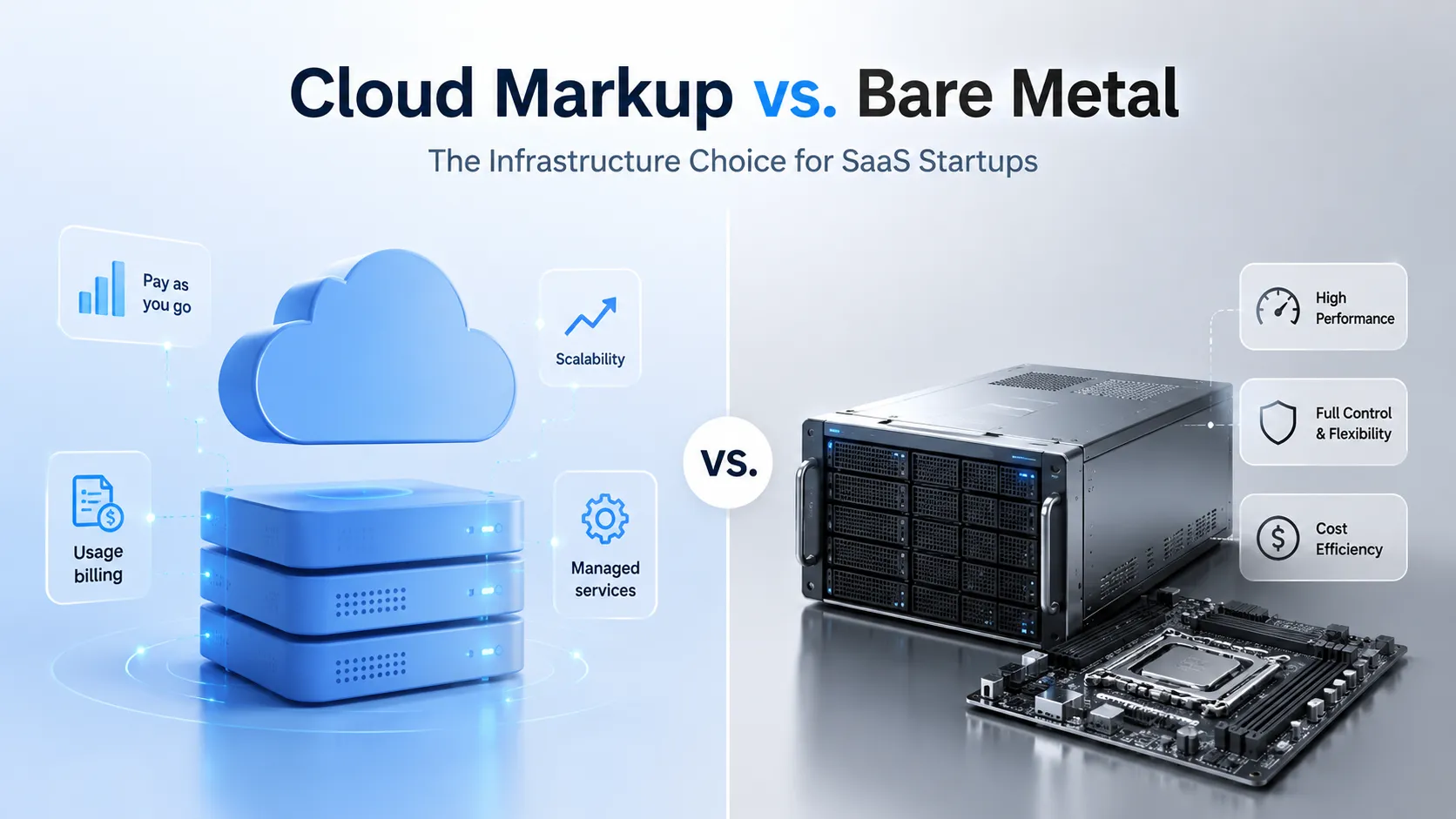
Key Takeaways
- Cloud infrastructure decisions can directly affect SaaS startup cost, scalability, speed, security, and long-term control.
- Founders need to compare managed cloud, dedicated instances, hybrid setups, and bare metal based on product stage.
- Compute, database, storage, bandwidth, backups, monitoring, and deployment workflows are core infrastructure areas.
- Early-stage startups often need speed and flexibility, while growing SaaS products need cost control and reliability.
- A smart infrastructure plan helps SaaS teams avoid vendor lock-in, surprise bills, downtime, and painful migrations later.
Infrastructure Signals
- Founders need visibility into monthly cloud spend, resource usage, bandwidth growth, database load, and scaling thresholds.
- Developers need stable deployment pipelines, environment separation, logs, monitoring, backups, and rollback options.
- Product teams need reliable performance for onboarding, dashboards, APIs, background jobs, and customer-facing workflows.
- Security teams need access controls, encryption, patching, firewall rules, audit logs, and incident response planning.
- Monitoring helps detect traffic spikes, slow queries, server overload, failed jobs, storage pressure, and cost increases.
Real Insights
- Managed cloud is useful for fast launch, but uncontrolled usage can damage margins as traffic becomes predictable.
- Bare metal or dedicated infrastructure can reduce costs for stable workloads, but it increases operational responsibility.
- The best infrastructure choice depends on team skill, workload pattern, uptime needs, compliance, and growth stage.
- SaaS founders should design portable architecture so the product can move when scale, cost, or strategy changes.
- Miracuves helps SaaS startups plan scalable infrastructure with cloud deployment, backend architecture, monitoring, security, and production-ready DevOps workflows.
For SaaS founders, infrastructure is often treated as a technical decision that can be handled later. In the early days, that feels reasonable. Managed cloud services help teams move quickly, avoid server administration, and launch without hiring a full DevOps team.
But as usage grows, the hosting bill starts becoming a business model question. Databases, bandwidth, backups, storage, logs, queues, search, analytics, and background jobs can turn from small monthly line items into serious margin variables.
The issue is not that managed cloud is bad. The issue is that many founders choose infrastructure before they understand how their product will consume infrastructure.
This is where the infrastructure autonomy variable matters.
A SaaS startup should ask one question early:
How much control do we need over hosting cost, deployment location, database architecture, and scaling strategy as the product grows?
Miracuves helps founders build source-code-owned, white-label, and cloud-ready software foundations that can be deployed across managed cloud, independent instances, or hybrid infrastructure depending on the business model. That flexibility matters because the right infrastructure decision is not always the most popular cloud logo. It is the setup that protects speed, reliability, cost control, and long-term operating margin.
The Hidden Hosting Bill: Spotting the Premium in Managed Database Platforms
Managed cloud platforms are popular because they remove a heavy operational burden. A founder does not need to manually patch database servers, configure every backup flow, or build high-availability infrastructure from scratch. That convenience has real value, especially before product validation.
The cost problem starts when usage scales faster than revenue.
Many SaaS teams begin with a managed database, managed storage, serverless functions, third-party monitoring, cloud logging, managed cache, managed search, and paid data transfer. Each service looks affordable alone. Together, they form a layered operating cost that may be difficult to unwind later.
For example, managed database services are usually priced around several moving parts: database instances, storage, backup storage, read/write activity, replication, and data transfer. These billing models are legitimate, but they show why founders must understand every meter attached to their architecture.
The real founder risk is not the first hosting bill. It is the pricing shape.
If your product has heavy read/write activity, file uploads, video previews, large reports, frequent API calls, or background processing, infrastructure cost may grow with user activity even before monetization catches up.
Read more: Launch Velocity: Comparing AI Tools, No-Code Platforms, and Pre-Built Clones
Why the managed-provider premium can still be worth it
Managed databases and cloud services are not automatically wasteful. They can be the right choice when the team needs speed, reliability, automatic backups, managed failover, quick scaling, and less infrastructure maintenance.
For pre-decision founders, the key is to separate convenience from dependency.
Paying more for managed infrastructure is acceptable when it buys speed and operational safety. It becomes dangerous when the architecture becomes too difficult to move, too expensive to scale, or too closely tied to one provider’s billing model.
Where SaaS hosting cost usually compounds
| Cost Area | Why It Looks Small Early | Why It Can Grow Later | Founder Decision Question |
|---|---|---|---|
| Managed database | Starter plans or small instances are easy to justify. | Compute, storage, replication, backups, I/O, and read replicas can increase as usage grows. | Will database activity scale faster than subscription revenue? |
| Bandwidth and transfer | Early users do not move much data. | Media, exports, APIs, dashboards, and cross-region traffic can create recurring transfer exposure. | Does the product monetize usage-heavy behavior? |
| Object storage | Storage per file looks inexpensive. | Retrieval, replication, lifecycle rules, and transfer patterns can affect total cost. | Are users uploading large files, images, audio, video, or reports? |
| Logs and observability | Logs feel like a developer convenience. | High-volume applications can generate expensive retention and query costs. | Do we know what data must be retained and for how long? |
| Serverless execution | Pay-per-use works well at low volume. | Predictable, always-on workloads may become cheaper on dedicated compute. | Is the workload spiky or consistently active? |
The Infrastructure Autonomy Variable: A Better Decision Framework for Founders
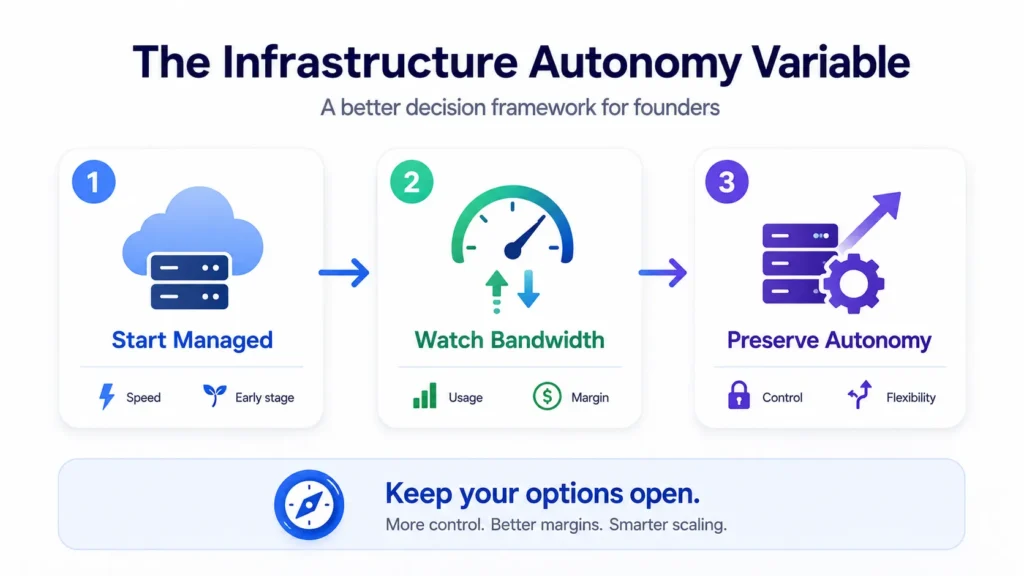
The usual cloud comparison asks, “Which provider should we use?”
That question is too shallow for a SaaS startup.
A better question is:
How much infrastructure autonomy should the business preserve from day one?
Infrastructure autonomy means the founder has meaningful control over where the application runs, how the database is deployed, how workloads are separated, how bandwidth is handled, and how easily the system can move when economics change.
That does not mean every startup should self-host everything. It means the codebase, deployment structure, database design, and DevOps workflow should not trap the company inside one narrow operating model.
1. Scale thresholds: when convenience still wins
Managed cloud is often the best starting point when the product is new, traffic is unpredictable, the team is small, and uptime matters more than cost optimization.
A founder who has not validated demand should not spend months over-engineering infrastructure.
At the early stage, managed services buy speed. The startup can test onboarding, pricing, activation, user retention, and monetization without hiring infrastructure specialists too early.
The threshold changes when traffic becomes predictable. Once the application has stable usage patterns, founders can estimate compute hours, database growth, background jobs, file storage, and bandwidth more accurately.
That is when dedicated instances, reserved capacity, or hybrid architecture may become worth evaluating.
2. Bandwidth costs: when user activity starts eating margin
Bandwidth is one of the most underestimated SaaS cost variables.
A workflow automation product may not move much data. A video, marketplace, delivery, AI, analytics, or file-sharing platform may move significant data through uploads, previews, exports, images, API responses, or dashboards.
Dedicated server providers often package bandwidth differently from hyperscale cloud providers. Some bare-metal and VPS providers include larger transfer allowances or predictable bandwidth plans, while hyperscale cloud providers often meter data movement more granularly.
These details vary by provider, region, and product. Founders should model their own workload before deciding.
The business question is simple:
If your users are creating heavy infrastructure activity, are you charging in a way that protects margin?
3. System autonomy: when deployment control becomes a strategic asset
A source-code-owned SaaS platform gives founders more room to make infrastructure decisions.
If the codebase is portable, containerized, and cleanly separated from provider-specific services, the company can begin on managed cloud and later move selected workloads to dedicated instances.
This is especially important for SaaS products with:
- High database write activity
- Large file or media storage
- Predictable background jobs
- High API traffic
- Data-heavy dashboards
- Regional hosting requirements
- Strict margin targets
- Need for custom deployment control
Infrastructure autonomy does not remove operational responsibility. It gives the founder choices.
That difference matters when the company grows beyond the first product release.
Read more: The Venture Margin Index: Why Specialized Business Apps Dominate Capital Efficiency
Cloud vs. Bare Metal vs. Hybrid SaaS Hosting: What Changes Operationally?
The cloud vs. bare metal debate is often framed as a cost battle.
In reality, it is a tradeoff between convenience, predictability, engineering control, and operational responsibility.
| Hosting Model | Best For | Founder Advantage | Founder Risk |
| Managed cloud | Early-stage SaaS, unpredictable traffic, small teams, fast launch needs | Speed, managed backups, availability options, rich ecosystem | Usage-based billing can become hard to predict as the product scales |
| Bare metal or dedicated instances | Predictable workloads, heavy compute, high bandwidth, mature usage patterns | Cost predictability, hardware control, stronger autonomy | Requires DevOps maturity, monitoring, backups, patching, and failover planning |
| Hybrid infrastructure | SaaS teams that need cloud convenience plus dedicated cost control | Balanced setup: managed services where useful, dedicated workloads where economical | More architecture discipline is required to avoid complexity |
A founder does not need to choose one forever.
A well-planned SaaS architecture can start with managed cloud, move database replicas or background workloads to independent infrastructure later, or keep sensitive workloads in specific environments depending on business needs.
The important point is to avoid architecture that cannot move.
Maximizing Venture Runway: Deploying Clean Code Blueprints to Independent Instances
Runway is not only payroll. It is also infrastructure burn.
A SaaS company with weak hosting discipline can spend heavily before proving retention, pricing, or expansion revenue.
This is where clean code blueprints matter.
A launch-ready platform should separate business logic from infrastructure assumptions. It should be possible to deploy the same product foundation to a managed cloud environment, a dedicated server environment, or a hybrid setup without rewriting the core application.
Miracuves’ software development services and cloud services support this type of decision-making by focusing on full source code ownership, cloud-ready architecture, and deployment flexibility.
For founders planning SaaS products, this means the infrastructure strategy can evolve with usage instead of being locked into the first hosting decision.
What a portable SaaS blueprint should include
A portable SaaS foundation should include:
- Containerized deployment: Docker-based packaging helps the application move across cloud and dedicated environments.
- Environment-based configuration: Secrets, database URLs, storage endpoints, and API keys should not be hardcoded.
- Database portability: PostgreSQL, MySQL, MongoDB, or Redis should be deployed in a way that avoids unnecessary provider lock-in unless the tradeoff is intentional.
- Infrastructure as code: Terraform or similar tooling improves repeatability and reduces manual setup risk.
- Observability baseline: Logs, metrics, alerts, and uptime checks should exist before scaling traffic.
- Backup and restore discipline: The founder should know how recovery works before a failure happens.
Miracuves’ DevOps engineering and Docker/Kubernetes development services are natural next steps for founders who want deployment control, infrastructure-as-code, and multi-environment readiness.
When Managed Cloud Is Still the Smarter Choice
Managed cloud is often the right decision when a startup is still validating the product.
The founder’s biggest risk at that stage is not a slightly higher infrastructure bill. It is spending too long building before learning whether users care.
Managed cloud is usually stronger when:
- The product has uncertain demand.
- The team does not yet have DevOps capacity.
- Traffic is spiky or seasonal.
- The product needs managed failover and backups quickly.
- The company needs fast experiments, not infrastructure control.
- The workload is small enough that optimization effort would cost more than the savings.
For example, a SaaS dashboard serving a few hundred customers may not need dedicated infrastructure immediately.
The founder may be better served by managed databases, cloud storage, and automated deployment while the product team focuses on activation, pricing, support, and retention.
When Bare Metal or Dedicated Instances Become More Attractive
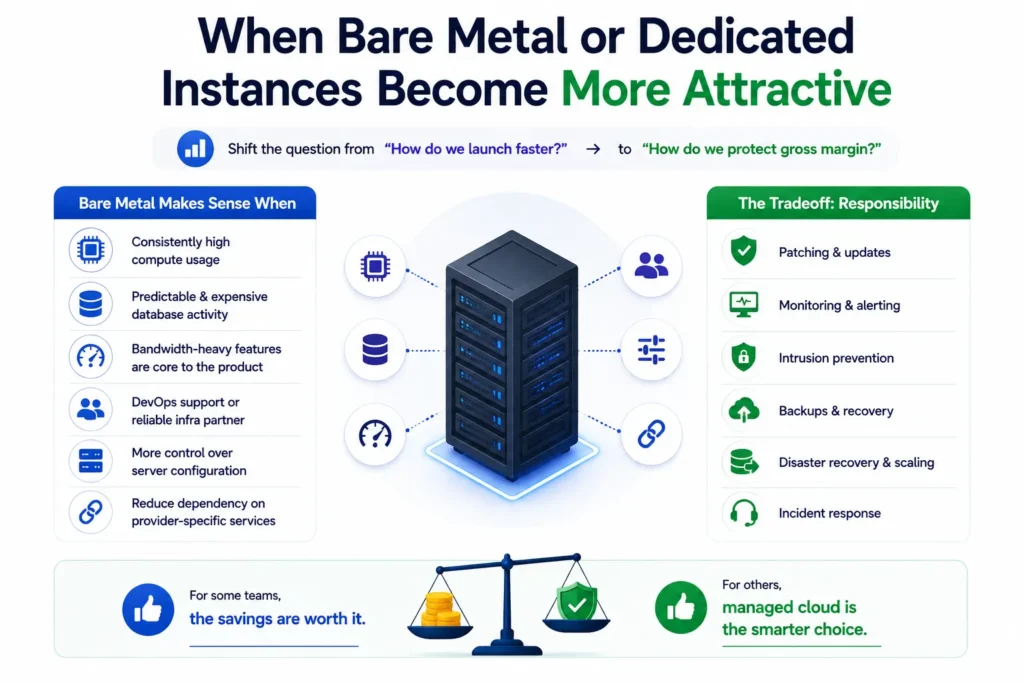
Bare metal becomes more attractive when the workload is stable, resource-heavy, and predictable.
The founder can calculate how much CPU, memory, storage, bandwidth, and database activity the product consumes each month. At that point, the conversation shifts from “how do we launch faster?” to “how do we protect gross margin?”
Dedicated infrastructure may make sense when:
- The application has consistently high compute usage.
- Database activity is predictable and expensive on managed platforms.
- Bandwidth-heavy features are central to the product.
- The team has DevOps support or a reliable infrastructure partner.
- The product needs more control over server configuration.
- The company wants to reduce dependency on provider-specific managed services.
The tradeoff is responsibility.
Bare metal does not magically reduce risk. The team must manage patching, monitoring, intrusion prevention, backups, disaster recovery, scaling, and incident response.
For some teams, the savings are worth it. For others, managed cloud remains the better business decision.
Founder Decision Signals
Speed
Use managed cloud when launch speed and operational simplicity matter more than perfect cost optimization.
Cost
Evaluate dedicated infrastructure when monthly usage becomes predictable and hosting spend starts reducing gross margin.
Scalability
Choose architecture that can scale vertically, horizontally, or across providers without rewriting the core product.
Market Fit
Do not over-engineer before validation. Preserve optionality so the infrastructure can mature after demand is proven.
How Miracuves Supports Cloud-Agnostic SaaS Architecture
A startup’s infrastructure strategy should not be trapped by its first deployment choice.
Founders need a product foundation that can launch quickly, support core business workflows, and remain flexible as usage patterns become clearer.
Miracuves helps founders build SaaS platforms, web applications, marketplace systems, delivery platforms, fintech apps, and custom software products with source-code ownership and deployment flexibility.
The goal is not to force every product into one infrastructure model. The goal is to make sure the codebase can support the model that fits the business.
For some founders, that means AWS with managed databases, CloudFront, containers, and automated scaling. For others, it means a lean dedicated instance setup with strong backups and monitoring.
For scaling teams, it may mean a hybrid model where the application layer remains cloud-native while predictable workloads move to independent infrastructure.
If your startup needs AWS-native services, Miracuves’ AWS development services can support that path. If you are evaluating broader infrastructure flexibility, the Miracuves solutions hub can help you map the product type before finalizing deployment strategy.
Mistakes Founders Should Avoid While Planning SaaS Hosting
Choosing infrastructure before understanding unit economics
A SaaS startup should know how user behavior affects infrastructure cost. If heavy usage is not monetized properly, cloud spend can grow faster than revenue.
Using provider-specific services without an exit plan
Managed services can be valuable, but founders should know what would be difficult to migrate later. Lock-in is acceptable only when the benefit is intentional.
Ignoring bandwidth until the bill becomes painful
Apps with media, analytics, files, APIs, or real-time dashboards should model transfer costs early because bandwidth can directly affect margin.
Moving to bare metal without operational discipline
Dedicated infrastructure can reduce cost for the right workload, but it requires serious backup, monitoring, patching, scaling, and incident-response planning.
Security and Reliability Cannot Be Removed From the Cost Equation
A founder should never reduce hosting cost by weakening security, backups, or operational controls.
Infrastructure autonomy only works when the application has disciplined security foundations.
For SaaS startups, that means encrypted data transfer, encrypted storage where relevant, role-based access control, secure API integration, audit logs, admin access controls, activity logs, backup policies, and monitoring.
Marketplace, fintech, healthcare, creator, and AI products may need additional verification, moderation, compliance, or data-handling workflows depending on the target market.
The right question is not:
“What is the cheapest server?”
The right question is:
“Which infrastructure model gives us the right balance of cost, control, uptime, security, and future flexibility?”
Final Thoughts: Infrastructure Autonomy Is a Business Decision
The cloud markup vs. bare metal debate is not about rejecting managed cloud.
It is about choosing infrastructure with clear eyes.
Managed cloud is powerful when speed, reliability, and operational simplicity matter. Bare metal and dedicated instances become attractive when usage is predictable, bandwidth is heavy, and infrastructure cost starts affecting margin.
Hybrid infrastructure can give founders the best of both when the architecture is built cleanly from the beginning.
The strongest SaaS infrastructure strategy is not the one that follows a trend. It is the one that protects runway, keeps deployment options open, and supports the product’s real usage pattern.
For founders planning a SaaS startup, Miracuves can help build a source-code-owned, cloud-ready product foundation that launches faster today and remains flexible enough for tomorrow’s infrastructure decisions.
FAQs
Is bare metal cheaper than cloud for SaaS startups?
Bare metal can be more cost-predictable for stable, high-usage workloads, especially when compute, memory, storage, or bandwidth needs are consistent. However, it is not always cheaper after DevOps, monitoring, backups, failover, and maintenance are included. Early-stage SaaS startups often benefit from managed cloud first, then evaluate dedicated infrastructure after usage patterns become predictable.
When should a SaaS startup move away from managed cloud services?
A startup should evaluate alternatives when infrastructure spend grows faster than revenue, database activity becomes expensive, bandwidth usage is high, or the team needs more control over deployment and scaling.
Are managed databases bad for startup margins?
No. Managed databases can be excellent for speed, backups, reliability, and reduced operational burden.
What is infrastructure autonomy for SaaS founders?
Infrastructure autonomy means the founder keeps meaningful control over where the software runs, how databases are deployed, how workloads are scaled, and how easily the product can move across environments. Source-code ownership, containerization, clean configuration, and infrastructure-as-code all improve autonomy.
Should a SaaS startup choose AWS, Azure, Google Cloud, or dedicated servers?
The right choice depends on workload type, team capability, traffic predictability, compliance needs, bandwidth usage, and runway goals. Managed cloud works well for speed and flexibility. Dedicated infrastructure can work better for predictable, resource-heavy workloads. Many scaling SaaS companies benefit from a hybrid strategy.
How does source-code ownership help with infrastructure cost control?
Source-code ownership gives founders more freedom to change deployment environments, optimize backend services, adjust database architecture, and avoid unnecessary platform dependency. Without source ownership, infrastructure decisions may be limited by the vendor or platform controlling the application.
Can Miracuves deploy SaaS products on different infrastructure setups?
Miracuves supports cloud-ready and source-code-owned product foundations that can be aligned with managed cloud, independent instances, or hybrid setups depending on the project scope. Final deployment strategy depends on the selected modules, integrations, and business requirements.