
Key Takeaways
- The most downloaded apps are not always the best businesses.
- Specialized B2B apps can create stronger cash flow with fewer users.
- Margin efficiency depends on CAC, churn, workflow depth, and monetization.
- Fintech, healthcare, logistics, and AI workflows often score higher.
- White-label app foundations can reduce wasted development capital.
Venture Margin Signals
- Check if the app solves a painful business workflow.
- Measure revenue quality, not only downloads or attention.
- Look for recurring use, high contract value, and low churn.
- Prioritize admin control, payments, reporting, and automation.
- Choose app categories with clear expansion and monetization paths.
Real Insights
- Downloads create visibility, but cash flow creates durability.
- Consumer apps often need scale before revenue becomes meaningful.
- B2B workflow apps can pay back capital faster.
- A focused vertical app can outperform a broad viral platform.
- Miracuves builds white-label business app foundations for capital-efficient launch.
Ask most people, “What are the 5 top apps?” and the answer usually sounds familiar: social media, short video, messaging, gaming, and ecommerce. These apps dominate attention, downloads, and headlines.
But investors and serious founders should ask a sharper question:
Which apps create the strongest long-term cash flow per dollar of capital invested?
That question changes the answer completely.
The most downloaded apps are not always the most investable app businesses. A viral consumer platform may need years of paid acquisition, creator incentives, moderation teams, infrastructure spending, and delayed monetization before it becomes financially meaningful. A specialized B2B workflow app, on the other hand, can serve fewer users, charge higher contract values, reduce churn through operational dependency, and create predictable revenue from day one.
This is where the Venture Margin Efficiency Index becomes useful. Instead of ranking apps by popularity, it ranks app categories by their ability to convert product infrastructure into durable margin.
For founders evaluating app opportunities, Miracuves helps turn this strategy into execution through ready-made, white-label, source-code-owned app foundations that can be customized around industry workflows, admin control, monetization, and faster market validation. Miracuves’ style guide emphasizes founder-focused decision support, practical execution, business-model clarity, and helpful conversion-led content rather than generic app lists.
Deconstructing the Valuation Mirage: Downloads vs. Long-Term Cash Generation
Downloads are a vanity signal unless they convert into revenue, retention, and margin.
A consumer social app can reach thousands of users and still struggle financially if those users do not pay, engage consistently, or attract profitable advertisers. Free users create infrastructure cost before they create revenue. Video platforms need storage, CDN, encoding, moderation, recommendation logic, and creator tools. Social networks need community liquidity before they become useful. Consumer marketplaces need both supply and demand before transactions begin.
That is why “top app” lists based only on downloads can mislead founders.
The smarter ranking method is not:
Which apps are popular?
It is:
Which app categories convert operational pain into recurring revenue with the least capital waste?
Research and benchmark commentary across SaaS markets repeatedly focuses on metrics like churn, net revenue retention, CAC payback, LTV, and gross margin because these numbers reveal whether a software company can survive beyond early growth. Current SaaS benchmark discussions commonly evaluate businesses around retention, CAC payback, gross margin, and revenue efficiency, not app-store popularity.
For capital-efficient founders, the highest-quality app opportunities usually have four traits:
- The user has a painful business problem.
- The buyer can pay meaningfully for the solution.
- The app becomes part of daily operations.
- The platform can expand into more workflows over time.
That is why specialized business apps often beat consumer networks in founder economics.
The Venture Margin Index: A Better Way to Rank the Top Apps
The Venture Margin Efficiency Index is a practical scoring model for evaluating app opportunities based on business quality instead of surface popularity.
It scores each app category across five dimensions:
Venture Margin Efficiency Index
| App Category | Business Value | Founder Impact |
|---|---|---|
| Fintech and Remittance Apps | Transaction-led revenue, wallet activity, FX flows, and business accounts. | Strong fit for founders with licensing paths, payment partners, or underserved money-transfer corridors. |
| On-Demand Service Marketplace Apps | Commissions, provider plans, lead fees, booking fees, and premium listings. | Works well when supply density can be built in a specific city, niche, or service category. |
| Healthcare Workflow Apps | Appointment booking, teleconsultation, patient communication, and clinic workflow control. | Creates value by solving necessary trust-based workflows rather than chasing viral attention. |
| Logistics and Dispatch Apps | Route control, order allocation, delivery visibility, and operational efficiency. | Best for founders targeting dense geographies, merchants, warehouses, or existing delivery networks. |
| AI Vertical Workflow Apps | Automation of repetitive business processes and internal productivity workflows. | Strong when the product solves a measurable pain for a specific business function. |
A consumer social platform may score high on attention potential but low on monetization predictability. A logistics automation platform may score lower on mass-market visibility but higher on contract value, retention, and workflow dependency.
That difference matters.
A founder with limited capital does not need the most downloaded app. They need an app category where every product decision improves the probability of revenue.
Read More: Cursor vs. Hiring a Dev Agency: The Honest Capital Comparison for Startups
The 5 Top Apps for Capital-Efficient Founders
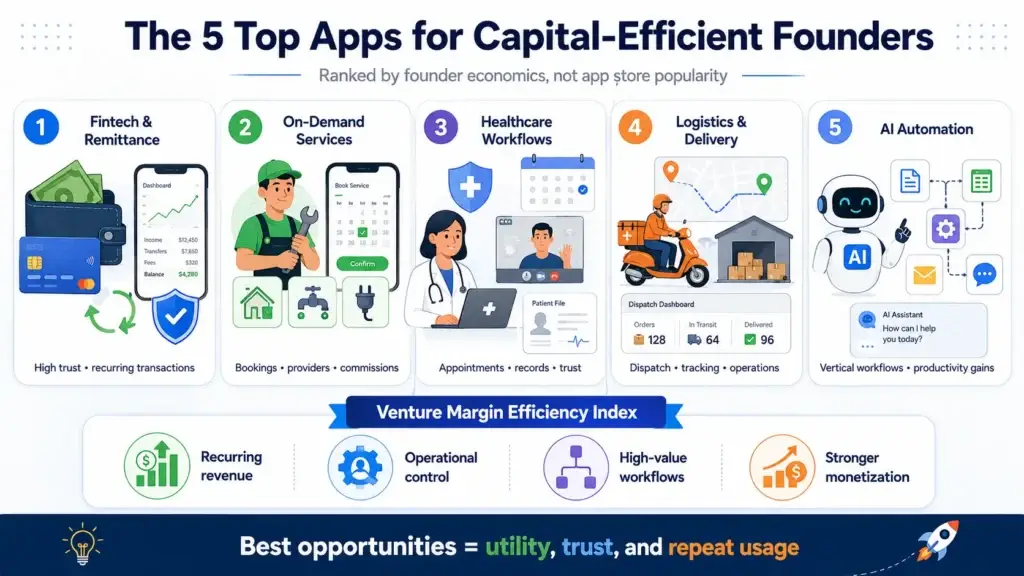
Image Source: AI-generated visual by Miracuves
Below are the five app categories that score strongest on the Venture Margin Efficiency Index.
These are not ranked by app store popularity. They are ranked by founder economics.
1. Fintech and Remittance Apps: High Trust, High Frequency, High Revenue Potential
Fintech apps are one of the strongest categories for margin-efficient founders because they sit close to money movement. Digital wallets, remittance apps, neobank platforms, and payment workflows solve financial problems users already understand.
A fintech app can monetize through:
- Transaction fees
- FX margins
- Subscription plans
- Card or wallet fees
- Business account plans
- Partner integrations
- Premium financial tools
The business value is not only in the app interface. It is in the transaction layer, admin risk controls, KYC workflows, wallet ledger accuracy, audit logs, and payment integrations.
For investors, this creates a stronger business case than a generic consumer app because fintech users are not only browsing. They are moving money, managing accounts, sending payments, or handling financial tasks.
Miracuves offers finance and investment app solutions across neobank, remittance, wallet, and investment categories, with source-code ownership and compliance-ready architecture language positioned carefully around licensing and integrations.
Founder decision signal: Choose fintech when you have access to a licensing path, payment partners, financial niche, remittance corridor, or underserved user segment with recurring transaction behavior.
Explore a white-label fintech platform or a specialized Wise clone solution if your business model involves cross-border money transfer.
2. On-Demand Service Marketplace Apps: Workflow Liquidity Over Viral Attention
On-demand service apps create value by matching customers with providers. Unlike social apps, where engagement is often entertainment-driven, service marketplaces solve urgent real-world needs.
Examples include:
- Home services
- Doctor booking
- Pet care
- Freelance work
- Local professional services
- Beauty and wellness booking
- Repair and maintenance workflows
These platforms monetize through commissions, subscriptions, lead fees, booking fees, featured listings, provider plans, and service markups.
The key advantage is operational dependency. Once providers rely on a marketplace for leads and customers rely on it for convenience, the app becomes a workflow layer rather than a disposable consumer product.
Miracuves’ on-demand service solution page describes marketplace categories across home services, healthcare, and freelance workflows, including customer apps, provider apps, payments, scheduling, and admin dashboards.
Founder decision signal: Choose on-demand services when you can build supply density in a specific city, profession, niche, or underserved service category.
Start with an on-demand service marketplace and customize the workflow around your local supply base.
3. Healthcare and Appointment Workflow Apps: Trust-Based Recurrence
Healthcare apps can be capital-efficient when they focus on practical workflows rather than broad wellness content.
The strongest healthcare app models usually include:
- Doctor discovery
- Appointment booking
- Teleconsultation
- Patient records
- Clinic dashboards
- Prescription handling
- Provider verification
- Admin access controls
Healthcare platforms tend to benefit from recurring need, trust-based usage, and operational complexity. A clinic, doctor network, or local healthcare operator may need digital workflows even if the app never becomes a mass-market consumer brand.
This is the difference between attention and utility.
A social app has to earn daily attention. A healthcare workflow app only needs to solve a necessary task reliably.
Security matters here. Healthcare app content should avoid claiming universal compliance unless verified. Better wording is that the app can be configured to support healthcare compliance requirements based on the target market. Miracuves’ security language rules recommend careful terms such as encrypted communication, role-based access, audit logs, consent workflows, and privacy-conscious data handling.
Founder decision signal: Choose healthcare workflows when you have access to clinics, practitioners, care networks, or a niche patient journey where scheduling and communication are currently inefficient.
4. Logistics, Delivery, and Dispatch Apps: Revenue Through Operational Control
Delivery and logistics apps are often misunderstood. Many founders see food delivery and quick commerce as consumer categories. But the higher-margin opportunity often sits in operational control.
The app is not just a customer ordering screen. It is a coordination system.
A strong logistics or delivery app may include:
- Customer ordering
- Merchant or warehouse management
- Delivery partner apps
- Route assignment
- Dispatch logic
- ETA tracking
- Inventory visibility
- Payment workflows
- Admin reporting
The profit opportunity improves when the platform solves a repeated operational bottleneck: faster delivery, better order allocation, lower manual coordination, fewer failed deliveries, or tighter inventory movement.
Miracuves’ broader solutions hub lists delivery, grocery, pharmacy, parcel, super app, and on-demand categories as part of its turnkey app ecosystem.
Founder decision signal: Choose logistics or delivery when you can target a dense geography, a specific vertical, or an existing merchant network that already has fulfillment demand.
A focused delivery app can later expand into grocery, courier, pharmacy, or super-app workflows depending on market demand.
5. AI Automation and Vertical Workflow Apps: Small User Bases, Deep Operational Value
AI apps are attractive, but generic AI tools are quickly commoditized. The stronger opportunity is not another broad chatbot. It is a vertical workflow product that uses AI to reduce manual effort inside a specific business process.
Examples include:
- AI customer support workflows
- Internal knowledge search
- Sales assistant automation
- Document processing
- Clinic intake automation
- Vendor support automation
- Creator workflow assistance
- Operations reporting assistants
The best AI automation apps do not win because they are flashy. They win because they remove repetitive work from a business process that already costs money.
Miracuves’ network and platform solution category includes AI and automation platforms alongside communication, social network, and file-sharing app foundations, with white-label positioning and source-code ownership.
Founder decision signal: Choose AI automation when you can define a painful workflow, a paying business user, and a measurable productivity improvement.
Venture Margin Efficiency Index: Consumer Apps vs. Specialized Business Apps
The table below shows how different app categories compare from a founder economics perspective.
| App Category | CAC Pressure | Monetization Strength | Churn Risk | Workflow Depth | Venture Margin Efficiency |
| Consumer Social Network | Very High | Low to Medium | High | Medium | Low |
| Short Video Platform | Very High | Medium | High | Medium | Low to Medium |
| Fintech / Remittance App | Medium | High | Medium | High | High |
| On-Demand Service Marketplace | Medium | High | Medium | High | High |
| Healthcare Workflow App | Medium | High | Low to Medium | High | High |
| Logistics / Dispatch App | Medium | High | Low to Medium | Very High | Very High |
| AI Vertical Workflow App | Medium | High | Medium | High | High |
This is not a universal ranking for every founder. It is a capital-efficiency lens.
A consumer platform can still become massive. But it usually requires scale, brand, network effects, content supply, moderation, and long monetization patience. A B2B workflow app can become profitable with a much smaller user base if it solves an expensive operational problem.
Read More: The Pre-Launch Compliance Checklist: Meeting Enterprise Security Standards
System Telemetry: Customer Acquisition Bloodbaths vs. Low-Churn B2B Workflows
Consumer apps often begin with a dangerous assumption:
“If we get users, we will figure out monetization later.”
That logic works only when capital is abundant and retention is exceptional. For most bootstrapped teams, it becomes an acquisition trap.
A founder may spend heavily to acquire users, only to discover:
- Users do not pay.
- Ad revenue is too low.
- Engagement is unstable.
- Content moderation becomes expensive.
- Viral loops are weaker than expected.
- Infrastructure cost grows before revenue does.
- Competitors can copy visible features quickly.
Academic research on in-app advertising has also highlighted the tension between ad revenue and user experience, including the risk that ad frequency and ad-related issues can harm user ratings and reliability.
B2B workflow apps behave differently.
They are not built around entertainment habits. They are built around operational dependency. If an app helps a clinic manage bookings, a courier team manage deliveries, a financial company process transfers, or a service marketplace manage providers, the software becomes part of the business system.
That creates three financial advantages:
- Higher willingness to pay because the app supports revenue or reduces cost.
- Lower churn potential because switching disrupts operations.
- Expansion revenue potential because customers may add users, modules, locations, or workflows.
This is why retention and CAC payback matter more than downloads. SaaS benchmark commentary commonly evaluates companies using metrics such as net revenue retention, gross revenue retention, CAC payback, and gross margin because these reveal whether growth is sustainable.
Founder Decision Signals: How to Choose the Right App Category
Use these signals before choosing your app idea.
1. Does the app replace a painful manual process?
The strongest app businesses remove spreadsheets, phone calls, WhatsApp coordination, manual payments, paper records, or fragmented dashboards.
A consumer app that entertains people may be nice to have. A business app that saves time or money is easier to sell.
2. Can one customer be worth hundreds or thousands of dollars?
A consumer app may need thousands of users to create meaningful revenue. A vertical B2B app may need only a small number of paying businesses to validate demand.
This changes the founder’s capital requirement.
3. Does the app create operational lock-in?
Lock-in should not mean trapping customers unfairly. It means the app becomes useful enough that leaving it would create workflow disruption.
Examples include:
- Historical transaction records
- Staff roles and permissions
- Customer data
- Provider performance history
- Automated reporting
- Booking history
- Payment records
- Admin controls
4. Can the app expand after the first use case?
A strong app category allows expansion.
A doctor appointment app can add teleconsultation. A delivery app can add merchant analytics. A fintech app can add wallets or business accounts. A service marketplace can add subscriptions, lead bidding, or premium provider listings.
Expansion is where margin efficiency compounds.
Choosing Success: Deploying Battle-Tested Clone Apps for High-Ticket Contracts
Building from zero gives founders flexibility, but it also creates delay, cost risk, technical uncertainty, and more chances to build the wrong thing.
A ready-made app foundation changes the founder’s risk profile.
Instead of spending months building user roles, dashboards, payments, notifications, catalogues, dispatch flows, booking logic, or moderation tools from scratch, founders can start with a battle-tested architecture and customize it around a specific market.
This is where Miracuves’ white-label approach becomes relevant.
Miracuves helps founders launch ready-made and white-label app solutions with source code, branded design, admin control, and faster deployment. The stronger decision is not to copy another business blindly. It is to use a proven product pattern, adapt it to a high-margin workflow, and validate demand faster.
For example:
| Founder Goal | Better App Category | Why It Works |
| Build recurring B2B revenue | Healthcare workflow app | Clinics need scheduling, records, and communication |
| Monetize transactions | Fintech or remittance app | Revenue can connect to transfers, FX, wallets, or account activity |
| Digitize fragmented local services | On-demand marketplace | Providers need leads; customers need trust and convenience |
| Improve operational efficiency | Logistics or dispatch app | Businesses pay for better coordination and visibility |
| Automate manual work | AI vertical workflow app | Productivity gains can justify subscription pricing |
Why White-Label Architectures Improve Margin Efficiency
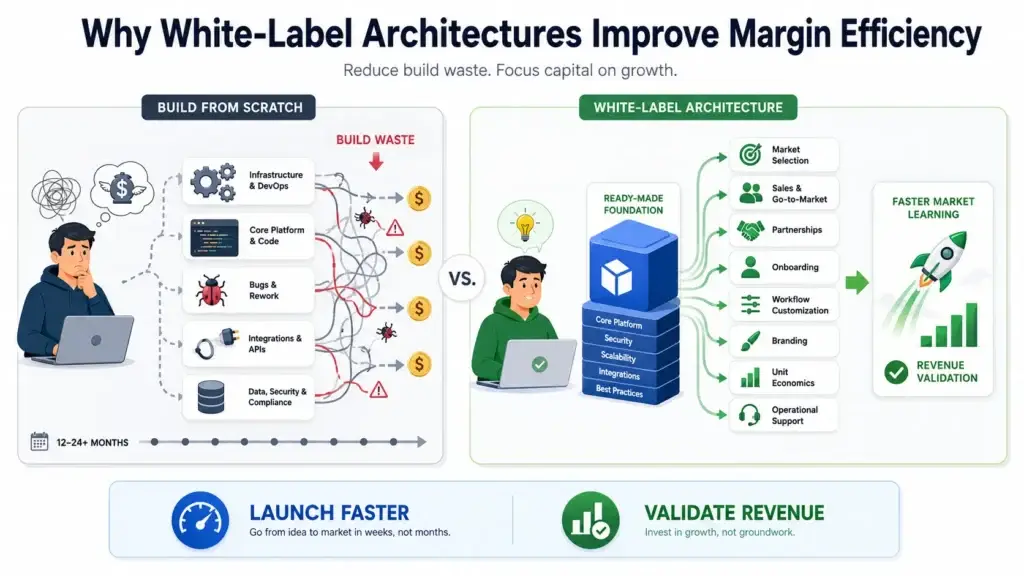
A white-label architecture does not automatically create a successful business. But it can improve the economics of testing one.
The advantage comes from reducing avoidable build waste.
A founder using a ready-made architecture can focus capital on:
- Market selection
- Sales
- Partnerships
- Customer onboarding
- Workflow customization
- Branding
- Unit economics
- Operational support
Instead of spending the entire early budget on foundational engineering, the founder can move faster toward revenue validation.
That matters because the first version of an app is rarely the final business. The faster a founder gets into the market, the faster they learn which workflows customers actually value.
Mistakes Capital Allocators Should Avoid When Choosing an App Category
Mistake 1: Ranking apps by downloads instead of revenue quality
Downloads do not pay salaries. Revenue quality does.
A smaller B2B app with 40 paying companies may be more valuable than a consumer app with 100,000 free users if the B2B product has recurring revenue, low churn, and expansion potential.
Mistake 2: Building a consumer platform without a distribution advantage
Consumer apps need attention. Attention is expensive.
If the founder does not have creators, community access, influencer distribution, existing audience, or capital for acquisition, the app may never reach the density needed to monetize.
Mistake 3: Ignoring admin control
The admin dashboard is not a backend detail. It is the operating system of the business.
Admin control affects pricing, users, vendors, payouts, disputes, moderation, refunds, service availability, reporting, and growth decisions.
Mistake 4: Treating clone apps as copies instead of product foundations
A clone app should not be a blind replica. It should be a launch-ready foundation based on proven workflows.
The opportunity is to customize the model around a better niche, geography, user segment, pricing strategy, or operational gap.
Mistake 5: Choosing a category with weak monetization logic
A beautiful app with unclear monetization is still a weak investment.
Before development starts, founders should define:
- Who pays?
- Why do they pay?
- How often do they pay?
- What workflow keeps them using it?
- What expansion path increases account value?
Read More: AI Codebase Handoff Checklist: 8 Steps Before You Hire a Dev Agency
Miracuves Perspective: The Top App Is the One That Pays Back Capital Faster
The strongest app opportunity is not always the one with the biggest consumer audience.
For capital-efficient founders, the better opportunity often sits inside industries where workflows are outdated, manual, fragmented, and expensive.
That is why fintech, healthcare, logistics, on-demand services, and AI workflow automation deserve more attention than generic consumer app lists.
Miracuves helps founders move from idea to launch faster with ready-made, white-label app solutions built for source-code ownership, branded deployment, admin control, and monetization-ready workflows.
If you are evaluating the 5 top apps to build, do not start with what gets the most downloads.
Start with what has the strongest margin logic.
Final Thoughts: Build for Margin, Not Just Momentum
The most popular apps are not always the strongest businesses.
Consumer social platforms can create massive outcomes, but they often require extraordinary scale, expensive acquisition, deep retention loops, and delayed monetization. Specialized business apps can win differently. They solve painful workflows, charge higher-value customers, reduce churn through operational dependency, and create more predictable cash flow.
The real “top app” is not the app with the loudest market signal.
It is the app that turns product infrastructure into durable revenue with the least wasted capital.
For founders, investors, and capital allocators, that is the smarter game.
FAQs
What are the 5 top apps for founders to build?
The 5 top apps for capital-efficient founders are fintech and remittance apps, on-demand service marketplaces, healthcare workflow apps, logistics and dispatch apps, and AI vertical workflow apps. These categories usually offer stronger monetization logic than generic consumer apps because they solve business or operational problems.
Why are B2B apps often more profitable than consumer apps?
B2B apps can often charge higher contract values, create recurring revenue, and become part of daily workflows. Consumer apps usually need large user bases before monetization becomes meaningful, especially when they rely on advertising or low-cost subscriptions.
Are consumer social apps bad startup ideas?
Not always. Consumer social apps can become large businesses when they have strong retention, network effects, creator supply, and distribution. The risk is that most founders underestimate acquisition cost, moderation needs, infrastructure cost, and the time required to monetize free users.
What is the Venture Margin Efficiency Index?
The Venture Margin Efficiency Index is a business-model framework for comparing app ideas based on CAC pressure, monetization strength, churn risk, workflow depth, and deployment efficiency. It helps founders rank apps by financial quality instead of popularity.
Which app category has the strongest monetization potential?
Fintech, logistics, healthcare workflows, and vertical B2B automation apps often have strong monetization potential because they connect directly to revenue, payments, operational efficiency, or compliance-related workflows. The best category depends on the founder’s access to customers, partners, and domain knowledge.
Why do white-label apps improve capital efficiency?
White-label apps can reduce development time because the foundation already includes core workflows, user roles, admin dashboards, payments, and deployment-ready modules. This lets founders focus more capital on sales, market validation, customization, and partnerships.
Should I build a clone app or a custom app?
A clone app foundation is useful when the core workflow is already proven and the founder wants faster launch. A custom app is better when the product requires highly unique workflows, complex integrations, or original technical architecture. Many founders start with a ready-made foundation and customize after validating demand.
How does Miracuves help founders launch high-margin app businesses?
Miracuves helps founders build ready-made and white-label app solutions with source-code ownership, branded design, admin control, and faster deployment. This helps founders reduce avoidable build risk and focus on market validation, revenue, and operational execution.
Miracuves is an independent software development company. We are not affiliated with, connected to, sponsored by, or endorsed by any company or product named in this article.
Terms such as “X Clone” are used descriptively. It is how the software industry refers to building a platform with functionality comparable to a known service, and how clients search for it.
The entire design and codebase of our products is built by our own team. Our products contain no code, design, graphics, or content originating from any third-party website or applications.
All third-party names and marks referenced in this article are the property of their respective owners, referenced solely to identify the services discussed.